वोकैबुलरीज

इंग्लिश वोकैबुलरी डिस्कवर, लर्न और मास्टर करें

noun
/ˈpɔːrtɛnt/
पूर्व संकेत (purv sanket)

A sign or warning that something, especially something momentous or calamitous, is likely to happen.

"The sudden drop in stock prices was seen as a portent of economic trouble."

"शेयर बाजार में अचानक गिरावट को आर्थिक संकट का पूर्व संकेत माना गया।" (Sheyar bazar mein achanak girawat ko aarthik sankat ka purv sanket mana gaya.)
adjective
/pɔːrˈtɛntəs/
घातक, गंभीर (ghatak, gambhir)

Giving a sign or warning that something, often bad or serious, is going to happen; or overly solemn and pompous.

"His portentous tone made everyone nervous about the news."

"उसकी घातक आवाज ने सबको समाचार को लेकर नर्वस कर दिया।" (Uski ghatak awaaz ne sabko samachar ko lekar nervous kar diya.)
portfolio definition card — visual illustration of the meaning
noun
/pɔːrtˈfoʊlioʊ/
निवेश पोर्टफोलियो (portfolio)

A collection of financial investments, artworks, or documents presented as a body of work.

"The designer showcased her portfolio during the interview."

"डिज़ाइनर ने साक्षात्कार के दौरान अपना पोर्टफोलियो प्रस्तुत किया।" (Designer ne sakshatkar ke dauran apna portfolio prastut kiya.)
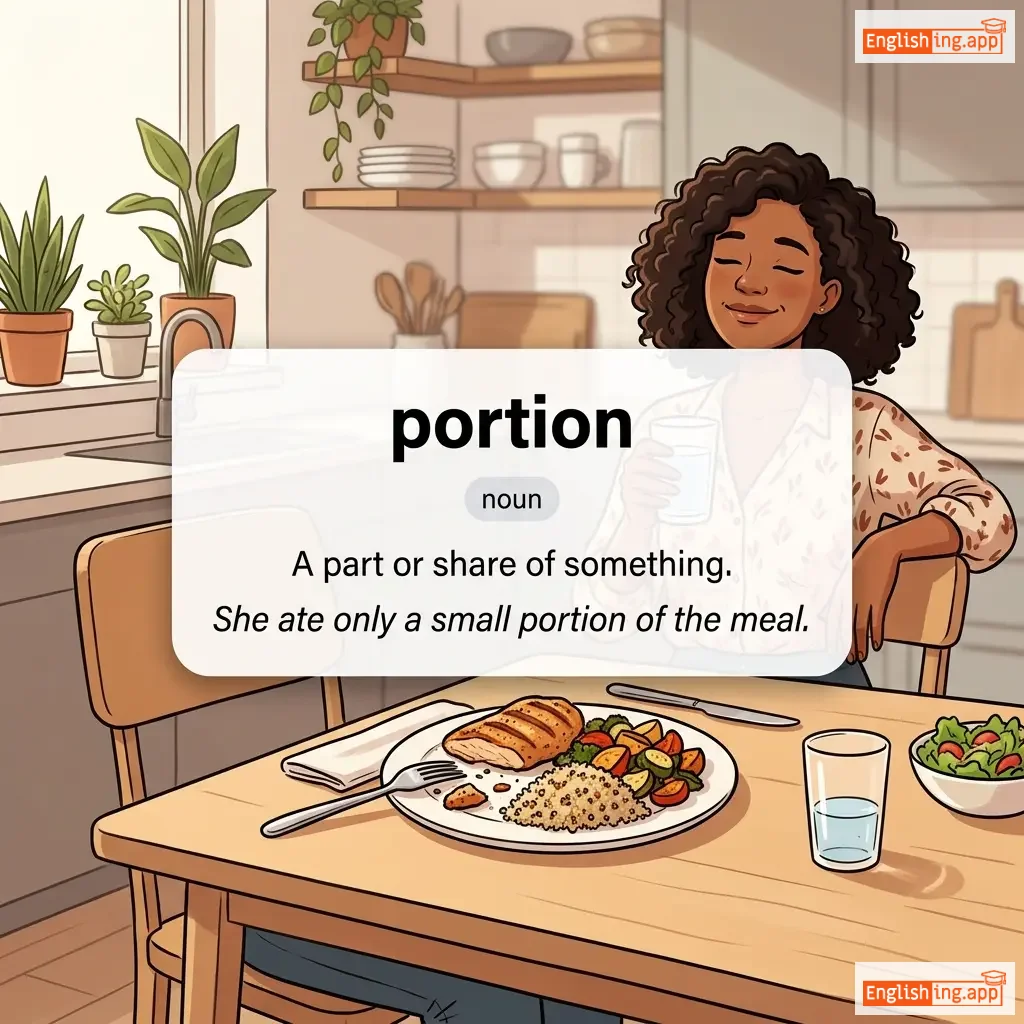
portion definition card — visual illustration of the meaning
noun
/ˈpɔːrʃən/
हिस्सा (hissa)

A part or share of something.

"She ate only a small portion of the meal."

"उसने भोजन का केवल एक छोटा हिस्सा खाया।" (Usne bhojan ka keval ek chhota hissa khaya.)
adjective
/ˈpɔːrtli/
भरतनुमा (bhartanuma)

Having a stout or somewhat fat body, often implying dignity or authority.

"The portly man entered the room with confidence."

"भरतनुमा आदमी आत्मविश्वास के साथ कमरे में दाखिल हुआ।" (Bhartanuma aadmi atmvishwas ke saath kamre mein dakhil hua.)
portrait definition card — visual illustration of the meaning
noun
/ˈpɔːtrət/
चित्रपट (chitrapat)

a painting, drawing, photograph, or engraving of a person, especially one showing the face

"The artist painted a beautiful portrait of his wife."

"कलाकार ने अपनी पत्नी का एक सुंदर चित्रपट बनाया।" (Kalakar ne apni patni ka ek sundar chitrapat banaya.)
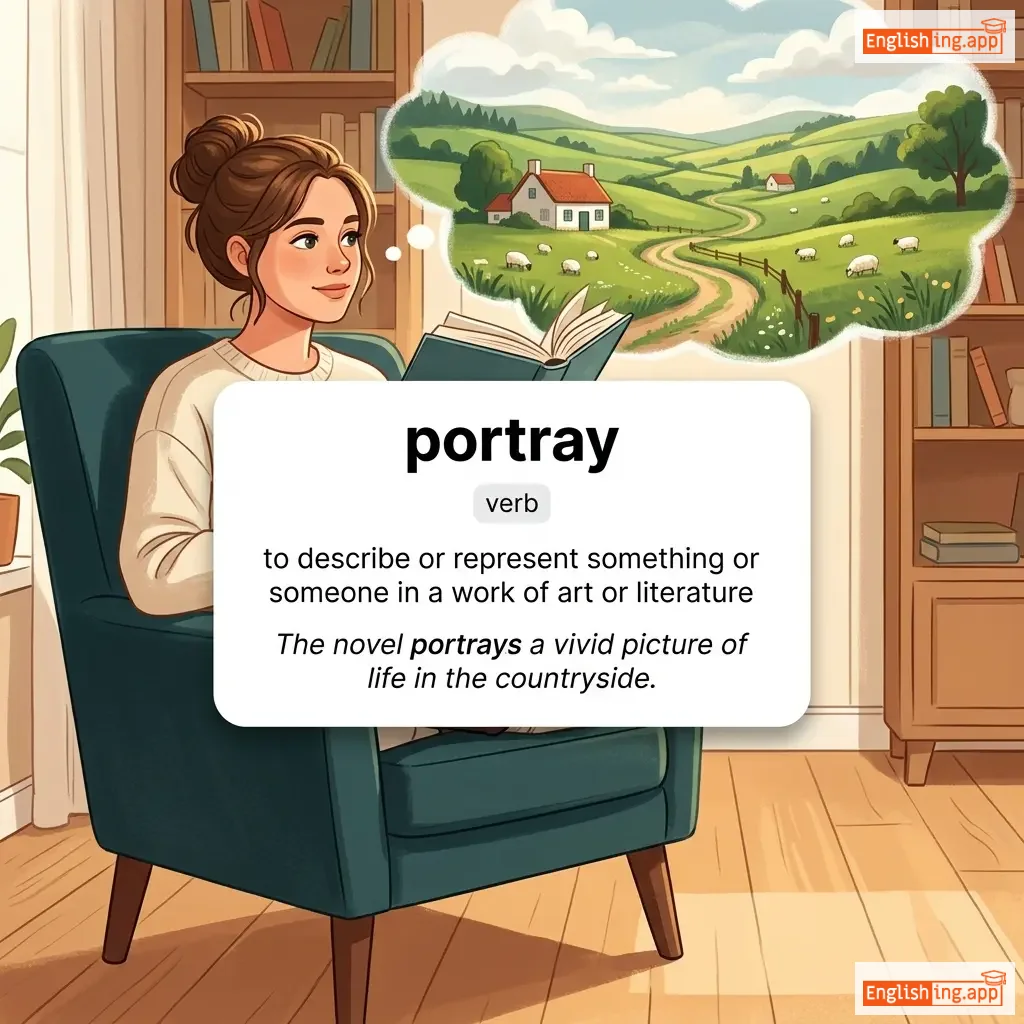
portray definition card — visual illustration of the meaning
verb
/pɔːˈtreɪ/
वर्णन करना (varnan karna)

to describe or represent something or someone in a work of art or literature

"The novel portrays a vivid picture of life in the countryside."

"उपन्यास ने ग्रामीण जीवन का एक जीवंत चित्र प्रस्तुत किया।" (Upanyas ne gramin jeevan ka ek jeevant chitra prastut kiya.)
verb
/poʊz/
खुशी (khushi)

To assume a particular position, especially for a photograph or display; to present a problem or question.

"She posed for a picture in front of the monument."

"जब उसने पुरस्कार प्राप्त किया तो वह अपनी खुशी को छिपा नहीं पाई।" (Jab usne puraskaar prapt kiya to vah apni khushi ko chhupa nahin pai.)
noun
/poʊˈzɜːr/
दिखावा करने वाला व्यक्ति (pozur)

A person who pretends to be something they are not, often to impress others.

"Many considered him a poseur because he exaggerated his accomplishments."

"कई लोगों ने उसे पोज़ूर माना क्योंकि उसने अपनी उपलब्धियों को बढ़ा-चढ़ाकर दिखाया।" (kai log use pozur maante the kyunki usne apni uplabdhiyon ko badha chadhaakar dikhaya)
verb
/ˈpɑːzɪt/
प्रस्तावित करना (posit)

To assume or suggest something as a fact or basis for reasoning.

"The scientist posited a new theory to explain the phenomenon."

"वैज्ञानिक ने घटना को समझाने के लिए एक नई थ्योरी प्रस्तुत की।" (Vaigyanik ne ghatna ko samjhane ke liye ek nai theory prastavit ki.)
position definition card — visual illustration of the meaning
noun
/pəˈzɪʃən/
पद / स्थिति (pad / sthiti)

A place, job, or status; the way in which someone or something is placed or arranged.

"She applied for a teaching position at the university."

"उसने विश्वविद्यालय में एक शिक्षक की स्थिति के लिए आवेदन किया।" (Usne vishwavidyalay mein ek shikshak ki sthiti ke liye aavedan kiya.)
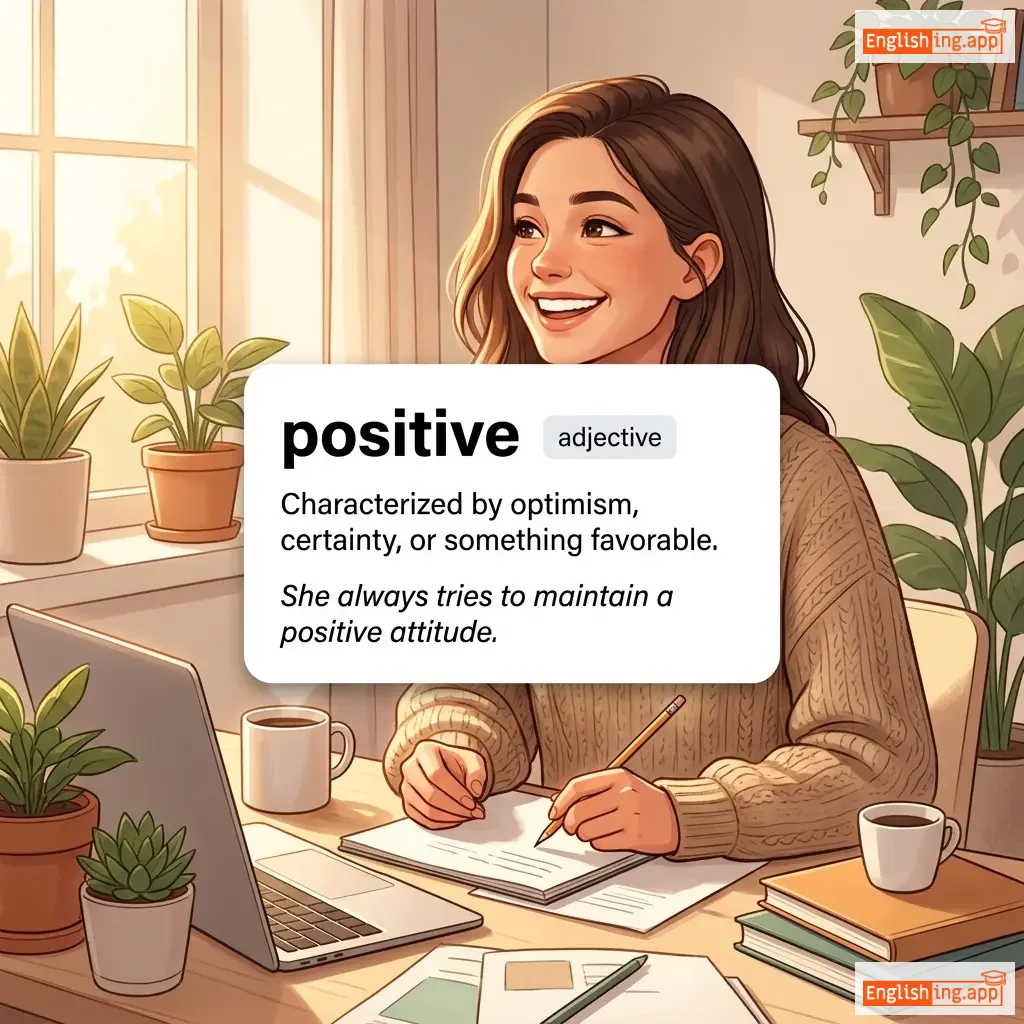
positive definition card — visual illustration of the meaning
adjective
/ˈpɒzɪtɪv/
सकारात्मक (sakaratmak)

Characterized by optimism, certainty, or something favorable.

"She always tries to maintain a positive attitude."

"वह हमेशा सकारात्मक दृष्टिकोण बनाए रखने की कोशिश करती है।" (Wah hamesha sakaratmak drishtikon banaye rakhne ki koshish karti hai.)
noun
/ˈpɒsi/
गैंग / दोस्त समूह (gang / dost samuh)

A group of people, often friends or a group organized to support or enforce the law.

"He arrived at the party with his posse of friends."

"वह अपनी दोस्त की गैंग के साथ पार्टी में आया।" (Woh apni dost ki gang ke saath party mein aaya.)
verb
/pəˈzɛs/
मालिक होना / अधिकार रखना (maalik hona / adhikar rakhna)

To have or own something; to hold a quality or characteristic.

"She possesses great talent in music."

"वह संगीत में अद्भुत प्रतिभा रखती है।" (Vah sangeet mein adbhut pratibha rakhti hai.)
noun
/pəˈzɛʃən/
स्वामित्व (swamitva)

The state of owning, controlling, or holding something.

"The ring was her most valuable possession."

"अंगूठी उसकी सबसे मूल्यवान संपत्ति थी।" (Angoothi uski sabse mulyavan sampatti thi.)
adjective
/pəˈzɛsɪv/
स्वामित्ववादी (swamitwawadi)

Showing a desire to own or control; relating to possession.

"He became very possessive about his old books."

"वह अपनी पुरानी किताबों के बारे में बहुत स्वामित्ववादी हो गया था।" (Wah apni purani kitabon ke baare mein bahut swamitwawadi ho gaya tha.)
noun
/pəˈzɛsər/
स्वामी (swami)

A person who owns or holds something.

"The possessor of the land built a new house."

"भूमि का स्वामी एक नया घर बनवाया।" (Bhoomi ka swami ek naya ghar banwaya.)
noun
/ˌpɒsəˈbɪləti/
संभावना (sambhavna)

something that may happen or be the case; a chance that something exists or might occur

"There is a strong possibility of rain tomorrow."

"कल बारिश की एक मजबूत संभावना है।" (kal barish ki ek majboot sambhavna hai.)
Possible definition card — visual illustration of the meaning
adjective
/ˈpɒsəbl̩/
संभव (sambhav)

Able to be done or achieved.

"Anything is possible if you work hard."

"कुछ भी संभव है अगर आप मेहनत करते हैं।" (Kuch bhi sambhav hai agar aap mehnat karte hain.)
adverb
/ˈpɒsɪbli/
संभवतः (sambhavatā)

maybe, or in a way that is not certain

"It could possibly rain later today."

"हो सकता है कि आज बाद में बारिश हो।" (Ho sakta hai ki aaj baad mein barish ho.)
noun, verb
/pəʊst/
पोस्ट (post)

a job or position, or to send something by mail

"She posted a letter to her friend yesterday."

"उसने कल अपने दोस्त को एक पत्र पोस्ट किया।" (Usne kal apne dost ko ek patra post kiya.)
noun
/ˈpoʊst ˌɒfɪs/
डाकघर (daakghar)

a public building or agency where mail is sent, received, and other postal services are provided

"I went to the post office to mail a package."

"मैं एक पैकेज भेजने के लिए डाकघर गया।" (main ek package bhejne ke liye daakghar gaya)
adjective
/ˌpoʊstˈwɔːr/
युद्धोत्तर (yuddhottar)

relating to the period after a war has ended

"The country experienced rapid economic growth in the post-war years."

"युद्धोत्तर वर्षों में देश ने तेज़ आर्थिक प्रगति की।" (yuddhottar varshon mein desh ne tez arthik pragati ki)
verb
/ˌpoʊstˈdeɪt/
पोस्टडेट करना (postdate karna)

To assign a date later than the actual date to a document or event.

"She postdated the check to next month."

"उसने चेक को अगले महीने की तारीख डाल दी।" (Usne check ko agle mahine ki tareekh daal di.)
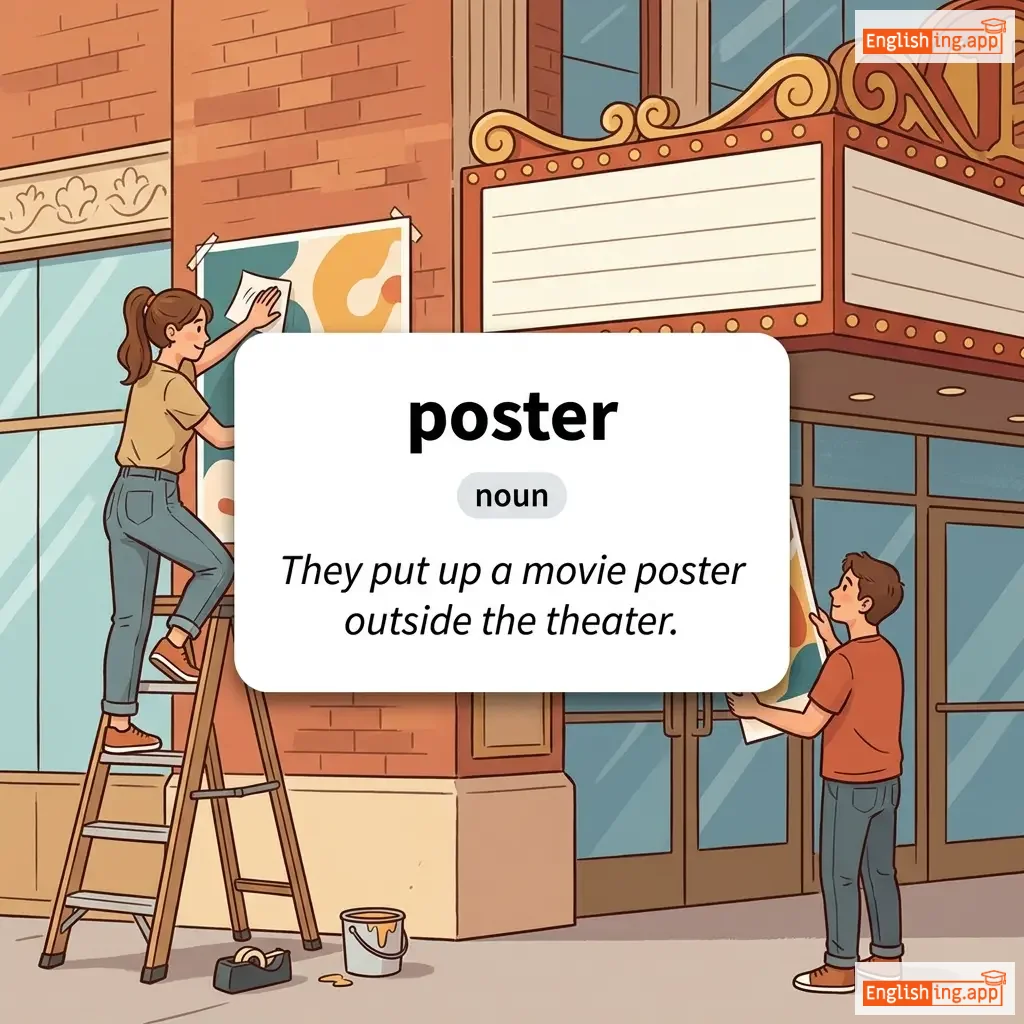
poster definition card — visual illustration of the meaning
noun
/ˈpoʊstər/
पोस्टर (poster)

a large printed picture or notice that is put on a wall for decoration or to advertise something

"They put up a movie poster outside the theater."

"वे थियेटर के बाहर एक मूवी पोस्टर लगा रहे थे।" (Ve theater ke baahar ek movie poster laga rahe the.)
adjective
/pɒˈstɪəriər/
पश्चात (poschat)

Situated at or toward the back; later in time.

"The posterior part of the brain controls vision."

"मस्तिष्क का पिछला हिस्सा दृष्टि नियंत्रित करता है।" (mastisk ka pichla hissa drishti niyantrit karta hai.)
noun
/pɒˈstɛrɪti/
भविष्य पीढ़ी (bhavishya pedhi)

All future generations of people.

"The monument was built for the benefit of posterity."

"स्मारक भविष्य पीढ़ियों के लाभ के लिए निर्मित किया गया था।" (Smarak bhavishya pedhiyon ke laabh ke liye nirmit kiya gaya tha.)
noun, adjective
/ˌpəʊstˈɡrædʒuət/
स्नातकोत्तर छात्र (snatakkottar chhatr)

A student who has completed a first degree and is studying for a further degree.

"She is doing postgraduate research in physics."

"वह भौतिकी में स्नातकोत्तर शोध कर रहा है।" (Wah bhoutiki mein snatakottar shodh kar raha hai.)
adjective
/ˈpɒstjʊməs/
मरणोत्तर (maranottar)

Occurring, awarded, or appearing after the death of the originator.

"He received a posthumous award for his bravery."

"उन्हें उनके साहस के लिए मरणोत्तर पुरस्कार मिला।" (Unhein unke sahas ke liye maranottar puraskar mila.)
noun, adjective
/ˌpəʊstˈmɔːtəm/
पोस्टमॉर्टम (postmortem)

An examination of a dead body to determine the cause of death.

"The doctor carried out a postmortem on the body."

"डॉक्टर ने शव पर पोस्टमॉर्टम किया।" (Doktar ne shav par postmortem kiya.)
verb
/pəʊs(t)ˈpəʊn/
पोस्टपोन करना (postpone karna)

to delay something to a later time

"The meeting was postponed until next week."

"बैठक को अगले सप्ताह तक पोस्टपोन कर दिया गया था।" (Baithak ko agle saptah tak postpone kar diya gaya tha.)
adjective
/ˌpəʊstˈprændɪəl/
भोजन के बाद (bhojan ke baad)

Occurring after a meal.

"He went for a postprandial walk after dinner."

"वह रात के खाने के बाद एक पोस्टप्रांडीअल वॉक पर गए।" (Wah raat ke khane ke baad ek postprandial walk par gaye.)
noun
/ˈpəʊstˌskrɪpt/
पोस्ट्रिप्ट (postscript)

an additional remark at the end of a letter or text, after the signature

"She added a brief postscript to thank him again."

"उसने उसे फिर से धन्यवाद देने के लिए एक संक्षिप्त पोस्टस्क्रिप्ट जोड़ा।" (Usne use phir se dhanyavaad dene ke liye ek sankshipt postscript joda.)
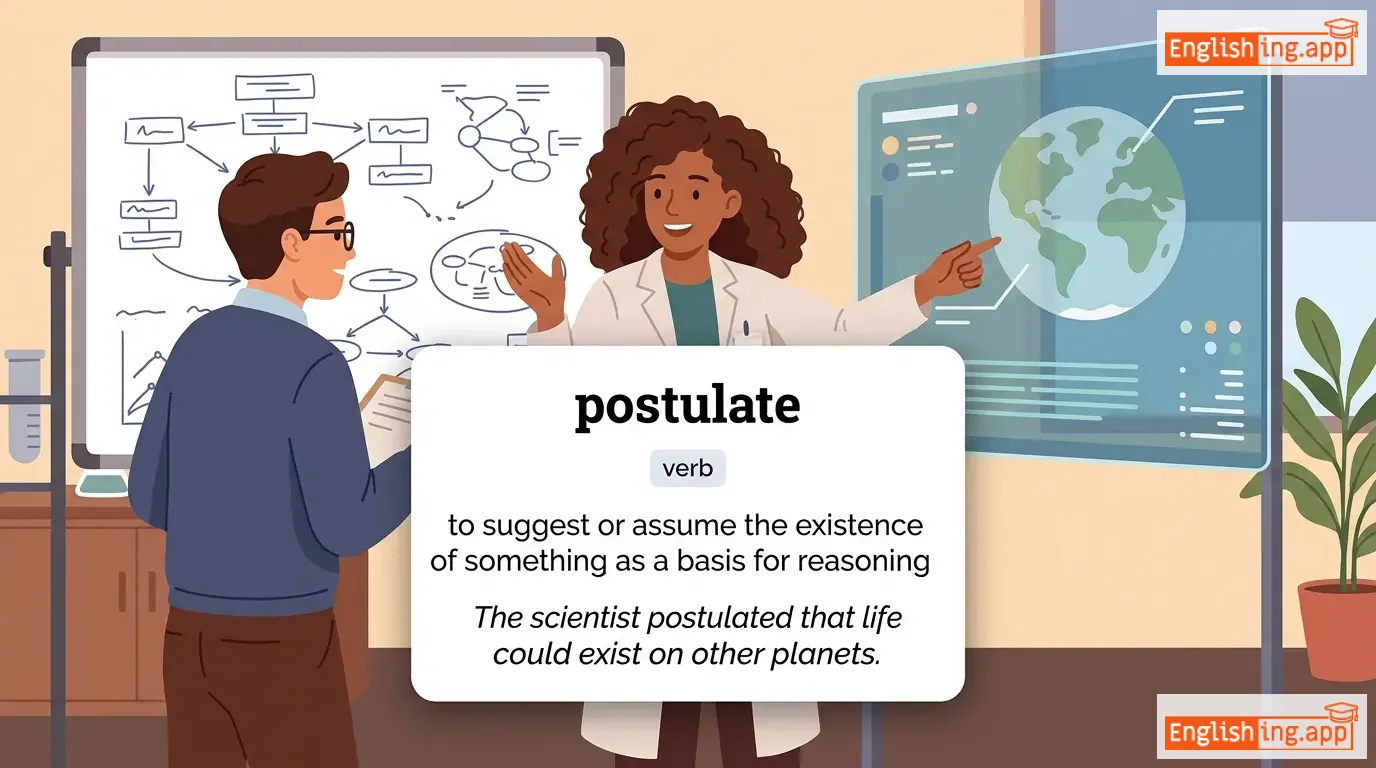
postulate definition card — visual illustration of the meaning
verb
/ˈpɒstjʊˌleɪt/
अनुमान करना (anumaan karna)

to suggest or assume the existence of something as a basis for reasoning

"The scientist postulated that life could exist on other planets."

"वैज्ञानिक ने अनुमान लगाया कि जीवन अन्य ग्रहों पर हो सकता है।" (Vaigyanik ne anuman lagaya ki jeevan anya grahon par ho sakta hai.)
noun
/ˈpɒstʃə/
सुख (sukh)

the position in which someone holds their body; an attitude or approach

"Good posture helps prevent back pain."

"जब उसने पुरस्कार प्राप्त किया तो वह अपनी खुशी छिपा नहीं पाई।" (Jab usne puraskar prapt kiya to vah apni khushi chhupa nahin pai.)
adjective
/ˈpəʊstwɔːr/
युद्धोत्तर (yuddhotar)

occurring or existing after a war

"The postwar period saw significant economic growth."

"पोस्टवार अवधि में महत्वपूर्ण आर्थिक वृद्धि देखी गई।" (Postwar avdhi mein mahatvapurn arthik vruddhi dekhi gayi.)
noun
/pɒt/
पॉट (pot)

a container, typically round and deep, used for cooking or holding plants

"She put the soup in a pot and set it on the stove."

"उसने सूप को एक पॉट में डाला और उसे चूल्हे पर रख दिया।" (Usne soup ko ek pot mein daala aur use chulhe par rakh diya.)
adjective
/ˈpəʊtəbl/
पेयजल (peyjal)

safe to drink; drinkable

"The villagers did not have access to potable water."

"गांववालों के पास पीने योग्य पानी तक पहुँच नहीं थी।" (Gaonwalon ke paas peene yogya paani tak pahuch nahi thi.)
noun
/pəˈteɪtoʊ/
आलू (aaloo)

a starchy plant tuber that is a staple food around the world

"We had mashed potato with our dinner."

"हमने अपने खाने में मसले हुए आलू खाए।" (Humne apne khane mein masle huye aaloo khaye.)
noun
/ˈpɒtˌbɔɪlə/
सस्ता साहित्यकर्म (sasta sahityakarm)

a book, play, or film produced quickly to make money rather than for artistic value

"The novel was dismissed by critics as a mere potboiler."

"उपन्यास को आलोचकों ने एक साधारण सस्ता साहित्यकर्म के रूप में खारिज कर दिया।" (Upanyas ko alochako ne ek sadharan sasta sahityakarm ke roop mein kharij kar diya.)
noun
/ˈpoʊtənsi/
शक्ति (shakti)

The power or ability of something to affect or influence; strength or effectiveness.

"The potency of the new medicine amazed the doctors."

"नई दवाई की शक्ति ने डॉक्टरों को हैरान कर दिया।" (Nayi dawaai ki shakti ne dokton ko hairaan kar diya.)
adjective
/ˈpoʊtənt/
शक्तिशाली (shaktishaalee)

Having great power, influence, or effect.

"This is a very potent drug that should be used carefully."

"यह एक बहुत शक्तिशाली दवा है जिसे सावधानी से उपयोग किया जाना चाहिए।" (Yeh ek bahut shaktishaalee dawa hai jise saavdhaanee se upayog kiya jaana chaahiye.)
adjective
/prɪˈhɛnsɪbəl/
पकड़ने योग्य (pakadne yogya)

capable of being grasped or seized

"The tool has a prehensible handle that improves safety."

"उपकरण में एक पकड़ने योग्य हैंडल है जो सुरक्षा बढ़ाता है।" (Upkaran mein ek pakadne yogya handle hai jo suraksha badhata hai.)
noun
/ˈprɛdʒədɪs/
पक्षपाती विचार (pakshapati vichar)

An unfair and unreasonable opinion or feeling, especially when formed without enough thought or knowledge.

"Prejudice often prevents people from seeing the truth about others."

"पक्षपाती विचार अक्सर लोगों को दूसरों के बारे में सत्य देखने से रोकते हैं।" (Pakshapati vichar aksar logon ko doosron ke baare mein satya dekhne se rokate hain.)
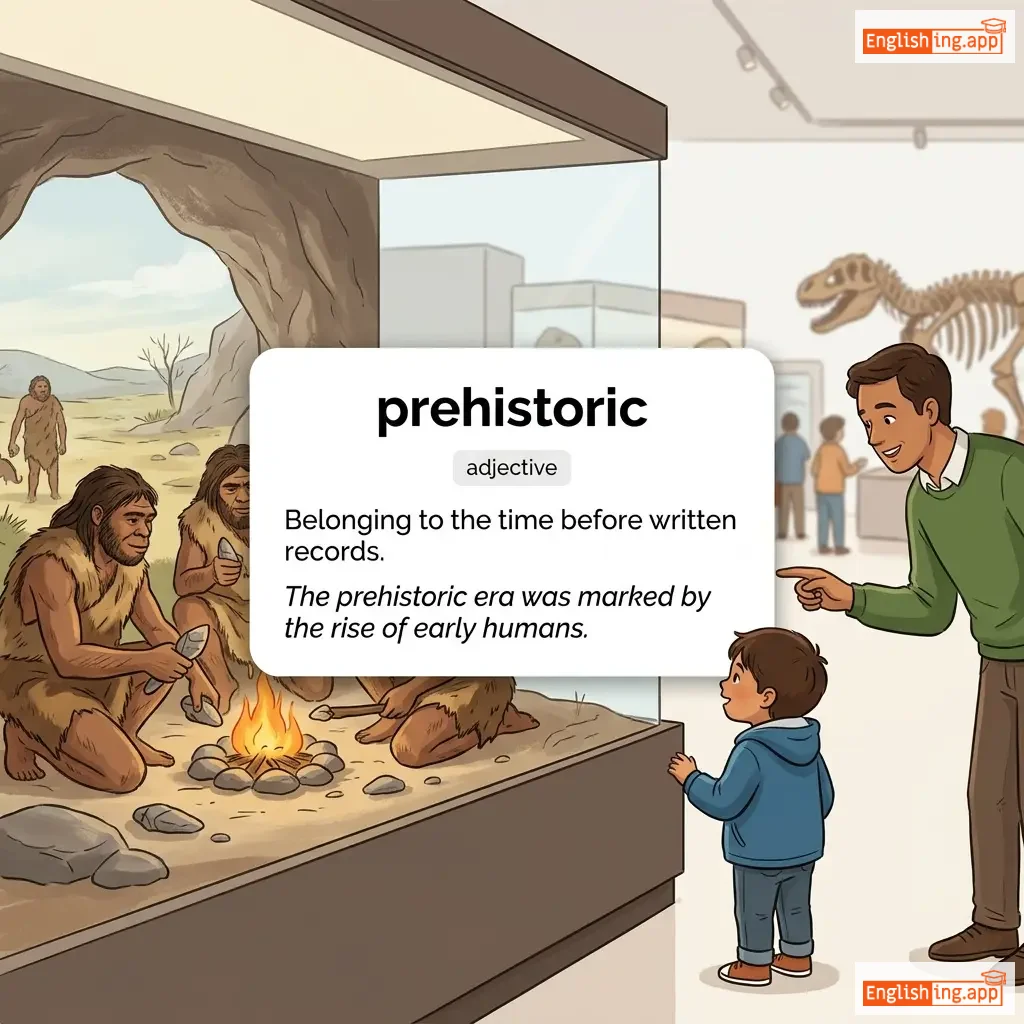
prehistoric definition card — visual illustration of the meaning
adjective
ˌpriːhɪˈstɒrɪk
प्रागैतिहासिक, इतिहास से पहले का समय (prāgaitihāsik, itihās se pahle kā samay)

Belonging to the time before written records.

"The prehistoric era was marked by the rise of early humans."

"प्रागैतिहासिक युग प्रारंभिक मानवों के उदय द्वारा चिह्नित था।" (prāgaitihāsik yug prārambhik mānavon ke uday dvārā chihnit thā.)
noun
/prɪˈhɛnʃən/
पकड़ने की क्रिया; कुछ पकड़ने की क्षमता (pakadne ki kriya; kuch pakadne ki kshamata)

the act of grasping or seizing; the ability to take hold of something

"Therapists assessed the patient's prehension during hand therapy."

"थेरेपिस्ट ने हाथ की थेरेपी के दौरान मरीज की पकड़ने की क्षमता का मूल्यांकन किया।" (Therapist ne hath ki therapy ke dauran mareez ki pakadne ki kshamata ka mulyankan kiya.)
adjective
/prɪˈhɛnsaɪl/
पकड़ने के लिए उपयुक्त (pakanne ke liye upyukt)

adapted for seizing or grasping, especially by wrapping around an object

"The monkey used its prehensile tail to hang from the branch."

"बंदर ने अपनी प्रिहेंसाइल पूंछ का इस्तेमाल डाल से लटकने के लिए किया।" (Bandar ne apni prehensile poonch ka istemal daal se latakne ke liye kiya.)
noun
/ˈprɛɡnənsi/
गर्भावस्था (garbhavastha)

the condition of being pregnant; the period during which a woman carries a developing fetus

"Her pregnancy was carefully monitored by her doctor."

"उसकी गर्भावस्था को उसके डॉक्टर द्वारा सावधानीपूर्वक मॉनिटर किया जा रहा था।" (Uski garbhavastha ko uske doctor dwara saavdhani poorvak monitor kiya ja raha tha.)
verb
/priːˈfɪɡjər/
पूर्वसूचना देना (purvasoochna dena)

to represent, show, or foreshadow something in advance

"The economic reforms prefigure major social changes."

"आर्थिक सुधार बड़े सामाजिक परिवर्तनों की पूर्वसूचना देते हैं।" (Aarthik sudhaar bade samaajik parivartano ki purvasoochna dete hain.)
noun/verb
/ˈpriːfɪks/
उपसर्ग; पहले जोड़ना (upsarg; pehle jodna)

a word, letter, or number placed before another; as a verb, to add something in front of something else

"Developers often prefix variables with an underscore."

"डेवलपर्स अक्सर वेरिएबल्स के साथ अंडरस्कोर जोड़ते हैं।" (Developers aksar variables ke saath underscore jodte hain.)