Vocabulaires

Découvrez, apprenez et maîtrisez le vocabulaire anglais

noun
/ˈpɔːrtɛnt/
prémonition (premonition)

A sign or warning that something, especially something momentous or calamitous, is likely to happen.

"The sudden drop in stock prices was seen as a portent of economic trouble."

"La chute soudaine des prix des actions a été vue comme une prémonition de problèmes économiques." (La chute soudaine des prix des actions a été vue comme une premonition de problèmes économiques.)
adjective
/pɔːrˈtɛntəs/
portentueux, grave (portentueux, grave)

Giving a sign or warning that something, often bad or serious, is going to happen; or overly solemn and pompous.

"His portentous tone made everyone nervous about the news."

"Son ton porteur de présages a rendu tout le monde nerveux à propos des nouvelles." (Son ton porteur de presages a rendu tout le monde nerveux a propos des nouvelles.)
portfolio definition card — visual illustration of the meaning
noun
/pɔːrtˈfoʊlioʊ/
portefeuille (portfolio)

A collection of financial investments, artworks, or documents presented as a body of work.

"The designer showcased her portfolio during the interview."

"Le designer a présenté son portfolio pendant l'entretien." (Le designer a presente son portfolio pendant l'entretien.)
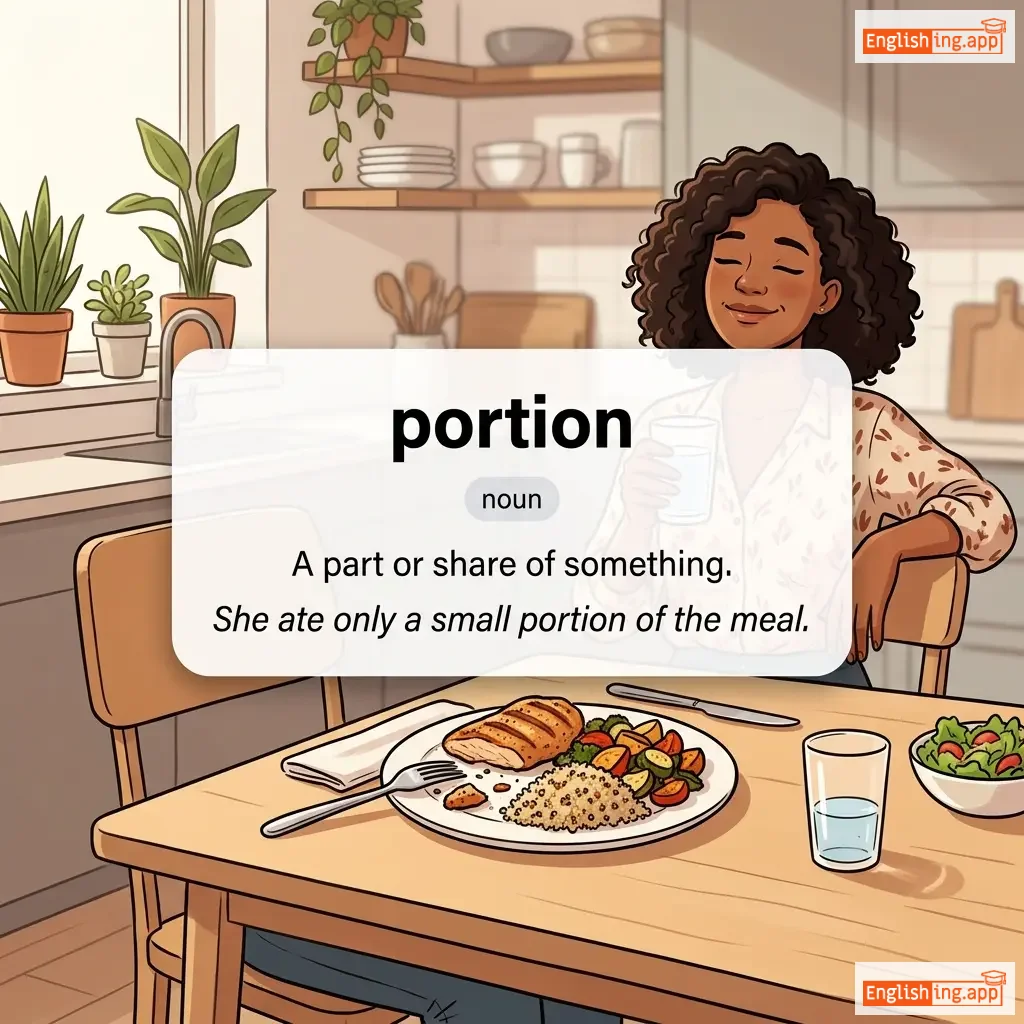
portion definition card — visual illustration of the meaning
noun
/ˈpɔːrʃən/
portion (portion)

A part or share of something.

"She ate only a small portion of the meal."

"Elle n'a mangé qu'une petite portion du repas." (Elle n'a mangé qu'une petite portion du repas.)
adjective
/ˈpɔːrtli/
corpulent (corpulent)

Having a stout or somewhat fat body, often implying dignity or authority.

"The portly man entered the room with confidence."

"L'homme corpulent est entré dans la pièce avec confiance." (L'homme corpulent est entré dans la pièce avec confiance.)
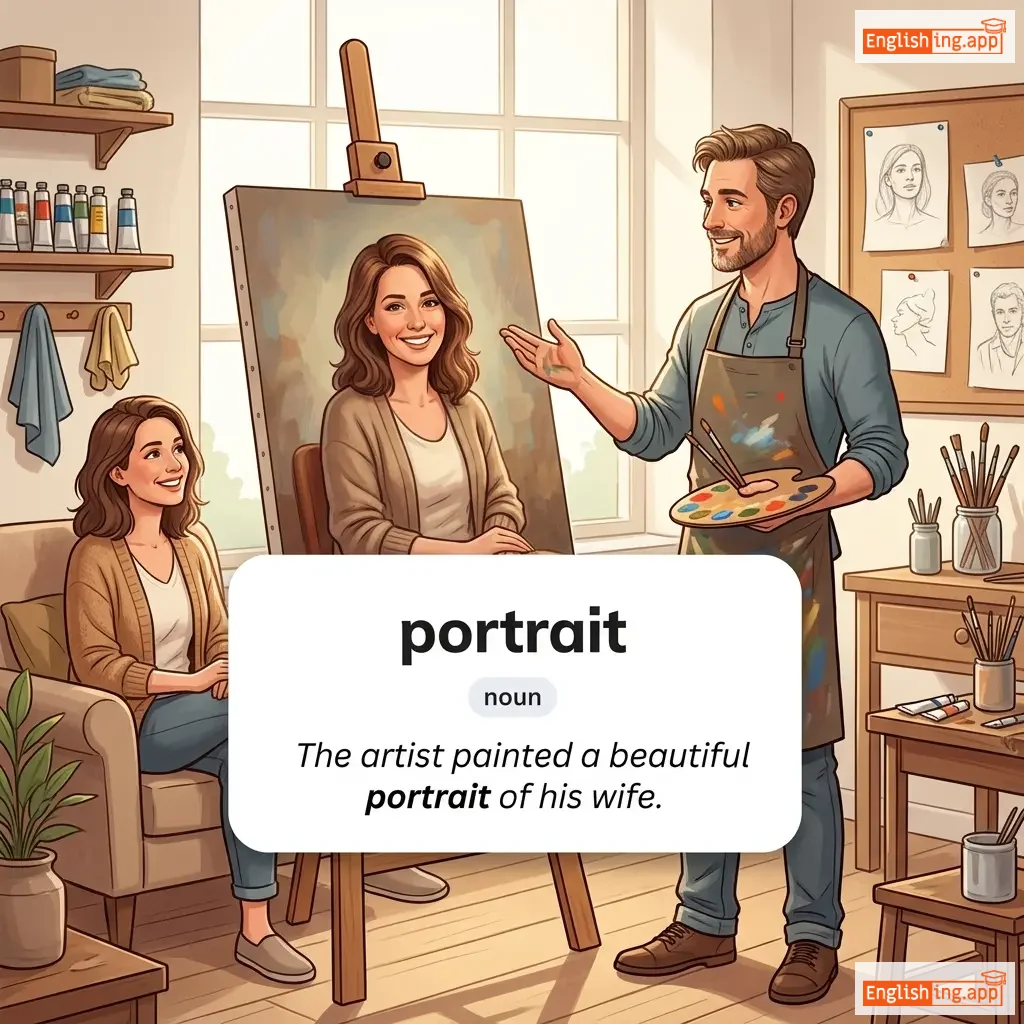
portrait definition card — visual illustration of the meaning
noun
/ˈpɔːtrət/
portrait (portrait)

a painting, drawing, photograph, or engraving of a person, especially one showing the face

"The artist painted a beautiful portrait of his wife."

"L'artiste a peint un beau portrait de sa femme." (L'artiste a peint un beau portrait de sa femme.)
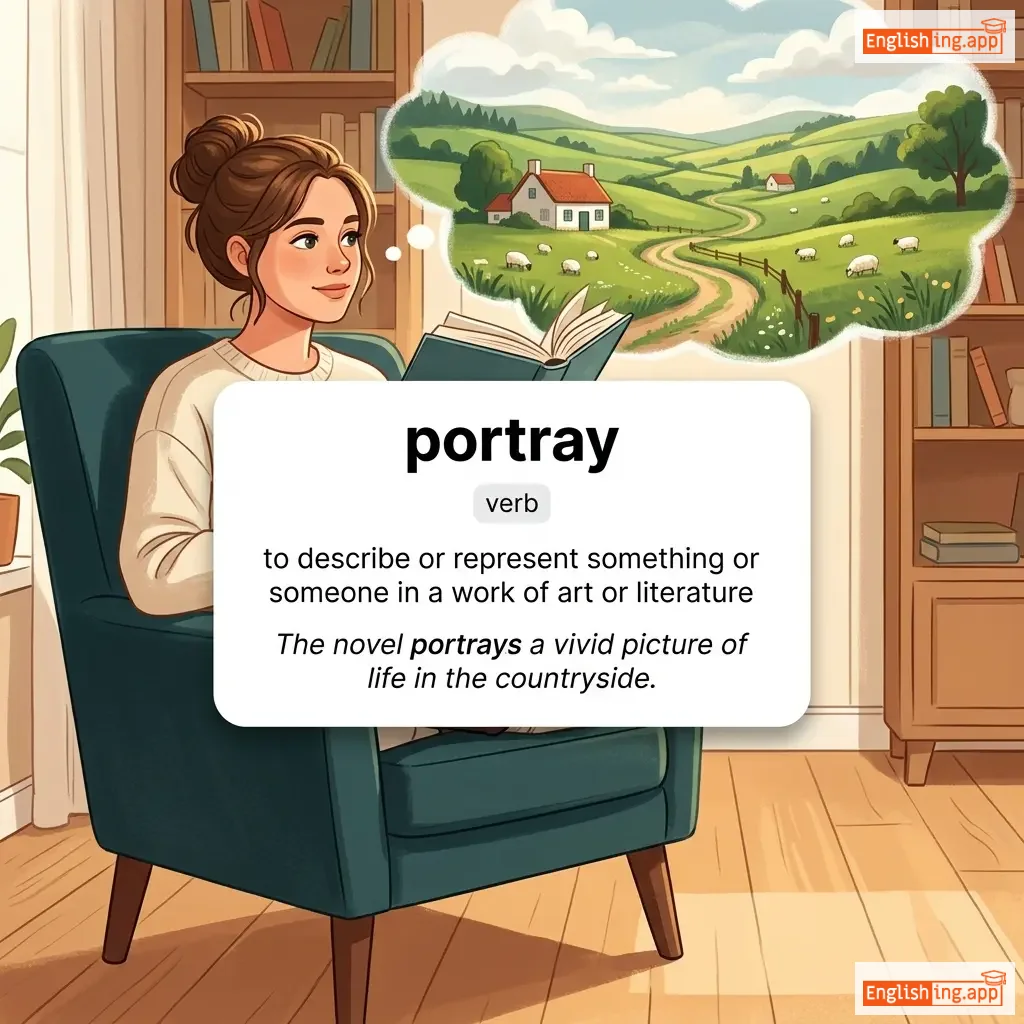
portray definition card — visual illustration of the meaning
verb
/pɔːˈtreɪ/
dépeindre (depeindre)

to describe or represent something or someone in a work of art or literature

"The novel portrays a vivid picture of life in the countryside."

"Le roman dépeint une image vivante de la vie à la campagne." (Le roman depeint une image vivante de la vie à la campagne.)
verb
/poʊz/
bonheur (bonheur)

To assume a particular position, especially for a photograph or display; to present a problem or question.

"She posed for a picture in front of the monument."

"Elle ne pouvait pas cacher son bonheur lorsqu'elle a reçu le prix." (Elle ne pouvait pas cacher son bonheur lorsqu'elle a reçu le prix.)
noun
/poʊˈzɜːr/
poseur (pozur)

A person who pretends to be something they are not, often to impress others.

"Many considered him a poseur because he exaggerated his accomplishments."

"Beaucoup le considéraient comme un poseur parce qu'il exagérait ses réalisations." (Beaucoup le consideraient comme un poseur parce qu il exagerait ses realisations)
verb
/ˈpɑːzɪt/
poser (posit)

To assume or suggest something as a fact or basis for reasoning.

"The scientist posited a new theory to explain the phenomenon."

"Le scientifique a posé une nouvelle théorie pour expliquer le phénomène." (Le scientifique a posé une nouvelle théorie pour expliquer le phénomène.)
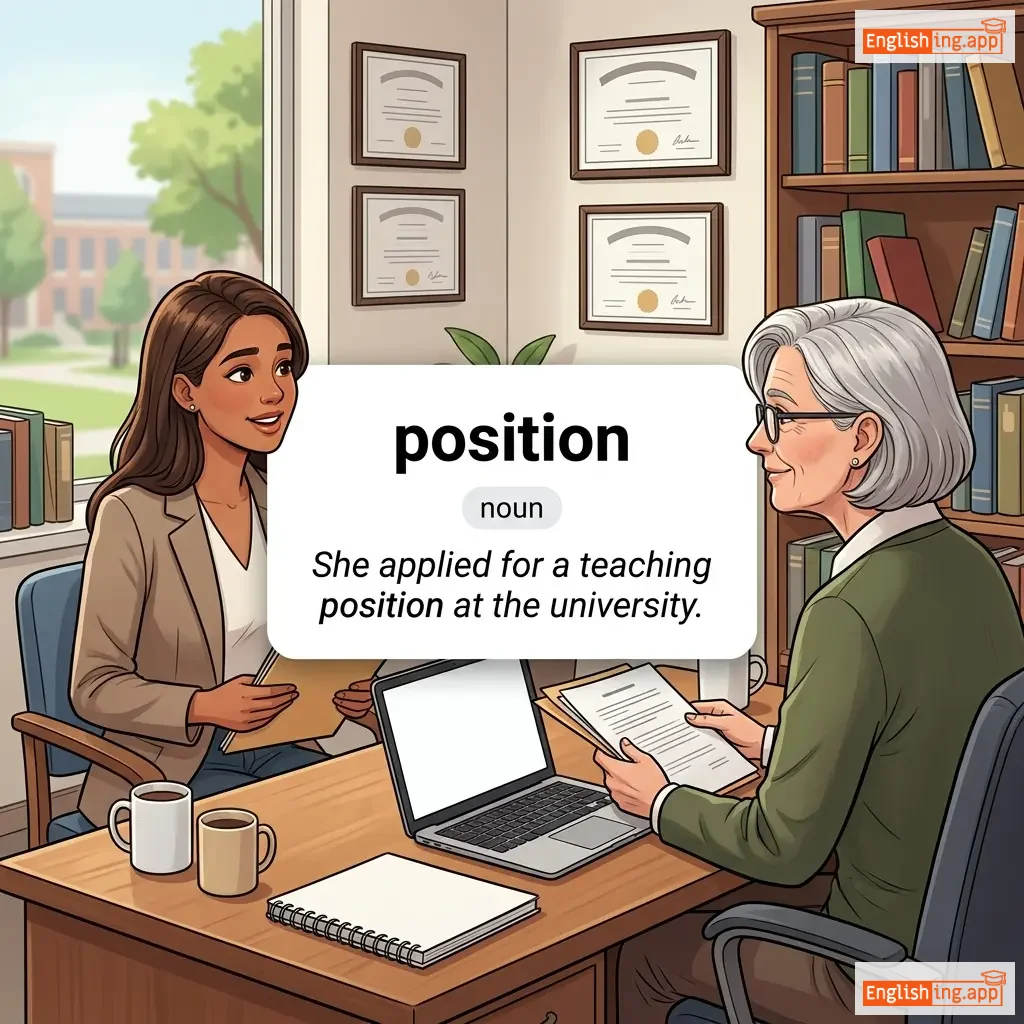
position definition card — visual illustration of the meaning
noun
/pəˈzɪʃən/
poste / position (poste / position)

A place, job, or status; the way in which someone or something is placed or arranged.

"She applied for a teaching position at the university."

"Elle a postulé pour un poste d'enseignant à l'université." (Elle a postulé pour un poste d'enseignant à l'université.)
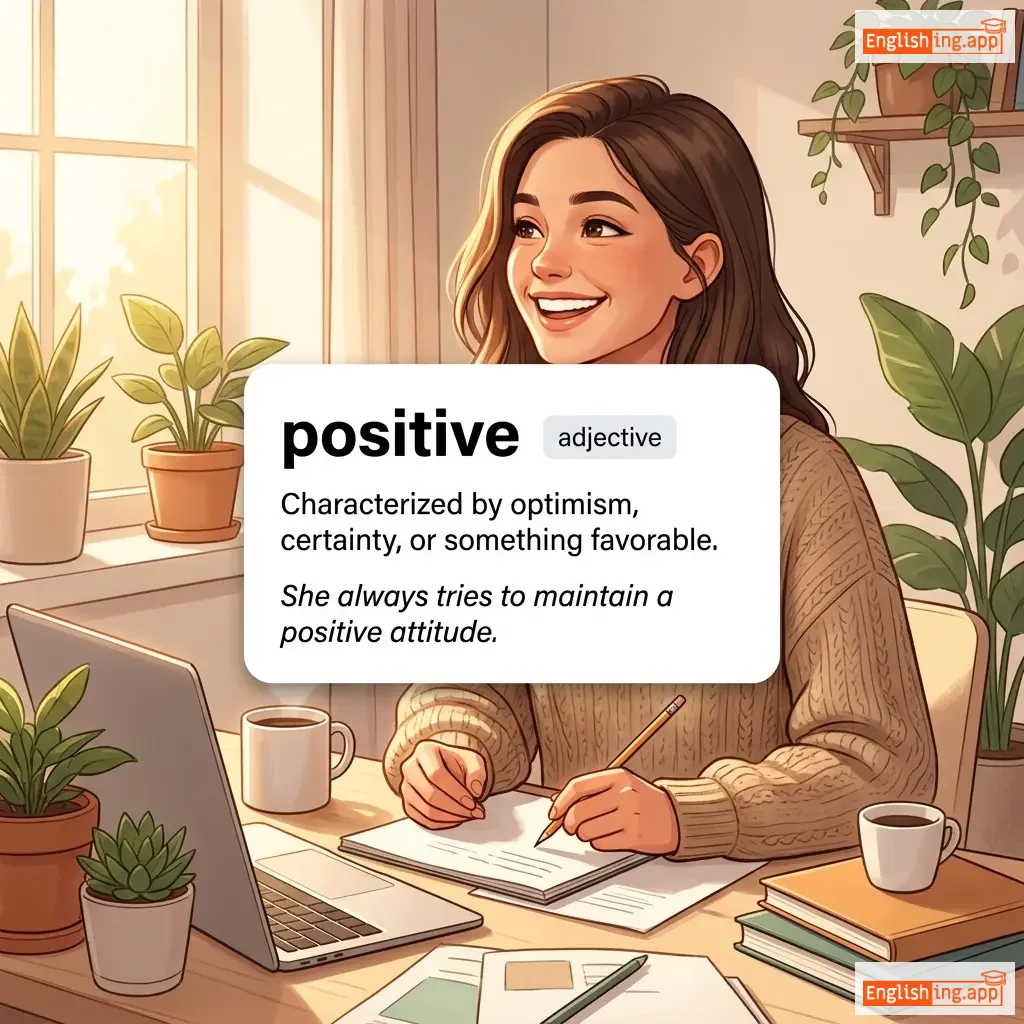
positive definition card — visual illustration of the meaning
adjective
/ˈpɒzɪtɪv/
positif (positif)

Characterized by optimism, certainty, or something favorable.

"She always tries to maintain a positive attitude."

"Elle essaie toujours de maintenir une attitude positive." (Elle essaie toujours de maintenir une attitude positive.)
noun
/ˈpɒsi/
gang / groupe d'amis (gang / groupe d'amis)

A group of people, often friends or a group organized to support or enforce the law.

"He arrived at the party with his posse of friends."

"Il est arrivé à la fête avec son groupe d'amis." (Il est arrivé à la fête avec son groupe d'amis.)
verb
/pəˈzɛs/
posséder / avoir (posséder / avoir)

To have or own something; to hold a quality or characteristic.

"She possesses great talent in music."

"Elle possède un grand talent en musique." (Elle possède un grand talent en musique.)
noun
/pəˈzɛʃən/
possession (possession)

The state of owning, controlling, or holding something.

"The ring was her most valuable possession."

"La bague était sa possession la plus précieuse." (La bague était sa possession la plus précieuse.)
adjective
/pəˈzɛsɪv/
possessif (possessif)

Showing a desire to own or control; relating to possession.

"He became very possessive about his old books."

"Il est devenu très possessif à propos de ses vieux livres." (Il est devenu très possessif à propos de ses vieux livres.)
noun
/pəˈzɛsər/
détenteur (detenteur)

A person who owns or holds something.

"The possessor of the land built a new house."

"Le détenteur de la terre a construit une nouvelle maison." (Le détenteur de la terre a construit une nouvelle maison.)
noun
/ˌpɒsəˈbɪləti/
possibilité (possibilité)

something that may happen or be the case; a chance that something exists or might occur

"There is a strong possibility of rain tomorrow."

"Il y a une forte possibilité de pluie demain." (Il y a une forte possibilité de pluie demain.)
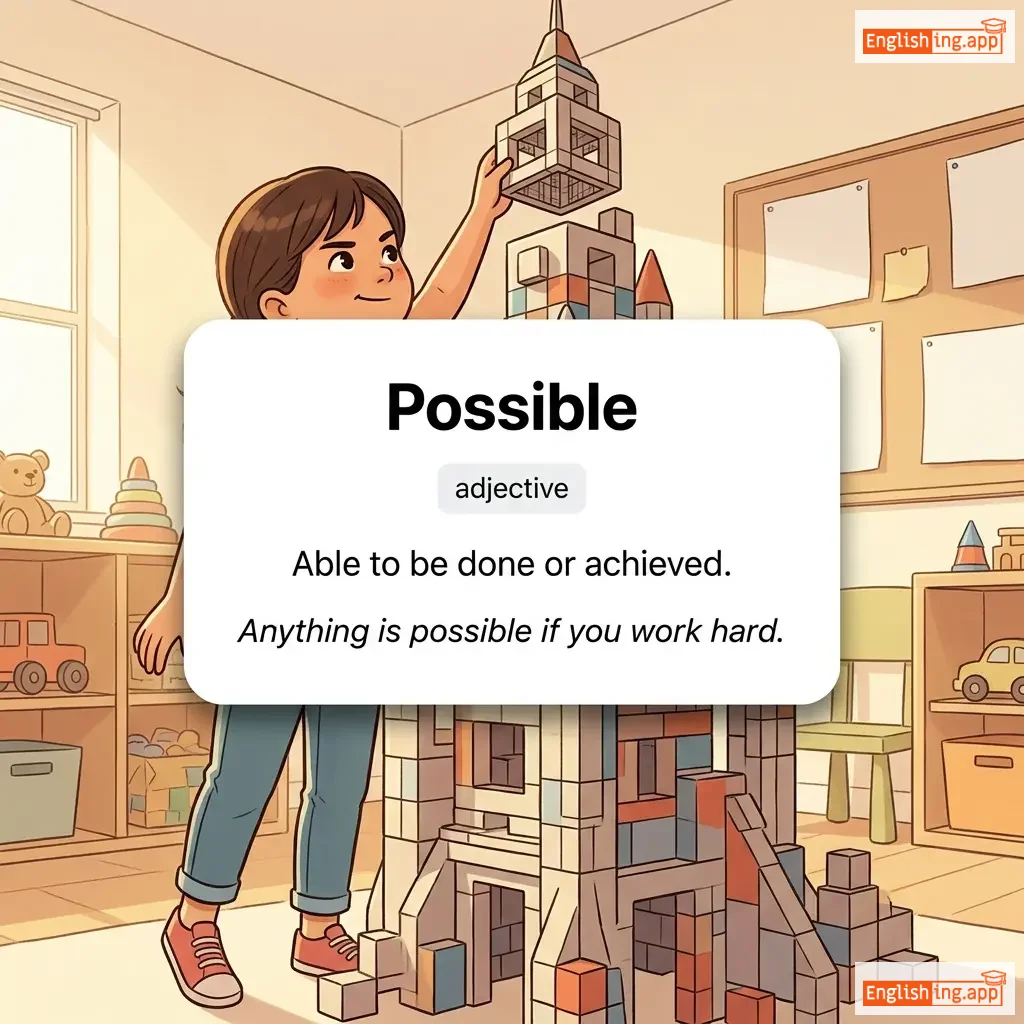
Possible definition card — visual illustration of the meaning
adjective
/ˈpɒsəbl̩/
possible (possible)

Able to be done or achieved.

"Anything is possible if you work hard."

"Tout est possible si vous travaillez dur." (Tout est possible si vous travaillez dur.)
adverb
/ˈpɒsɪbli/
éventuellement (even-tuellement)

maybe, or in a way that is not certain

"It could possibly rain later today."

"Il pourrait éventuellement pleuvoir plus tard aujourd'hui." (Il pourrait éventuellement pleuvoir plus tard aujourd'hui.)
noun, verb
/pəʊst/
poster (post)

a job or position, or to send something by mail

"She posted a letter to her friend yesterday."

"Elle a posté une lettre à son amie hier." (Elle a posté une lettre à son amie hier.)
noun
/ˈpoʊst ˌɒfɪs/
bureau de poste (bureau de poste)

a public building or agency where mail is sent, received, and other postal services are provided

"I went to the post office to mail a package."

"Je suis allé au bureau de poste pour envoyer un colis." (je suis alle au bureau de poste pour envoyer un colis)
adjective
/ˌpoʊstˈwɔːr/
d'après-guerre (d'apres-guerre)

relating to the period after a war has ended

"The country experienced rapid economic growth in the post-war years."

"Le pays a connu une croissance rapide dans les années d'après-guerre." (le pays a connu une croissance rapide dans les annees d'apres-guerre)
verb
/ˌpoʊstˈdeɪt/
mettre une date ultérieure (mettre une date ulterieure)

To assign a date later than the actual date to a document or event.

"She postdated the check to next month."

"Elle a postdaté le chèque pour le mois prochain." (Elle a postdaté le chèque pour le mois prochain.)
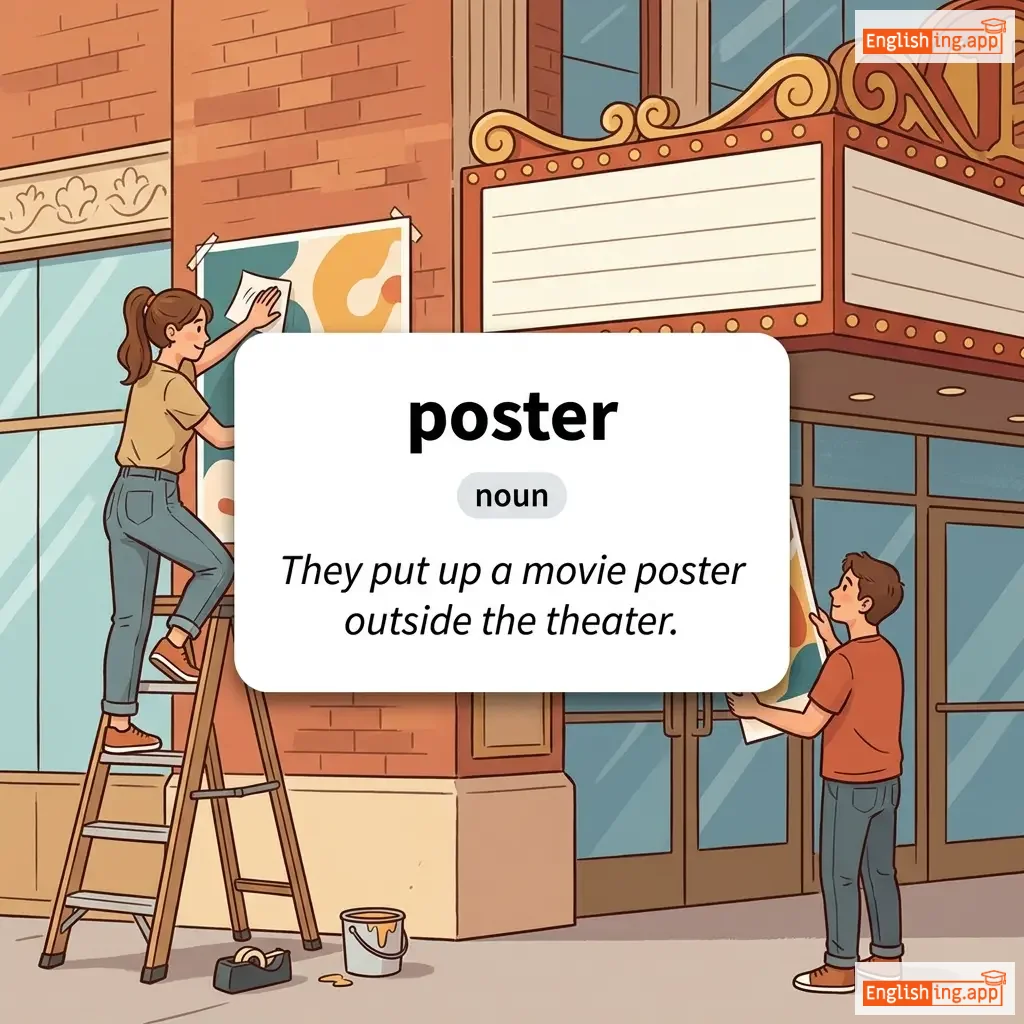
poster definition card — visual illustration of the meaning
noun
/ˈpoʊstər/
affiche (affiche)

a large printed picture or notice that is put on a wall for decoration or to advertise something

"They put up a movie poster outside the theater."

"Ils ont mis un poster de film dehors du cinéma." (Ils ont mis un poster de film dehors du cinéma.)
adjective
/pɒˈstɪəriər/
postérieur (posterieur)

Situated at or toward the back; later in time.

"The posterior part of the brain controls vision."

"La partie postérieure du cerveau contrôle la vision." (La partie posterieure du cerveau controle la vision.)
noun
/pɒˈstɛrɪti/
postérité (posterite)

All future generations of people.

"The monument was built for the benefit of posterity."

"Le monument a été construit pour le bénéfice de la postérité." (Le monument a été construit pour le bénéfice de la postérité.)
noun, adjective
/ˌpəʊstˈɡrædʒuət/
étudiant de troisième cycle (etudiant de troisieme cycle)

A student who has completed a first degree and is studying for a further degree.

"She is doing postgraduate research in physics."

"Elle fait des recherches de troisième cycle en physique." (Elle fait des recherches de troisieme cycle en physique.)
adjective
/ˈpɒstjʊməs/
posthume (posthume)

Occurring, awarded, or appearing after the death of the originator.

"He received a posthumous award for his bravery."

"Il a reçu un prix posthume pour son courage." (Il a reçu un prix posthume pour son courage.)
noun, adjective
/ˌpəʊstˈmɔːtəm/
autopsie (autopsie)

An examination of a dead body to determine the cause of death.

"The doctor carried out a postmortem on the body."

"Le médecin a pratiqué une autopsie sur le corps." (Le médecin a pratiqué une autopsie sur le corps.)
verb
/pəʊs(t)ˈpəʊn/
reporter (reporter)

to delay something to a later time

"The meeting was postponed until next week."

"La réunion a été reportée à la semaine prochaine." (La reunion a ete reportee a la semaine prochaine.)
adjective
/ˌpəʊstˈprændɪəl/
postprandial (postprandial)

Occurring after a meal.

"He went for a postprandial walk after dinner."

"Il est allé faire une promenade postprandiale après le dîner." (Il est alle faire une promenade postprandiale apres le diner.)
noun
/ˈpəʊstˌskrɪpt/
post-scriptum (post-scriptum)

an additional remark at the end of a letter or text, after the signature

"She added a brief postscript to thank him again."

"Elle a ajouté une brève post-scriptum pour le remercier à nouveau." (Elle a ajoute une breve post-scriptum pour le remercier a nouveau.)
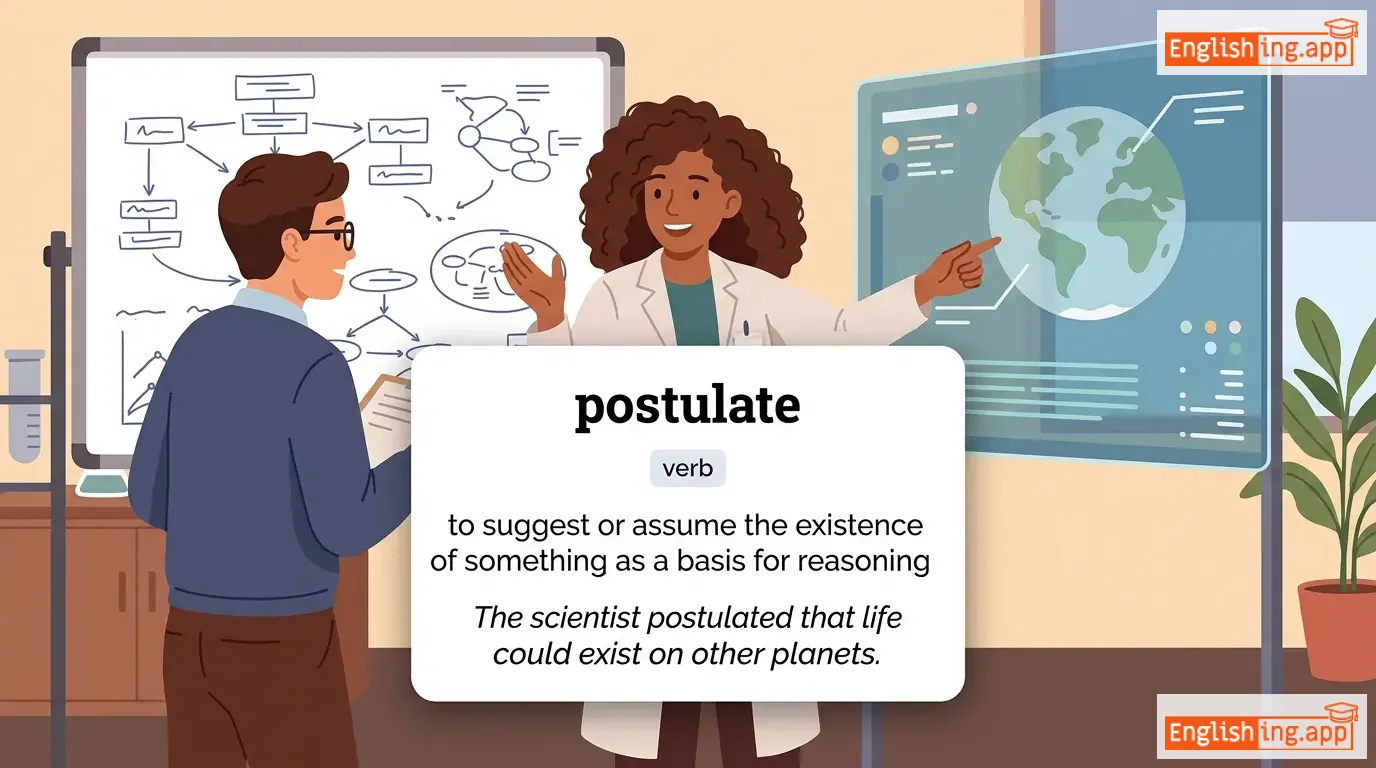
postulate definition card — visual illustration of the meaning
verb
/ˈpɒstjʊˌleɪt/
postuler (postuler)

to suggest or assume the existence of something as a basis for reasoning

"The scientist postulated that life could exist on other planets."

"Le scientifique a postulé que la vie pourrait exister sur d'autres planètes." (Le scientifique a postulé que la vie pourrait exister sur d'autres planètes.)
noun
/ˈpɒstʃə/
bonheur (bonheur)

the position in which someone holds their body; an attitude or approach

"Good posture helps prevent back pain."

"Elle ne pouvait pas cacher son bonheur lorsqu'elle a reçu le prix." (Elle ne pouvait pas cacher son bonheur lorsqu'elle a reçu le prix.)
adjective
/ˈpəʊstwɔːr/
d'après-guerre (d'apres-guerre)

occurring or existing after a war

"The postwar period saw significant economic growth."

"La période d'après-guerre a vu une croissance économique significative." (La periode d'apres-guerre a vu une croissance economique significative.)
noun
/pɒt/
pot (pot)

a container, typically round and deep, used for cooking or holding plants

"She put the soup in a pot and set it on the stove."

"Elle a mis la soupe dans un pot et l'a placé sur le poêle." (Elle a mis la soupe dans un pot et l'a place sur le poêle.)
adjective
/ˈpəʊtəbl/
potable (potable)

safe to drink; drinkable

"The villagers did not have access to potable water."

"Les villageois n'avaient pas accès à l'eau potable." (Les villageois n'avaient pas accès à l'eau potable.)
noun
/pəˈteɪtoʊ/
pomme de terre (pomme de terre)

a starchy plant tuber that is a staple food around the world

"We had mashed potato with our dinner."

"Nous avons mangé de la purée de pommes de terre au dîner." (Nous avons mange de la puree de pommes de terre au diner.)
noun
/ˈpɒtˌbɔɪlə/
livre de série B (livre de serie B)

a book, play, or film produced quickly to make money rather than for artistic value

"The novel was dismissed by critics as a mere potboiler."

"Le roman a été rejeté par les critiques comme un simple livre de série B." (Le roman a été rejeté par les critiques comme un simple livre de série B.)
noun
/ˈpoʊtənsi/
puissance (puissance)

The power or ability of something to affect or influence; strength or effectiveness.

"The potency of the new medicine amazed the doctors."

"La puissance du nouveau médicament a étonné les médecins." (La puissance du nouveau médicament a étonné les médecins.)
adjective
/ˈpoʊtənt/
puissant (pwee-sãt)

Having great power, influence, or effect.

"This is a very potent drug that should be used carefully."

"C'est un médicament très puissant qui doit être utilisé avec précaution." (C'est un médicament très puissant qui doit être utilisé avec précaution.)
adjective
/prɪˈhɛnsɪbəl/
préhensible (prehensible)

capable of being grasped or seized

"The tool has a prehensible handle that improves safety."

"L'outil a une prise préhensible qui améliore la sécurité." (L'outil a une prise prehensible qui ameliore la securite.)
noun
/ˈprɛdʒədɪs/
préjugé (prejuge)

An unfair and unreasonable opinion or feeling, especially when formed without enough thought or knowledge.

"Prejudice often prevents people from seeing the truth about others."

"Le préjugé empêche souvent les gens de voir la vérité sur les autres." (Le prejuge empeche souvent les gens de voir la verite sur les autres.)
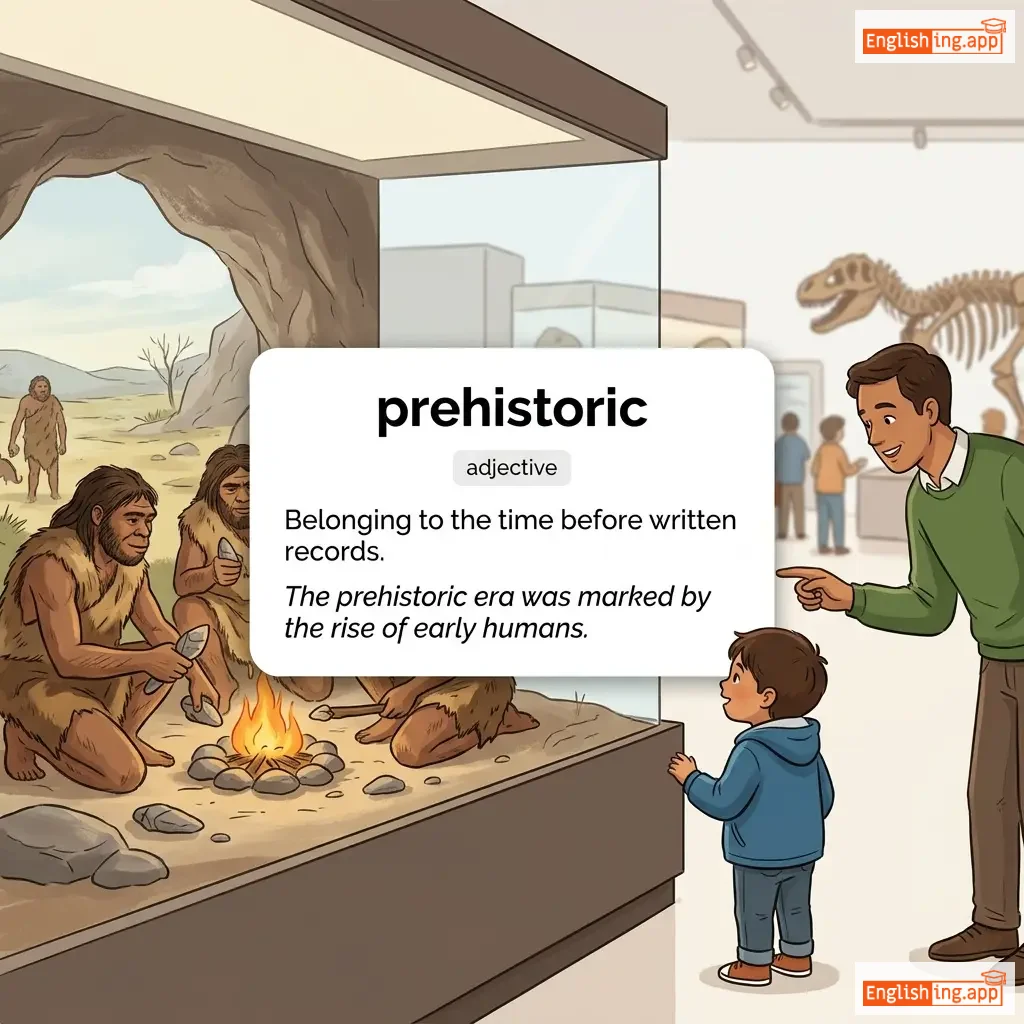
prehistoric definition card — visual illustration of the meaning
adjective
ˌpriːhɪˈstɒrɪk
préhistorique, avant les archives écrites (préhistorique, avant les archives écrites)

Belonging to the time before written records.

"The prehistoric era was marked by the rise of early humans."

"L'ère préhistorique a été marquée par l'ascension des premiers humains." (L'ère préhistorique a été marquée par l'ascension des premiers humains.)
noun
/prɪˈhɛnʃən/
action de saisir; capacité à saisir quelque chose (action de saisir; capacite a saisir quelque chose)

the act of grasping or seizing; the ability to take hold of something

"Therapists assessed the patient's prehension during hand therapy."

"Les thérapeutes ont évalué la préhension du patient pendant la thérapie manuelle." (Les therapeutess ont evalue la prehension du patient pendant la therapie manuelle.)
adjective
/prɪˈhɛnsaɪl/
préhensile (prehensile)

adapted for seizing or grasping, especially by wrapping around an object

"The monkey used its prehensile tail to hang from the branch."

"Le singe a utilisé sa queue préhensile pour se suspendre à la branche." (Le singe a utilisé sa queue préhensile pour se suspendre à la branche.)
noun
/ˈprɛɡnənsi/
grossesse (grossesse)

the condition of being pregnant; the period during which a woman carries a developing fetus

"Her pregnancy was carefully monitored by her doctor."

"Sa grossesse a été soigneusement suivie par son médecin." (Sa grossesse a ete soigneusement suivie par son medecin.)
verb
/priːˈfɪɡjər/
préfigurer (préfigurer)

to represent, show, or foreshadow something in advance

"The economic reforms prefigure major social changes."

"Les réformes économiques préfigurent des changements sociaux majeurs." (Les réformes économiques préfigurent des changements sociaux majeurs.)
noun/verb
/ˈpriːfɪks/
préfixe; ajouter quelque chose au début (prefixe; ajouter quelque chose au debut)

a word, letter, or number placed before another; as a verb, to add something in front of something else

"Developers often prefix variables with an underscore."

"Les développeurs préfixent souvent les variables avec un underscore." (Les développeurs préfixent souvent les variables avec un underscore.)