Vocabulaires

Découvrez, apprenez et maîtrisez le vocabulaire anglais

adjective
/priˈɛmptɪv/
préventif (preventif)

Serving or intended to prevent something by taking action first.

"The government took preemptive measures to control inflation."

"Le gouvernement a pris des mesures préventives pour contrôler l'inflation." (Le gouvernement a pris des mesures préventives pour contrôler l'inflation.)
verb
/priːn/
se préparer (se preparer)

To groom or dress oneself with care; to show pride in one's appearance.

"She preened in front of the mirror before leaving for the party."

"Elle se préparait devant le miroir avant de partir pour la fête." (Elle se préparait devant le miroir avant de partir pour la fête.)
verb
/ˌpriːɪnˈɡeɪdʒ/
préadopter (preadopter)

To contract or engage beforehand; to arrange in advance.

"The workers were preengaged before the project officially started."

"Les travailleurs ont été préengagés avant le début officiel du projet." (Les travailleurs ont été préengagés avant le début officiel du projet.)
verb
/ˌpriːɪˈstæblɪʃ/
préalablement établir (prealablement etablir)

To establish or set up beforehand.

"Certain rules were preestablished before the meeting."

"Certaines règles ont été préétablies avant la réunion." (Certaines règles ont été préétablies avant la réunion.)
verb
/ˌpriːɪɡˈzɪst/
exister au préalable (exister au préalable)

to exist beforehand or before something else

"These customs preexist the arrival of modern technology."

"Ces coutumes existaient avant l'arrivée de la technologie moderne." (Ces coutumes existaient avant l'arrivée de la technologie moderne.)
noun
/ˌpriːɪɡˈzɪstəns/
préexistence (preexistence)

the state of existing before something else

"Philosophers often debated the preexistence of the soul."

"Les philosophes débattaient souvent de la préexistence de l'âme." (Les philosophes debaient souvent de la preexistence de l'ame.)
noun
/ˈprɛfəs/
préface (préface)

an introduction to a book, speech, or other written work

"The author explained his motivation in the preface."

"L'auteur a expliqué sa motivation dans la préface." (L'auteur a expliqué sa motivation dans la préface.)
adjective
/ˈprɛfətɔːri/
prélude (prelude)

serving as an introduction or preface

"He made some prefatory remarks before the lecture began."

"Il a fait quelques remarques préliminaires avant que la conférence ne commence." (Il a fait quelques remarques preliminaires avant que la conference ne commence.)
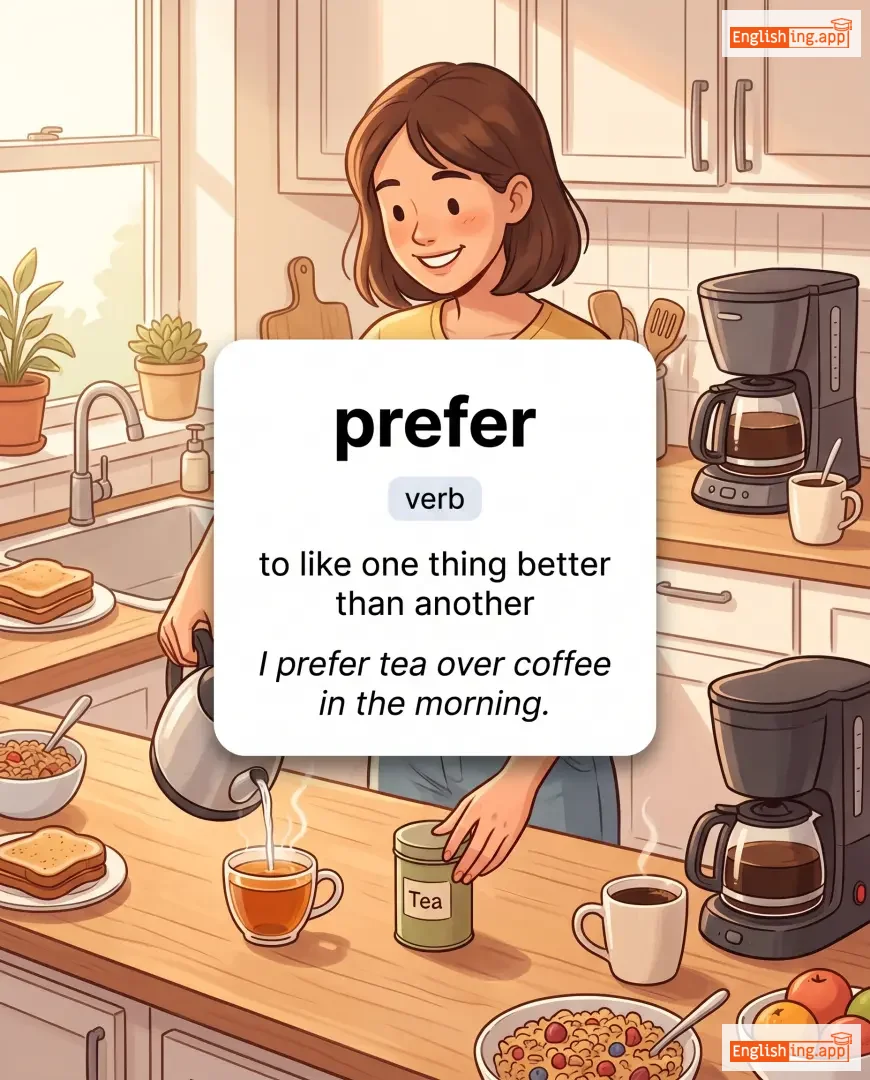
prefer definition card — visual illustration of the meaning
verb
/prɪˈfɜːr/
préférer (preferer)

to like one thing better than another

"I prefer tea over coffee in the morning."

"Je préfère le thé au café le matin." (Je préfère le thé au café le matin.)
adjective
/ˈprɛf(ə)rəb(ə)l/
préférable (preferable)

more desirable or suitable; better than something else

"It is preferable to take the train rather than drive in heavy traffic."

"Il est préférable de prendre le train plutôt que de conduire dans le trafic dense." (Il est preferable de prendre le train plutot que de conduire dans le trafic dense.)
noun
/ˈprɛf(ə)rəns/
préférence (preference)

a greater liking for one alternative over another

"She has a preference for tea over coffee."

"Elle a une préférence pour le thé plutôt que le café." (Elle a une preference pour le thé plutot que le café.)
adjective
/ˌprɛfəˈrɛnʃəl/
privilégié (privilégie)

showing or giving advantage to one over others

"Members receive preferential treatment at the club."

"Les membres bénéficient d'un traitement préférentiel au club." (Les membres bénéficient d'un traitement préférentiel au club.)
noun
/prɪˈfɜːrmənt/
promotion (promotion)

promotion or advancement in rank, position, or office

"He hoped for preferment in the government office."

"Il espérait une promotion dans le bureau du gouvernement." (Il esperait une promotion dans le bureau du gouvernement.)
verb
/priːˈfɪɡjər/
préfigurer (préfigurer)

to represent, show, or foreshadow something in advance

"The economic reforms prefigure major social changes."

"Les réformes économiques préfigurent des changements sociaux majeurs." (Les réformes économiques préfigurent des changements sociaux majeurs.)
noun/verb
/ˈpriːfɪks/
préfixe; ajouter quelque chose au début (prefixe; ajouter quelque chose au debut)

a word, letter, or number placed before another; as a verb, to add something in front of something else

"Developers often prefix variables with an underscore."

"Les développeurs préfixent souvent les variables avec un underscore." (Les développeurs préfixent souvent les variables avec un underscore.)
noun
/ˈprɛɡnənsi/
grossesse (grossesse)

the condition of being pregnant; the period during which a woman carries a developing fetus

"Her pregnancy was carefully monitored by her doctor."

"Sa grossesse a été soigneusement suivie par son médecin." (Sa grossesse a ete soigneusement suivie par son medecin.)
adjective
/ˈprɛɡnənt/
enceinte; significatif (enceinte; significatif)

having a child developing in the womb; also, full of meaning or significance

"She announced that she was three months pregnant."

"Elle a annoncé qu'elle était enceinte de trois mois." (Elle a annoncé qu'elle était enceinte de trois mois.)
adjective
/prɪˈhɛnsɪbəl/
préhensible (prehensible)

capable of being grasped or seized

"The tool has a prehensible handle that improves safety."

"L'outil a une prise préhensible qui améliore la sécurité." (L'outil a une prise prehensible qui ameliore la securite.)
adjective
/prɪˈhɛnsaɪl/
préhensile (prehensile)

adapted for seizing or grasping, especially by wrapping around an object

"The monkey used its prehensile tail to hang from the branch."

"Le singe a utilisé sa queue préhensile pour se suspendre à la branche." (Le singe a utilisé sa queue préhensile pour se suspendre à la branche.)
noun
/prɪˈhɛnʃən/
action de saisir; capacité à saisir quelque chose (action de saisir; capacite a saisir quelque chose)

the act of grasping or seizing; the ability to take hold of something

"Therapists assessed the patient's prehension during hand therapy."

"Les thérapeutes ont évalué la préhension du patient pendant la thérapie manuelle." (Les therapeutess ont evalue la prehension du patient pendant la therapie manuelle.)
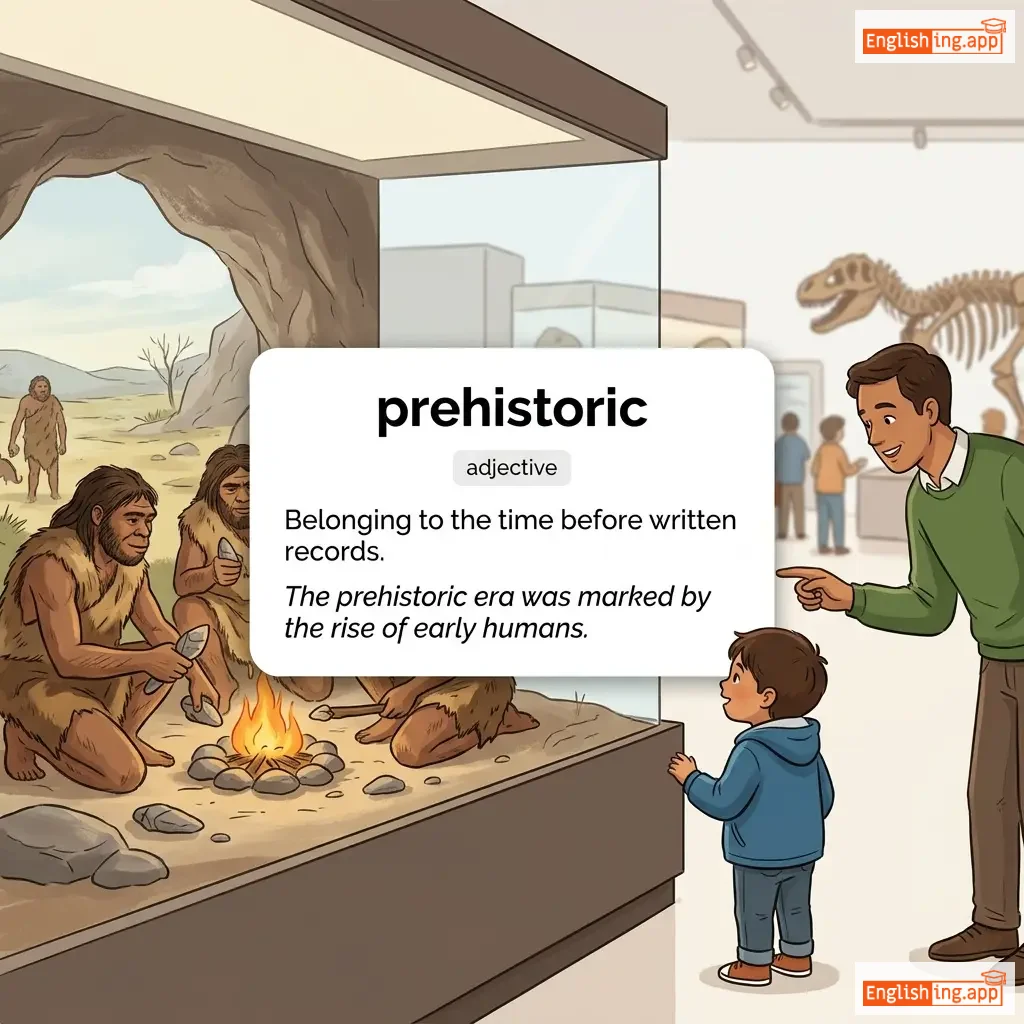
prehistoric definition card — visual illustration of the meaning
adjective
ˌpriːhɪˈstɒrɪk
préhistorique, avant les archives écrites (préhistorique, avant les archives écrites)

Belonging to the time before written records.

"The prehistoric era was marked by the rise of early humans."

"L'ère préhistorique a été marquée par l'ascension des premiers humains." (L'ère préhistorique a été marquée par l'ascension des premiers humains.)
noun
/ˈprɛdʒədɪs/
préjugé (prejuge)

An unfair and unreasonable opinion or feeling, especially when formed without enough thought or knowledge.

"Prejudice often prevents people from seeing the truth about others."

"Le préjugé empêche souvent les gens de voir la vérité sur les autres." (Le prejuge empeche souvent les gens de voir la verite sur les autres.)
adjective
/ˈprɛdʒədɪst/
préjudicié (prejudicié)

having or showing a dislike or bias against a person or group without proper reason

"He was prejudiced against people from other regions."

"Il était préjugé contre les personnes d'autres régions." (Il était préjugé contre les personnes d'autres régions.)
noun
/ˈprɛləsi/
prélature (prelature)

The office, dignity, or system of church government by prelates.

"The medieval church was dominated by prelacy and its traditions."

"L'Église médiévale était dominée par la prélature et ses traditions." (L'Église médiévale était dominée par la prélature et ses traditions.)
noun
/ˈprɛlət/
haut membre du clergé (haut membre du clergé)

A high-ranking member of the clergy, especially a bishop or abbot.

"The prelate delivered a sermon to the congregation."

"Le prélat a prononcé un sermon devant la congrégation." (Le prélat a prononcé un sermon devant la congrégation.)
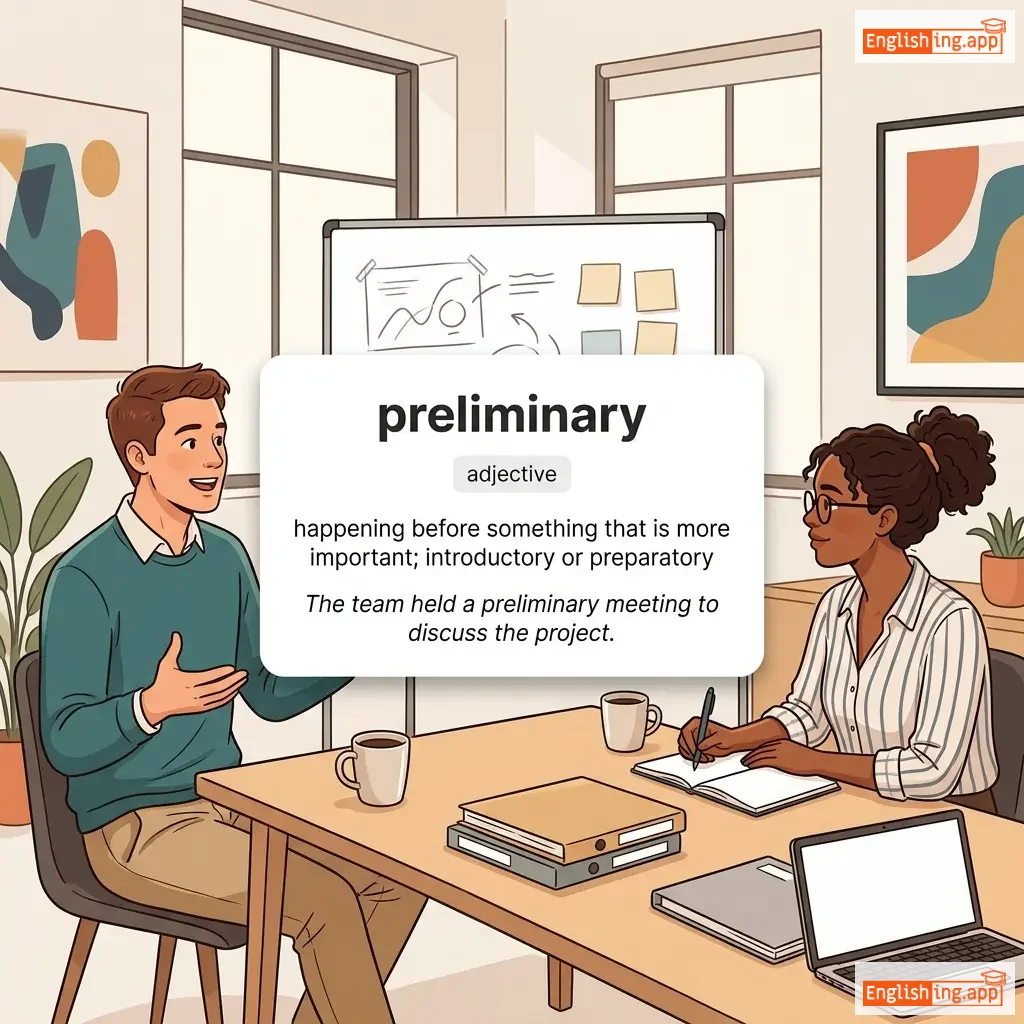
preliminary definition card — visual illustration of the meaning
adjective
/prɪˈlɪmɪˌneri/
préliminaire (preliminaire)

happening before something that is more important; introductory or preparatory

"The team held a preliminary meeting to discuss the project."

"L'équipe a tenu une réunion préliminaire pour discuter du projet." (L'équipe a tenu une réunion préliminaire pour discuter du projet.)
noun
/ˈprɛljuːd/
prélude (prelude)

An action, event, or statement that serves as an introduction to something more important.

"The small fight was only a prelude to a bigger conflict."

"La petite bagarre n'était qu'un prélude à un plus grand conflit." (La petite bagarre n'etait qu'un prelude a un plus grand conflit.)
adjective
/ˌpriːməˈtjʊər/
prématuré (premature)

Happening or done before the usual or proper time.

"His decision to quit the job was premature."

"Sa décision de quitter son travail était prématurée." (Sa décision de quitter son travail était prématurée.)
verb
/ˌpriːˈmɛdɪteɪt/
préméditer (premediter)

to think about and plan something (especially a crime) beforehand

"The suspect was accused of premeditating the crime."

"Le suspect a été accusé d'avoir prémédité le crime." (Le suspect a été accusé d'avoir prémédité le crime.)
adjective
/ˌpriːˈmɛdɪˌteɪtɪd/
prémédité (premedite)

planned in advance; done deliberately

"The crime was clearly premeditated."

"Le crime était clairement prémédité." (Le crime était clairement prémédité.)
noun, adjective
/prɪˈmɪər/ or /ˈpriːmiər/
premier ministre / principal (premier ministre / principal)

the head of government in some countries; first in importance or rank

"The French premier addressed the nation."

"Le premier ministre français a adressé la nation." (Le premier ministre francais a adresse la nation.)
noun
/ˈprɛmɪs/
prémisse / bâtiment (premisse / batiment)

a statement or idea on which reasoning or an argument is based; also a building or property

"His argument was based on a false premise."

"Son argument était basé sur une fausse prémisse." (Son argument etait base sur une fausse premisse.)
noun
/prɪˈsɛntɪmənt/
présentiment (presentiment)

An intuitive feeling about the future, especially of something bad about to happen.

"He had a strong presentiment that the plan would fail."

"Il avait un fort pressentiment que le plan échouerait." (Il avait un fort pressentiment que le plan echouerait.)
verb
/prɪˈskrʌɪb/
prescrire (prescrire)

to recommend or authorize the use of something, especially medicine

"The doctor prescribed medication for my cold."

"Le médecin a prescrit des médicaments pour mon rhume." (Le médecin a prescrit des médicaments pour mon rhume.)
noun
/ˈpriːskrɪpt/
prescription (prescription)

An authoritative rule or direction; something laid down as a command.

"The prescript of the organization required strict punctuality."

"Le prescript de l'organisation exigeait une ponctualité stricte." (Le prescript de l'organisation exigeait une ponctualité stricte.)
adjective
/prɪˈskrɪptɪbəl/
prescriptible (prescriptible)

Capable of being prescribed or laid down as a rule or directive.

"Certain regulations are prescriptible under the law."

"Certaines régulations sont prescrites par la loi." (Certaines régulations sont prescrites par la loi.)
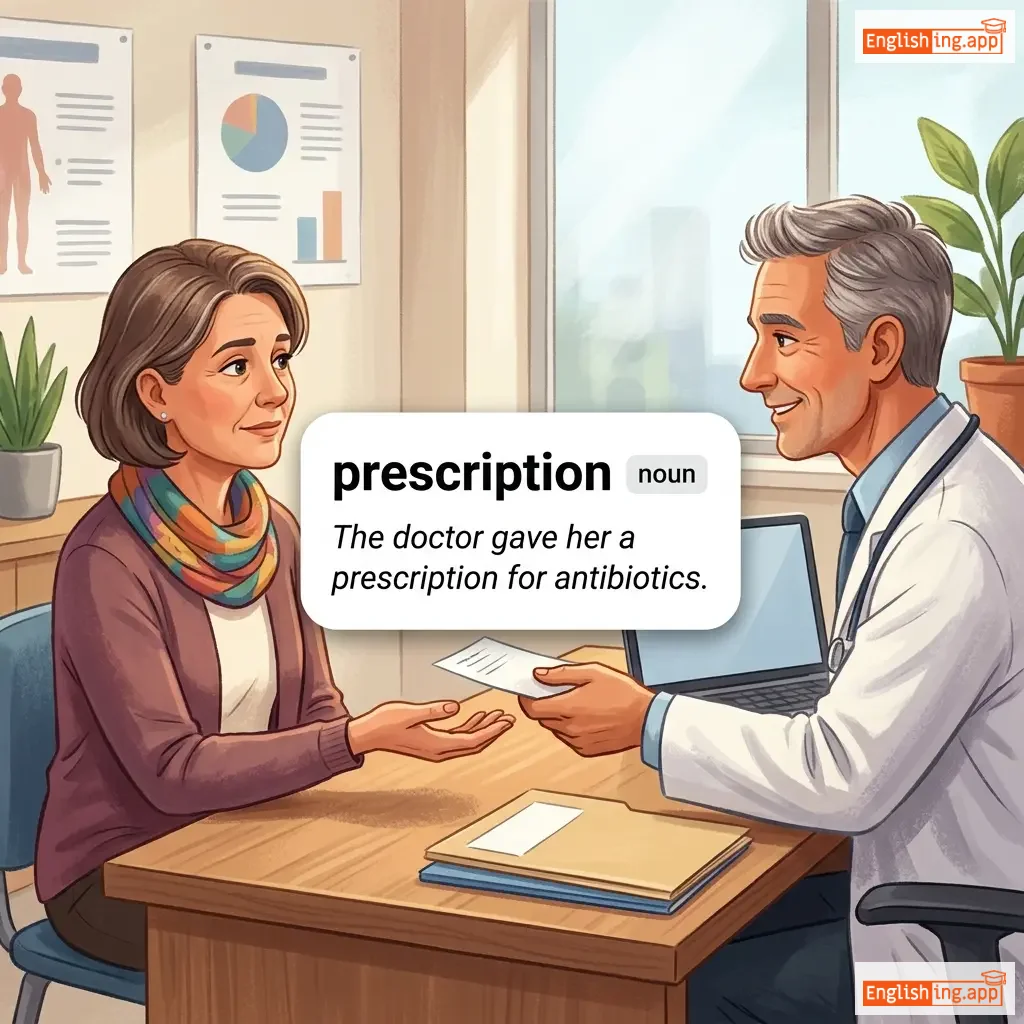
prescription definition card — visual illustration of the meaning
noun
/prɪˈskrɪpʃən/
ordonnance (ordonnance)

A written order from a doctor for the preparation and administration of a medicine; also, a recommendation or authoritative rule.

"The doctor gave her a prescription for antibiotics."

"Le médecin lui a donné une ordonnance pour des antibiotiques." (Le médecin lui a donné une ordonnance pour des antibiotiques.)
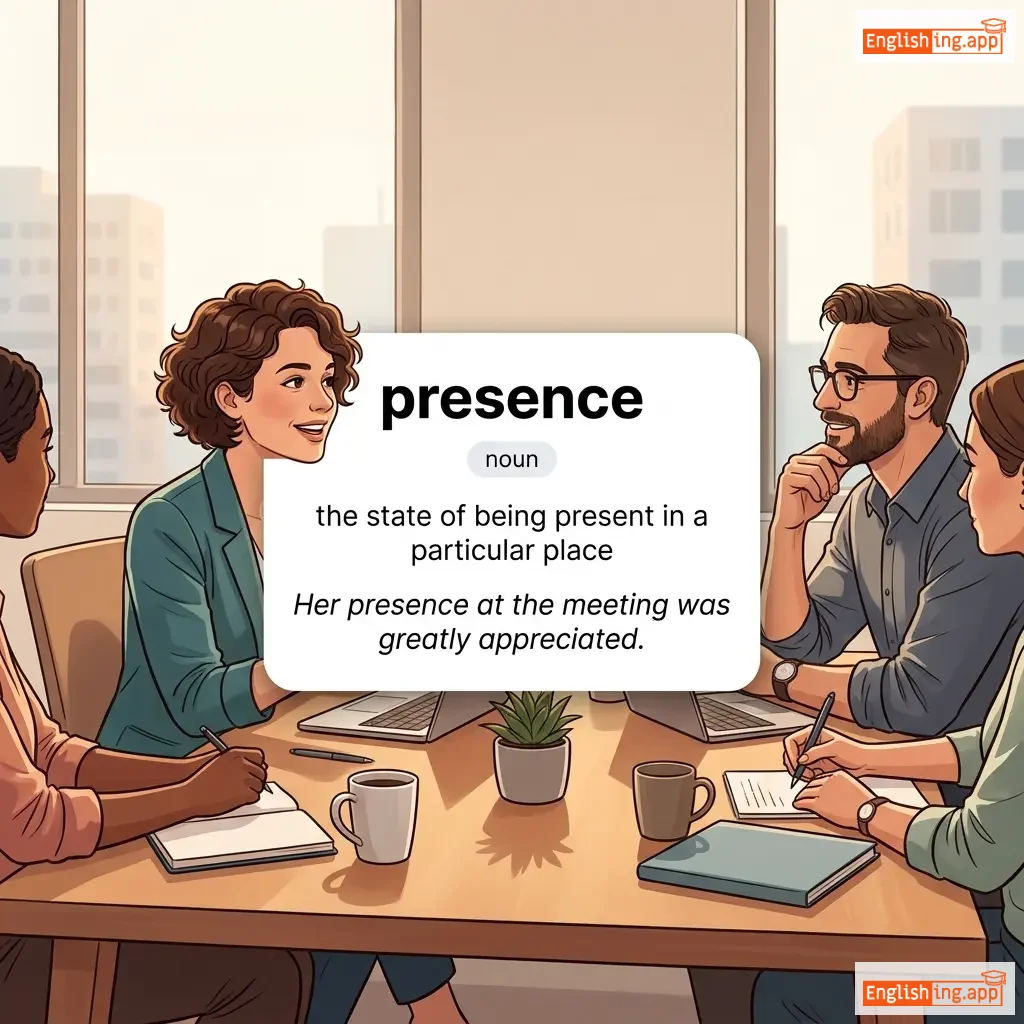
presence definition card — visual illustration of the meaning
noun
/ˈprɛzəns/
présence (presence)

the state of being present in a particular place

"Her presence at the meeting was greatly appreciated."

"Sa présence à la réunion a été grandement appréciée." (Sa presence à la réunion a été grandement appréciée.)
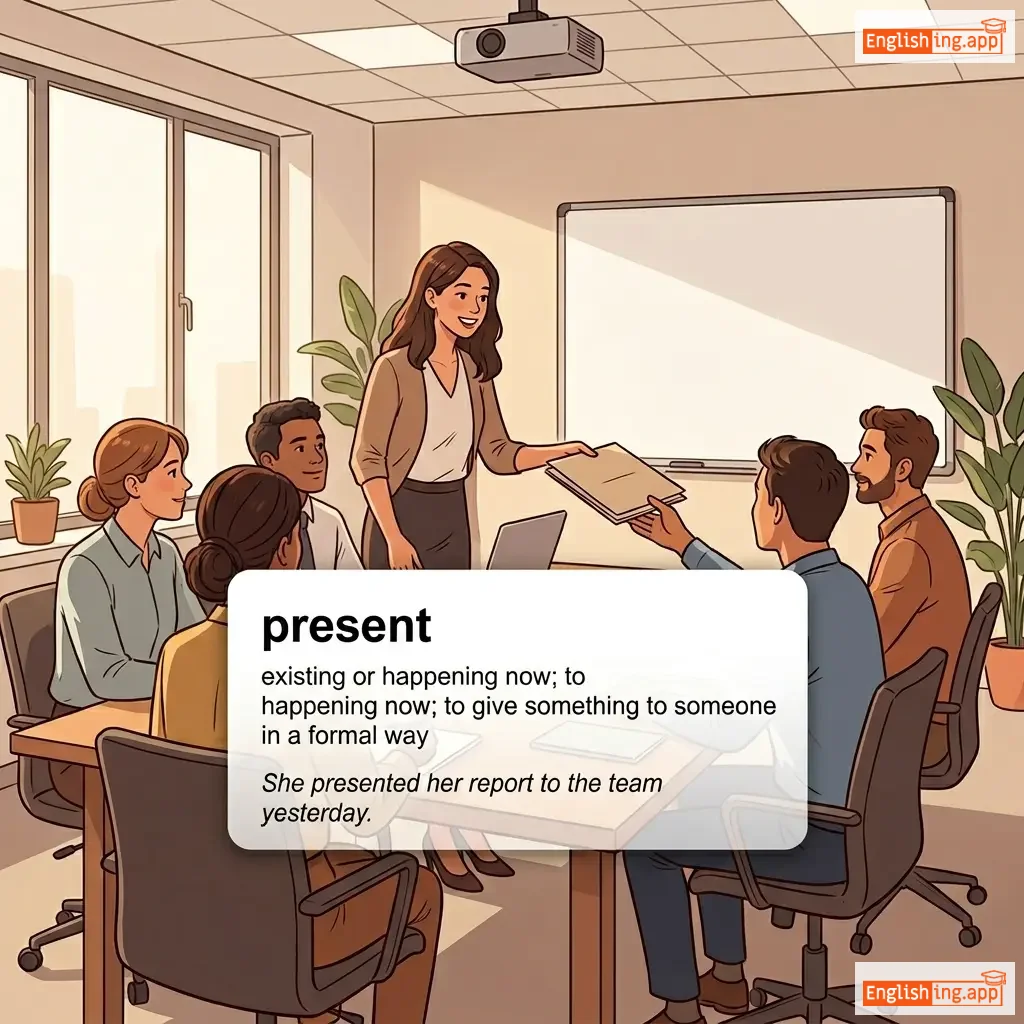
present definition card — visual illustration of the meaning
noun, verb, adjective
/ˈprɛzənt/
présent (present)

existing or happening now; to give something to someone in a formal way

"She presented her report to the team yesterday."

"Elle a présenté son rapport à l'équipe hier." (Elle a présenté son rapport à l'équipe hier.)
adjective
/prɪˈzentəbl/
présentable; convenable pour être vu en public (présentable; convenable pour être vu en public)

neat and suitable for being seen in public; acceptable in appearance

"Make sure you look presentable for the job interview."

"Assurez-vous de paraître présentable pour l'entretien d'embauche." (assurez-vous de paraître présentable pour l'entretien d'embauche)
presentation definition card — visual illustration of the meaning
noun
/ˌprɛzənˈteɪʃən/
présentation (presentation)

the act of presenting something to an audience, typically involving speaking or showing information

"The presentation on digital marketing was very informative."

"La présentation sur le marketing numérique était très informative." (La presentation sur le marketing numerique etait tres informative.)
adjective
/prɪˈsɛnʃənt/
présentiment (présentiment)

Having a feeling or sense of something about to happen; predictive.

"She was presentient of the coming disaster."

"Elle avait un pressentiment du désastre à venir." (Elle avait un pressentiment du désastre a venir.)
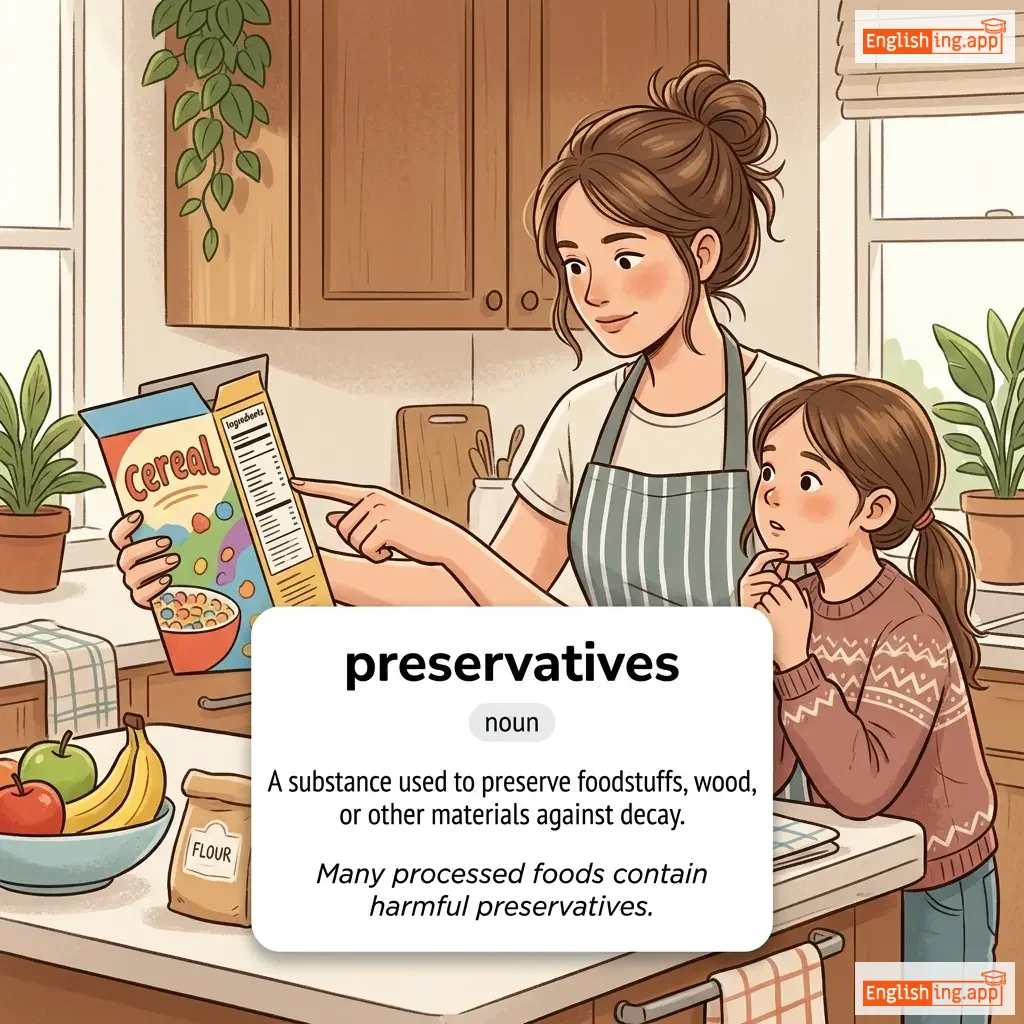
preservatives definition card — visual illustration of the meaning
noun
prɪˈzɜː.və.tɪvz
conservateurs (conservateurs)

A substance used to preserve foodstuffs, wood, or other materials against decay.

"Many processed foods contain harmful preservatives."

"De nombreux aliments transformés contiennent des conservateurs nuisibles." (De nombreux aliments transformés contiennent des conservateurs nuisibles.)
noun
/ˈpoʊtənˌteɪt/
potentat (potentat)

A monarch or ruler, especially one with absolute power.

"The ancient land was ruled by a powerful potentate."

"L'ancienne terre était gouvernée par un puissant potentat." (L'ancienne terre était gouvernée par un puissant potentat.)
noun
/ˈprɛzɪdənsi/
présidence (presidance)

the office or position of being a president

"He was elected to the presidency in 2020."

"Il a été élu à la présidence en 2020." (Il a ete elu a la presidence en 2020.)
👩‍⚖️

preside (prɛzaɪd)

verb
/prɪˈzaɪd/
présider (présider)

to be in charge of a meeting, event, or organization

"She will preside over the meeting tomorrow."

"Elle présidera la réunion demain." (Elle présidera la réunion demain.)
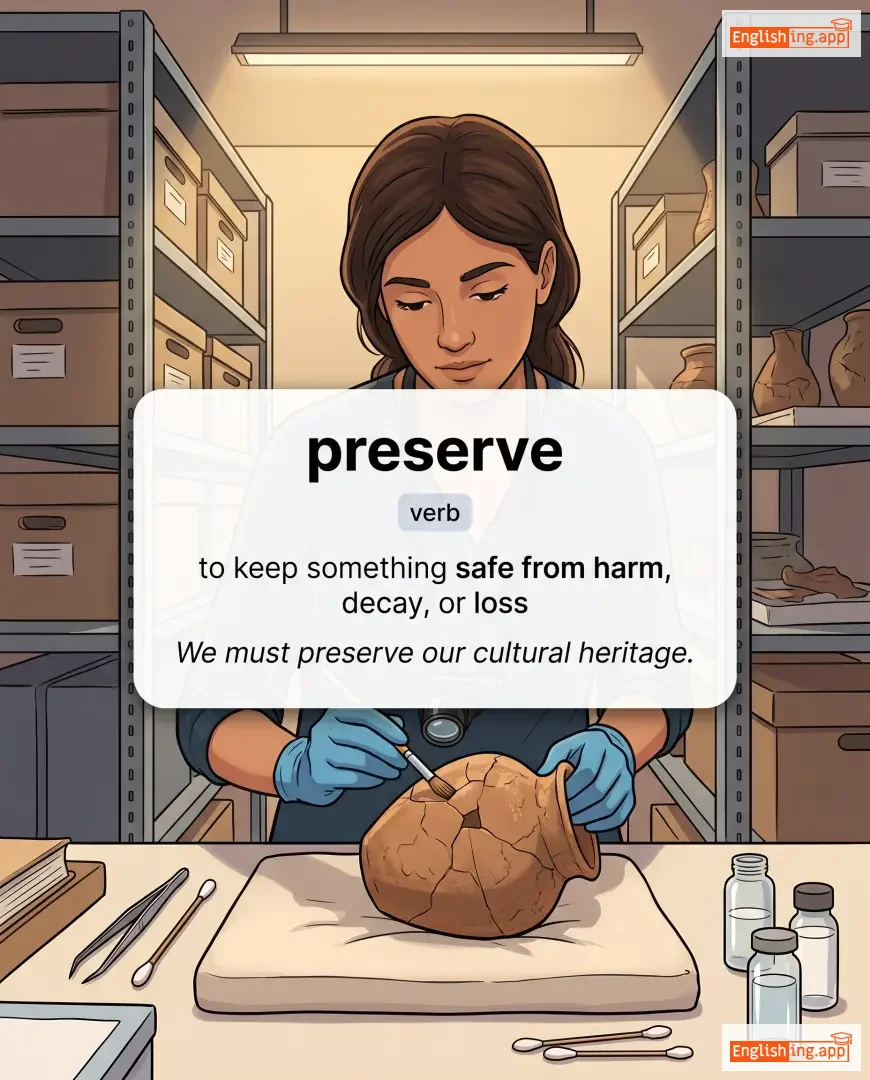
preserve definition card — visual illustration of the meaning
verb
/prɪˈzɜːrv/
préserver (preserver)

to keep something safe from harm, decay, or loss

"We must preserve our cultural heritage."

"Nous devons préserver notre patrimoine culturel." (Nous devons preserver notre patrimoine culturel.)
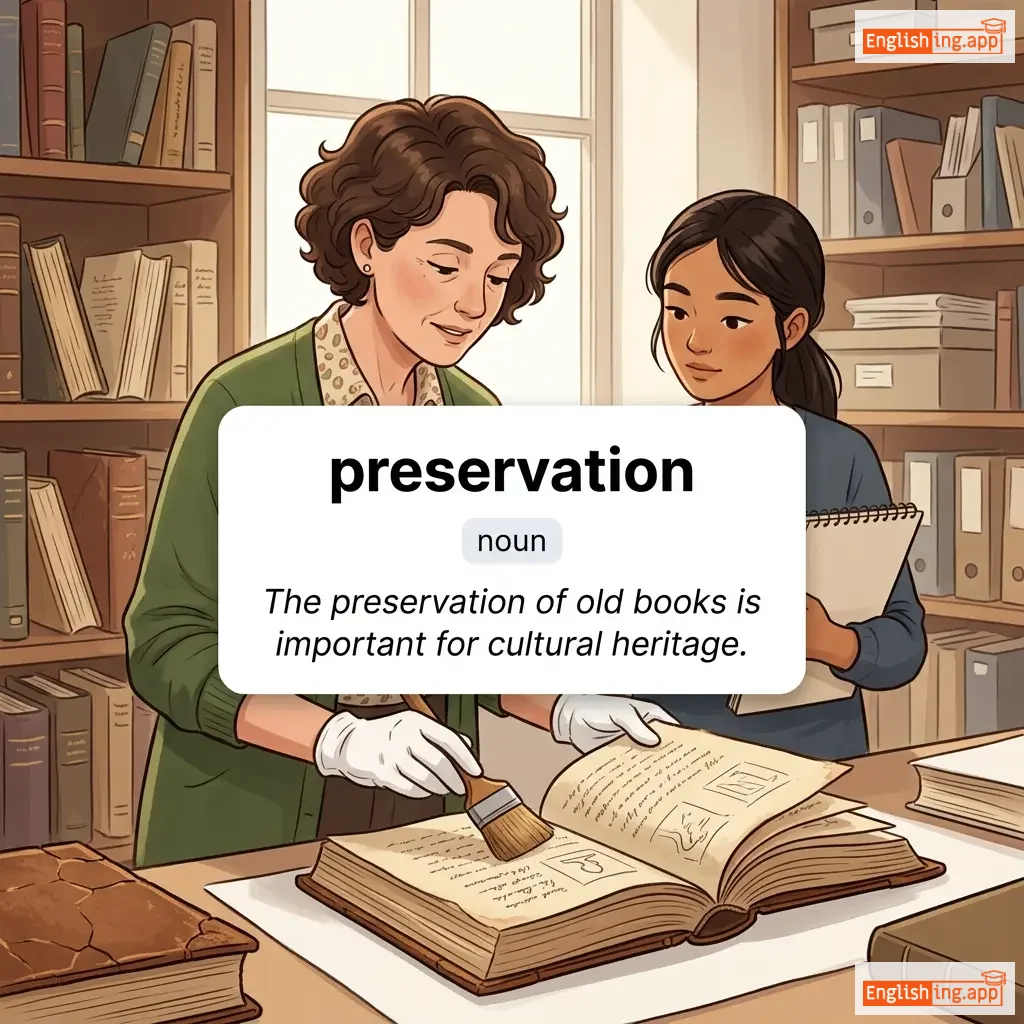
preservation definition card — visual illustration of the meaning
noun
/ˌprɛzəˈveɪʃən/
préservation (preservacion)

The act of keeping something in its original state or protecting it from harm or decay.

"The preservation of old books is important for cultural heritage."

"La préservation des vieux livres est importante pour le patrimoine culturel." (La préservation des vieux livres est importante pour le patrimoine culturel.)
adverb
/ˈprɛzntli/
actuellement (actuellement)

at the current moment; now

"Presently, I am working on a new project."

"Actuellement, je travaille sur un nouveau projet." (Actuellement, je travaille sur un nouveau projet.)
noun
/prɪˈzɛntmənt/
présentation formelle (presentation formelle)

The act of presenting something formally or officially; a formal statement or document.

"The lawyer made a presentment of the evidence to the court."

"L'avocat a fait une présentation des preuves devant le tribunal." (L'avocat a fait une presentation des preuves devant le tribunal.)