词汇表

英语词汇词典 | 单词含义、定义和示例

noun
/ɪˈleɪʃən/
极乐 (jile)

A feeling of great happiness and excitement.

"His elation was evident after winning the championship."

"赢得冠军后,他的极乐心情显而易见。" (Yíng dé guànjūn hòu, tā de jílè xīnqíng xiǎn'ér yìjiàn.)
noun/verb
/ˈɛl.boʊ/
肘部 (zhoubu)

The joint connecting the forearm and the upper arm; as a verb, to push aside using the elbow.

"He accidentally hit the table with his elbow."

"他不小心用肘部撞到了桌子。" (Ta bu xiaoxin yong zhoubu zhuangdao le zhuozi.)
noun
/ˈɛldər/
长者 (zhǎng zhě)

a person who is older or has higher rank; an older person in a family or community

"We should always respect our elders."

"我们应该永远尊敬我们的长辈。" (Wǒmen yīnggāi yǒngyuǎn zūnjìng wǒmen de zhǎngbèi.)
adjective
/ˈɛldərli/
老年 (laonian)

Being old or advanced in years.

"The elderly man walks slowly across the street."

"那位老年人慢慢地穿过街道。" (Na wei laonian ren man man de chuan guo jiedao.)
verb
/ɪˈlɛkt/
选举 (xuǎnjǔ)

To choose someone for a position or office by voting.

"The citizens elected a new president."

"公民选举了新总统。" (Gōngmín xuǎnjǔle xīn zǒngtǒng.)
noun
/ɪˈlɛkʃən/
选举 (xuanju)

The process of choosing someone for public office by voting.

"The election will be held next month."

"选举将在下个月举行。" (Xuanju jiang zai xiage yue juxing.)
adjective
/ɪˈlɛktərəl/
选举的 (xuǎnjǔ de)

related to elections or voting

"The electoral process in the country has been reformed in recent years."

"该国的选举程序在近年来进行了改革。" (Gāi guó de xuǎnjǔ chéngxù zài jìnnián lái jìnxíngle gǎigé.)
adjective
/ɪˈlɛktrɪk/
电的 (diàn de)

Relating to or operated by electricity.

"The room was lit by an electric lamp."

"房间里用电灯照明。" (Fángjiān lǐ yòng diàndēng zhàomíng.)
noun
/ɪˈlɛktrɪk drɪl/
电动钻孔机 (diàndòng zuànkǒng jī)

A power tool used for drilling holes in various materials

"He used an electric drill to make holes in the wall for hanging pictures."

"他用电动钻孔机在墙上打孔,用于挂画。" (Tā yòng diàndòng zuànkǒng jī zài qiáng shàng dǎ kǒng, yòng yú guà huà.)
noun
/ɪˈlek.trɪk fæn/
电风扇 (diàn fēng shàn)

a device with rotating blades that creates airflow to cool or ventilate a room

"The electric fan keeps the room cool during hot summer days."

"电风扇在炎热的夏天保持房间凉爽。" (diàn fēng shàn zài yánrè de xiàtiān bǎochí fángjiān liángshuǎng.)
noun
/ɪˈlɛktrɪk ˈkɛtəl/
电热水壶 (dian re shui hu)

An electrical appliance that heats water quickly using electricity

"The electric kettle automatically turns off when the water starts boiling."

"电热水壶在水开始沸腾时自动关闭。" (Dian re shui hu zai shui kaishi fei teng shi zidong guanbi.)
adjective
/ɪˈlɛktrɪkəl/
电的 (diàn de)

related to electricity or the use of electrical power

"The electrical system in the house needs repair."

"房子的电力系统需要修理。" (Fángzi de diànlì xìtǒng xūyào xiūlǐ.)
noun
/ɪˌlɛkˈtrɪsɪti/
电力 (dianli)

A form of energy resulting from the existence of charged particles.

"The storm caused a power cut and we had no electricity."

"风暴导致了停电,我们没有电力。" (Fengbao daozhi le tingdian, women meiyou dianli.)
verb
/ɪˈlɛktrɪfaɪ/
通电; 激动 (tong dian; jidong)

to charge with electricity; to excite or thrill intensely

"The speaker's speech electrified the audience."

"演讲者的演讲让观众感到兴奋。" (Yanjiang zhe de yanjian rang guanzhong gandao xingfen)
noun
/ɪˌlɛkˈtrɑː.lə.sɪs/
电解 (dianjie)

A chemical decomposition produced by passing an electric current through a liquid or solution.

"Electrolysis is used to separate hydrogen from water."
"电解被用于从水中分离氢气。" (Dianjie bei yongyu cong shui zhong fenli qingqi.)
electrolytes definition card — visual illustration of the meaning
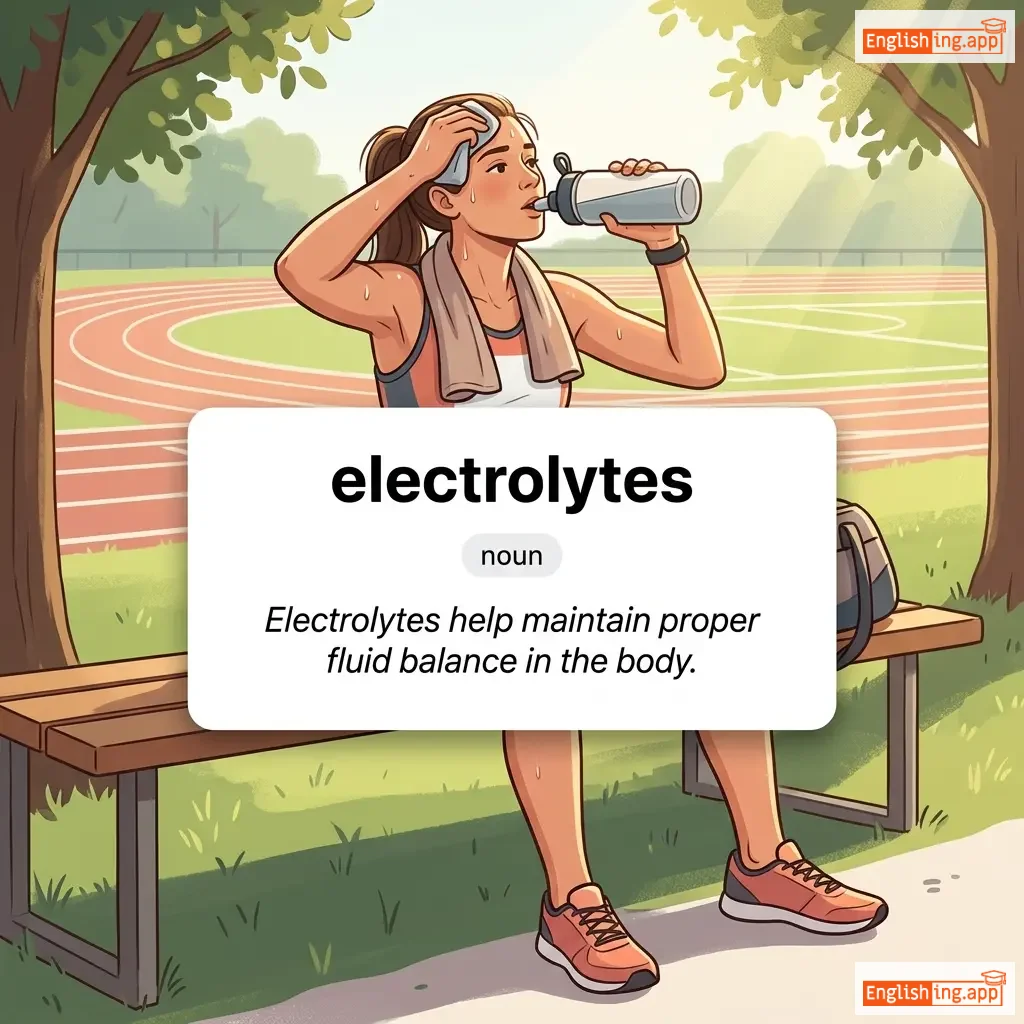
noun
/ɪˈlɛk.trəʊ.laɪts/
电解质 (dianjie zhi)

Minerals in body fluids that carry an electric charge and are essential for many bodily functions.

"Electrolytes help maintain proper fluid balance in the body."
"电解质有助于维持体内的液体平衡。" (Dianjie zhi youzhu yu weichi tinei de yiti pingheng.)
electromagnetic definition card — visual illustration of the meaning
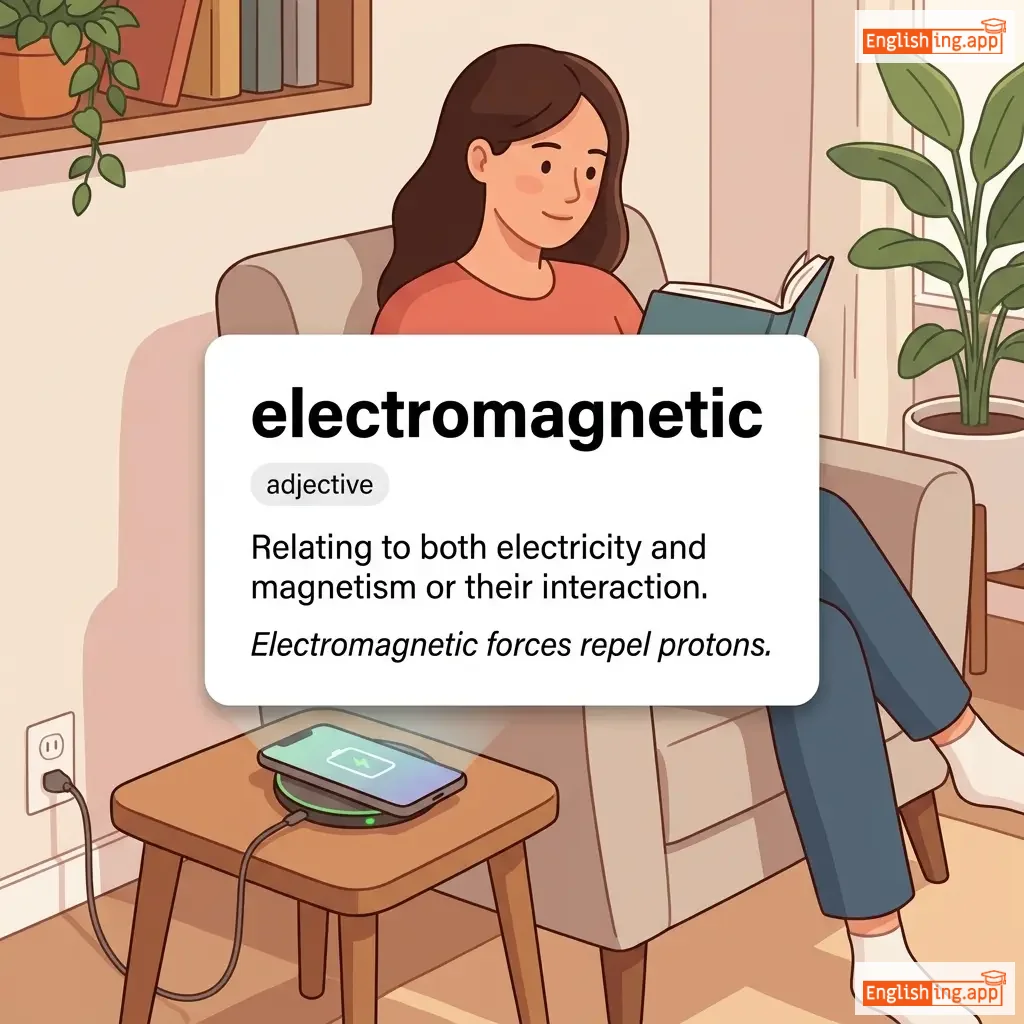
adjective
ɪˌlektrəʊmæɡˈnetɪk
电磁的 (diancide)

Relating to both electricity and magnetism or their interaction.

"Electromagnetic forces repel protons."

"电磁力排斥质子。" (Dianci li paichi zhizu.)
adjective
/ɪˌlɛkˈtrɒnɪk/
电子的 (dianzi de)

Operating with or produced by the use of electronic devices.

"She bought an electronic keyboard for her music lessons."

"她为她的音乐课买了一台电子键盘。" (Tā wèi tā de yīnyuè kè mǎile yī tái diànzǐ jiànpán.)
noun
/ɪˌlɛkˈtrɒnɪks/
电子学 (dianzi xue)

the branch of physics and technology dealing with circuits and devices using transistors, microchips, and other components

"He studied electronics at university."

"他在大学学习电子学。" (Ta zai daxue xuexi dianzi xue.)
noun
/ɪˈlɛk.trə.taɪp/
电铸版 (dian zhu ban)

A duplicate printing plate made by electroplating a mold of the original.

"The printer used an electrotype to produce multiple copies of the page."

"打印机使用了电铸版来制作页面的多个副本。" (Dayinji shiyong le dian zhu ban lai zhizu yemian de duoshao fuben.)
adjective
/ˌɛl.ɪˈmɑː.səˌnɛr.i/
慈善的 (cishande)

Relating to charity; dependent on or supported by charity.

"The hospital was founded as an eleemosynary institution."

"医院作为一个慈善机构成立。" (Yiyuan zuowei yige cishan jigou chengli.)
adjective
/ˈɛlɪɡənt/
优雅且精致 (yōuyǎ qiě jīngzhì)

pleasingly graceful and stylish in appearance or manner

"She looked elegant in her evening gown."

"她在晚礼服中看起来优雅。" (Tā zài wǎn lǐfú zhōng kàn qǐlái yōuyǎ.)
adjective
/ˌɛl.ɪˈdʒaɪ.ək/
哀歌的 (aige de)

Expressing sorrow, often for something past; resembling an elegy.

"The novel ends on an elegiac note, mourning the lost era."

"这本小说以哀歌的语气结束,哀悼失落的时代。" (Zhè běn xiǎoshuō yǐ āigē de yǔqì jiéshù, āidào shīluò de shídài.)
elegy definition card — visual illustration of the meaning
noun
/ˈɛlɪdʒi/
挽歌 (wǎn gē)

A poem or song expressing sorrow, especially for someone who has died.

"The poet wrote an elegy for his late friend."

"诗人为他已故的朋友写了一首挽歌。" (Shīrén wèi tā yǐ gù de péngyǒu xiěle yī shǒu wǎn gē.)
noun
/ˈɛlɪmənt/
元素 (yuánsù)

A basic or essential part of something; a simple substance that cannot be broken down further.

"Trust is a key element of any strong relationship."

"信任是任何强大关系的关键元素。" (Xìnrèn shì rènhé qiángdà guānxì de guānjiàn yuánsù.)
adjective
/ˌɛlɪˈmɛntəri/
基础的 (jīchǔ de)

Relating to the basic or fundamental aspects of something; simple or easy to understand.

"She gave an elementary explanation of the problem."

"她给出了一个问题的基础性解释。" (Tā gěichūle yīgè wèntí de jīchǔ xìng jiěshì.)
noun
/ˈɛlɪfənt/
幸福 (xìngfú)

a very large animal with a trunk, long curved tusks, and thick gray skin, found in Africa and Asia

"The elephant sprayed water over itself with its trunk."

"当她收到奖项时,她无法隐藏自己的幸福。" (Dāng tā shōudào jiǎngxiàng shí, tā wúfǎ yǐncáng zìjǐ de xìngfú.)
noun
/ˈel.ɪ.fənt ˈæp.əl/
大象苹果 (dà xiàng píng guǒ)

a tropical fruit with a hard shell and acidic flesh

"Elephant apple is used to make delicious jams and pickles."

"大象苹果被用来制作美味的果酱和腌菜。" (Dà xiàng píng guǒ bèi yòng lái zhìzuò měiwèi de guǒjiàng hé yān cài.)
adjective
/ˌɛlɪˈfæntaɪn/
像大象一样的 (xiàng dà xiàng yīyàng de)

Huge, clumsy, or resembling an elephant in size or movement.

"The man moved with an elephantine grace."

"那个人以大象般的优雅走动。" (Nàgè rén yǐ dàxiàng bān de yōuyǎ zǒudòng.)
elevate definition card — visual illustration of the meaning
verb
/ˈɛlɪveɪt/
提升 (tisheng)

To raise or lift something to a higher position; to improve in status, mood, or quality.

"Good music can elevate your mood instantly."

"好音乐可以瞬间提升你的情绪。" (Hao yinyue keyi shunjian tisheng nide qingxu.)
noun
/ˌɛlɪˈveɪʃən/
海拔 (haiba)

The act of raising something to a higher position or level.

"The hikers reached a high elevation after hours of climbing."

"登山者经过数小时的攀登后达到了较高的海拔。" (Deng shanzhe jinguo shu xiaoshi de pandeng hou daduole jiao gao de haiba.)
noun
/ˈɛləˌveɪtər/
电梯 (dianti)

a machine that carries people or goods up and down between floors in a building

"We took the elevator to the tenth floor."

"我们乘坐电梯到达了第十层。" (Wǒmen chéngzuò diàntī dàodále dì shí céng.)
1️⃣1️⃣

eleven (eleven)

number
/ɪˈlɛvən/
十一 (shiyi)

the number after ten and before twelve; 11

"There are eleven students in the classroom."
"教室里有十一名学生。" (Jiaoshiru you shiyi ming xuesheng.)
elicit definition card — visual illustration of the meaning
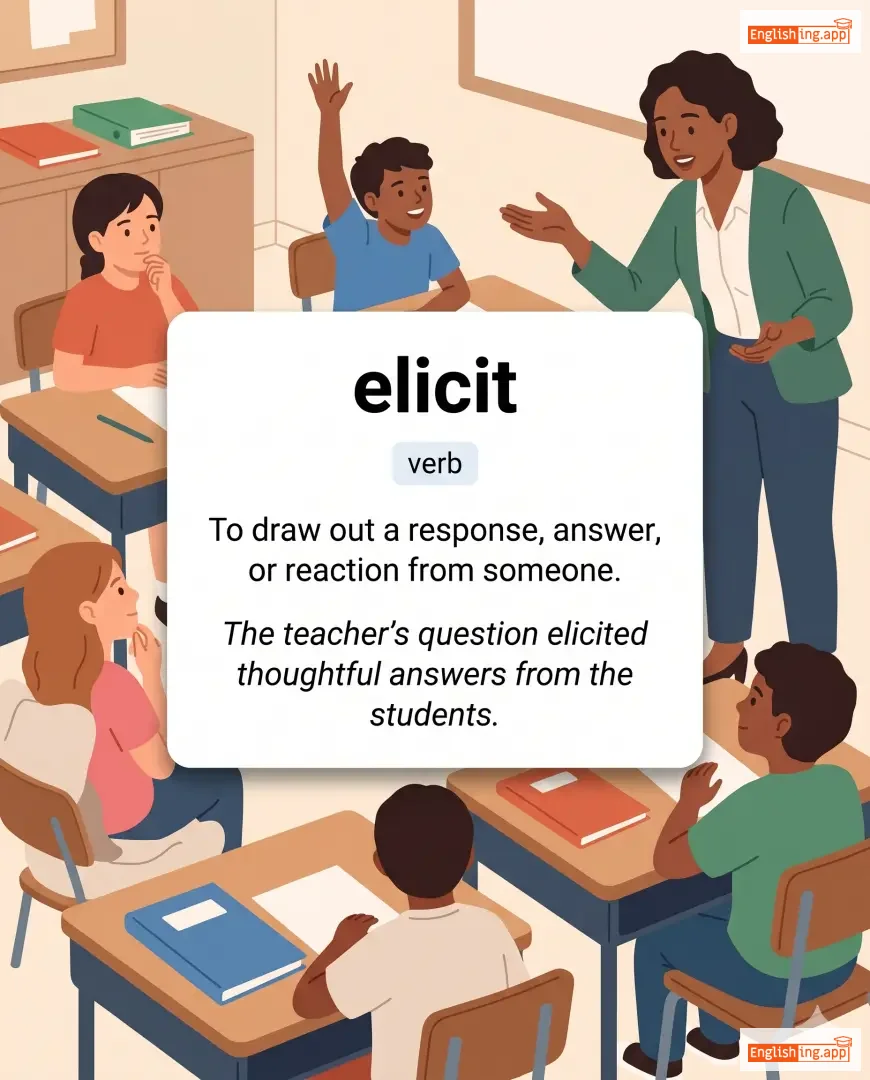
verb
/ɪˈlɪsɪt/
引出 (yǐn chū)

To draw out a response, answer, or reaction from someone.

"The teacher’s question elicited thoughtful answers from the students."

"老師的問題引發了學生的深思熟慮的回答。" (Lǎoshī de wèntí yǐn fāle xuéshēng men de shēnsī shúlüè de huídá.)
eligibility definition card — visual illustration of the meaning
noun
/ˌel.ɪ.dʒəˈbɪl.ə.ti/
资格 (ziga)

the state of having the right to do or obtain something

"Students must meet certain requirements to maintain their eligibility for the scholarship."
"学生必须满足特定要求,以保持他们的奖学金资格。" (Xuéshēng bìxū mǎnzú tèdìng yāoqiú, yǐ bǎochí tāmen de jiǎngxuéjīn zīgé.)
eligible definition card — visual illustration of the meaning
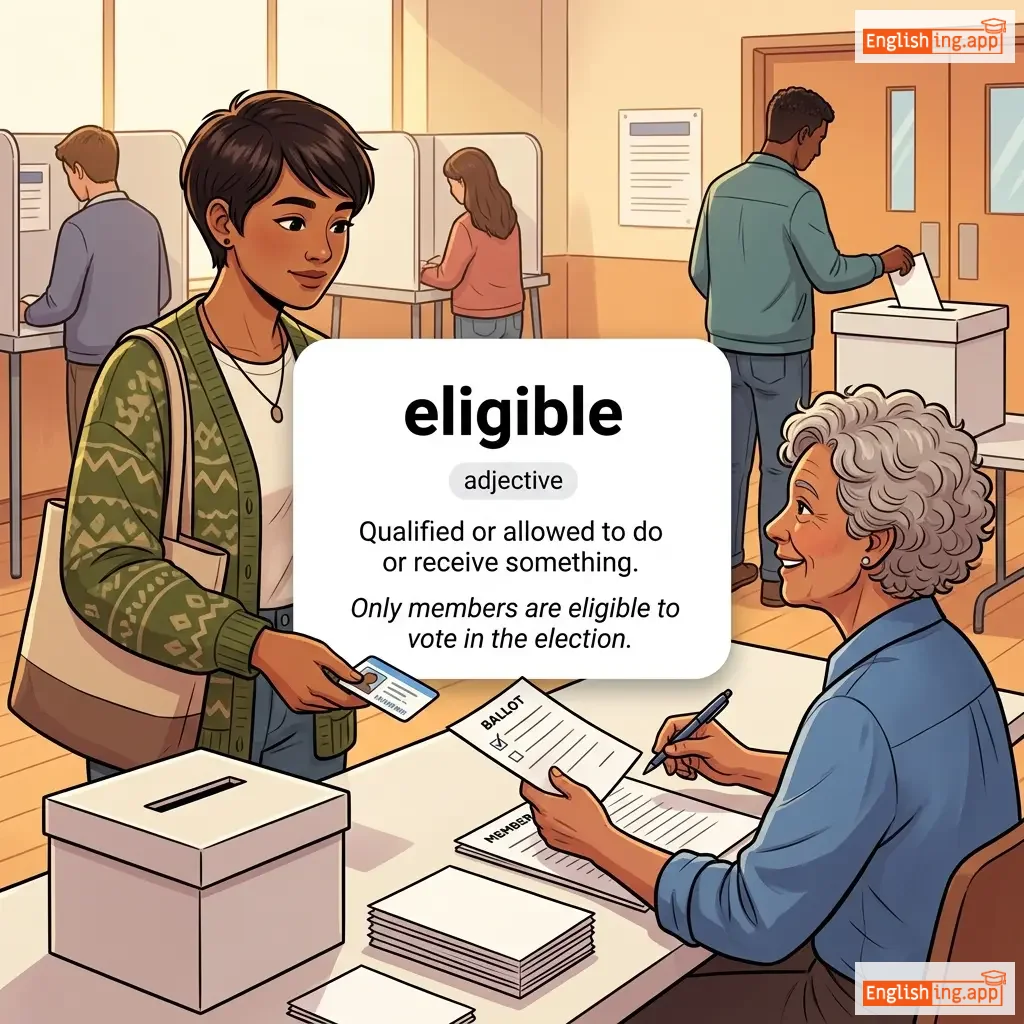
adjective
/ˈɛlɪdʒəbl/
合格的 (hege de)

Qualified or allowed to do or receive something.

"Only members are eligible to vote in the election."

"只有会员才能在选举中投票。" (Zhiyou huiyuan cai neng zai xuanju zhong tou piao.)
eliminate definition card — visual illustration of the meaning
verb
/ɪˈlɪməˌneɪt/
消除 (xiaochu)

To completely remove or get rid of something.

"The new policy aims to eliminate corruption in the system."
"新政策旨在消除系统中的腐败。" (xin zhengce zhi zai xiaochu xitong zhong de fubai.)
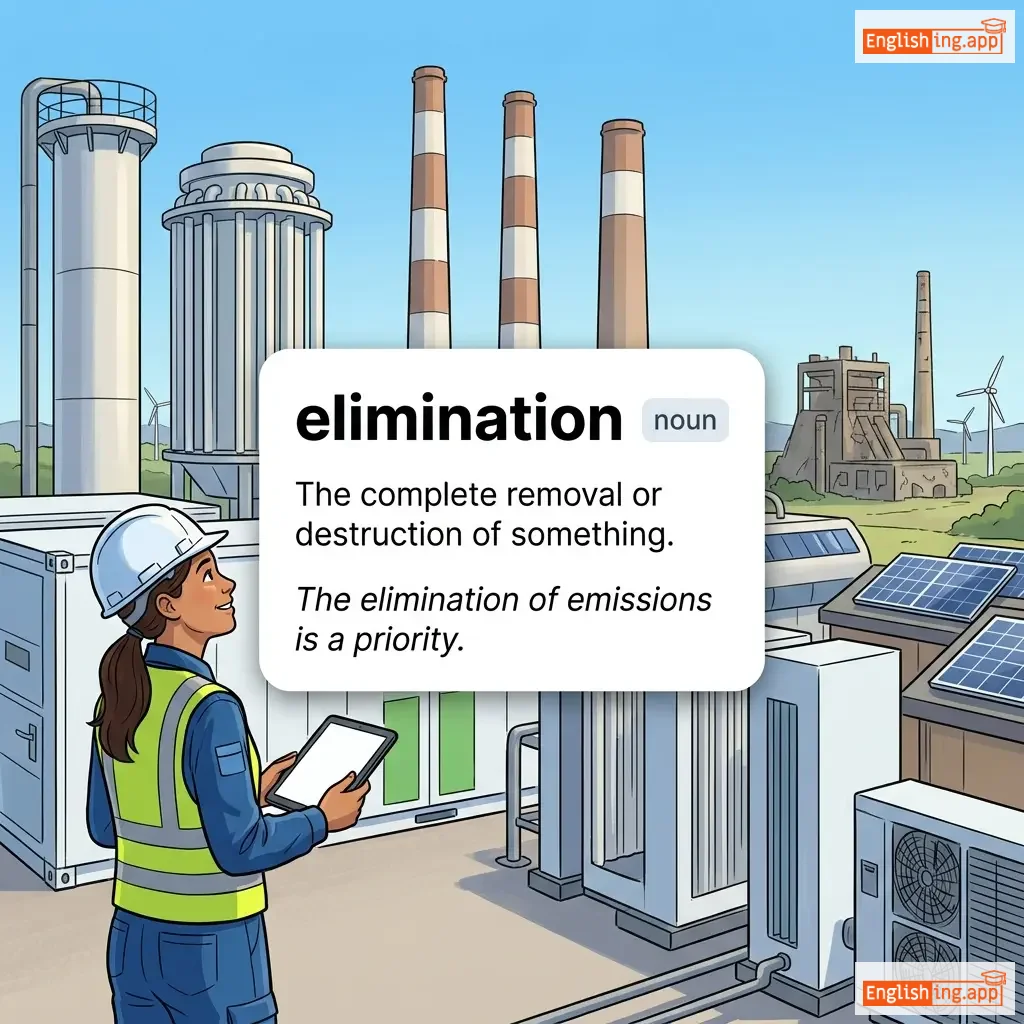
elimination definition card — visual illustration of the meaning
noun
ɪˌlɪm.ɪˈneɪ.ʃən
消除 (xiaochu)

The complete removal or destruction of something.

"The elimination of emissions is a priority."

"排放的消除是优先事项。" (Paifang de xiaochu shi youxian shixiang.)
noun
/ɪˈliːt/ or /eɪˈliːt/
精英 (jing ying)

A select group that is superior in terms of ability or qualities.

"Only the elite were invited to the exclusive event."

"只有精英才被邀请参加独家活动。" (Zhi you jing ying cai bei yaoqing canjia dujia huodong.)
noun/adjective
/ɪˈliːtɪst/
精英主义者 (jingying zhuyi zhe)

A person who believes that a society should be led by an elite; showing preference for a privileged class.

"His elitist attitude made him unpopular among his peers."
"他的精英主义态度使他在同事中不受欢迎。" (Tā de jīngyīng zhǔyì tàidù shǐ tā zài tóngshì zhōng bù shòu huānyíng.)
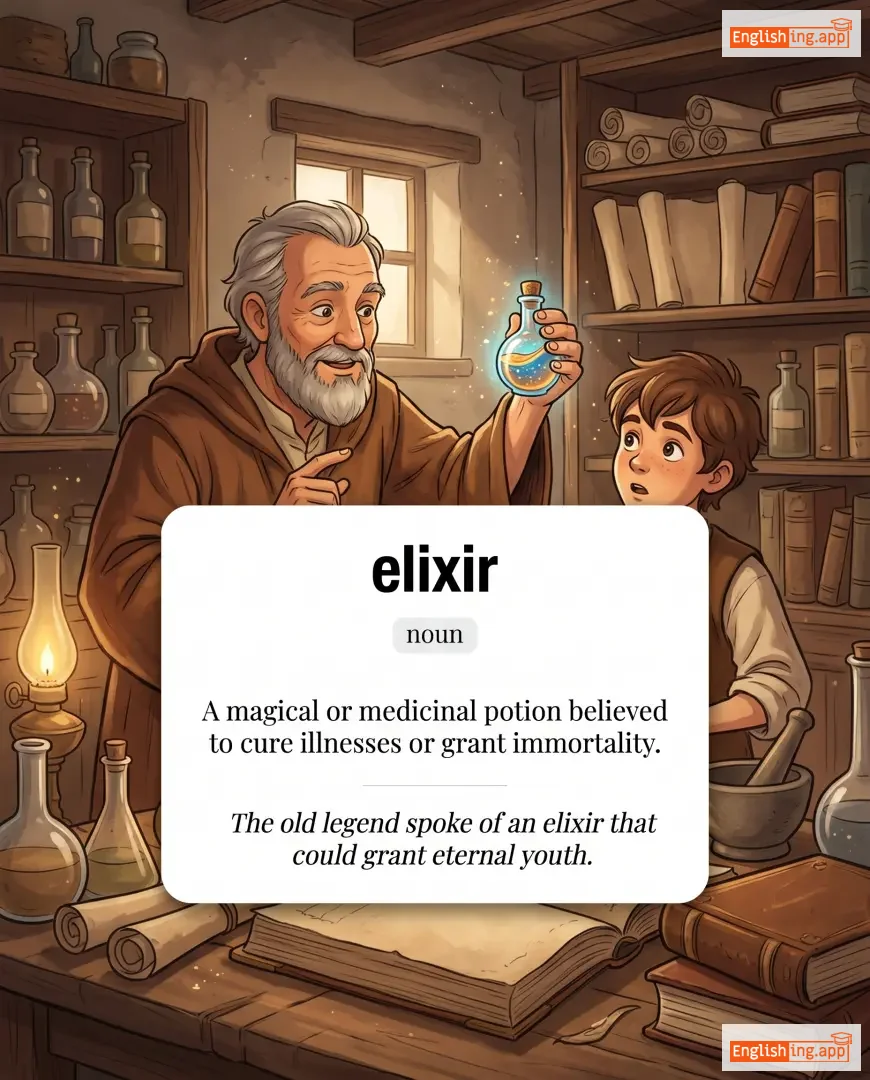
elixir definition card — visual illustration of the meaning
noun
/ɪˈlɪksər/
灵药 (líng yào)

A magical or medicinal potion believed to cure illnesses or grant immortality.

"The old legend spoke of an elixir that could grant eternal youth."

"古老的传说中提到了一个可以赋予永恒青春的灵药。" (Gǔlǎo de chuánshuō zhōng tí dào le yīgè kěyǐ fùyǔ yǒnghéng qīngchūn de líng yào.)
adjective
/ɪˌlɪzəˈbiːθən/
伊丽莎白时代 (Yīlìshābái shídài)

Relating to the reign of Queen Elizabeth I of England (1558–1603), especially the style of that period.

"Shakespeare wrote many of his plays during the Elizabethan era."

"莎士比亚在伊丽莎白时代写了许多剧作。" (Shāshìbǐyà zài Yīlìshābái shídài xiěle xǔduō jùzuò.)
noun
/ɪˈlɪpsɪs/
省略号 (shenglüè hào)

The omission of words in a sentence, represented by three dots (...).

"The writer used an ellipsis to show that part of the quote was omitted."

"作者使用省略号来表示引用的部分被省略。" (Zuòzhě shǐyòng shěnglüè hào lái biǎoshì yǐnyòng de bùfen bèi shěnglüè.)
adjective
/ɪˈlɪptɪkl/
椭圆形的 (tuo yuan xing de)

Having the shape of an ellipse; also, a style of speech that is concise and sometimes obscure.

"The planet follows an elliptical orbit around the sun."

"行星沿着椭圆形的轨道围绕太阳运行。" (Xingxing yanzhe tuo yuan xing de guidao weirao taiyang yunxing.)
noun
/ˌɛləˈkjuːʃn/
口才 (kǒucái)

The skill of clear and expressive speech, especially in public speaking.

"She improved her elocution through constant practice."

"她通过不断练习提高了她的口才。" (Tā tōngguò bùduàn liànxí tígāo le tā de kǒucái.)
verb
/ɪˈloʊp/
偷偷结婚 (tōutōu jiéhūn)

to run away secretly in order to get married, especially without parental consent

"The young couple decided to elope to another city."
"这对年轻情侣决定逃到另一个城市结婚。" (Zhè duì niánqīng qínglǚ juédìng táo dào lìng yīgè chéngshì jiéhūn.)
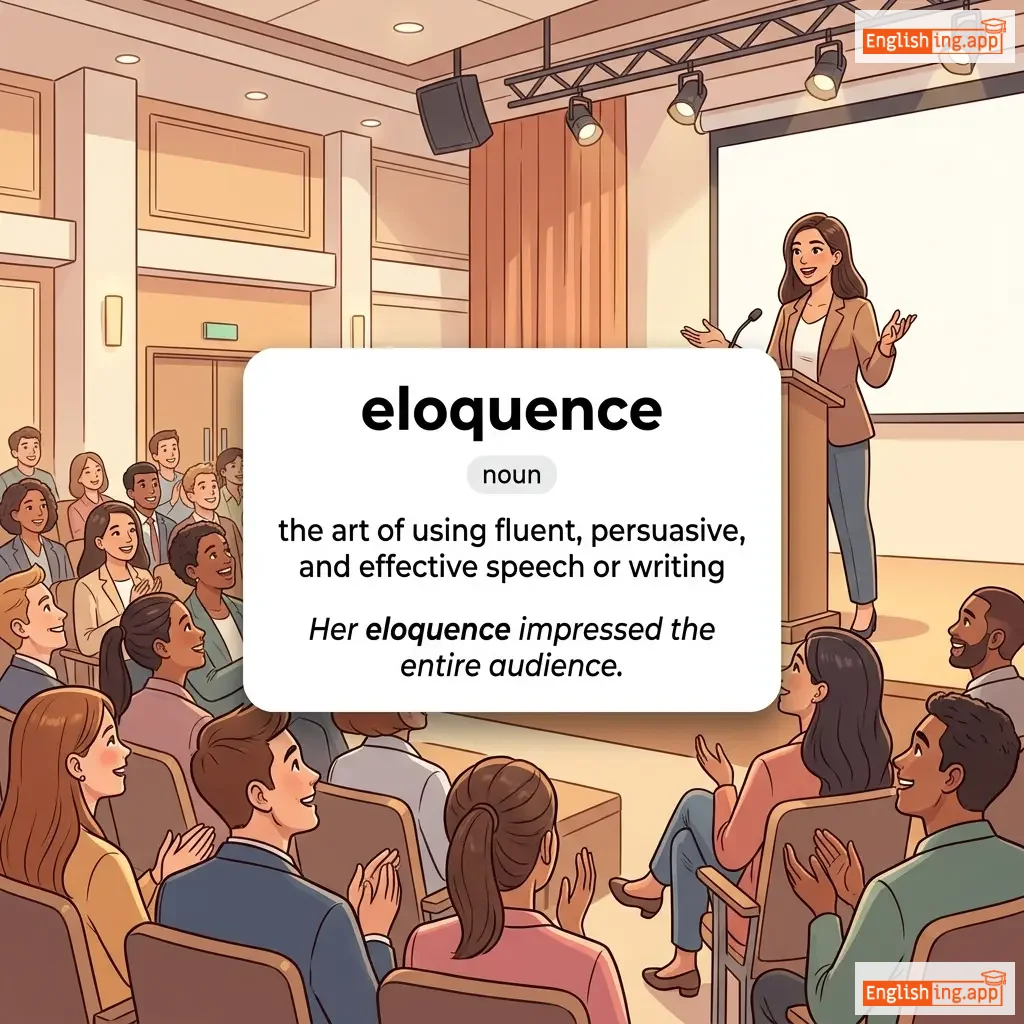
eloquence definition card — visual illustration of the meaning
noun
/ˈɛləkwəns/
雄辩 (xióngbiàn)

the art of using fluent, persuasive, and effective speech or writing

"Her eloquence impressed the entire audience."
"她的雄辩给整个观众留下了深刻印象。" (tā de xióngbiàn gěi zhěnggè guānzhòng liúxiàle shēnkè yìnxiàng.)
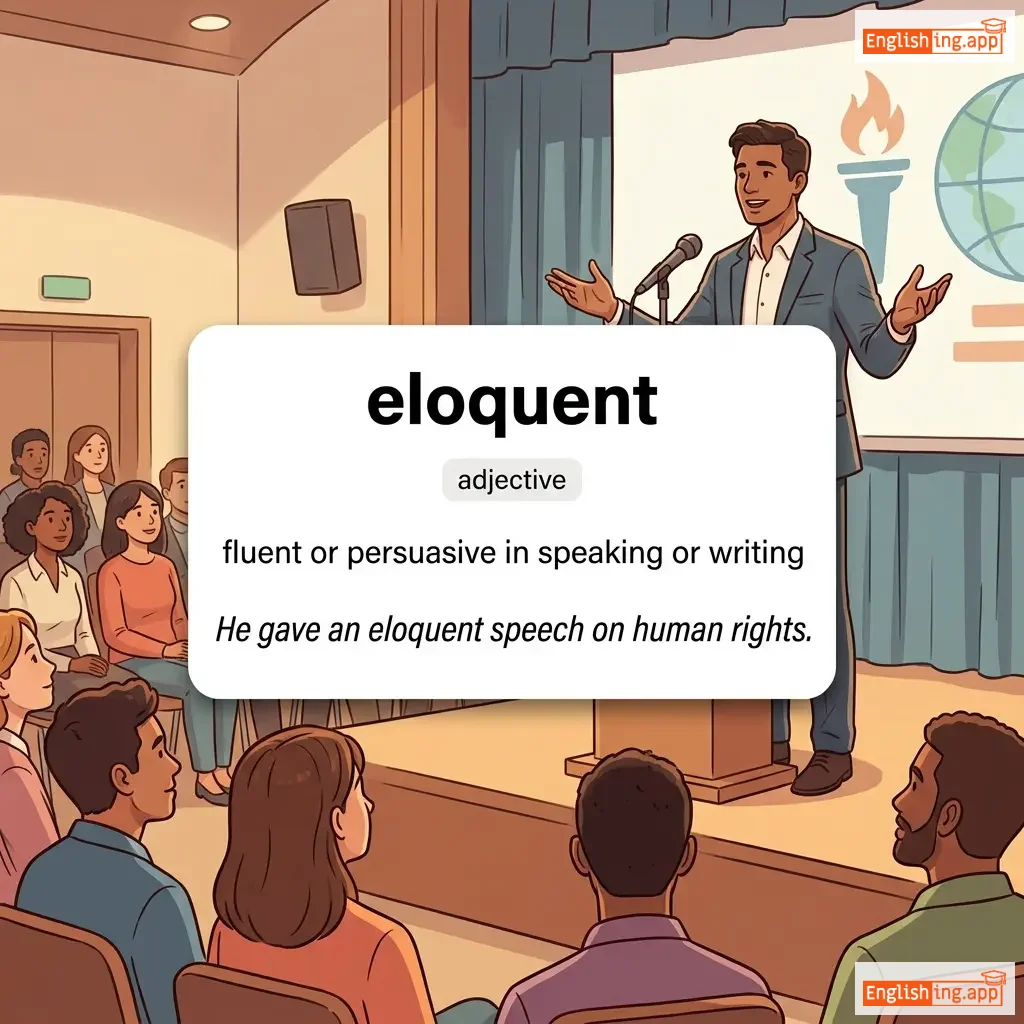
eloquent definition card — visual illustration of the meaning
adjective
/ˈɛləkwənt/
雄辩的 (xióngbiàn de)

fluent or persuasive in speaking or writing

"He gave an eloquent speech on human rights."

"他就人权问题发表了一篇雄辩的演讲。" (tā jiù rénquán wèntí fābiǎo le yī piān xióngbiàn de yǎnjiǎng)
adverb
/ɛls/
还有别的吗 (hái yǒu bié de ma)

In addition; besides.

"Is there anything else you need?"

"你还需要其他的吗?" (Nǐ hái xūyào qítā de ma?)
adverb
/ˈɛlswɛr/
在别的地方 (zài bié de dìfāng)

In, at, or to some other place.

"If you can’t find it here, try looking elsewhere."

"如果你在这里找不到,试着去别的地方找找。" (Rúguǒ nǐ zài zhèlǐ zhǎo bù dào, shìzhe qù bié de dìfāng zhǎo zhǎo.)