Словари

Словарь английского языка | Значения слов, определения и примеры

noun
/ˈsʌb.mə.riːn/
подводная лодка (podvodnaya lodka)

a warship with a streamlined hull designed to operate completely submerged in the sea

"The submarine dived deep into the ocean to avoid detection."

"Субмарина нырнула глубоко в океан, чтобы избежать обнаружения." (Submarina nyrnula gluboko v okean, chtoby izbezhat' obnaruzheniya.)
adverb
/ˌsʌb ˈroʊzə/
в секрете (v sekrete)

secretly, in confidence, or in private

"The deal was made sub rosa to avoid public scrutiny."

"Сделка была заключена суб роза, чтобы избежать публичного контроля." (Sdelka byla zaklyuchena sub rosa, chtoby izbezhat' publichnogo kontrolya.)
adjective
/ˈsʌb.æs.ɪd/
слегка кислый (slegka kisly)

Slightly sour or acidic in taste or nature.

"The fruit had a subacid flavor that was refreshing on a hot day."

"Фрукт имел слегка кислый вкус, который был освежающим в жаркий день." (Frukt imel slegka kislyy vkus, kotoryy byl osvezhayushchim v zharkiy den.)
noun
/sʌbˈɔːl.tən/
человек, занимающий подчинённое положение; в армии, младший офицер (subaltern)

A person holding a subordinate position; in the military, a junior officer.

"The subaltern was responsible for leading a small platoon of soldiers."

"Сабальтерн был ответственен за руководство небольшим отрядом солдат." (Sabaltern byl otvetstvenen za rukovodstvo nebol'shim otryadom soldat.)
adjective
/ˌsʌb.əˈkwɒt.ɪk/
подводный (podvodny)

Existing, living, or located under water.

"Divers explored the subaquatic cave system filled with rare fish."

"Дайверы исследовали подводную пещерную систему, заполненную редкими рыбами." (Dajvery issledovali podvodnuyu peshchernuyu sistemy, zapolnennuyu redkimi rybami.)
subconscious definition card — visual illustration of the meaning
adjective, noun
/ˌsʌbˈkɒn.ʃəs/
подсознание (podsoznanie)

Relating to the part of the mind that influences thoughts and actions without full awareness.

"Her fear of dogs was rooted in her subconscious."
"Ее страх перед собаками был укоренен в ее подсознании." (Eyo strakh pered sobakami byl ukorenen v eyo podsoznanii.)
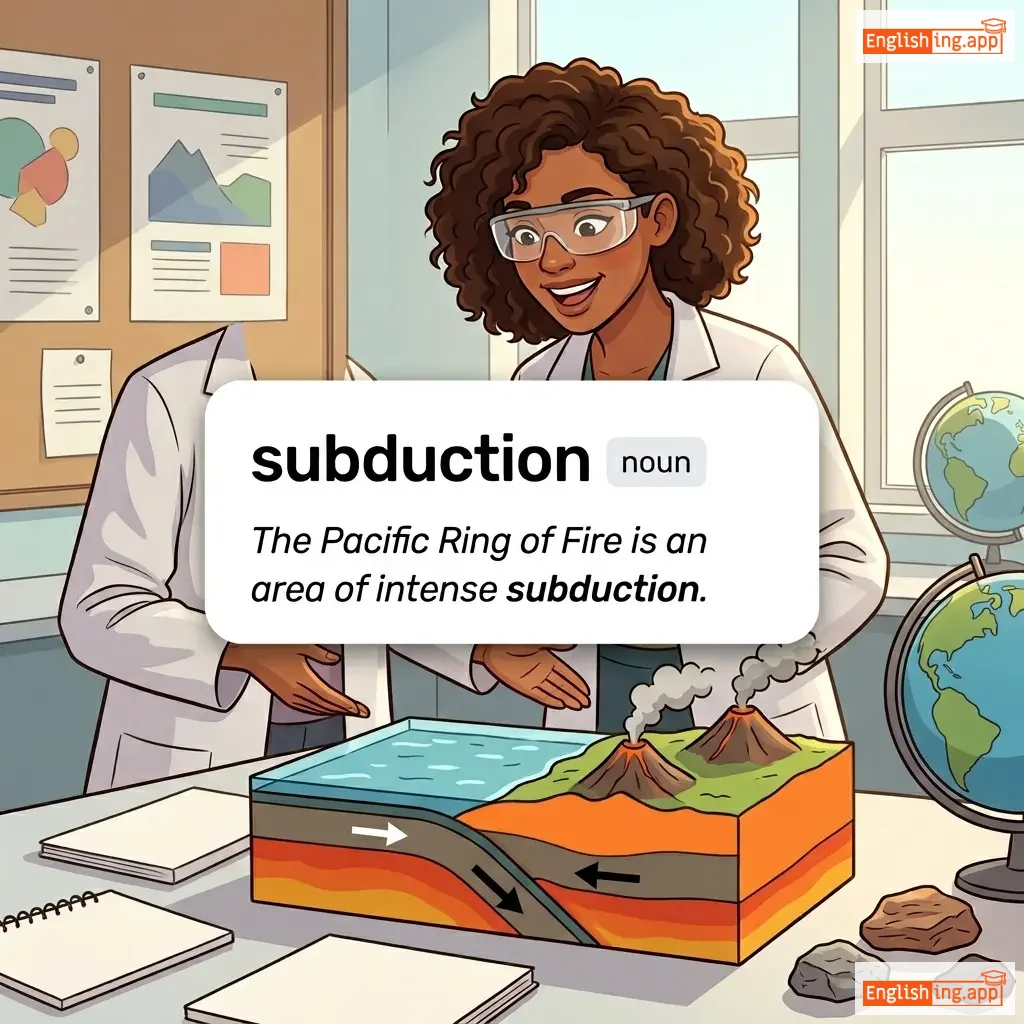
subduction definition card — visual illustration of the meaning
noun
/səbˈdʌk.ʃən/
Боковое и вниз движение слоя земной коры в мантии под другим слоем. (Bokovoye i vnyz dvizhēniye sloya zemnoy kory v mantii pod drugim sloem.)

The lateral and downward movement of the edge of a plate of the earth's crust into the mantle beneath another plate.

"The Pacific Ring of Fire is an area of intense subduction."

"Тихоокеанское кольцо огня - это зона интенсивной субдукции." (Tikhookeanskoye kol'tso ognya - eto zona intensivnoy subduktsii.)
⚔️

subdue

verb
/səbˈdjuː/

To bring under control, especially by force; to overcome or quiet.

"The army was able to subdue the rebellion quickly."

adjective
/sʌbˈdʒeɪsənt/
подлежащий (podlezhaschij)

lying immediately beneath; underlying

"The geological survey revealed subjacent layers of rock."

"Геологическое исследование выявило подлежащие слои горных пород." (Geologicheskoe issledovanie vyyavilo podlezhaschie sloi gornykh porod.)
noun/verb/adjective
/ˈsʌbdʒɪkt/ (noun), /səbˈdʒɛkt/ (verb)
предмет (predmet)

noun: a topic or theme; verb: to cause to undergo; adjective: dependent or under authority

"The teacher introduced a new subject in class."

"Учитель ввел новый предмет в классе." (Uchitel' vvedel novyy predmet v klasse.)
noun
/səbˈdʒɛkʃən/
порабощение (poraboschhenie)

the act of bringing someone or something under control or domination

"The people suffered under the subjection of a cruel ruler."

"Люди страдали под владычеством жестокого правителя." (Lyudi stradali pod vladychestvom zhestokogo pravitelya.)
adjective
/səbˈdʒɛktɪv/
субъективный (sub'yektivnyy)

based on personal feelings, tastes, or opinions rather than facts

"Beauty is often considered a subjective concept."

"Красоту часто считают субъективным понятием." (Krasotu chasto schitayut sub'yektivnym ponyatiem.)
adjective
/ˈstjuːdiəs/
усердный ученик (userdnyy uchenik)

spending a lot of time studying or reading; very dedicated to learning

"She is a studious girl who spends hours in the library."

"Она усердная ученица, которая проводит часы в библиотеке." (Ona userdnaya uchenitsa, kotoraya provodit chasy v biblioteke.)
Soon definition card — visual illustration of the meaning
adverb
/suːn/
скоро (skoro)

in a short time; shortly

"I will be home soon."

"Я буду дома скоро." (Ya budu doma skoro.)
adjective
/səˈnɔːrəs/
глубокий звук (glubokiy zvuk)

Deep, full, and rich in sound.

"The actor's sonorous voice filled the entire theater."

"Сонорный голос актера наполнил весь театр." (Sonornyy golos aktera napolnil ves' teatr.)
noun
/ˈsɒnɪt/
сонет (sonet)

A poem of 14 lines using formal rhyme schemes, often about love.

"Shakespeare wrote many famous sonnets about love and beauty."

"Шекспир написал много известных сонетов о любви и красоте." (Shekspir napisal mnogo izvestnykh sonetov o lyubvi i krasote.)
adjective
/ˈsɒnɪk/
звуковой (zvukovoy)

Relating to or involving sound waves or speed of sound.

"The jet created a loud boom when it broke the sonic barrier."
"Самолет создал громкий звук, когда он преодолел звуковой барьер." (Samolyot sozdaval gromkiy zvuk, kogda on preodolel zvukovoy bar'er.)
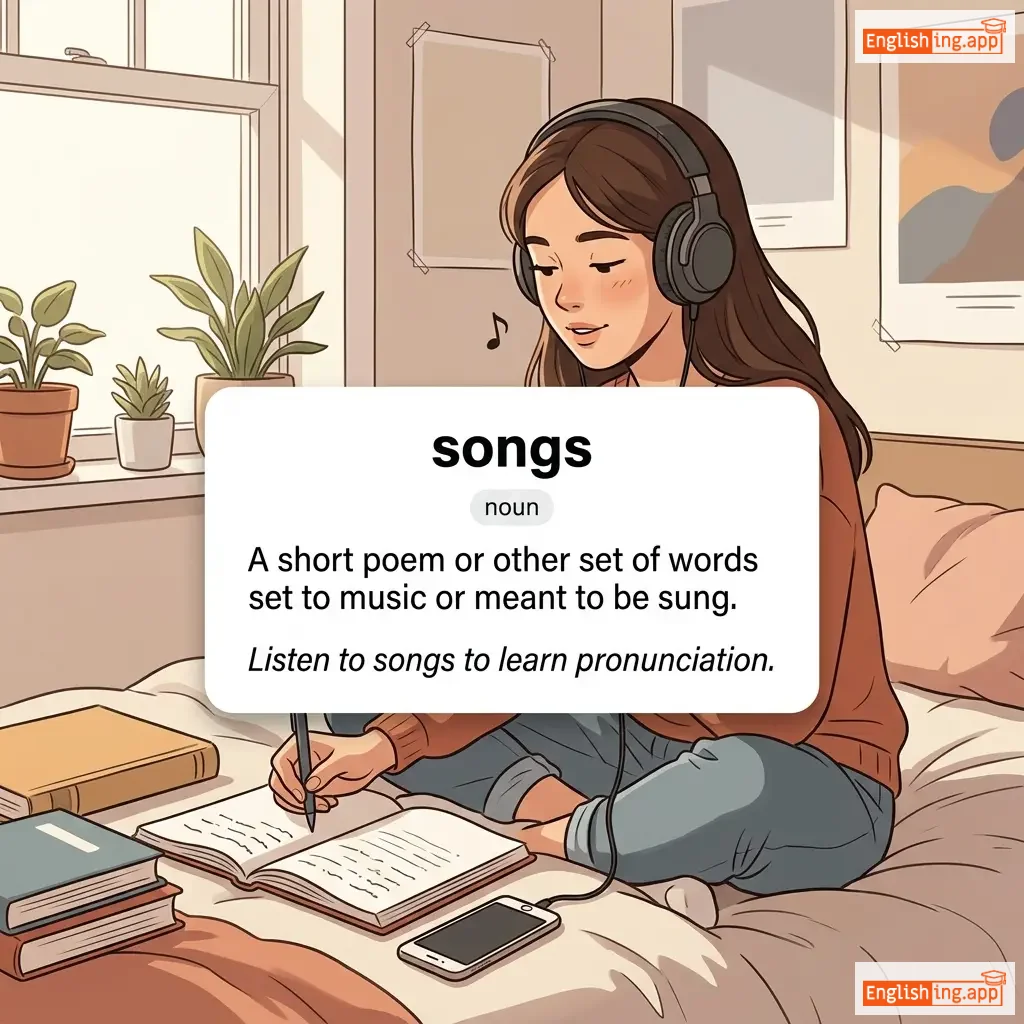
songs definition card — visual illustration of the meaning
noun
sɔːŋz
песни (pesni)

A short poem or other set of words set to music or meant to be sung.

"Listen to songs to learn pronunciation."

"Слушайте песни, чтобы учить произношение." (Slushayte pesni, chtoby uchit' proyiznashenie.)
song definition card — visual illustration of the meaning
noun
/sɔːŋ/
песня (pesnya)

a short piece of music with words that are sung

"She sang a beautiful song at the concert."

"Она спела красивую песню на концерте." (Ona spela krasivuyu pesnyu na koncerte.)
noun
/səˈnɑːtə/
музыкальная композиция (соната) (muzykal'naya kompozitsiya (sonata))

A musical composition for one or more instruments, typically in several movements.

"She performed a beautiful Beethoven sonata on the piano."

"Она исполнила прекрасную сонату Бетховена на пианино." (Ona ispolnila prekrasnuyu sonatu Betkhovena na pianino.)
noun
/sʌn/
сын (syn)

a male child of a parent

"His son is very talented in music."

"Его сын очень талантлив в музыке." (Ego syn ochen' talantliv v musike.)
adjective
/ˈsɒmnələnt/
сонный (sonny)

Sleepy or drowsy; causing a desire to sleep.

"The somnolent lecture made half the class fall asleep."

"Сомнолентная лекция заставила половину класса заснуть." (Somnolentnaya lektsiya zastavila polovinu klassa zasnut'.)
somnolence definition card — visual illustration of the meaning
noun
/ˈsɒmnələns/
сонливость (sonlivost)

A strong desire for sleep or drowsiness.

"After the heavy meal, he felt a wave of somnolence."

"После тяжелой пищи он почувствовал волну сонливости." (Posle tyazheloy pishchi on pochuvstvoval volnu sonlivosti.)
adjective
/sɒmˈnɪfərəs/
снотворный (snotvornyy)

Tending to induce sleep; soporific.

"The professor's somniferous lecture put half the class to sleep."

"Сомниферная лекция профессора усыпила половину класса." (Somnifernaya lektsiya professora usypila polovinu klassa.)
noun
/sɒmˈnæmbjʊlɪst/
сомнамбулист (somnambulist)

A person who sleepwalks.

"The somnambulist wandered out of the house at night."

"Сомнамбулист ночью вышел из дома." (Somnambulist noch'yu vyshel iz doma.)
adverb
/ˈsʌmˌwɛr/
где-то (gde-to)

in, at, or to a place that is not known or specified

"Somewhere in the city, there is a hidden café."

"Где-то в городе есть скрытое кафе." (Gde-to v gorode yest' skrytoe kafe.)
adverb
/ˈsʌmˌwʌt/
немного (nemnogo)

to a small degree or extent

"The new policy is somewhat better than the previous one."

"Новая политика немного лучше предыдущей." (Novaya politika nemnogo luchshe predydushchey.)
adverb
/ˈsʌmˌtaɪmz/
иногда (inogda)

at certain times, but not always

"Sometimes I wonder what life would have been like if I had made different choices."

"Иногда я задумываюсь, как бы сложилась жизнь, если бы я принял другие решения." (Inogda ya zadumyvayus', kak by slozhilas' zhizn', esli by ya prinjal drugie resheniya.)
adverb
/ˈsʌm.taɪm/
когда-нибудь (kogda-nibud)

at a time that is not known or stated; occasionally

"Let's meet for coffee sometime next week."

"Давай встретимся за кофе когда-нибудь на следующей неделе." (Davaj vstretimsya za kofe kogda-nibud na sleduyushchey nedele.)
pronoun
/ˈsʌmθɪŋ/
что-то (chto-to)

an unspecified or unknown thing

"I think something is wrong with my phone."

"Я думаю, что с моим телефоном что-то не так." (Ya dumayu, chto s moim telefonov chto-to ne tak.)
pronoun
/ˈsʌmwʌn/
кто-то (kto-to)

a person, but not specifically known or named

"Someone left their umbrella in the hallway."

"Кто-то оставил свой зонтик в коридоре." (Kto-to ostavil svoy zontik v koridore.)
adverb
/ˈsʌmˌhaʊ/
как-то (kak-to)

in some way, but not exactly known or specified

"Somehow, they managed to finish the project on time."

"Как-то они успели закончить проект вовремя." (Kak-to oni uspeli zakonchit' proyekt vovremya.)
adverb
/ˈsʌm.deɪ/
когда-нибудь (kogda-nibud)

at some time in the future

"Someday, I want to travel the world."

"Когда-нибудь я хочу путешествовать по миру." (Kogda-nibud ya khochu puteshestvovat' po miru.)
pronoun
/ˈsʌmbədi/
кто-то (kto-to)

an unspecified person

"Somebody is knocking at the door."

"Кто-то стучит в дверь." (Kto-to stuchit v dver'.)
adjective
/ˈsoʊloʊ/
соло (solo)

performed by one person alone; a single performance

"She decided to perform a solo dance at the talent show."

"Она решила выступить с сольным танцем на шоу талантов." (Ona reshila vystupit' s sol'nym tantsem na shou talantov.)
verb
/səˈlɪsɪt/
просить (prosit)

to ask for or try to obtain something from someone

"The charity is soliciting donations for flood victims."

"Благотворительная организация просит пожертвования для жертв наводнений." (Blagotvoritel'naya organizatsiya prosit pozhertvovaniya dlya zhertv navodneniy.)
noun
/səˈlɪsɪtər/
адвокат (advokat)

A type of lawyer who gives legal advice and prepares legal documents, often representing clients in lower courts.

"She consulted a solicitor before signing the contract."
"Она проконсультировалась с адвокатом перед подписанием контракта." (Ona prokonsul'tirovalas' s advokatom pered podpisaniem kontrakta.)
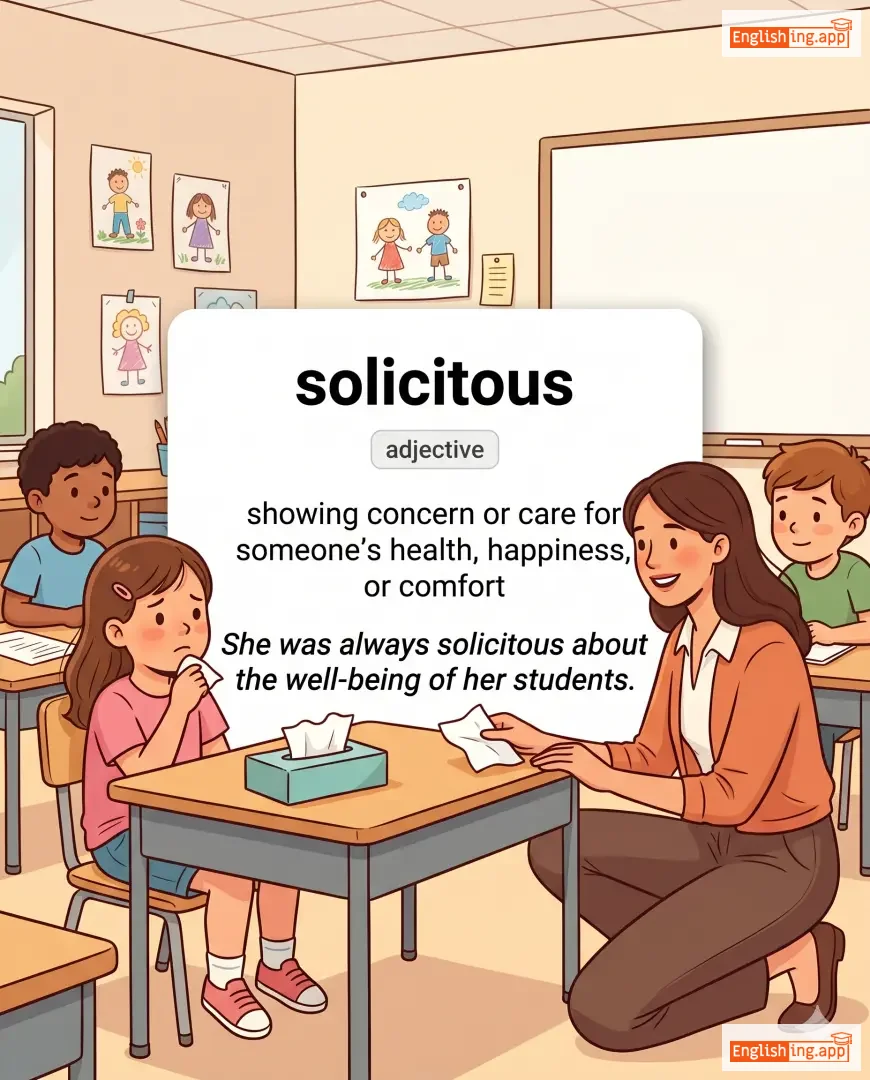
solicitous definition card — visual illustration of the meaning
adjective
/səˈlɪsɪtəs/
заботливый (zabotlivyj)

showing concern or care for someone's health, happiness, or comfort

"She was always solicitous about the well-being of her students."

"Она всегда была заботлива о благополучии своих студентов." (Ona vsegda byla zabotliva o blagopoluchii svoikh studentov.)
noun
/səˈlɪsɪˌtuːd/
беспокойство, забота (bespokoystvo, zabota)

Care or concern for someone or something.

"His mother showed great solicitude for his safety."
"Его мать проявила большую заботу о его безопасности." (Ego mat' proyavila bol'shuyu zabotu o ego bezopasnosti.)
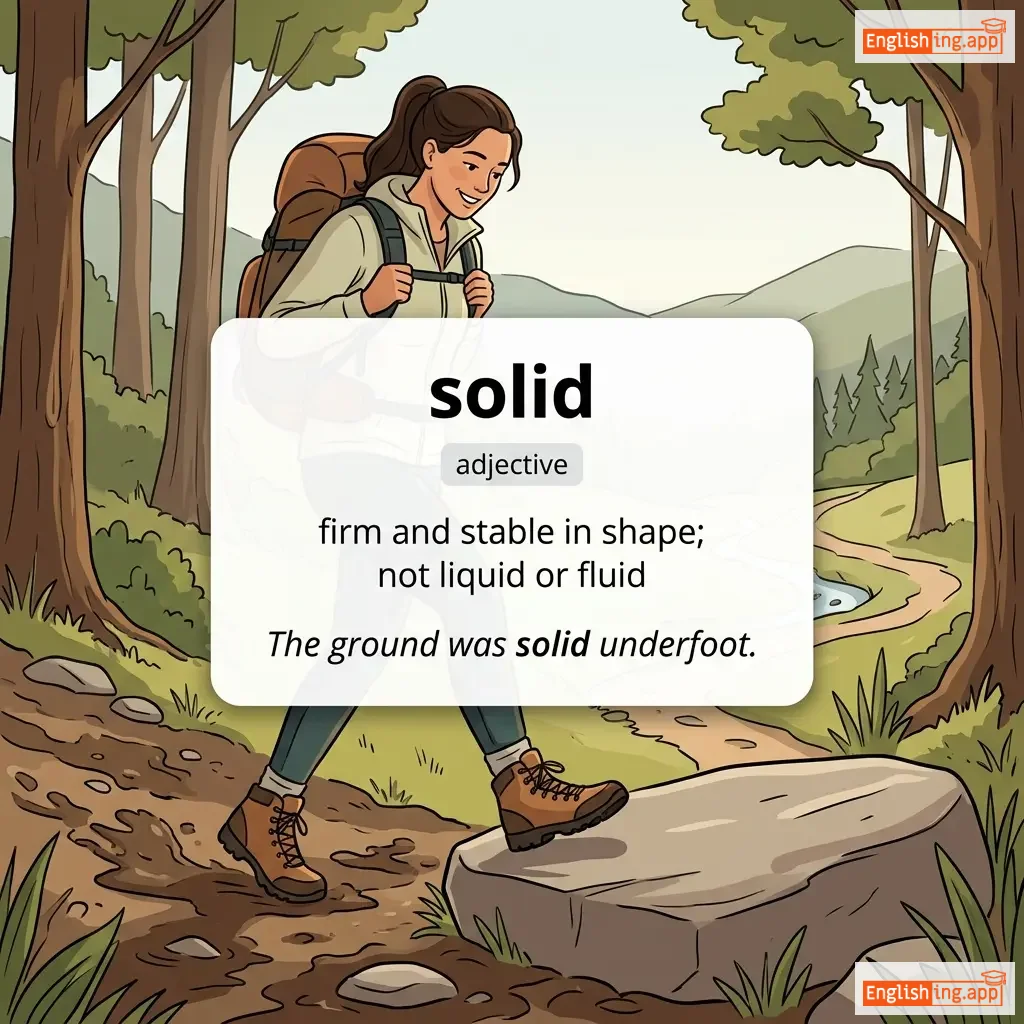
solid definition card — visual illustration of the meaning
adjective
/ˈsɒlɪd/
твердый (tvyordyy)

firm and stable in shape; not liquid or fluid

"The ground was solid underfoot."

"Земля была твёрдой под ногами." (Zemlya byla tvyordoy pod nogami.)
Solidarity definition card — visual illustration of the meaning
noun
/ˌsɒlɪˈdærɪti/
солидарность (solidarnost)

Unity or agreement of feeling or action, especially among individuals with a common interest.

"Workers held a strike in solidarity with their colleagues."

"Рабочие провели забастовку в знак солидарности с коллегами." (Rabochie proveli zabastovku v znak solidarnosti s kollegami.)
verb
/səˈlɪdəˌfaɪ/
укрепить (ukrepit)

To make something firm, strong, or more certain.

"The company solidified its position in the market."

"Компания укрепила свою позицию на рынке." (Kompanija ukrepila svoyu poziciyu na rynke.)
soliloquy definition card — visual illustration of the meaning
noun
/səˈlɪləkwi/
монолог (monolog)

a speech in which a character talks to themselves, often used in drama to reveal inner thoughts

"Hamlet's soliloquy is one of the most famous passages in Shakespearean drama."

"Монолог Гамлета — это один из самых известных отрывков в драме Шекспира." (Monolog Gamleta — eto odin iz samykh izvestnykh otryvkov v drame Shekspira.)
adjective
/ˈsɒl.ɪ.ter.i/
одинокий; изолированный; один (odinokiy; izolirovannyy; odin)

alone; without companions; single; isolated

"He lived a solitary life in the mountains."
"Он вел одиночную жизнь в горах." (On vel odinochnuyu zhizn v gorakh.)
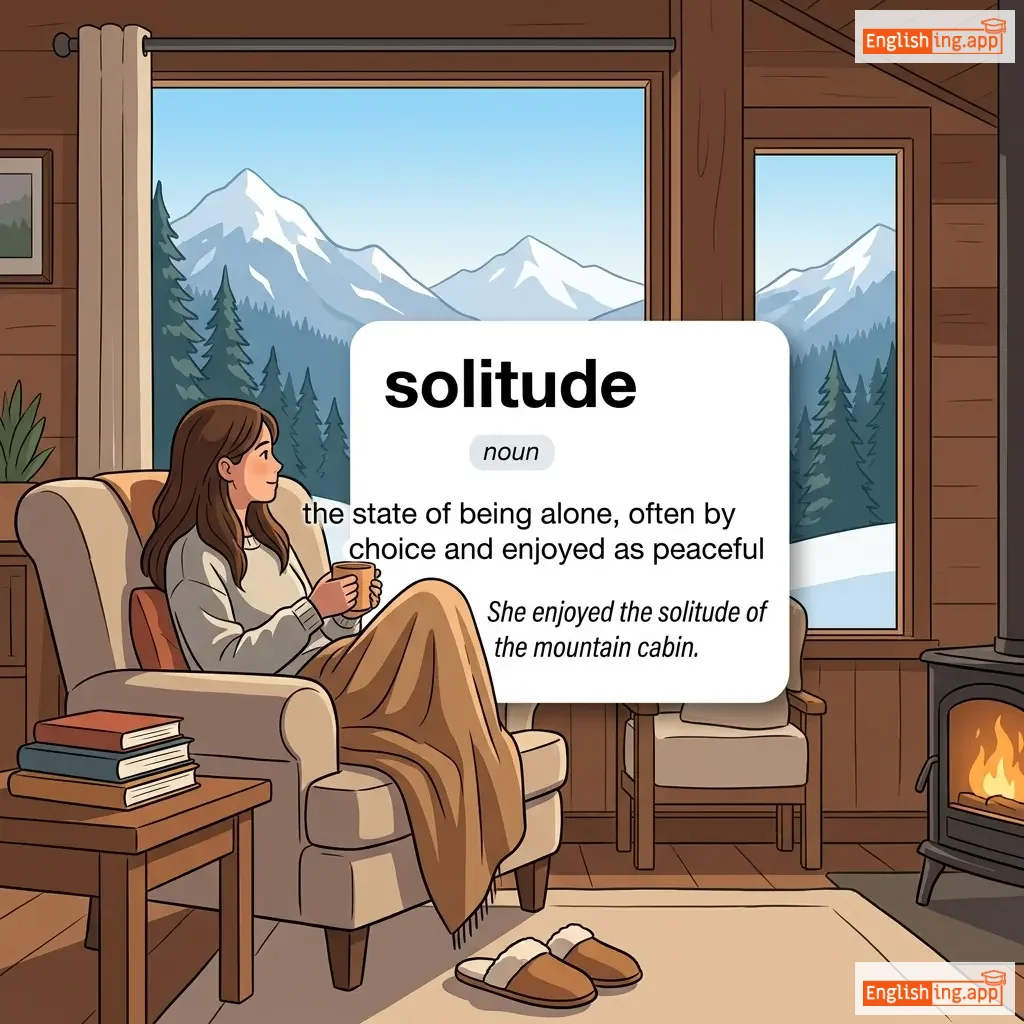
solitude definition card — visual illustration of the meaning
noun
/ˈsɒlɪtjuːd/
одиночество (odinochestvo)

the state of being alone, often by choice and enjoyed as peaceful

"She enjoyed the solitude of the mountain cabin."
"Она наслаждалась одиночеством в горной хижине." (Ona naslazhdalas' odinochestvom v gornoy khizhine.)
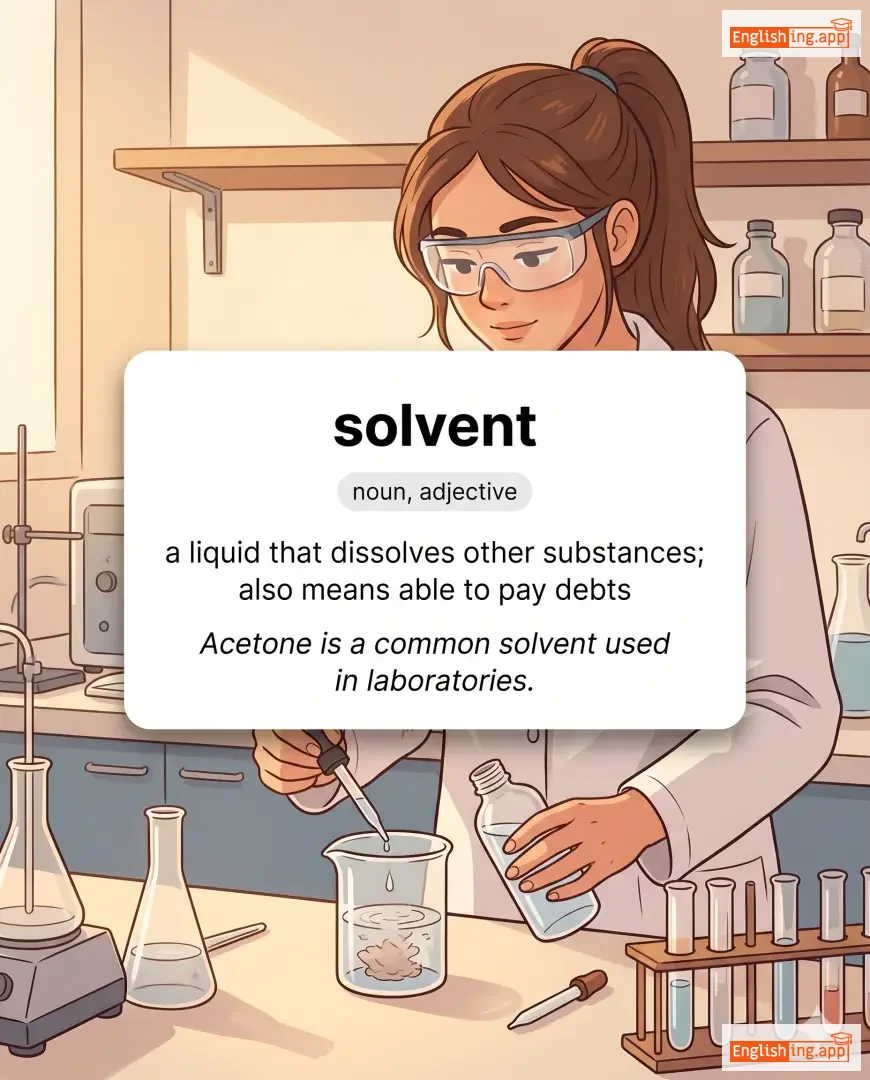
solvent definition card — visual illustration of the meaning
noun, adjective
/ˈsɒlvənt/
растворитель, способный погасить долги (rastvoritel, sposobnyj pogasit' dolgi)

a liquid that dissolves other substances; also means able to pay debts

"Acetone is a common solvent used in laboratories."

"Ацетон — это распространенный растворитель, используемый в лабораториях." (Atseton — eto rasprostranennyy rastvoritel', ispol'zuemyy v laboratoriyakh.)
solve definition card — visual illustration of the meaning
verb
/sɒlv/
решать (reshat)

to find an answer or explanation for a problem or question

"She solved the mystery in no time."

"Она разгадала загадку в кратчайшие сроки." (Ona razgadala zagadku v kratkayshie sroki.)
solvency definition card — visual illustration of the meaning
noun
/ˈsɒl.vən.si/
способность погашать долги; наличие активов, превышающих обязательства (sposobnost' pogashat' dolgi; nalichie aktivov, prevyshayushchikh obyazatel'stva)

The possession of assets in excess of liabilities; ability to pay debts.

"The company's solvency determines its financial health."

"Платежеспособность компании определяет её финансовое здоровье." (Platezhesposobnost' kompanii opredelyaet yey finansovoe zdorov'ye.)
solutions definition card — visual illustration of the meaning
noun
səˈluː.ʃənz
решения (resheniya)

A means of solving a problem or dealing with a difficult situation.

"Biotechnology provides solutions to environmental challenges."

"Биотехнология предоставляет решения для экологических проблем." (Biotekhnologiya predostavlyaet resheniya dlya ekologicheskikh problem.)
somatic definition card — visual illustration of the meaning
adjective
/səˈmætɪk/
телесный (telesnyy)

Relating to the body, especially as distinct from the mind.

"Yoga can improve both somatic and mental health."

"Йога может улучшить как телесное, так и психическое здоровье." (Yoga mozhet uluchshit' kak telesnoe, tak i psikhicheskoe zdorov'ye.)