語彙集

英単語辞書 | 単語の意味、定義、例文

noun/verb
/sleɪt/
スレート / 予定する (surēto / yotei suru)

a fine-grained rock used for roofing or writing; to schedule or designate for a task

"The meeting is slated for next Monday."

"ミーティングは次の月曜日に予定されています。" (Mītingu wa tsugi no getsuyōbi ni yotei sareteimasu.)
noun
/ˈslæt.ən/
だらしない女性 (darashinai josei)

a woman who is untidy or slovenly in appearance or habits

"The house looked as if a slattern lived there."

"その家は、だらしない女性が住んでいるように見えた。" (Sono ie wa, darashinai josei ga sunde iru yō ni mietā.)
noun/verb
/ˈslɔː.tər/
虐殺 / 大量殺人 (gyakusatsu / tairyou satsujin)

the killing of animals for food; killing in large numbers violently

"The army slaughtered hundreds of enemy soldiers."

"軍隊は数百人の敵兵を虐殺した。" (Guntai wa suuhyaku-nin no tekihei wo gyakusatsu shita.)
noun
/sleɪv/
奴隷 (dorei)

a person who is the legal property of another and is forced to work for them

"The abolitionist movement fought for the rights of slaves."

"廃奴隷運動は奴隷の権利のために戦いました。" (Hainoroi undō wa dorei no kenri no tame ni tatakatta.)
⛓️

slavery

noun
/ˈsleɪvəri/

the system or state of being owned and forced to work for someone else

"Slavery was abolished in most countries in the 19th century."

adjective
/ˈsleɪ.vɪʃ/
奴隷のような (dorei no yō na)

showing no originality; completely imitative or overly submissive

"His slavish devotion to tradition prevented any innovation."

"彼の伝統への奴隷のような献身が革新を阻んだ。" (Kare no dentō e no dorei no yō na kenshin ga kakushin o habanda.)
⚔️

slay

verb
/sleɪ/

to kill violently; informally, to impress greatly

"The hero vowed to slay the dragon."

adjective
/ˈsliːzi/
不道徳な、汚い、または低品質な (fudōtoku na, kitanai, mata wa tei hinshitsu na)

morally low, dirty, or cheap in quality

"He avoided the sleazy nightclub downtown."

"彼はダウンタウンのスリージーなナイトクラブを避けた。" (Kare wa downtown no surīji na naitokurabu o saketa.)
noun
/slɛdʒ/
そり (sori)

a vehicle for traveling over snow, often pulled by animals

"The children rode a sledge down the snowy hill."

"子供たちは雪山をスレッジで滑り降りた。" (Kodomotachi wa yukiyama o surejide suberi orita.)
adjective
/sliːk/
滑らかで光沢のある (nameraka de kōtaku no aru)

smooth, shiny, and stylish

"She drove a sleek black sports car."
"彼女は光沢のある黒いスポーツカーを運転していました。" (Kanojo wa kōtaku no aru kuroi supōtsukā o unten shite imashita.)
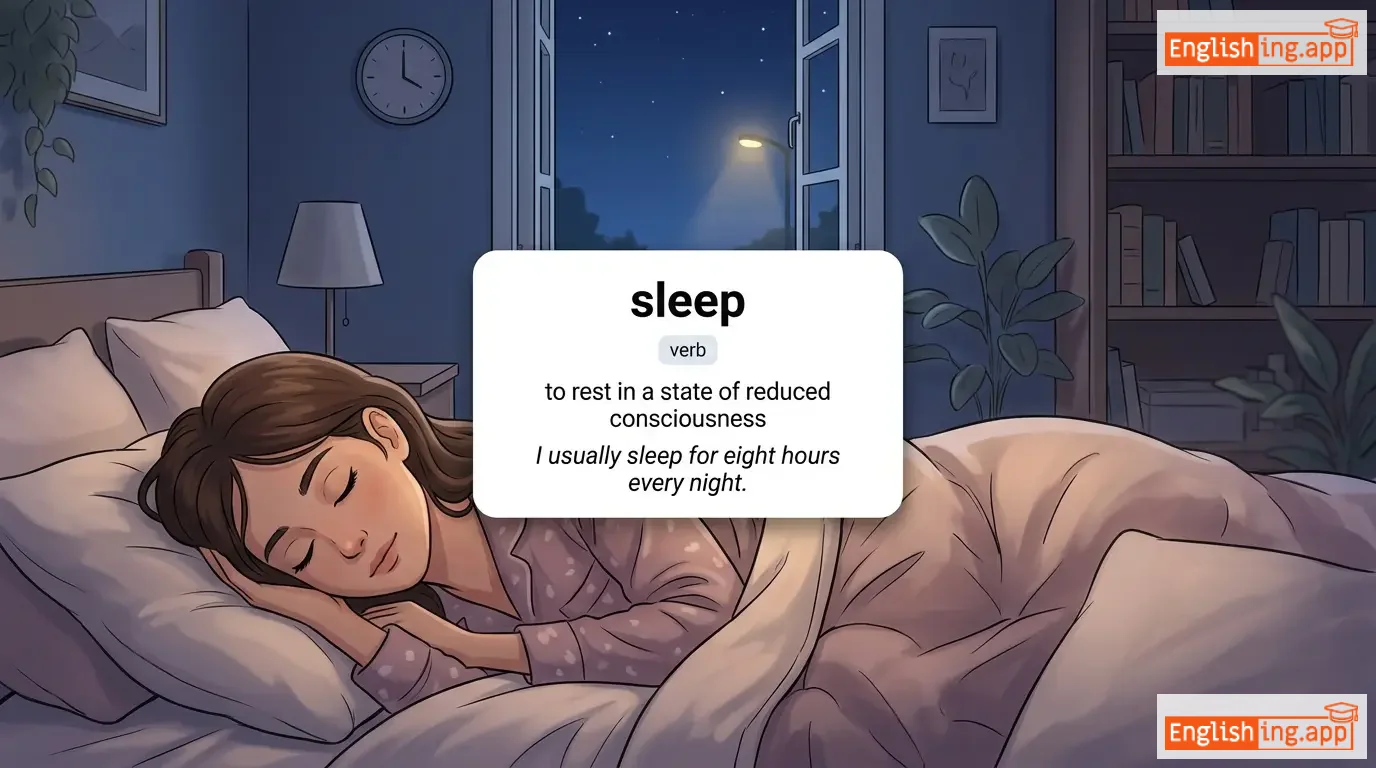
sleep definition card — visual illustration of the meaning
verb
/sliːp/
寝る (neru)

to rest in a state of reduced consciousness

"I usually sleep for eight hours every night."

"私は通常、毎晩8時間寝ます。" (Watashi wa tsuujou, maiban hachi jikan nemasu.)
sleep deprivation definition card — visual illustration of the meaning
noun
sliːp dɛprɪˈveɪʃən
睡眠不足 (suimin fusoku)

Lack of adequate sleep, which has negative effects on physical and mental health

"Sleep deprivation leads to cognitive decline and fatigue."

"睡眠不足は認知機能の低下と疲労を引き起こす。" (Suimin fusoku wa ninchi kinō no teika to hirō o hikiokosu.)
noun
/ˈsliːpər/
眠っている人;予想外に成功するもの (nemutte iru hito; yosōgai ni seikō suru mono)

a person or thing that sleeps; something that unexpectedly succeeds

"The movie turned out to be a real sleeper hit."

"映画は予想外のヒットになった。" (Eiga wa yosōgai no hitto ni natta.)
noun
/sliːv/
(sode)

the part of a garment that covers all or part of the arm

"He rolled up his sleeves before starting the work."

"彼は仕事を始める前に袖をまくった。" (Kare wa shigoto o hajimeru mae ni sode o makutta.)
noun
/sleɪ/
そり (sori)

A vehicle pulled by horses or reindeer over snow or ice.

"Children were excited to ride in the sleigh through the snowy village."

"子供たちは雪に覆われた村でそりに乗ることに興奮していました。" (Kodomotachi wa yuki ni ōwareta mura de sori ni noru koto ni kōfun shiteimashita.)
noun
/slaɪt/
手品 (tepin)

Skill or dexterity, especially in performing tricks.

"The magician amazed the crowd with his sleight of hand."

"マジシャンはその手品で観客を驚かせた。" (Majishan wa sono tepin de kankyaku o odorokaseta.)
verb
/sluː/
急に曲がる (kyū ni magaru)

To turn or slide violently in a particular direction.

"The car slewed across the icy road."

"車は凍った道路を滑っていった。" (Kuruma wa kōtta dōro o subette itta.)
noun
/slaɪs/
スライス (suraizu)

a thin, flat piece of food or other substance

"I cut the bread into slices."

"私はパンをスライスに切りました。" (Watashi wa pan o suraizu ni kirimashita.)
adjective
/slɪk/
滑らかな (namerakana)

Smooth, clever, or efficient, often in a way that seems superficial.

"He gave a slick presentation to impress the investors."

"彼は投資家を感動させるために滑らかなプレゼンテーションを行った。" (Kare wa tōshika o kandō saseru tame ni namerakana purezentēshon o okonatta.)
verb
/slaɪd/
滑る (suberu)

to move smoothly along a surface while maintaining continuous contact with it

"The children love to slide down the playground slide."

"子供たちは遊び場のスライドを滑るのが大好きです。" (Kodomotachi wa asobiba no suraido o suberu no ga daisuki desu.)
adjective
/slaɪt/
軽微な (keimina)

Small in degree; not considerable.

"There was a slight change in the schedule."

"スケジュールに軽微な変更がありました。" (Sukejūru ni keimina henkō ga arimashita.)
adverb
/ˈslaɪtli/
少し (sukoshi)

to a small degree or extent

"The temperature has slightly increased today."

"今日、温度は少し上昇しました。" (Kyou, ondo wa sukoshi joushou shimashita.)
adjective
/slɪm/
スリム (surimu)

thin in an attractive or healthy way; small in amount or chance

"She looked slim in her new dress."

"彼女は新しいドレスでスリムに見えた。" (Kanojo wa atarashī doresu de surimu ni mieta.)
verb
/slɪŋ/
投げる、掛ける (nageru, kakeru)

to throw or hang something roughly or carelessly

"He slung his bag over his shoulder before leaving."

"彼は出発前に肩にバッグをかけた。" (Kare wa shuppatsu mae ni kata ni baggu o kaketa.)
verb
/slɪŋk/
忍び寄る (shinobiyoru)

to move quietly and secretly, often to avoid being noticed

"The cat slunk into the room without making a sound."

"その猫は音を立てずに部屋に忍び込んだ。" (Sono neko wa oto wo tatezu ni heya ni shinobikonda.)
verb
/slɪp/
滑る (suberu)

to lose balance or fall while moving, or to accidentally slide from a position

"She slipped on the wet floor and fell."

"彼女は濡れた床で滑って転んだ。" (Kanojo wa nureta yuka de subette koronda.)
noun
/ˈslɪpər/
スリッパ (surippa)

light, comfortable shoe without a back, worn indoors

"She put on her slippers before walking around the house."

"家の中を歩く前にスリッパを履きました。" (Ie no naka o aruku mae ni surippa o hakimashita.)
adjective
/ˈslɪpəri/
滑りやすい (suberiyasui)

difficult to hold, walk on, or deal with because of being smooth, wet, or tricky

"The road was slippery after the rain."

"雨の後、道は滑りやすかった。" (Ame no ato, michi wa suberiyasukatta.)
adjective
/ˈslɪpʃɒd/
おおざっぱな, いい加減な (oozappana, iikagen na)

done in a careless, sloppy, or untidy way

"The project failed due to slipshod planning."

"計画が雑だったため、プロジェクトは失敗した。" (Keikaku ga zatsu datta tame, purojekuto wa shippai shita.)
noun
/slɪt/
切れ目 (kireme)

a long narrow opening or cut

"There was a small slit in the fabric."

"生地に小さな切れ目がありました。" (Kiji ni chiisana kireme ga arimashita.)
verb
/ˈslɪðər/
滑る (suberu)

to move smoothly over a surface with a twisting, sliding motion, like a snake

"The snake slithered through the grass."

"ヘビは草の中を滑って進んだ。" (Hebi wa kusa no naka o subette susunda.)
🗣️

slogan

noun
/ˈsloʊɡən/

a short and memorable phrase used to promote a cause or product

"The campaign used a powerful slogan to inspire people."

noun
/sloʊp/
(saka)

a surface of which one end or side is at a higher level than another; a slanting surface or line

"The children rolled down the grassy slope."

"子供たちは草の坂を転がり落ちました。" (Kodomotachi wa kusa no saka o korogari ochimashita.)
adjective
/ˈslɒpi/
だらしない (darashinai)

Careless, messy, or lacking attention to detail.

"His sloppy handwriting made the note hard to read."

"彼のだらしない手書きはメモを読むのが難しくしました。" (Kare no darashinai tegaki wa memo o yomu no ga muzukashiku shimashita.)
noun
/slɒt/
スロット (surotto)

a narrow opening into which something fits or is placed

"Insert the card into the slot to open the door."

"カードをスロットに挿入して、ドアを開けてください。" (Kaado o surotto ni sōnyū shite, doa o akete kudasai.)
noun
/sloʊθ/ or /slɒθ/
怠惰 (taida)

A lack of effort or laziness; also a slow-moving mammal in Central and South America.

"His constant sloth kept him from achieving his goals."

"彼の継続的な怠惰は、彼が目標を達成するのを妨げていました。" (Kare no keizokuteki na taida wa, kare ga mokuhyō o tassei suru no o samatageite imashita.)
adjective
/ˈsloʊθfəl/
怠惰 (taida)

Lazy, idle, and unwilling to work.

"She was too slothful to get out of bed early."

"彼女はベッドから早く起きるにはあまりにも怠惰でした。" (Kanojo wa beddo kara hayaku okiru ni wa amari ni mo taida deshita.)
verb
/slaʊtʃ/
だらしなく座る (darashinaku suwaru)

To stand, sit, or move in a lazy or awkward way.

"He slouched in the chair, looking tired."

"彼は椅子にだらりと座り、疲れた様子だった。" (kare wa isu ni darari to suwari, tsukareta yousu datta.)
verb
/slʌf/ or /sluː/
皮を捨てる / 湿地 (kawa wo suteru / shicchi)

To shed or cast off (like dead skin); also a swampy or muddy area.

"The snake sloughed off its old skin."

"ヘビは古い皮を捨てた。" (Hebi wa furui kawa wo suteta.)
adjective
/ˈslʌvənli/
だらしない (darashinai)

Untidy or careless in appearance, habits, or work.

"His slovenly appearance made a bad impression at the interview."

"彼のだらしない外見は面接で悪い印象を与えました。" (Kare no darashinai gaiken wa mensetsu de warui inshō o ataemashita.)
adjective
/sloʊ/
遅い (osoi)

moving or happening at a low speed

"The car moved slowly down the street."

"車は通りをゆっくり走っていました。" (Kuruma wa toori o yukkuri hashitte imashita.)
adverb
/ˈsloʊli/
ゆっくり (yukkuri)

in a slow manner

"She walked slowly to the door."

"彼女はゆっくりとドアに向かって歩いた。" (Kanojo wa yukkuri to doa ni mukatte aruita.)
noun
/ˈslʌɡərd/
怠け者 (namakemono)

A lazy, sluggish person.

"The sluggard refused to get out of bed even at noon."

"怠け者は正午でもベッドから起きることを拒否しました。" (Namakemono wa shōgo demo beddo kara okiru koto o kyohi shimashita.)
adjective
/ˈslʌɡɪʃ/
鈍い (nibui)

Lacking energy or alertness; slow-moving or inactive.

"He felt sluggish after eating a heavy meal."

"重い食事を食べた後、彼は鈍く感じた。" (omoi shokuji o tabeta ato, kare wa nibui to kanjita.)
noun/verb
/sluːs/
水門 / 洗う (suimon / arau)

A sliding gate for controlling the flow of water; to wash or rinse with water in large quantities.

"The workers sluiced the mud off the street after the heavy rain."

"作業員は大雨の後に通りから泥を洗い流しました。" (Sagyouin wa ooi ame no ato ni toori kara doro o arainagashimashita.)
noun
/slʌm/
スラム街 (suram gai)

a poor urban area with substandard housing and squalid conditions

"The government is working to improve conditions in the slum."

"政府はスラムの条件を改善するために取り組んでいます。" (Seifu wa suramu no jouken wo kaizen suru tame ni torikundeimasu.)
noun/verb
/ˈslʌmbər/
眠り (nemuri)

A state of sleep; to sleep lightly or rest.

"The child slumbered peacefully through the night."

"子供は一晩中静かに寝ていた。" (Kodomo wa hitobanjuu shizukani neteita.)
noun, verb
/slɜːr/
侮辱 / 侮辱的な言葉 (bujoku / bujokuteki na kotoba)

An insulting remark or suggestion; or to speak indistinctly.

"He made a slur against her character."

"彼は彼女のキャラクターについて侮辱的な発言をした。" (Kare wa kanojo no kyarakutā ni tsuite bujokuteki na hatsugen o shita.)
adjective
/slaɪ/
ずるい / 狡猾 (zurui / kōkatsu)

Clever in a deceitful or cunning way.

"She gave him a sly smile."

"彼女は彼にずるい笑顔を向けた。" (Kanojo wa kare ni zurui egao o muketa.)
adjective
/smɔːl/
小さい (chiisai)

not large in size, amount, or importance

"He lives in a small house near the river."

"彼は川の近くの小さな家に住んでいます。" (Kare wa kawa no chikaku no chiisana ie ni sundeimasu.)