語彙集

英単語辞書 | 単語の意味、定義、例文

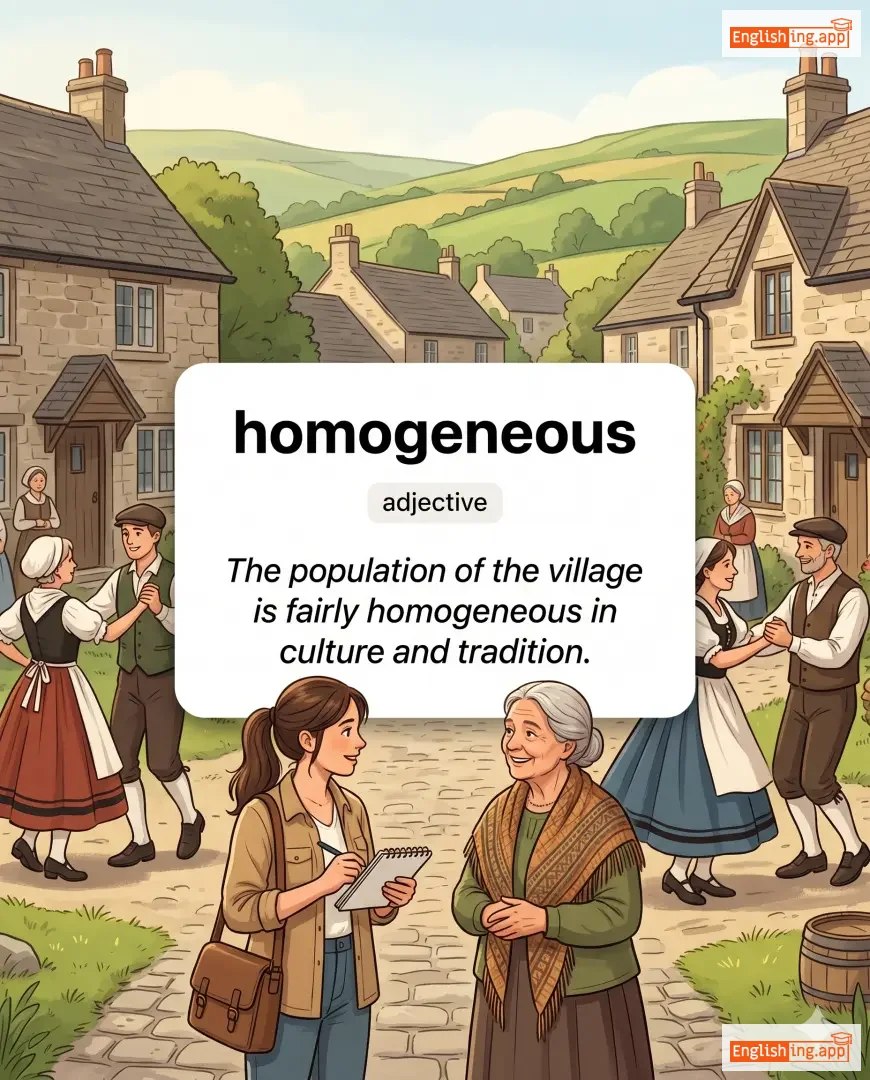
homogeneous definition card — visual illustration of the meaning
adjective
/ˌhoʊ.məˈdʒiː.ni.əs/
均質な (kinshitsuna)

Consisting of parts or elements that are all the same kind; uniform in composition.

"The population of the village is fairly homogeneous in culture and tradition."

"その村の人口は文化や伝統においてかなり均質です。" (Sono mura no jinkō wa bunka ya dentō ni oite kanari kinshitsudesu.)
verb
/həˈmɑː.dʒə.naɪz/
均質化 (kinshitsuka)

To make uniform or similar by blending or mixing different elements.

"The company tried to homogenize its products across global markets."

"その会社は世界市場で製品を均質化しようとしました。" (Sono kaisha wa sekai shijō de seihin o kinshitsuka shiyō to shimashita.)
adjective
/həˈmɑː.dʒə.nəs/
同質の (doushitsu no)

Similar or uniform in nature; often used interchangeably with 'homogeneous'.

"The class was made up of a homogenous group of students."

"クラスは同質の学生グループで構成されていました。" (Kurasu wa doushitsu no gakusei gurūpu de kōsei sareteimashita.)
adjective
/həˈmɑː.lə.ɡəs/
同源 (構造) (dōgen (kōzō))

Having the same relation, relative position, or structure, especially due to evolutionary origin.

"The wings of bats and the arms of humans are homologous structures."

"コウモリの翼と人間の腕は同源の構造です。" (Kōmori no tsubasa to ningen no ude wa dōgen no kōzō desu.)
noun
/ˈhɑː.mə.nɪm/
同義語 (dōgigo)

A word that is spelled and pronounced like another word but has a different meaning.

"The word 'bat' is a homonym because it can mean an animal or a sports tool."

"'コウモリ'という言葉は、動物またはスポーツ用品を意味することができるため、同義語です。" ('Kōmori' to iu kotoba wa, dōbutsu matawa supōtsu yōhin o imi suru koto ga dekiru tame, dōgigo desu.)
noun
/ˈhɒməˌfoʊn/
同音異義語 (dōon igigo)

A word that is pronounced the same as another word but differs in meaning, and often spelling.

"The words 'pair' and 'pear' are homophones."

"「pair」と「pear」の単語は同音異義語です。" ('pair' to 'pear' no tango wa dōon igigo desu.)
verb
/hoʊn/
研ぐ、スキルを磨く (togu, sukiru wo migaku)

To sharpen a blade or to improve a skill through practice.

"She honed her presentation skills before the big meeting."

"彼女は大きな会議の前にプレゼンテーションスキルを磨きました。" (kanojo wa ōkina kaigi no mae ni purezentēshon sukiru wo migakimashita.)
adjective
/ˈɑːnɪst/
正直 (shoujiki)

free of deceit and untruthfulness; sincere

"She is known as an honest and trustworthy person."

"彼女は誠実で信頼できる人物として知られています。" (Kanojo wa seijitsu de shinrai dekiru jinbutsu toshite shirareteimasu.)
adverb
/ˈɒnɪstli/
正直に (shoujiki ni)

in a truthful, sincere, or fair way

"She spoke honestly about her mistakes."

"彼女は自分の間違いについて正直に話しました。" (Kanojo wa jibun no machigai ni tsuite shoujiki ni hanashimashita.)
noun
/ˈɒnɪsti/
正直 (shoujiki)

the quality of being truthful and sincere

"Honesty is the best policy in all situations."

"正直はすべての状況で最良の方針です。" (Shoujiki wa subete no joukyou de sairyō no hōshin desu.)
noun
/ˈhʌni/
蜂蜜 (hachimitsu)

A sweet, sticky substance made by bees from nectar.

"She likes to put honey in her tea."

"彼女はお茶に蜂蜜を入れるのが好きです。" (Kanojo wa ocha ni hachimitsu o ireru no ga suki desu.)
noun
/ˈɑːnər/
名誉 (meiyo)

high respect; great esteem

"He received an award in honor of his achievements."

"彼は業績を讃えて名誉を受け取った。" (Kare wa gyōseki o tataete meiyo o uketotta.)
noun
/ˌɒnəˈreəriəm/
謝礼 (sharei)

A payment given for professional services that are rendered without a fee.

"The guest lecturer received an honorarium for her talk."

"ゲスト講師は彼女の講演に対して謝礼を受け取った。" (Gesuto kōshi wa kanojo no kōen ni taishite sharei o uketotta.)
honour definition card — visual illustration of the meaning
verb
/ˈɒnər/
敬う (uyamau)

to show respect; to keep a promise

"We honour our veterans for their service."

"私たちは退役軍人をその奉仕のために敬意を表します。" (Watashitachi wa taieki gunjin wo sono hōshi no tame ni keii wo hyōshimasu.)
adjective
/ˈɒnərəbəl/
名誉ある (meiyo aru)

deserving respect or admiration because of moral integrity; showing honesty and fairness

"She is known as an honourable leader who always keeps her promises."

"彼女は常に約束を守る名誉ある指導者として知られている。" (kanojo wa tsuneni yakusoku o mamoru meiyo aru shidosha toshite shirarete iru)
adjective; past participle
/ˈɒnəd/
光栄に思う (koei ni omou)

treated with respect or distinction; feeling proud and privileged

"She felt deeply honoured to receive the award."

"彼女は賞を受け取って光栄に思った。" (Kanojo wa sho o uketotte koei ni omotta)
noun
/hʊd/
フッド (fuddo)

the expandable neck region of certain snakes like cobras; a covering for the head

"The cobra spread its hood when it felt threatened."

"コブラは脅威を感じるとフッドを広げました。" (kobura wa kyoui wo kanjiru to fuddo wo hirogemashita.)
verb
/ˈhʊdwɪŋk/
だます (damasu)

To deceive or trick someone.

"The scammer hoodwinked many people with false promises."

"詐欺師は嘘の約束で多くの人々をだました。" (Sagishi wa uso no yakusoku de ōku no hitobito o damashita.)
noun
/huːf/
ひづめ (hizume)

the hard part covering the foot of horses, cattle, sheep, and other animals

"The horse's hoof was injured after stepping on a sharp rock."

"馬のひづめは鋭い岩に踏んだ後、けがをしました。" (Uma no hizume wa surudoi iwa ni funda ato, kega o shimashita.)
hook definition card — visual illustration of the meaning
noun, verb
/hʊk/
フックまたは吊るす道具 (fukku mata wa tsurusu dōgu)

a curved piece of metal or other material used for catching, holding, or pulling something; to catch or attach with a hook

"She hooked her keys onto her bag."

"彼女は鍵をバッグに掛けた。" (Kanojo wa kagi o baggu ni kaketa.)
🌟

hope

verb
/hoʊp/

To want something to happen or be true and think it is possible.

"I hope everything goes well with your exam."

adjective
/ˈhəʊpfʊl/
希望に満ちた (kibou ni michita)

feeling or showing optimism about a future event

"She is hopeful about the results of the interview."

"彼女は面接の結果に希望を持っている。" (Kanojo wa mensetsu no kekka ni kibou o motte iru.)
adverb
/ˈhoʊpfəli/
希望的に (kibou-teki ni)

in a hopeful manner; expressing hope or optimism

"Hopefully, the weather will be nice tomorrow."

"明日、天気が良いことを願っています。" (Ashita, tenki ga yoi koto o negatteimasu.)
adjective
/ˈhoʊpləs/
絶望的; 希望がない (zetsubōteki; kibō ga nai)

feeling or causing despair about something; without hope; desperate

"The situation seemed hopeless until help arrived."

"助けが到着するまで、状況は絶望的に見えた。" (Tasuke ga tōchaku suru made, jōkyō wa zetsubōteki ni mietā.)
noun
/hɔːrd/
群衆 (gunshuu)

A large group or crowd, especially one that is disorderly or difficult to control.

"A horde of fans gathered outside the stadium."

"スタジアムの外でファンの群衆が集まりました。" (sutajiamu no soto de fan no gunshuu ga atsumarimashita.)
noun
/həˈraɪ.zən/
地平線 (chiheisen)

the line where the earth seems to meet the sky; the limit of one's knowledge, experience, or interest

"The sun disappeared below the horizon."

"太陽は地平線の下に消えました。" (Taiyou wa chiheisen no shita ni kiemashita.)
horizons definition card — visual illustration of the meaning
noun
/həˈraɪ.zənz/
地平線 (chiheisen)

The limit of a person's mental perception, experience, or interest.

"The telescope opens new horizons for astronomy."

"望遠鏡は天文学の新しい地平線を開きます。" (Bōenkyō wa tenmongaku no atarashī chiheisen o hirakimasu.)
adjective
/ˌhɒrɪˈzɒntəl/
水平な (suihei na)

parallel to the horizon; flat and level from side to side

"The table must be perfectly horizontal to keep the glass from sliding."

"グラスが滑らないように、テーブルは水平である必要があります。" (Gurasu ga suberanai you ni teeburu wa suihei de aru hitsuyou ga arimasu)
noun
/ˈhɔːrmoʊn/
ホルモン (horumon)

a chemical substance produced in the body that influences how the body grows or functions

"Insulin is a hormone that controls blood sugar levels."

"インスリンは血糖値をコントロールするホルモンです。" (Insurin wa kettōchi o kontorōru suru horumon desu.)
noun
/hɔːrn/
角, ホーン (kaku, hōn)

a hard, pointed part growing from the head of some animals; a device that makes a loud sound as a warning

"The driver pressed the horn to warn the pedestrians."

"運転手は歩行者に警告するためにホーンを鳴らしました。" (Untenshu wa hokōsha ni keikoku suru tame ni hōn o narashimashita.)
noun
/ˈhɔːrn.bɪl/
ホーンビル鳥 (hōn biru tori)

a large tropical bird with a large curved beak and often a horn-like projection

"The colorful hornbill perched on the highest branch."

"色とりどりのホーンビルが最も高い枝に止まった。" (Irotoridori no hōn biru ga mottomo takai eda ni tomatta.)
noun
/ˈhɔːr.nət/
スズメバチ (suzumebachi)

a large wasp that can sting and is often aggressive

"The hornet built its nest under the roof."

"スズメバチは屋根の下に巣を作った。" (Suzumebachi wa yane no shita ni su o tsukutta.)
noun
/ˈhɒrəˌskoʊp/
ホロスコープ (horosukoopu)

A forecast of a person's future based on the positions of the stars and planets at their birth.

"She read her horoscope every morning to see what the stars predicted."

"彼女は毎朝、自分のホロスコープを読んで、星が何を予測したかを確認していました。" (Kanojo wa mai asa, jibun no horosukoopu o yonde, hoshi ga nani o yosoku shita ka o kakunin shite imashita.)
adjective
/ˈhɔːrɪbəl/
ひどい, 恐ろしい (hidoi, osoroshii)

very unpleasant or causing horror; extremely bad or unpleasant

"The food at that restaurant was horrible."

"そのレストランの料理はひどかった。" (Sono resutoran no ryōri wa hidokatta.)
horrify definition card — visual illustration of the meaning
verb
/ˈhɔːrɪfaɪ/
恐れさせる (osoresaseru)

to fill with horror; to shock or disgust greatly

"The violent scene horrified the audience."

"暴力的な場面が観客を恐れさせた。" (bouryokuteki na bamen ga kankyaku o osore saseta)
noun
/ˈhɒr.ər/
恐怖 (kyōfu)

an intense feeling of fear, shock, or disgust

"She screamed in horror when she saw the accident."

"彼女は事故を見て恐怖で叫んだ。" (Kanojo wa jiko o mite kyōfu de sakenda.)
noun
/hɔːrs/
(uma)

a large, strong animal used for riding, racing, or carrying loads

"The horse ran across the field."

"馬は野原を駆け抜けました。" (Uma wa nohara o kakenukemashita.)
noun
/ˈhɔːrs.liːt͡ʃ/
馬のヒル (uma no hiru)

a large species of leech that was traditionally used in veterinary medicine

"The veterinarian explained that horse-leach was once commonly used to treat horses."

"獣医は、馬のヒルがかつて馬の治療に広く使われていたと説明しました。" (Jūi wa, uma no hiru ga katsute uma no chiryō ni hiroku tsukawarete ita to setsumei shimashita.)
adjective
/ˈhɔːrtətɪv/

Giving strong encouragement or urging.

"The teacher gave a hortative speech to motivate the students before the exam."

adjective
/ˈhɔːrtətɔːri/

Intended to encourage or urge to action.

"The manager’s hortatory words inspired the team to work harder."

adjective
/ˌhɔːrtɪˈkʌltʃərəl/
園芸に関連する (engei ni kanren suru)

Relating to the art or practice of garden cultivation and management.

"She studied horticultural science at the university."

"彼女は大学で園芸学を学びました。" (Kanojo wa daigaku de engeigaku o manabimashita.)
noun
/ˈhɔːrtɪˌkʌltʃər/

The art or practice of garden cultivation and management.

"Horticulture plays a vital role in producing fruits, vegetables, and ornamental plants."

noun
/ˈhoʊʒəri/
靴下や足用の衣類 (kutsushita ya ashiyou no irui)

Stockings, socks, and other knitted clothing for the legs and feet.

"She bought new hosiery for the winter season."

"彼女は冬のシーズン用に新しいホジエリーを買いました。" (Kanojo wa fuyu no shiizun you ni atarashii hojierii wo kaimashita.)
adjective
/ˈhɑːspɪtəbl/
ホスピタブル (hosupitāburu)

Friendly and welcoming to guests or strangers.

"The villagers were very hospitable to the travelers."

"村人たちは旅行者にとてもホスピタブルでした。" (Mura hito tachi wa ryokōsha ni totemo hosupitāburu deshita.)
noun
/ˈhɒs.pɪ.təl/
病院 (byouin)

an institution where sick or injured people are given medical treatment

"He was taken to the hospital after the accident."

"彼は事故の後、病院に運ばれました。" (Kare wa jiko no ato, byouin ni hakobaremashita.)
noun
/ˌhɑːspɪˈtæləti/

The friendly and generous reception and entertainment of guests or strangers.

"We enjoyed the hospitality of our hosts during the holiday."

noun, verb
/hoʊst/
ホスト (hosuto)

a person who receives or entertains guests; to organize and provide for an event

"She will host the conference next week."

"彼女は来週、会議を開催します。" (Kanojo wa raishū, kaigi o kaisai shimasu.)
noun
/ˈhɑːstɪdʒ/
人質 (hitojichi)

A person seized or held as security for the fulfillment of a condition.

"The rebels took several people as hostages."

"反乱者たちは何人かを人質として取った。" (Hanranshatachi wa nan-nin ka wo hitojichi to shite totta.)
noun
/ˈhɑːstəlri/
宿泊施設 (shukuhaku shisetsu)

An inn or lodging place, especially one for travelers.

"They stayed at a small hostelry near the mountains."

"彼らは山の近くの小さな宿泊施設に泊まりました。" (Karera wa yama no chikaku no chiisana shukuhaku shisetsu ni tomarimashita.)
adjective
/ˈhɒstaɪl/
敵対的 (tekitai-teki)

showing or feeling opposition, dislike, or hatred

"The soldiers entered a hostile territory."

"兵士たちは敵対的な領土に入った。" (Heishitachi wa tekitai-teki na ryōdo ni haitta.)