語彙集

英単語辞書 | 単語の意味、定義、例文

adjective
/ɡɑːrˈɡæntʃuən/
巨大な (kyodaina)

Extremely large; enormous.

"They served a gargantuan meal at the feast."

"彼らは宴会で巨大な食事を提供しました。" (Karera wa enkai de kyodaina shokuji o teikyō shimashita.)
noun
/ˈɡɑːrɡɔɪl/
石の彫刻(グロテスクな形) (ishi no chōkoku (gurotesuku na katachi))

A carved stone figure, often of a grotesque creature, on a building, typically used as a spout to carry water away.

"The ancient cathedral had gargoyles on every corner."

"古代の大聖堂には、すべての角にガーゴイルがありました。" (Kodai no daiseidō ni wa, subete no kado ni gāgoiru ga arimashita.)
adjective
/ˈɡɛə.rɪʃ/
過度に明るく派手 (kado ni akaruku hade)

Excessively bright and showy, often in a tasteless or unattractive way.

"The room was decorated with garish neon lights."

"部屋は過度に明るいネオンライトで飾られていました。" (Heya wa kado ni akarui neon raito de kazararete imashita.)
noun
/ˈɡɑːr.lənd/
花冠; ガーランド; (hanakan, gārando)

a wreath of flowers and leaves, worn on the head or hung as decoration

"The bride wore a beautiful floral garland during the traditional ceremony."

"花嫁は伝統的な式典で美しい花の冠を身に着けていました。" (Hanayome wa dentōteki na shikiten de utsukushī hana no kanmuri o mi ni tsukete imashita.)
noun
/ˈɡɑːrlɪk/
にんにく (ninniku)

A strong-smelling plant used as a seasoning in cooking.

"She added garlic to the curry."

"彼女はカレーににんにくを加えました。" (Kanojo wa karē ni ninniku o kuwaemashita.)
noun
/ˈɡɑː.mənt/
衣類 (irui)

An item of clothing.

"She bought a new garment for the party."

"彼女はパーティーのために新しい衣類を買いました。" (Kanojo wa pātī no tame ni atarashī irui o kaimashita.)
verb
/ˈɡɑː.nər/
集める (atsumeru)

To gather or collect, especially information, support, or approval.

"The politician garnered support from young voters."

"政治家は若い有権者から支持を集めた。" (Seiji-ka wa wakai yūken-sha kara shiji o atsumeta.)
verb
/ˈɡɑː.nɪʃ/
飾る (kazaru)

To decorate food with small items for added flavor or visual appeal.

"She garnished the dish with fresh coriander leaves."

"彼女は新鮮なコリアンダーの葉で料理を飾りました。" (Kanojo wa shinsen na koriandā no ha de ryōri o kazarimashita.)
noun
/ˈɡær.ɪ.sən/
駐屯地 (chūtonchi)

A body of troops stationed in a particular location, usually to defend it.

"The garrison defended the fortress against the invaders."

"駐屯地は侵略者に対して要塞を守った。" (Chūtonchi wa shinryakusha ni taishite yōsai o mamotta.)
noun, verb
/ɡəˈrɒt/
絞め殺す (shimekorosu)

A method of execution by strangulation, or to strangle someone with a cord or wire.

"The assassin attempted to garrote his target in the alley."

"暗殺者は路地でターゲットを絞め殺そうとした。" (Ansatsusha wa roji de taagetto wo shimekoroso to shita.)
noun
/ɡəˈruːlɪti/
おしゃべり (oshaberi)

Excessive talkativeness, especially about trivial matters.

"His garrulity made it hard to focus during the meeting."
"彼の多弁は会議中に集中するのを難しくした。" (Kare no taben wa kaigi chuu ni shuuchuu suru no wo muzukashiku shita.)
Garrulous definition card — visual illustration of the meaning
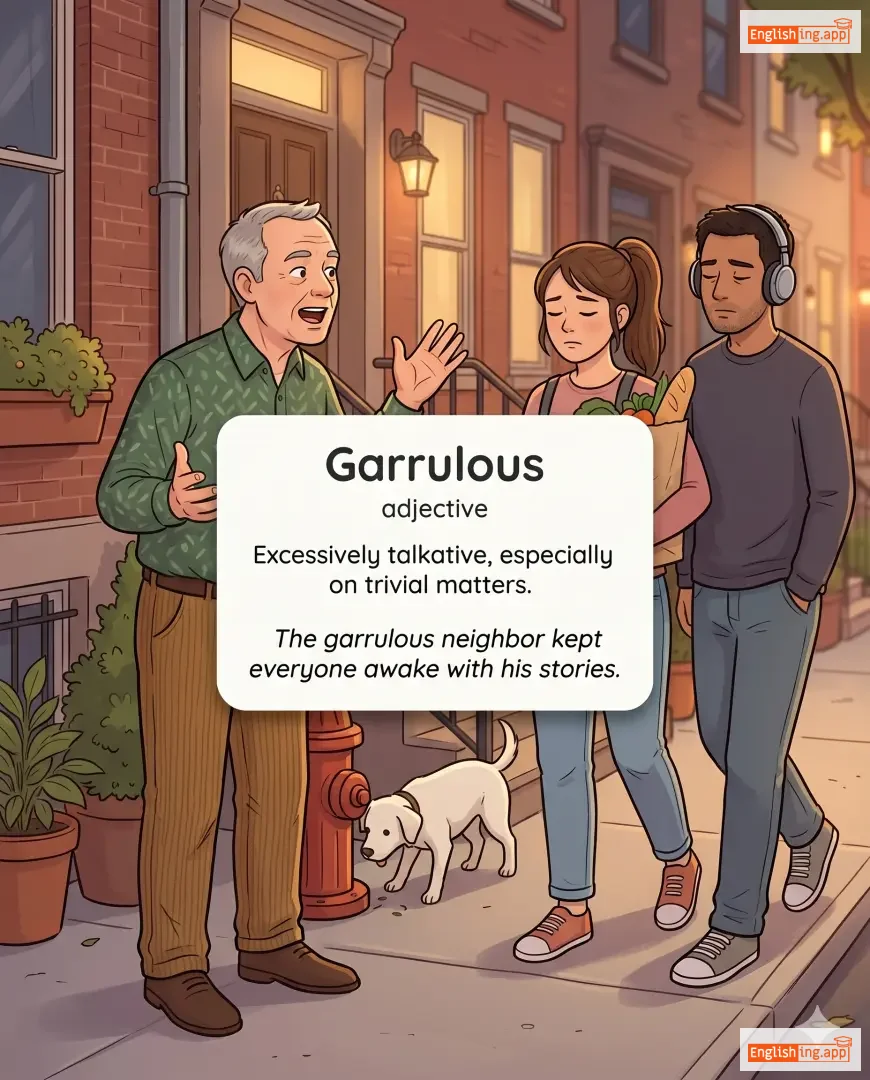
adjective
/ˈɡærələs/
おしゃべりな、話好きな (oshaberi na, hanashi sukina)

Excessively talkative, especially on trivial matters.

"The garrulous neighbor kept everyone awake with his stories."

"おしゃべりな隣人は彼の話で皆を起こしていた。" (Oshaberi na rinjin wa kare no hanashi de mina o okoshite ita.)
gas definition card — visual illustration of the meaning
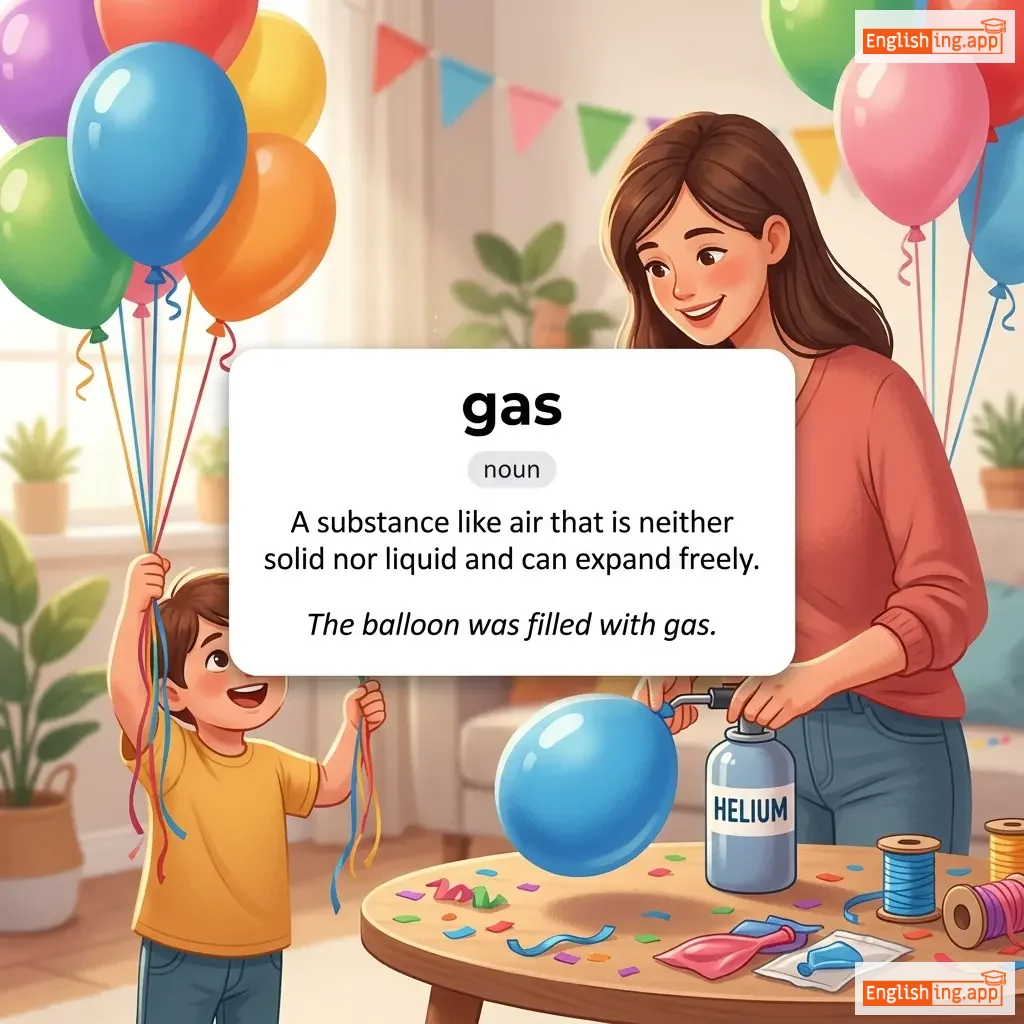
noun
/ɡæs/
ガス (gasu)

A substance like air that is neither solid nor liquid and can expand freely.

"The balloon was filled with gas."

"風船はガスで満たされていた。" (Fūsen wa gasu de mitasarete ita.)
noun
/ˌɡæskəˈneɪd/
誇張, 自慢 (kochou, jiman)

Extravagant boasting or bragging.

"His endless gasconade made him unpopular among his peers."

"彼の終わりのない自慢は彼を仲間の中で不人気にした。" (Kare no owarinai jiman wa kare o nakama no naka de funinki ni shita.)
adjective
/ˈɡæsiəs/
気体の (kitai no)

Relating to or having the form of gas.

"Carbon dioxide is a gaseous substance."

"二酸化炭素は気体の物質です。" (Nisankatanso wa kitai no busshitsu desu.)
noun/verb
/ɡæʃ/
深い切り傷 (fukai kirikizu)

A long, deep cut or wound; to cut deeply or violently.

"He had a deep gash on his leg after the accident."

"事故の後、彼の足には深い切り傷があった。" (Jiko no ato, kare no ashi ni wa fukai kirikizu ga atta.)
noun
/ˌɡæsɪfɪˈkeɪʃən/
ガス化 (gasuka)

The process of converting solid or liquid fuel into gas.

"Gasification is widely used to produce fuel gas from coal."

"ガス化は、石炭から燃料ガスを生産するために広く使用されています。" (Gasuka wa, sekitan kara nenryou gasu wo seisan suru tame ni hiroku shiyou sareteimasu.)
noun
/ˈɡæsəˌliːn/
ガソリン (gasorin)

a liquid fuel made from petroleum, used mainly to power engines in vehicles

"The price of gasoline has increased significantly this month."

"今月のガソリン価格は大幅に上昇しました。" (kongetsu no gasorin kakaku wa ouhaba ni joushou shimashita.)
adjective
/ˈɡæstrɪk/
胃の / 胃の問題 (i no / i no mondai)

Relating to the stomach.

"She was prescribed medicine for her gastric problems."

"彼女は胃の問題のために薬を処方されました。" (Kanojo wa i no mondai no tame ni kusuri o shohou saremashita.)
noun
/ɡæsˈtraɪtɪs/
ガストリティス (gasutoritisu)

Inflammation of the lining of the stomach.

"The doctor diagnosed him with gastritis after his endoscopy."
"医師は内視鏡検査後に彼にガストリティスと診断しました。" (Ishi wa naishikyou kensa go ni kare ni gasutoritisu to shindan shimashita.)
gastrointestinal definition card — visual illustration of the meaning
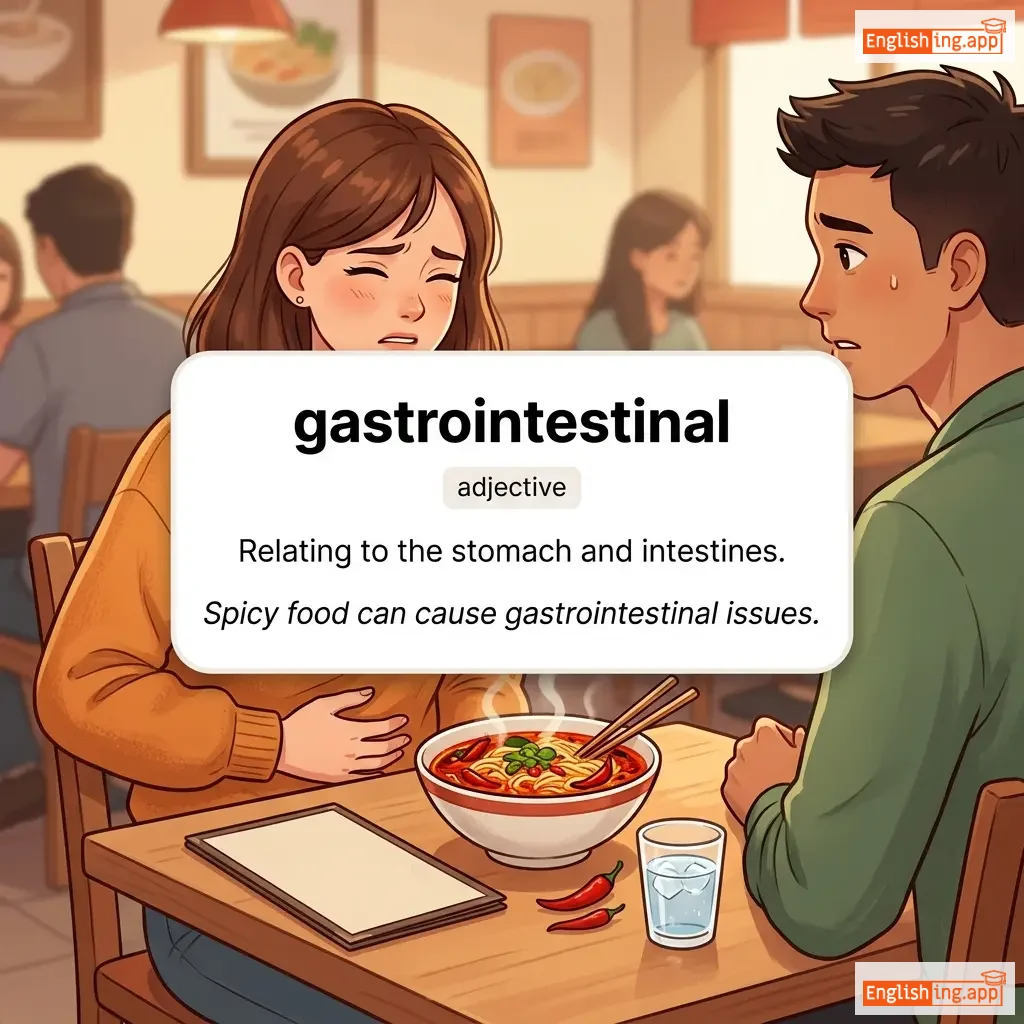
adjective
ˌɡæs.troʊ.ɪnˈtes.tɪ.nəl
胃腸の (ichou no)

Relating to the stomach and intestines.

"Spicy food can cause gastrointestinal issues."

"辛い食べ物は胃腸に問題を引き起こすことがあります。" (Karai tabemono wa ichou ni mondai o hikiokosu koto ga arimasu.)
noun
/ɡæsˈtrɒnəmi/
食文化 (shokubunka)

The art or science of good eating and fine cuisine.

"Paris is famous for its rich tradition of gastronomy."

"パリはその豊かなガストロノミーの伝統で有名です。" (Pari wa sono yutaka na gasutoronomī no dentō de yūmei desu.)
noun
/ɡeɪt/
幸せ (shiawase)

A movable barrier that opens and closes to allow or prevent entry through an opening.

"She closed the gate behind her as she left the garden."

"彼女は賞を受け取ったとき、喜びを隠すことができませんでした。" (Kanojo wa shō o uketotta toki, yorokobi o kakusu koto ga dekimasen deshita.)
noun
/ˈɡeɪt.weɪ/
ゲートウェイ; 入り口 (geetowei; iriguchi)

an entrance or opening that provides access to a place; a means of achieving a particular state or condition

"The ancient stone gateway served as the entrance to the magnificent palace."
"古代の石のゲートウェイは壮大な宮殿の入り口として機能しました。" (Kodai no ishi no geetowei wa sōdaina kyūden no iriguchi toshite kinō shimashita.)
gather definition card — visual illustration of the meaning
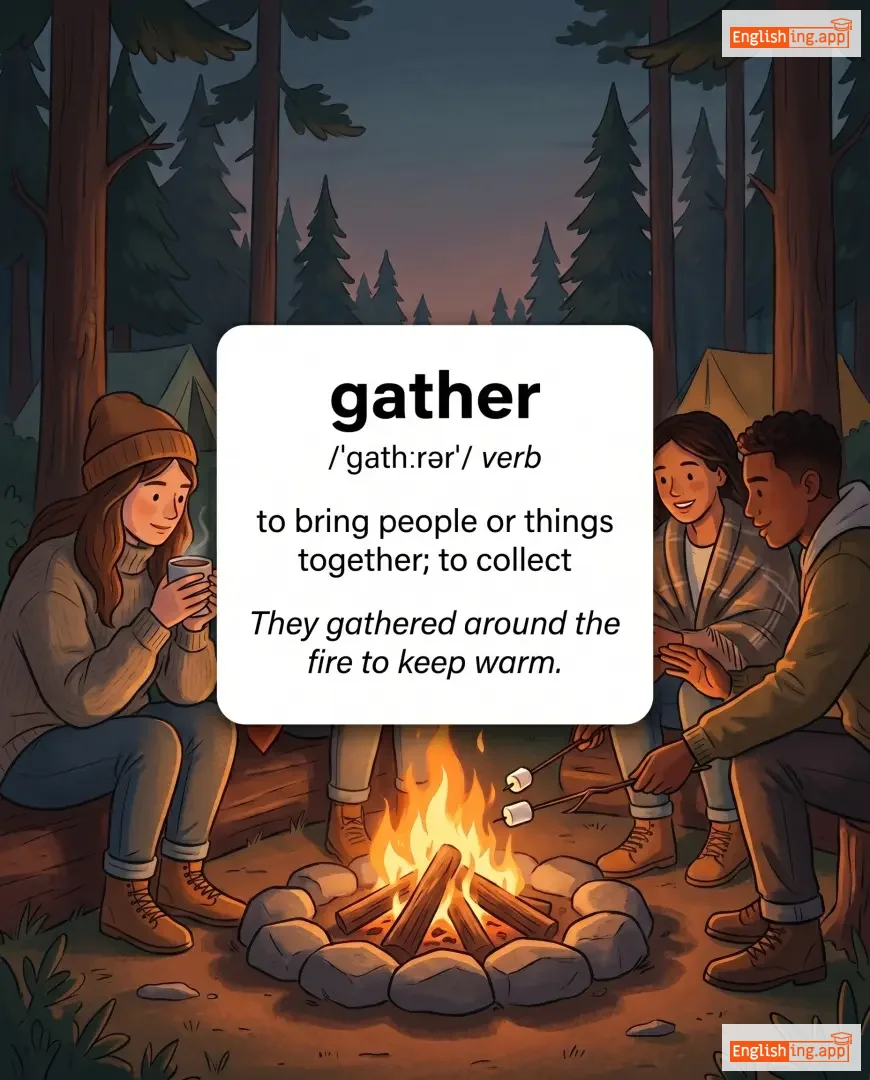
verb
/ˈɡæðər/
集める (atsumeru)

to bring people or things together; to collect

"They gathered around the fire to keep warm."

"彼らは暖かく保つために火の周りに集まりました。" (Karera wa atatakai koto o tamotsu tame ni hi no mawari ni atsumarimashita.)
noun
/ˈɡæðərɪŋ/
集まり (atsumari)

a meeting or assembly of people for a particular purpose

"We attended a family gathering last weekend."
"私たちは先週末、家族の集まりに参加しました。" (Watashitachi wa senshūmatsu, kazoku no atsumari ni sankashimashita.)
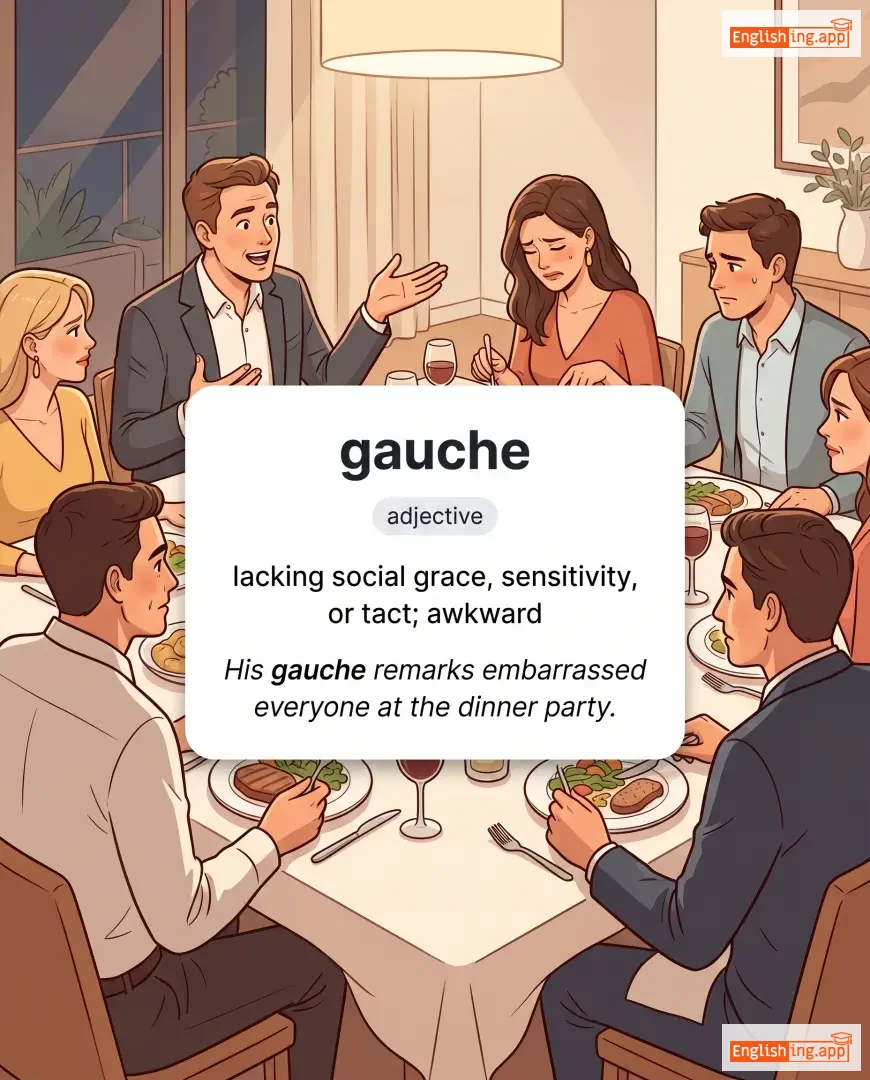
gauche definition card — visual illustration of the meaning
adjective
/ɡoʊʃ/
不器用 (bukiyou)

lacking social grace, sensitivity, or tact; awkward

"His gauche remarks embarrassed everyone at the dinner party."

"彼の不器用なコメントはディナーパーティーで皆を困らせた。" (Kare no bukiyou na komento wa dinā pātī de mina o komarase ta.)
adjective
/ˈɡɔːdi/
けばけばしい (kebakebashi)

excessively showy or flashy, often in a tasteless way

"She wore a gaudy necklace that clashed with her elegant dress."

"彼女は彼女のエレガントなドレスと合わないけばけばしいネックレスを着けていました。" (Kanojo wa kanojo no ereganto na doresu to awanai kebakebashi nekkuresu o tsukete imashita.)
verb
/ɡeɪdʒ/
測定する (sokutei suru)

to measure, estimate, or determine the magnitude, amount, or capacity of something

"The mechanic gauged the pressure in the car tires."

"メカニックは車のタイヤの圧力を測定した。" (Mekanik wa kuruma no taiya no atsuryoku o sokutei shita.)
adjective
/ɡɔːnt/
痩せこけた (yasekoketa)

extremely thin, bony, and haggard in appearance, often due to hunger or illness

"After weeks of illness, he looked pale and gaunt."

"何週間もの病気の後、彼は青白くて痩せこけて見えた。" (Nan shūkan mono byōki no ato, kare wa aoshiroくて yasekokete mieta.)
noun
/ˈɡɔːntlɪt/
ガントレット / 挑戦 (gantoretto / chousen)

a protective glove; a challenge or trial; to 'throw down the gauntlet' means to issue a challenge

"The knight threw down his gauntlet as a sign of challenge."

"騎士は挑戦の印として自分のガントレットを投げた。" (kishi wa chousen no shirushi toshite jibun no gantoretto o nageta.)
noun
/ˈɡævəl/
ガベル (gaberu)

A small ceremonial mallet used by a judge or an auctioneer to signal attention or mark a decision.

"The judge struck the gavel to call the court to order."

"裁判官は法廷に秩序を呼びかけるためにガベルを打った。" (Saibankan wa hōtei ni chitsujo o yobikakeru tame ni gaberu o utta.)
verb
/ɡɔːk/
じっと見る (jitto miru)

To stare openly and rudely.

"Tourists gawked at the celebrity walking down the street."

"観光客は通りを歩く有名人をじっと見ていた。" (Kankōkyaku wa tōri o aruku yūmeijin o jitto mite ita.)
adjective
/ˈɡɔːki/
不器用 (bukiyou)

Awkward and clumsy in appearance or behavior.

"The teenager felt gawky in his oversized suit."

"そのティーンエイジャーは大きすぎるスーツを着て不器用に感じた。" (Sono tīneijā wa ōkisu giru sūtsu o kite bukiyō ni kanjita.)
🏳️‍🌈

gay (ゲイ)

adjective
/ɡeɪ/
ゲイ (gei)

sexually attracted to people of the same sex; also used to mean cheerful or lively

"He came out as gay during college."

"彼は大学でゲイであることをカミングアウトした。" (Kare wa daigaku de gei de aru koto o kamingu auto shita.)
verb
/ɡeɪz/
じっと見る (jitto miru)

To look steadily and intently at something, usually with admiration, surprise, or thought.

"He gazed at the stars in wonder."

"彼は驚きで星を見つめた。" (kare wa odoroki de hoshi o mitsumeta.)
noun
/ɡəˈzɛt/
公報 (kouhou)

An official journal, newspaper, or publication, especially one issued by a government.

"The law was published in the government gazette."

"その法律は政府の公報に掲載されました。" (Sono houritsu wa seifu no kouhou ni keisai saremashita.)
noun
/ɡɪə(r)/
装備 / ギア (sōbi / gia)

Equipment or apparatus for a particular purpose; also a toothed wheel in machinery.

"The climber packed all his gear before starting the journey."

"登山者は旅を始める前にすべてのギアをパックしました。" (Tozan-sha wa tabi o hajimeru mae ni subete no gia o pakkushimashita.)
noun
/dʒem/
宝石 (houseki)

a precious or semi-precious stone, especially when cut and polished or engraved

"She wore a beautiful gem necklace to the party."

"彼女はパーティーに美しい宝石のネックレスをしていました。" (Kanojo wa paatii ni utsukushii houseki no nekuresu o shite imashita.)
noun
/ˈʒɑːndɑːrm/
ジャンダールム (jandaarumu)

A French police officer, especially a member of a military-style police force.

"The gendarme stopped the car for a routine check."

"ジャンダールムは定期的なチェックのために車を止めた。" (Jandaarumu wa teikiteki na chekku no tame ni kuruma o tometa.)
noun
/ˈdʒɛndər/
性別 (seibetsu)

The state of being male, female, or another identity as recognized socially or culturally.

"The survey asked about participants' age and gender."

"調査は参加者の年齢と性別について尋ねました。" (Chousa wa sanka-sha no nenrei to seibetsu ni tsuite tazunemashita.)
noun
/dʒiːn/
遺伝子 (iden-shi)

A unit of heredity in living organisms, transferred from parent to offspring, determining traits.

"Eye color is influenced by genes inherited from parents."

"目の色は親から受け継いだ遺伝子によって影響を受けます。" (me no iro wa oya kara uketsuida idenshi ni yotte eikyo o ukemasu.)
noun
/ˌdʒiːniˈælədʒɪst/
系譜学者 (keifu gakusha)

A person who studies or traces the history of families and their lineages.

"The genealogist uncovered records dating back to the 18th century."

"系譜学者は18世紀に遡る記録を発見した。" (Keifu gakusha wa 18 seiki ni sakanoboru kiroku o hakken shita.)
noun
/ˌdʒiːniˈælədʒi/
系図学 (keizugaku)

The study and tracing of lines of descent or family history.

"She spent years researching her family's genealogy."

"彼女は家族の系図学を研究するのに何年も費やしました。" (Kanojo wa kazoku no keizugaku o kenkyū suru no ni nan-nen mo費やしました.)
adjective
/ˈdʒɛnərəl/
一般的 (ippan-teki)

Relating to all or most people, things, or situations; not specific.

"He made a general comment about the project."

"彼はプロジェクトに関する一般的なコメントをしました。" (Kare wa purojekuto ni kansuru ippan-teki na komento o shimashita.)
noun
/ˌdʒenəˈræləti/
一般性 (ippan-sei)

A vague, non-specific statement or principle that applies broadly.

"The speech was full of generalities and lacked concrete details."

"スピーチは一般的な内容で、具体的な詳細が欠けていました。" (Supīchi wa ippan-teki na naiyō de, gutai-teki na shōsai ga kakete imashita.)
verb
/ˈdʒenərəlaɪz/
一般化する (ippan-ka suru)

To make a broad statement by inferring from specific cases.

"It is wrong to generalize based on a few experiences."

"いくつかの経験に基づいて一般化するのは間違っています。" (Ikutsuka no keiken ni motozuite ippan-ka suru no wa machigatte imasu.)
adverb
/ˈdʒɛnərəli/
一般的に (ippanteki ni)

in most cases; usually; as a rule

"He generally arrives at work before 9 a.m."
"彼は一般的に午前9時前に仕事に到着します。" (Kare wa ippanteki ni gozen 9 ji mae ni shigoto ni touchakushimasu.)
verb
/ˈdʒɛnəreɪt/

to produce or create something

"The machine generates electricity."

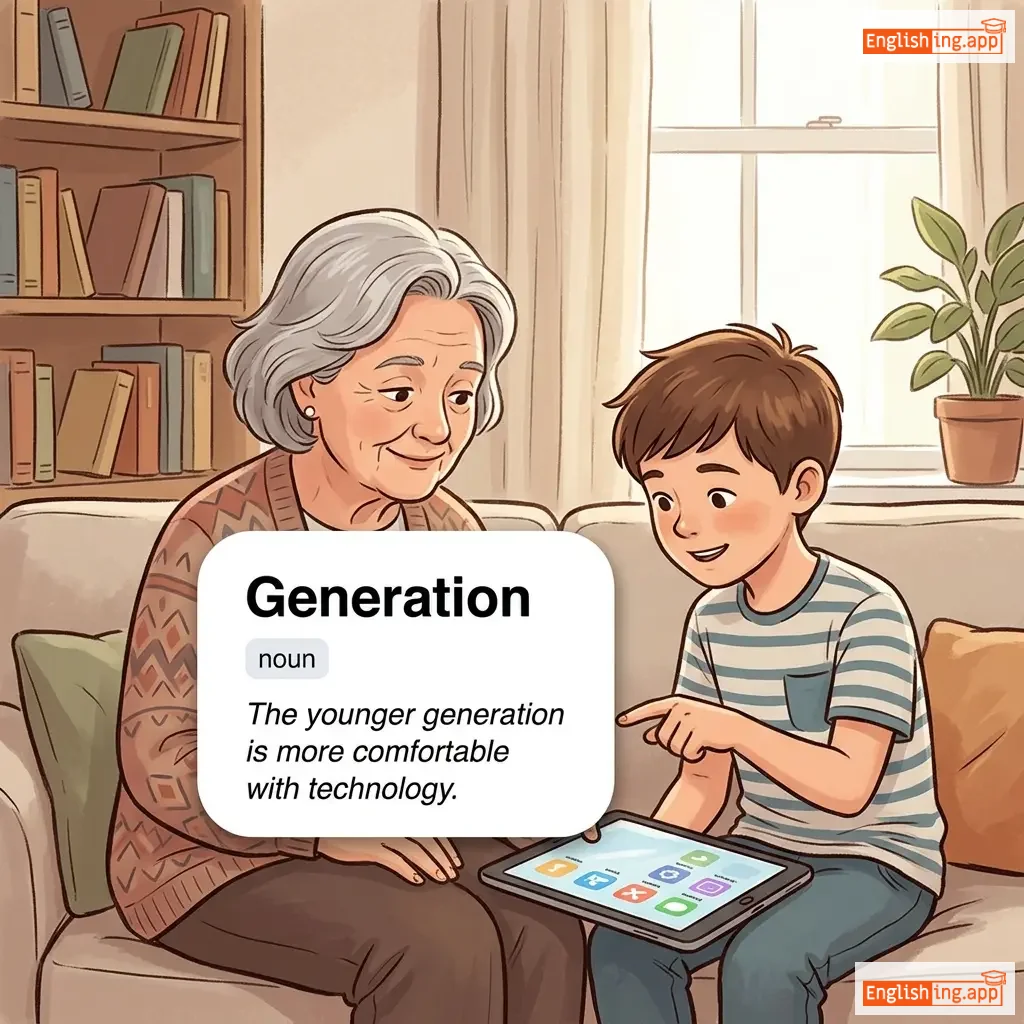
Generation definition card — visual illustration of the meaning
noun
/ˌdʒɛnəˈreɪʃən/
世代 (sedai)

all the people born and living at about the same time; the process of producing something

"The younger generation is more comfortable with technology."

"若い世代はテクノロジーにもっと慣れています。" (wakai sedai wa tekunorojī ni motto nareteimasu.)