वोकैबुलरीज

इंग्लिश वोकैबुलरी डिस्कवर, लर्न और मास्टर करें

verb
/spɪt/
थूकना (thookna)

to force liquid, especially saliva, out of the mouth

"He spat on the ground in anger."

"उसने गुस्से में ज़मीन पर थूक दिया।" (Usne gusse mein zameen par thook diya.)
noun
/spaɪt/
द्वेष (dwesh)

a desire to hurt, annoy, or offend someone

"She refused the gift out of spite."

"उसने द्वेषवश उपहार को ठुकरा दिया।" (Usne dweshvash uphaar ko thukra diya.)
noun
/spliːn/
प्लीहा; क्रोध (pliha; krodh)

an organ in the body that produces lymphocytes and filters blood; also refers to bad temper or spite

"He vented his spleen on his coworkers after the meeting."

"उसने बैठक के बाद अपने सहकर्मियों पर अपना गुस्सा निकाला।" (Usne baithak ke baad apne sahakarmiyon par apna gussa nikala.)
adjective
/ˈsplendɪd/
शानदार; उत्कृष्ट; बहुत प्रभावशाली (shandar; utkrsht; bahut prabhavshali)

magnificent; excellent; very impressive

"The castle looked splendid in the sunset."

"महल सूर्योदय में शानदार लग रहा था।" (mahal suryoday mein shandar lag raha tha.)
adjective
/splɪˈnɛtɪk/
चिड़चिड़ा, खुन्नस रखने वाला (chidchida, khunnas rakhne wala)

bad-tempered, irritable, spiteful

"His splenetic remarks offended everyone in the room."

"उसकी चिड़चिड़ी टिप्पणियाँ कमरे में सभी को आहत कर गईं।" (Uski chidchidi tippaniyan kamre mein sabhi ko aahat kar gayi.)
verb
/splaɪs/
जोड़ना (jodna)

to join two pieces of rope, film, or other material by weaving or attaching them together

"The technician spliced the two wires to restore the connection."

"टेक्नीशियन ने दो तारों को जोड़कर कनेक्शन बहाल किया।" (Technician ne do taaron ko jodkar connection bahaal kiya.)
/splɪnt/
स्प्लिंट (splint)

A rigid device used to support and immobilize a broken or injured body part.

"The doctor applied a splint to stabilize the patient's broken arm."

"डॉक्टर ने मरीज के टूटे हुए हाथ को स्थिर करने के लिए स्प्लिंट लगाया।" (Doktor ne mareez ke toote hue haath ko sthir karne ke liye splint lagaya.)
verb
/splɪt/
विभाजित करना (vibhajit karna)

to divide or separate into parts or groups

"He split the log in two with an axe."

"उसने कुल्हाड़ी से लकड़ी को दो हिस्सों में काट दिया।" (Usne kulhadi se lakdi ko do hisso mein kaat diya.)
verb
/spɔɪl/
नष्ट करना (naṣṭ karna)

to damage or ruin something

"The rain spoiled the outdoor event."

"बारिश ने आउटडोर इवेंट को खराब कर दिया।" (Bāriś nē ā'ūṭḍōr īvēnṭ kō khrāb kar diyā.)
noun
/ˈspɔɪlˌspɔːrt/
मज़ा ख़त्म करने वाला (maza khatm karne wala)

A person who ruins other people's enjoyment or fun.

"Don't be a spoilsport and let us enjoy the party."

"मज़ा ख़त्म करने वाला मत बनो और हमें पार्टी का आनंद लेने दो।" (Maza khatm karne wala mat bano aur humein party ka anand lene do.)
noun/verb
/spiːd/
गति (gati)

the rate at which something moves or happens

"The car was moving at high speed."

"गाड़ी तेज़ गति में चल रही थी।" (Gaadi tez gati mein chal rahi thi.)
verb
/ˈʃɔːrtn/
छोटा करना (chhota karna)

To make something shorter in length, duration, or extent

"She decided to shorten her speech to fit the time limit."

"उसने समय सीमा में फिट होने के लिए अपना भाषण छोटा करने का निर्णय लिया।" (Usne samay seema mein fit hone ke liye apna bhaashan chhota karne ka nirnay liya.)
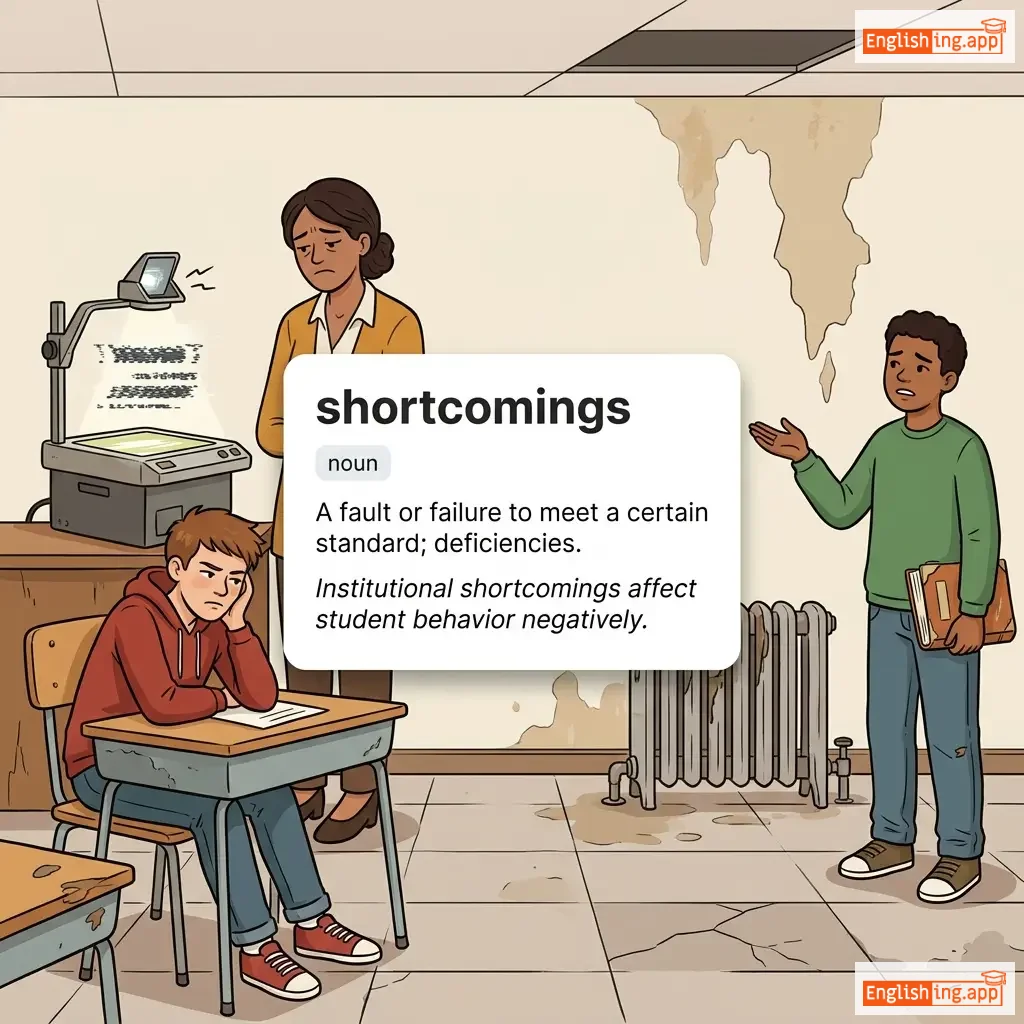
shortcomings definition card — visual illustration of the meaning
noun
ˈʃɔːtkʌmɪŋz
कमियाँ (kamiyaan)

A fault or failure to meet a certain standard; deficiencies.

"Institutional shortcomings affect student behavior negatively."

"संस्थान की कमियाँ छात्र व्यवहार को नकारात्मक रूप से प्रभावित करती हैं।" (Sansthan ki kamiyaan chhatra vyavhaar ko nakaratmak roop se prabhavit karti hain.)
noun
/ˈʃɔːrt.kʌm.ɪŋ/
अवगति; कमी; दोष (avgati; kami; dosh)

a fault or failure to meet a certain standard; a deficiency

"Despite his many talents, he has some shortcomings."

"इसके कई गुणों के बावजूद, उसके कुछ अवगति हैं।" (iske kai gunon ke bawajood, uske kuch avgati hain)
noun
/ˈʃɔːrtɪdʒ/
कमी (kami)

a state or situation in which something needed cannot be obtained in sufficient amounts

"There is a shortage of skilled workers in the industry."

"उद्योग में कुशल श्रमिकों की कमी है।" (Udyog mein kushal shramikon ki kami hai.)
short-term definition card — visual illustration of the meaning
adjective
/ˈʃɔːrt tɜːrm/
संक्षिप्तकालिक (sankshiptakalik)

lasting for or involving a short period of time

"They offered a short-term loan to help the business."

"उन्होंने व्यापार को सहायता प्रदान करने के लिए एक संक्षिप्तकालिक ऋण दिया।" (Unhone vyapar ko sahayata pradan karne ke liye ek sankshiptakalik rin diya.)
adjective
/ˈʃɔːrt ˌtempərd/
जल्दी गुस्सा हो जाने वाला; आसानी से नाराज होने वाला (jaldi gussa ho jane wala; aasani se naaraaz hone wala)

quick to lose one's temper; easily angered

"She became short-tempered when the traffic made her late for the meeting."

"वह मीटिंग के लिए देर हो जाने पर जल्दी गुस्से में आ गई।" (vah meeting ke liye der ho jaane par jaldi gusse mein aa gayi.)
adjective
/ˈʃɔːrt ˌsaɪtɪd/
दूरदर्शिता हीन; संकुचित दृष्टिकोण (door-darshita heen; sankuchit drishti-kon)

lacking foresight or consideration for the future; myopic

"His short-sighted decision to quit school early affected his career prospects."

"उसका शॉर्ट-साइटेड निर्णय स्कूल जल्दी छोड़ने का उसके करियर के दृष्टिकोण को प्रभावित किया।" (uska short-sighted nirnay school jaldi chhodne ka uske career ke drishti-kon ko prabhavit kiya.)
adjective
/ʃɔːrt/
छोटा (chhota)

having little length or duration

"She wore a short dress for the party."

"उसने पार्टी के लिए एक शॉर्ट ड्रेस पहनी।" (Usne party ke liye ek short dress pehni.)
noun
/ʃɔːr/
तट (tat)

the land along the edge of a sea, lake, or other large body of water

"We walked along the shore of the lake."

"हम झील के किनारे पर चल रहे थे।" (Hum jheel ke kinare par chal rahe the.)
adjective
/ˈʃɑːpwɔːrn/
पुराना / फीका (purana / feeka)

worn or faded from being displayed in a shop; no longer fresh or original

"The shopworn shoes were sold at a discount."

"शॉपवॉर्न जूते डिस्काउंट पर बेचे गए थे।" (Shopworn joote discount par beche gaye the.)
noun
/ˈʃɒpɪŋ/
खरीदारी (khareedari)

the activity of going to shops to buy things

"She spent the afternoon shopping for clothes."

"उसने कपड़े खरीदने के लिए दोपहर शॉपिंग में बिताई।" (Usne kapde kharidne ke liye dopahar shopping mein bitayi.)
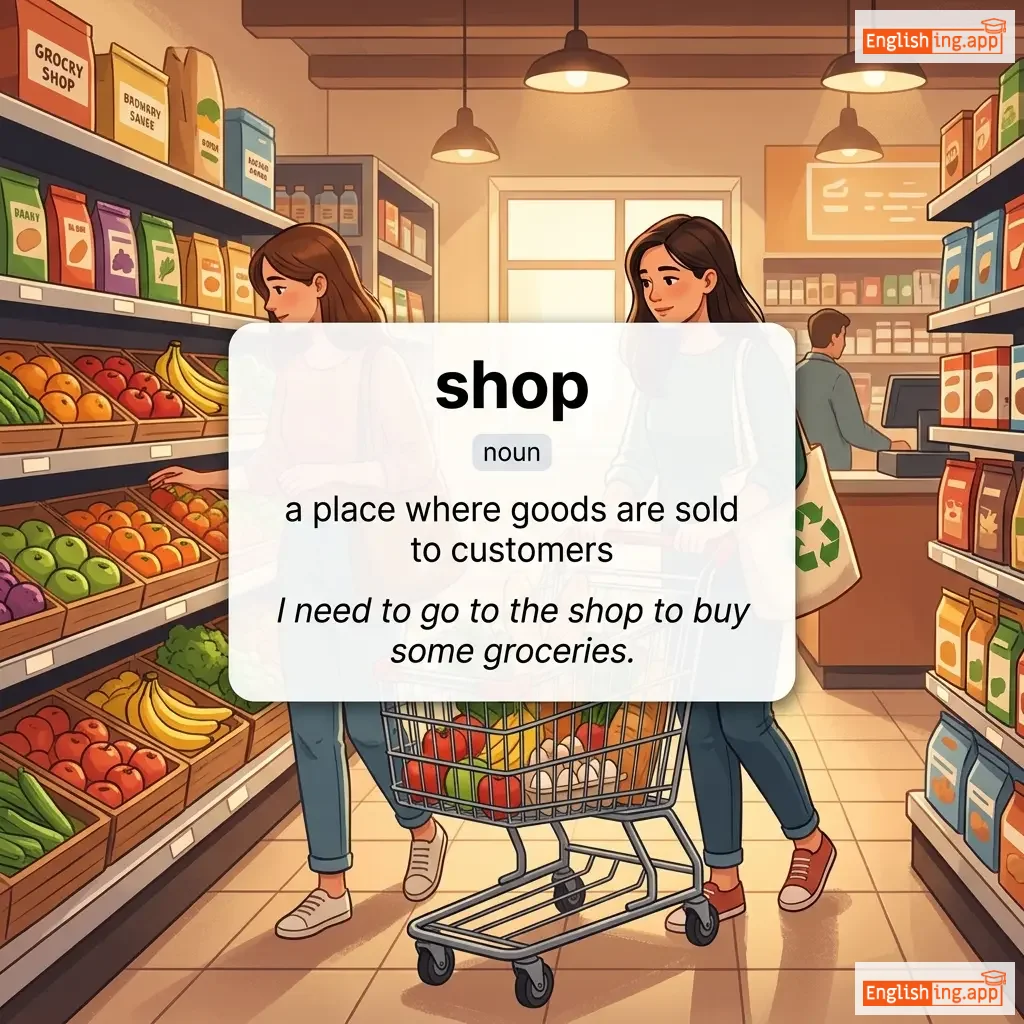
shop definition card — visual illustration of the meaning
noun
/ʃɒp/
दुकान (dukaan)

a place where goods are sold to customers

"I need to go to the shop to buy some groceries."

"मुझे कुछ किराने का सामान खरीदने के लिए शॉप पर जाना है।" (Mujhē kuch kirānē kā sāmaan kharīdnē kē liye shop par jānā hai.)
noun
/ˈʃuːtɪŋ/
शूटिंग (shooting)

the action of shooting a gun, camera, or similar device

"The shooting of the movie took several months."

"फिल्म की शूटिंग में कई महीने लग गए।" (Film kī shooting mein kaī mahīne lag ga'e.)
verb
/ʃuːt/
गोली चलाना / तस्वीर लेना (goli chalana / tasveer lena)

to fire a bullet or arrow from a weapon; to take a photograph or film

"He learned how to shoot a bow and arrow."

"उसने धनुष और बाण चलाने का तरीका सीखा।" (Usne dhanush aur baan chalane ka tareeka seekha.)
noun
/ʃuː/
जूता (joota)

a covering for the foot, typically made of leather, with a sturdy sole and heel

"She bought a new pair of shoes for the wedding."

"उसने शादी के लिए एक नया जोड़ा जूते खरीदे।" (Usne shaadi ke liye ek naya joda jute khareede.)
adjective
/ˈʃɑːdi/
नकली (nakli)

badly made or done; of poor quality

"The contractor did a shoddy job on the repairs."

"ठेकेदार ने मरम्मत में नकली काम किया।" (Thekedaar ne marammat mein nakli kaam kiya.)
adjective
/ˈʃɒkɪŋ/
चकित करने वाला (chakit karne wala)

causing surprise or disbelief; startling

"The news of the accident was shocking to everyone."

"दुर्घटना की खबर सभी के लिए चौंकाने वाली थी।" (Durghatna ki khabar sabhi ke liye chonkaane wali thi.)
noun
/ʃɒk/
आघात (āghāt)

a sudden upsetting or surprising event or experience

"The news of his sudden departure was a shock to everyone."

"उसकी अचानक departure की खबर सबके लिए शॉक थी।" (Uski achānak departure kī khabar sabke liye shock thī.)
noun
/ʃoʊl/
झुंड (jhund)

a large group of fish swimming together; a shallow place in water

"We saw a shoal of fish near the coast."

"हमने समुद्र तट के पास मछलियों का झुंड देखा।" (Humne samudra tat ke paas machhliyon ka jhund dekha.)
noun
/ʃɪt/
गोबर (gobar)

a vulgar term for feces or excrement

"The dog made a mess by leaving its shit on the floor."

"कुत्ते ने मंजिल पर अपनी शिट छोड़कर गड़बड़ कर दी।" (Kutte ne manzil par apni shit chhodkar gadbad kar di.)
noun
/ʃɜːrt/
शर्ट (shirt)

a piece of clothing worn on the upper body, usually with sleeves and a collar

"He wore a blue shirt to the party."

"उसने पार्टी में नीली शर्ट पहनी थी।" (Usne party mein neeli shirt pehni thi.)
verb
/ʃɜːrk/
बचना (bachna)

to avoid or neglect a duty or responsibility

"He always tries to shirk his responsibilities at work."

"वह हमेशा अपने काम के जिम्मेदारियों से बचने की कोशिश करता है।" (vah hamesha apne kaam ke jimmedariyon se bachne ki koshish karta hai.)
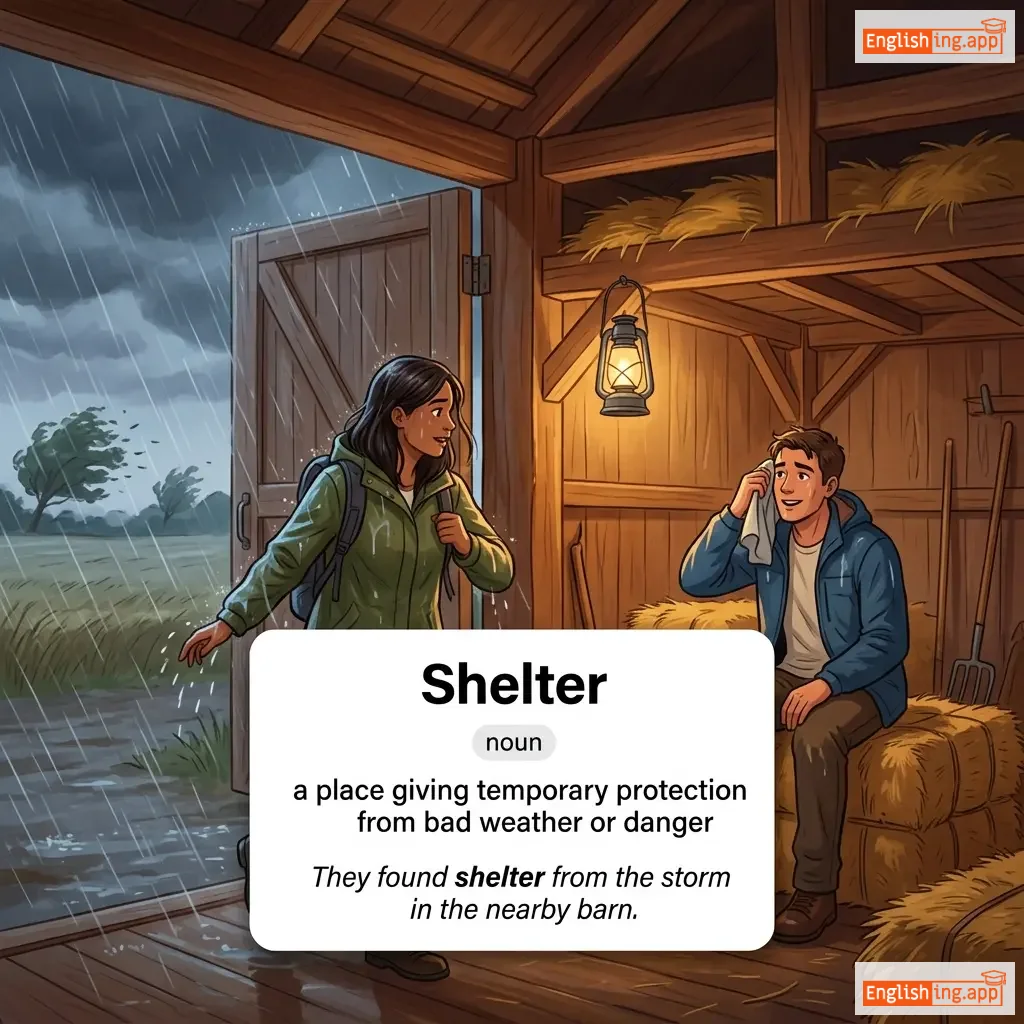
Shelter definition card — visual illustration of the meaning
noun
/ˈʃɛltər/
आश्रय (ashray)

a place giving temporary protection from bad weather or danger

"They found shelter from the storm in the nearby barn."

"उन्होंने आंधी से बचने के लिए पास के गोशाला में शरण ली।" (Unhone aandhi se bachne ke liye paas ke goshala mein sharan li.)
pronoun
/ʃi/
वह (woh)

a female person or animal previously mentioned or easily identified

"She is going to the market to buy vegetables."

"वह बाजार में सब्जियाँ खरीदने जा रही है।" (Woh bazaar mein sabziyan kharidne ja rahi hai.)
noun
/ʃiːf/
गेहूं की बंडल (gehun ki bundel)

a bundle of grain stalks laid lengthwise and tied together after reaping; a bundle of objects tied together

"The farmer carried a sheaf of wheat on his shoulder."

"किसान अपने कंधे पर गेहूं का शीफ़ ले कर चल रहा था।" (Kisan apne kandhe par gehun ka sheaf le kar chal raha tha.)
verb
/ʃɪə/
काटना (katna)

to cut the wool off a sheep or to cut something with sharp tools like scissors or shears

"The farmer will shear the sheep in the spring."

"किसान बसंत में भेड़ की ऊन काटेंगे।" (Kisan basant mein bhed ki un katenge.)
noun
/ʃiːt fɪʃ/
बोयल मछली (boayal machhli)

A large freshwater catfish with a broad flat head and long barbels

"The sheat-fish is one of the largest freshwater fish in South Asia."

"बोयल मछली दक्षिण एशिया की सबसे बड़ी मीठे पानी की मछलियों में से एक है।" (boayal machhli dakshin ashiya ki sabse badi meethe pani ki machhliyon mein se ek hai)
verb
/ʃiːð/
खाप में डालना (khap mein daalna)

to put a sword or knife back into its cover

"He quickly sheathed his sword after the duel."

"वह द्वंद्वयुद्ध के बाद जल्दी से अपनी तलवार खापे में डाल दी।" (Vah dvandvayudh ke baad jaldi se apni talwar khape mein daal di.)
verb
/ʃɛd/
झड़ना (jhadna)

to let something fall off naturally, such as leaves, hair, or tears

"Trees shed their leaves in autumn."

"पेड़ पतझड़ में अपने पत्ते झड़ते हैं।" (Ped patjhad mein apne patte jhadte hain.)
noun
/ʃiːp/
भेड़ (bhed)

a farm animal with thick wool that is raised for its wool, meat, and milk

"The farmer keeps a large flock of sheep."

"किसान एक बड़ी भेड़-बकरियों की झुंड रखते हैं।" (Kisaan ek badi bhed-bakriyon ki jhund rakhte hain.)
adjective
/ʃɪə/
पूर्ण (poorn)

complete and utter; very steep or transparent

"The cliff was a sheer drop into the sea."

"चट्टान समुद्र में एक पूरी ढलान थी।" (Chattan samudra mein ek poori dhalan thi.)
noun
/ʃiːt/
चादर (chadar)

a large piece of cloth or paper, typically used to cover or protect something

"I need a clean sheet to cover the bed."

"मुझे बिस्तर को ढकने के लिए एक साफ़ शीट चाहिए।" (Mujhe bistar ko dhakne ke liye ek saaf sheet chahiye.)
noun
/ʃɛlf/
शेल्फ (shelf)

a flat surface used for storing or displaying things, typically fixed to a wall or inside a cabinet

"I placed the books on the shelf next to the window."

"मैंने खिड़की के पास शेल्फ पर किताबें रखी।" (Maine khidki ke paas shelf par kitaabein rakhi.)
noun
/ʃɛl/
शंख (shankh)

the hard outer covering of a mollusk or a crustacean, or something similar

"She picked up a beautiful seashell on the beach."

"उसने समुद्र तट पर एक सुंदर शंख उठाया।" (Usne samudra tat par ek sundar shankh uthaya.)
adjective
/ˈʃaɪ.ni/
चमकदार; चमचमाता; (chamakdar; chamchamata;)

reflecting light; bright and polished; glossy

"The shiny new car caught everyone's attention."

"चमकदार नई कार ने सभी का ध्यान आकर्षित किया।" (chamakdar nai car ne sabhi ka dhyan aakarshit kiya.)
verb
/ˈʃɪmər/
चमकना (chamakna)

To shine with a soft, wavering light.

"The lake shimmered under the moonlight."

"चाँदनी रात में झील चमक रही थी।" (Chandani raat mein jheel chamak rahi thi.)
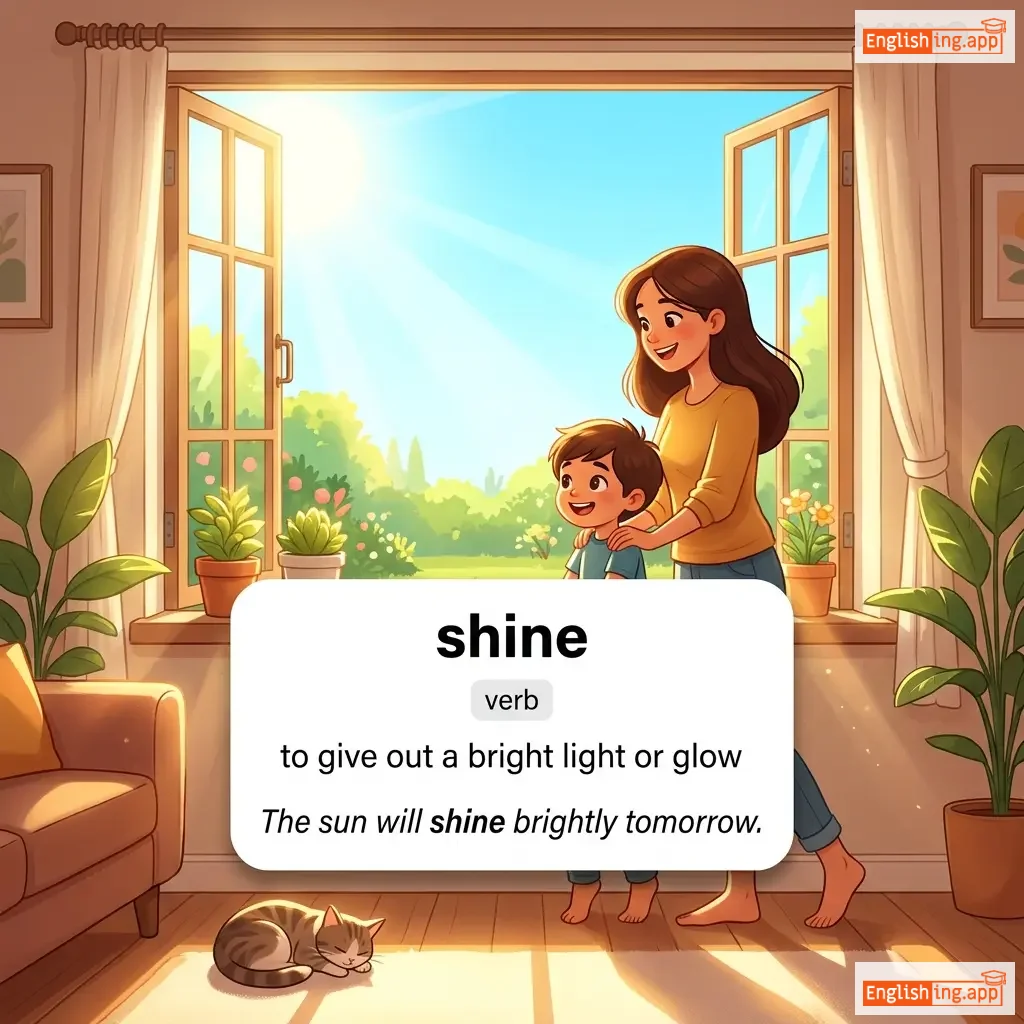
shine definition card — visual illustration of the meaning
verb
/ʃaɪn/
चमकना (chamakna)

to give out a bright light or glow

"The sun will shine brightly tomorrow."

"सूरज कल चमकदार तरीके से चमकेगा।" (Suraj kal chamakdaar tareeke se chamkega.)
adjective
/ˈʃɪft.ləs/
आलसी (aalsi)

Lacking ambition or the ability to accomplish anything; lazy and unmotivated.

"He was seen as a shiftless young man with no goals."

"उसे एक आलसी युवक के रूप में देखा गया, जिसके पास कोई लक्ष्य नहीं था।" (Use ek aalsi yuva ke roop mein dekha gaya, jiske paas koi lakshya nahi tha.)
noun
/ʃɪp/
जहाज़ (jahaz)

a large boat used for travel or transporting goods across water

"The ship set sail across the ocean."

"जहाज़ ने महासागर के पार यात्रा शुरू की।" (Jahaz ne mahaasagar ke paar yatra shuru ki.)