Vocabulaires

Découvrez, apprenez et maîtrisez le vocabulaire anglais

verb
/spɪt/
cracher (cracher)

to force liquid, especially saliva, out of the mouth

"He spat on the ground in anger."

"Il a craché par terre en colère." (Il a craché par terre en colère.)
noun
/spaɪt/
rancune (rancune)

a desire to hurt, annoy, or offend someone

"She refused the gift out of spite."

"Elle a refusé le cadeau par rancune." (Elle a refuse le cadeau par rancune.)
noun
/spliːn/
rate; colère (rate; colere)

an organ in the body that produces lymphocytes and filters blood; also refers to bad temper or spite

"He vented his spleen on his coworkers after the meeting."

"Il a exprimé sa colère sur ses collègues après la réunion." (Il a exprime sa colere sur ses collegues apres la reunion.)
adjective
/ˈsplendɪd/
splendide; magnifique; impressionnant (splendide; magnifique; impressionnant)

magnificent; excellent; very impressive

"The castle looked splendid in the sunset."

"Le château semblait splendide au coucher du soleil." (Le chateau semblait splendide au coucher du soleil.)
adjective
/splɪˈnɛtɪk/
irritable, colérique (irritable, colérique)

bad-tempered, irritable, spiteful

"His splenetic remarks offended everyone in the room."

"Ses remarques colériques ont offensé tout le monde dans la pièce." (Ses remarques colériques ont offensé tout le monde dans la pièce.)
verb
/splaɪs/
joindre (joindre)

to join two pieces of rope, film, or other material by weaving or attaching them together

"The technician spliced the two wires to restore the connection."

"Le technicien a joint les deux fils pour restaurer la connexion." (Le technicien a joint les deux fils pour restaurer la connexion.)
/splɪnt/
attelle (attelle)

A rigid device used to support and immobilize a broken or injured body part.

"The doctor applied a splint to stabilize the patient's broken arm."

"Le médecin a appliqué une attelle pour stabiliser le bras cassé du patient." (Le medecin a applique une attelle pour stabiliser le bras casse du patient.)
verb
/splɪt/
diviser (diviser)

to divide or separate into parts or groups

"He split the log in two with an axe."

"Il a fendu le tronc en deux avec une hache." (Il a fendu le tronc en deux avec une hache.)
verb
/spɔɪl/
gâcher (gâcher)

to damage or ruin something

"The rain spoiled the outdoor event."

"La pluie a gâché l'événement en plein air." (La pluie a gâché l'événement en plein air.)
noun
/ˈspɔɪlˌspɔːrt/
rabat-joie (rabat-joie)

A person who ruins other people's enjoyment or fun.

"Don't be a spoilsport and let us enjoy the party."

"Ne sois pas un rabat-joie et laisse-nous profiter de la fête." (Ne sois pas un rabat-joie et laisse-nous profiter de la fête.)
noun/verb
/spiːd/
vitesse (vitesse)

the rate at which something moves or happens

"The car was moving at high speed."

"La voiture roulait à grande vitesse." (La voiture roulait à grande vitesse.)
verb
/ˈʃɔːrtn/
raccourcir (raccourcir)

To make something shorter in length, duration, or extent

"She decided to shorten her speech to fit the time limit."

"Elle a décidé de raccourcir son discours pour respecter la limite de temps." (Elle a decide de raccourcir son discours pour respecter la limite de temps.)
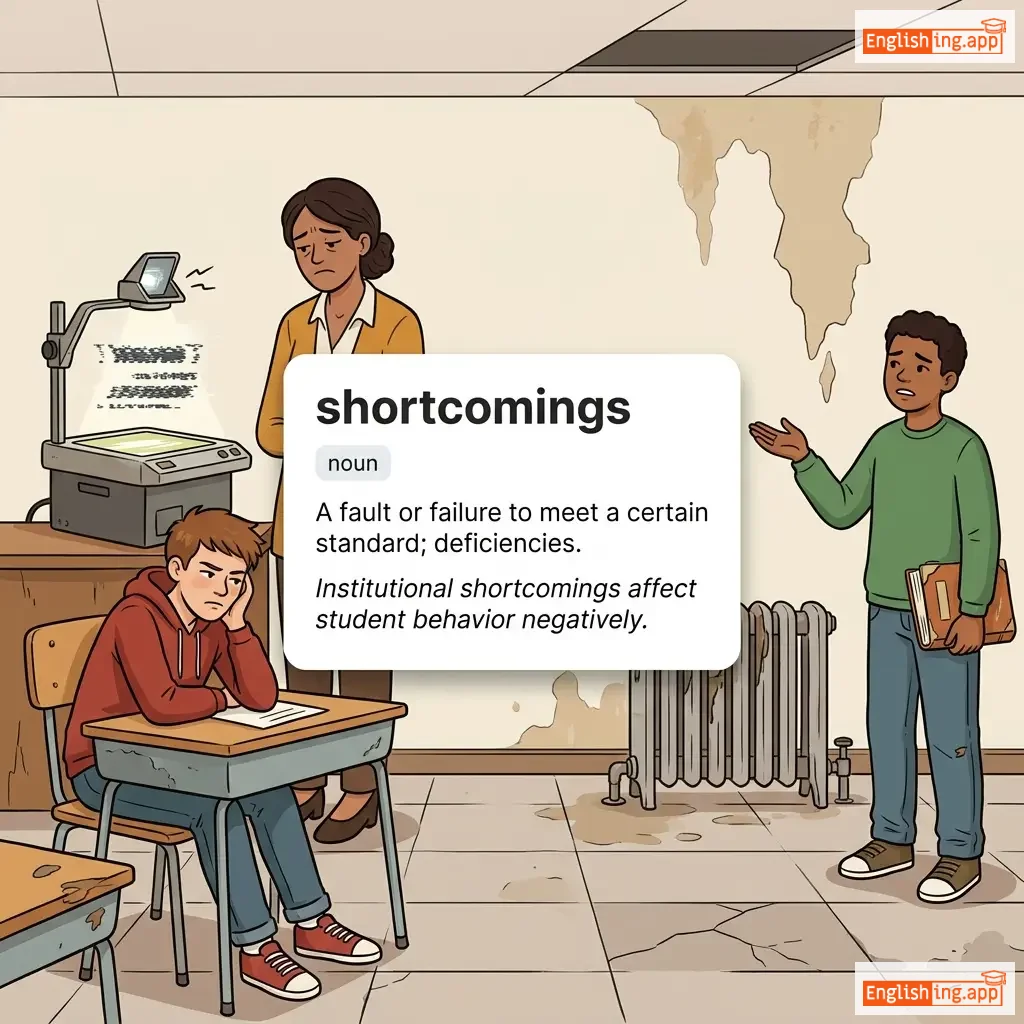
shortcomings definition card — visual illustration of the meaning
noun
ˈʃɔːtkʌmɪŋz
lacunes (lacunes)

A fault or failure to meet a certain standard; deficiencies.

"Institutional shortcomings affect student behavior negatively."

"Les lacunes institutionnelles affectent négativement le comportement des étudiants." (Les lacunes institutionnelles affectent négativement le comportement des étudiants.)
noun
/ˈʃɔːrt.kʌm.ɪŋ/
lacune; défaut; carence (lacune; défaut; carence)

a fault or failure to meet a certain standard; a deficiency

"Despite his many talents, he has some shortcomings."

"Malgré ses nombreux talents, il a quelques lacunes." (Malgré ses nombreux talents, il a quelques lacunes.)
noun
/ˈʃɔːrtɪdʒ/
pénurie (penurie)

a state or situation in which something needed cannot be obtained in sufficient amounts

"There is a shortage of skilled workers in the industry."

"Il y a une pénurie de travailleurs qualifiés dans l'industrie." (Il y a une penurie de travailleurs qualifies dans l'industrie.)
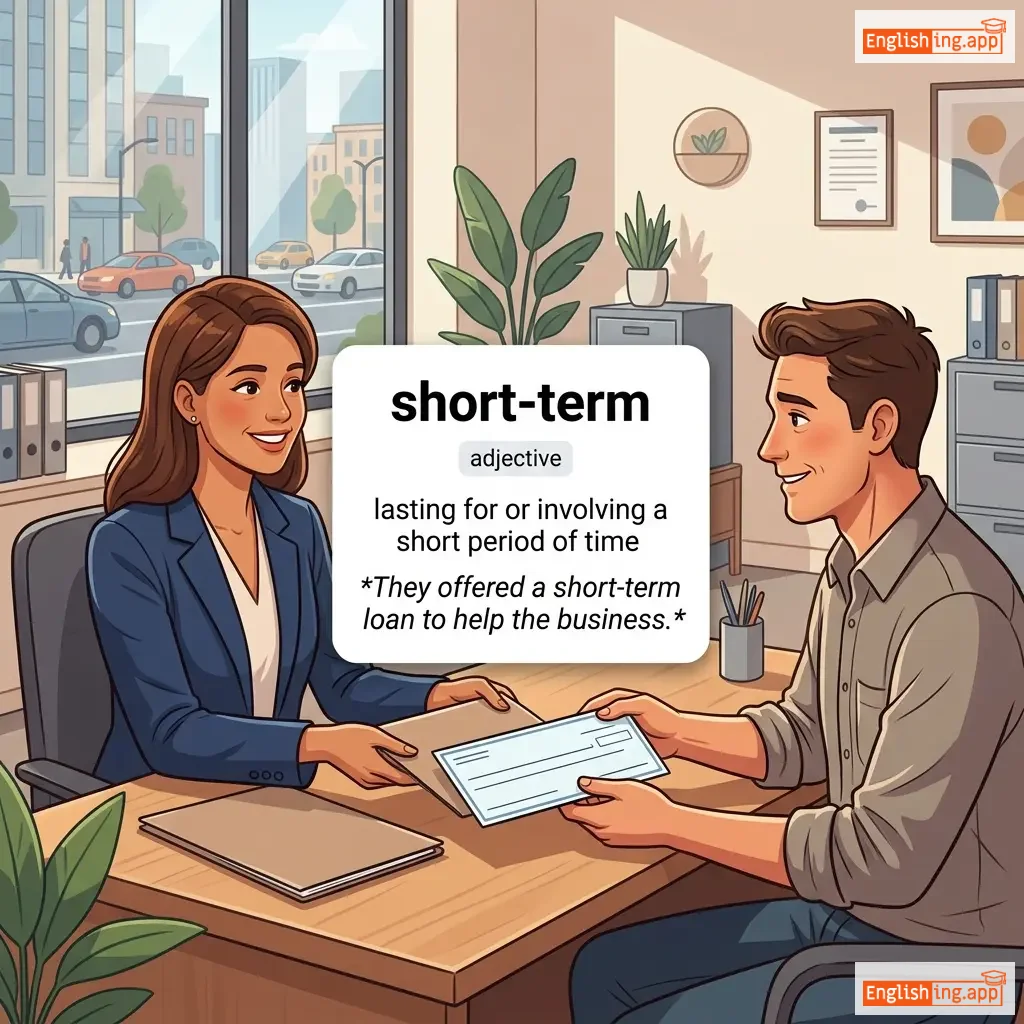
short-term definition card — visual illustration of the meaning
adjective
/ˈʃɔːrt tɜːrm/
à court terme (a court terme)

lasting for or involving a short period of time

"They offered a short-term loan to help the business."

"Ils ont offert un prêt à court terme pour aider l'entreprise." (Ils ont offert un prêt à court terme pour aider l'entreprise.)
adjective
/ˈʃɔːrt ˌtempərd/
irritable; facilement en colère (irritable; facilement en colere)

quick to lose one's temper; easily angered

"She became short-tempered when the traffic made her late for the meeting."

"Elle est devenue irritable lorsque le trafic l'a rendue en retard pour la réunion." (Elle est devenue irritable lorsque le trafic l'a rendue en retard pour la reunion.)
adjective
/ˈʃɔːrt ˌsaɪtɪd/
myopie; vision à court terme (myopie; vision a court terme)

lacking foresight or consideration for the future; myopic

"His short-sighted decision to quit school early affected his career prospects."

"Sa décision à court terme d'abandonner l'école tôt a affecté ses perspectives de carrière." (sa decision a court terme d'abandonner l'ecole tot a affecte ses perspectives de carriere.)
adjective
/ʃɔːrt/
court (kur)

having little length or duration

"She wore a short dress for the party."

"Elle portait une robe courte pour la fête." (Elle portait une robe courte pour la fête.)
noun
/ʃɔːr/
rive (rive)

the land along the edge of a sea, lake, or other large body of water

"We walked along the shore of the lake."

"Nous avons marché le long de la rive du lac." (Nous avons marché le long de la rive du lac.)
adjective
/ˈʃɑːpwɔːrn/
usé / vieilli (use / vieilli)

worn or faded from being displayed in a shop; no longer fresh or original

"The shopworn shoes were sold at a discount."

"Les chaussures shopworn ont été vendues à prix réduit." (Les chaussures shopworn ont été vendues à prix réduit.)
noun
/ˈʃɒpɪŋ/
achats (achats)

the activity of going to shops to buy things

"She spent the afternoon shopping for clothes."

"Elle a passé l'après-midi à faire du shopping pour des vêtements." (Elle a passé l'après-midi à faire du shopping pour des vêtements.)
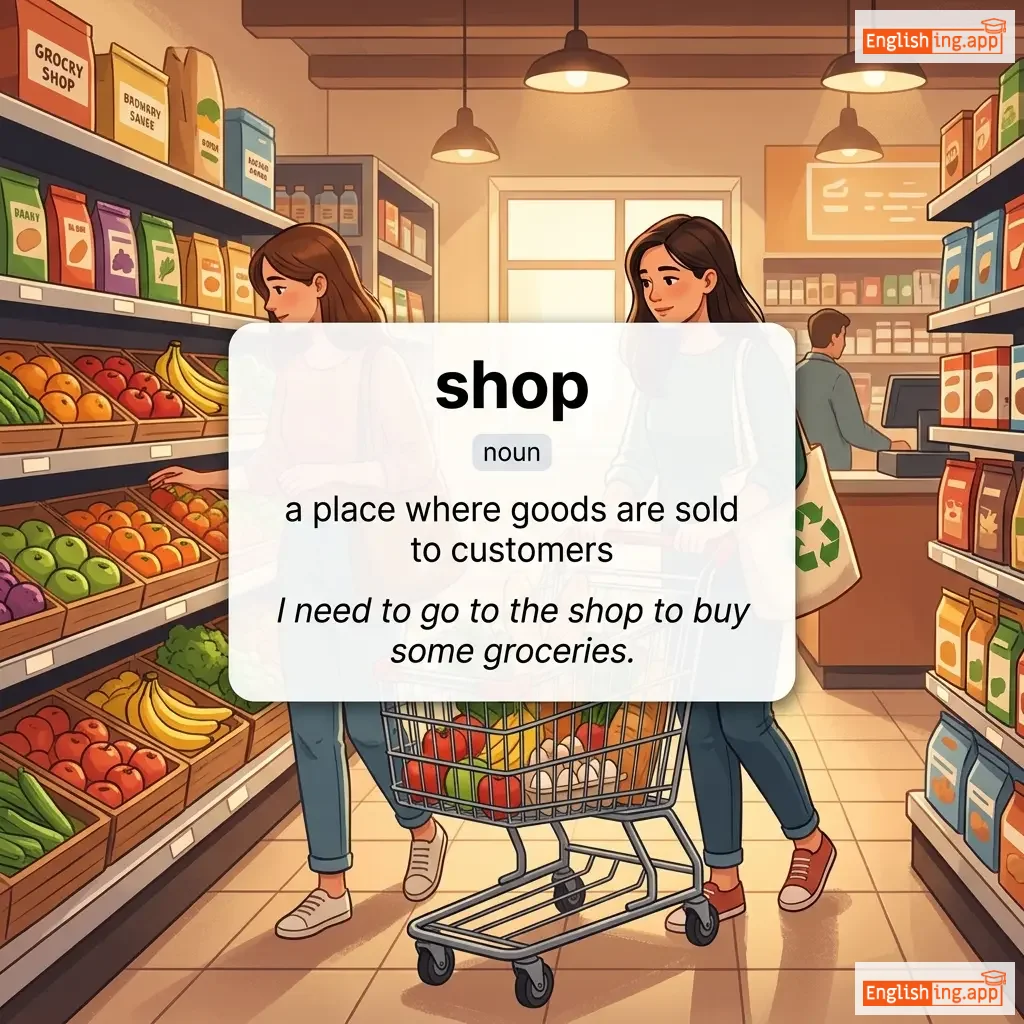
shop definition card — visual illustration of the meaning
noun
/ʃɒp/
magasin (magasin)

a place where goods are sold to customers

"I need to go to the shop to buy some groceries."

"J'ai besoin d'aller au magasin pour acheter des courses." (J'ai besoin d'aller au magasin pour acheter des courses.)
noun
/ˈʃuːtɪŋ/
tournage (tournage)

the action of shooting a gun, camera, or similar device

"The shooting of the movie took several months."

"Le tournage du film a pris plusieurs mois." (Le tournage du film a pris plusieurs mois.)
verb
/ʃuːt/
tirer / prendre une photo (tirer / prendre une photo)

to fire a bullet or arrow from a weapon; to take a photograph or film

"He learned how to shoot a bow and arrow."

"Il a appris à tirer à l'arc et à la flèche." (Il a appris à tirer à l'arc et à la flèche.)
noun
/ʃuː/
chaussure (chaussure)

a covering for the foot, typically made of leather, with a sturdy sole and heel

"She bought a new pair of shoes for the wedding."

"Elle a acheté une nouvelle paire de chaussures pour le mariage." (Elle a achete une nouvelle paire de chaussures pour le mariage.)
adjective
/ˈʃɑːdi/
de mauvaise qualité (de mauvaise qualite)

badly made or done; of poor quality

"The contractor did a shoddy job on the repairs."

"L'entrepreneur a fait un travail de mauvaise qualité lors des réparations." (L'entrepreneur a fait un travail de mauvaise qualité lors des réparations.)
adjective
/ˈʃɒkɪŋ/
choquant (choquant)

causing surprise or disbelief; startling

"The news of the accident was shocking to everyone."

"La nouvelle de l'accident a choqué tout le monde." (La nouvelle de l'accident a choqué tout le monde.)
noun
/ʃɒk/
choc (choc)

a sudden upsetting or surprising event or experience

"The news of his sudden departure was a shock to everyone."

"La nouvelle de son départ soudain a été un choc pour tout le monde." (La nouvelle de son départ soudain a été un choc pour tout le monde.)
noun
/ʃoʊl/
école de poissons (ecole de poissons)

a large group of fish swimming together; a shallow place in water

"We saw a shoal of fish near the coast."

"Nous avons vu une école de poissons près de la côte." (Nous avons vu une école de poissons près de la côte.)
noun
/ʃɪt/
merde (merd)

a vulgar term for feces or excrement

"The dog made a mess by leaving its shit on the floor."

"Le chien a causé un désordre en laissant sa merde par terre." (Le chien a cause un desordre en laissant sa merde par terre.)
noun
/ʃɜːrt/
chemise (chemise)

a piece of clothing worn on the upper body, usually with sleeves and a collar

"He wore a blue shirt to the party."

"Il portait une chemise bleue à la fête." (Il portait une chemise bleue à la fête.)
verb
/ʃɜːrk/
éviter (eviter)

to avoid or neglect a duty or responsibility

"He always tries to shirk his responsibilities at work."

"Il essaie toujours d'éviter ses responsabilités au travail." (Il essaie toujours d'éviter ses responsabilités au travail.)
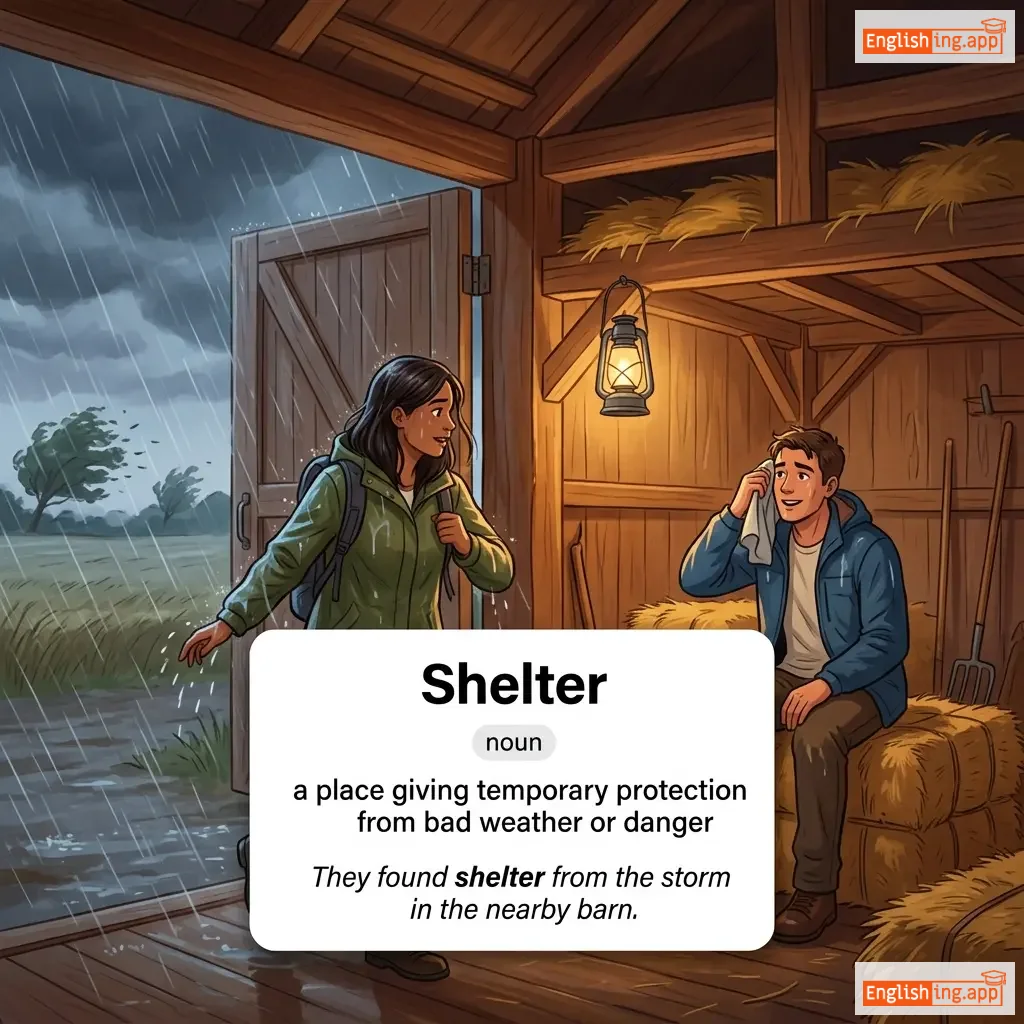
Shelter definition card — visual illustration of the meaning
noun
/ˈʃɛltər/
abri (abri)

a place giving temporary protection from bad weather or danger

"They found shelter from the storm in the nearby barn."

"Ils ont trouvé un abri contre la tempête dans la grange voisine." (Ils ont trouvé un abri contre la tempête dans la grange voisine.)
pronoun
/ʃi/
elle (elle)

a female person or animal previously mentioned or easily identified

"She is going to the market to buy vegetables."

"Elle va au marché acheter des légumes." (Elle va au marche acheter des legumes.)
noun
/ʃiːf/
gerbe de blé (gerbe de ble)

a bundle of grain stalks laid lengthwise and tied together after reaping; a bundle of objects tied together

"The farmer carried a sheaf of wheat on his shoulder."

"Le fermier portait une gerbe de blé sur son épaule." (Le fermier portait une gerbe de blé sur son épaule.)
verb
/ʃɪə/
couper (couper)

to cut the wool off a sheep or to cut something with sharp tools like scissors or shears

"The farmer will shear the sheep in the spring."

"L'agriculteur shear le mouton au printemps." (L'agriculteur shear le mouton au printemps.)
noun
/ʃiːt fɪʃ/
silure (silur)

A large freshwater catfish with a broad flat head and long barbels

"The sheat-fish is one of the largest freshwater fish in South Asia."

"Le silure est l’un des plus grands poissons d’eau douce d’Asie du Sud." (Le silur est lun des plu gran poisson do douce dAsi du Sud)
verb
/ʃiːð/
remettre dans le fourreau (remettre dans le fourreau)

to put a sword or knife back into its cover

"He quickly sheathed his sword after the duel."

"Il remit rapidement son épée dans son fourreau après le duel." (Il remit rapidement son épée dans son fourreau après le duel.)
verb
/ʃɛd/
perdre (perdre)

to let something fall off naturally, such as leaves, hair, or tears

"Trees shed their leaves in autumn."

"Les arbres perdent leurs feuilles en automne." (Les arbres perdent leurs feuilles en automne.)
noun
/ʃiːp/
mouton (mouton)

a farm animal with thick wool that is raised for its wool, meat, and milk

"The farmer keeps a large flock of sheep."

"Le fermier garde un grand troupeau de moutons." (Le fermier garde un grand troupeau de moutons.)
adjective
/ʃɪə/
total (total)

complete and utter; very steep or transparent

"The cliff was a sheer drop into the sea."

"La falaise était une chute complète dans la mer." (La falaise était une chute complète dans la mer.)
noun
/ʃiːt/
drap (drap)

a large piece of cloth or paper, typically used to cover or protect something

"I need a clean sheet to cover the bed."

"J'ai besoin d'un drap propre pour couvrir le lit." (J'ai besoin d'un drap propre pour couvrir le lit.)
noun
/ʃɛlf/
étagère (etagere)

a flat surface used for storing or displaying things, typically fixed to a wall or inside a cabinet

"I placed the books on the shelf next to the window."

"J'ai posé les livres sur l'étagère près de la fenêtre." (J'ai posé les livres sur l'étagère près de la fenêtre.)
noun
/ʃɛl/
coquillage (koyiyaj)

the hard outer covering of a mollusk or a crustacean, or something similar

"She picked up a beautiful seashell on the beach."

"Elle a ramassé un joli coquillage sur la plage." (Elle a ramassé un joli coquillage sur la plage.)
adjective
/ˈʃaɪ.ni/
brillant; luisant; (brillant; luisant;)

reflecting light; bright and polished; glossy

"The shiny new car caught everyone's attention."

"La voiture neuve brillante a attiré l'attention de tous." (La voiture neuve brillante a attiré l'attention de tous.)
verb
/ˈʃɪmər/
scintiller (scintiller)

To shine with a soft, wavering light.

"The lake shimmered under the moonlight."

"Le lac scintillait sous la lumière de la lune." (Le lac scintillait sous la lumière de la lune.)
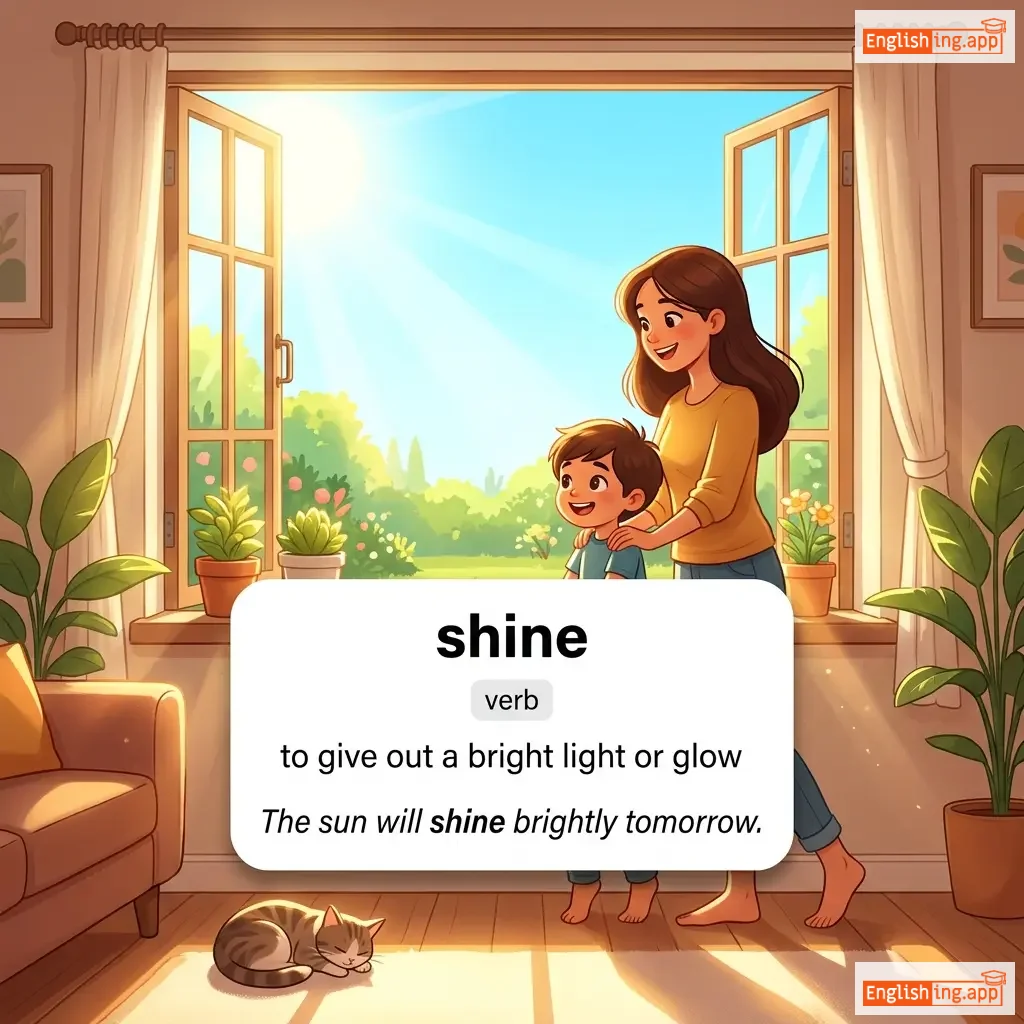
shine definition card — visual illustration of the meaning
verb
/ʃaɪn/
briller (briller)

to give out a bright light or glow

"The sun will shine brightly tomorrow."

"Le soleil brillera fortement demain." (Le soleil brillera fortement demain.)
adjective
/ˈʃɪft.ləs/
paresseux (paresseux)

Lacking ambition or the ability to accomplish anything; lazy and unmotivated.

"He was seen as a shiftless young man with no goals."

"Il a été vu comme un jeune homme paresseux sans objectifs." (Il a été vu comme un jeune homme paresseux sans objectifs.)
noun
/ʃɪp/
navire (navire)

a large boat used for travel or transporting goods across water

"The ship set sail across the ocean."

"Le navire a pris le large à travers l'océan." (Le navire a pris le large a travers l'ocean.)