Vocabulaires

Découvrez, apprenez et maîtrisez le vocabulaire anglais

adjective
/ˈʃɔːrt ˌtempərd/
irritable; facilement en colère (irritable; facilement en colere)

quick to lose one's temper; easily angered

"She became short-tempered when the traffic made her late for the meeting."

"Elle est devenue irritable lorsque le trafic l'a rendue en retard pour la réunion." (Elle est devenue irritable lorsque le trafic l'a rendue en retard pour la reunion.)
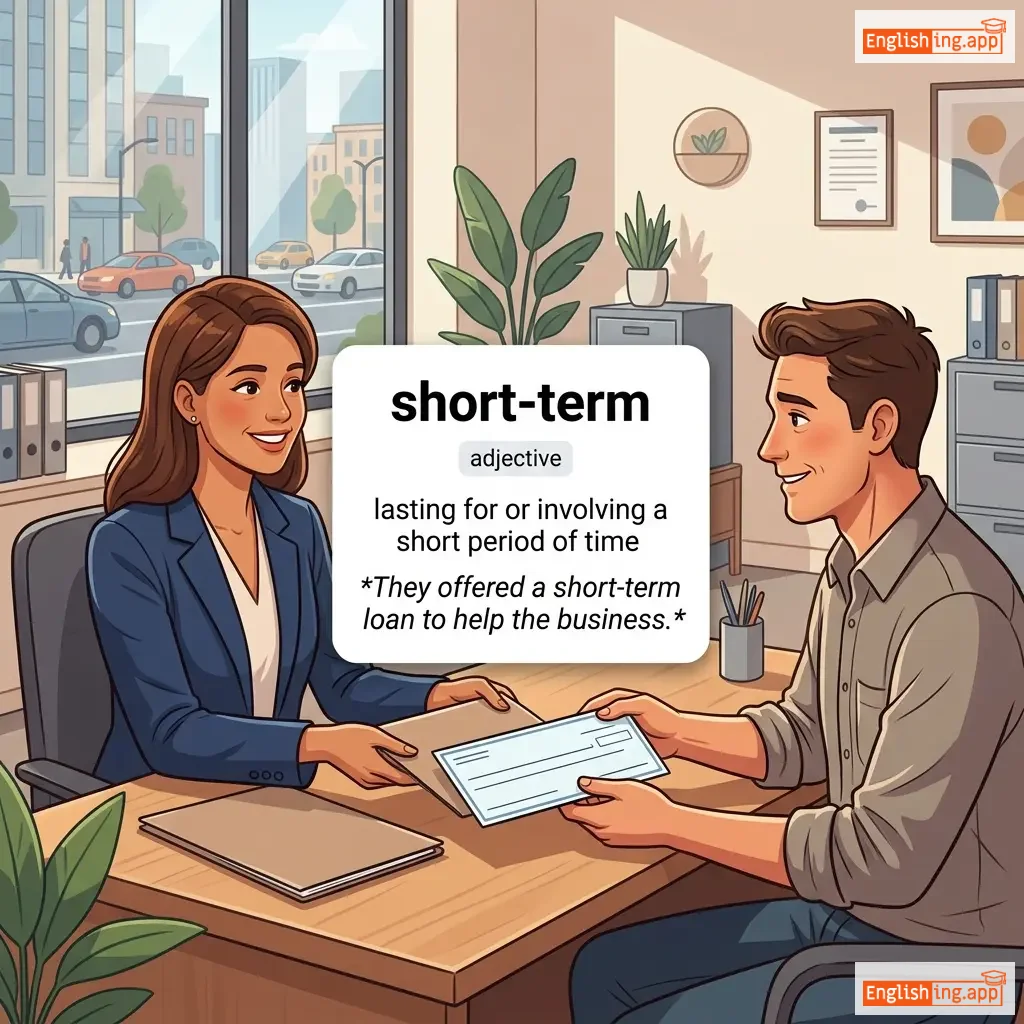
short-term definition card — visual illustration of the meaning
adjective
/ˈʃɔːrt tɜːrm/
à court terme (a court terme)

lasting for or involving a short period of time

"They offered a short-term loan to help the business."

"Ils ont offert un prêt à court terme pour aider l'entreprise." (Ils ont offert un prêt à court terme pour aider l'entreprise.)
noun
/ˈʃɔːrtɪdʒ/
pénurie (penurie)

a state or situation in which something needed cannot be obtained in sufficient amounts

"There is a shortage of skilled workers in the industry."

"Il y a une pénurie de travailleurs qualifiés dans l'industrie." (Il y a une penurie de travailleurs qualifies dans l'industrie.)
noun
/ˈʃɔːrt.kʌm.ɪŋ/
lacune; défaut; carence (lacune; défaut; carence)

a fault or failure to meet a certain standard; a deficiency

"Despite his many talents, he has some shortcomings."

"Malgré ses nombreux talents, il a quelques lacunes." (Malgré ses nombreux talents, il a quelques lacunes.)
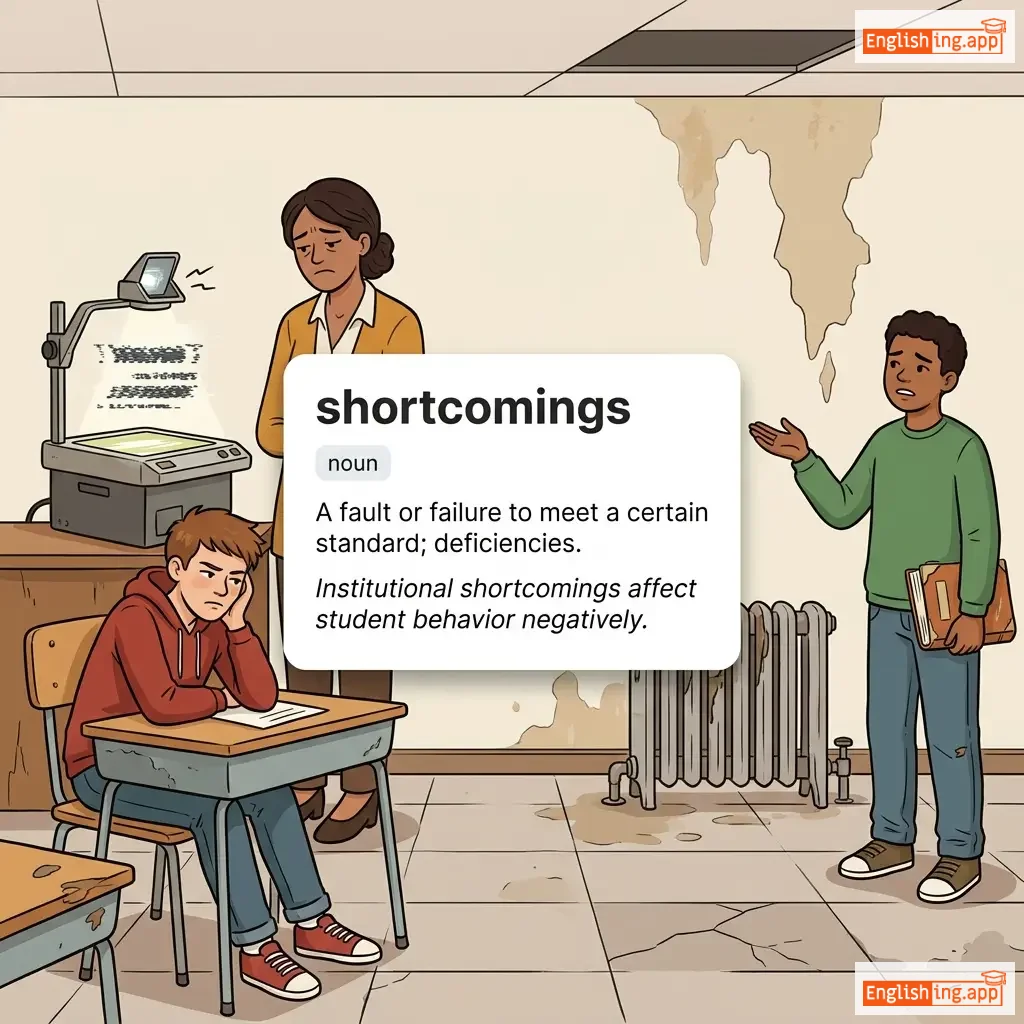
shortcomings definition card — visual illustration of the meaning
noun
ˈʃɔːtkʌmɪŋz
lacunes (lacunes)

A fault or failure to meet a certain standard; deficiencies.

"Institutional shortcomings affect student behavior negatively."

"Les lacunes institutionnelles affectent négativement le comportement des étudiants." (Les lacunes institutionnelles affectent négativement le comportement des étudiants.)
verb
/ˈʃɔːrtn/
raccourcir (raccourcir)

To make something shorter in length, duration, or extent

"She decided to shorten her speech to fit the time limit."

"Elle a décidé de raccourcir son discours pour respecter la limite de temps." (Elle a decide de raccourcir son discours pour respecter la limite de temps.)
verb
/ʃʌk/
éplucher (éplucher)

To remove the outer covering, such as the husk of corn or shell of shellfish.

"She learned how to shuck oysters quickly."

"Elle a appris à ouvrir les huîtres rapidement." (Elle a appris à ouvrir les huîtres rapidement.)
adjective, adverb
/ˈsaɪdlɔːŋ/
regard oblique (regard oblique)

Directed to the side; indirect, furtive, or not straightforward.

"She gave him a sidelong glance across the room."

"Elle lui lança un regard oblique à travers la pièce." (Elle lui lanca un regard oblique a travers la piece.)
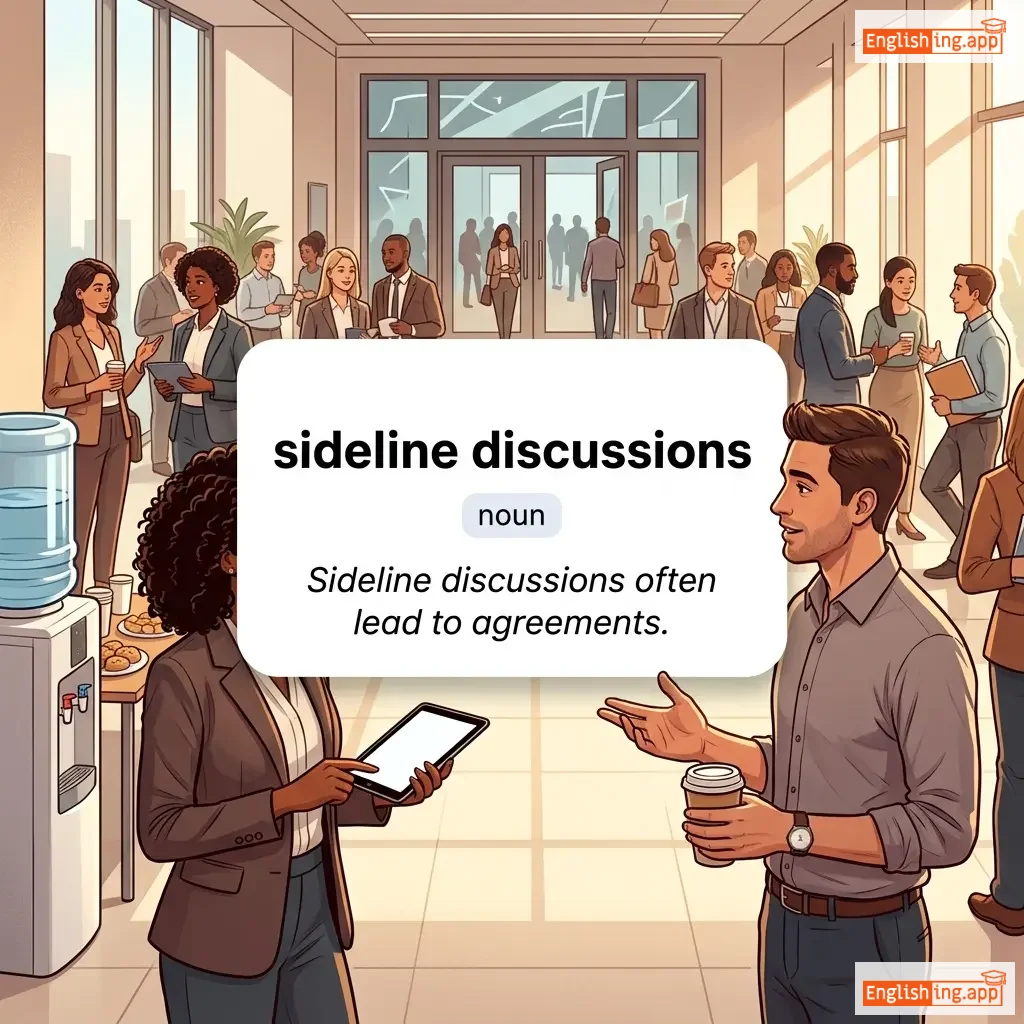
sideline discussions definition card — visual illustration of the meaning
noun
/ˈsaɪd.laɪn dɪˈskʌʃənz/
discussions secondaires (discussions secondaires)

Informal or secondary conversations that occur outside the main agenda of a formal meeting.

"Sideline discussions often lead to agreements."

"Les discussions secondaires mènent souvent à des accords." (Les discussions secondaires mènent souvent à des accords.)
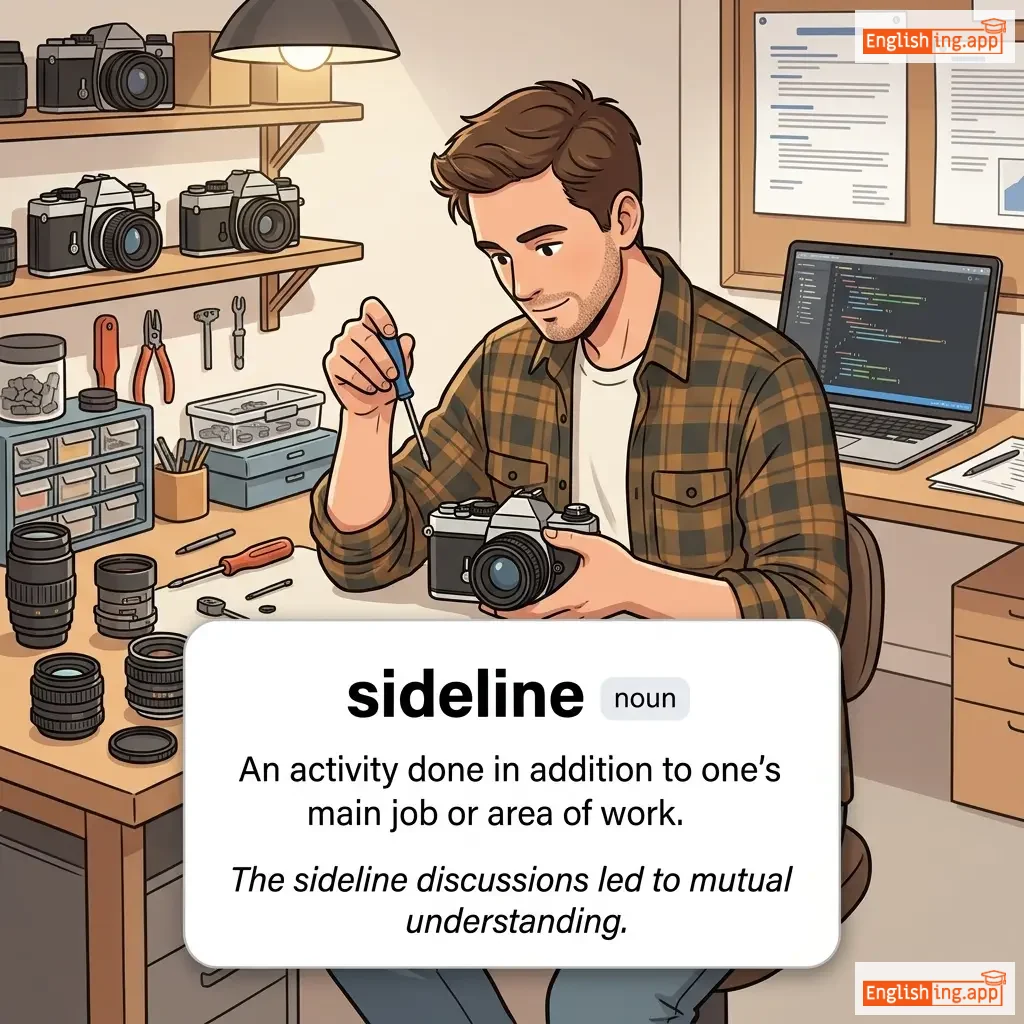
sideline definition card — visual illustration of the meaning
noun
/ˈsaɪd.laɪn/
activité secondaire (activite secondaire)

An activity done in addition to one's main job or area of work.

"The sideline discussions led to mutual understanding."

"Les discussions secondaires ont mené à une meilleure compréhension mutuelle." (Les discussions secondaires ont mené à une meilleure compréhension mutuelle.)
noun
/saɪd/
côté (cote)

a position to the left or right of something

"The store is on the side of the road."

"Le magasin est du côté de la route." (Le magasin est du cote de la route.)
noun
/ˈsɪk.nəs/
maladie; affection (maladie; affection)

the state of being ill; a disease or illness

"She took time off work due to sickness."

"Elle a pris du temps libre du travail à cause de la maladie." (Elle a pris du temps libre du travail à cause de la maladie.)
adjective
/ˈsɪk.li/
fragile; malade; pâle (fragil)

weak and unhealthy; prone to illness; appearing weak or pale

"The sickly child needed extra care and attention."

"L'enfant fragile avait besoin de soins et d'attention supplémentaires." (L'enfant fragile avait besoin de soins et d'attention supplémentaires)
noun
/ˈsɪk.əl/
faucille (faucille)

a tool with a curved metal blade and short handle used for cutting grain crops

"The farmer harvested wheat using a traditional sickle."

"Le fermier a récolté du blé en utilisant une faucille traditionnelle." (Le fermier a récolté du blé en utilisant une faucille traditionnelle.)
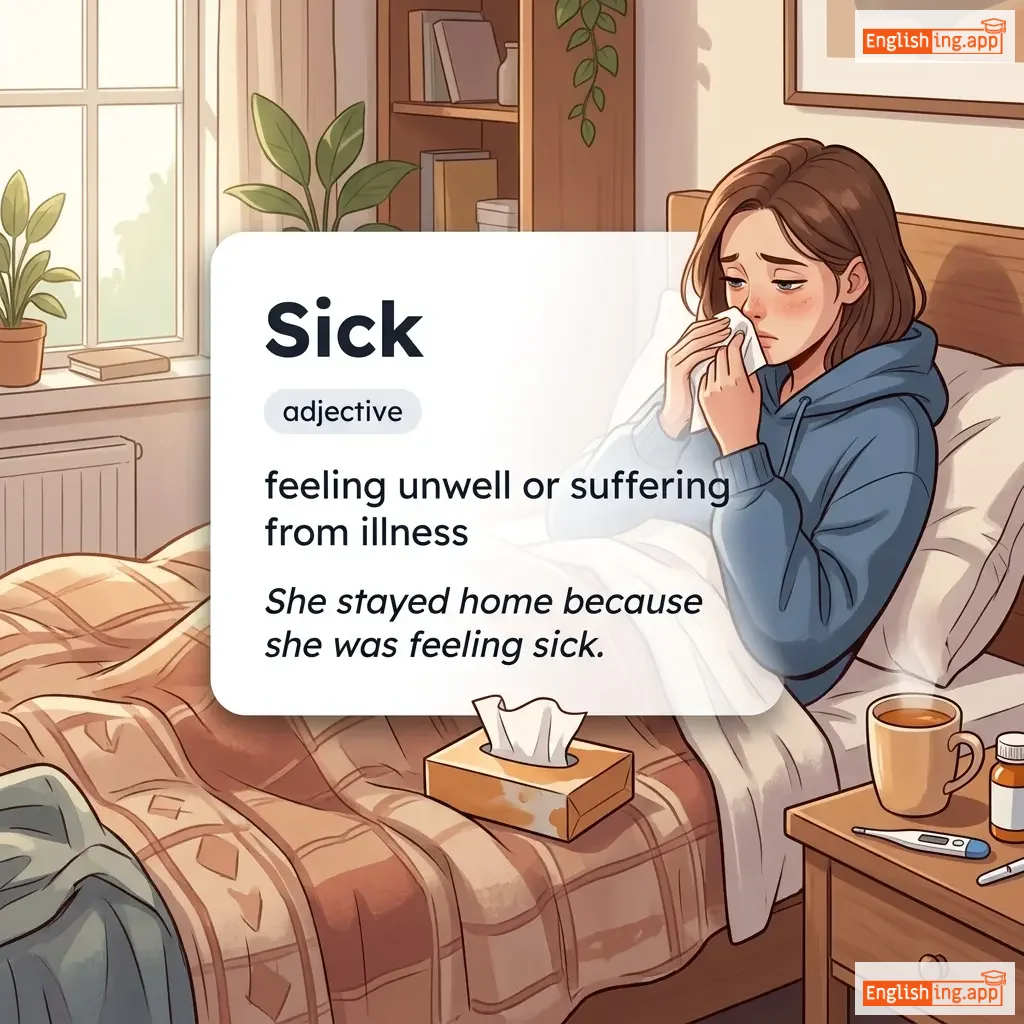
Sick definition card — visual illustration of the meaning
adjective
/sɪk/
malade (malad)

feeling unwell or suffering from illness

"She stayed home because she was feeling sick."

"Elle est restée à la maison parce qu'elle se sentait malade." (El e reste a la mezon parse kel se sante malad)
adjective
/ˈsɪbɪlaɪn/
sibyllin (sibyllin)

Prophetic, mysterious, or cryptic in meaning.

"The old woman gave a sibylline warning about the future."

"La vieille femme a donné un avertissement sibyllin sur l'avenir." (La vieille femme a donne un avertissement sibyllin sur l'avenir.)
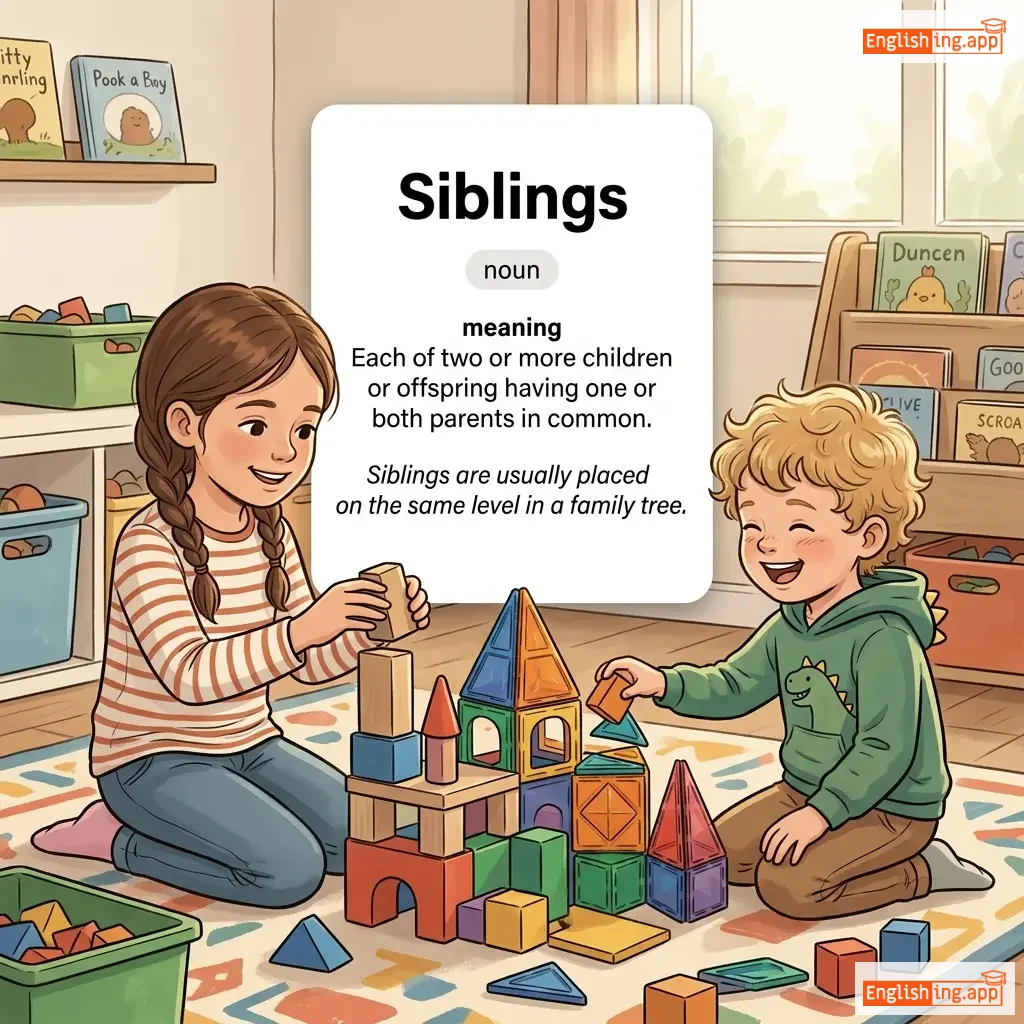
Siblings definition card — visual illustration of the meaning
noun
ˈsɪblɪŋz
frères et sœurs (freres et seurs)

Each of two or more children or offspring having one or both parents in common.

"Siblings are usually placed on the same level in a family tree."

"Les frères et sœurs sont généralement placés au même niveau dans un arbre généalogique familial." (Les freres et sœurs sont generalement places au meme niveau dans un arbre genealogique familial.)
noun
/ˈsɪblɪŋ/
frère/sœur (frère/sœur)

A brother or sister.

"She has three siblings, two brothers and one sister."

"Elle a trois frères et sœurs, deux frères et une sœur." (Elle a trois frères et sœurs, deux frères et une sœur.)
verb
/ˈsɪbəleɪt/
prononcer avec un sifflement (prononcer avec un sifflement)

To pronounce with a hissing sound.

"The actor sibilated his lines for dramatic effect."

"L'acteur a prononcé ses répliques avec un sifflement pour un effet dramatique." (L'acteur a prononcé ses répliques avec un sifflement pour un effet dramatique.)
adjective
/ˈsɪbɪlənt/
avec un son sifflant (avec un son sifflant)

Making or characterized by a hissing sound.

"The word 'snake' starts with a sibilant sound."

"Le mot 'snake' commence par un son sifflant." (Le mot 'snake' commence par un son sifflant.)
noun
/ˈsɪbɪləns/
son sifflant (son sifflant)

A hissing or hushing sound, especially in speech with 's' or 'sh'.

"The poet used sibilance to create a soft, hissing effect in the verse."

"Le poète a utilisé la sibilance pour créer un effet doux et sifflant dans le vers." (Le poète a utilisé la sibilance pour créer un effet doux et sifflant dans le vers.)
noun
/ˈʃaɪstər/
escroc (escroc)

a person, especially a lawyer, who uses unscrupulous or dishonest methods

"The businessman was exposed as a shyster who cheated clients."

"L'homme d'affaires a été exposé comme un escroc qui trompait les clients." (L'homme d'affaires a été exposé comme un escroc qui trompait les clients.)
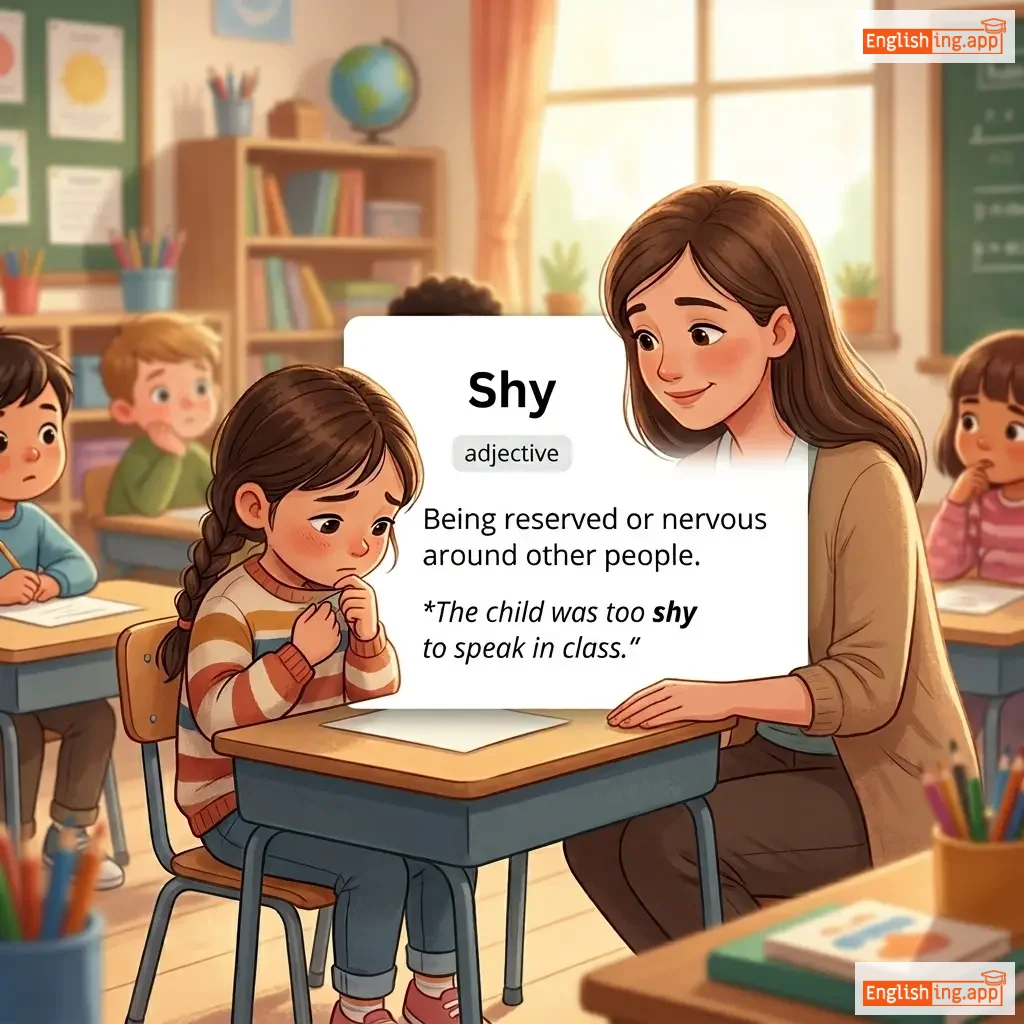
Shy definition card — visual illustration of the meaning
adjective
/ʃaɪ/
timide (timid)

Being reserved or nervous around other people.

"The child was too shy to speak in class."

"L'enfant était trop timide pour parler en classe." (L'enfant était trop timide pour parler en classe.)
noun
/ˈʃʌtəl/
véhicule qui voyage régulièrement entre deux endroits (vehicule qui voyage regulierement entre deux endroits)

a vehicle or craft that travels regularly between two places.

"The airport shuttle runs every 30 minutes."

"La navette de l'aéroport circule toutes les 30 minutes." (La navette de l'aéroport circule toutes les 30 minutes.)
verb
/ʃʌt/
fermer (fermer)

to close something, especially a door or window

"Please shut the door before you leave."

"Veuillez fermer la porte avant de partir." (Veuillez fermer la porte avant de partir.)
verb
/ʃʌnt/
détourner (detourner)

to move or turn aside; to push or divert from one track to another

"The train was shunted onto a different track."

"Le train a été dévié sur une autre voie." (Le train a ete devie sur une autre voie.)
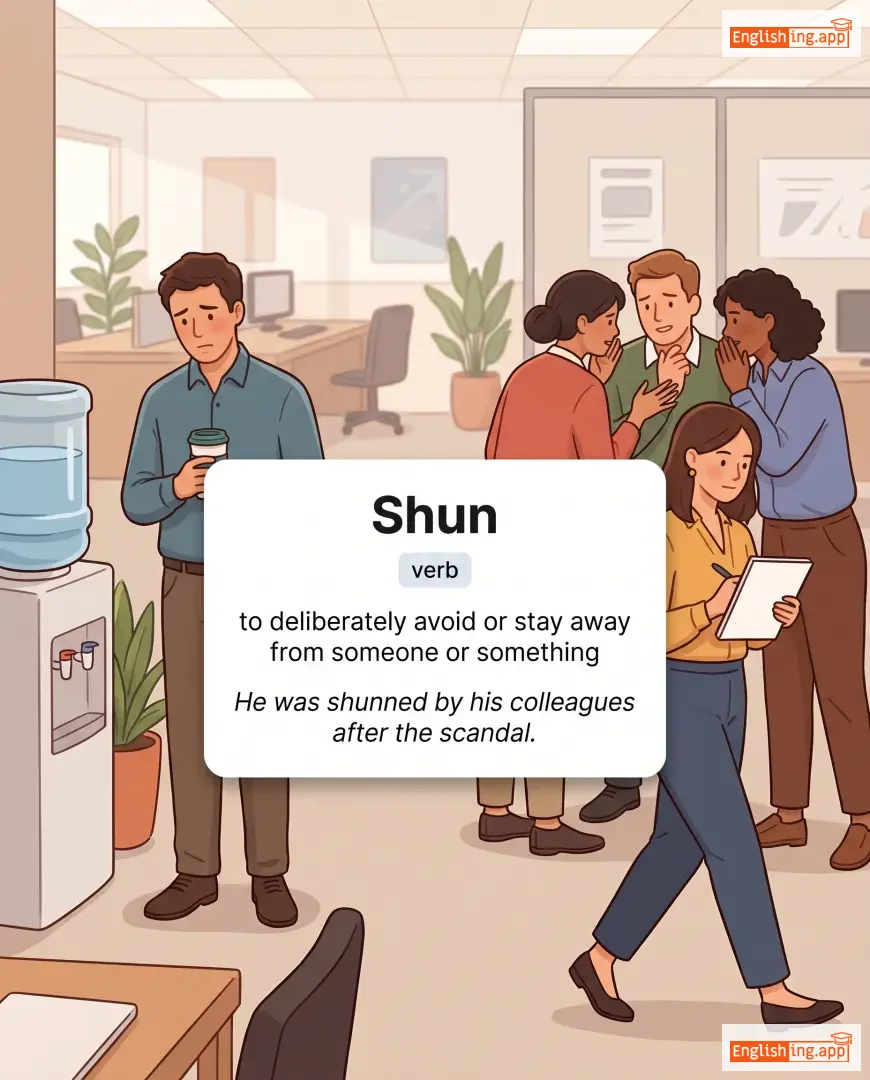
Shun definition card — visual illustration of the meaning
verb
/ʃʌn/
éviter (eviter)

to deliberately avoid or stay away from someone or something

"He was shunned by his colleagues after the scandal."

"Il a été évité par ses collègues après le scandale." (Il a été évité par ses collègues après le scandale.)
verb
/ˈʃʌfəl/
marcher en traînant les pieds / mélanger (marcher en trainant les pieds / melanger)

to walk by dragging one's feet along or without lifting them fully; to mix or rearrange

"He shuffled the cards before dealing them."

"Il a mélangé les cartes avant de les distribuer." (Il a melangé les cartes avant de les distribuer.)
verb
/ˈʃʌdər/
frissonner (frissonner)

to tremble or shake suddenly, often due to fear, cold, or strong emotion

"She shuddered at the thought of walking alone in the dark forest."

"Elle frissonna à l'idée de marcher seule dans la forêt sombre." (Elle frissonna à l'idée de marcher seule dans la forêt sombre.)
noun
/ʃruː/
femme irritable / petit animal ressemblant à une souris (femme irritable / petit animal ressemblant a une souris)

a small mouse-like animal; also a woman with a bad temper

"The play describes a strong-willed woman as a shrew."

"La pièce décrit une femme déterminée comme une femme irritable." (La piece decrit une femme determinee comme une femme irritable.)
noun
/ʃɔːrts/
shorts (shorts)

a short garment worn on the lower half of the body that covers each leg separately, usually above the knees.

"He wore a pair of blue shorts to the beach."

"Il portait un short bleu à la plage." (Il portait un short bleu à la plage.)
noun, verb
/ʃɒt/
tir (tir)

a single attempt to hit something, usually with a weapon or a ball

"He took a shot at the goal."

"Il a pris un tir en direction du but." (Il a pris un tir en direction du but.)
modal verb
/ʃʊd/
devrait (devrait)

used to indicate obligation or duty

"You should study for your exams."

"Tu devrais étudier pour tes examens." (Tu devrais etudier pour tes examens.)
noun
/ˈʃoʊldər/
épaule (epaule)

the upper joint of the human arm and the part of the body to which it is attached

"He hurt his shoulder while lifting weights."

"Il s'est blessé à l'épaule en soulevant des poids." (Il s'est blesse a l'epaule en soulevant des poids.)
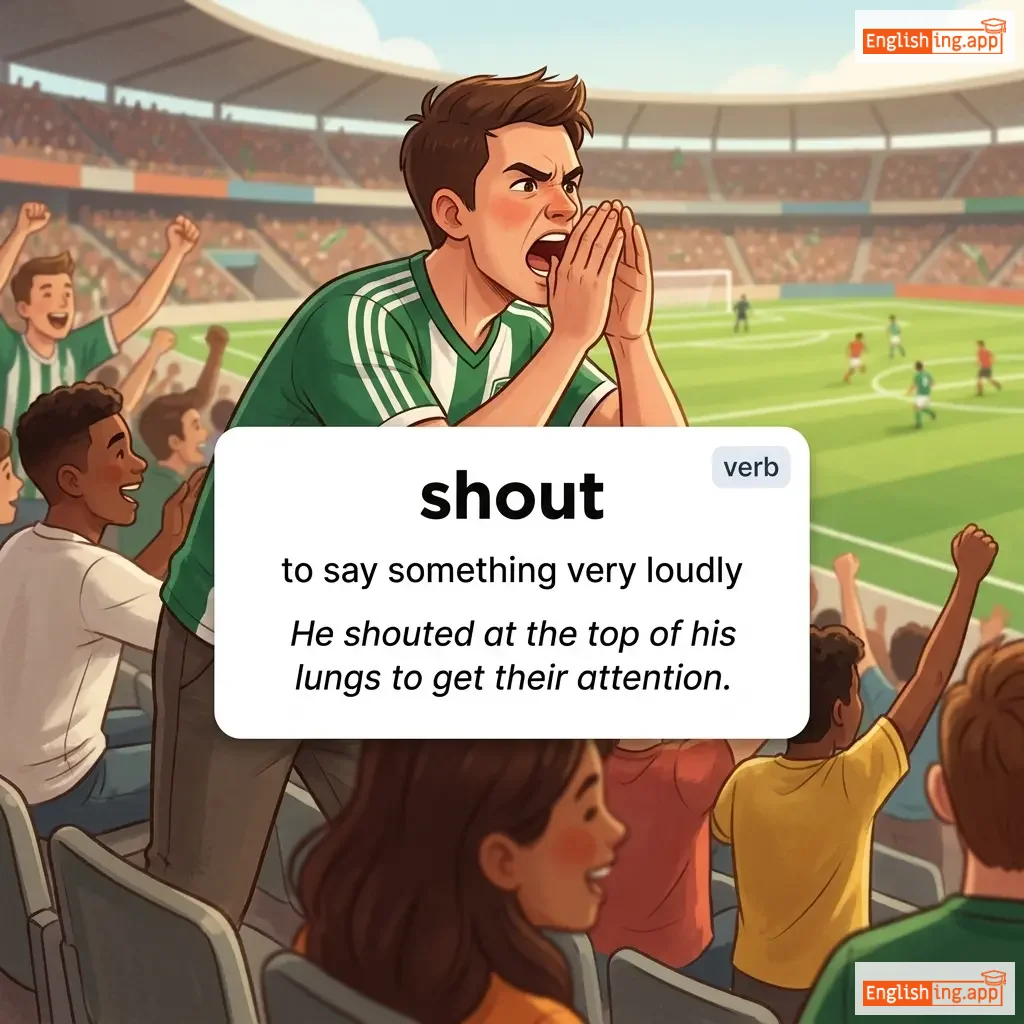
shout definition card — visual illustration of the meaning
verb
/ʃaʊt/
crier (crier)

to say something very loudly

"He shouted at the top of his lungs to get their attention."

"Il a crié aussi fort qu'il le pouvait pour attirer leur attention." (Il a crié aussi fort qu'il le pouvait pour attirer leur attention.)
verb
/ʃʌv/
pousser (pousser)

to push someone or something roughly

"He shoved the box into the corner."

"Il a poussé la boîte dans le coin." (Il a poussé la boîte dans le coin.)
noun
/ˈʃʌv.əl/
pelle (pelle)

a tool with a broad flat blade and long handle used for digging and moving earth, snow, or other materials

"He grabbed a shovel to clear the snow from the driveway."

"Il a pris une pelle pour nettoyer la neige de l'allée." (Il a pris une pelle pour nettoyer la neige de l'allée.)
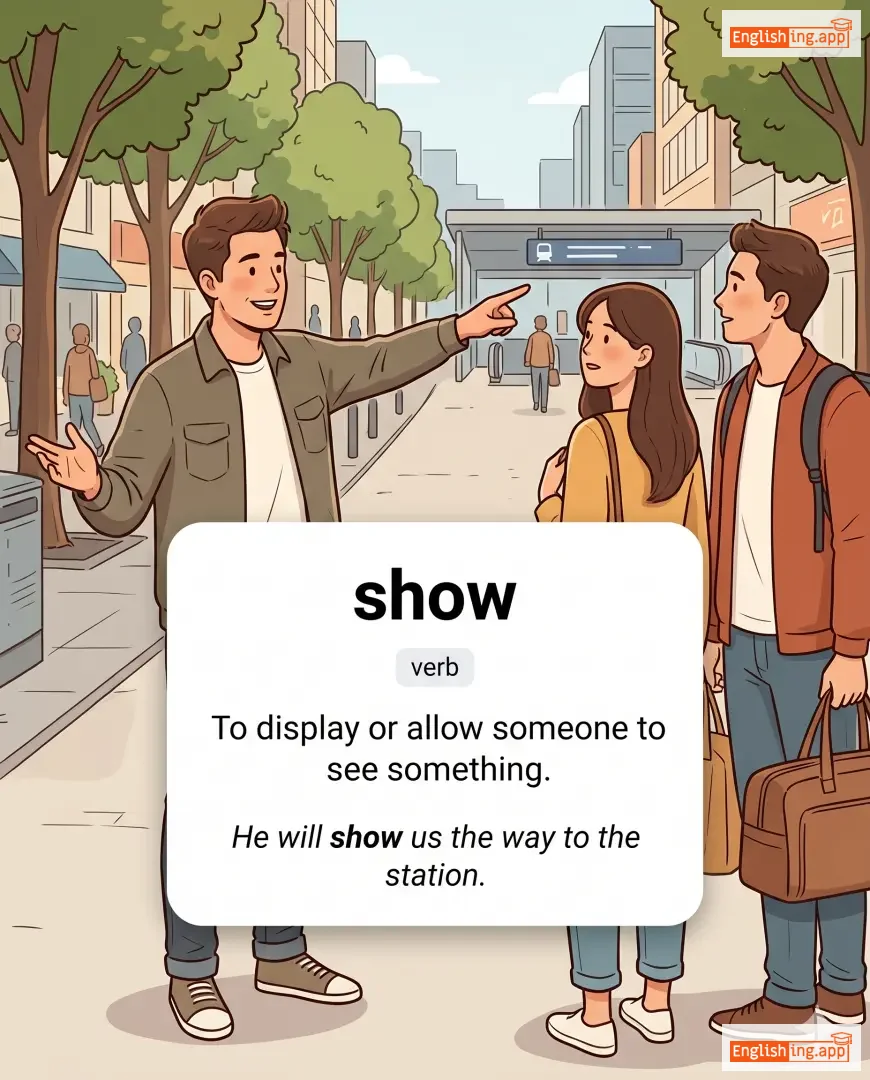
show definition card — visual illustration of the meaning
verb
/ʃoʊ/
montrer (montrer)

To display or allow someone to see something.

"He will show us the way to the station."

"Il nous montrera le chemin jusqu'à la station." (Il nous montrera le chemin jusqu'à la station.)
noun
/ˈsɛrəf/
séraphin (seraphin)

An angelic being associated with light and purity, often depicted as a high-ranking angel in Christian theology.

"The stained-glass window depicted a seraph with outstretched wings."

"Le vitrail représentait un séraphin avec des ailes déployées." (Le vitrail représentait un seraphin avec des ailes déployées.)
noun
/ˈʃaʊər/
douche (shower)

a brief fall of rain or snow or a device for taking a bath or washing oneself

"After the workout, I took a quick shower to refresh myself."

"Après l'entraînement, j'ai pris une douche rapide pour me rafraîchir." (Apres lentrainement jai pris une douche rapide pour me rafraichir.)
/ʃrɛd/
déchiqueter (dechiqueter)

to tear or cut something into small pieces

"She shredded the old documents before throwing them away."

"Elle a déchiqueté les vieux documents avant de les jeter." (Elle a déchiqueté les vieux documents avant de les jeter.)
noun
/ʃraɪn/
sanctuaire (sanctuaire)

A place regarded as holy, often associated with a saint or deity.

"Thousands of pilgrims visit the shrine each year."

"Des milliers de pèlerins visitent le sanctuaire chaque année." (Des milliers de pèlerins visitent le sanctuaire chaque année.)
verb
/ʃrʌɡ/
hausser les épaules (hausser les épaules)

To raise and lower the shoulders to express uncertainty or indifference.

"He shrugged when asked about the missing file."

"Il haussait les épaules lorsqu'on lui posait des questions sur le fichier manquant." (Il haussait les épaules lorsqu'on lui posait des questions sur le fichier manquant.)
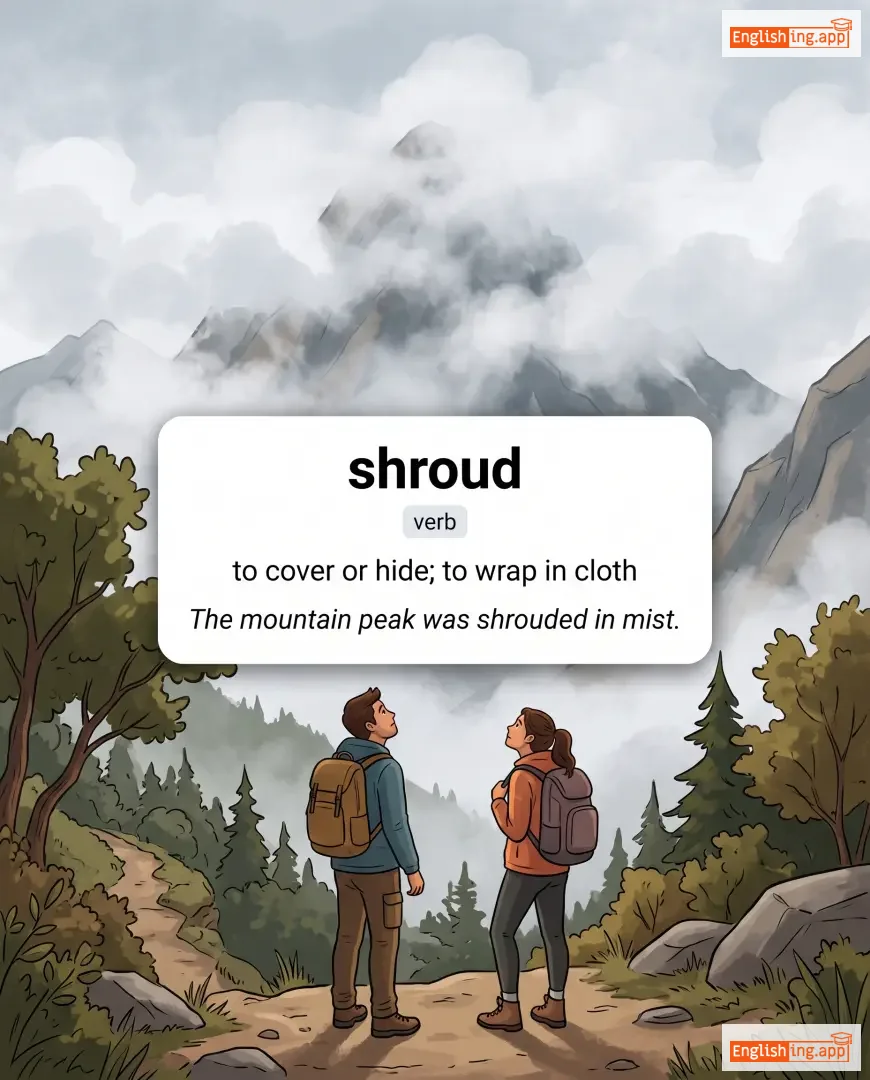
shroud definition card — visual illustration of the meaning
verb
/ʃraʊd/
envelopper (envelopper)

to cover or hide; to wrap in cloth

"The mountain peak was shrouded in mist."

"Le sommet de la montagne était enveloppé de brume." (Le sommet de la montagne était enveloppé de brume.)
verb
/ˈʃrɪvəl/
ridé (ridé)

To become dry, wrinkled, and smaller due to lack of moisture.

"The flowers shriveled under the hot sun."

"Les fleurs se sont ridées sous le soleil chaud." (Les fleurs se sont ridées sous le soleil chaud.)
noun
/ˈʃrɪŋkɪdʒ/
rétrécissement (retrecissement)

The process of becoming smaller in size, amount, or value.

"The company reported a shrinkage in profits this quarter."

"L'entreprise a rapporté une diminution des profits ce trimestre." (L'entreprise a rapporte une diminution des profits ce trimestre.)
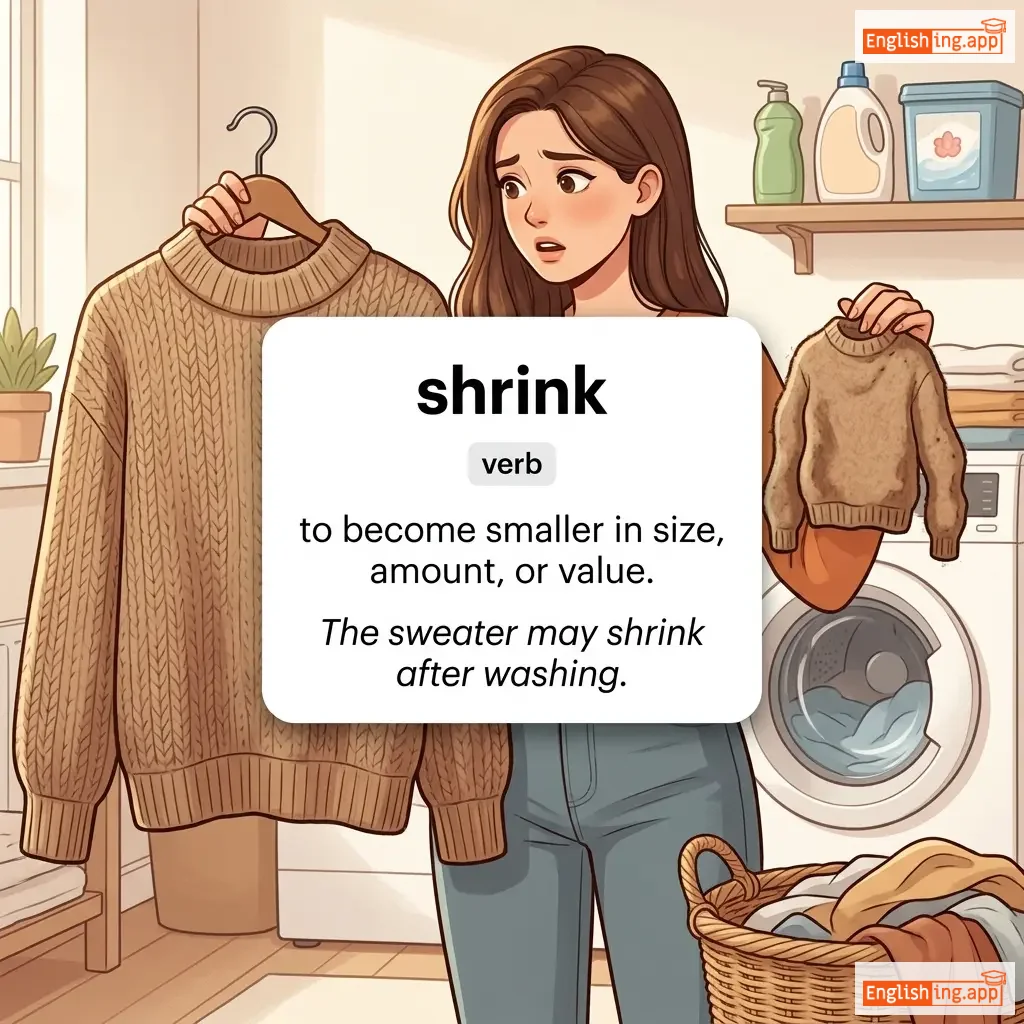
shrink definition card — visual illustration of the meaning
verb
/ʃrɪŋk/
bonheur (bonheur)

to become smaller in size, amount, or value.

"The sweater may shrink after washing."

"Elle ne pouvait pas cacher son bonheur lorsqu'elle a reçu le prix." (Elle ne pouvait pas cacher son bonheur lorsqu'elle a reçu le prix.)
adjective
/ʃrɪl/
son aigu (son aigu)

High-pitched and piercing in sound.

"The shrill whistle startled everyone in the room."

"Le sifflement aigu a surpris tout le monde dans la pièce." (Le sifflement aigu a surpris tout le monde dans la pièce.)
adjective
/ʃruːd/
astucieux (astucieux)

having sharp judgment and practical intelligence

"She made a shrewd investment in real estate."

"Elle a fait un investissement astucieux dans l'immobilier." (Elle a fait un investissement astucieux dans l'immobilier.)
verb
/ʃriːk/
crier (crier)

to make a loud, high-pitched cry

"She shrieked when she saw the spider."

"Elle a crié quand elle a vu l'araignée." (Elle a crié quand elle a vu l'araignée.)