वोकैबुलरीज

इंग्लिश वोकैबुलरी डिस्कवर, लर्न और मास्टर करें

noun
/spuːn/
चम्मच (chammach)

a utensil consisting of a small shallow bowl with a handle, used for eating, stirring, or serving food

"She stirred her coffee with a silver spoon."

"उसने चांदी के चम्मच से अपनी कॉफी को हिलाया।" (Usne chaandee ke chammach se apni coffee ko hilaaya.)
noun
/ˈspuːnərɪzəm/
स्पूनरीज़म (spoonarizm)

A verbal error in which the initial sounds of words are swapped to create a humorous effect.

"He made a spoonerism by saying 'queer old dean' instead of 'dear old queen'."

"उसने 'क्वीर ओल्ड डीन' कहने में एक स्पूनरिज़म किया, जो कि 'डियर ओल्ड क्वीन' होना चाहिए था।" (Usne 'queer old dean' kehne mein ek spoonarizm kiya, jo ki 'dear old queen' hona chahiye tha.)
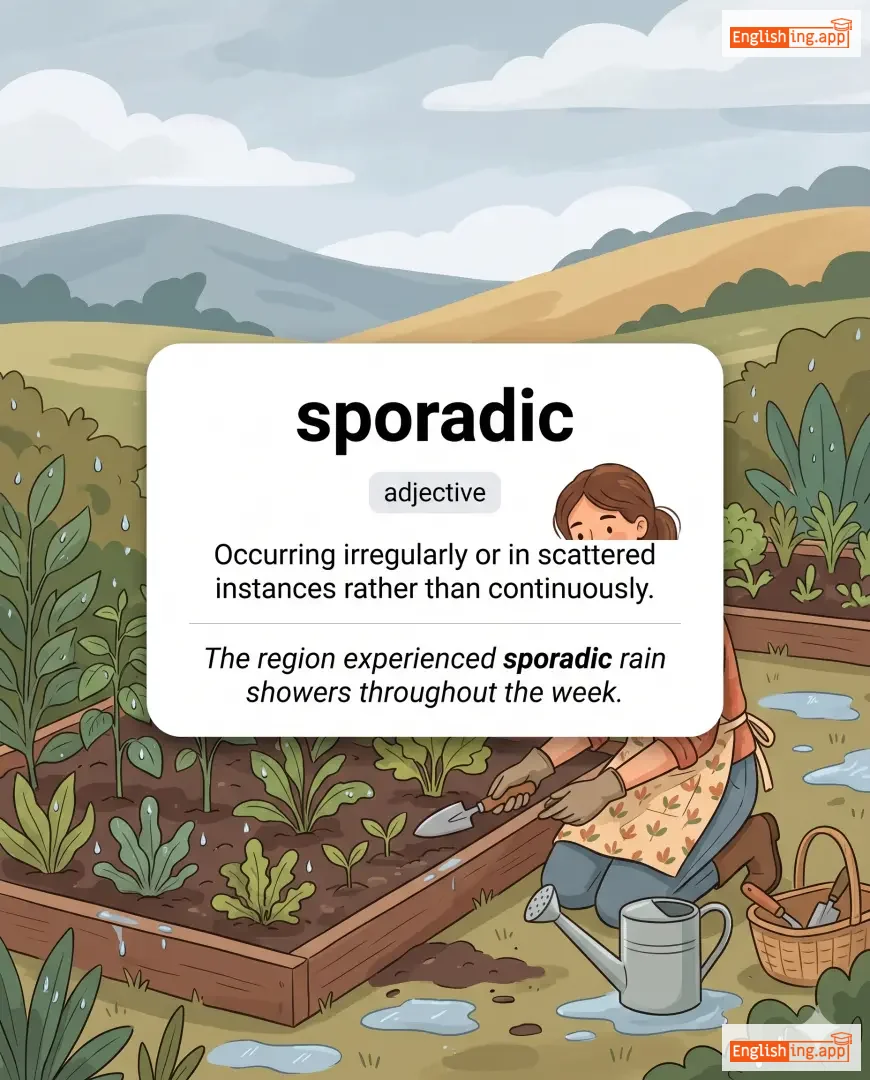
sporadic definition card — visual illustration of the meaning
adjective
/spəˈrædɪk/
अप्रत्याशित (apratyashit)

Occurring irregularly or in scattered instances rather than continuously.

"The region experienced sporadic rain showers throughout the week."

"क्षेत्र ने सप्ताह भर अप्रत्याशित बारिश के बौछारें देखी।" (kshetra ne saptah bhar apratyashit barish ke bouchare dekhi.)
noun
/spɔːt/
खेल (khel)

an activity involving physical exertion and skill in which an individual or team competes against another or others for entertainment

"Football is a popular sport around the world."

"फुटबॉल दुनिया भर में एक लोकप्रिय खेल है।" (Phutbol duniya bhar mein ek lokpriya khel hai.)
adjective
/ˈspɔːrtɪv/
खेल कूद से संबंधित (khel kood se sambandhit)

Playful, lively, or full of fun.

"The children were in a sportive mood during the picnic."

"पिकनिक के दौरान बच्चे खेल कूद से संबंधित मूड में थे।" (piknik ke dauran bachche khel kood se sambandhit mood mein the.)
noun
/ˈspɔːrtsmən/
खिलाड़ी (khiladi)

A person who is skilled in sports or enjoys participating in athletic activities.

"He is a true sportsman, always fair and respectful to his opponents."

"वह एक सच्चा खिलाड़ी है, हमेशा अपने प्रतिद्वंद्वियों के प्रति निष्पक्ष और सम्मानजनक।" (Vah ek sachcha khiladi hai, hamesha apne pratiddvandviyon ke prati nispaksh aur sammaanjanak.)
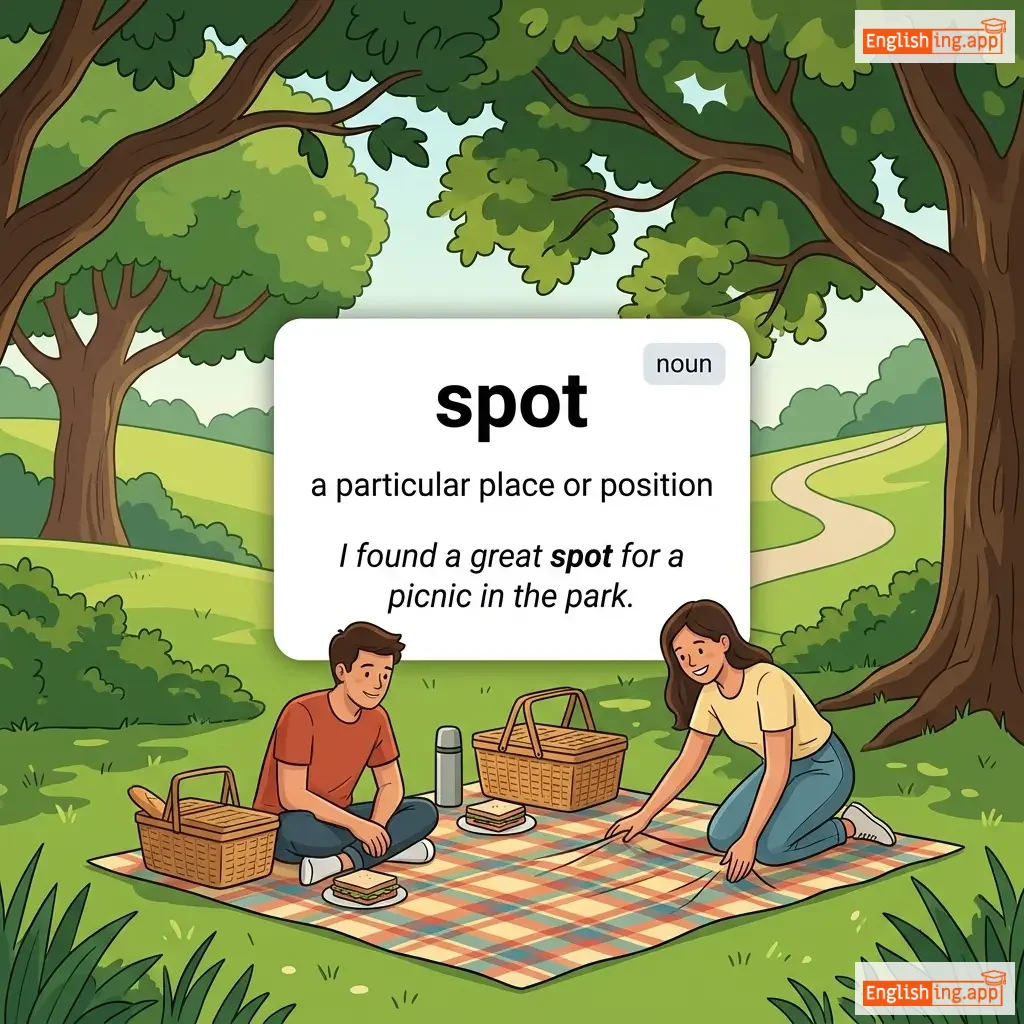
spot definition card — visual illustration of the meaning
noun
/spɒt/
स्थान (sthan)

a particular place or position

"I found a great spot for a picnic in the park."

"मैंने पार्क में पिकनिक के लिए एक बेहतरीन स्थान पाया।" (Maine park mein picnic ke liye ek behtareen sthan paaya.)
noun
/ˈspɒt.laɪt/
स्पॉटलाइट (spotlait)

a strong beam of light directed onto a particular area; figuratively, public attention

"The singer stood proudly in the spotlight."

"गायिका गर्व से स्पॉटलाइट में खड़ी थी." (gayika garv se spotlait mein khadi thi)
adjective
/ˈspɒtɪd/
धब्बेदार; चिन्हित; देखा गया (dhabbedar; chinhit; dekha gaya)

having spots or marks; noticed or seen

"The spotted leopard moved silently through the jungle."

"धब्बेदार तेंदुआ जंगल में चुपचाप चला गया।" (dhabbedar tendua jangal mein chupchaap chala gaya.)
noun
/ˈspɒt.ɪd sneɪk hed/
चन्ना पंक्टाटा (channa punctata)

a type of freshwater fish with spotted markings and an elongated head resembling a snake

"The spotted snake head is a popular fish for aquaculture in South Asia."

"स्पॉटेड स्नेक हेड दक्षिण एशिया में जलीय कृषि के लिए एक लोकप्रिय मछली है।" (spotted snake head dakshin eshiya me jaliye krishi ke liye ek lokpriya machhli hai)
noun
/spaʊs/
जीवनसाथी (jeevansathi)

a person's husband or wife

"Each employee may include their spouse in the health insurance plan."

"प्रत्येक कर्मचारी अपनी पत्नी या पति को स्वास्थ्य बीमा योजना में शामिल कर सकता है।" (Pratyek karmchari apni patni ya pati ko swasthya beema yojna mein shaamil kar sakta hai.)
noun, verb
/spreɪn/
मचका देना (machka dena)

an injury to a joint in which the ligaments are stretched or torn

"She sprained her ankle while running in the park."

"वह पार्क में दौड़ते हुए अपने टखने को मोच दे बैठी।" (Wah park mein daudte hue apne takhne ko moch de baithi.)
verb
/spreɪ/
स्प्रे करना (spre karna)

to apply liquid to something in a fine mist

"She sprayed perfume on her wrist before leaving."

"वह बाहर जाने से पहले अपनी कलाई पर परफ्यूम स्प्रे करती थी।" (Woh bahar jaane se pehle apni kalaai par perfume spre karti thi.)
verb
/sprɛd/
फैलाना (phailana)

to open or extend something over an area

"She spread the blanket on the grass for a picnic."

"उसने घास पर पिकनिक के लिए चादर बिछाई।" (Usne ghas par picnic ke liye chadar bichai.)
adjective
/ˈspraɪtli/
उत्साही (utsahi)

full of energy and life; lively

"The sprightly old man danced with joy at the wedding."

"उत्साही बूढ़ा आदमी शादी में खुशी से नाच रहा था।" (Utsahi budha aadmi shaadi mein khushi se naach raha tha.)
noun
/sprɪŋ/
वसंत (vasant)

the season between winter and summer when plants begin to grow

"Flowers bloom in the spring."

"वसंत में फूल खिलते हैं।" (Vasant mein phool khilte hain.)
verb
/ˈsprɪŋkəl/
छिड़कना (chhidkana)

to scatter small drops or particles of a substance over a surface

"She sprinkled sugar on top of the cake."

"उसने केक के ऊपर चीनी छिड़की।" (Usne kek ke upar cheeni chhidki.)
verb, noun
/spraʊt/
अंकुरित होना (ankurit hona)

to begin to grow; to produce new leaves or shoots

"The seeds began to sprout after a few days of rain."

"बीजों ने कुछ दिनों की बारिश के बाद अंकुरित होना शुरू कर दिया।" (Beejon ne kuch dinon ki barish ke baad ankurit hona shuru kar diya.)
verb, adjective, noun
/spruːs/
साफ़ करना / एक प्रकार का पेड़ (saaf karna / ek prakar ka ped)

to make neat or tidy in appearance; also refers to an evergreen tree

"He spruced up his room before the guests arrived."

"उसने मेहमानों के आने से पहले अपने कमरे को सुंदर बनाया।" (Usne mehmanon ke aane se pehle apne kamre ko sundar banaya.)
adjective
/spraɪ/
चपल (chapal)

active and lively, especially in old age

"The spry grandmother surprised everyone with her quick dance steps."

"चपल दादी ने अपनी तेज़ नृत्य की चाल से सभी को चौंका दिया।" (Chapal dadi ne apni tez nritya ki chaal se sabhi ko chaunka diya.)
noun
/spjuːm/
फेना (fena)

Froth or foam, especially found on waves or liquids.

"The waves crashed against the rocks, leaving spume in the air."

"लहरों ने चट्टानों से टकराया, और हवा में फेन छोड़ दिया।" (Lahron ne chattanon se takraya, aur hawa mein fena chhod diya.)
verb
/spɜːr/
प्रेरित करना / उत्तेजित करना (prerit karna / uttejit karna)

To encourage or motivate someone to take action.

"The teacher's praise spurred him to study harder."

"शिक्षक की सराहना ने उसे अधिक मेहनत करने के लिए प्रेरित किया।" (Shikshak ki sarahna ne use adhik mehnat karne ke liye prerit kiya.)
adjective
/ˈspjʊəriəs/
झूठा / नकली (jhutha / nakli)

Not genuine, authentic, or true; false or fake.

"The report was based on spurious claims."

"रिपोर्ट झूठे दावों पर आधारित थी।" (Report jhuthe daavon par aadharit thi.)
verb
/spɜːrn/
तिरस्कारपूर्वक नकारना (tirskaarpurvak nakarna)

To reject something or someone with disdain or contempt.

"She spurned his offer of help."

"वह उसकी मदद की पेशकश को तिरस्कार के साथ नकार दी।" (Vah uski madad ki peshkash ko tiraskaar ke saath nakar diya.)
🕵️‍♂️

spy (स्पाई)

verb
/spaɪ/
जासूस बनाना (jasoos banana)

to secretly collect information about a person, group, or country

"He was caught spying on his neighbor through the window."

"वह अपनी खिड़की से पड़ोसी पर जासूसी करते हुए पकड़ा गया।" (vah apni khidki se padosi par jaasoosi karte huye pakda gaya.)
verb
/ˈskwɒbəl/
छोटी या तुच्छ बातों पर शोर मचाना (chhoti ya tuchchh baaton par shor machana)

To argue noisily over something small or unimportant.

"The children squabbled over the last piece of cake."

"बच्चे केक के आखिरी टुकड़े को लेकर झगड़ रहे थे।" (Bacche kek ke aakhri tukde ko lekar jhagad rahe the.)
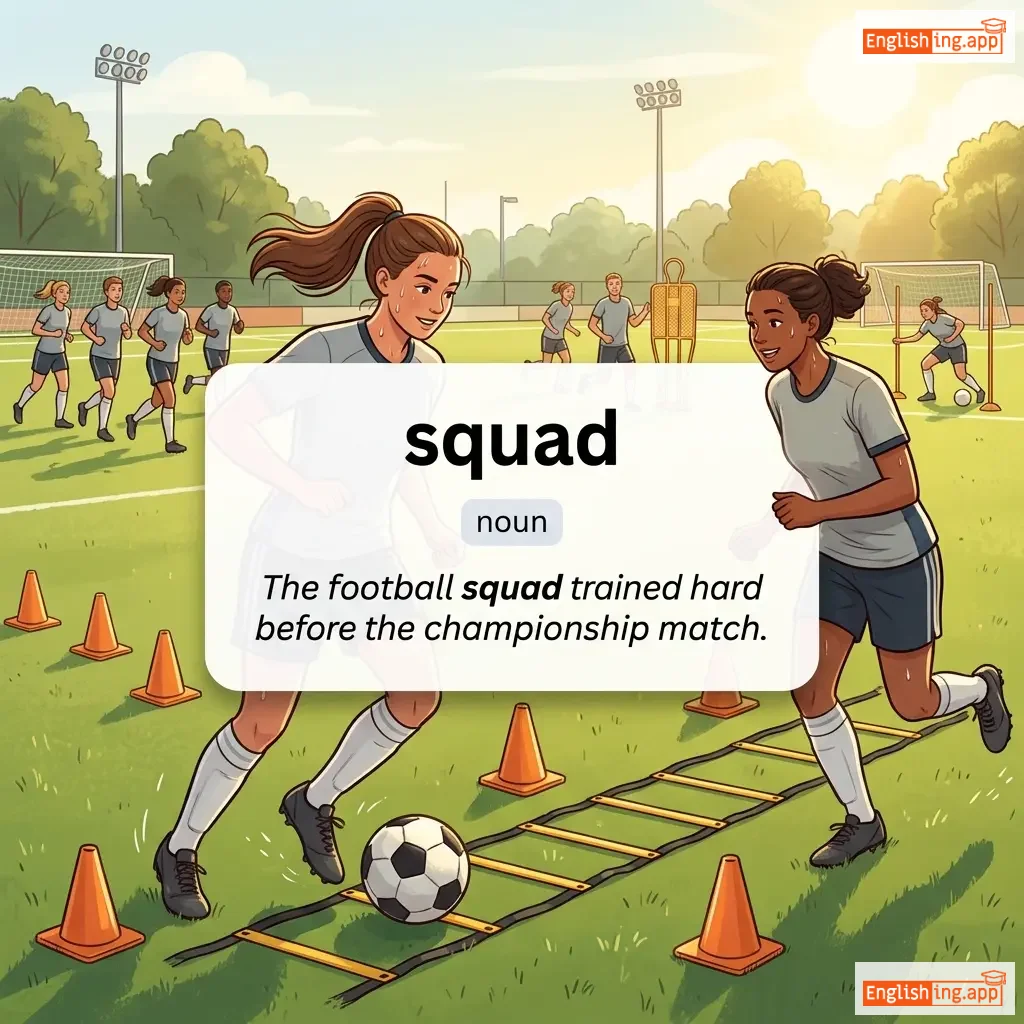
squad definition card — visual illustration of the meaning
noun
/skwɒd/
दल (dal)

a small group of people organized for a specific purpose or task, often in the military or sports

"The football squad trained hard before the championship match."

"चैंपियनशिप मैच से पहले फुटबॉल दल ने कठिन प्रशिक्षण लिया था।" (Championship match se pehle football dal ne kathin prashikshan liya tha.)
adjective
/ˈskwɒlɪd/
अत्यधिक गंदा (atyadhik ganda)

extremely dirty and unpleasant, often due to poverty or neglect

"He lived in a squalid room with broken furniture."

"वह एक गंदी कमरे में टूटी हुई फर्नीचर के साथ रहता था।" (Vah ek gandi kamre mein tooti hui furniture ke saath rehta tha.)
noun
/skwɔːl/
आंधी (aandhi)

a sudden violent gust of wind, often accompanied by rain, snow, or sleet

"A sudden squall caught the sailors off guard."

"एक अचानक आंधी ने नाविकों को चौंका दिया।" (Ek achanak aandhi ne naavikon ko chonka diya.)
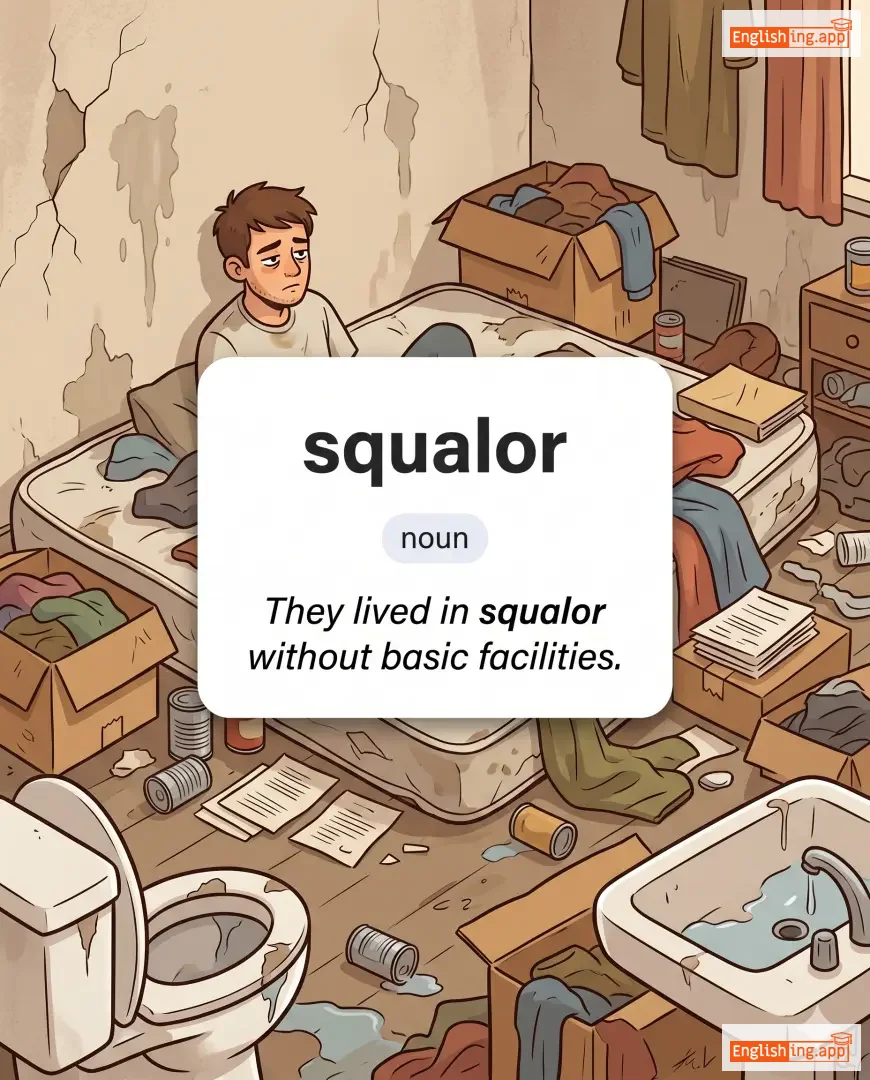
squalor definition card — visual illustration of the meaning
noun
/ˈskwɒlər/
गंदगी (gandagi)

the state of being extremely dirty and unpleasant, especially due to poverty or neglect

"They lived in squalor without basic facilities."

"वे बुनियादी सुविधाओं के बिना गंदगी में रहते थे।" (ve buniyadi suvidhaon ke bina gandagi mein rahte the.)
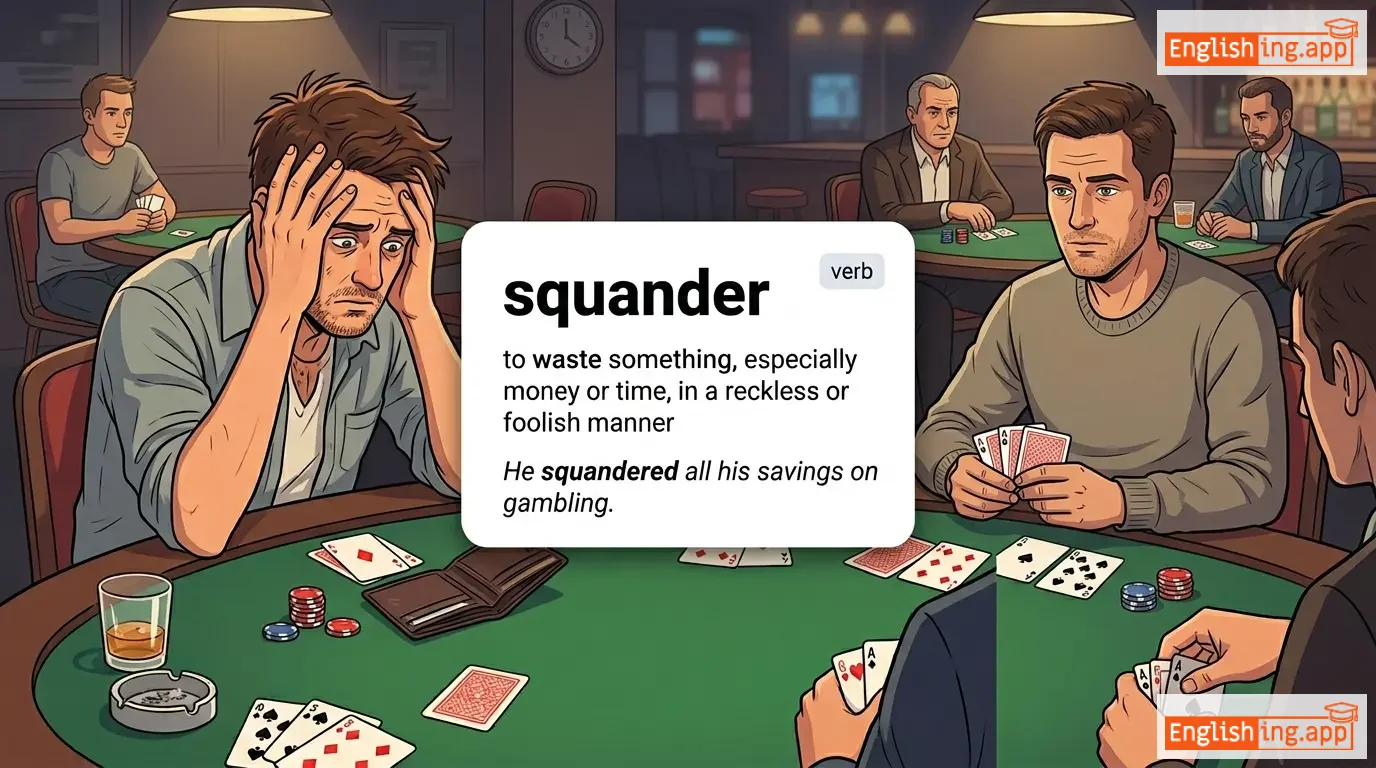
squander definition card — visual illustration of the meaning
verb
/ˈskwɒndər/
बर्बाद करना (barbaad karna)

to waste something, especially money or time, in a reckless or foolish manner

"He squandered all his savings on gambling."

"उसने जुआ खेलने पर अपनी सारी बचत बर्बाद कर दी।" (Usne jua khelne par apni saari bachat barbaad kar di.)
noun
/skwɛə(r)/
वर्ग (varg)

a shape with four equal straight sides and four right angles

"The table has a square shape."

"टेबल का आकार वर्ग है।" (Tebal ka akar varg hai.)
adjective
/ˈstɔːlwərt/
स्थिर, वफादार (sthir, wafadar)

Loyal, reliable, and hardworking; strongly built or sturdy.

"She has always been a stalwart supporter of the community."

"वह हमेशा समुदाय का एक स्थिर समर्थक रही है।" (Vah hamesha samudaay ka ek sthir samarthak rahi hai.)
adjective
/ˈsteɪ.dʒi/
अत्यधिक नाटकीय (atyadhik natakiya)

Overly theatrical, artificial, or exaggerated in manner or style.

"Her performance felt stagy and unnatural."

"उसकी प्रदर्शन स्टेजी और अस्वाभाविक महसूस हो रही थी।" (Uski pradarshan steji aur aswabhavik mehsoos ho rahi thi.)
adjective
/steɪd/
गंभीर, शालीन (gambhir, shalin)

Serious, respectable, and unadventurous.

"He came from a staid family background."

"वह एक गंभीर परिवार से आया था।" (Vah ek gambhir parivar se aaya tha.)
verb
/steɪn/
दाग (daag)

to mark or discolor something permanently; a spot or mark left behind

"The coffee spilled and stained the tablecloth."

"कॉफी गिर गई और टेबलक्लॉथ पर दाग लग गया।" (Coffee gir gayi aur tablecloth par daag lag gaya.)
noun
/stɛə/
सीढ़ी (seedhi)

a step or set of steps leading from one level to another

"He tripped on the stair and fell down."

"वह सीढ़ी पर ठोकर खा कर गिर पड़ा।" (Vah seedhi par thokar khaa kar gir pada.)
noun, verb
/steɪk/
हिस्सा, जोखिम (hissa, jokhim)

A share or interest in a business or venture; to risk or support something of value.

"He has a major stake in the new company."

"उसके पास नई कंपनी में एक बड़ा हिस्सा है।" (Uske paas nayi company mein ek bada hissa hai.)
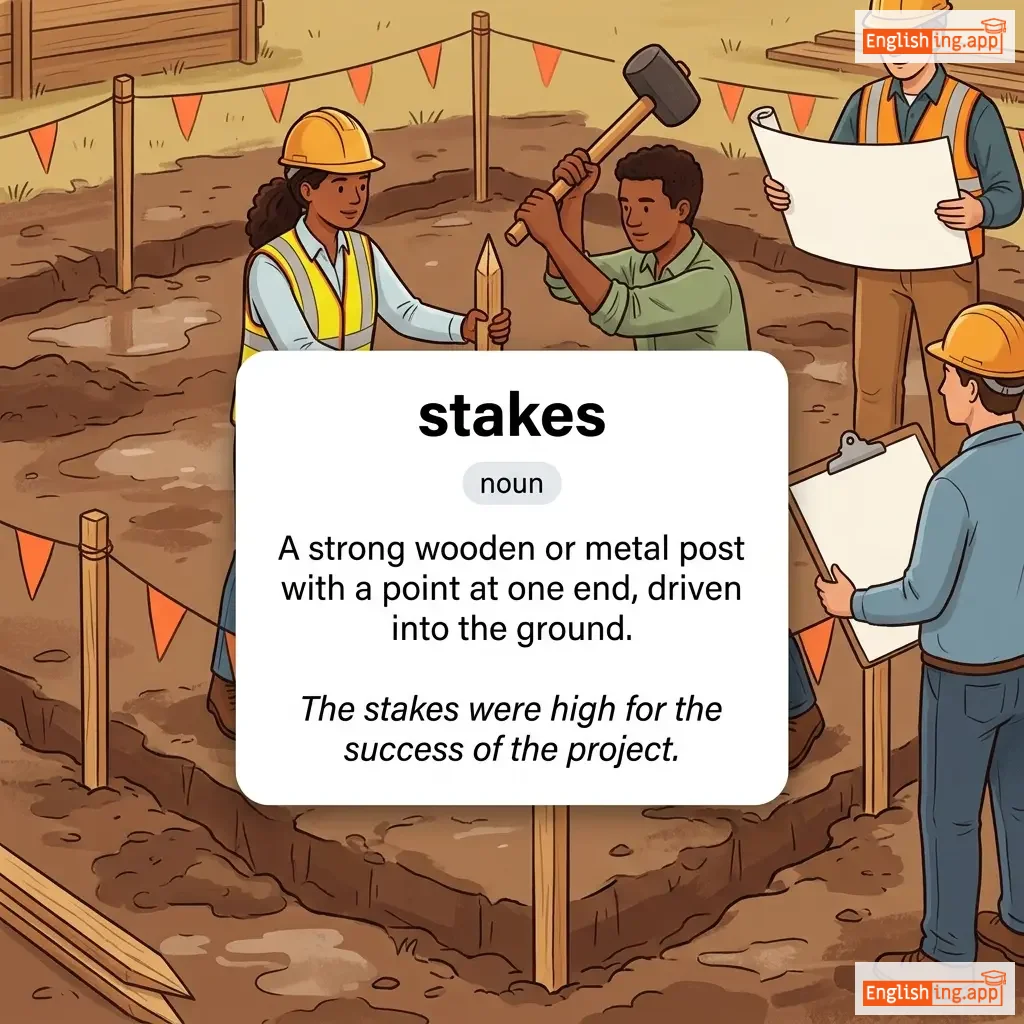
stakes definition card — visual illustration of the meaning
noun
steɪks
दांव (daav)

A strong wooden or metal post with a point at one end, driven into the ground.

"The stakes were high for the success of the project."

"प्रोजेक्ट की सफलता के लिए दांव ऊँचा था।" (Project ki safalta ke liye daav ooncha tha.)
adjective
/steɪl/
बासी; पुराना; ताजगी नहीं होने वाला (stail)

no longer fresh; lacking originality or novelty

"The bread became stale after sitting out for three days."

"तीन दिन बाहर रखने के बाद रोटी बासी हो गई थी।" (teen din baahar rakhne ke baad roti baasi ho gayi thi.)
noun
/ˈsteɪl.meɪt/
सन्नाटा (sannata)

A situation in which no progress can be made or no party can win.

"Negotiations ended in a stalemate."

"संधियों का अंत सन्नाटे में हो गया।" (Sandhiyon ka ant sannate mein ho gaya.)
verb, noun
/stɔːl/
रोकना, छोटा दुकान (rokna, chhota dukaan)

to stop or cause to stop temporarily; a small shop or stand

"The car stalled on the way to the office."

"गाड़ी ऑफिस जाने के रास्ते में रुक गई थी।" (Gaadi office jane ke raste mein ruk gayi thi.)
noun
/ˈstæl.i.ən/
प्रजनन के लिए पुरुष घोड़ा (prajanan ke liye purush ghoda)

An adult male horse that is not castrated, often used for breeding.

"The farm owns a powerful stallion for breeding purposes."

"खेत में प्रजनन के उद्देश्य के लिए एक शक्तिशाली पुरुष घोड़ा है।" (Khet mein prajanan ke uddeshya ke liye ek shaktishali purush ghoda hai.)
noun
/stæns/
स्थिति (sthiti)

a person's attitude, opinion, or position on an issue

"The company took a strong stance on environmental protection."

"कंपनी ने पर्यावरण संरक्षण पर एक मजबूत स्थिति अपनाई।" (Company ne paryavaran sanrakshan par ek majboot sthiti apnaayi.)
standards definition card — visual illustration of the meaning
noun
ˈstæn.dədz
मानक (maanak)

A level of quality or attainment.

"Institutions must meet international standards."

"संस्थाओं को अंतर्राष्ट्रीय मानकों को पूरा करना होगा।" (Sansthaon ko antarraashtreey maanakon ko poora karna hoga.)
noun
/ˈstændərd/
मानक (maanak)

a level of quality or achievement, or a measure of comparison

"This car meets all the safety standards."

"यह कार सभी सुरक्षा मानकों को पूरा करती है।" (Yah kar sabhi suraksha maanakon ko poora karti hai.)
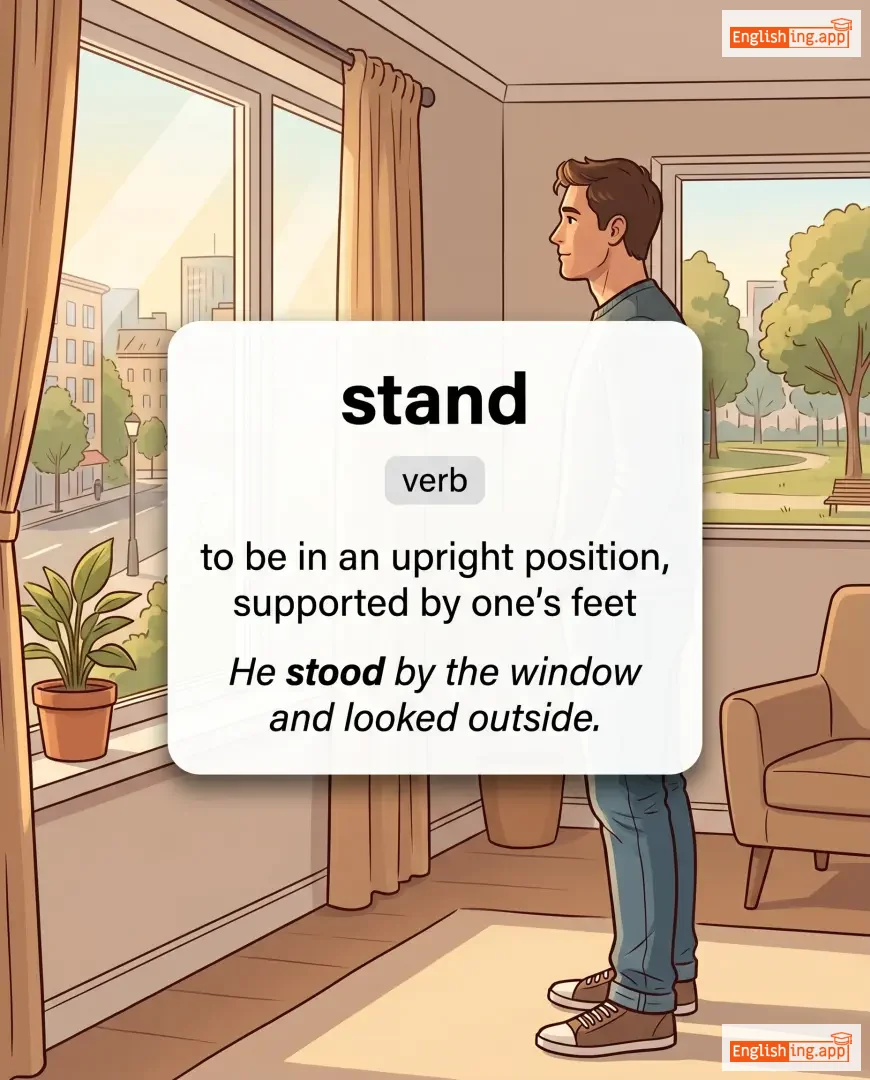
stand definition card — visual illustration of the meaning
verb
/stænd/
खड़ा होना (khada hona)

to be in an upright position, supported by one's feet

"He stood by the window and looked outside."

"वह खिड़की के पास खड़ा था और बाहर देख रहा था।" (Vah khidki ke paas khada tha aur baahar dekh raha tha.)
noun
/ˈstænʃən/
स्तंभ (stambh)

a strong upright bar or post used as support or to control movement

"The red rope was attached to the stanchions to guide the crowd."

"लाल रस्सी स्टैंशनों से जुड़ी थी ताकि भीड़ को मार्गदर्शन किया जा सके।" (Lal rassi stanshano se judi thi taki bhid ko margdarshan kiya ja sake.)
verb
/stɑːntʃ/
रक्तस्राव को रोकना (raktasraav ko rokna)

to stop the flow of blood or liquid from a wound or source

"The nurse quickly stanched the bleeding from the cut."

"नर्स ने कट से रक्तस्राव को जल्दी रोक लिया।" (Nars ne kat se raktasraav ko jaldi rok liya.)
verb
/stæmp/
मोहर लगाना / ज़ोर से पैर मारना (mohar lagana / zor se pair maarna)

To bring down (one's foot) heavily on the ground; to imprint a mark or seal.

"She stamped her foot in frustration."

"वह निराशा में अपना पैर ज़मीन पर मरोड़ दिया।" (Wah niraasha mein apna pair zameen par marod diya.)