वोकैबुलरीज

इंग्लिश वोकैबुलरी डिस्कवर, लर्न और मास्टर करें

verb
/ˌkaʊntərˈækt/
प्रतिक्रियाविरोधी कार्य करना (pratikriyavirodhi karya karna)

to act against something in order to reduce its effect

"The medicine helps counteract the side effects of the treatment."

"दवा इलाज के दुष्प्रभावों को काउंटरऐक्ट करने में मदद करती है।" (Dawa ilaaj ke dushprabhavon ko counteract karne mein madad karti hai.)
verb
/ˌkaʊntərˈbæləns/
प्रतिकूल प्रभाव को संतुलित करना (pratikool prabhav ko santulit karna)

to offset or balance the effect of something

"Exercise can counterbalance the negative effects of stress."

"व्यायाम तनाव के नकारात्मक प्रभाव को संतुलित कर सकता है।" (Vyayam tanav ke nakaratmak prabhav ko santulit kar sakta hai.)
noun, verb
/ˈkaʊntərˌtʃɑːrdʒ/
प्रतिवादी आरोप (prativaadi aarop)

an opposing charge or accusation; to make an opposing attack

"The lawyer filed a countercharge against the accuser."

"वकील ने आरोपी के खिलाफ प्रतिवादी आरोप दायर किया।" (Vakeel ne aaropi ke khilaaf prativaadi aarop daayr kiya.)
adjective, verb, noun
/ˈkaʊntərfɪt/
नकल (nakal)

made to look like something genuine in order to deceive

"The police seized a batch of counterfeit currency."

"पुलिस ने नकल के नोटों का एक बैच जब्त किया।" (Polis ne nakal ke noton ka ek batch zabt kiya.)
adjective
/ˌkaʊntərɪnˈtuːɪtɪv/
विरोधाभासी (virodhabhaasi)

contrary to what one would intuitively expect

"His approach seems counterintuitive but it actually works."

"उसका तरीका विरोधाभासी लगता है, लेकिन यह वास्तव में काम करता है।" (Uska tareeka virodhabhaasi lagta hai, lekin yah vastav mein kaam karta hai.)
verb
/ˌkaʊntərˈmænd/
आदेश रद्द करना (adesh radd karna)

to revoke or cancel an order or command

"The general countermanded the previous orders immediately."

"जनरल ने तुरंत पिछले आदेशों को रद्द कर दिया।" (General ne turant pichhle aadeshon ko radd kar diya.)
noun
/ˈkaʊntərˌpɑːrt/
समकक्ष व्यक्ति (samaksh vyakti)

a person or thing that corresponds to or has the same function as another

"The CEO met with his counterpart in the partner company."

"सीईओ ने पार्टनर कंपनी में अपने समकक्ष व्यक्ति से मुलाकात की।" (CEO ne partner company mein apne samaksh vyakti se mulaqat ki.)
noun
/ˈkaʊntərˌpɔɪnt/
विपरीत बिंदु या विपरीत तर्क (vipareet bindu ya vipareet tark)

an argument, idea, or theme contrasting with another; also a musical term for independent melody

"Her calm attitude was a counterpoint to his anger."

"उसका शांत व्यवहार उसके गुस्से का विपरीत था।" (Uska shant vyavhaar uske gusse ka vipareet tha.)
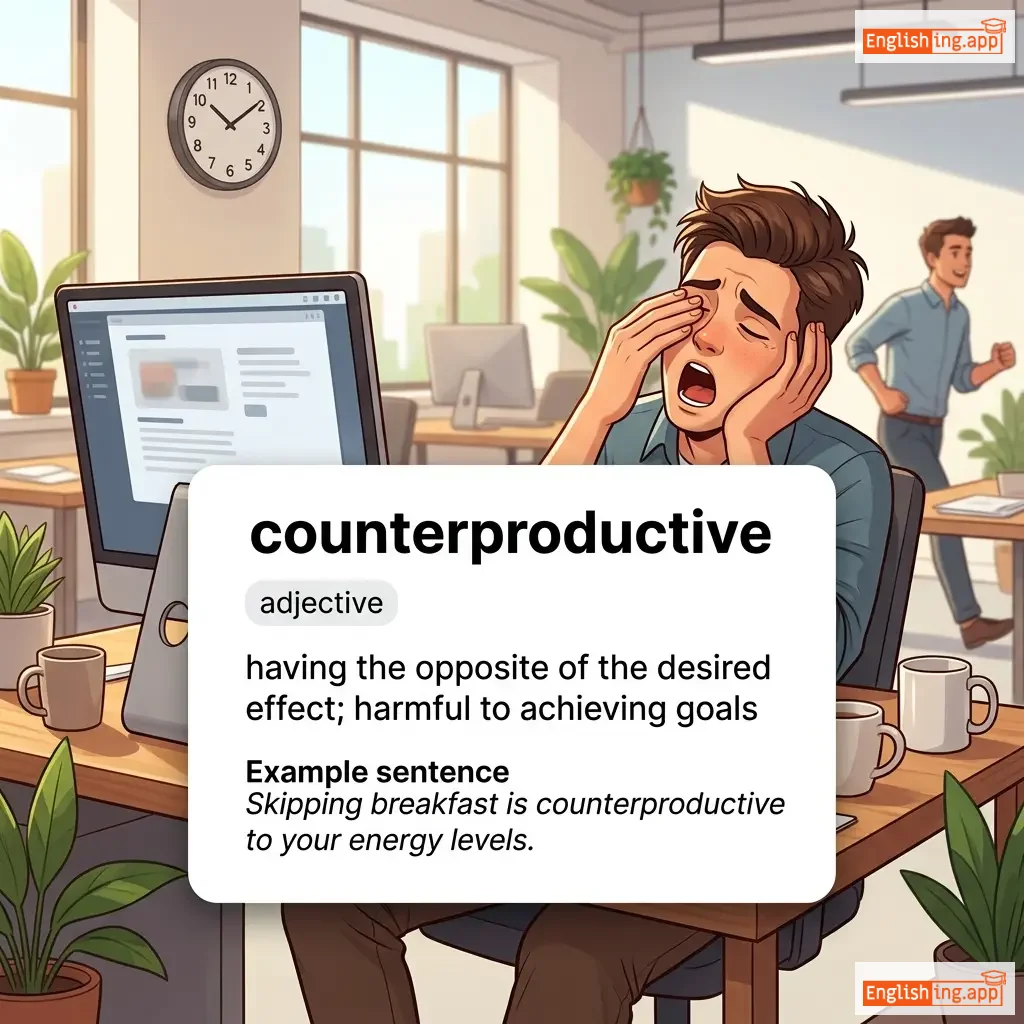
counterproductive definition card — visual illustration of the meaning
adjective
/ˌkaʊntərprəˈdʌktɪv/
विपरीत प्रभावी (viparit prabhavi)

having the opposite of the desired effect; harmful to achieving goals

"Skipping breakfast is counterproductive to your energy levels."

"नाश्ता छोड़ना आपकी ऊर्जा स्तर के लिए विपरीत प्रभावी है।" (Nashta chhodna aapki urja star ke liye viparit prabhavi hai.)
verb
/ˌkaʊntərˈveɪl/
प्रभाव को विपरीत करना (prabhav ko vipareet karna)

to offset or counteract the effect of something

"The benefits of the new policy countervail its drawbacks."

"नई नीति के लाभ इसके नुकसान के प्रभाव को उलट देते हैं।" (Nayi neeti ke laabh iske nuksan ke prabhav ko ulat dete hain.)
noun
/ˈkaʊntɪŋˌhaʊs/
लेखा रखने का कार्यालय (lekha rakhne ka karyalaya)

a business office where accounts are kept and financial transactions are managed

"The merchant spent most of his day in the counting-house reviewing ledgers."

"व्यापारी ने अपना अधिकांश समय लेखा रखने के कार्यालय में खाता-पुस्तकें समीक्षा करने में बिताया।" (Vyapari ne apna adhikansh samay lekha rakhne ke karyalaya mein khata-pustakein sameeksha karne mein bitaya.)
adjective
/ˈkaʊntləs/
गिनती नहीं की जा सकती (ginti nahi ki ja sakti)

too many to be counted; innumerable

"There are countless stars in the sky."

"आसमान में अनगिनत तारे हैं।" (Aasman mein anginat tare hain.)
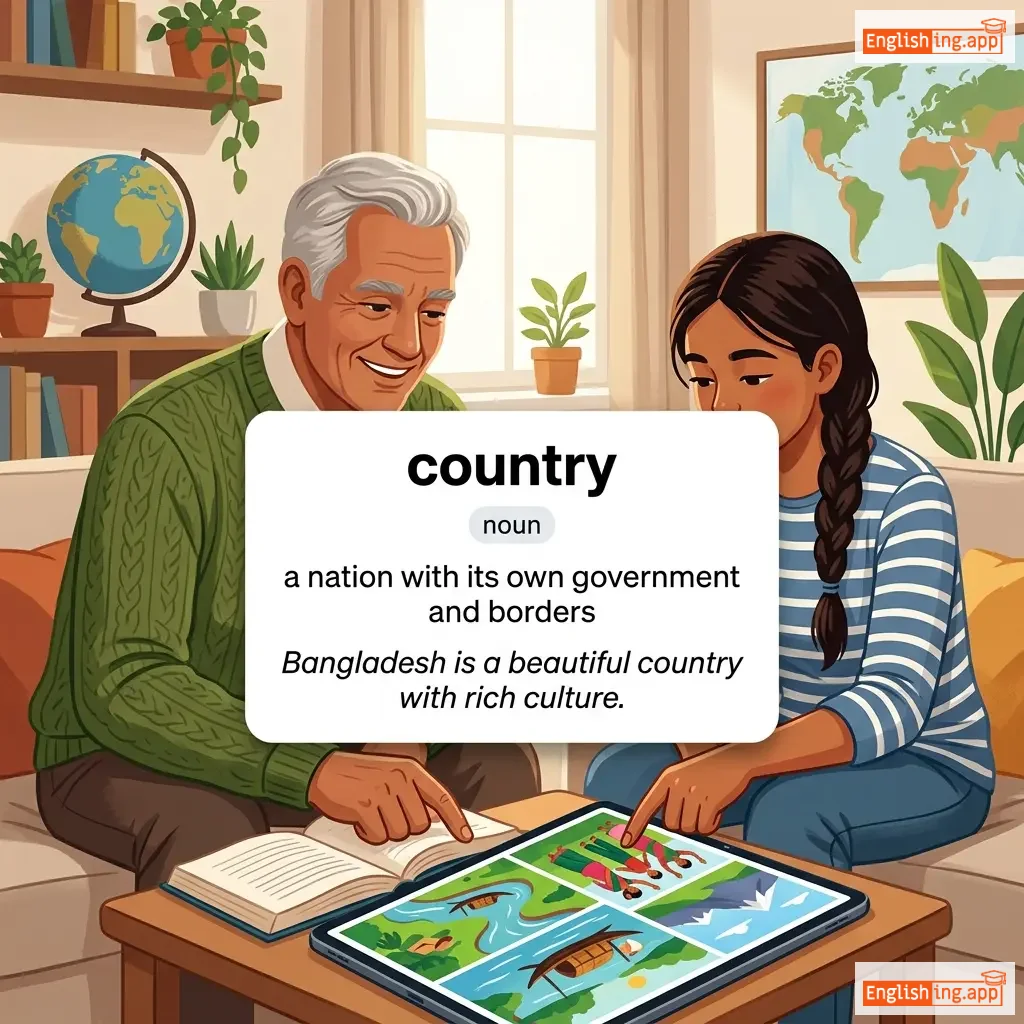
country definition card — visual illustration of the meaning
noun
/ˈkʌn.tri/
देश (desh)

a nation with its own government and borders

"Bangladesh is a beautiful country with rich culture."

"भारत एक सुंदर देश है जिसकी समृद्ध संस्कृति है।" (Bharat ek sundar desh hai jiske samriddh sanskriti hai.)
noun
/ˈkʌntrɪmən/
देशवासी (deshvasi)

a person from one's own country or rural area

"He was proud to meet a fellow countryman at the international conference."

"उसे अंतर्राष्ट्रीय सम्मेलन में एक सहदेशवासी से मिलकर गर्व हुआ।" (Use antarraashtreey sammelan mein ek sahdeshvasi se milkar garv hua.)
noun
/ˈkʌntrisaɪd/
ग्रामीण इलाका (gramin ilaka)

land outside cities and towns; rural areas with farms, fields, and villages

"She enjoys the peace and beauty of the countryside."

"वह ग्रामीण इलाके की शांति और सुंदरता का आनंद लेती है।" (vah gramin ilake ki shanti aur sundarta ka anand leti hai)
noun
/ˈkaʊnti/
जिला (zila)

A territorial division within a country, typically a region with its own local government.

"She grew up in a small county in northern England."

"वह उत्तर इंग्लैंड के एक छोटे जिले में पली-बढ़ी।" (vah uttar England ke ek chhote zile mein pali-badhi.)
noun
/kuː/
कूप (koop)

a sudden, decisive action that brings about a change, especially in government

"The military staged a coup to overthrow the existing regime."

"सैन्य ने मौजूदा शासन को उखाड़ फेंकने के लिए एक कूप किया।" (Sainya ne maujooda shasan ko ukhad fenkne ke liye ek koop kiya.)
noun
/ˈkʌpəl/
जोड़ा (joda)

two people or things considered together; a pair

"They make a lovely couple and have been married for five years."

"वे एक सुंदर जोड़ी बनाते हैं और पाँच सालों से शादीशुदा हैं।" (Ve ek sundar jodi banate hain aur paanch salon se shaadishuda hain.)
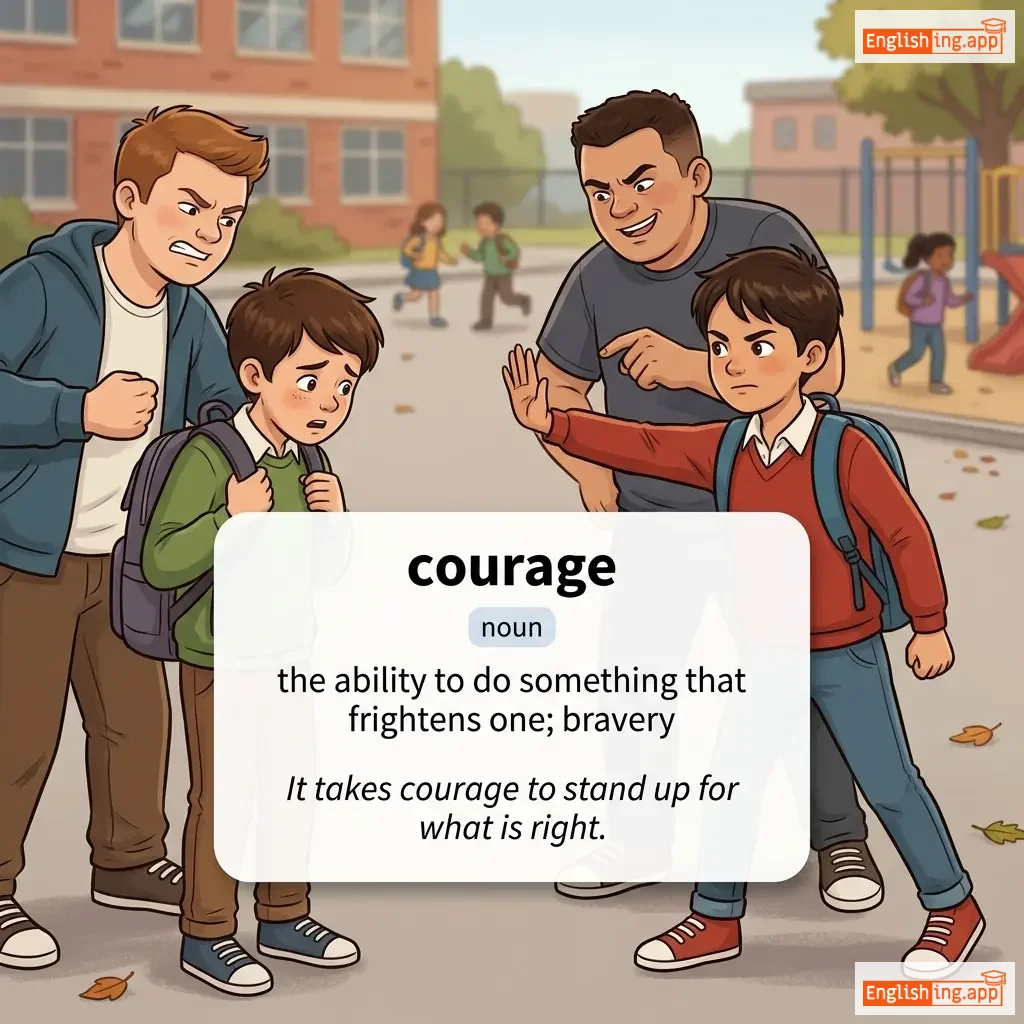
courage definition card — visual illustration of the meaning
noun
/ˈkʌrɪdʒ/
साहस (sahas)

the ability to do something that frightens one; bravery

"It takes courage to stand up for what is right."

"जो सही है उसके लिए खड़ा होने में साहस लगता है।" (Jo sahi hai uske liye khada hone mein sahas lagta hai.)
adjective
/kəˈreɪdʒəs/
साहसी (sahasi)

having or showing bravery; able to face danger or difficulty

"The firefighter was courageous as he rescued the children from the burning building."

"अग्निशामक अधिकारी साहसी थे जब उन्होंने जलती हुई इमारत से बच्चों को बचाया।" (Agnishamak adhikari sahasi the jab unhone jalti hui imarat se bachon ko bachaya.)
noun
/ˈkʊriər/
संदेशवाहक (sandeshwahaak)

a person or company that delivers messages, packages, or mail

"The courier delivered the documents on time."

"कूरियर ने समय पर दस्तावेज़ पहुँचाए।" (Courier ne samay par dastavez pahuchaye.)
noun
/kɔːrs/
कोर्स, पाठ्यक्रम या रास्ता (course, path ya pathyakram)

a direction, path, or a set of educational lessons

"She enrolled in a computer science course."

"वह कंप्यूटर विज्ञान के कोर्स में नामांकित हुई।" (Woh computer vigyan ke course mein naamankit hui.)
noun
/kɔːrs flaʊər/
कोर्स आटा (kors ata)

coarsely ground flour with larger particles, typically used for baking bread

"She used course flour to make homemade bread with a rustic texture."

"उसने घर का बना रोटी बनाने के लिए कोर्स फ्लावर का इस्तेमाल किया जिसमें एक देहाती बनावट थी।" (usne ghar ka bana roti banane ke liye kors flour ka istemal kiya jismein ek dehati banawat thi.)
noun
/ˈkɔːrsər/
तेज़ घोड़ा या शिकार के लिए प्रयुक्त घोड़ा (tez ghoda ya shikar ke liye prayukt ghoda)

a swift horse or a hunting horse

"The knight rode a fast courser into battle."

"योद्धा ने युद्ध में तेज़ कोर्सर की सवारी की।" (Yoddha ne yudh mein tez courser ki sawaari ki.)
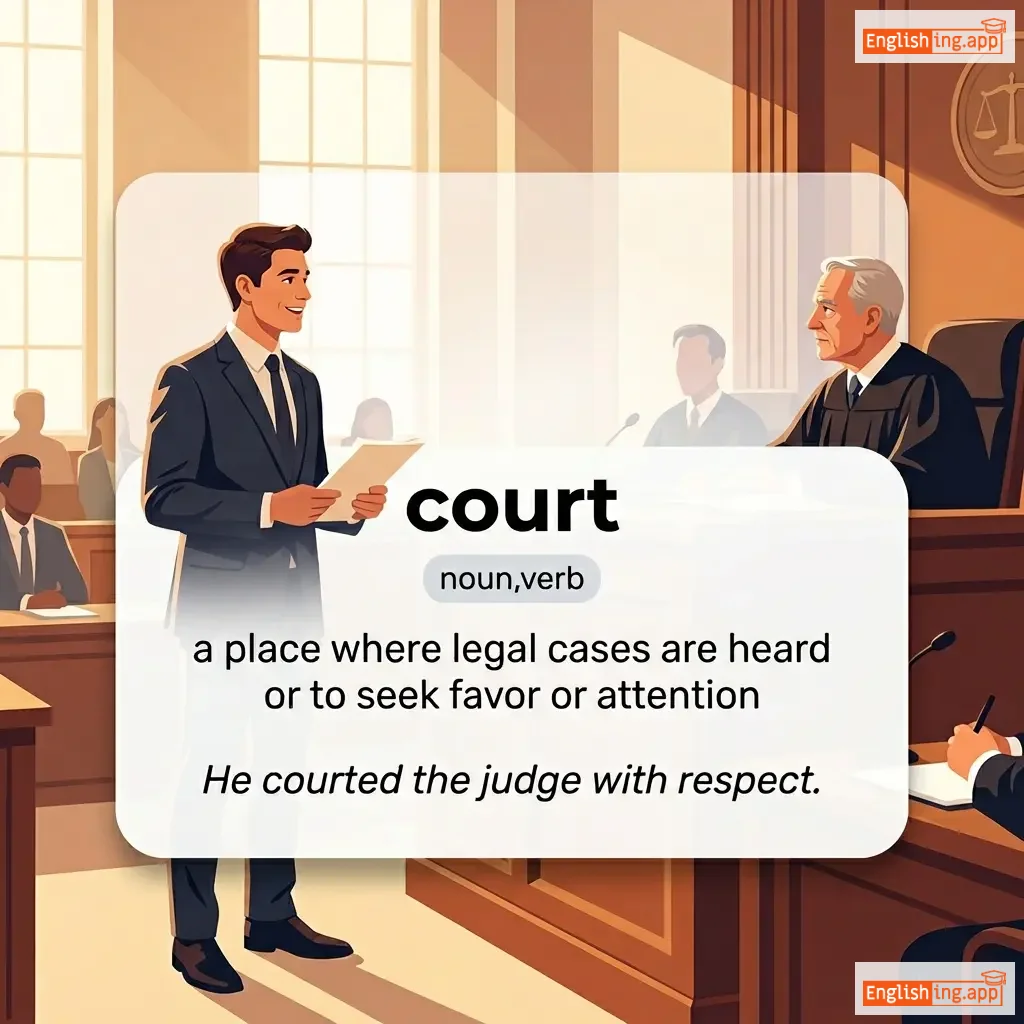
court definition card — visual illustration of the meaning
noun,verb
/kɔːrt/
अदालत या ध्यान आकर्षित करने का स्थान (adalat ya dhyan akarshit karne ka sthan)

a place where legal cases are heard or to seek favor or attention

"He courted the judge with respect."

"उसने जज के सामने सम्मान दिखाकर ध्यान आकर्षित करने की कोशिश की।" (Usne jajj ke samne sammaan dikhakar dhyan akarshit karne ki koshish ki.)
adjective
/ˈkɜːrtiəs/
विनम्र (vinamra)

polite, respectful, or considerate in manner

"The staff at the hotel were very courteous to all guests."

"होटल में कर्मचारियों ने सभी मेहमानों के प्रति बहुत विनम्रता दिखाई।" (Hotel mein karmachariyon ne sabhi mehmanon ke prati bahut vinamrata dikhai.)
noun
/ˈkɜːrtəsi/
शिष्टाचार, विनम्रता या सौजन्य (shishtachar, vinamrata ya soujanya)

polite behavior or a polite action; a favor or privilege

"He opened the door as a courtesy."

"उसने दरवाजा एक शिष्टाचार के रूप में खोला।" (Usne darwaza ek shishtachar ke roop mein khola.)
noun
/ˈkɔːtruːm/
अदालत कक्ष (kortroom)

a room in which legal cases are heard and decided by a judge

"The witness was called to testify in the courtroom."

"गवाह को अदालत के कोर्टरूम में गवाही देने के लिए बुलाया गया था" (Gawah ko adaalat ke kortroom mein gawahi dene ke liye bulaya gaya tha)
noun
/ˈkʌzn/
कज़िन (kazin)

A child of one's uncle or aunt.

"My cousin is coming to visit us this weekend."

"मेरा कज़िन इस सप्ताहांत हमसे मिलने आ रहा है।" (Mera kazin is saptahant humse milne aa raha hai.)
noun
/ˈkʌvən/
तांत्रिकों का समूह (tantrikon ka samuh)

a group or gathering of witches

"The witches met secretly in a coven in the forest."

"जादूगरनियां जंगल में एक तांत्रिकों के समूह में गुपचुप मिलीं।" (Jadugarniyan jangal mein ek tantrikon ke samuh mein gupchup mili.)
noun
/ˈkʌvənənt/
संविदा (samvida)

a formal agreement or promise, often legally binding

"The landlord and tenant signed a covenant to maintain the property."

"मालिक और किराएदार ने संपत्ति बनाए रखने के लिए एक संविदा पर हस्ताक्षर किए।" (Malik aur kirayedar ne sampatti banaye rakhne ke liye ek samvida par hastakshar kiye.)
cover definition card — visual illustration of the meaning
verb
/ˈkʌvər/
ढकना (dhakna)

to place something over or on top of something else to protect or hide it

"She used a blanket to cover the sleeping child."

"वह सोते हुए बच्चे को ढकने के लिए कंबल का इस्तेमाल किया।" (Wah sote hue bachche ko dhakne ke liye kambal ka istemal kiya.)
noun
/ˈkʌvərɪdʒ/
कवरेज (kavarej)

The extent or scope of something, such as insurance protection or media reporting.

"The news channel provided extensive coverage of the event."

"समाचार चैनल ने घटना की व्यापक कवरेज प्रदान की।" (Samachar channel ne ghatna ki vyapak kavarej pradan ki.)
covered definition card — visual illustration of the meaning
verb
/ˈkʌv.ərd/
कवर किया हुआ (kavar kiya hua)

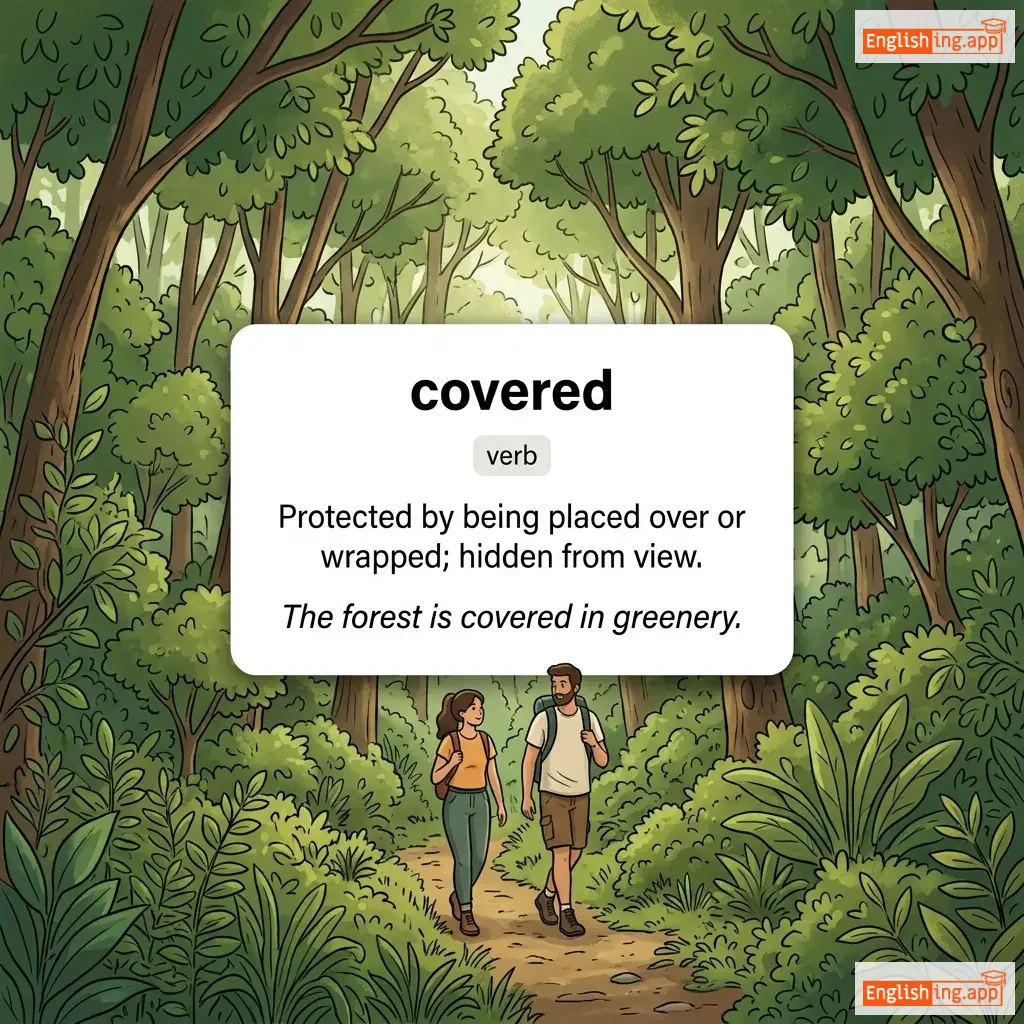
Protected by being placed over or wrapped; hidden from view.

"The forest is covered in greenery."

"जंगल हरे-भरे में कवर किया हुआ है।" (Jangal hare-bhare mein kavar kiya hua hai.)
covert definition card — visual illustration of the meaning
adjective
/ˈkoʊvərt/
गुप्त (gupt)

hidden, secret, or not openly acknowledged

"The spy conducted a covert operation behind enemy lines."

"जासूस ने दुश्मन की सीमाओं के पीछे एक गुप्त अभियान चलाया।" (Jasoos ne dushman ki seemaon ke peeche ek gupt abhiyan chalaya.)
verb
/ˈkʌvət/
लालच करना (lalach karna)

to desire something belonging to someone else

"He coveted his neighbor's new car."

"उसने अपने पड़ोसी की नई कार को लालच किया।" (Usne apne padosi ki nayi car ko lalach kiya.)
covetous definition card — visual illustration of the meaning
adjective
/ˈkʌvətəs/
लालची (laalchi)

having or showing a strong desire for someone else's possessions

"She gave him a covetous look when he showed his new watch."

"उसने अपनी नई घड़ी दिखाते समय उसे एक लालच भरी नज़र से देखा।" (Usne apni nai ghadi dikhate samay use ek laalch bhari nazar se dekha.)
noun
/ˈkʌvi/
पक्षियों का एक छोटा समूह (pakshiyon ka ek chhota samooh)

a small group of birds, especially partridges or quails

"A covey of quails flew across the field."

"एक कोवी क्वेल्स खेत के ऊपर उड़ गई।" (Ek covey quails khet ke upar ud gayi.)
noun
/kaʊ/
गाय (gaay)

a large domesticated bovine animal kept for milk or meat

"The farmer milked the cow early in the morning."

"किसान ने सुबह जल्दी गाय से दूध दुह लिया।" (Kisan ne subah jaldi gaay se doodh duh liya)
noun
/ˈkaʊ.ərd/
कायर (kayar)

a person who lacks the courage to do or endure dangerous or unpleasant things

"He called himself a coward for not standing up to the bully."

"उसने खुद को कायर कहा क्योंकि उसने बुली के सामने खड़ा नहीं हुआ।" (usne khud ko kayar kaha kyonki usne bully ke samne khada nahi hua.)
noun
/ˈkaʊərdɪs/
कायरता (kāyaratā)

lack of courage; behavior showing fear

"His cowardice prevented him from speaking up."

"उसकी कायरता ने उसे बोलने से रोक दिया।" (Uski kāyaratā ne use bolne se rok diyā.)
noun
/ˈkaʊbɔɪ/
गै़र牧पालक (gairpālka)

a man, typically one on horseback, who herds and tends cattle

"The cowboy rode across the plains."

"काउबॉय मैदान के पार सवारी कर रहा था।" (Cowboy maidān ke paar sawarī kar rahā thā.)
verb
/ˈkaʊər/
डर से झुका होना (dar se jhuka hona)

to crouch down in fear

"The child cowered behind the sofa during the thunderstorm."

"बच्चा तूफान के दौरान सोफे के पीछे डर से झुका हुआ था।" (Baccha toofan ke dauran sofe ke peeche dar se jhuka hua tha.)
noun
/ˈkɒksweɪn/
नाविक प्रमुख (navik pramukh)

the person in charge of navigating and steering a boat, especially a racing or small boat

"The coxswain shouted instructions to the rowing team."

"कॉकस्वेन ने रोइंग टीम को निर्देश दिए।" (Coxswain ne rowing team ko nirdesh diye.)
adjective
/kɔɪ/
संकोची, लज्जाशील (sankochi, lajjashil)

reluctant to give details or reveal feelings; shy or reserved

"She gave a coy smile when asked about her plans."

"जब उससे उसकी योजनाओं के बारे में पूछा गया तो उसने एक संकोची मुस्कान दी।" (Jab usse uski yojnaon ke baare mein poocha gaya to usne ek sankochi muskaan di.)
cozen definition card — visual illustration of the meaning
verb
/ˈkʌzən/
धोखा देना, ठगना (dhokha dena, thagna)

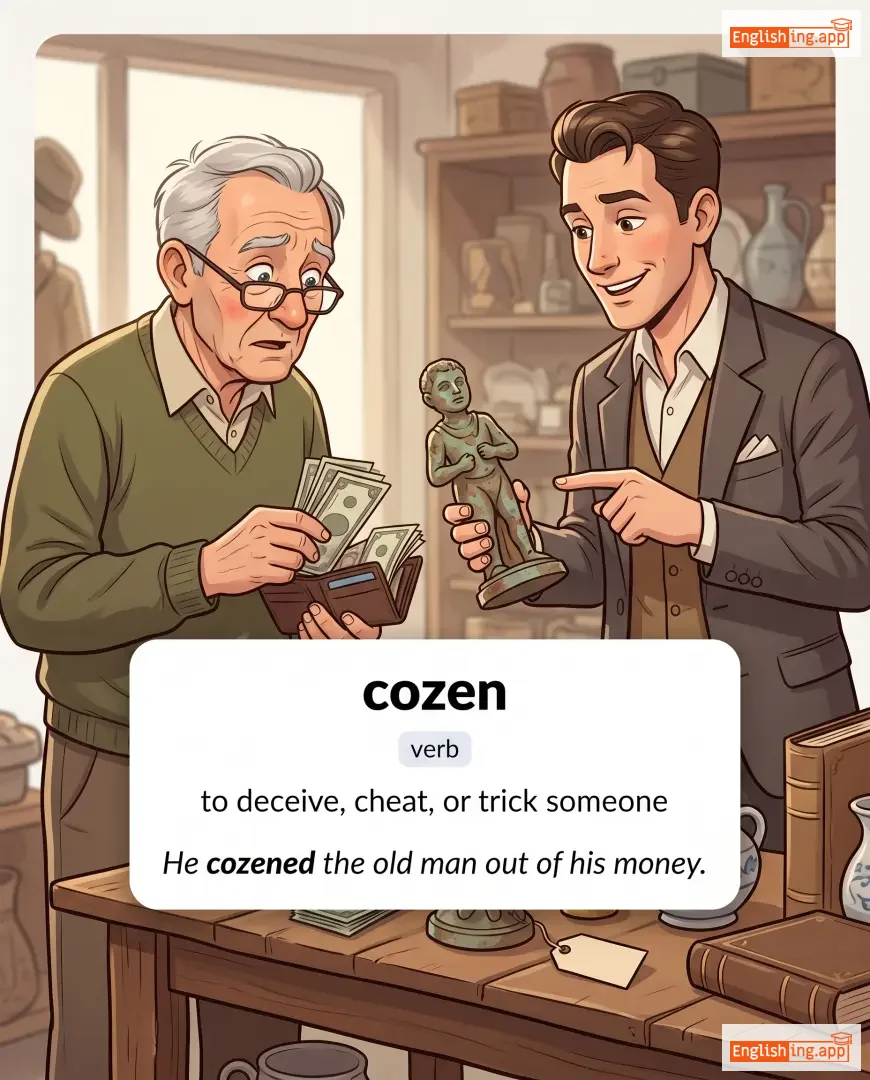
to deceive, cheat, or trick someone

"He cozened the old man out of his money."

"उसने पुराने आदमी को उसके पैसे से धोखा देकर ठग लिया।" (Usne purane aadmi ko uske paise se dhokha dekar thag liya.)
adjective
/ˈkoʊzi/
आरामदायक (aaramdayak)

giving a feeling of comfort, warmth, and relaxation

"We sat in a cozy little café on a rainy day."

"हम एक आरामदायक छोटे कैफे में बैठे थे, एक बारिश वाले दिन में।" (ham ek aaramdayak chhote cafe mein baithe the, ek baarish wale din mein.)
noun
/kræb/
केकड़ा (kekda)

a crustacean with a broad carapace, stalked eyes, and five pairs of legs, the first pair of which are modified as pincers

"The crab scuttled sideways across the sand."

"केकड़ा बालू पर साइडवेज़ में रेंगता हुआ गया।" (kekda bālū par sāidvež mein reṅgtā huā gayā.)
adjective
/ˈkræbɪd/
पढ़ने में कठिन, चिड़चिड़ा स्वभाव (padhne mein kathin, chidhchidhā svabhāv)

difficult to read or understand; ill-tempered

"His handwriting was crabbed and almost illegible."

"उसकी हैंडराइटिंग कठिन और लगभग अपरिष्कृत थी।" (Uski handwriting kathin aur lagbhag aparishkrit thi.)
verb
/kræk/
खुशी (khushi)

To break or cause to break without complete separation; to make a sharp sound.

"The glass cracked when it was dropped on the floor."

"जब उसे पुरस्कार मिला, तो वह अपनी खुशी नहीं छिपा सकी।" (Jab use puraskaar mila, to vah apni khushi nahin chhupa sakee.)