वोकैबुलरीज

इंग्लिश वोकैबुलरी डिस्कवर, लर्न और मास्टर करें

noun
/ˈkrɪk.ɪt/
झींझी (jhinjhi)

a jumping insect that makes a chirping sound by rubbing its wings together

"We could hear crickets chirping in the evening."

"हम शाम को क्रिकेट की आवाज़ सुन सकते थे।" (ham shaam ko cricket ki awaaz sun sakte the.)
crime definition card — visual illustration of the meaning
noun
/kraɪm/
अपराध (apraadh)

An illegal act punishable by law.

"The police are investigating the crime."

"पुलिस अपराध की जांच कर रही है।" (Police apraadh ki jaanch kar rahi hai.)
noun, adjective
/ˈkrɪmɪnəl/
अपराधी (apraadhi)

A person who has committed a crime; relating to crime

"The police arrested a dangerous criminal last night."

"पुलिस ने पिछले रात एक खतरनाक अपराधी को गिरफ्तार किया।" (Police ne pichhle raat ek khatarnaak apraadhi ko giraftar kiya.)
adjective
/ˈkrɪm.zən/
गहरे लाल (gahre lal)

a deep purplish-red color

"The crimson sunset painted the sky with beautiful shades."

"गहरे लाल सूर्योदय ने आकाश को सुंदर रंगों से रंग दिया।" (gahre lal suryoday ne akash ko sundar rangon se rang diya.)
verb
/krɪndʒ/
लज्जित होना (lajjit hona)

To shrink back in fear, embarrassment, or discomfort.

"She cringed when she remembered her mistake."

"वह अपनी गलती याद करते हुए लज्जित हुई।" (Wah apni galti yaad karte hue lajjit hui.)
verb
/ˈkrɪŋ.kəl/
झुर्री (jhurri)

To form small creases or wrinkles.

"She crinkled her nose at the strange smell."

"उसने अजीब गंध से अपनी नाक सिकोड़ दी।" (Usne ajeeb gandh se apni naak sikod di.)
crisis definition card — visual illustration of the meaning
noun
/ˈkraɪsɪs/
संकट (sankat)

A time of intense difficulty or danger

"The company faced a financial crisis during the recession."

"कंपनी ने मंदी के दौरान एक वित्तीय संकट का सामना किया।" (Company ne mandi ke dauran ek vittiya sankat ka samna kiya.)
noun
/kraɪˈtɪəriə/
मानदंड (mandand)

Standards or principles by which something is judged or decided.

"The candidates were evaluated based on strict criteria."

"उम्मीदवारों का कठोर मानदंडों के आधार पर मूल्यांकन किया गया।" (Ummeedwaron ka kathor mandandon ke aadhar par mulyankan kiya gaya.)
noun
/kraɪˈtɪəriən/
मानदंड (maandand)

A standard or rule used to make a judgment or decision.

"Honesty is an important criterion for this job."

"ईमानदारी इस नौकरी के लिए एक महत्वपूर्ण मानदंड है।" (Imaandari is naukri ke liye ek mahatvapurn maandand hai.)
critic definition card — visual illustration of the meaning
noun
/ˈkrɪtɪk/
आलोचक (aalochak)

A person who judges the merits of something, especially art or literature

"The film critic praised the director's latest movie."

"फिल्म आलोचक ने निर्देशक की नवीनतम फिल्म की सराहना की।" (Film aalochak ne nirdeshak ki naveenatam film ki sarahna ki.)
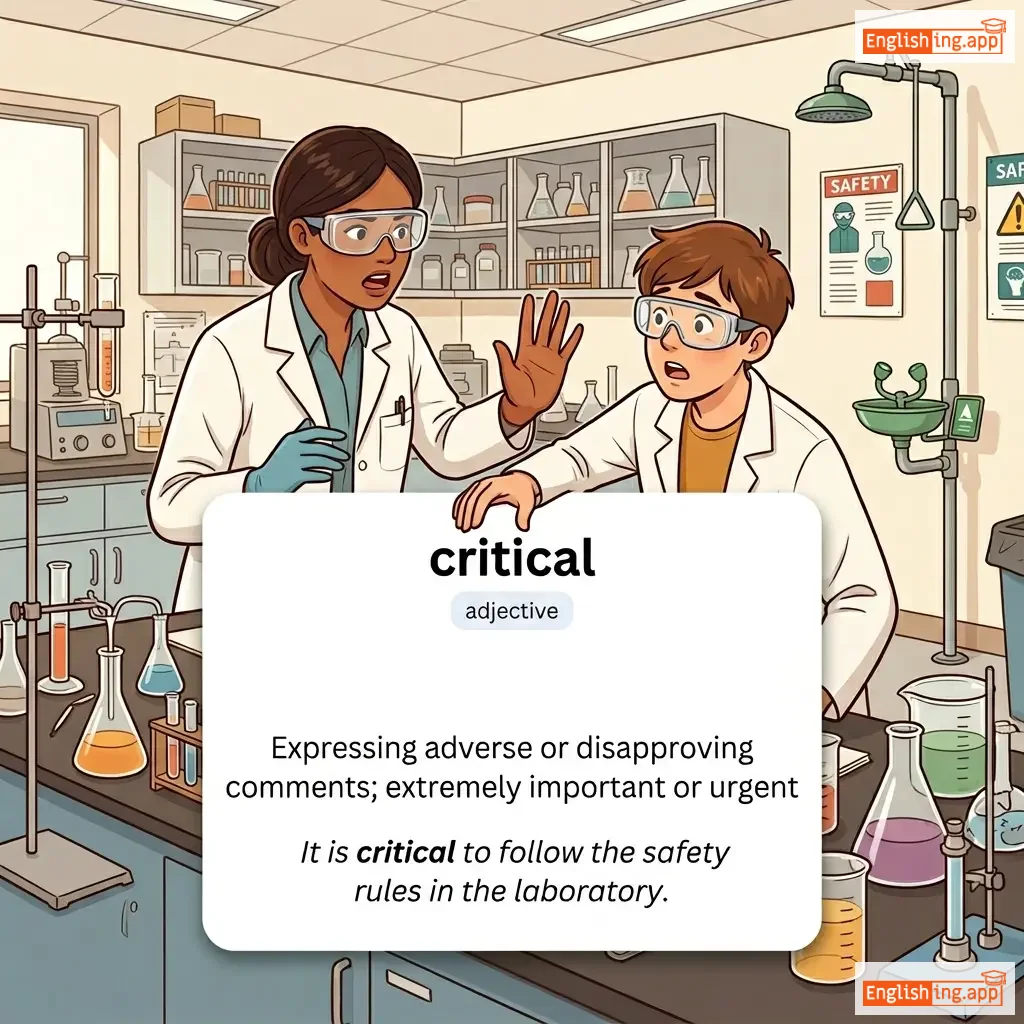
critical definition card — visual illustration of the meaning
adjective
/ˈkrɪtɪkəl/
महत्वपूर्ण / संकटपूर्ण (mahatvapoorn / sankatpoorn)

Expressing adverse or disapproving comments; extremely important or urgent

"It is critical to follow the safety rules in the laboratory."

"प्रयोगशाला में सुरक्षा नियमों का पालन करना अत्यंत महत्वपूर्ण है।" (Prayogshala mein suraksha niyamon ka paalan karna atyant mahatvapoorn hai.)
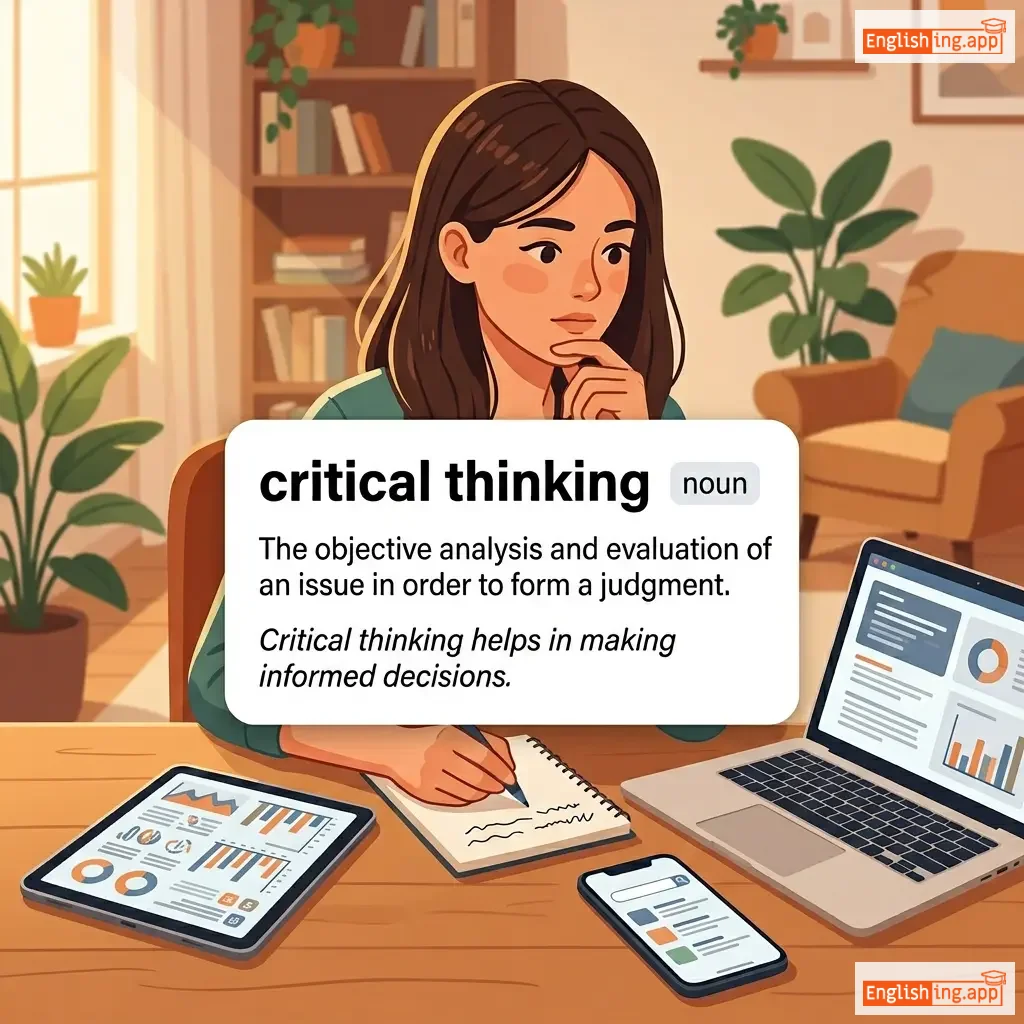
critical thinking definition card — visual illustration of the meaning
noun
ˈkrɪt.ɪ.kəl ˈθɪŋ.kɪŋ
समीक्षात्मक सोच (sameekshatmak soch)

The objective analysis and evaluation of an issue in order to form a judgment.

"Critical thinking helps in making informed decisions."

"समीक्षात्मक सोच सूचित निर्णय लेने में मदद करती है।" (Sameekshatmak soch soochit nirnay lene mein madad karti hai.)
adverb
/ˈkrɪtɪkli/
गंभीरता से (gambheerta se)

in a way that expresses disapproval or a very serious, important way

"He was critically injured in the accident."

"वह दुर्घटना में गंभीर रूप से घायल हुआ था।" (Vah durghatna mein gambheer roop se ghaayal hua tha.)
noun
/ˈkrɪtɪˌsɪzəm/
आलोचना (aalochana)

The expression of disapproval or judgment of the merits of something

"The new policy has faced a lot of criticism from the public."

"नई नीति को जनता से बहुत आलोचना मिली है।" (Nayi neeti ko janata se bahut aalochana mili hai.)
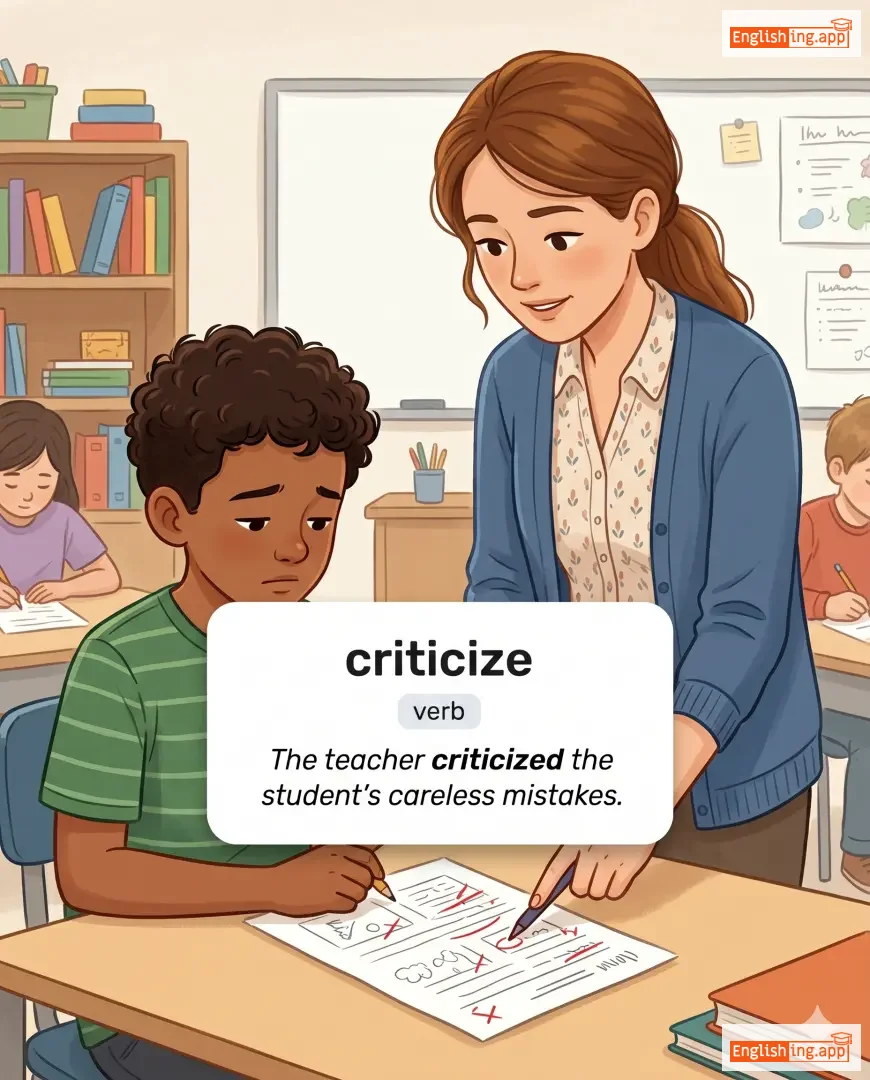
criticize definition card — visual illustration of the meaning
verb
/ˈkrɪtɪsaɪz/
आलोचना करना (aalochana karna)

to express disapproval of someone or something by pointing out faults or shortcomings

"The teacher criticized the student's careless mistakes."

"अध्यापक ने छात्र की लापरवाह गलतियों की आलोचना की।" (Adhyapak ne chatra ki laaparwah galtiyon ki aalochana ki.)
noun/verb
/krɪˈtiːk/
आलोचना (aalochna)

A detailed analysis and assessment of something, especially a literary, philosophical, or political theory; to evaluate critically.

"The professor asked the students to critique each other's essays."

"प्रोफेसर ने छात्रों से एक-दूसरे के निबंधों की आलोचना करने को कहा।" (Professor ne chhatron se ek-doosre ke nibandhon ki alochna karne ko kaha.)
noun/verb
/kroʊˈʃeɪ/
क्रोशे (kroshe)

Needlework made by interlocking loops of thread with a hooked needle; the act of making such items.

"She learned how to crochet a scarf for winter."

"वह सर्दी के लिए एक स्कार्फ क्रोशे करना सीखी।" (Woh sardi ke liye ek scarf crochet karna seekhi.)
noun
/krɑk pɑt/
क्रॉक पॉट (krok pot)

an electric cooking pot that cooks food slowly at low temperatures

"I put the chicken and vegetables in the crock pot before going to work."

"मैं काम पर जाने से पहले चिकन और सब्जियां क्रॉक पॉट में डालता हूँ" (main kaam par jaane se pehle chicken aur sabziyan krok pot mein daalta hoon)
noun
/ˈkrɒkəri/
बर्तन (bartan)

Dishes, plates, cups, and other items made of earthenware or china.

"The hotel provided clean crockery for the guests."

"होटल ने मेहमानों के लिए साफ बर्तन उपलब्ध कराए।" (Hotel ne mehmanon ke liye saaf bartan uplabdh karaaye.)
noun
/ˈkrɒk.ə.daɪl/
मगरमच्छ (magarmachchh)

a large reptile with a long mouth and sharp teeth that lives in rivers and lakes in hot countries

"The crocodile slowly moved through the murky water."

"मगरमच्छ धीरे-धीरे गंदे पानी में से गुजर रहा था।" (magarmachchh dheere-dheere gande pani mein se guzra raha tha)
noun
/kroʊn/
वृद्धा महिला (vruddha mahila)

An old woman, often one who is thin and ugly, sometimes associated with witch-like qualities.

"The children were scared by the story of the wicked crone in the forest."

"बच्चे जंगल में बुरी वृद्धा महिला की कहानी से डर गए थे।" (Bachche jangal mein buri vruddha mahila ki kahani se dar gaye the.)
noun
/ˈkroʊniˌɪzəm/
घृणित पक्षपातीवाद (ghrinat pakshapativad)

The practice of favoring friends or associates, especially in political appointments or business deals.

"The company was accused of cronyism in hiring practices."

"कंपनी को भर्ती प्रथाओं में घृणित पक्षपातीवाद का आरोप लगा था।" (Kampani ko bharti prathao mein ghrinat pakshapativad ka aarop laga tha.)
noun
/krʊk/
धोखेबाज़ (dhokhebaaz)

a dishonest person, especially a criminal

"The police finally caught the crook who had been stealing cars."

"पुलिस ने अंततः उस धोखेबाज़ को पकड़ लिया जो कारें चुरा रहा था।" (Police ne antatah us dhokhebaaz ko pakad liya jo kaarein chura raha tha.)
verb
/kruːn/
नर्म, धीमी और कोमल आवाज़ में गाना या गुनगुनाना (narm, dheemi aur komal awaaz mein gaana ya gungunana)

to sing or hum in a soft, low, and gentle voice

"She crooned a lullaby to help the baby fall asleep."

"वह बच्चे को सोने में मदद करने के लिए एक लोरी गा रही थी।" (Wah bachche ko sone mein madad karne ke liye ek lori gaa rahi thi.)
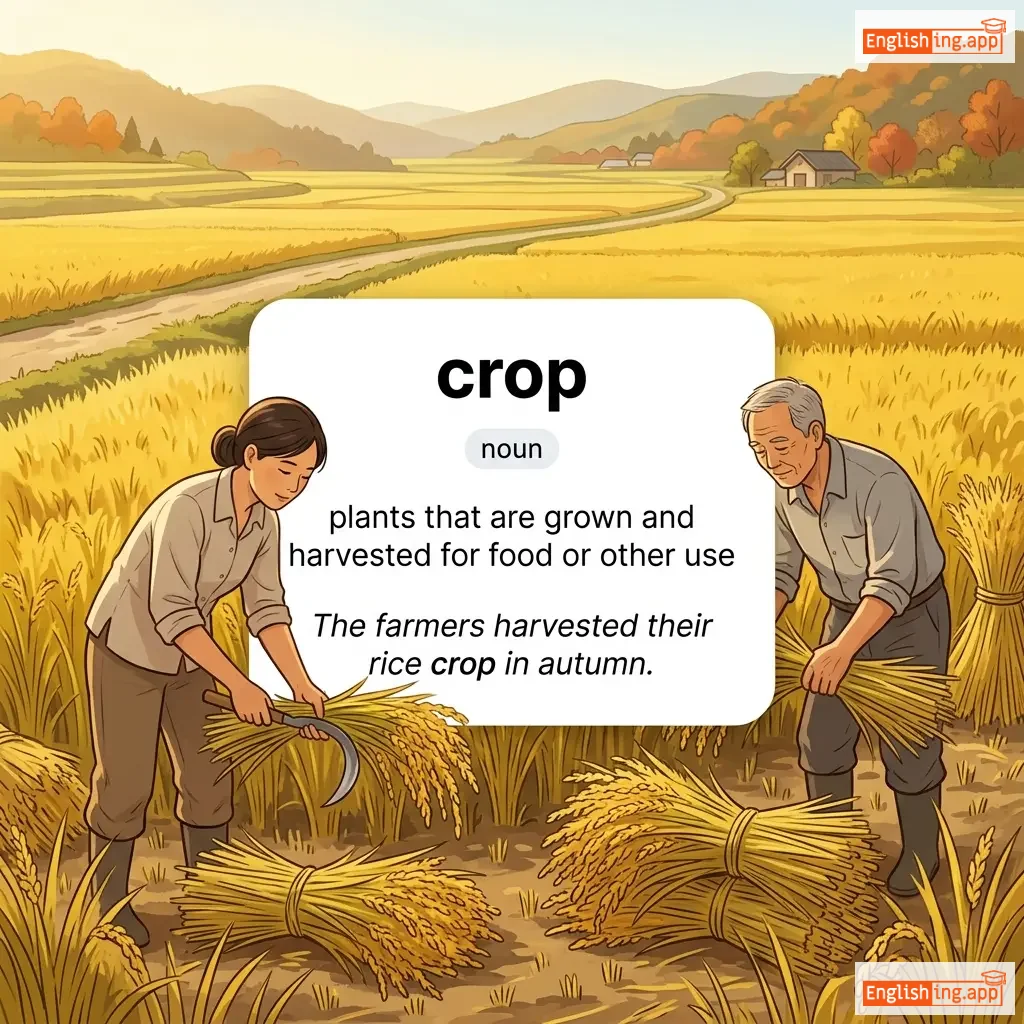
crop definition card — visual illustration of the meaning
noun
/krɒp/
फसल (fasal)

plants that are grown and harvested for food or other use

"The farmers harvested their rice crop in autumn."

"किसानों ने शरद ऋतु में अपनी चावल की फसल काटी।" (Kisaano ne sharad ritu mein apni chawal ki fasal kaatee.)
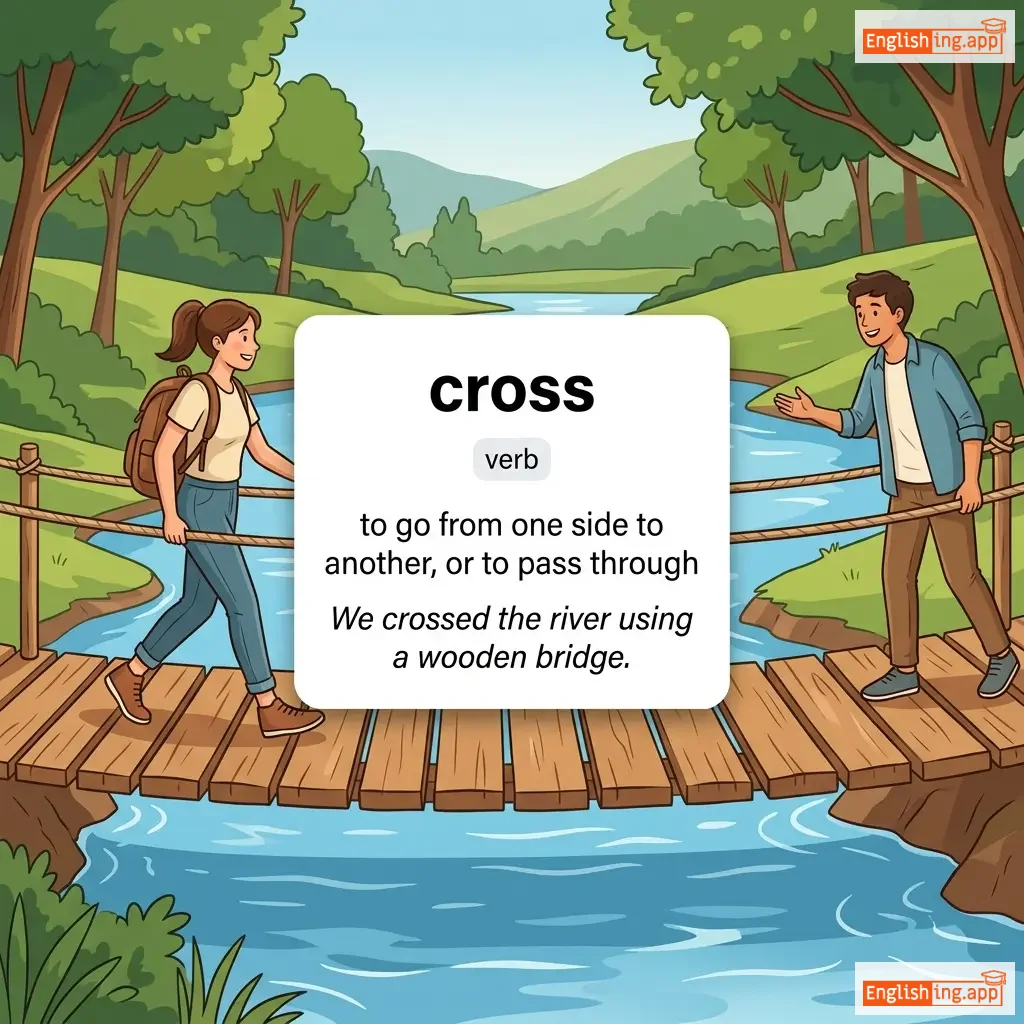
cross definition card — visual illustration of the meaning
verb
/krɒs/
पार होना (paar hona)

to go from one side to another, or to pass through

"We crossed the river using a wooden bridge."

"हमने लकड़ी के पुल का उपयोग करके नदी को पार किया।" (Hamne lakdi ke pul ka upyog karke nadi ko paar kiya.)
verb
/ˈkrɒs.briːd/
संकरित करना (sankrit karna)

to produce an animal or plant by mating two different breeds, varieties, or species

"Farmers crossbreed cows to improve milk production."

"किसान गायों को दूध उत्पादन बढ़ाने के लिए क्रॉसब्रीड करते हैं।" (Kisan gaayon ko doodh utpadan badhane ke liye crossbreed karte hain.)
adverb
/ˈkrɒswaɪz/
आड़ा-तिरछा (aada-tircha)

in the form of a cross; diagonally across

"Place the logs crosswise to build a stable fire."

"एक स्थिर आग बनाने के लिए लकड़ियों को आड़ा-तिरछा रखें।" (ek sthir aag banane ke liye lakdiyon ko aada-tircha rakhen)
adjective
/ˈkrɒtʃ.ə.ti/
चिढ़चिढ़ा (chidhchidhā)

bad-tempered, easily annoyed, and often complaining

"The crotchety old man yelled at the children for playing near his house."

"चिढ़चिढ़े बूढ़े आदमी ने बच्चों को अपनी घर के पास खेलने के लिए डांटा।" (Chidhchidhē bōṛhē ādmī nē bachōn kō apnī ghar kē paas khēlnē kē liye ḍāntā.)
verb
/kraʊtʃ/
झुका हुआ (jhuka hua)

to bend your knees and lower your body close to the ground

"The cat crouched before leaping at its prey."

"बिल्ली शिकार पर कूदने से पहले झुकी हुई थी।" (Billi shikar par koodne se pehle jhuki hui thi.)
noun
/kroʊ/
कौआ (kaua)

a large black bird known for its intelligence and harsh call

"The crow cawed loudly from the tree branch."

"कौआ ग़ुस्से में ग़ज़ब की आवाज़ में डाल से चिल्लाया।" (Kaua gusse mein gazab ki awaaz mein daal se chillaya.)
noun
/ˈkroʊ.bɑːr/
क्रोबार (krobar)

a heavy iron bar with a curved end used as a lever for prying things apart

"He used a crowbar to remove the old nails."

"उसने पुराने कीलें निकालने के लिए क्रोबार का उपयोग किया।" (usne purane keele nikaalne ke liye krobar ka upyog kiya.)
noun
/kraʊd/
भीड़ (bhir)

a large number of people gathered together

"A huge crowd gathered to watch the concert."

"कन्सर्ट देखने के लिए एक बड़ी भीड़ जमा हो गई।" (Concert dekhne ke liye ek badi bhir jama ho gayi.)
🚶‍♂️🚶‍♀️

crowded (हैपीनेस)

adjective
/ˈkraʊdɪd/
ख़ुशी (khushi)

filled with too many people or things

"The bus was so crowded that I could hardly move."

"जब उसने पुरस्कार प्राप्त किया, तो वह अपनी खुशी को छिपा नहीं सकी।" (Jab usne puraskar prapt kiya, to vah apni khushi ko chhupa nahi saki.)
noun
/kraʊn/
मुकुट (mukut)

a circular ornamental headdress worn by a monarch as a symbol of authority

"The king wore his golden crown at the ceremony."

"राजा ने समारोह में अपनी सोने की मुकुट पहनी।" (Raja ne samarooh mein apni sone ki mukut pehni.)
crucial definition card — visual illustration of the meaning
adjective
/ˈkruːʃəl/
महत्वपूर्ण (mahatvapurn)

extremely important or necessary

"Trust is crucial for a strong relationship."

"एक मजबूत रिश्ते के लिए विश्वास महत्वपूर्ण है।" (Ek majboot rishte ke liye vishwas mahatvapurn hai.)
noun
/ˈkruːsɪbəl/
कठिन परीक्षा, धातु पिघलाने का पात्र (kathin pariksha, dhaatu pighlaane ka patra)

a severe test or trial; a container used for heating substances to very high temperatures

"The team emerged stronger from the crucible of competition."

"टीम प्रतियोगिता के क्रूसिबल से मजबूत होकर उभरी।" (Team pratiyogita ke crucible se majboot hokar ubhri.)
adjective
/kruːd/
कच्चा (kaccha)

in a natural or raw state; not yet processed or refined

"The crude oil is processed into fuel and chemicals."

"कच्चा तेल ईंधन और रसायन में संसाधित होता है।" (Kaccha tel indhan aur rasayan mein sansadhit hota hai.)
adjective
/ˈkruːəl/
क्रूर (kroor)

Willfully causing pain or suffering to others, or feeling no concern about it.

"It was cruel to make fun of the injured boy."

"घायल लड़के का मजाक उड़ाना क्रूर था।" (ghayal ladke ka mazaak udaana kroor tha.)
noun
/ˈkruː.əl.ti/
क्रूरता; निर्दयता; दुख पहुंचाने का व्यवहार (krurta, nirdayata, dukh pahuchane ka vyavhaar)

behavior that causes pain or suffering to others; the quality of being cruel

"The documentary exposed the cruelty of factory farming to animals."

"डॉक्यूमेंट्री ने फैक्ट्री फार्मिंग द्वारा जानवरों पर की जाने वाली क्रूरता को उजागर किया।" (dokyumentri ne factory farming dwara janwaron par ki jaane wali krurta ko ujagar kiya.)
noun
/ˈkruːɪt/
छोटा पात्र (chhota patra)

a small container, especially for salt, pepper, oil, or vinegar, used at a dining table

"She filled the cruet with olive oil for the salad."

"उसने सलाद के लिए क्रूएट में जैतून का तेल डाला" (Usne salad ke liye cruet mein jaitoon ka tel dala)
🛳️

cruise

verb
/kruːz/
खुशी (khushi)

to travel smoothly at a moderate speed, especially for pleasure

"They decided to cruise along the coast during their vacation."

"जब उसे पुरस्कार मिला तो वह अपनी खुशी छिपा नहीं पाई।" (Jab use puraskar mila to wah apni khushi chhupa nahi pai.)
compounding definition card — visual illustration of the meaning
noun
kəmˈpaʊnd.ɪŋ
चक्रवृद्धि (chakravruddhi)

The process in which an asset's earnings, from either capital gains or interest, are reinvested to generate additional earnings over time.

"Compounding allows investments to grow exponentially over time."

"चक्रवृद्धि निवेशों को समय के साथ तेजी से बढ़ने की अनुमति देती है।" (Chakravruddhi niveshon ko samay ke saath tezi se badhne ki anumati deti hai.)
verb
/ˌkɒmprɪˈhɛnd/
समझना (samajhna)

to understand or grasp the meaning of something

"It is difficult to comprehend the scale of the disaster."

"आपदा के पैमाने को समझना मुश्किल है।" (Aapda ke paimane ko samajhna mushkil hai.)
adjective
/ˌkɒmprɪˈhɛnsəbl/
समझने योग्य (samajhne yogya)

able to be understood; intelligible

"The teacher explained the topic in a comprehensible way."

"शिक्षक ने विषय को एक समझने योग्य तरीके से समझाया।" (Shikshak ne vishay ko ek samajhne yogya tareeke se samjhaya.)
comprehension definition card — visual illustration of the meaning
noun
/ˌkɒmprɪˈhɛnʃən/
समझ (samajh)

the ability to understand something

"Good reading comprehension is essential for academic success."

"अच्छी पठन समझ शैक्षिक सफलता के लिए आवश्यक है।" (Achhi pathan samajh shaikshik safalta ke liye aavashyak hai.)
comprehensive definition card — visual illustration of the meaning
adjective
/ˌkɒmprɪˈhɛnsɪv/
व्यापक (vyapak)

including all or nearly all elements or aspects; complete

"The report provides a comprehensive overview of the project."

"रिपोर्ट परियोजना का एक व्यापक अवलोकन प्रदान करती है।" (Report pariyojna ka ek vyapak avlokan pradan karti hai.)
verb
/kəmˈprɛs/
दबाकर छोटा करना (dabakaar chhota karna)

to press or squeeze something so that it becomes smaller

"The file was compressed to save storage space."

"स्टोरेज स्पेस बचाने के लिए फाइल को कंप्रेस किया गया।" (Storage space bachane ke liye file ko compress kiya gaya.)
adjective
/kəmˈprɛsəbl̩/
संपीड़नीय (sampidniya)

Capable of being compressed or reduced in volume.

"Air is a compressible substance, unlike water."

"वायु एक संपीड़नीय पदार्थ है, पानी नहीं।" (Vaayu ek sampidniya padarth hai, paani nahin.)
noun
/kəmˈprɛʃn̩/
संपीड़न (sampidan)

The act of pressing or squeezing something into a smaller space.

"File compression helps reduce storage requirements."

"फाइल संपीड़न संग्रहण आवश्यकताओं को घटाने में मदद करता है।" (File sampidan sangrahan aavashyaktaon ko ghatane mein madad karta hai.)