Vocabularios

Descubra, aprenda y domine el vocabulario en inglés

verb
/ˌkaʊntərˈækt/
contrarrestar (contrarrestar)

to act against something in order to reduce its effect

"The medicine helps counteract the side effects of the treatment."

"El medicamento ayuda a contrarrestar los efectos secundarios del tratamiento." (El medicamento ayuda a contrarrestar los efectos secundarios del tratamiento.)
verb
/ˌkaʊntərˈbæləns/
contrarrestar (contrarrestar)

to offset or balance the effect of something

"Exercise can counterbalance the negative effects of stress."

"El ejercicio puede contrarrestar los efectos negativos del estrés." (El ejercicio puede contrarrestar los efectos negativos del estrés.)
noun, verb
/ˈkaʊntərˌtʃɑːrdʒ/
contracargo (contracargo)

an opposing charge or accusation; to make an opposing attack

"The lawyer filed a countercharge against the accuser."

"El abogado presentó una contracarga contra el acusador." (El abogado presentó una contracarga contra el acusador.)
adjective, verb, noun
/ˈkaʊntərfɪt/
falsificado (falsificado)

made to look like something genuine in order to deceive

"The police seized a batch of counterfeit currency."

"La policía confiscó un lote de billetes falsificados." (La policia confiscó un lote de billetes falsificados.)
adjective
/ˌkaʊntərɪnˈtuːɪtɪv/
contradictorio (contradictorio)

contrary to what one would intuitively expect

"His approach seems counterintuitive but it actually works."

"Su enfoque parece contradictorio, pero en realidad funciona." (Su enfoque parece contradictorio, pero en realidad funciona.)
verb
/ˌkaʊntərˈmænd/
revocar una orden (revocar una orden)

to revoke or cancel an order or command

"The general countermanded the previous orders immediately."

"El general revocó las órdenes anteriores inmediatamente." (El general revocó las órdenes anteriores inmediatamente.)
noun
/ˈkaʊntərˌpɑːrt/
contraparte (contraparte)

a person or thing that corresponds to or has the same function as another

"The CEO met with his counterpart in the partner company."

"El CEO se reunió con su contraparte en la empresa asociada." (El CEO se reunio con su contraparte en la empresa asociada.)
noun
/ˈkaʊntərˌpɔɪnt/
contrapunto (contrapunto)

an argument, idea, or theme contrasting with another; also a musical term for independent melody

"Her calm attitude was a counterpoint to his anger."

"Su actitud tranquila fue un contrapunto a su ira." (Su actitud tranquila fue un contrapunto a su ira.)
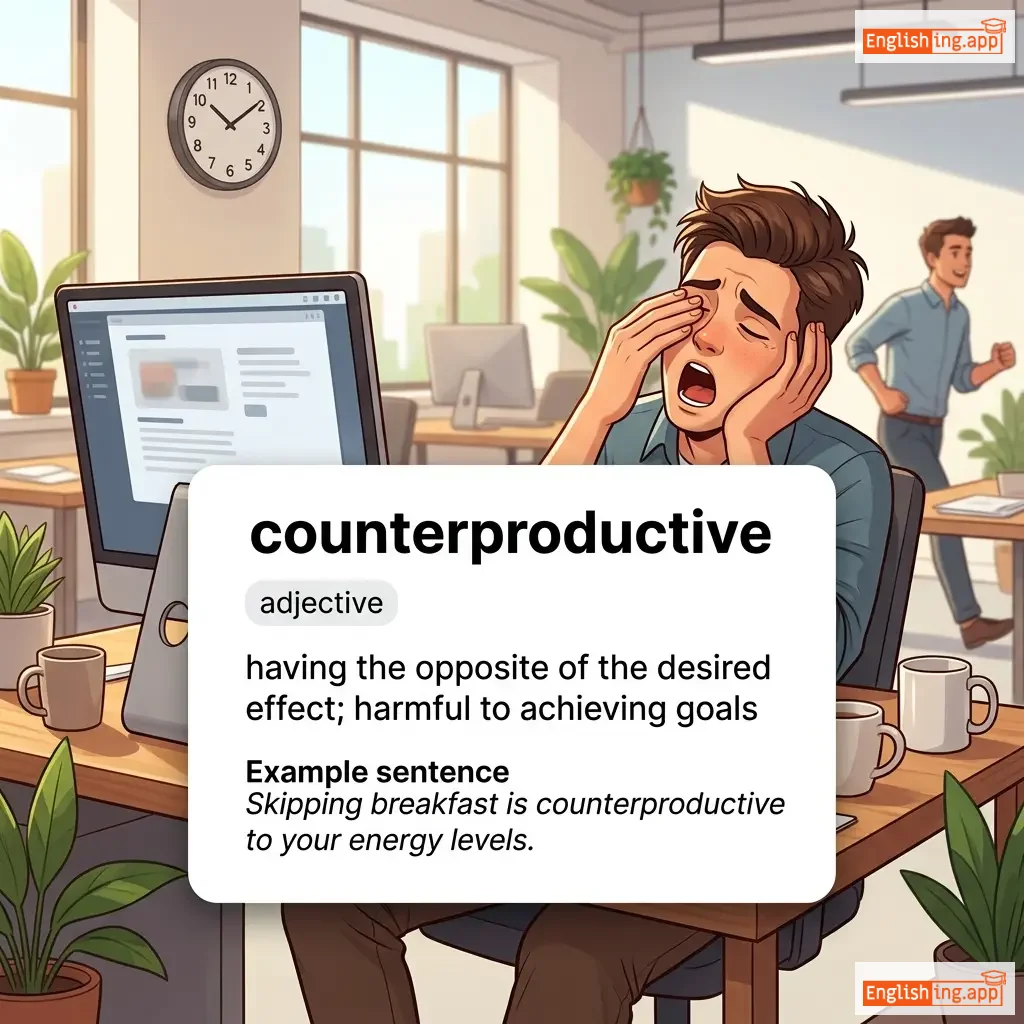
counterproductive definition card — visual illustration of the meaning
adjective
/ˌkaʊntərprəˈdʌktɪv/
contraproducente (contraproducente)

having the opposite of the desired effect; harmful to achieving goals

"Skipping breakfast is counterproductive to your energy levels."

"Saltar el desayuno es contraproducente para tus niveles de energía." (Saltar el desayuno es contraproducente para tus niveles de energía.)
verb
/ˌkaʊntərˈveɪl/
contrarrestar (contrarrestar)

to offset or counteract the effect of something

"The benefits of the new policy countervail its drawbacks."

"Los beneficios de la nueva política contrarrestan sus desventajas." (Los beneficios de la nueva política contrarrestan sus desventajas.)
noun
/ˈkaʊntɪŋˌhaʊs/
oficina de contabilidad (oficina de contabilidad)

a business office where accounts are kept and financial transactions are managed

"The merchant spent most of his day in the counting-house reviewing ledgers."

"El comerciante pasó la mayor parte de su día en la oficina de contabilidad revisando los libros de contabilidad." (El comerciante pasó la mayor parte de su día en la oficina de contabilidad revisando los libros de contabilidad.)
adjective
/ˈkaʊntləs/
incontable (incontable)

too many to be counted; innumerable

"There are countless stars in the sky."

"Hay innumerables estrellas en el cielo." (Hay innumerables estrellas en el cielo.)
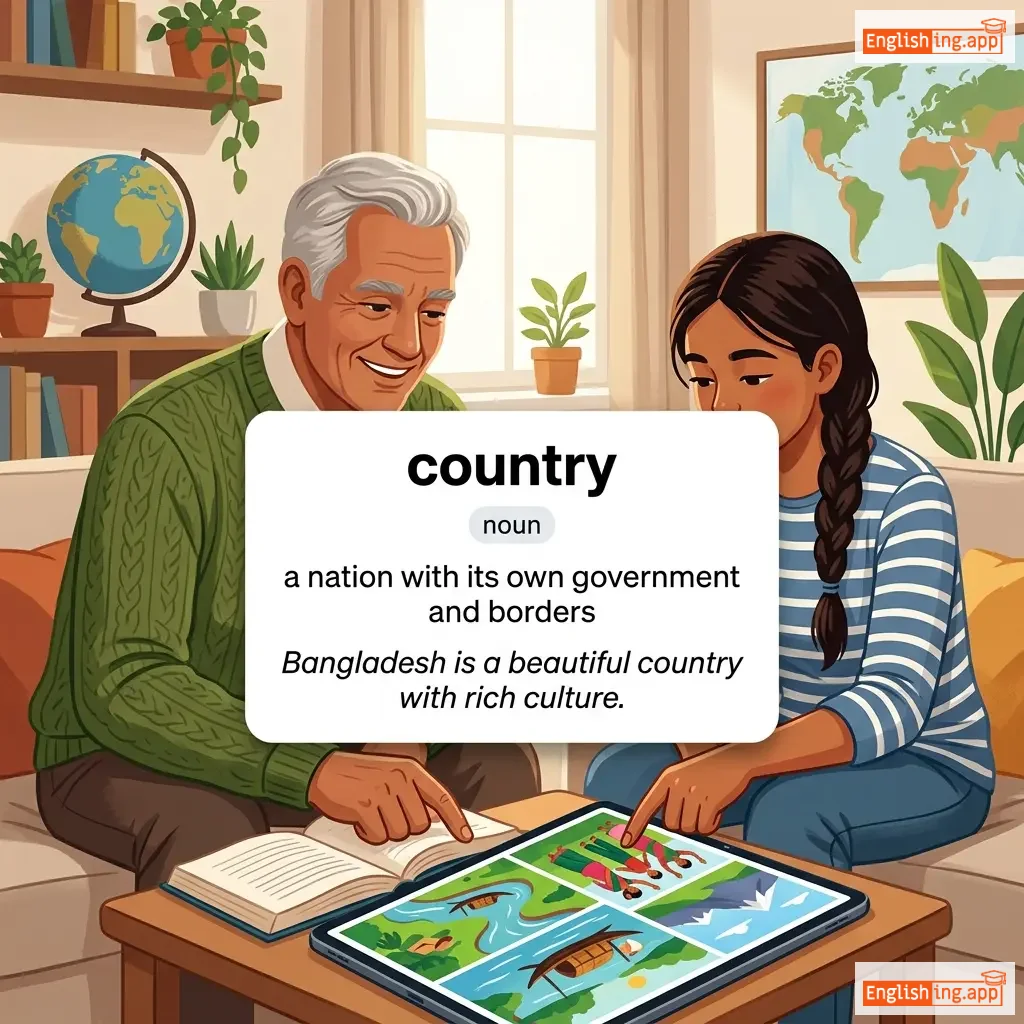
country definition card — visual illustration of the meaning
noun
/ˈkʌn.tri/
país (pais)

a nation with its own government and borders

"Bangladesh is a beautiful country with rich culture."

"Bangladés es un hermoso país con una rica cultura." (Bangladesh es un hermoso pais con una rica cultura.)
noun
/ˈkʌntrɪmən/
compatriota (compatriota)

a person from one's own country or rural area

"He was proud to meet a fellow countryman at the international conference."

"Se sintió orgulloso de conocer a un compatriota en la conferencia internacional." (Se sintió orgulloso de conocer a un compatriota en la conferencia internacional.)
noun
/ˈkʌntrisaɪd/
campo (campo)

land outside cities and towns; rural areas with farms, fields, and villages

"She enjoys the peace and beauty of the countryside."

"Ella disfruta de la paz y la belleza del campo." (ella disfruta de la paz y la belleza del campo)
noun
/ˈkaʊnti/
condado (condado)

A territorial division within a country, typically a region with its own local government.

"She grew up in a small county in northern England."

"Ella creció en un pequeño condado en el norte de Inglaterra." (Ella crecio en un pequeno condado en el norte de Inglaterra.)
noun
/kuː/
golpe de estado (golpe de estado)

a sudden, decisive action that brings about a change, especially in government

"The military staged a coup to overthrow the existing regime."

"El ejército llevó a cabo un golpe para derrocar al régimen existente." (El ejercito llevo a cabo un golpe para derrocar al regimen existente.)
noun
/ˈkʌpəl/
pareja (pareja)

two people or things considered together; a pair

"They make a lovely couple and have been married for five years."

"Ellos hacen una pareja encantadora y han estado casados por cinco años." (Ellos hacen una pareja encantadora y han estado casados por cinco años.)
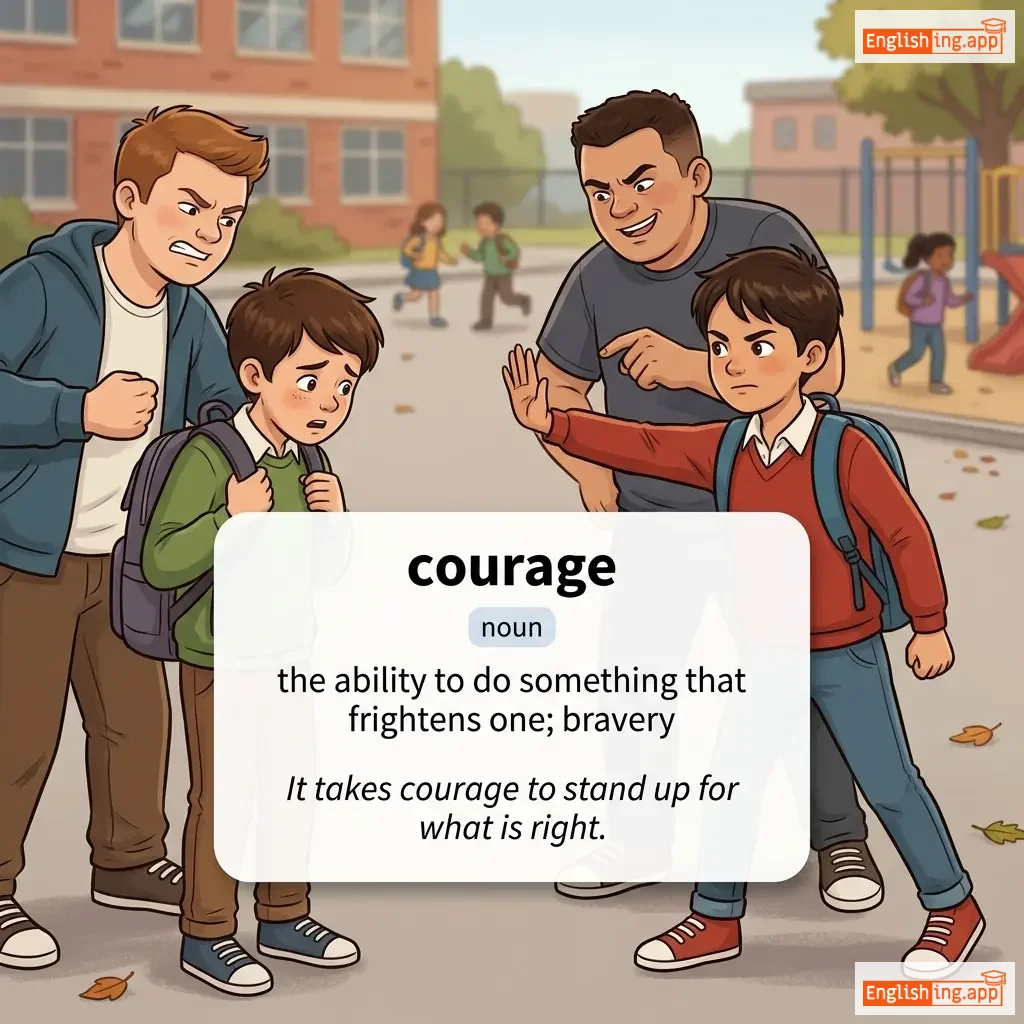
courage definition card — visual illustration of the meaning
noun
/ˈkʌrɪdʒ/
coraje (coraje)

the ability to do something that frightens one; bravery

"It takes courage to stand up for what is right."

"Se necesita coraje para defender lo que es correcto." (Se necesita coraje para defender lo que es correcto.)
adjective
/kəˈreɪdʒəs/
valiente (valiente)

having or showing bravery; able to face danger or difficulty

"The firefighter was courageous as he rescued the children from the burning building."

"El bombero fue valiente cuando rescató a los niños del edificio en llamas." (El bombero fue valiente cuando rescató a los niños del edificio en llamas.)
noun
/ˈkʊriər/
mensajero (mensajero)

a person or company that delivers messages, packages, or mail

"The courier delivered the documents on time."

"El mensajero entregó los documentos a tiempo." (El mensajero entregó los documentos a tiempo.)
noun
/kɔːrs/
curso, trayecto o conjunto de lecciones educativas (curso, trayecto o conjunto de lecciones educativas)

a direction, path, or a set of educational lessons

"She enrolled in a computer science course."

"Ella se inscribió en un curso de ciencias de la computación." (Ella se inscribió en un curso de ciencias de la computación.)
noun
/kɔːrs flaʊər/
harina gruesa (harina gruesa)

coarsely ground flour with larger particles, typically used for baking bread

"She used course flour to make homemade bread with a rustic texture."

"Ella usó harina gruesa para hacer pan casero con una textura rústica." (Ella uso harina gruesa para hacer pan casero con una textura rustica.)
noun
/ˈkɔːrsər/
caballo rápido o caballo de caza (caballo rapido o caballo de caza)

a swift horse or a hunting horse

"The knight rode a fast courser into battle."

"El caballero montó un corcel rápido en la batalla." (El caballero monto un corcel rapido en la batalla.)
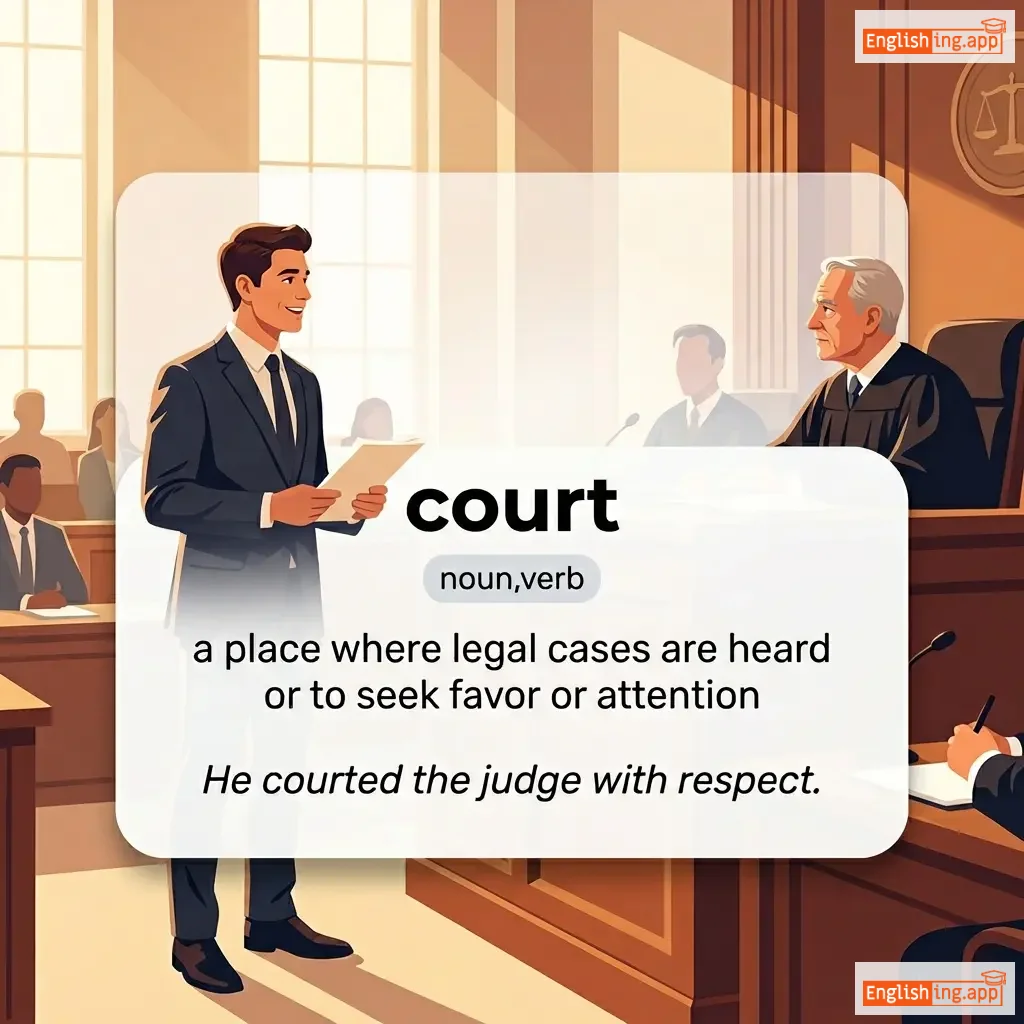
court definition card — visual illustration of the meaning
noun,verb
/kɔːrt/
tribunal o lugar donde se busca atención o favor (tribunal o lugar donde se busca atencion o favor)

a place where legal cases are heard or to seek favor or attention

"He courted the judge with respect."

"Él corteó al juez con respeto." (Él corteó al juez con respeto.)
adjective
/ˈkɜːrtiəs/
cortés (cortes)

polite, respectful, or considerate in manner

"The staff at the hotel were very courteous to all guests."

"El personal del hotel fue muy cortés con todos los huéspedes." (El personal del hotel fue muy cortes con todos los huespedes.)
noun
/ˈkɜːrtəsi/
cortesía, amabilidad o favor (cortesía, amabilidad o favor)

polite behavior or a polite action; a favor or privilege

"He opened the door as a courtesy."

"Él abrió la puerta por cortesía." (Él abrió la puerta por cortesía.)
noun
/ˈkɔːtruːm/
sala de audiencias (sala de audiencias)

a room in which legal cases are heard and decided by a judge

"The witness was called to testify in the courtroom."

"Se llamo al testigo a testificar en la sala de audiencias." (Se llamo al testigo a testificar en la sala de audiencias.)
noun
/ˈkʌzn/
primo/prima (primo/prima)

A child of one's uncle or aunt.

"My cousin is coming to visit us this weekend."

"Mi primo viene a visitarnos este fin de semana." (Mi primo viene a visitarnos este fin de semana.)
🧙‍♀️

coven (cóven)

noun
/ˈkʌvən/
un grupo de brujas (un grupo de brujas)

a group or gathering of witches

"The witches met secretly in a coven in the forest."

"Las brujas se reunieron secretamente en un coven en el bosque." (Las brujas se reunieron secretamente en un coven en el bosque.)
noun
/ˈkʌvənənt/
pacto (pacto)

a formal agreement or promise, often legally binding

"The landlord and tenant signed a covenant to maintain the property."

"El arrendador y el inquilino firmaron un pacto para mantener la propiedad." (El arrendador y el inquilino firmaron un pacto para mantener la propiedad.)
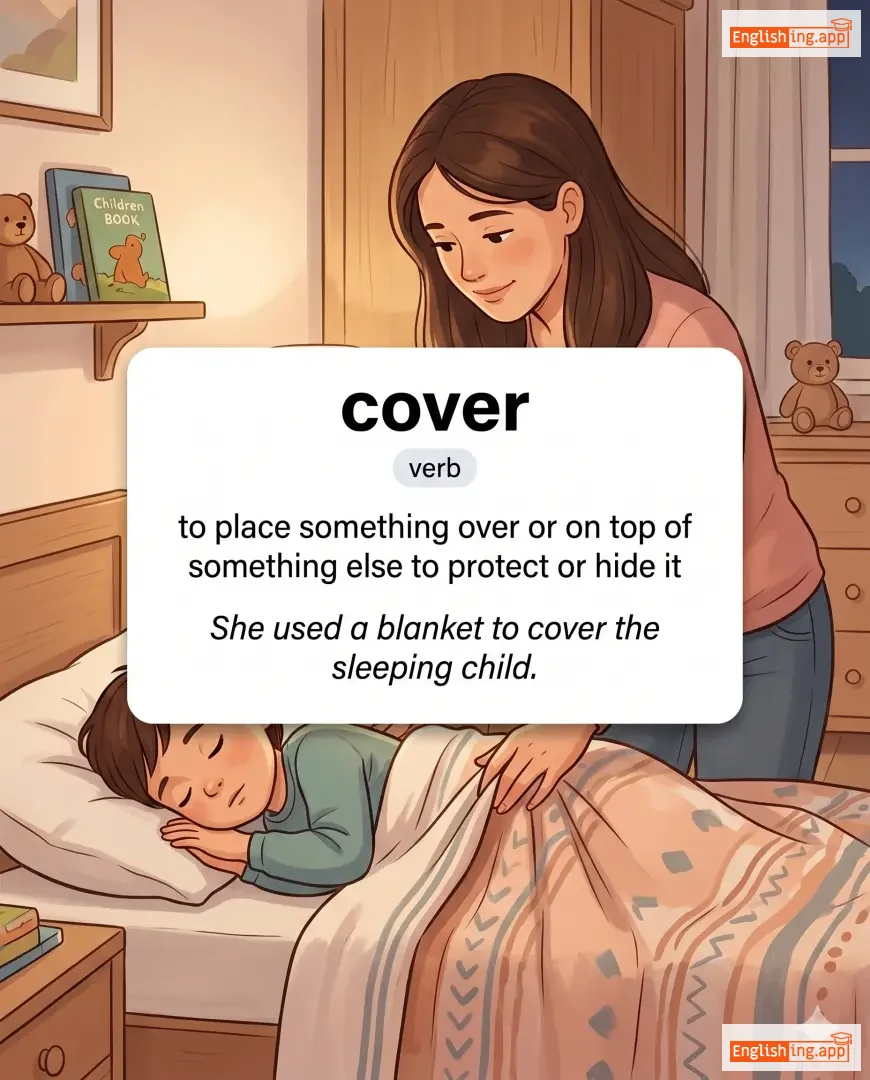
cover definition card — visual illustration of the meaning
verb
/ˈkʌvər/
cubrir (cubrir)

to place something over or on top of something else to protect or hide it

"She used a blanket to cover the sleeping child."

"Ella usó una manta para cubrir al niño que dormía." (Ella usó una manta para cubrir al niño que dormía.)
noun
/ˈkʌvərɪdʒ/
cobertura (cobertura)

The extent or scope of something, such as insurance protection or media reporting.

"The news channel provided extensive coverage of the event."

"El canal de noticias proporcionó una amplia cobertura del evento." (El canal de noticias proporcionó una amplia cobertura del evento.)
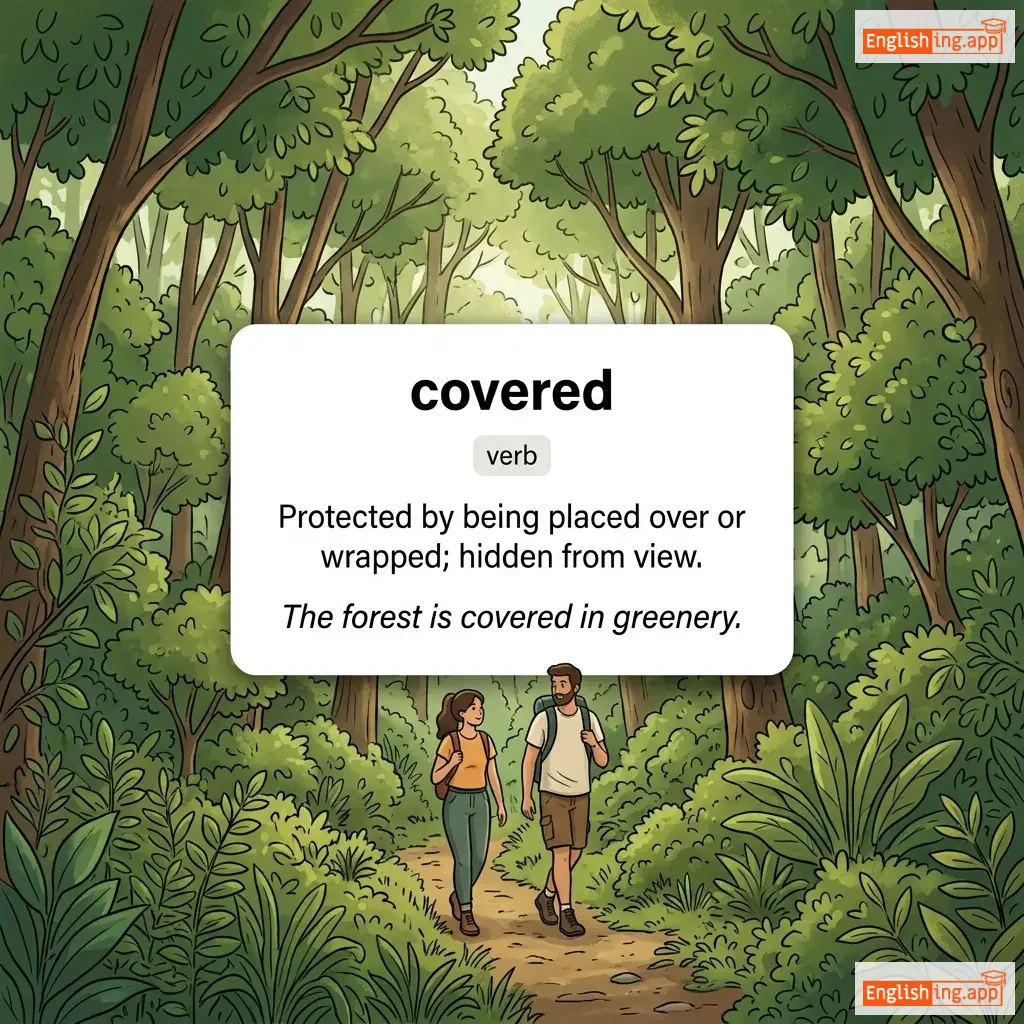
covered definition card — visual illustration of the meaning
verb
/ˈkʌv.ərd/
cubierto (cubierto)

Protected by being placed over or wrapped; hidden from view.

"The forest is covered in greenery."

"El bosque está cubierto de vegetación." (El bosque está cubierto de vegetación.)
covert definition card — visual illustration of the meaning
🕵️‍♂️

covert (cóvert)

adjective
/ˈkoʊvərt/
secreto (secreto)

hidden, secret, or not openly acknowledged

"The spy conducted a covert operation behind enemy lines."

"El espía llevó a cabo una operación encubierta detrás de las líneas enemigas." (El espía llevó a cabo una operación encubierta detrás de las líneas enemigas.)
verb
/ˈkʌvət/
codiciar (codiciar)

to desire something belonging to someone else

"He coveted his neighbor's new car."

"Él codició el coche nuevo de su vecino." (Él codició el coche nuevo de su vecino.)
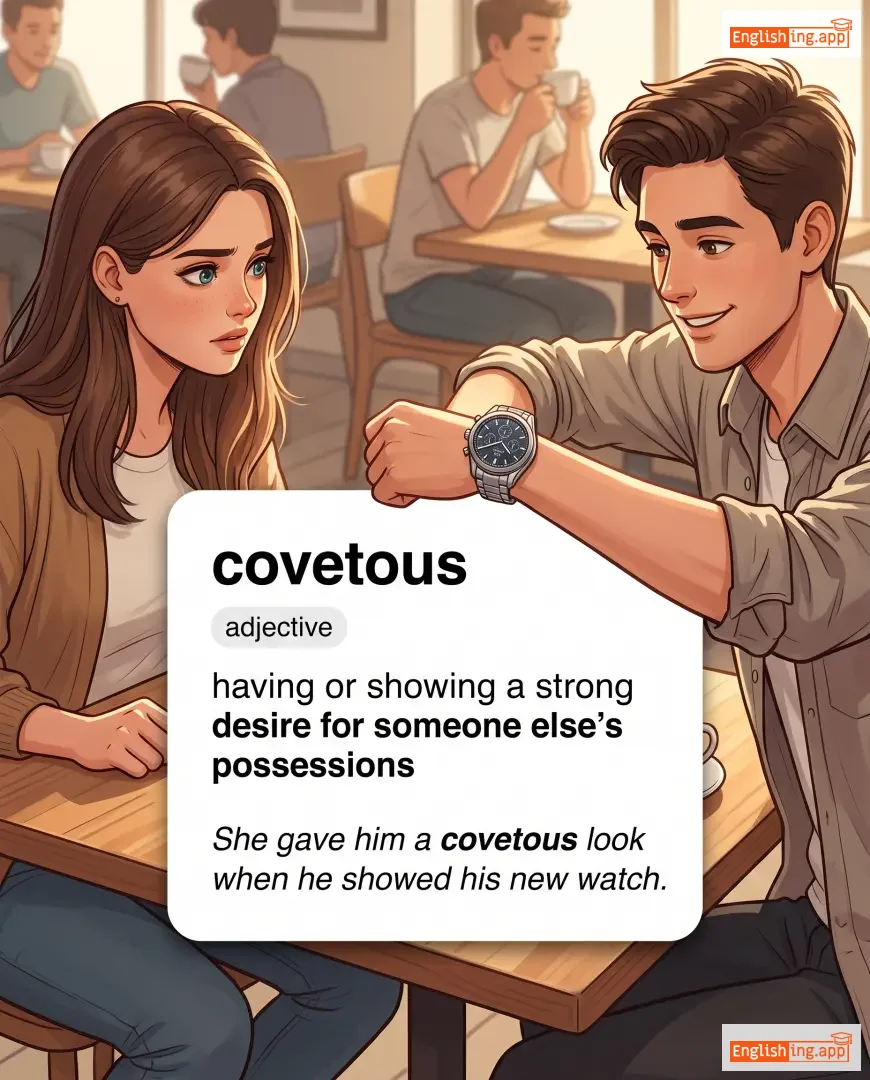
covetous definition card — visual illustration of the meaning
adjective
/ˈkʌvətəs/
codicioso (codicioso)

having or showing a strong desire for someone else's possessions

"She gave him a covetous look when he showed his new watch."

"Le lanzó una mirada codiciosa cuando mostró su nuevo reloj." (Le lanzo una mirada codiciosa cuando mostro su nuevo reloj.)
noun
/ˈkʌvi/
un pequeño grupo de aves (un pequeno grupo de aves)

a small group of birds, especially partridges or quails

"A covey of quails flew across the field."

"Un covey de codornices voló sobre el campo." (Un covey de codornices voló sobre el campo.)
noun
/kaʊ/
vaca (kau)

a large domesticated bovine animal kept for milk or meat

"The farmer milked the cow early in the morning."

"El granjero ordeñó la vaca temprano por la mañana." (El granjero ordeno la vaca temprano por la manana.)
noun
/ˈkaʊ.ərd/
cobarde (cobarde)

a person who lacks the courage to do or endure dangerous or unpleasant things

"He called himself a coward for not standing up to the bully."

"Él se llamó a sí mismo un cobarde por no enfrentarse al matón." (El se llamo a si mismo un cobarde por no enfrentarse al maton.)
noun
/ˈkaʊərdɪs/
cobardía (cobardía)

lack of courage; behavior showing fear

"His cowardice prevented him from speaking up."

"Su cobardía le impidió hablar." (Su cobardía le impidió hablar.)
noun
/ˈkaʊbɔɪ/
vaquero (vaquero)

a man, typically one on horseback, who herds and tends cattle

"The cowboy rode across the plains."

"El vaquero cabalgaba por las llanuras." (El vaquero cabalgaba por las llanuras.)
verb
/ˈkaʊər/
agacharse por miedo (agacharse por miedo)

to crouch down in fear

"The child cowered behind the sofa during the thunderstorm."

"El niño se encogió detrás del sofá durante la tormenta." (El niño se encogió detrás del sofá durante la tormenta.)
noun
/ˈkɒksweɪn/
timón de barco (timón de barco)

the person in charge of navigating and steering a boat, especially a racing or small boat

"The coxswain shouted instructions to the rowing team."

"El coxswain dio instrucciones al equipo de remo." (El coxswain dio instrucciones al equipo de remo.)
adjective
/kɔɪ/
tímido, reservado (timido, reservado)

reluctant to give details or reveal feelings; shy or reserved

"She gave a coy smile when asked about her plans."

"Ella dio una sonrisa tímida cuando le preguntaron sobre sus planes." (Ella dio una sonrisa timida cuando le preguntaron sobre sus planes.)
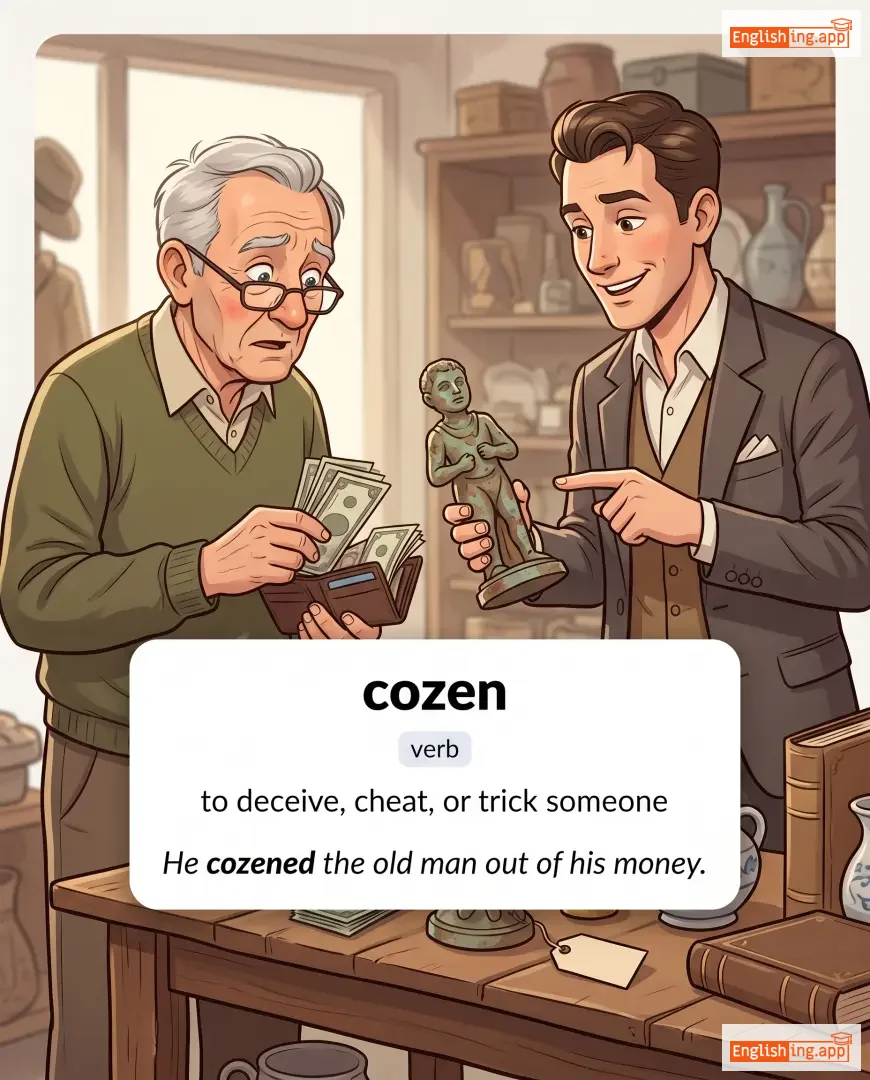
cozen definition card — visual illustration of the meaning
verb
/ˈkʌzən/
engañar, estafar (engañar, estafar)

to deceive, cheat, or trick someone

"He cozened the old man out of his money."

"Él engañó al anciano y le quitó su dinero." (Él engañó al anciano y le quitó su dinero.)
adjective
/ˈkoʊzi/
acogedor (acogedor)

giving a feeling of comfort, warmth, and relaxation

"We sat in a cozy little café on a rainy day."

"Nos sentamos en un acogedor café pequeño en un día lluvioso." (Nos sentamos en un acogedor cafe pequeno en un dia lluvioso.)
noun
/kræb/
cangrejo (cangrejo)

a crustacean with a broad carapace, stalked eyes, and five pairs of legs, the first pair of which are modified as pincers

"The crab scuttled sideways across the sand."

"El cangrejo se arrastró lateralmente por la arena." (El cangrejo se arrastró lateralmente por la arena.)
adjective
/ˈkræbɪd/
difícil de leer, malhumorado (dificil de leer, malhumorado)

difficult to read or understand; ill-tempered

"His handwriting was crabbed and almost illegible."

"Su letra era difícil de leer y casi ilegible." (Su letra era dificil de leer y casi ilegible.)
verb
/kræk/
felicidad (felicidad)

To break or cause to break without complete separation; to make a sharp sound.

"The glass cracked when it was dropped on the floor."

"Ella no pudo ocultar su felicidad cuando recibió el premio." (Ella no pudo ocultar su felicidad cuando recibió el premio.)