Vocabulaires

Découvrez, apprenez et maîtrisez le vocabulaire anglais

verb
/ˌkaʊntərˈækt/
contrer (contrer)

to act against something in order to reduce its effect

"The medicine helps counteract the side effects of the treatment."

"Le médicament aide à contrer les effets secondaires du traitement." (Le médicament aide à contrer les effets secondaires du traitement.)
verb
/ˌkaʊntərˈbæləns/
contrebalancer (contrebalancer)

to offset or balance the effect of something

"Exercise can counterbalance the negative effects of stress."

"L'exercice peut contrebalancer les effets négatifs du stress." (L'exercice peut contrebalancer les effets négatifs du stress.)
noun, verb
/ˈkaʊntərˌtʃɑːrdʒ/
contre-accusation (contre-accusation)

an opposing charge or accusation; to make an opposing attack

"The lawyer filed a countercharge against the accuser."

"L'avocat a déposé une contre-accusation contre l'accusateur." (L'avocat a déposé une contre-accusation contre l'accusateur.)
adjective, verb, noun
/ˈkaʊntərfɪt/
contrefait (contrefait)

made to look like something genuine in order to deceive

"The police seized a batch of counterfeit currency."

"La police a saisi un lot de billets contrefaits." (La police a saisi un lot de billets contrefaits.)
adjective
/ˌkaʊntərɪnˈtuːɪtɪv/
contre-intuitif (contre-intuitif)

contrary to what one would intuitively expect

"His approach seems counterintuitive but it actually works."

"Son approche semble contre-intuitive, mais elle fonctionne réellement." (Son approche semble contre-intuitive, mais elle fonctionne réellement.)
verb
/ˌkaʊntərˈmænd/
annuler un ordre (annuler un ordre)

to revoke or cancel an order or command

"The general countermanded the previous orders immediately."

"Le général a annulé les ordres précédents immédiatement." (Le général a annulé les ordres précédents immédiatement.)
noun
/ˈkaʊntərˌpɑːrt/
homologue (homologue)

a person or thing that corresponds to or has the same function as another

"The CEO met with his counterpart in the partner company."

"Le PDG a rencontré son homologue dans l'entreprise partenaire." (Le PDG a rencontre son homologue dans l'entreprise partenaire.)
noun
/ˈkaʊntərˌpɔɪnt/
contrepoint (contrepoint)

an argument, idea, or theme contrasting with another; also a musical term for independent melody

"Her calm attitude was a counterpoint to his anger."

"Son attitude calme était un contrepoint à sa colère." (Son attitude calme était un contrepoint à sa colère.)
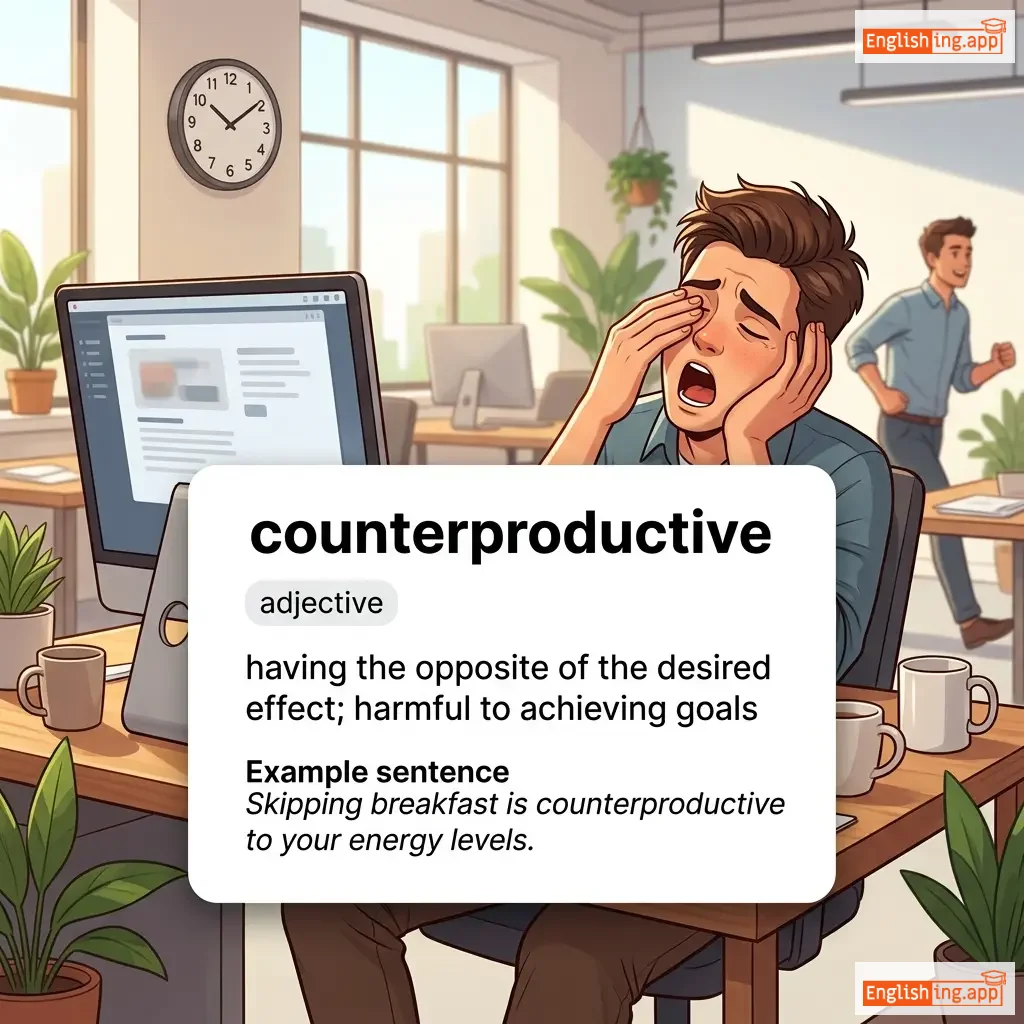
counterproductive definition card — visual illustration of the meaning
adjective
/ˌkaʊntərprəˈdʌktɪv/
contre-productif (contre-productif)

having the opposite of the desired effect; harmful to achieving goals

"Skipping breakfast is counterproductive to your energy levels."

"Sauter le petit-déjeuner est contre-productif pour vos niveaux d'énergie." (Sauter le petit-déjeuner est contre-productif pour vos niveaux d'énergie.)
verb
/ˌkaʊntərˈveɪl/
contrebalancer (contrebalancer)

to offset or counteract the effect of something

"The benefits of the new policy countervail its drawbacks."

"Les avantages de la nouvelle politique contrebalancent ses inconvénients." (Les avantages de la nouvelle politique contrebalancent ses inconvénients.)
noun
/ˈkaʊntɪŋˌhaʊs/
bureau de comptabilité (bureau de comptabilité)

a business office where accounts are kept and financial transactions are managed

"The merchant spent most of his day in the counting-house reviewing ledgers."

"Le marchand passait la majeure partie de sa journée dans le bureau de comptabilité à examiner les livres de comptes." (Le marchand passait la majeure partie de sa journée dans le bureau de comptabilité à examiner les livres de comptes.)
adjective
/ˈkaʊntləs/
innombrable (innombrable)

too many to be counted; innumerable

"There are countless stars in the sky."

"Il y a des étoiles innombrables dans le ciel." (Il y a des étoiles innombrables dans le ciel.)
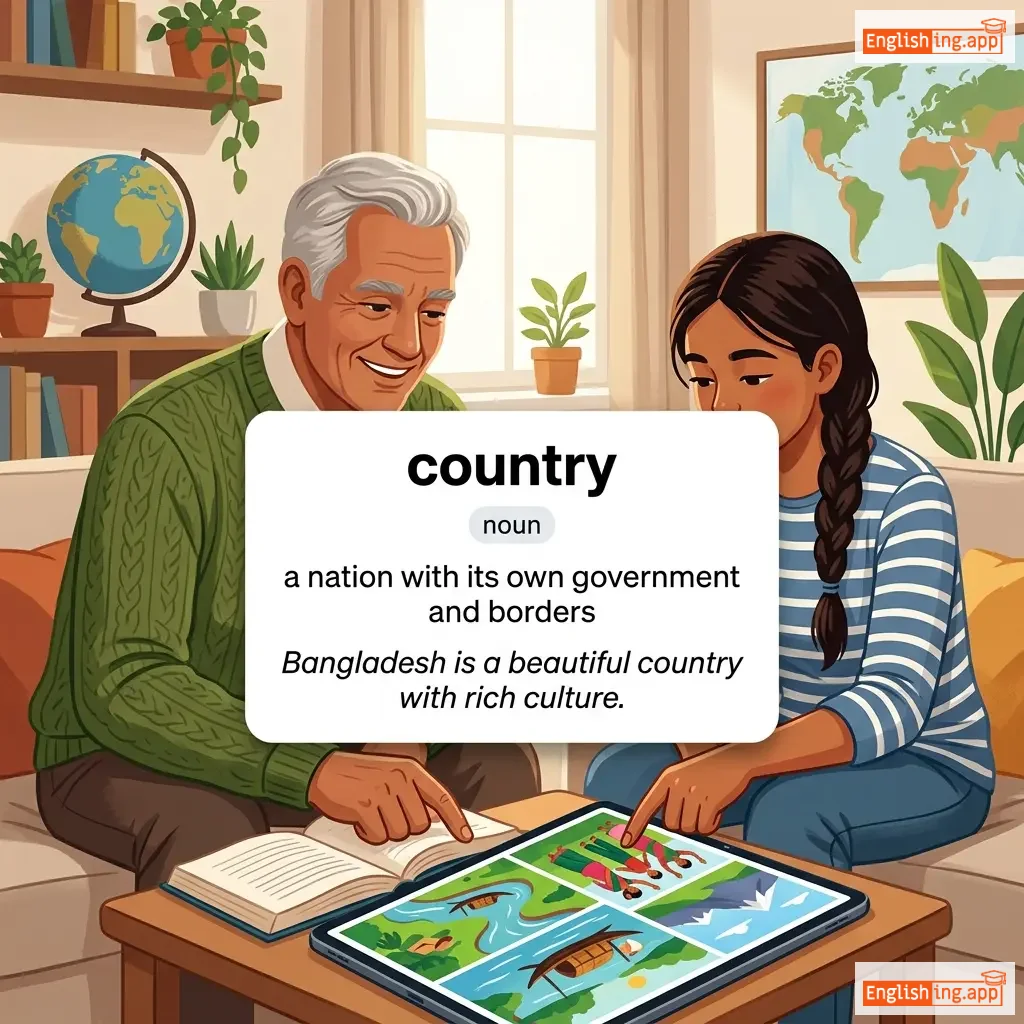
country definition card — visual illustration of the meaning
noun
/ˈkʌn.tri/
pays (pays)

a nation with its own government and borders

"Bangladesh is a beautiful country with rich culture."

"Le Bangladesh est un beau pays avec une culture riche." (Le Bangladesh est un beau pays avec une culture riche.)
noun
/ˈkʌntrɪmən/
compatriote (compatriote)

a person from one's own country or rural area

"He was proud to meet a fellow countryman at the international conference."

"Il était fier de rencontrer un compatriote à la conférence internationale." (Il etait fier de rencontrer un compatriote a la conference internationale.)
noun
/ˈkʌntrisaɪd/
campagne (campagne)

land outside cities and towns; rural areas with farms, fields, and villages

"She enjoys the peace and beauty of the countryside."

"Elle apprécie le calme et la beauté de la campagne." (elle apprecie le calme et la beaute de la campagne)
noun
/ˈkaʊnti/
comté (comte)

A territorial division within a country, typically a region with its own local government.

"She grew up in a small county in northern England."

"Elle a grandi dans un petit comté du nord de l'Angleterre." (Elle a grandi dans un petit comte du nord de l'Angleterre.)
noun
/kuː/
coup d'État (cou d'etat)

a sudden, decisive action that brings about a change, especially in government

"The military staged a coup to overthrow the existing regime."

"L'armée a organisé un coup d'État pour renverser le régime en place." (L'armee a organise un coup d'Etat pour renverser le regime en place.)
noun
/ˈkʌpəl/
couple (couple)

two people or things considered together; a pair

"They make a lovely couple and have been married for five years."

"Ils forment un couple adorable et sont mariés depuis cinq ans." (Ils forment un couple adorable et sont mariés depuis cinq ans.)
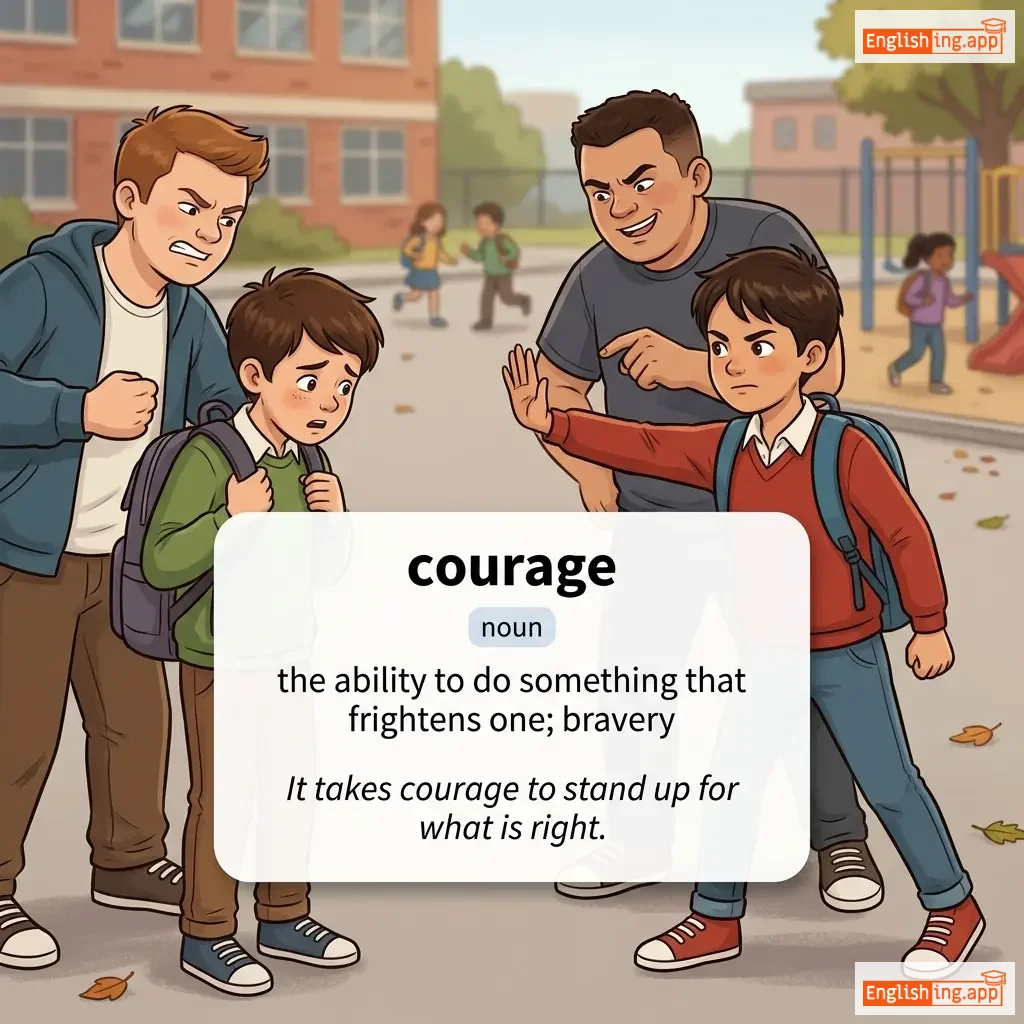
courage definition card — visual illustration of the meaning
noun
/ˈkʌrɪdʒ/
courage (courage)

the ability to do something that frightens one; bravery

"It takes courage to stand up for what is right."

"Il faut du courage pour défendre ce qui est juste." (Il faut du courage pour défendre ce qui est juste.)
adjective
/kəˈreɪdʒəs/
courageux (courageux)

having or showing bravery; able to face danger or difficulty

"The firefighter was courageous as he rescued the children from the burning building."

"Le pompier était courageux lorsqu'il a sauvé les enfants du bâtiment en feu." (Le pompier était courageux lorsqu'il a sauvé les enfants du bâtiment en feu.)
noun
/ˈkʊriər/
livreur (livreur)

a person or company that delivers messages, packages, or mail

"The courier delivered the documents on time."

"Le livreur a livré les documents à temps." (Le livreur a livré les documents à temps.)
noun
/kɔːrs/
cours, chemin ou ensemble de leçons éducatives (cours, chemin ou ensemble de leçons éducatives)

a direction, path, or a set of educational lessons

"She enrolled in a computer science course."

"Elle s'est inscrite à un cours de sciences informatiques." (Elle s'est inscrite à un cours de sciences informatiques.)
noun
/kɔːrs flaʊər/
farine grossière (farine grossière)

coarsely ground flour with larger particles, typically used for baking bread

"She used course flour to make homemade bread with a rustic texture."

"Elle a utilisé de la farine grossière pour faire du pain maison avec une texture rustique." (Elle a utilise de la farine grossiere pour faire du pain maison avec une texture rustique.)
noun
/ˈkɔːrsər/
cheval rapide ou cheval de chasse (cheval rapide ou cheval de chasse)

a swift horse or a hunting horse

"The knight rode a fast courser into battle."

"Le chevalier monta un coursier rapide au combat." (Le chevalier monta un coursier rapide au combat.)
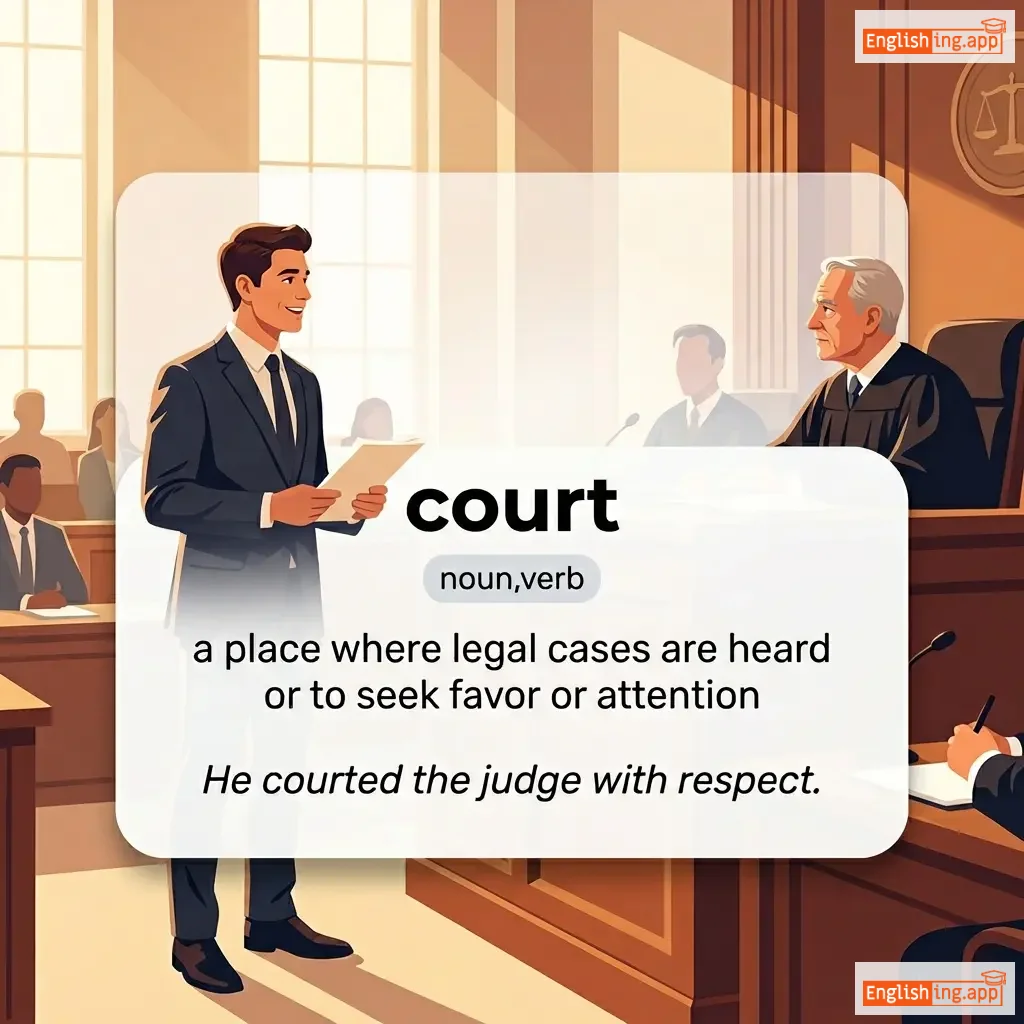
court definition card — visual illustration of the meaning
noun,verb
/kɔːrt/
tribunal ou chercher à attirer l'attention ou la faveur (tribunal ou chercher a attirer l'attention ou la faveur)

a place where legal cases are heard or to seek favor or attention

"He courted the judge with respect."

"Il a courtisé le juge avec respect." (Il a courtisé le juge avec respect.)
adjective
/ˈkɜːrtiəs/
courtois (courtois)

polite, respectful, or considerate in manner

"The staff at the hotel were very courteous to all guests."

"Le personnel de l'hôtel a été très courtois avec tous les invités." (Le personnel de l'hotel a ete tres courtois avec tous les invites.)
noun
/ˈkɜːrtəsi/
courtoisie, politesse ou faveur (courtoisie, politesse ou faveur)

polite behavior or a polite action; a favor or privilege

"He opened the door as a courtesy."

"Il a ouvert la porte par courtoisie." (Il a ouvert la porte par courtoisie.)
noun
/ˈkɔːtruːm/

a room in which legal cases are heard and decided by a judge

"The witness was called to testify in the courtroom."

noun
/ˈkʌzn/
cousin/cousine (cousin/cousine)

A child of one's uncle or aunt.

"My cousin is coming to visit us this weekend."

"Mon cousin vient nous rendre visite ce week-end." (Mon cousin vient nous rendre visite ce week-end.)
🧙‍♀️

coven (covène)

noun
/ˈkʌvən/
un groupe de sorcières (un groupe de sorcières)

a group or gathering of witches

"The witches met secretly in a coven in the forest."

"Les sorcières se sont réunies secrètement dans un coven dans la forêt." (Les sorcieres se sont reunies secretement dans un coven dans la foret.)
noun
/ˈkʌvənənt/
contrat (contrat)

a formal agreement or promise, often legally binding

"The landlord and tenant signed a covenant to maintain the property."

"Le propriétaire et le locataire ont signé un contrat pour maintenir la propriété." (Le propriétaire et le locataire ont signé un contrat pour maintenir la propriété.)
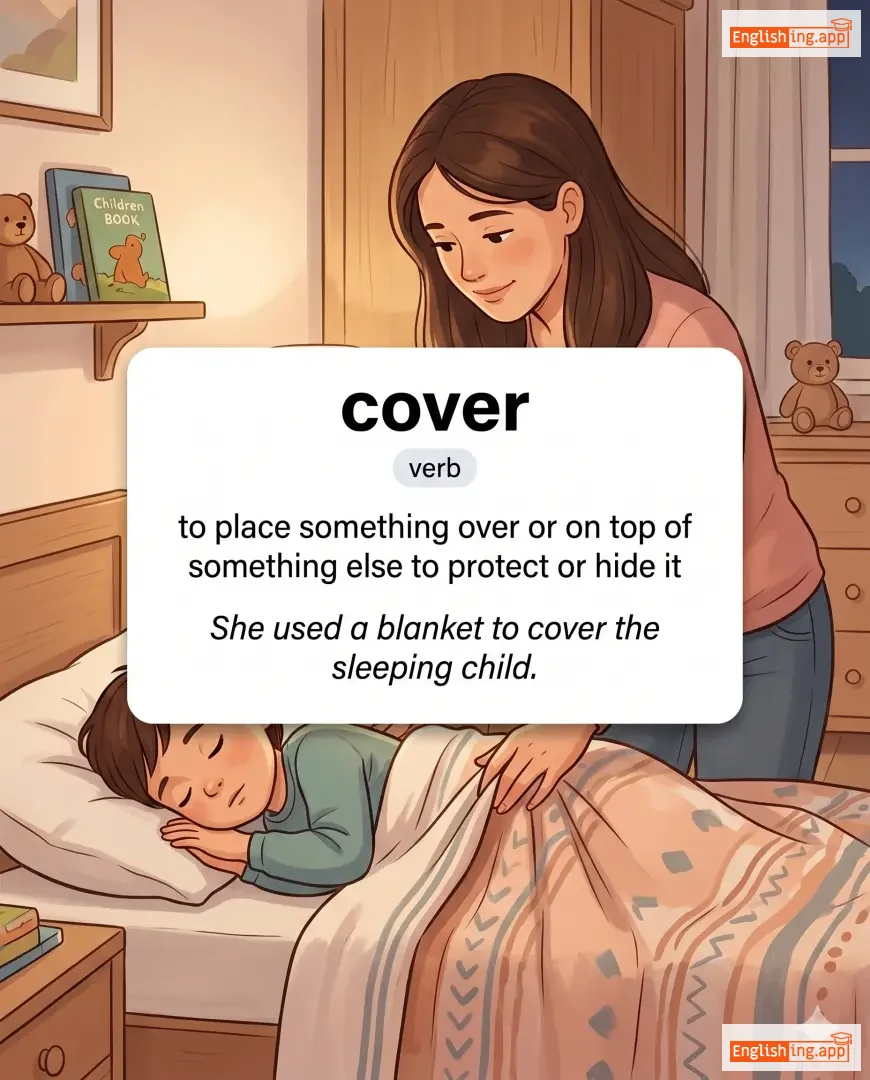
cover definition card — visual illustration of the meaning
verb
/ˈkʌvər/
couvrir (couvrir)

to place something over or on top of something else to protect or hide it

"She used a blanket to cover the sleeping child."

"Elle a utilisé une couverture pour couvrir l'enfant endormi." (Elle a utilisé une couverture pour couvrir l'enfant endormi.)
noun
/ˈkʌvərɪdʒ/
couverture (couverture)

The extent or scope of something, such as insurance protection or media reporting.

"The news channel provided extensive coverage of the event."

"La chaîne de nouvelles a fourni une couverture étendue de l'événement." (La chaine de nouvelles a fourni une couverture etendue de l'evenement.)
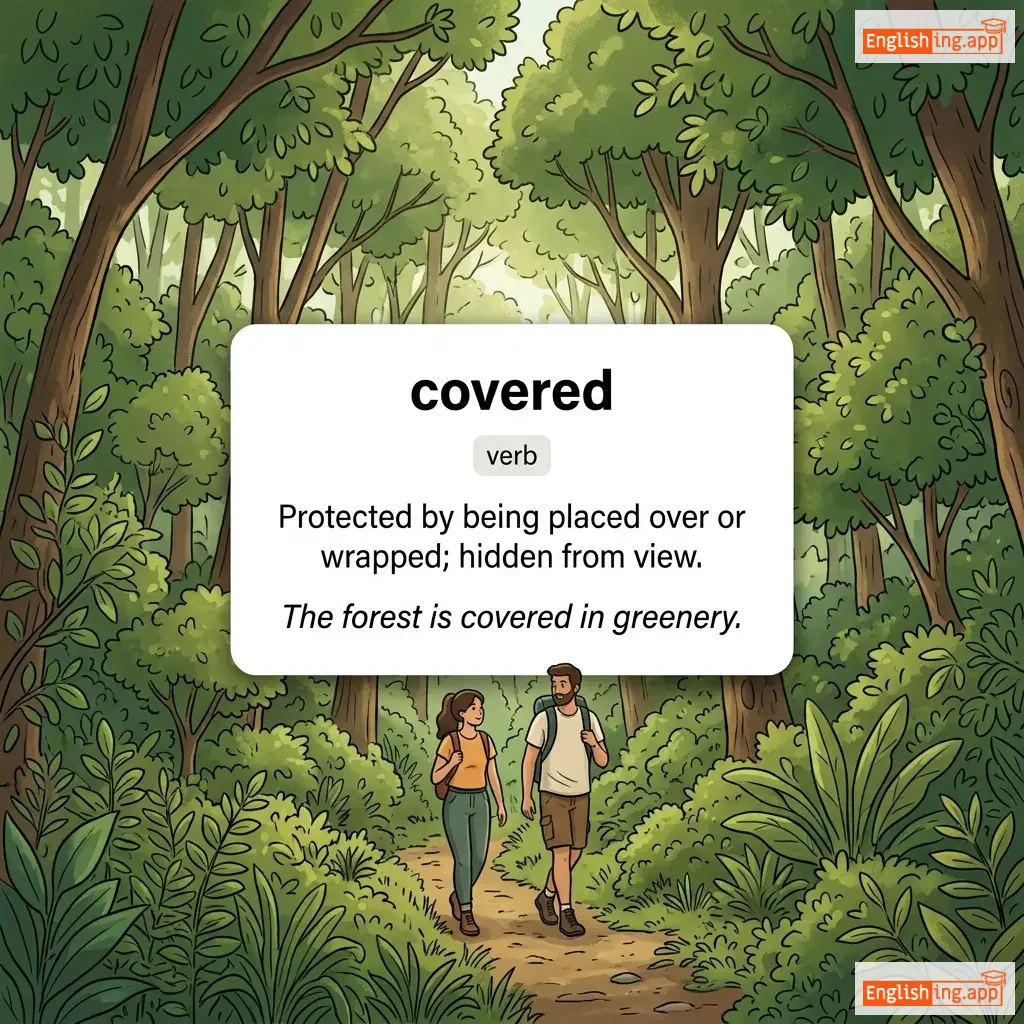
covered definition card — visual illustration of the meaning
verb
/ˈkʌv.ərd/
couverte (couverte)

Protected by being placed over or wrapped; hidden from view.

"The forest is covered in greenery."

"La forêt est couverte de verdure." (La forêt est couverte de verdure.)
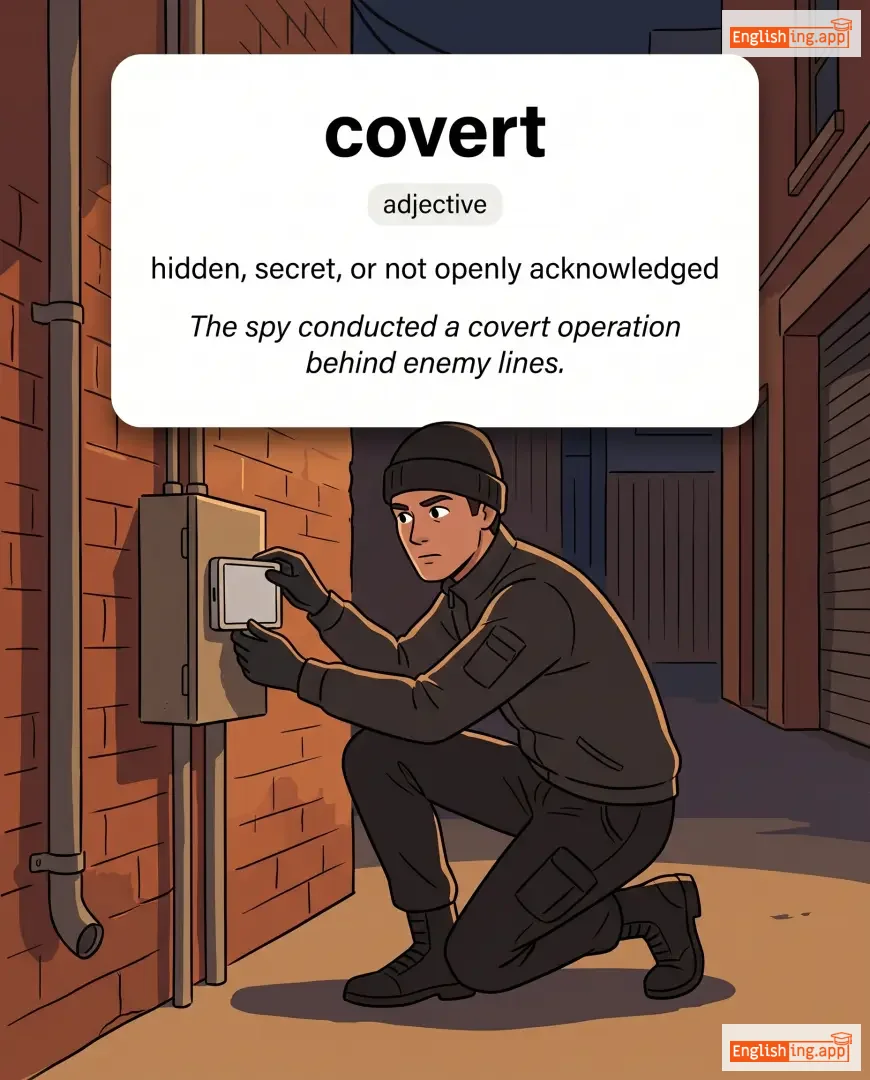
covert definition card — visual illustration of the meaning
🕵️‍♂️

covert (covert)

adjective
/ˈkoʊvərt/
secret (secret)

hidden, secret, or not openly acknowledged

"The spy conducted a covert operation behind enemy lines."

"L'espion a mené une opération secrète derrière les lignes ennemies." (L'espion a mené une opération secrète derrière les lignes ennemies.)
verb
/ˈkʌvət/
convoiter (convoiter)

to desire something belonging to someone else

"He coveted his neighbor's new car."

"Il convoitait la nouvelle voiture de son voisin." (Il convoitait la nouvelle voiture de son voisin.)
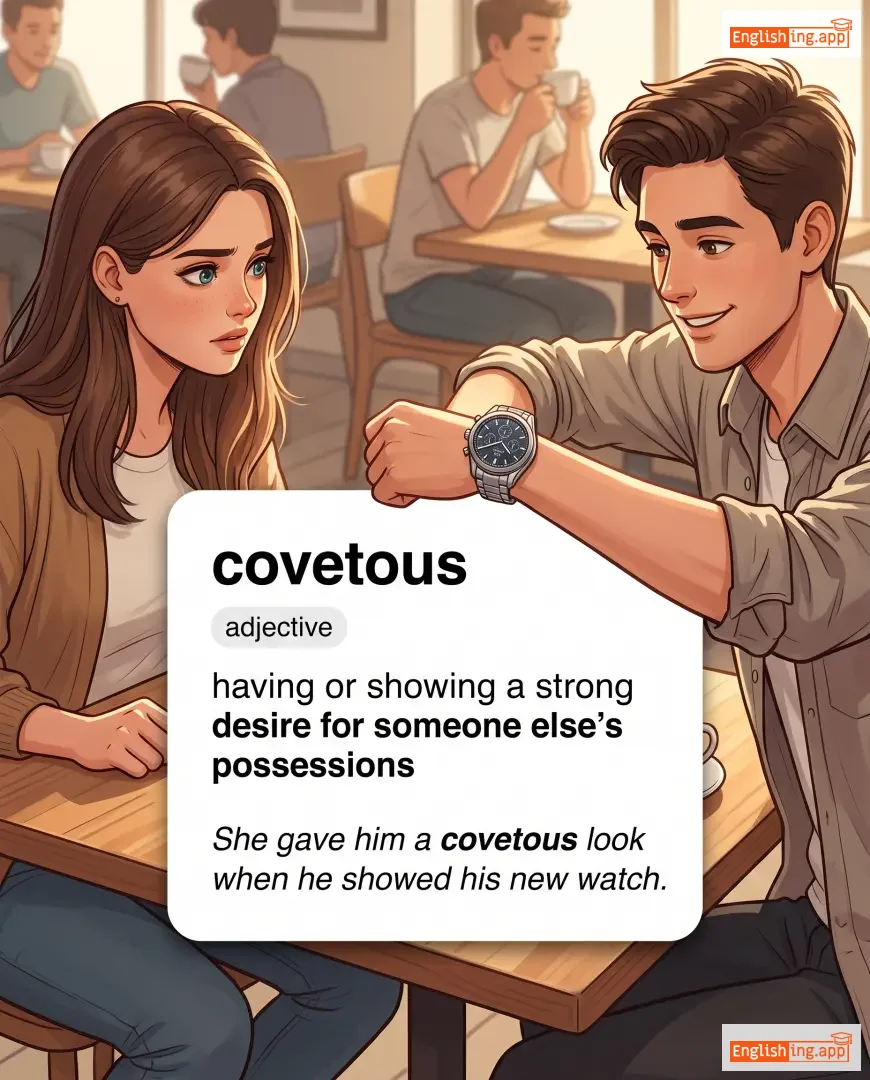
covetous definition card — visual illustration of the meaning
adjective
/ˈkʌvətəs/
convoiteux (convoiteux)

having or showing a strong desire for someone else's possessions

"She gave him a covetous look when he showed his new watch."

"Elle lui lança un regard convoiteux lorsqu'il montra sa nouvelle montre." (Elle lui lança un regard convoiteux lorsqu'il montra sa nouvelle montre.)
noun
/ˈkʌvi/
un petit groupe d'oiseaux (un petit groupe d'oiseaux)

a small group of birds, especially partridges or quails

"A covey of quails flew across the field."

"Un covey de cailles a volé à travers le champ." (Un covey de cailles a volé à travers le champ.)
noun
/kaʊ/
vache (kaow)

a large domesticated bovine animal kept for milk or meat

"The farmer milked the cow early in the morning."

"Le fermier a trait la vache tot le matin." (Le fermier a trait la vache tot le matin.)
noun
/ˈkaʊ.ərd/
lâche (lache)

a person who lacks the courage to do or endure dangerous or unpleasant things

"He called himself a coward for not standing up to the bully."

"Il s'est appelé un lâche pour ne pas avoir affronté l'intimidateur." (Il s'est appelle un lache pour ne pas avoir affronte l'intimidateur.)
noun
/ˈkaʊərdɪs/
lâcheté (lâcheté)

lack of courage; behavior showing fear

"His cowardice prevented him from speaking up."

"Sa lâcheté l'a empêché de prendre la parole." (Sa lâcheté l'a empêché de prendre la parole.)
noun
/ˈkaʊbɔɪ/
cow-boy (cow-boy)

a man, typically one on horseback, who herds and tends cattle

"The cowboy rode across the plains."

"Le cow-boy traversait les plaines." (Le cow-boy traversait les plaines.)
verb
/ˈkaʊər/
se recroqueviller de peur (se recroqueviller de peur)

to crouch down in fear

"The child cowered behind the sofa during the thunderstorm."

"L'enfant se coucha derrière le canapé pendant l'orage." (L'enfant se coucha derrière le canapé pendant l'orage.)
noun
/ˈkɒksweɪn/
barreur (barreur)

the person in charge of navigating and steering a boat, especially a racing or small boat

"The coxswain shouted instructions to the rowing team."

"Le coxswain a donné des instructions à l'équipe d'aviron." (Le coxswain a donné des instructions à l'équipe d'aviron.)
adjective
/kɔɪ/
timide, réservé (timide, reserve)

reluctant to give details or reveal feelings; shy or reserved

"She gave a coy smile when asked about her plans."

"Elle a donné un sourire timide lorsqu'on lui a demandé ses projets." (Elle a donne un sourire timide lorsqu'on lui a demande ses projets.)
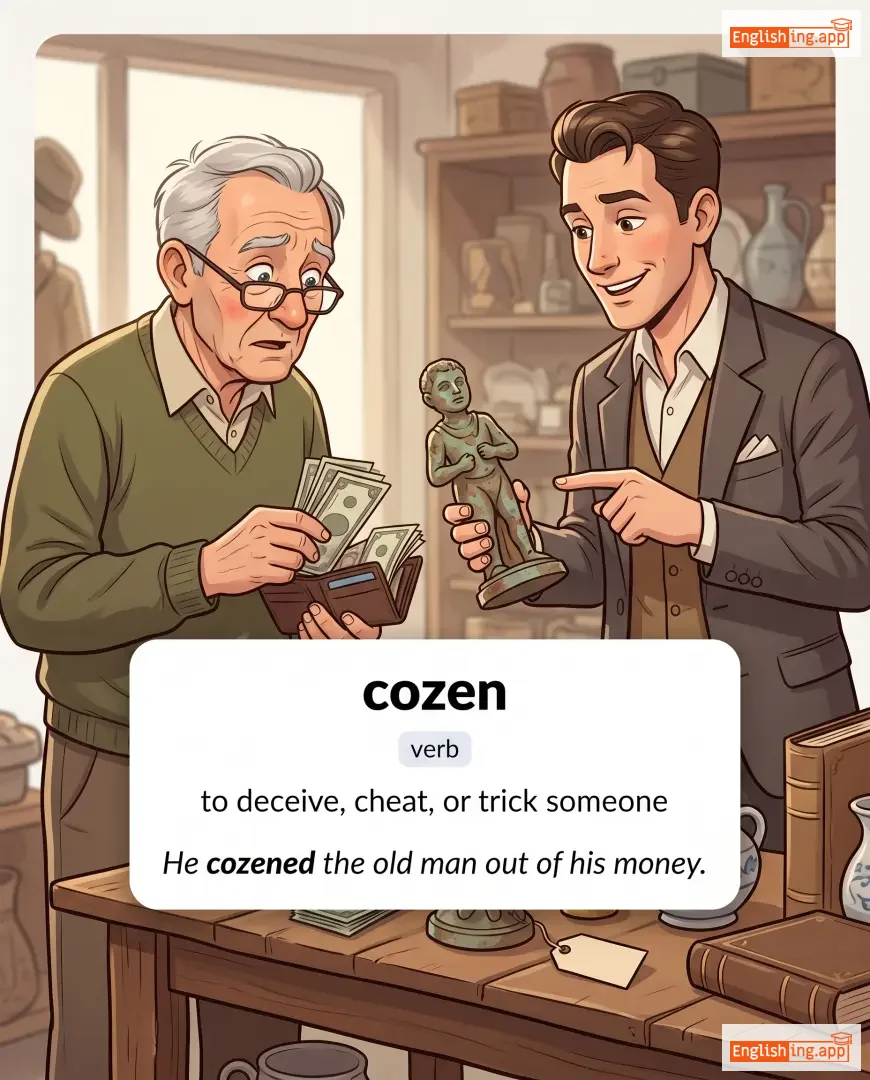
cozen definition card — visual illustration of the meaning
verb
/ˈkʌzən/
tromper, arnaquer (tromper, arnaquer)

to deceive, cheat, or trick someone

"He cozened the old man out of his money."

"Il a trompé le vieil homme et lui a pris son argent." (Il a trompé le vieil homme et lui a pris son argent.)
adjective
/ˈkoʊzi/
confortable (confortable)

giving a feeling of comfort, warmth, and relaxation

"We sat in a cozy little café on a rainy day."

"Nous nous sommes assis dans un petit café confortable un jour de pluie." (Nous nous sommes assis dans un petit cafe confortable un jour de pluie.)
noun
/kræb/
crabe (crabe)

a crustacean with a broad carapace, stalked eyes, and five pairs of legs, the first pair of which are modified as pincers

"The crab scuttled sideways across the sand."

"Le crabe a marché latéralement sur le sable." (Le crabe a marché latéralement sur le sable.)
adjective
/ˈkræbɪd/
difficile à lire, de mauvais caractère (difficile à lire, de mauvais caractère)

difficult to read or understand; ill-tempered

"His handwriting was crabbed and almost illegible."

"Son écriture était difficile à lire et presque illisible." (Son écriture était difficile à lire et presque illisible.)
verb
/kræk/
bonheur (bonheur)

To break or cause to break without complete separation; to make a sharp sound.

"The glass cracked when it was dropped on the floor."

"Elle ne pouvait pas cacher son bonheur quand elle a reçu le prix." (Elle ne pouvait pas cacher son bonheur quand elle a reçu le prix.)