Vocabulaires

Découvrez, apprenez et maîtrisez le vocabulaire anglais

noun
/ˈkɒn.tjʊ.mə.si/
désobéissance, entêtement (desobeissance, entetement)

stubborn refusal to obey authority

"His contumacy led to his suspension from the council."

"Sa désobéissance a conduit à sa suspension du conseil." (Sa désobéissance a conduit à sa suspension du conseil.)
noun
/ˈkɒn.tjʊ.mə.li/
insulte, mépris (insulte, mepris)

insulting or humiliating treatment

"He endured the contumely of his colleagues with patience."

"Il a supporté le mépris de ses collègues avec patience." (Il a supporté le mépris de ses collègues avec patience.)
verb
/kənˈtjuːz/
contusionner (contusionner)

to bruise by striking or hitting

"He contused his arm when he fell off the bike."

"Il s'est contusionné le bras lorsqu'il est tombé de son vélo." (Il s'est contusionné le bras lorsqu'il est tombé de son vélo.)
noun
/kənˈtjuː.ʒən/
contusion, ecchymose (contusion, ecchymose)

a bruise or injury without breaking the skin

"The boxer had several contusions after the match."

"Le boxeur avait plusieurs contusions après le match." (Le boxeur avait plusieurs contusions après le match.)
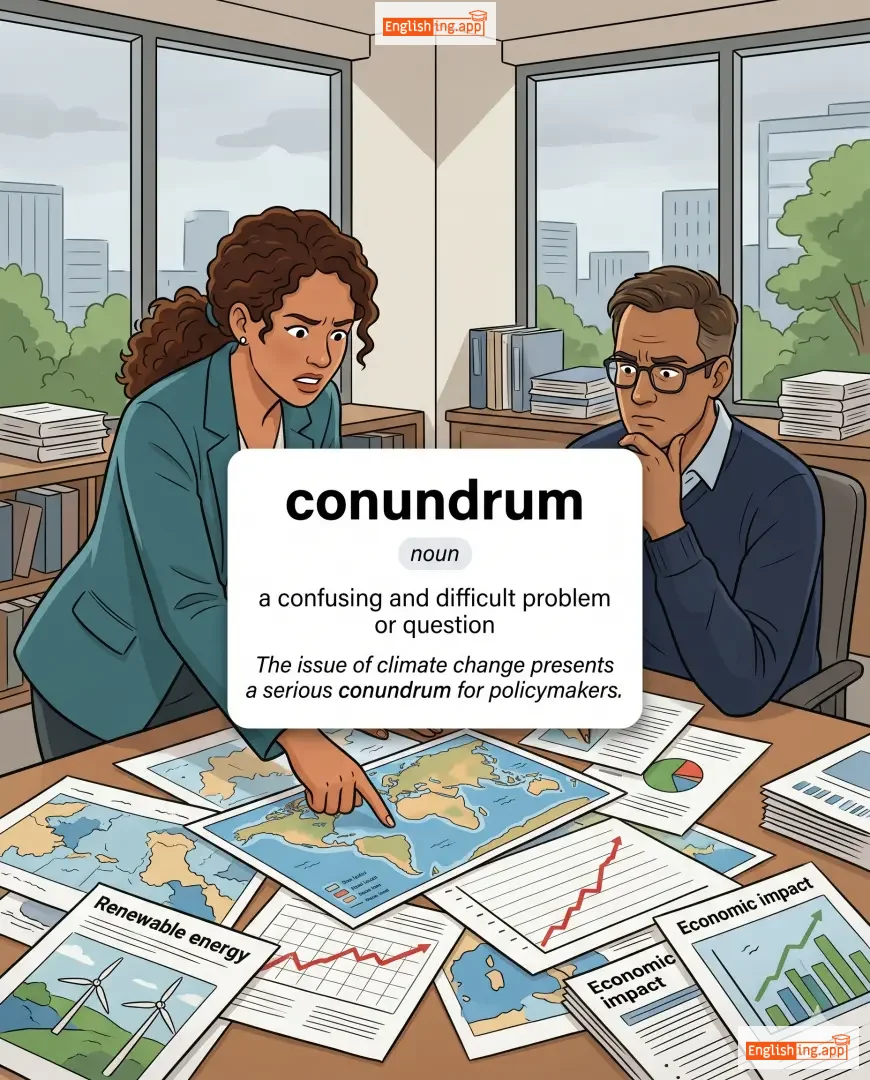
conundrum definition card — visual illustration of the meaning
noun
/kəˈnʌndrəm/
énigme (enigme)

a confusing and difficult problem or question

"The issue of climate change presents a serious conundrum for policymakers."

"La question du changement climatique présente une énigme sérieuse pour les décideurs politiques." (La question du changement climatique présente une enigme serieuse pour les decideurs politiques.)
verb
/ˌkɒnvəˈlɛs/
se rétablir, récupérer la santé et la force après une maladie ou un traitement médical (se retablir, recuperer la sante et la force apres une maladie ou un traitement medical)

to recover health and strength after illness or medical treatment

"After the surgery, she spent several weeks convalescing at home."

"Après l'opération, elle a passé plusieurs semaines à récupérer chez elle." (Apres l'operation, elle a passe plusieurs semaines a recuperer chez elle.)
noun
/ˌkɒnvəˈlɛsns/
convalescence (convalescence)

the period of time spent recovering from an illness or medical treatment

"His convalescence lasted for almost two months after the accident."

"Sa convalescence a duré presque deux mois après l'accident." (Sa convalescence a dure presque deux mois apres l'accident.)
adjective
/ˌkɒnvəˈlɛsnt/
en convalescence, en rétablissement après une maladie ou un traitement médical (en convalescence, en retablissement apres une maladie ou un traitement medical)

recovering from an illness or medical treatment

"The hospital has a special ward for convalescent patients."

"L'hôpital dispose d'une salle spéciale pour les patients en convalescence." (L'hopital dispose d'une salle speciale pour les patients en convalescence.)
verb
/kənˈviːn/
se réunir, convoquer une réunion ou un rassemblement (se reunir, convoquer une reunion ou un rassemblement)

to come together or assemble, especially for a meeting or formal gathering

"The board will convene tomorrow to discuss the new policy."

"Le conseil se réunira demain pour discuter de la nouvelle politique." (Le conseil se reunira demain pour discuter de la nouvelle politique.)
noun
/kənˈviːniəns/
commodité (commodite)

the state of being able to do something easily or comfortably

"Online shopping offers great convenience for busy people."

"Les achats en ligne offrent une grande commodité pour les personnes occupées." (Les achats en ligne offrent une grande commodité pour les personnes occupées.)
adjective
/kənˈviː.ni.ənt/
pratique (pratik)

suitable or easy to use; fitting in well with one's needs

"This shop is convenient for my daily needs."

"Ce magasin est pratique pour mes besoins quotidiens." (Ce magasin est pratique pour mes besoins quotidiens.)
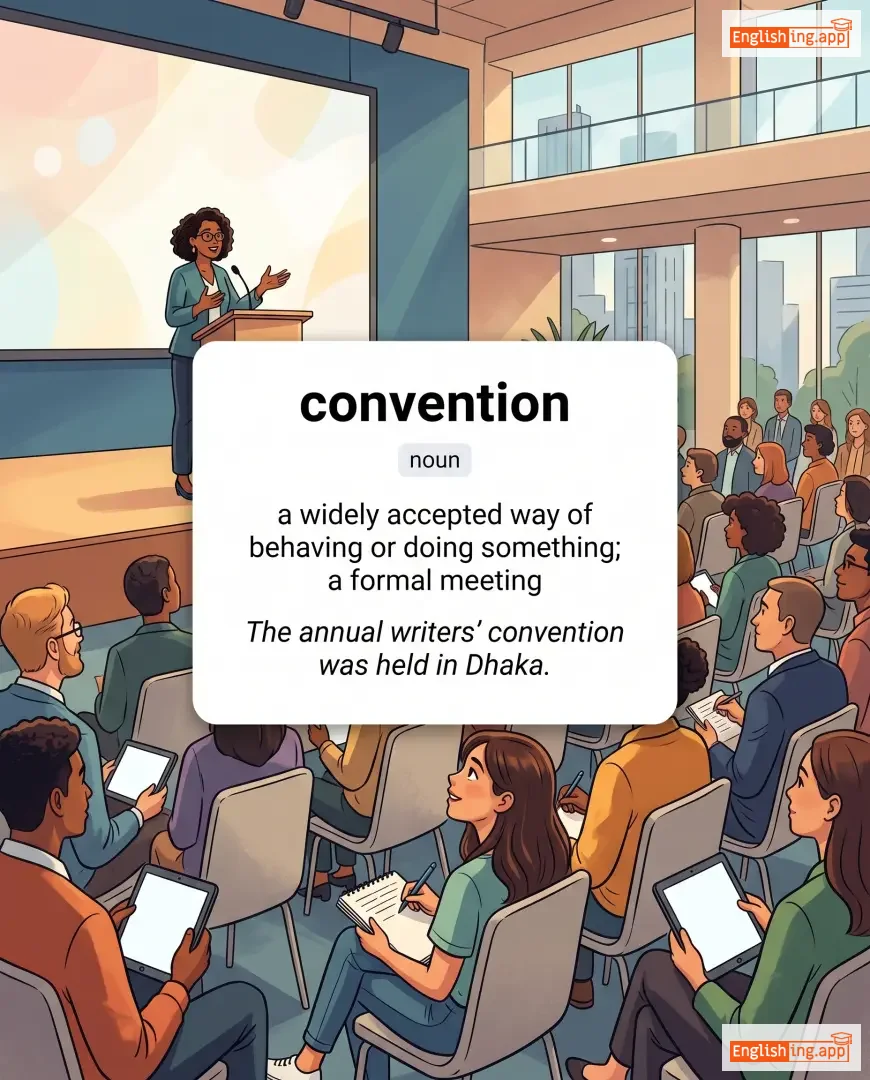
convention definition card — visual illustration of the meaning
noun
/kənˈvɛnʃən/
convention (convention)

a widely accepted way of behaving or doing something; a formal meeting

"The annual writers' convention was held in Dhaka."

"La convention annuelle des écrivains a eu lieu à Dhaka." (La convention annuelle des ecrivains a eu lieu a Dhaka.)
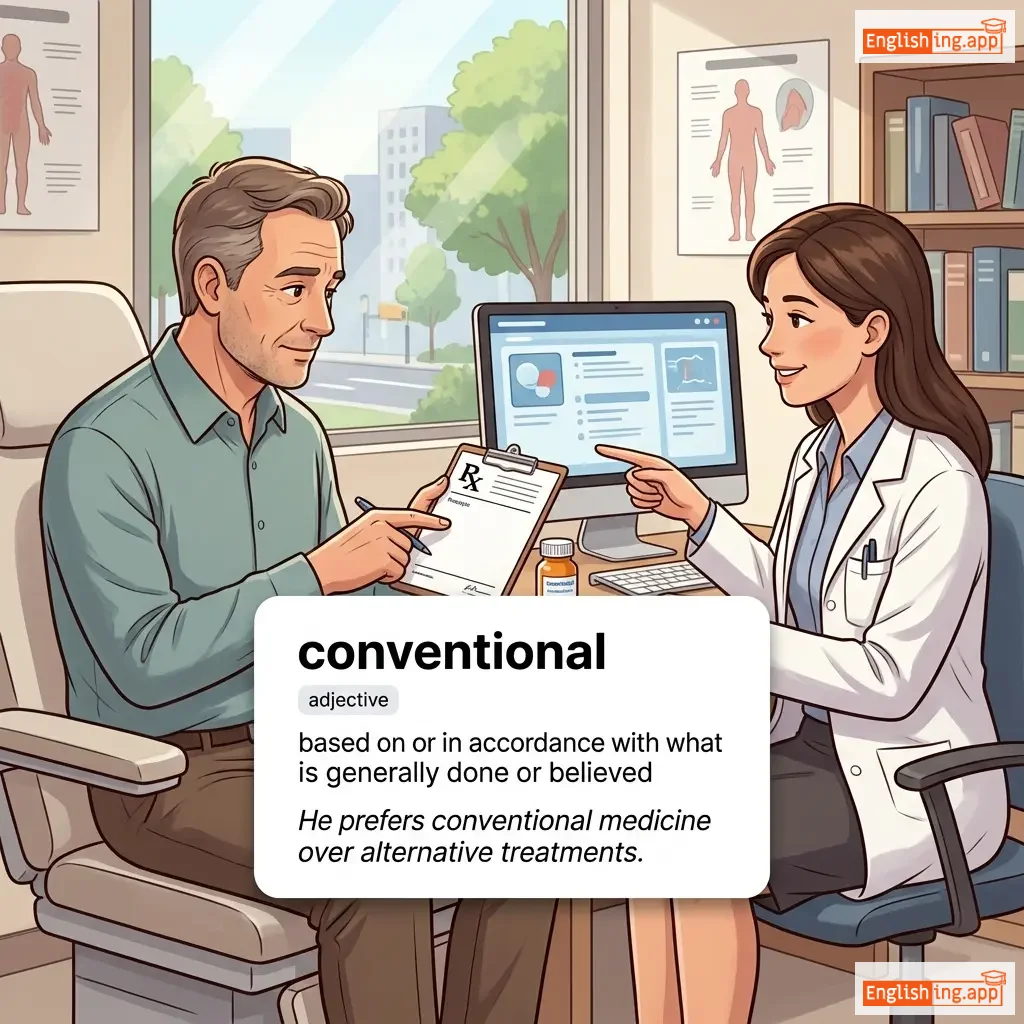
conventional definition card — visual illustration of the meaning
adjective
/kənˈvɛnʃənəl/
traditionnel (traditionnel)

based on or in accordance with what is generally done or believed

"He prefers conventional medicine over alternative treatments."

"Il préfère la médecine traditionnelle aux traitements alternatifs." (Il préfère la médecine traditionnelle aux traitements alternatifs.)
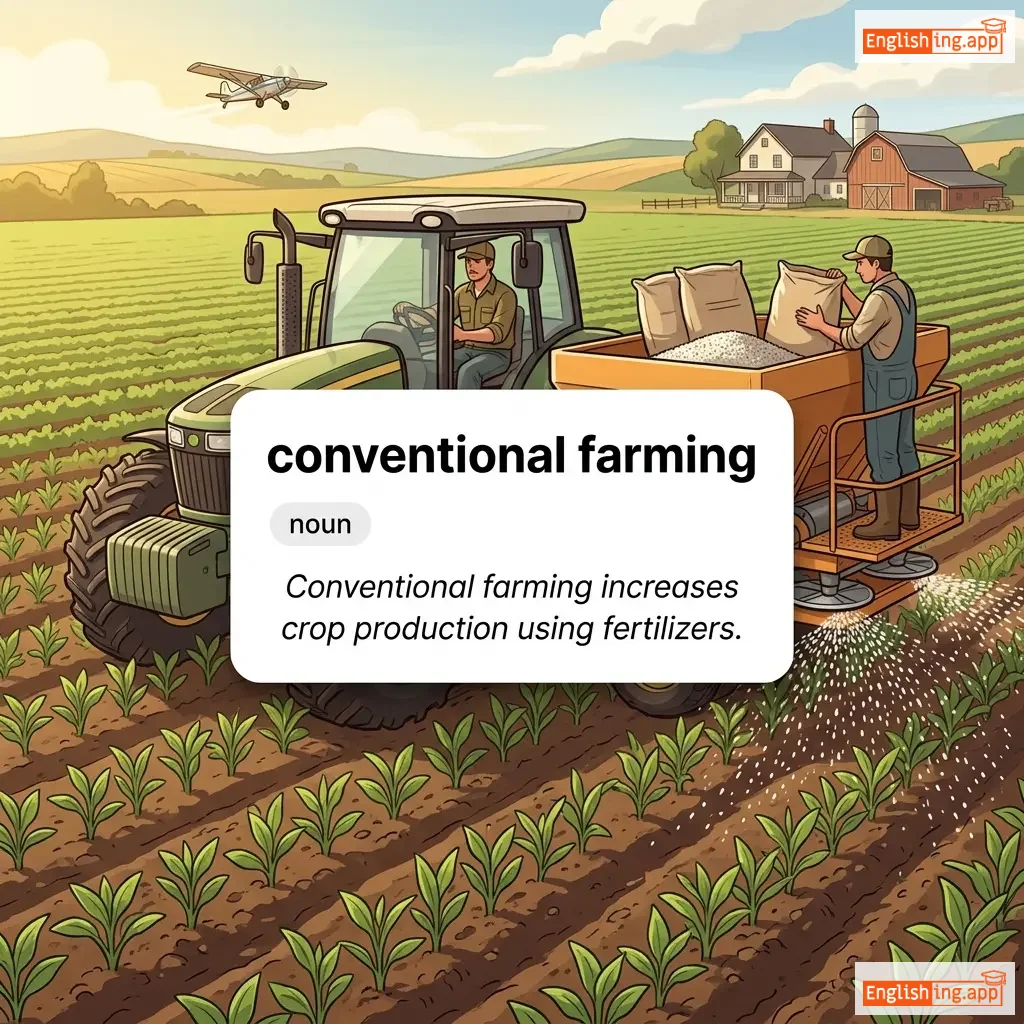
conventional farming definition card — visual illustration of the meaning
noun
/kənˈvɛn.ʃən.əl ˈfɑːr.mɪŋ/
agriculture conventionnelle (agriculture conventionnelle)

Traditional farming method using synthetic fertilizers, pesticides, and modern technology.

"Conventional farming increases crop production using fertilizers."

"L'agriculture conventionnelle augmente la production des cultures en utilisant des engrais." (L'agriculture conventionnelle augmente la production des cultures en utilisant des engrais.)
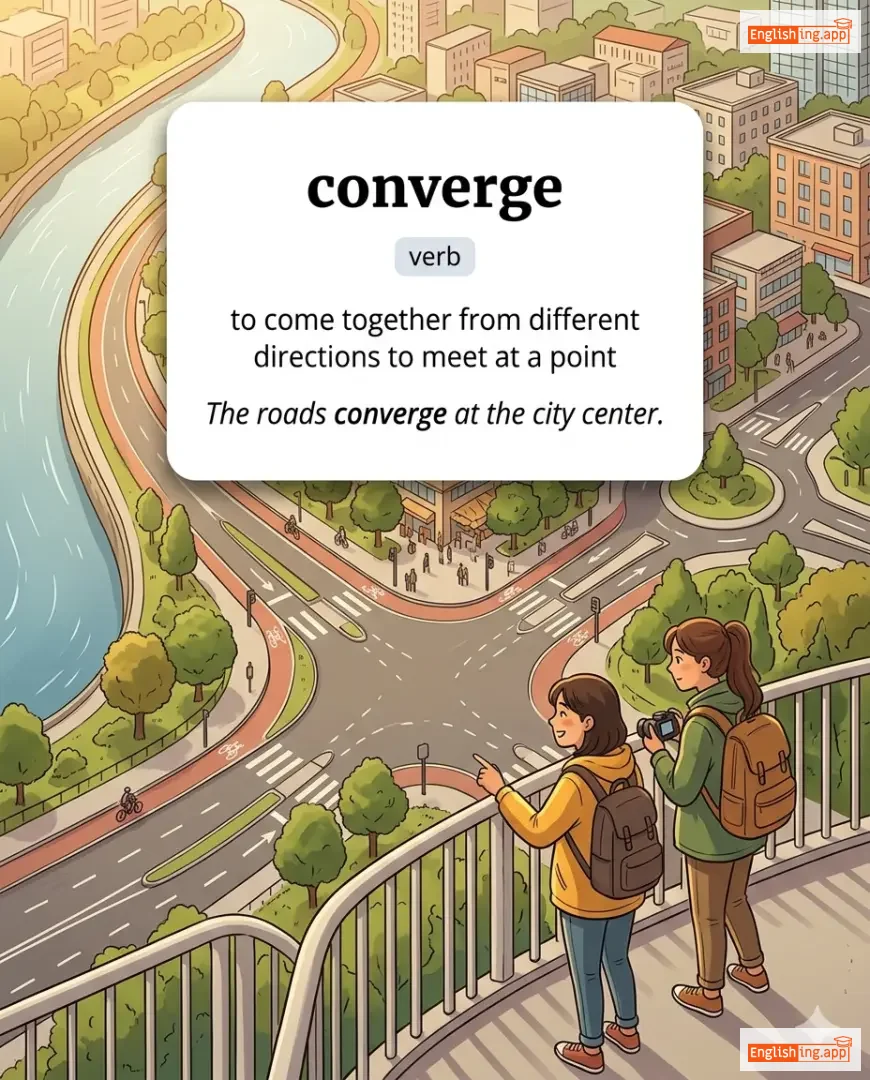
converge definition card — visual illustration of the meaning
verb
/kənˈvɜːrdʒ/
converger (kon-ver-jay)

to come together from different directions to meet at a point

"The roads converge at the city center."

"Les routes convergent au centre de la ville." (Les routes convergent au centre de la ville.)
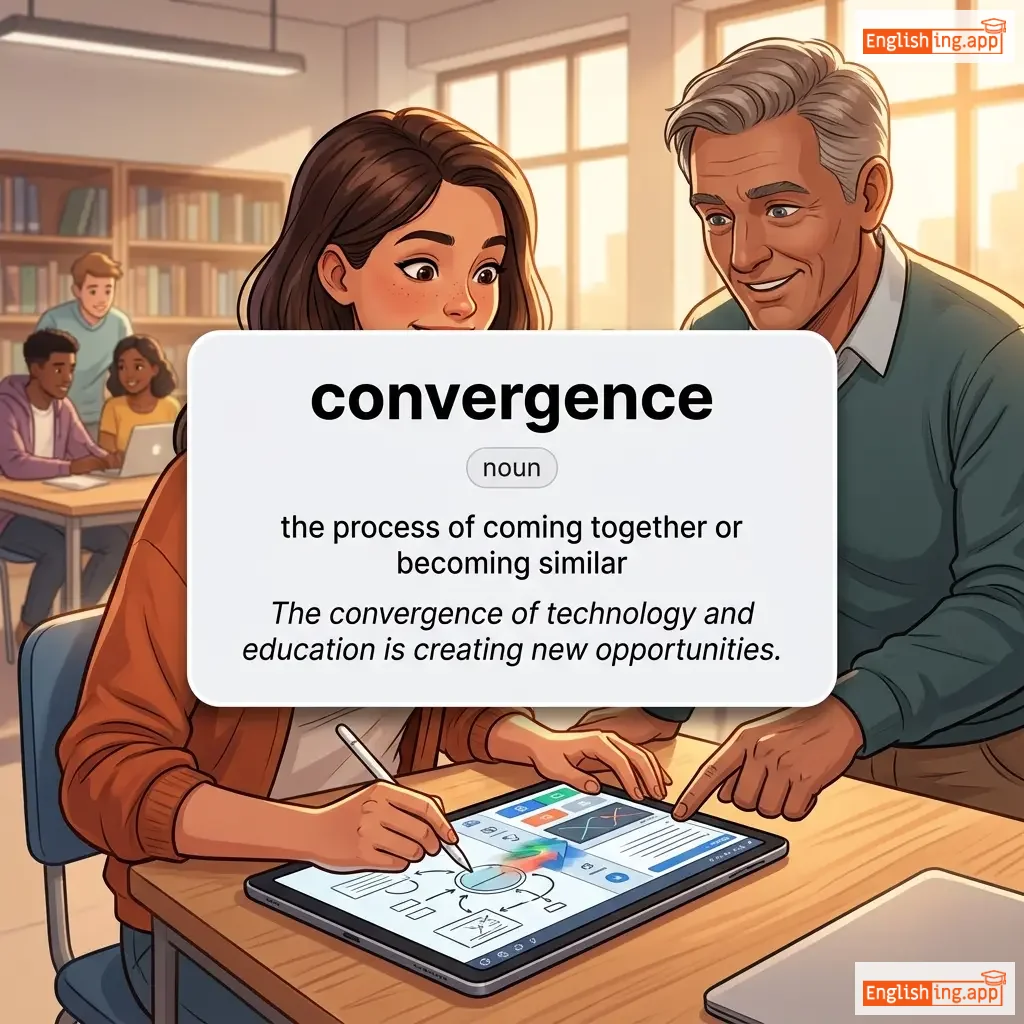
convergence definition card — visual illustration of the meaning
noun
/kənˈvɜː.dʒəns/
convergence (convergence)

the process of coming together or becoming similar

"The convergence of technology and education is creating new opportunities."

"La convergence de la technologie et de l'éducation crée de nouvelles opportunités." (La convergence de la technologie et de l'éducation crée de nouvelles opportunités.)
adjective
/kənˈvɜːrdʒənt/
convergent (convergent)

tending to move toward a common point or result

"The two rivers have a convergent path before entering the lake."

"Les deux rivières ont un chemin convergent avant d'entrer dans le lac." (Les deux rivières ont un chemin convergent avant d'entrer dans le lac.)
adjective
/kənˈvɜːrsənt/
familier, connaisseur (familier, connaisseur)

familiar with or knowledgeable about something

"She is conversant with the latest developments in technology."

"Elle est familière avec les derniers développements technologiques." (Elle est familière avec les derniers développements technologiques.)
noun
/ˌkɒnvəˈseɪʃn/
conversation (conversation)

an informal talk between two or more people, in which ideas, feelings, and thoughts are exchanged

"We had a long conversation about future plans."

"Nous avons eu une longue conversation sur les plans futurs." (Nous avons eu une longue conversation sur les plans futurs.)
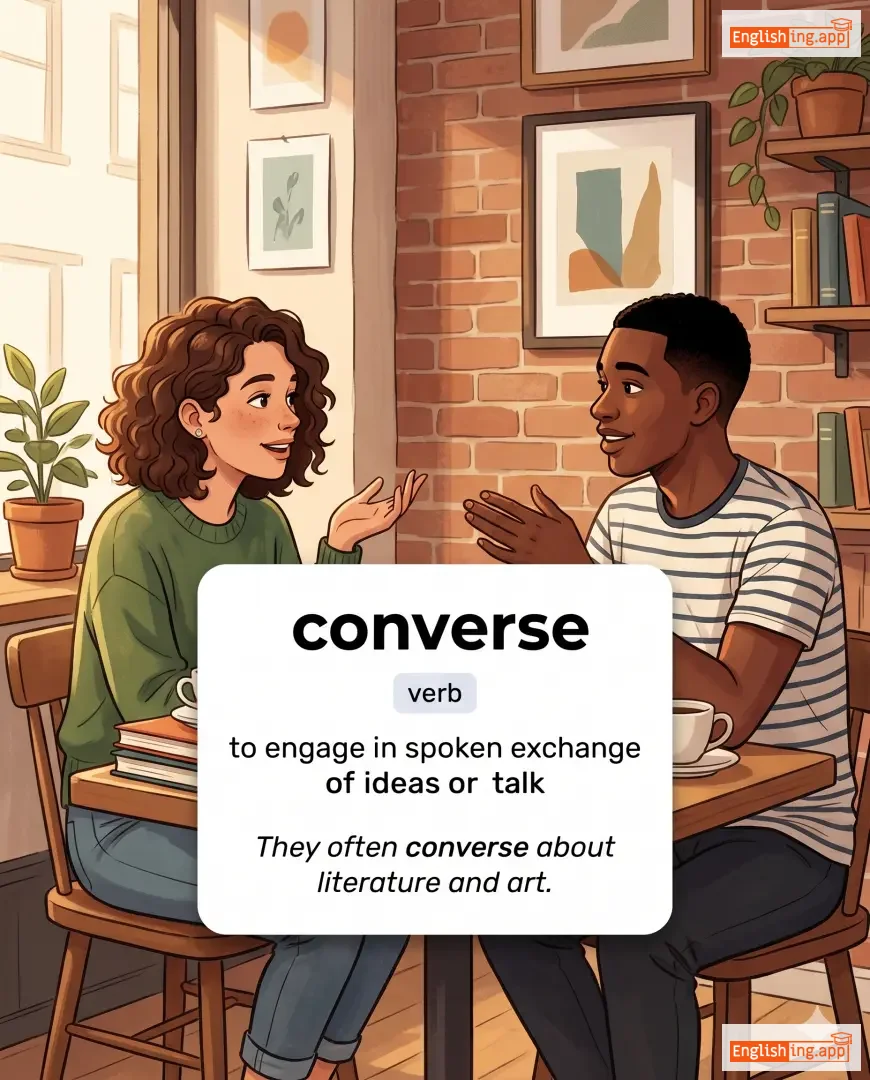
converse definition card — visual illustration of the meaning
verb
/kənˈvɜːrs/
converser (converser)

to engage in spoken exchange of ideas or talk

"They often converse about literature and art."

"Ils conversent souvent sur la littérature et l'art." (Ils conversent souvent sur la littérature et l'art.)
adverb
/kənˈvɜːrsli/
inversement (inversement)

in an opposite or contrary manner

"He is rich, conversely, his brother struggles financially."

"Il est riche, inversement, son frère lutte financièrement." (Il est riche, inversement, son frère lutte financièrement.)
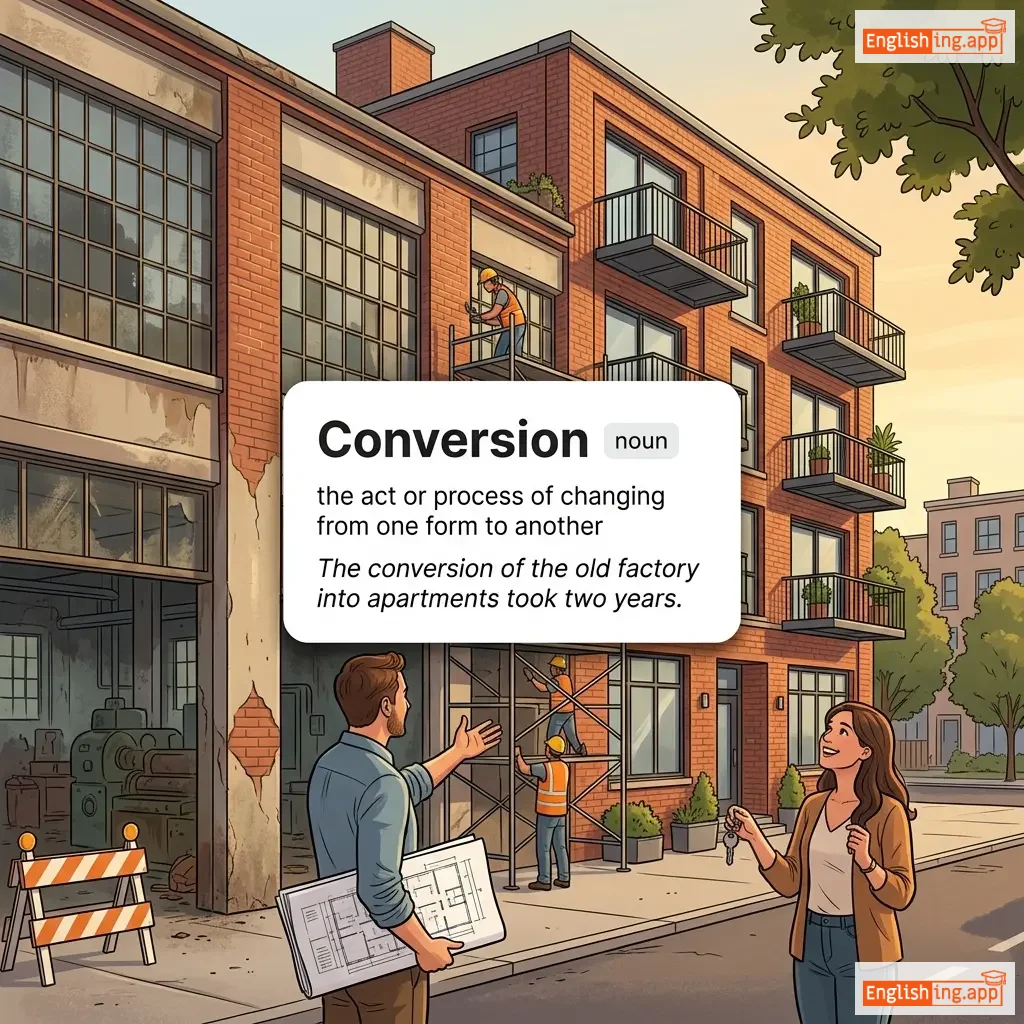
Conversion definition card — visual illustration of the meaning
noun
/kənˈvɜːrʒən/
conversion, changement (conversion, changement)

the act or process of changing from one form to another

"The conversion of the old factory into apartments took two years."

"La conversion de l'ancienne usine en appartements a pris deux ans." (La conversion de l'ancienne usine en appartements a pris deux ans.)
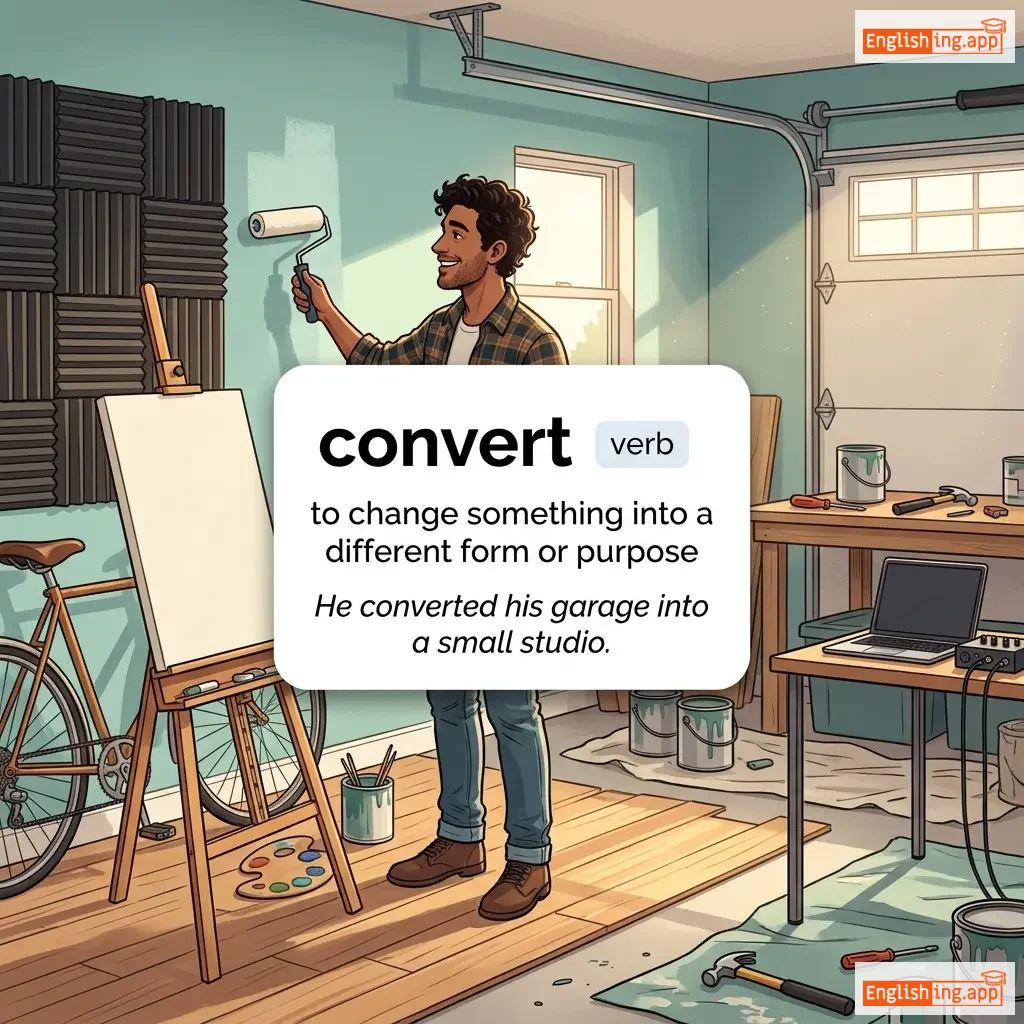
convert definition card — visual illustration of the meaning
verb
/kənˈvɜːrt/
convertir (convertir)

to change something into a different form or purpose

"He converted his garage into a small studio."

"Il a converti son garage en un petit studio." (Il a converti son garage en un petit studio.)
noun
/kənˈvɜːrtər/
convertisseur (convertisseur)

a device or person that changes something from one form, system, or use to another; a tool that converts data, energy, or materials

"The engineer used a converter to change AC power into DC power."

"L’ingénieur a utilisé un convertisseur pour transformer le courant alternatif en continu." (L ingenieur a utilise un convertisseur pour transformer le courant alternatif en continu)
adjective
/kənˈvɜːrtəbl/
cabriolet, voiture avec toit rabattable (cabriolet, voiture avec toit rabattable)

able to be changed into a different form or use; also a car with a roof that can be folded down

"She drove her new convertible along the coastal road."

"Elle a conduit sa nouvelle voiture décapotable sur la route côtière." (Elle a conduit sa nouvelle voiture decapotable sur la route cotiere.)
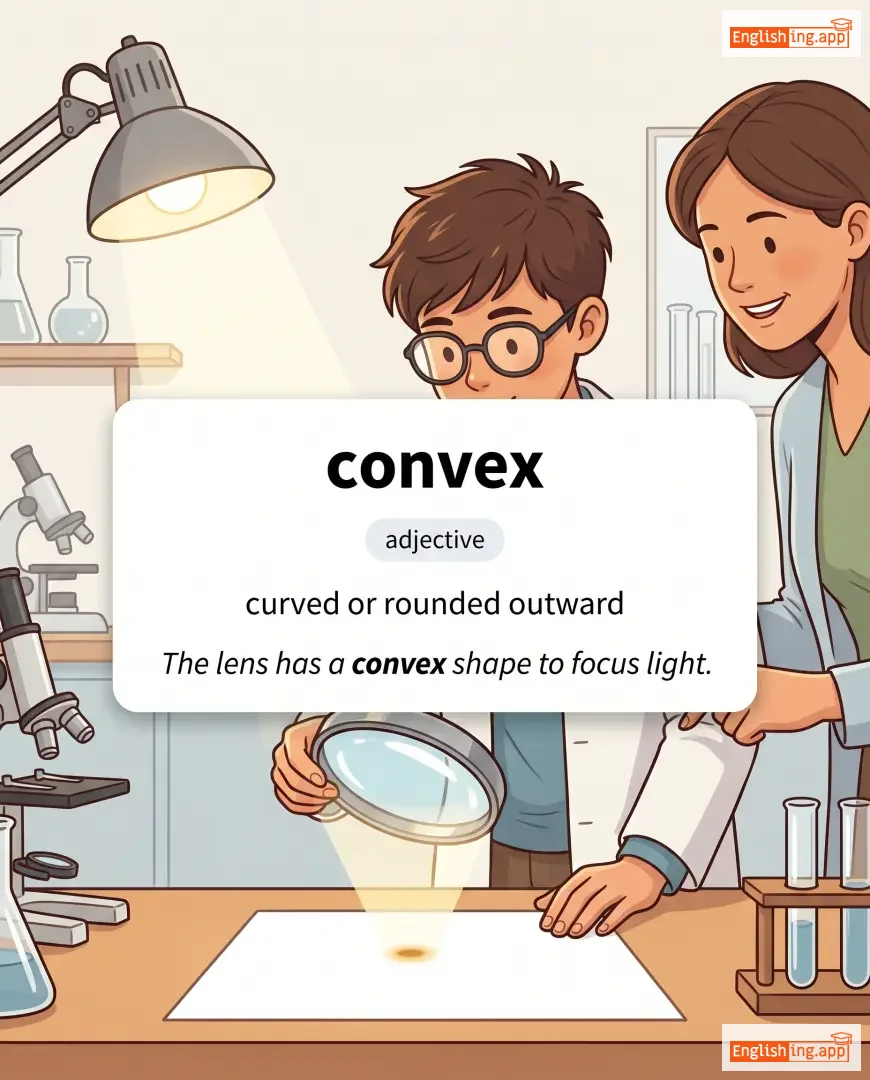
convex definition card — visual illustration of the meaning
adjective
/ˈkɒnvɛks/
convexe, arrondi vers l'extérieur (convexe, arrondi vers l'extérieur)

curved or rounded outward

"The lens has a convex shape to focus light."

"La lentille a une forme convexe pour focaliser la lumière." (La lentille a une forme convexe pour focaliser la lumière.)
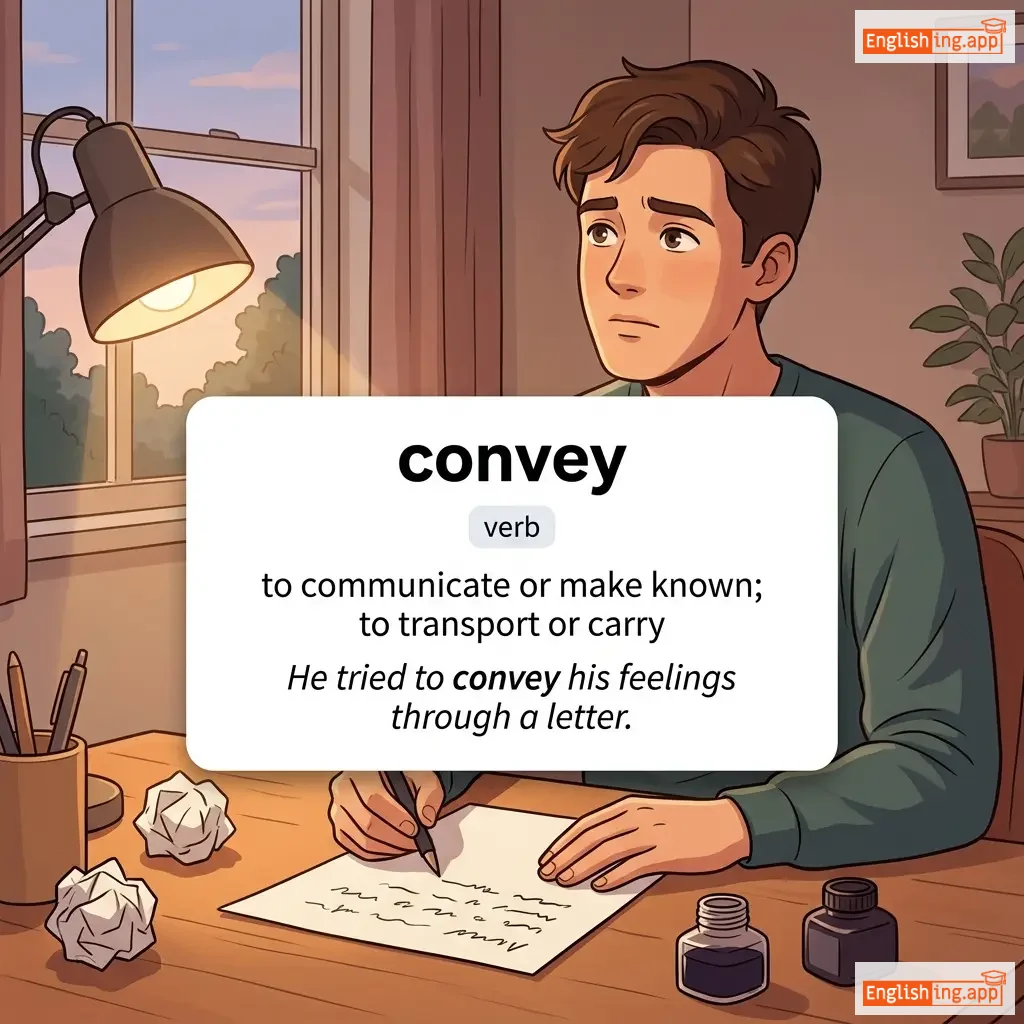
convey definition card — visual illustration of the meaning
verb
/kənˈveɪ/
transmettre, communiquer (transmettre, communiquer)

to communicate or make known; to transport or carry

"He tried to convey his feelings through a letter."

"Il a essayé de transmettre ses sentiments par une lettre." (Il a essayé de transmettre ses sentiments par une lettre.)
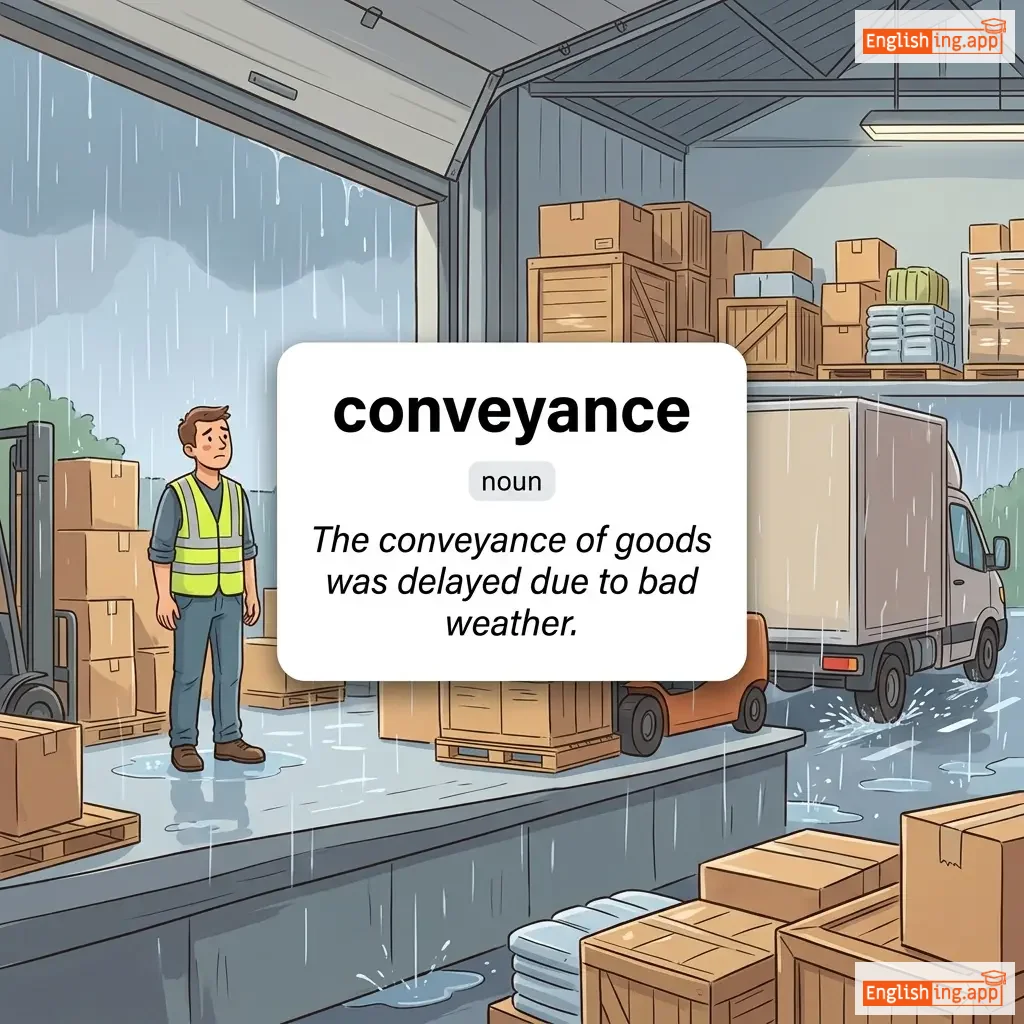
conveyance definition card — visual illustration of the meaning
noun
/kənˈveɪəns/
transport, moyen de transport, véhicule (transport, moyen de transport, vehicule)

the act of transporting or communicating something; a vehicle or means of transport

"The conveyance of goods was delayed due to bad weather."

"Le transport des marchandises a été retardé à cause du mauvais temps." (Le transport des marchandises a été retardé à cause du mauvais temps.)
verb
/ˈkɒnvɪkt/
condamner (kondamner)

to find someone guilty of a crime in a court of law

"The court convicted him of theft."

"Le tribunal l'a condamné pour vol." (Le tribunal l'a kondamné pour vol.)
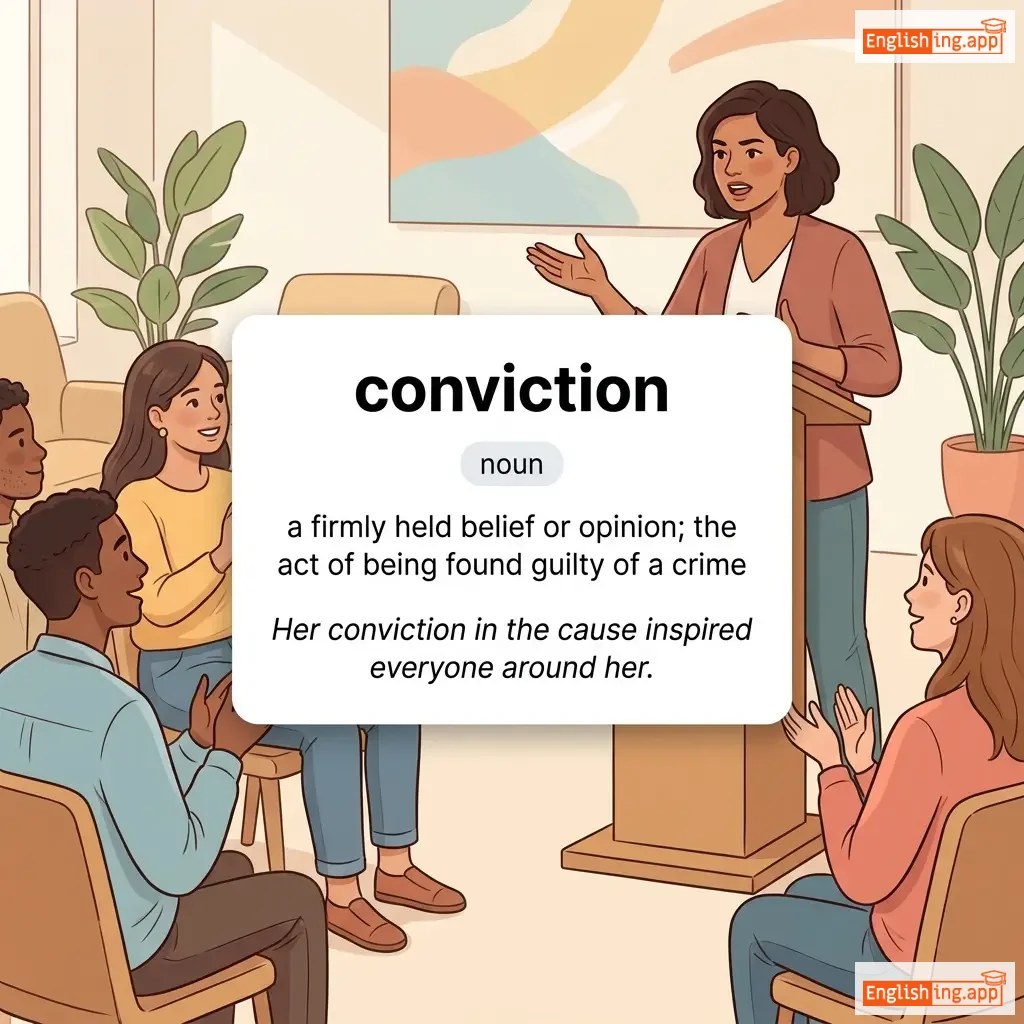
conviction definition card — visual illustration of the meaning
noun
/kənˈvɪkʃən/
croyance ferme, condamnation (croyance ferme, condamnation)

a firmly held belief or opinion; the act of being found guilty of a crime

"Her conviction in the cause inspired everyone around her."

"Sa conviction dans la cause a inspiré tout le monde autour d'elle." (Sa conviction dans la cause a inspiré tout le monde autour d'elle.)
verb
/kənˈvɪns/
convaincre (convaincre)

to make someone believe or feel certain about something

"She convinced him to attend the meeting."

"Elle l'a convaincu de assister à la réunion." (Elle l'a convaincu de assister à la réunion.)
adjective
/kənˈvɪnst/
convaincu (convaincu)

completely certain or sure about something

"She was convinced that he was telling the truth."

"Elle était convaincue qu'il disait la vérité." (Elle était convaincue qu'il disait la vérité.)
adjective
/kənˈvɪnsɪŋ/
convaincant (convaincant)

having the ability to make someone believe that something is true or real

"Her argument was very convincing."

"Son argument était très convaincant." (Son argument était très convaincant.)
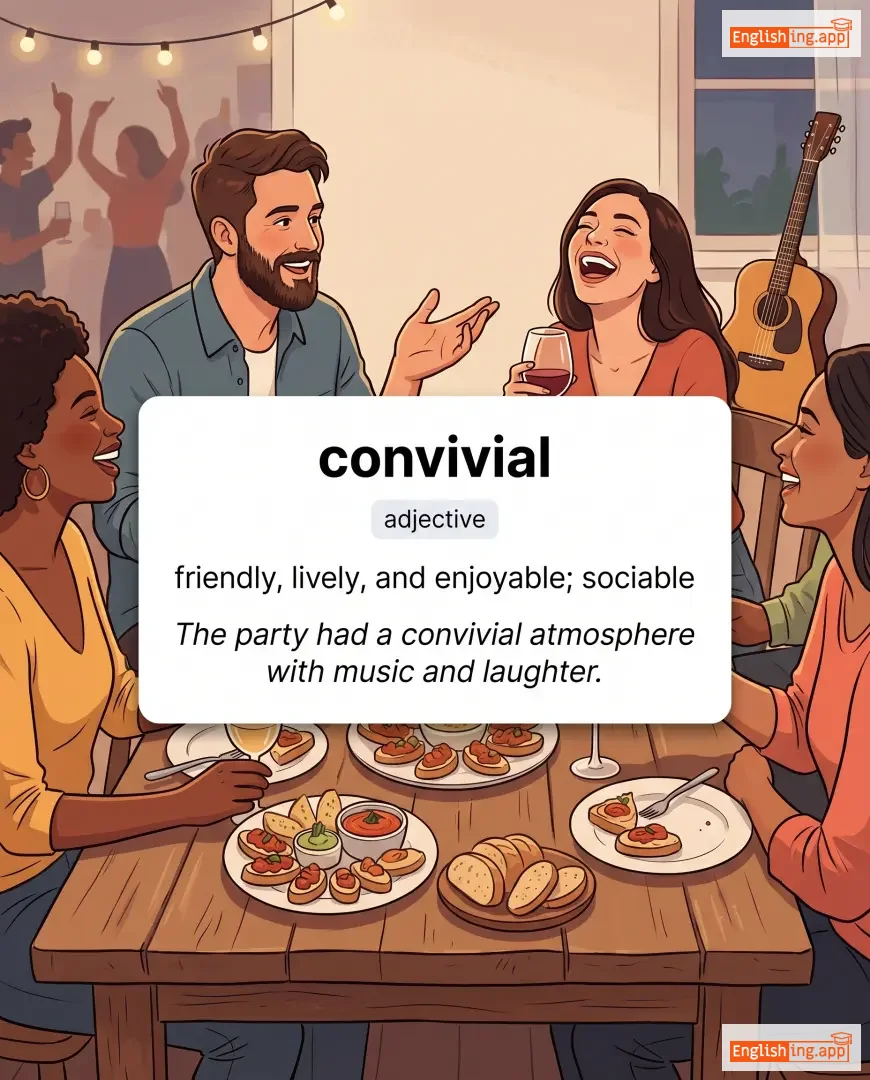
convivial definition card — visual illustration of the meaning
adjective
/kənˈvɪviəl/
amical, animé et agréable; sociable (amical, anime et agreable; sociable)

friendly, lively, and enjoyable; sociable

"The party had a convivial atmosphere with music and laughter."

"La fête avait une atmosphère conviviale avec de la musique et des rires." (La fete avait une atmosphere conviviale avec de la musique et des rires.)
verb
/kənˈvoʊk/
convocation (convocation)

to call together or summon a meeting or assembly

"The committee convoked an emergency session to discuss the crisis."

"Le comité a convoqué une session d'urgence pour discuter de la crise." (Le comite a convoque une session d'urgence pour discuter de la crise.)
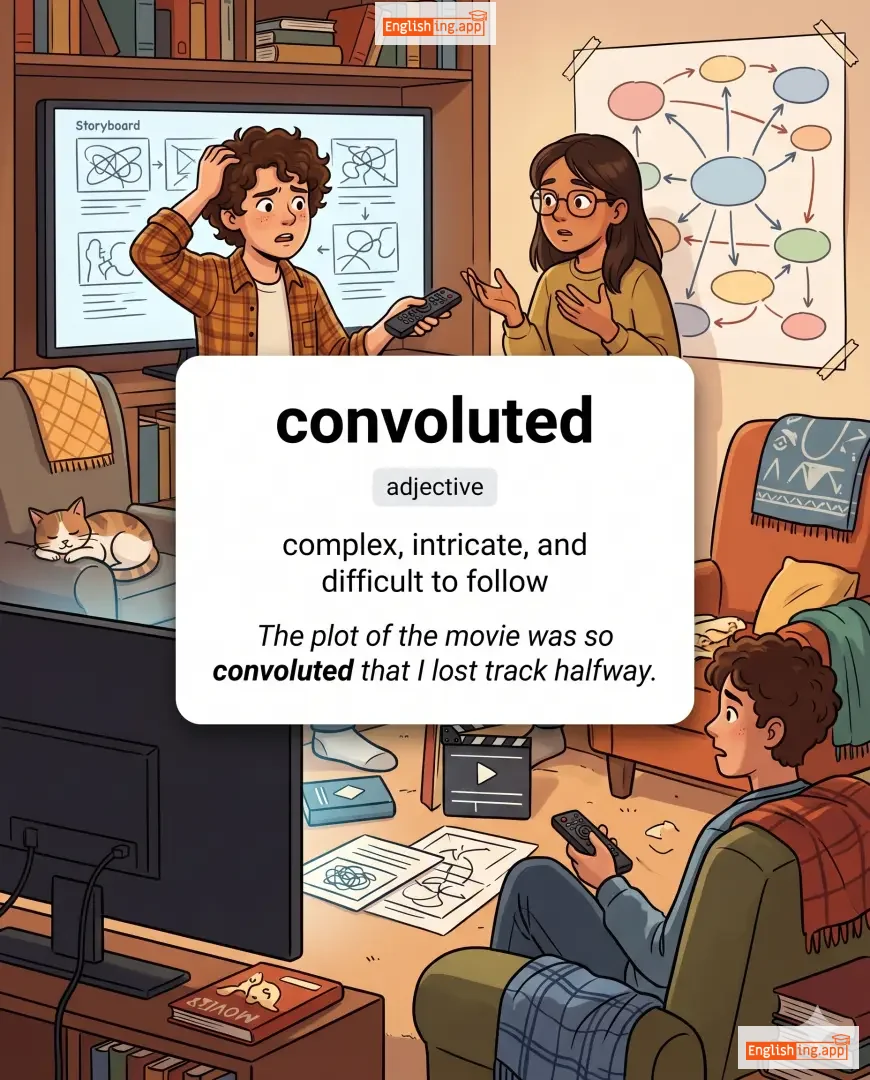
convoluted definition card — visual illustration of the meaning
adjective
/ˈkɒnvəluːtɪd/
complexe, compliqué (komplekse, komplike)

complex, intricate, and difficult to follow

"The plot of the movie was so convoluted that I lost track halfway."

"L'intrigue du film était tellement compliquée que j'ai perdu le fil en cours de route." (L'intrigue du film était tellement compliquée que j'ai perdu le fil en cours de route.)
noun
/ˌkɒnvəˈluːʃən/
convolution, courbe complexe ou structure (convolution, courbe complexe ou structure)

a twist, coil, or a complex and intricate shape or arrangement

"The brain has many convolutions that increase its surface area."

"Le cerveau a de nombreuses convolutions qui augmentent sa surface." (Le cerveau a de nombreuses convolutions qui augmentent sa surface.)
verb
/kənˈvɑːlv/
enrouler ou tordre ensemble; enrouler ou entrelacer (enrouler ou tordre ensemble)

to roll or twist together; to coil or entwine

"The vines convolve around the tree trunk."

"Les vignes s'enroulent autour du tronc de l'arbre." (Les vignes s'enroulent autour du tronc de l'arbre.)
noun
/ˈkɒn.vɔɪ/
convoi (convoi)

a group of vehicles or ships traveling together, often for protection

"The military convoy moved through the desert at dawn."

"Le convoi militaire a traversé le désert à l'aube." (Le convoi militaire a traverse le desert a l'aube.)
verb
/kənˈvʌls/
secouer violemment; souffrir de contractions involontaires soudaines (secouer violemment; souffrir de contractions involontaires soudaines)

to shake violently; to suffer sudden involuntary contractions

"The patient convulsed during the seizure."

"Le patient a convulsé pendant la crise." (Le patient a convulsé pendant la crise.)
noun
/kənˈvʌl.ʃən/
convulsion (convulsion)

a sudden, violent, involuntary contraction of muscles; a seizure

"The medicine helped prevent convulsions in children."

"Le médicament a aidé à prévenir les convulsions chez les enfants." (Le médicament a aidé à prévenir les convulsions chez les enfants.)
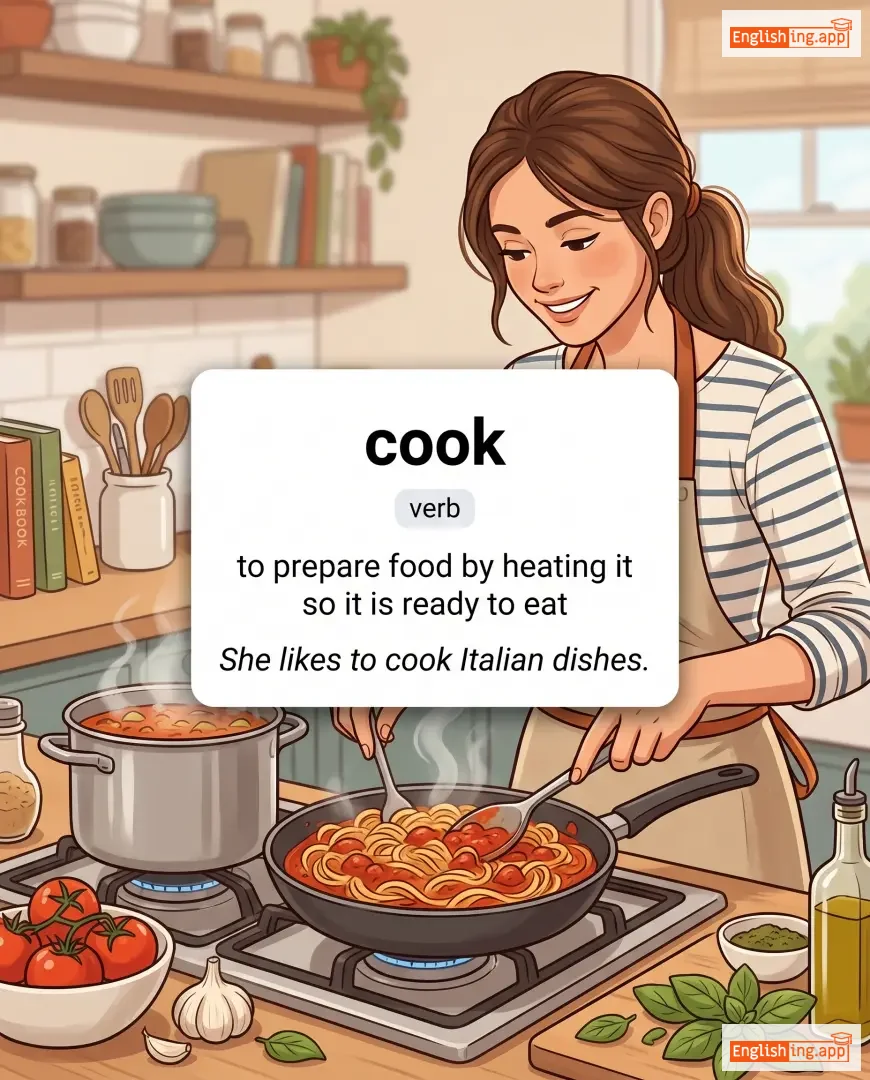
cook definition card — visual illustration of the meaning
👩‍🍳

cook (kook)

verb
/kʊk/
cuisiner (cuisiner)

to prepare food by heating it so it is ready to eat

"She likes to cook Italian dishes."

"Elle aime cuisiner des plats italiens." (Elle aime cuisiner des plats italiens.)
noun
/ˈkʊkər/
cuisinière; cuiseur (cuisiniere; cuiseur)

a device or appliance used for cooking food; a person or thing that cooks

"The rice cooker makes cooking meals much easier."

"Le cuiseur à riz rend la cuisine plus facile." (Le cuiseur a riz rend la cuisine plus facile)
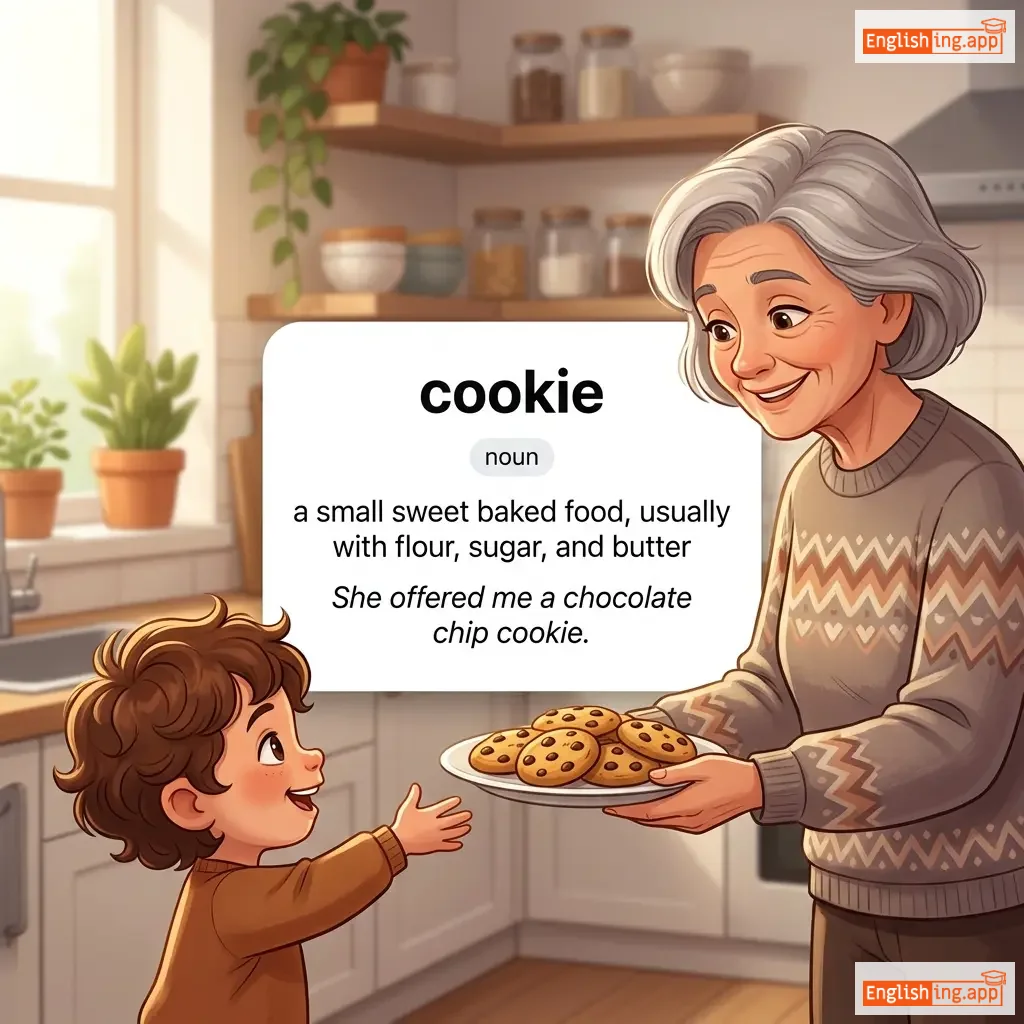
cookie definition card — visual illustration of the meaning
noun
/ˈkʊki/
cookie (cookie)

a small sweet baked food, usually with flour, sugar, and butter

"She offered me a chocolate chip cookie."

"Elle m'a offert un cookie aux pépites de chocolat." (Elle m'a offert un cookie aux pepites de chocolat.)
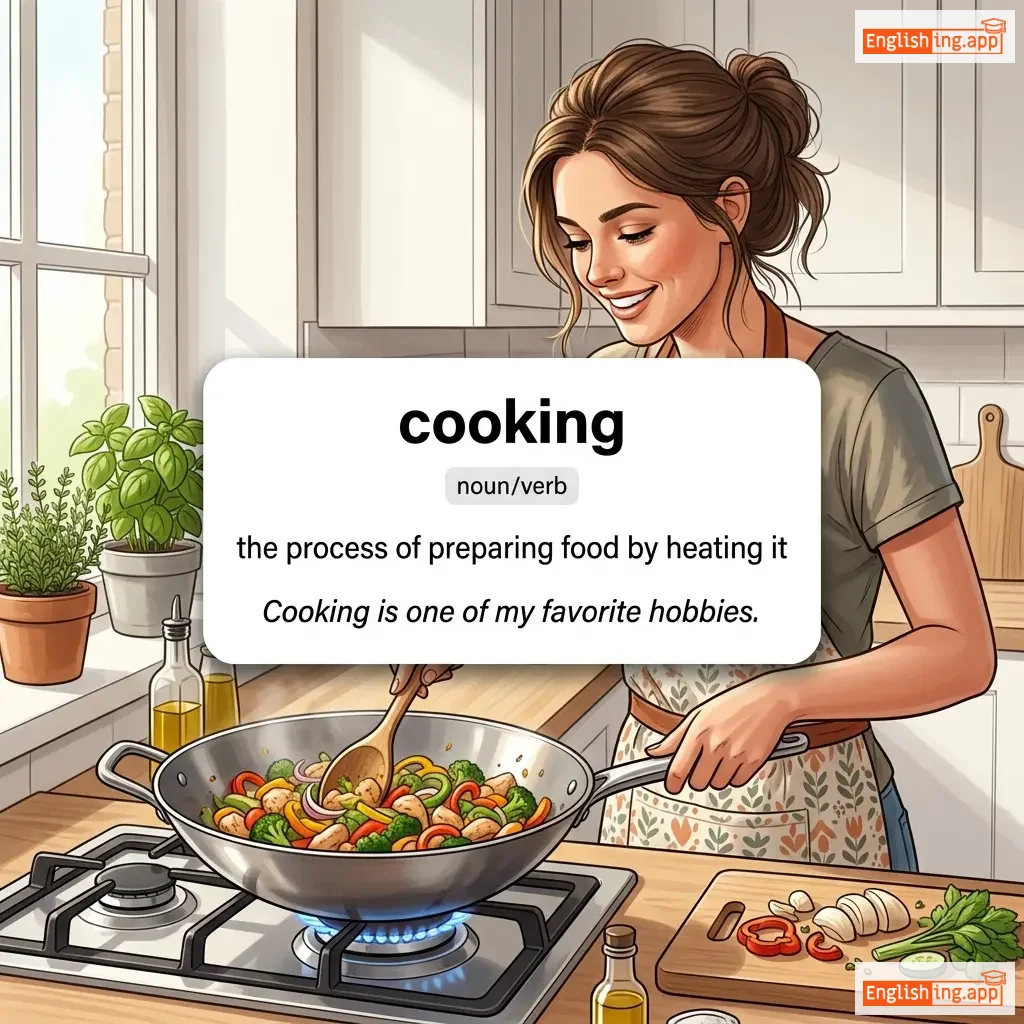
cooking definition card — visual illustration of the meaning
noun/verb
/ˈkʊkɪŋ/
cuisine (cuisine)

the process of preparing food by heating it

"Cooking is one of my favorite hobbies."

"La cuisine est l'un de mes passe-temps préférés." (La cuisine est l'un de mes passe-temps préférés.)
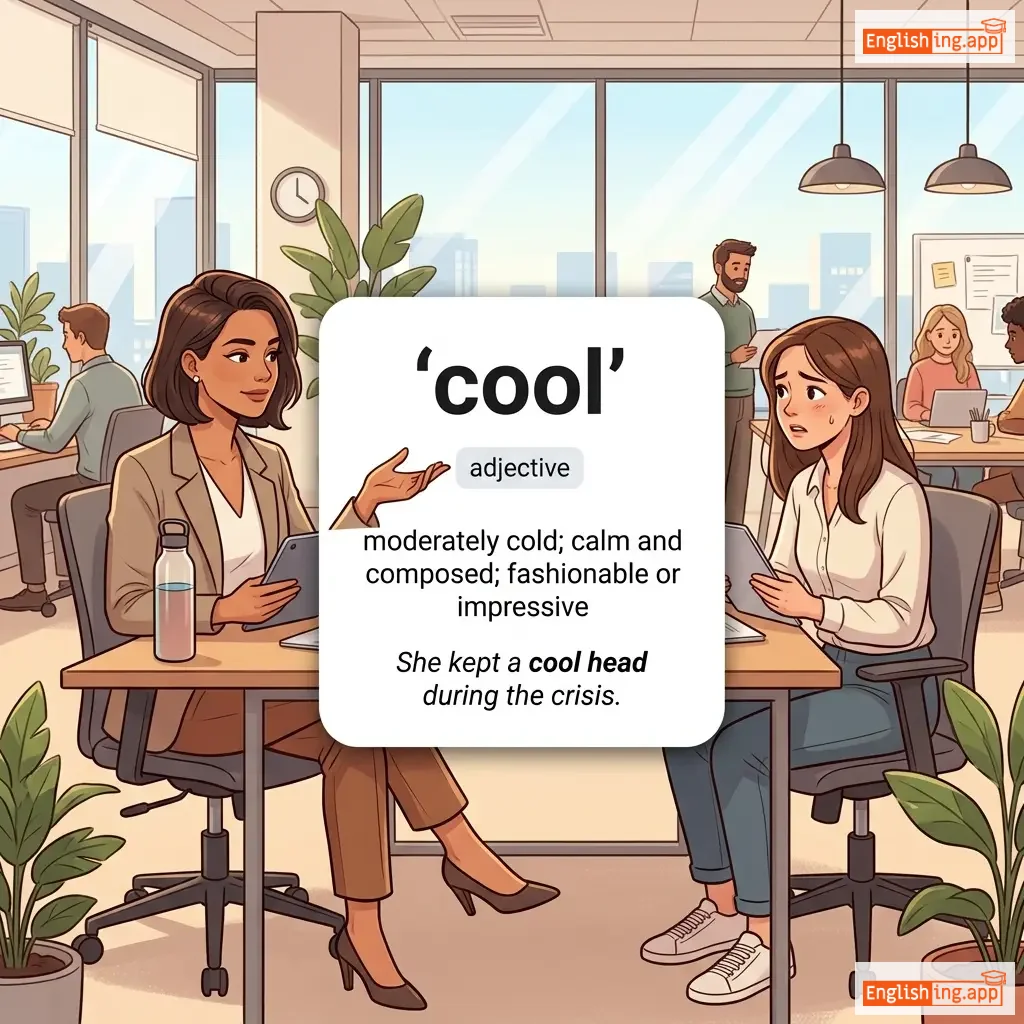
cool definition card — visual illustration of the meaning
adjective
/kuːl/
frais, calme, impressionnant (frais, calme, impressionnant)

moderately cold; calm and composed; fashionable or impressive

"She kept a cool head during the crisis."

"Elle a gardé son calme pendant la crise." (Elle a gardé son calme pendant la crise.)
noun
/ˈkuː.li/
coolie (coolie)

a laborer who does physical work for wages

"The cooly carried heavy bags at the railway station."

"Le coolie portait des sacs lourds à la gare." (Le coolie portait des sacs lourds à la gare.)
noun
/kuːp/
un petit enclos ou cage pour les poules ou autres oiseaux (un petit enclos ou cage pour les poules ou autres oiseaux)

a small enclosure or cage for chickens or other birds

"The farmer checked the chickens in the coop every morning."

"Le fermier vérifiait les poules dans le poulailler chaque matin." (Le fermier verifiait les poules dans le poulailler chaque matin.)
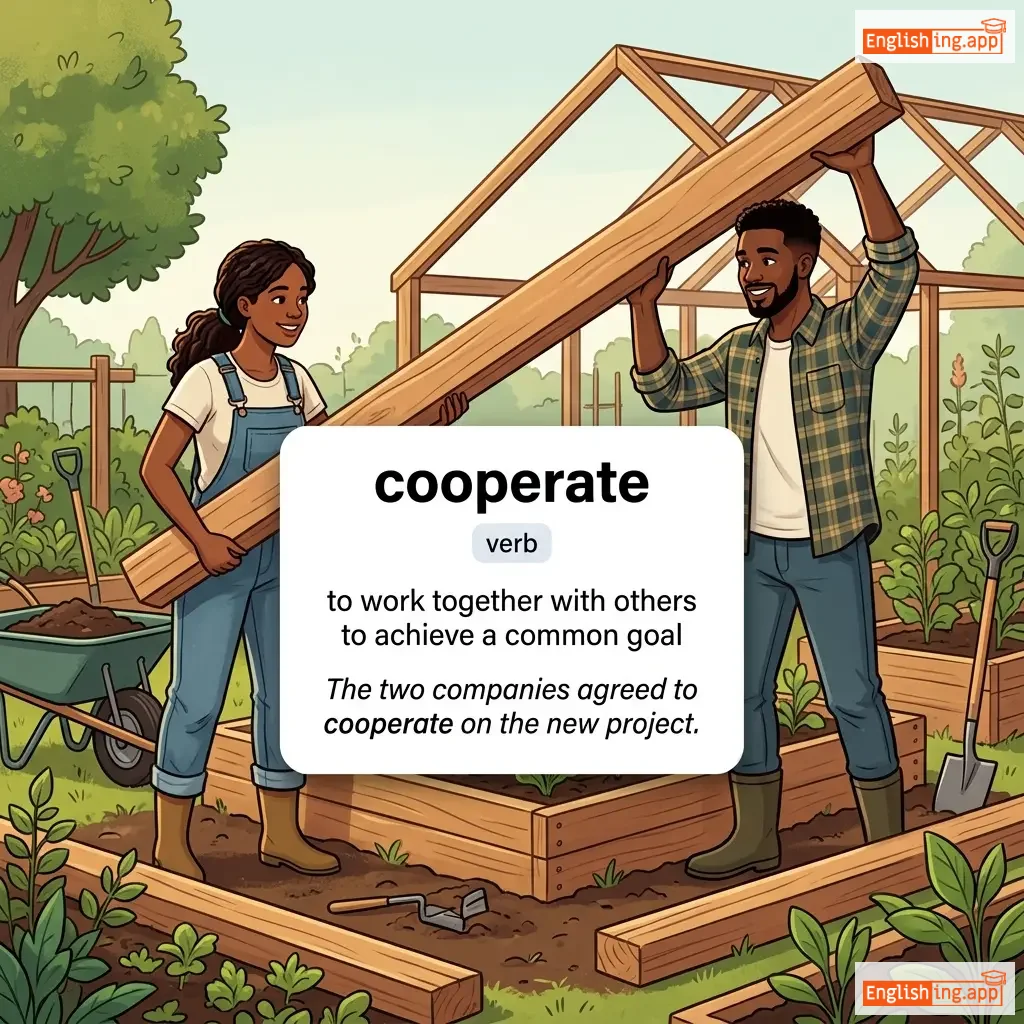
cooperate definition card — visual illustration of the meaning
verb
/kəʊˈɒpəreɪt/
coopérer (cooperer)

to work together with others to achieve a common goal

"The two companies agreed to cooperate on the new project."

"Les deux entreprises ont accepté de coopérer sur le nouveau projet." (Les deux entreprises ont accepté de coopérer sur le nouveau projet.)
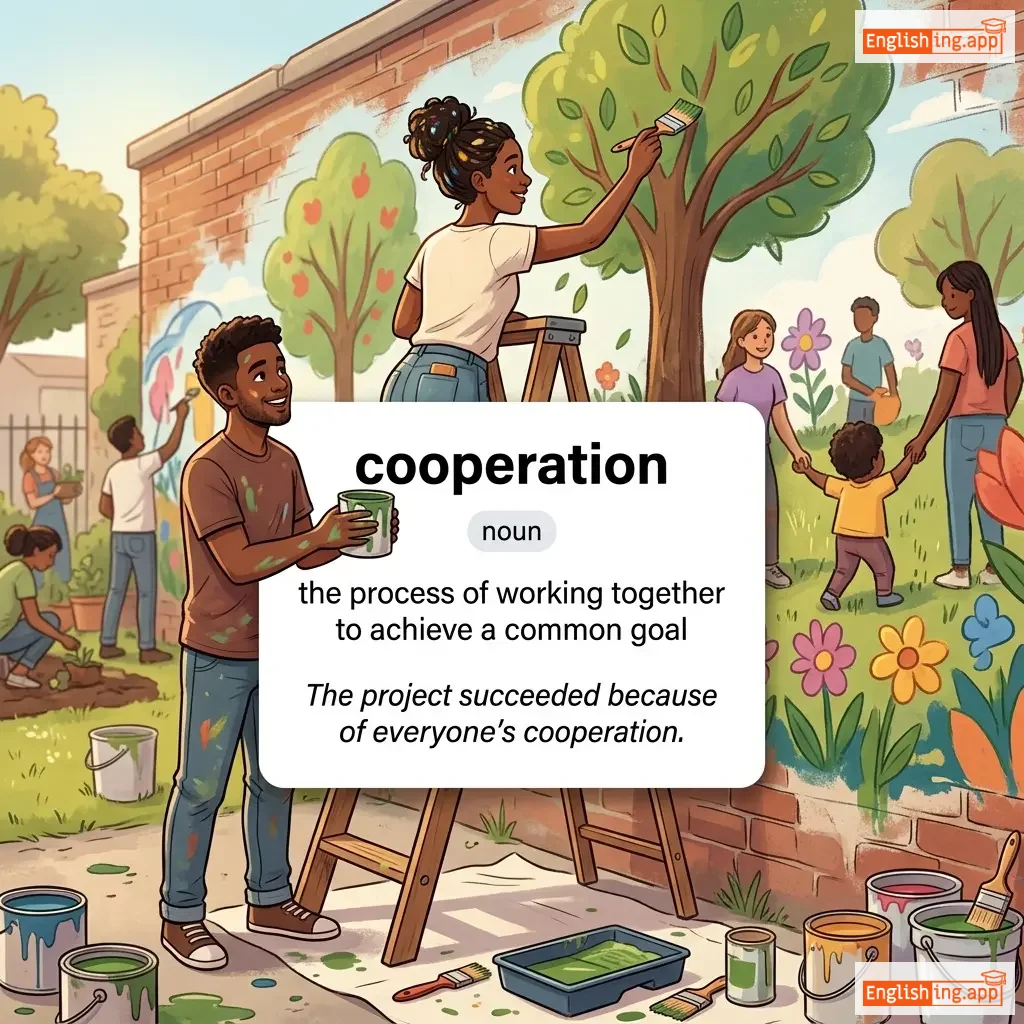
cooperation definition card — visual illustration of the meaning
noun
/koʊˌɒpəˈreɪʃn/
coopération (cooperation)

the process of working together to achieve a common goal

"The project succeeded because of everyone’s cooperation."

"Le projet a réussi grâce à la coopération de tous." (Le projet a reussi grace a la cooperation de tous.)