Vocabulaires

Découvrez, apprenez et maîtrisez le vocabulaire anglais

noun
/ˈtoʊ.pæz/
topaze (topaz)

a precious stone, typically colorless, yellow, or blue, used in jewelry

"The queen's crown was adorned with a magnificent blue topaz."

"La couronne de la reine était décorée d'un magnifique topaze bleu." (La couronne de la reine etait decoree d'un magnifique topaze bleu.)
noun
/tɒp/
sommet (somay)

the highest or uppermost point, part, or surface of something

"The book is on the top shelf."

"Le livre est sur l'étagère du haut." (Le livre est sur l'etagere du haut.)
noun
/tuːθ/
dent (dã)

each of the hard, pointed structures in the mouth used for biting and chewing food

"He has a toothache and needs to see the dentist."

"Il a mal aux dents et doit voir le dentiste." (Il a mal aux dents et doit voir le dentiste.)
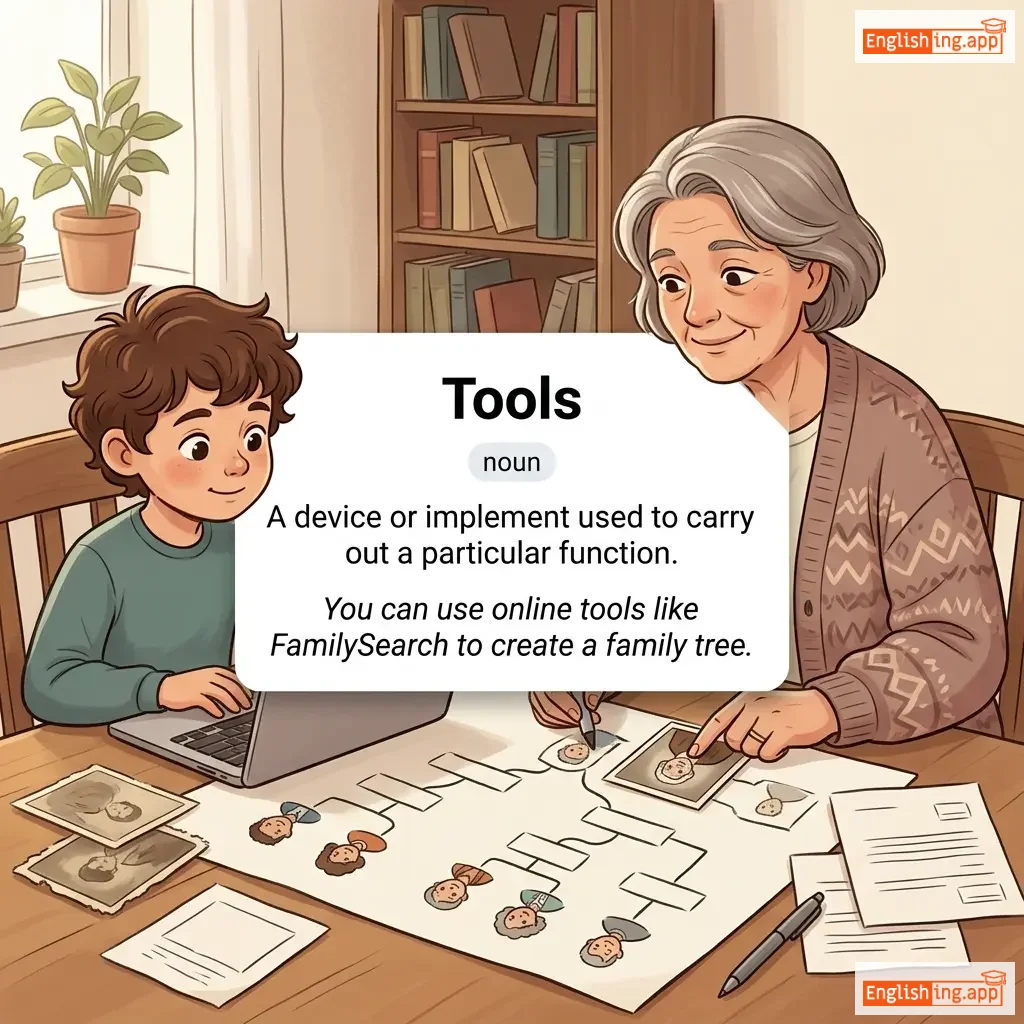
Tools definition card — visual illustration of the meaning
noun
tuːlz
outils (ootils)

A device or implement used to carry out a particular function.

"You can use online tools like FamilySearch to create a family tree."

"Vous pouvez utiliser des outils en ligne comme FamilySearch pour créer un arbre généalogique." (Vous pouvez utiliser des outils en ligne comme FamilySearch pour créer un arbre généalogique.)
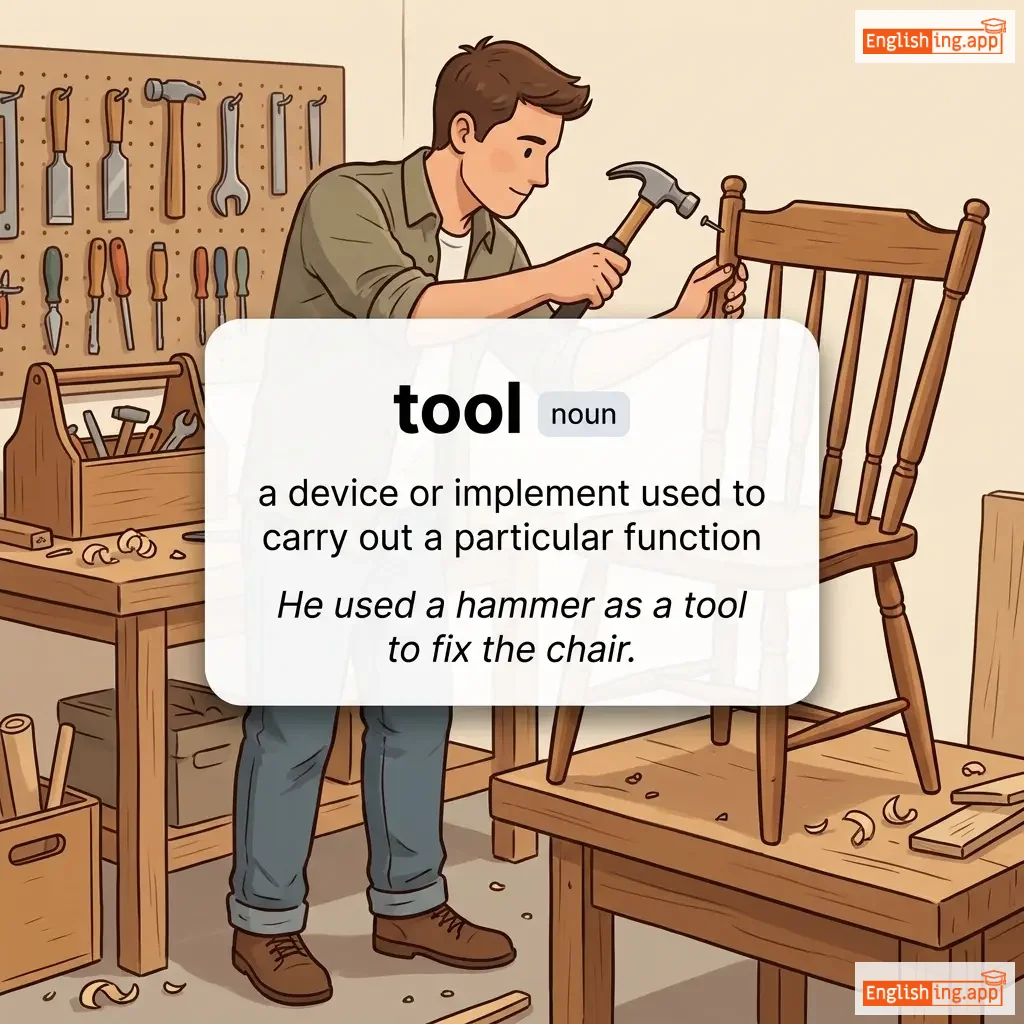
tool definition card — visual illustration of the meaning
noun
/tuːl/
outil (outil)

a device or implement used to carry out a particular function

"He used a hammer as a tool to fix the chair."

"Il a utilisé un marteau comme outil pour réparer la chaise." (Il a utilise un marteau comme outil pour reparer la chaise.)
adverb
/tuː/
trop (trop)

to a higher degree than is desirable, permissible, or possible

"She is too tired to continue working."

"Elle est trop fatiguée pour continuer à travailler." (Elle est trop fatiguée pour continuer à travailler.)
noun
/ˈtɒnʃər/
tonsure (tonsure)

the practice of shaving or cutting the hair on the scalp, especially in a religious context

"The monk received his tonsure as part of his religious initiation."

"Le moine a reçu sa tonsure dans le cadre de son initiation religieuse." (Le moine a recu sa tonsure dans le cadre de son initiation religieuse.)
adjective
/tɒnˈsɔːriəl/
relatif au barbier (relatif au barbier)

relating to barbers or hairdressing

"The town's new barber offered a wide range of tonsorial services."

"Le nouveau barbier de la ville a offert une large gamme de services tonsoriaux." (Le nouveau barbier de la ville a offert une large gamme de services tonsoriaux.)
adverb, noun
/təˈnaɪt/
ce soir (ce soir)

on or during the night of the current day

"We're going to the party tonight."

"Nous allons à la fête ce soir." (Nous allons à la fête ce soir.)
noun
/ˈtɒnɪk/
tonique (tonik)

a medicine or drink that restores or refreshes health and energy

"A glass of lemonade was the perfect tonic on a hot day."

"Un verre de limonade était le tonique parfait lors d'une chaude journée." (Un verre de limonade etait le tonique parfait lors d'une chaude journee.)
noun
/tʌŋ/
langue (langue)

a fleshy muscular organ in the mouth used for tasting, swallowing, and speaking

"She stuck out her tongue playfully."

"Elle sortit sa langue de manière ludique." (Elle sortit sa langue de maniere ludique.)
noun
/tɒŋz/
pince (pince)

a tool consisting of two movable arms that are joined at one end, used for picking up and holding things

"Use the tongs to pick up the hot pieces of meat from the grill."

"Utilisez les pinces pour ramasser les morceaux chauds de viande du grill." (Utilisez les pinces pour ramasser les morceaux chauds de viande du grill.)
noun
/tɒŋ/
pince (pince)

a tool with two movable arms used to pick up and hold objects

"He used the tong to pick up the hot coal."

"Il a utilisé la pince pour ramasser le charbon chaud." (Il a utilise la pince pour ramasser le charbon chaud.)
noun, verb
/toʊn/
ton (ton)

the general character or attitude of a place, piece of writing, situation, etc.

"The tone of the letter was very formal."

"Le ton de la lettre était très formel." (Le ton de la lettre etait tres formel.)
noun
/tʌn/
tonne (tonne)

A unit of weight equal to 2,000 pounds (US) or 1,000 kilograms (metric); a large amount of something

"The truck carried a ton of apples to the market."

"Le camion a transporté une tonne de pommes au marché." (Le camion a transporte une tonne de pommes au marche.)
noun, adverb
/təˈmɒroʊ/
demain (demain)

the day after today

"We are meeting tomorrow for the project discussion."

"Nous nous rencontrons demain pour discuter du projet." (Nous nous rencontrons demain pour discuter du projet.)
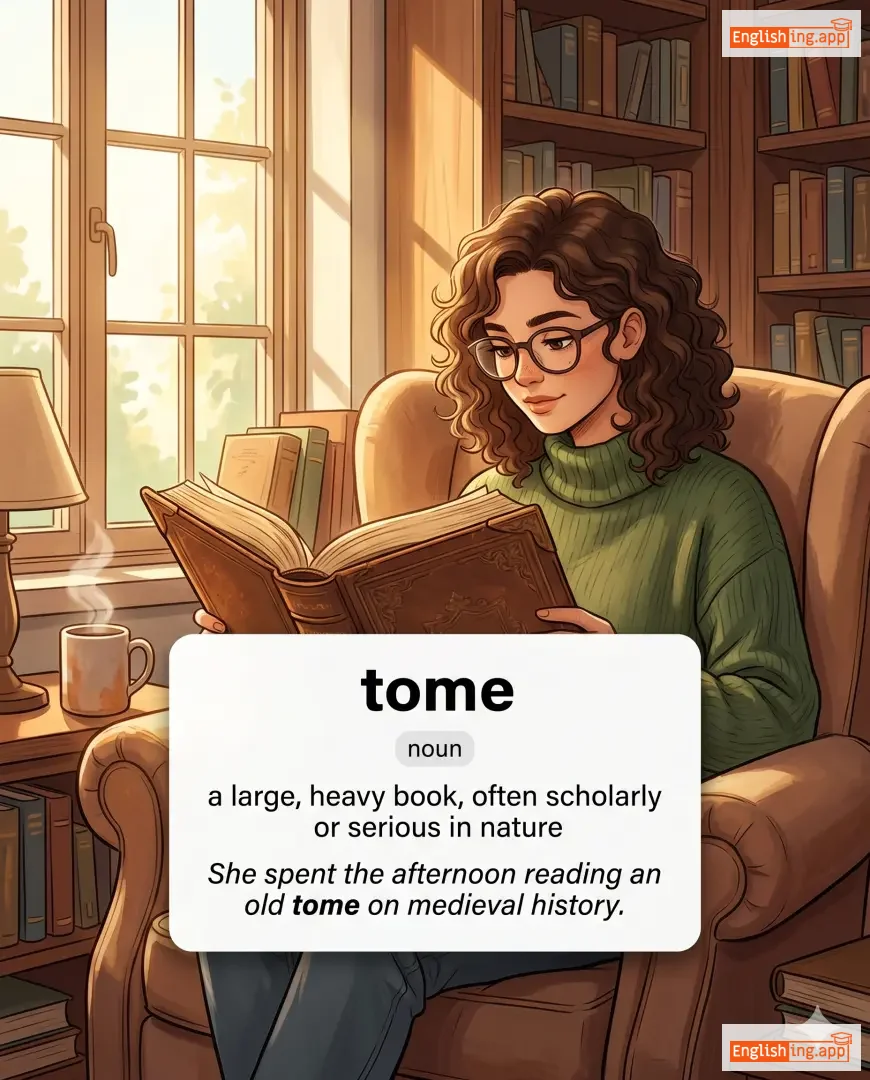
tome definition card — visual illustration of the meaning
noun
/toʊm/
gros livre (gro livre)

a large, heavy book, often scholarly or serious in nature

"She spent the afternoon reading an old tome on medieval history."

"Elle a passé l'après-midi à lire un vieux gros livre sur l'histoire médiévale." (Elle a passé l'après-midi à lire un vieux gros livre sur l'histoire médiévale.)
noun
/təˈmeɪtoʊ/
tomate (tomate)

a red or yellowish fruit that is typically eaten as a vegetable

"I added some tomato to the salad."

"J'ai ajouté un peu de tomate à la salade." (J'ai ajouté un peu de tomate à la salade.)
noun
/toʊl/
péage / dommage (peage / dommage)

A charge payable for using a road or bridge; also the extent of damage or suffering caused by something.

"The flood took a heavy toll on the village."

"L'inondation a causé un lourd dommage au village." (L'inondation a cause un lourd dommage au village.)
noun
/ˌtɒləˈreɪʃən/
tolérance (tolerance)

The practice of allowing something that one does not necessarily agree with.

"The government promoted religious toleration."

"Le gouvernement a promu la tolérance religieuse." (Le gouvernement a promu la tolérance religieuse.)
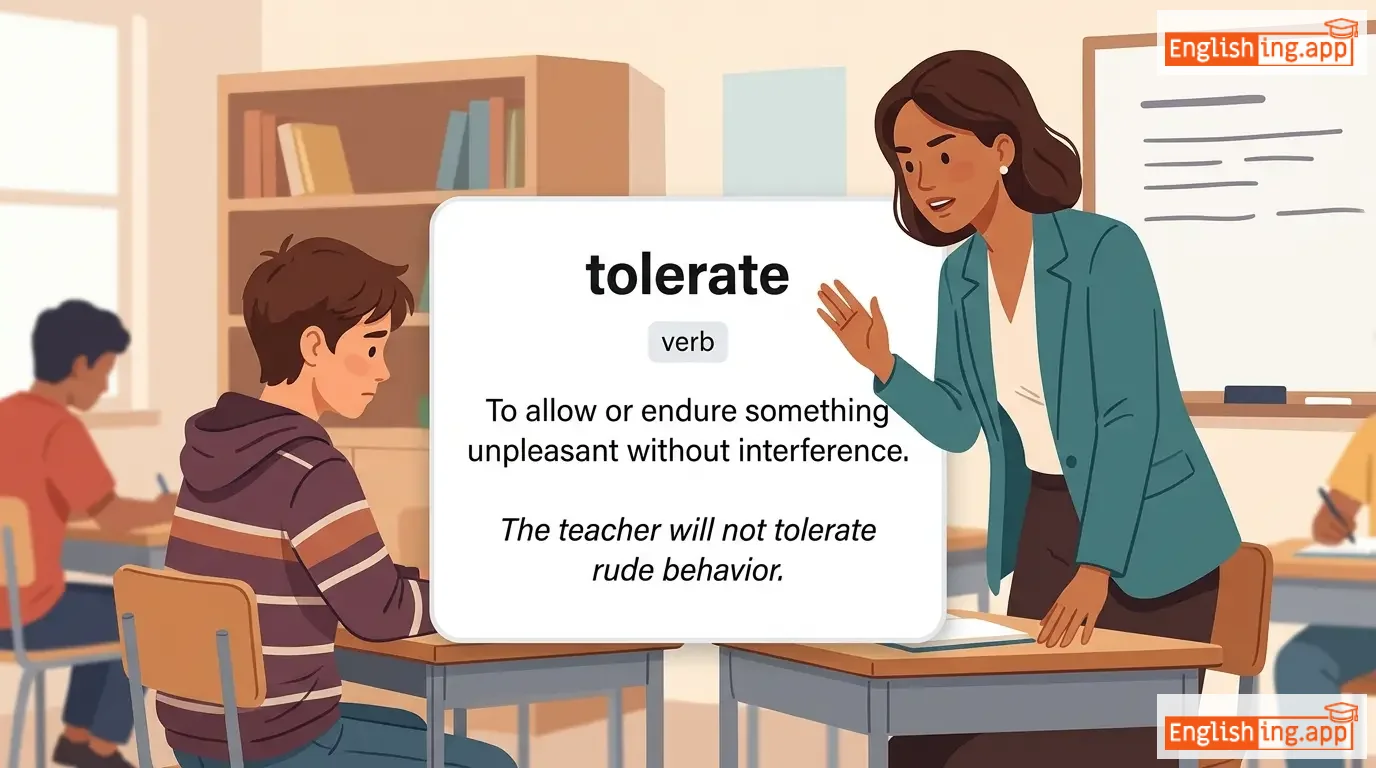
tolerate definition card — visual illustration of the meaning
verb
/ˈtɒləreɪt/
tolérer (tolérer)

To allow or endure something unpleasant without interference.

"The teacher will not tolerate rude behavior."

"L'enseignant ne tolérera pas un comportement grossier." (L'enseignant ne tolérera pas un comportement grossier.)
adjective
/ˈtɒlərənt/
tolérant (toleran)

Showing willingness to allow the existence of opinions or behaviors that one dislikes or disagrees with.

"He is very tolerant of other people's beliefs."

"Il est très tolérant envers les croyances des autres." (Il est tres tolerant envers les croyances des autres.)
noun
/ˈtɒlərəns/
tolérance (tolerance)

The ability or willingness to accept or endure differences, behaviors, or opinions without hostility.

"Her tolerance for different cultures impressed everyone."

"Sa tolérance envers les différentes cultures a impressionné tout le monde." (Sa tolerance envers les differentes cultures a impressionne tout le monde.)
adjective
/ˈtɒl.ər.ə.bəl/
tolérable (tolerable)

Able to be endured or put up with; fairly acceptable.

"The pain was tolerable after the medicine."

"La douleur était tolérable après le médicament." (La douleur était tolérable après le médicament.)
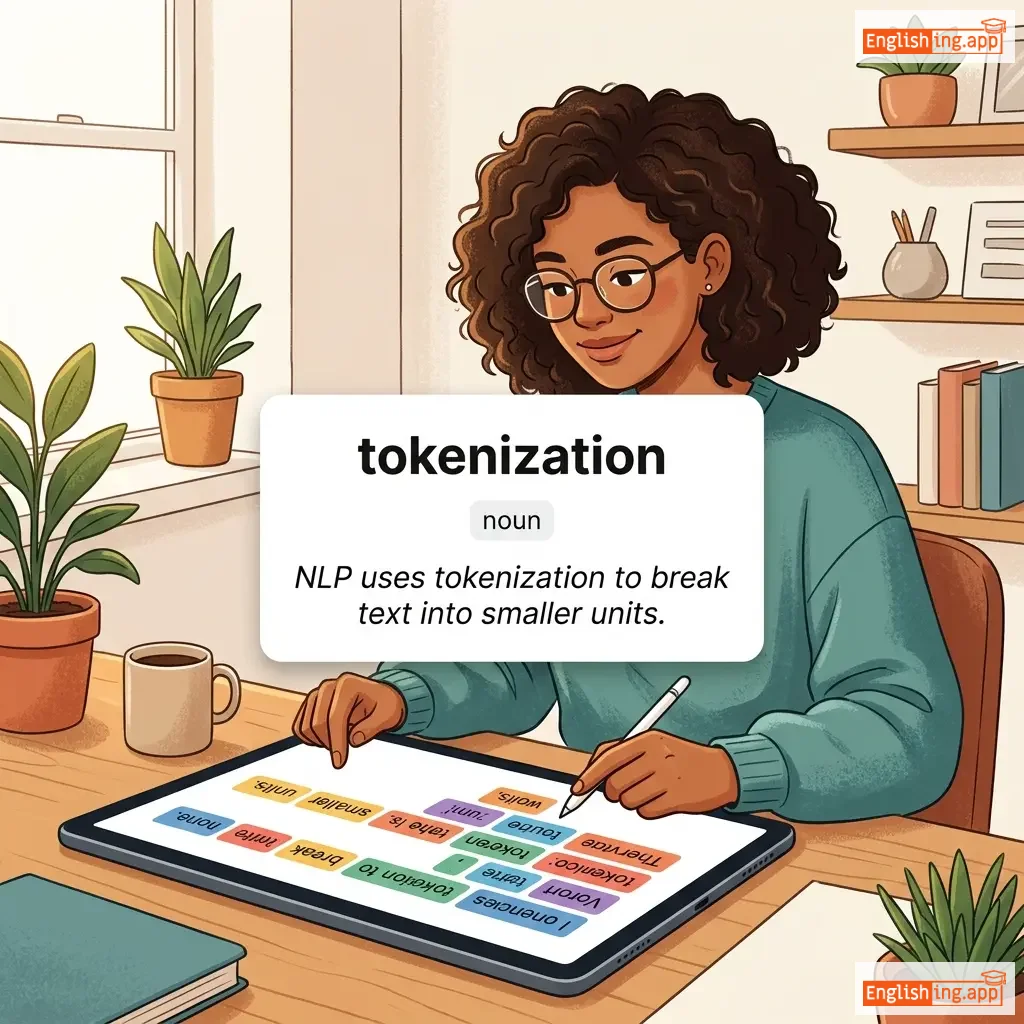
tokenization definition card — visual illustration of the meaning
noun
ˌtoʊ.kə.nɪˈzeɪ.ʃən
Le processus de diviser un texte en unités plus petites comme des mots, des phrases ou des symboles pour l'analyse. (tokenization)

The process of breaking text into smaller units like words, phrases, or symbols for analysis.

"NLP uses tokenization to break text into smaller units."

"NLP utilise la tokenisation pour diviser le texte en unités plus petites." (NLP utilise la tokenisation pour diviser le texte en unités plus petites.)
noun
/ˈtoʊ.kən/
symbole / jeton (symbole / jeton)

A symbol or object that represents something, often given as a sign of appreciation or as a substitute for money.

"She gave him a small gift as a token of gratitude."

"Elle lui a donné un petit cadeau comme un token de gratitude." (Elle lui a donne un petit cadeau comme un token de gratitude.)
adjective
/ˈtɔɪl.səm/
épuisant (epuisant)

Involving hard or exhausting work; laborious.

"The workers had a toilsome day in the hot sun."

"Les travailleurs ont eu une journée épuisante sous le soleil chaud." (Les travailleurs ont eu une journée épuisante sous le soleil chaud.)
noun
/ˈtɔɪlət/
toilette (toilette)

a fixture used for the disposal of human waste

"The public toilet was clean and well maintained."

"Les toilettes publiques étaient propres et bien entretenues." (Les toilettes publiques etaient propres et bien entretenues.)
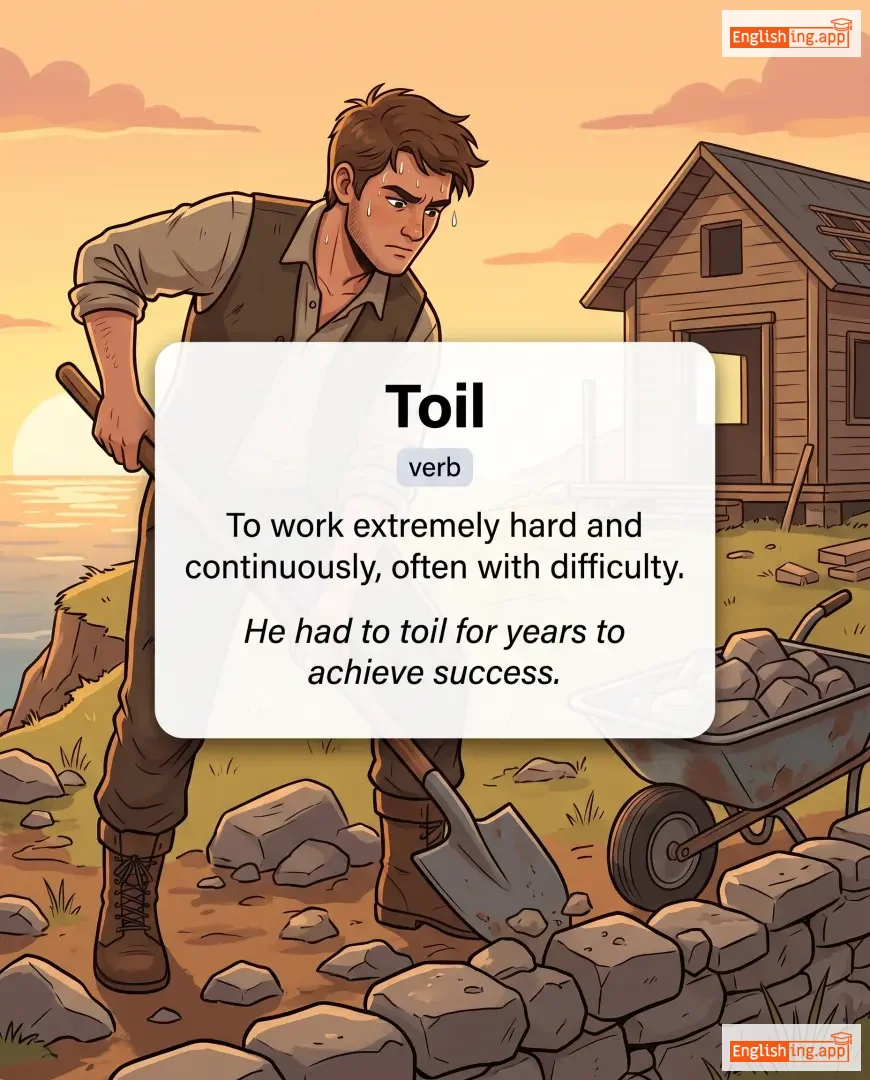
Toil definition card — visual illustration of the meaning
verb
/tɔɪl/
travailler dur (travailler dur)

To work extremely hard and continuously, often with difficulty.

"He had to toil for years to achieve success."

"Il a dû travailler dur pendant des années pour réussir." (Il a dû travailler dur pendant des années pour réussir.)
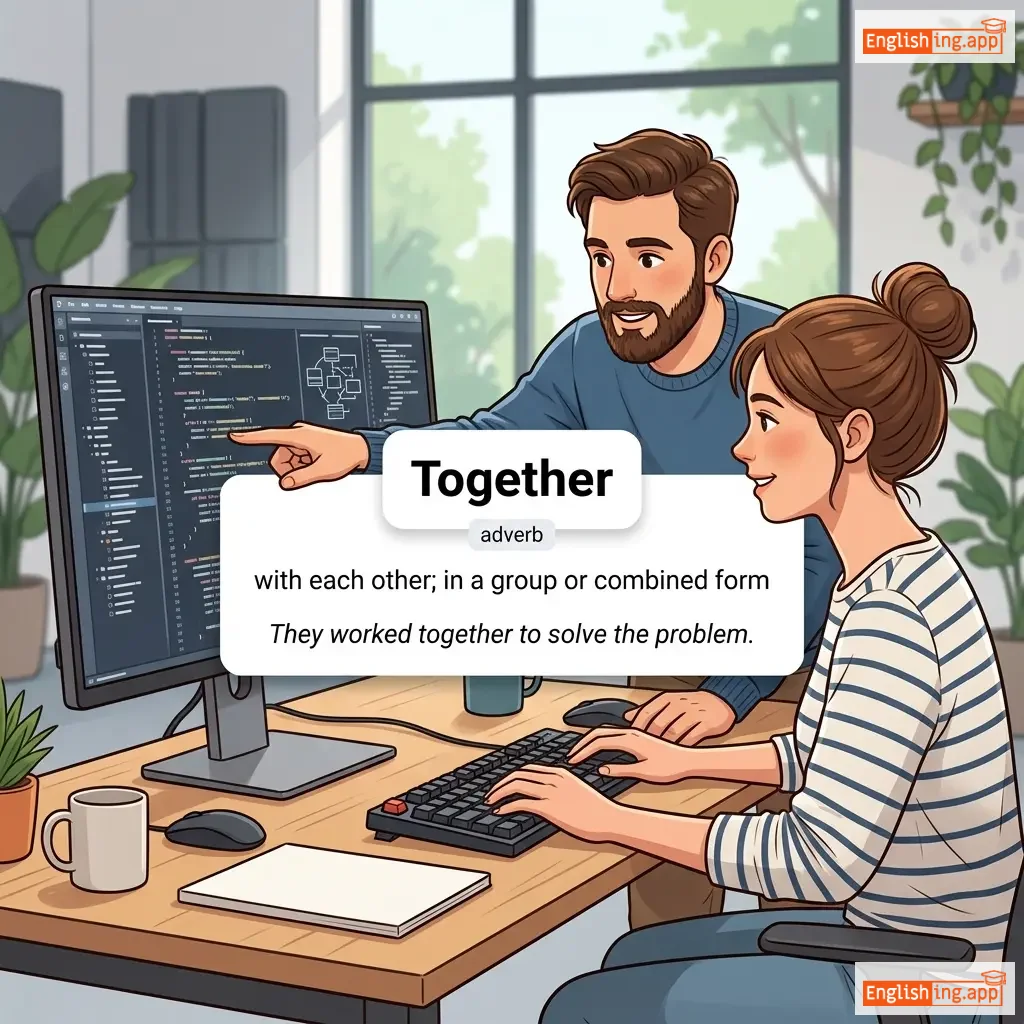
Together definition card — visual illustration of the meaning
adverb
/təˈɡɛðər/
ensemble (ensemble)

with each other; in a group or combined form

"They worked together to solve the problem."

"Ils ont travaillé ensemble pour résoudre le problème." (Ils ont travaillé ensemble pour résoudre le problème.)
adverb
/ðʌs/
ainsi (ainsi)

as a result or consequence of something previously stated

"He was late, thus he missed the meeting."

"Il est arrivé en retard, ainsi il a manqué la réunion." (Il est arrive en retard, ainsi il a manque la reunion.)
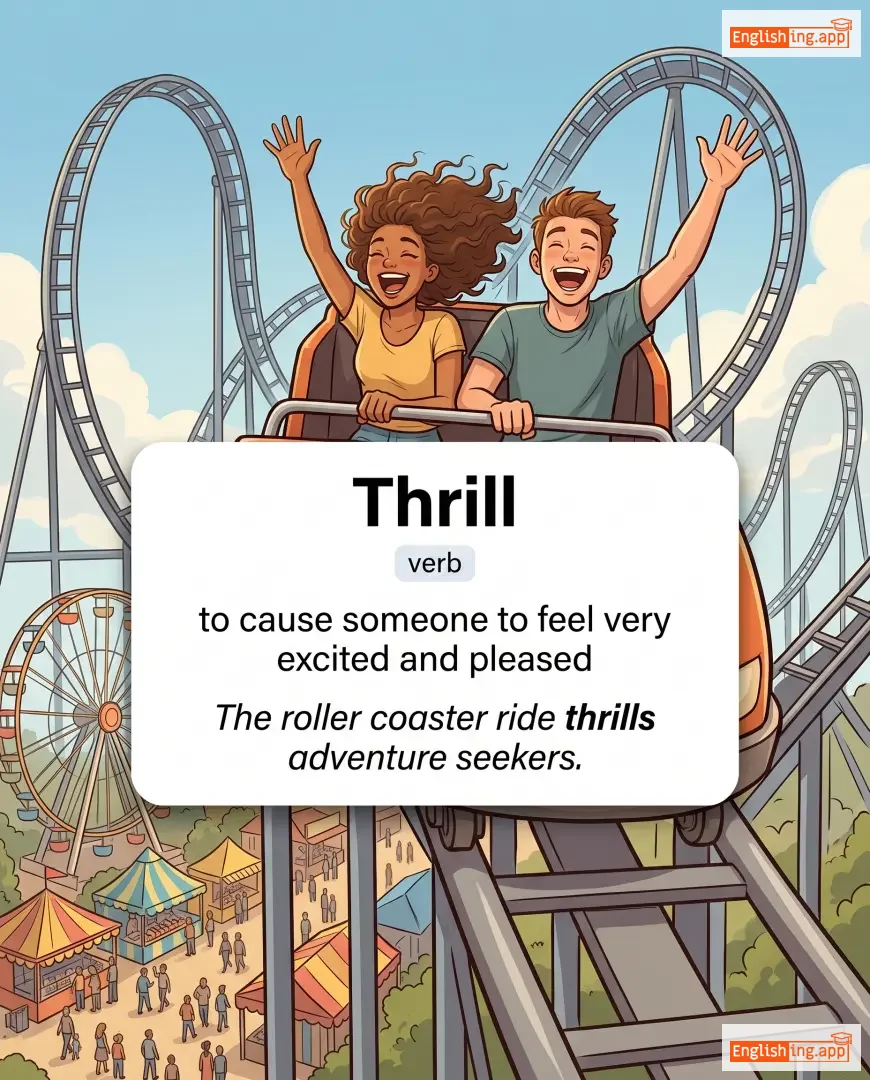
Thrill definition card — visual illustration of the meaning
verb
/θrɪl/
exciter (exciter)

to cause someone to feel very excited and pleased

"The roller coaster ride thrills adventure seekers."

"Les montagnes russes excitent les amateurs d'aventure." (Les montagnes russes excitent les amateurs d'aventure.)
adjective
/θrɪld/
ravi (ravi)

extremely happy or excited

"She was thrilled with the surprise party."

"Elle était ravie de la fête surprise." (Elle était ravie de la fête surprise.)
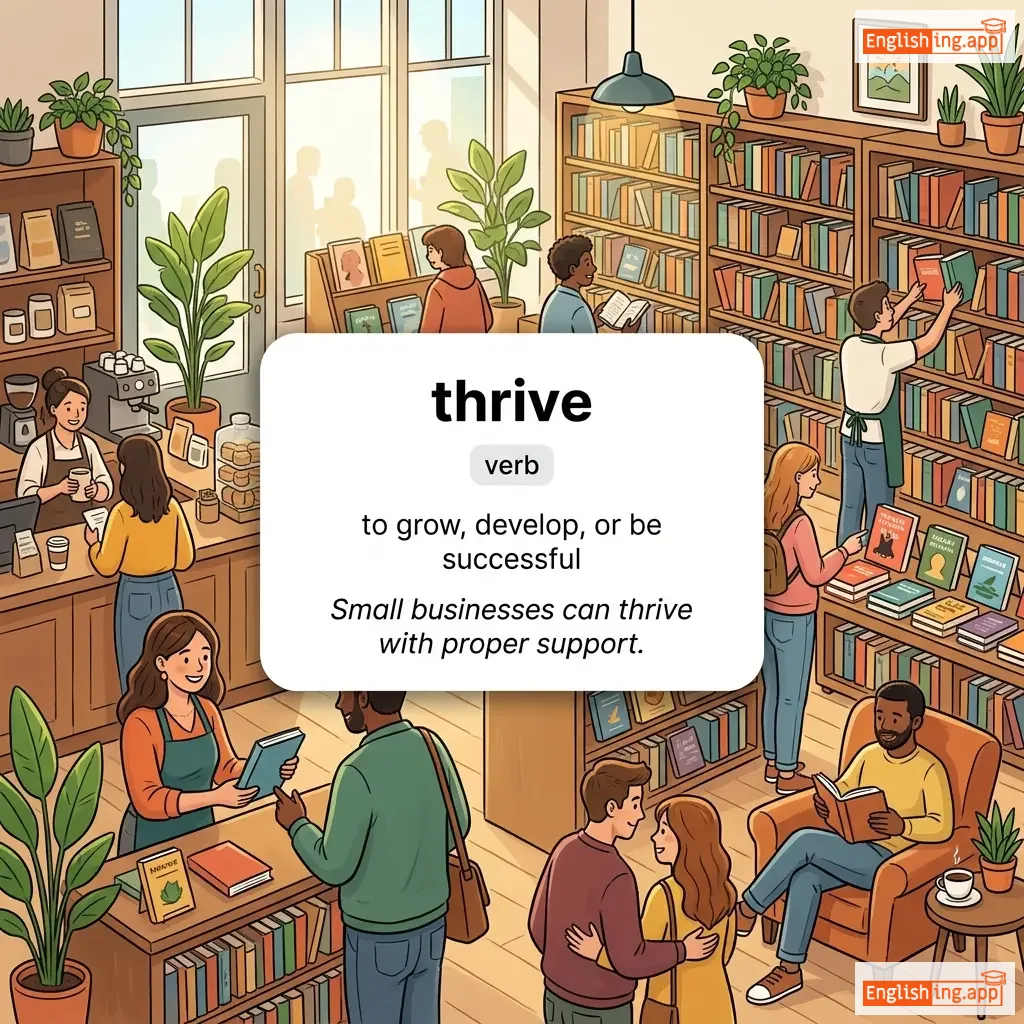
thrive definition card — visual illustration of the meaning
verb
/θraɪv/
prospérer (prosperer)

to grow, develop, or be successful

"Small businesses can thrive with proper support."

"Les petites entreprises peuvent prospérer avec un soutien approprié." (Les petites entreprises peuvent prosperer avec un soutien approprie.)
noun
/θroʊt/
gorge (gorge)

the front part of the neck, containing the pharynx and larynx

"He felt a lump in his throat while speaking."

"Il a ressenti une boule dans sa gorge en parlant." (Il a ressenti une boule dans sa gorge en parlant.)
verb
/θrɒb/
battre (battre)

to beat or pulse strongly, often with pain

"His head began to throb after the long day."

"Sa tête a commencé à battre après la longue journée." (Sa tête a commencé à battre après la longue journée.)
noun
/θroʊz/
agonie intense (agonie intense)

intense or violent pain and struggle, often at the beginning or end of something

"The country was in the throes of a political crisis."

"Le pays était dans l'agonie intense d'une crise politique." (Le pays était dans l'agonie intense d'une crise politique.)
noun/verb
/θrɒŋ/
foule (foule)

A large, densely packed crowd of people or animals; to fill or be present in a place in large numbers.

"Tourists thronged the streets during the festival."

"Les touristes ont envahi les rues pendant le festival." (Les touristes ont envahi les rues pendant le festival.)
verb/noun
/ˈθrɒt.əl/
étrangler/contrôler la vitesse (etrangler/controle vitesse)

To choke or strangle; to control the flow of fuel or power in an engine.

"The driver throttled the engine to slow down the car."

"Le conducteur a ralenti la voiture en réduisant la puissance du moteur." (Le conducteur a ralenti la voiture en réduisant la puissance du moteur.)
preposition
/θruː/
à travers de (a travers de)

moving in one side and out the other side of something

"The train passed through the tunnel."

"Le train est passé à travers le tunnel." (Le train est passe a travers le tunnel.)
preposition
/θruːˈaʊt/
tout au long (tou o lon)

in every part of a place or during the whole time of an event

"She worked throughout the night."

"Elle a travaillé toute la nuit." (Elle a travaillé toute la nuit.)
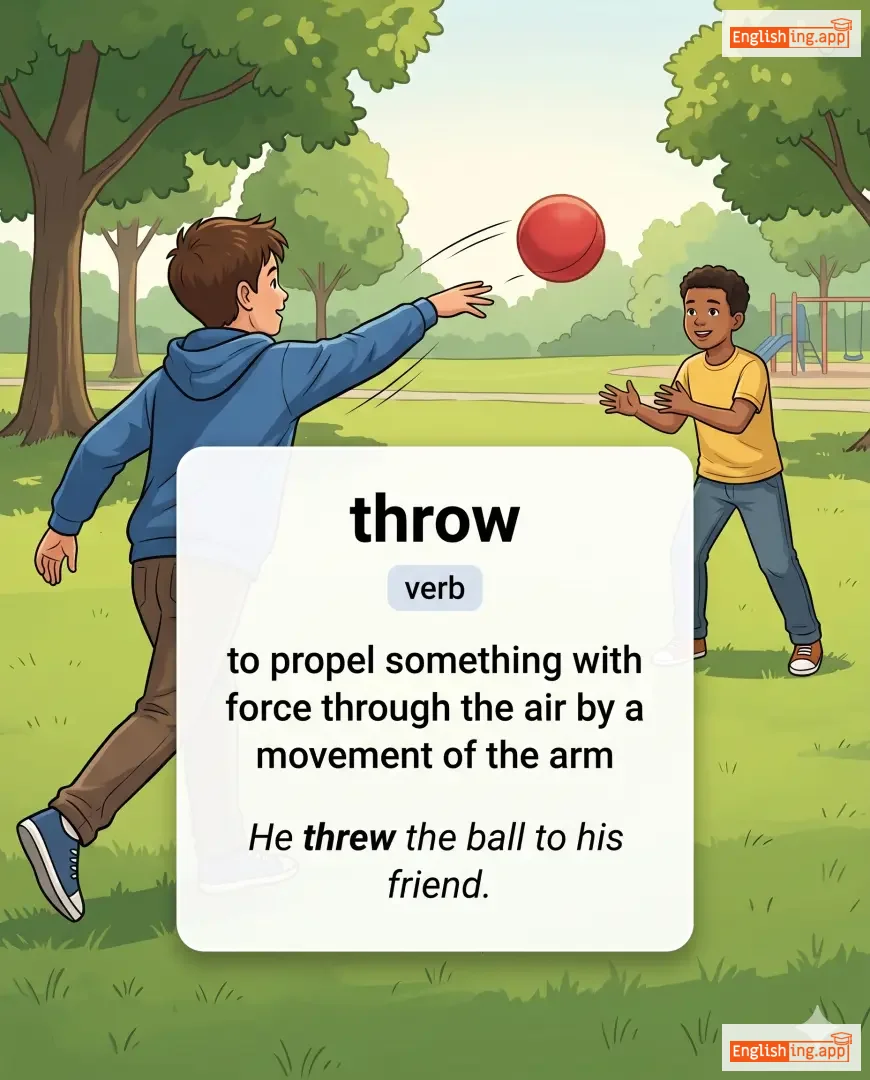
throw definition card — visual illustration of the meaning
verb
/θroʊ/
lancer (lancer)

to propel something with force through the air by a movement of the arm

"He threw the ball to his friend."

"Il a lancé la balle à son ami." (Il a lancé la balle à son ami.)
noun
/θʌm/
pouce (pous)

the short, thick finger on the side of the hand, used for gripping and holding things

"He gave a thumbs-up to show his approval."

"Il a levé son pouce pour montrer son approbation." (Il a levé son pouce pour montrer son approbation.)
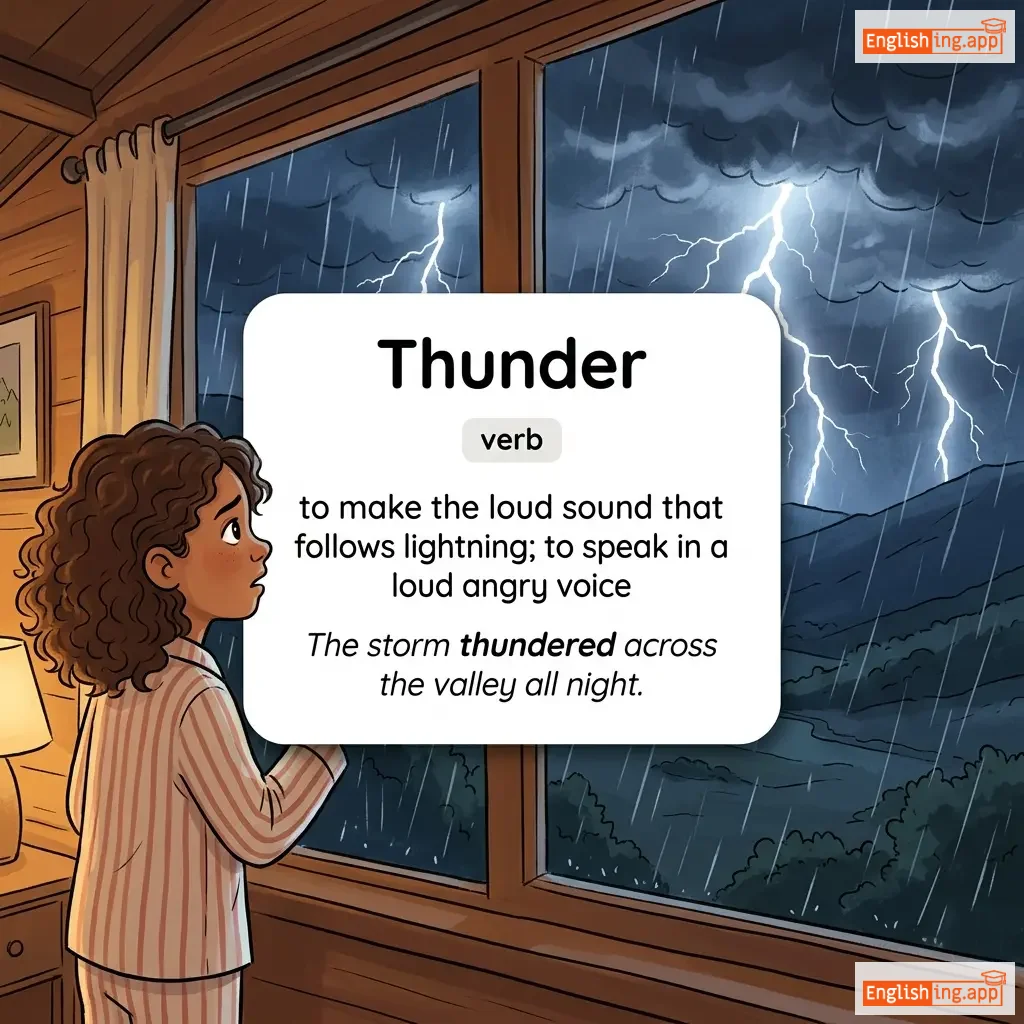
Thunder definition card — visual illustration of the meaning
noun
/ˈθʌn.dər/
tonnerre (tonnerre)

the loud rumbling or crashing noise heard after a lightning flash

"We heard thunder during the storm last night."

"Nous avons entendu le tonnerre pendant la tempête de la nuit dernière." (Nous avons entendu le tonnerre pendant la tempete de la nuit derniere.)
noun
/ˈθɜːrzdeɪ/
jeudi (jeudi)

The fifth day of the week, following Wednesday and preceding Friday.

"We have a meeting scheduled for Thursday."

"Nous avons une réunion prévue jeudi." (Nous avons une reunion prevue jeudi.)
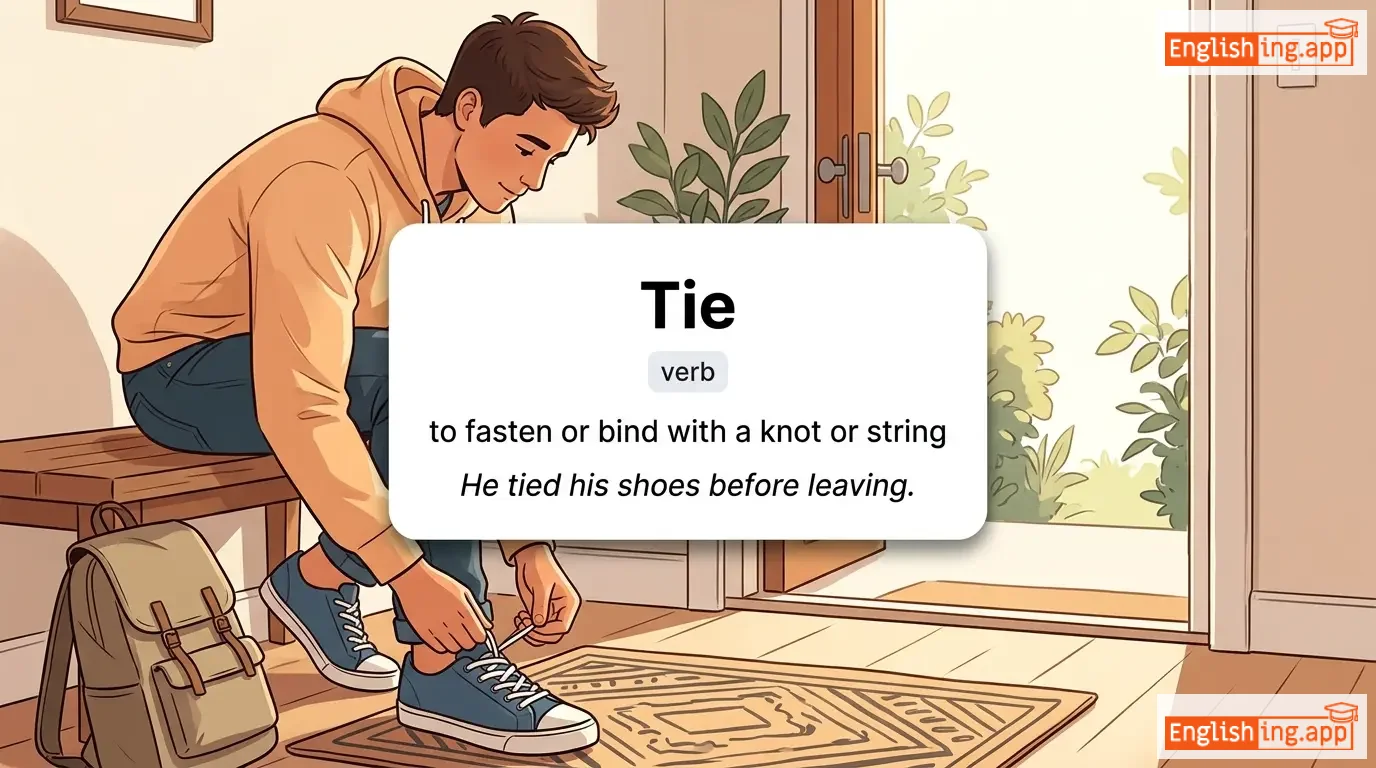
Tie definition card — visual illustration of the meaning
verb
/taɪ/
attacher (attacher)

to fasten or bind with a knot or string

"He tied his shoes before leaving."

"il a attaché ses chaussures avant de partir." (il a attaché ses chaussures avant de partir.)
adjective
/ˈtɪd.li/
légèrement ivre; petit ou minuscule (tiddli)

slightly drunk; small or tiny

"After a few drinks, he felt a bit tiddley."

"Après quelques verres, il se sentit un peu tiddley." (Apres quelques verres, il se sentit un peu tiddley.)
noun
/taɪd/
marée (maree)

the regular rise and fall of the sea caused by the moon and sun's gravity; a powerful flow or movement

"The fisherman waited for the tide to come in."

"Le pêcheur attendait que la marée monte." (Le pecheur attendait que la maree monte.)
adjective
/ˈtaɪ.di/
ordonné; propre (ordonne; propre)

arranged neatly and in order; clean and organized

"She keeps her room very tidy and organized."

"Elle garde sa chambre très ordonnée et propre." (Elle garde sa chambre très ordonnée et propre.)
adjective
/ˈtɪklɪʃ/
chatouilleuse, sensible (chatouilleuse, sensible)

easily made to laugh by being touched lightly; easily upset or sensitive

"She is very ticklish and bursts into laughter when touched on her feet."

"Elle est très chatouilleuse et éclate de rire lorsqu'on lui touche les pieds." (Elle est très chatouilleuse et éclate de rire lorsqu'on lui touche les pieds.)