語彙集

英単語辞書 | 単語の意味、定義、例文

noun
/ˈdɛskænt/
追加メロディー (tsuika merodī)

An additional melody or counterpoint sung or played above the main melody.

"The choir added a beautiful descant to the hymn."

"合唱団は賛美歌に美しい追加メロディーを加えました。" (Gasshōdan wa sanbika ni utsukushī tsuika merodī o kuwaemashita.)
⬇️

descend

verb
/dɪˈsɛnd/

To move or fall downward; to come or go down from a higher place.

"The hikers descended the steep mountain path."

noun
/dɪˈsɛndənt/
子孫 (shison)

A person who is descended from a particular ancestor.

"She is a descendant of a famous poet."

"彼女は有名な詩人の子孫です。" (Kanojo wa yūmei na shijin no shison desu.)
adjective
/dɪˈsɛndənt/
下降する (kōka suru)

Moving downward; going down or descending.

"The river followed a descendent course toward the valley."

"川は谷に向かって下降するコースをたどった。" (Kawa wa tani ni mukatte kōka suru kōsu o tadotta.)
noun
/dɪˈsɛnt/
降下 / 祖先 (kōka / sosen)

the action of moving downward, falling, or dropping; ancestry or origin

"The climbers began their descent from the mountain peak."

"登山者は山頂から降下を始めました。" (Tōzansha wa sanchō kara kōka o hajimemashita.)
verb
/dɪˈskraɪb/
説明する (setsumei suru)

to give an account of something in words, including details

"She described the scene vividly."
"彼女はそのシーンを鮮明に説明した。" (Kanojo wa sono shīn o senmei ni setsumei shita.)
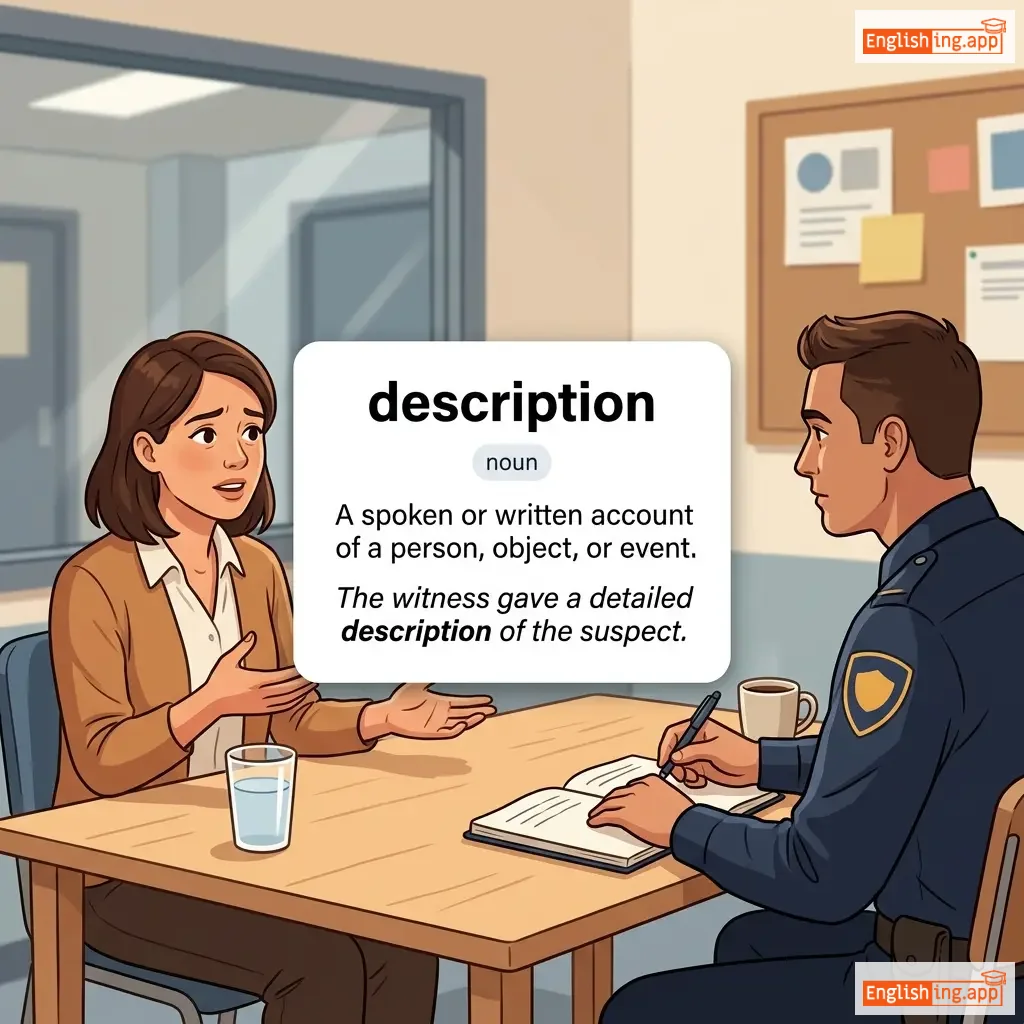
description definition card — visual illustration of the meaning
noun
/dɪˈskrɪpʃən/
説明 (setsumei)

A spoken or written account of a person, object, or event.

"The witness gave a detailed description of the suspect."

"証人は容疑者の詳細な説明をしました。" (Shōnin wa yōgisha no shōsai na setsumei o shimashita.)
verb
/dɪˈskraɪ/
遠くで見る (tōku de miru)

to catch sight of something, especially something distant or obscure

"From the hilltop, they descried a small village in the distance."

"丘の頂上から、彼らは遠くの小さな村を見た。" (Oka no chōjō kara, karera wa tōku no chiisana mura o mita.)
verb
/ˈdɛsɪkreɪt/
冒涜する (bōtoku suru)

to treat a sacred place or object with disrespect or violation

"The vandals desecrated the ancient temple walls with graffiti."
"ヴァンダルたちは古代の寺院の壁をグラフィティで冒涜しました。" (Vandaru-tachi wa kodai no jiin no kabe o gurafiti de bōtoku shimashita.)
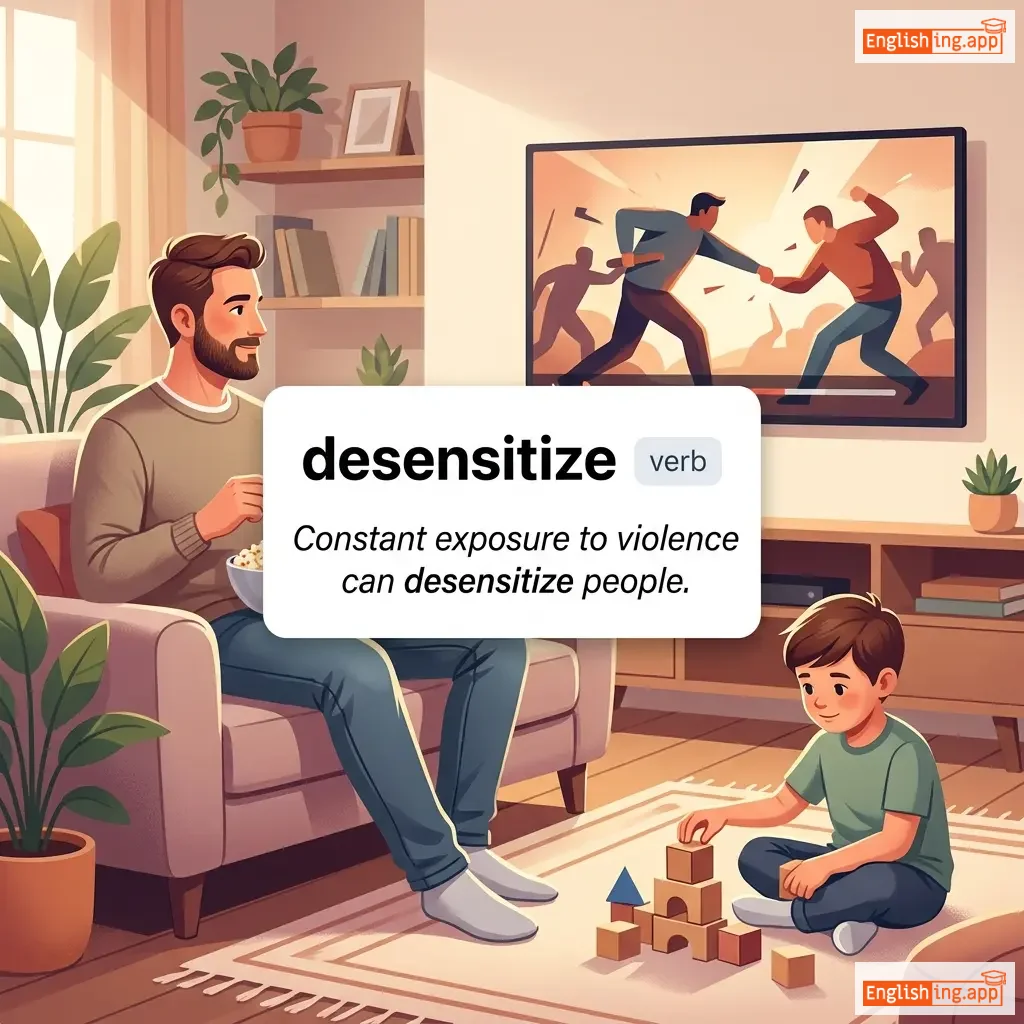
desensitize definition card — visual illustration of the meaning
verb
diːˈsɛn.sɪ.taɪz
脱感作 (datsukansaku)

To make someone less sensitive or reactive to something through repeated exposure.

"Constant exposure to violence can desensitize people."

"継続的な暴力の露出は人々を鈍感にする可能性があります。" (Keizokuteki na bouryoku no rokutsu wa hitobito o donkan ni suru kanousei ga arimasu.)
🏜️

Desert

noun, verb
/ˈdez.ɚt/ (noun/adjective), /dɪˈzɜːrt/ (verb)

as a noun, a barren sandy region; as a verb, to abandon someone or something

"He deserted his friends in their time of need."

adjective
/dɪˈzɜːrtɪd/
人がいない (hito ga inai)

Empty of people; abandoned.

"The village looked completely deserted after the storm."
"嵐の後、その村は完全に人がいないように見えた。" (Arashi no ato, sono mura wa kanzen ni hito ga inai you ni mieta.)
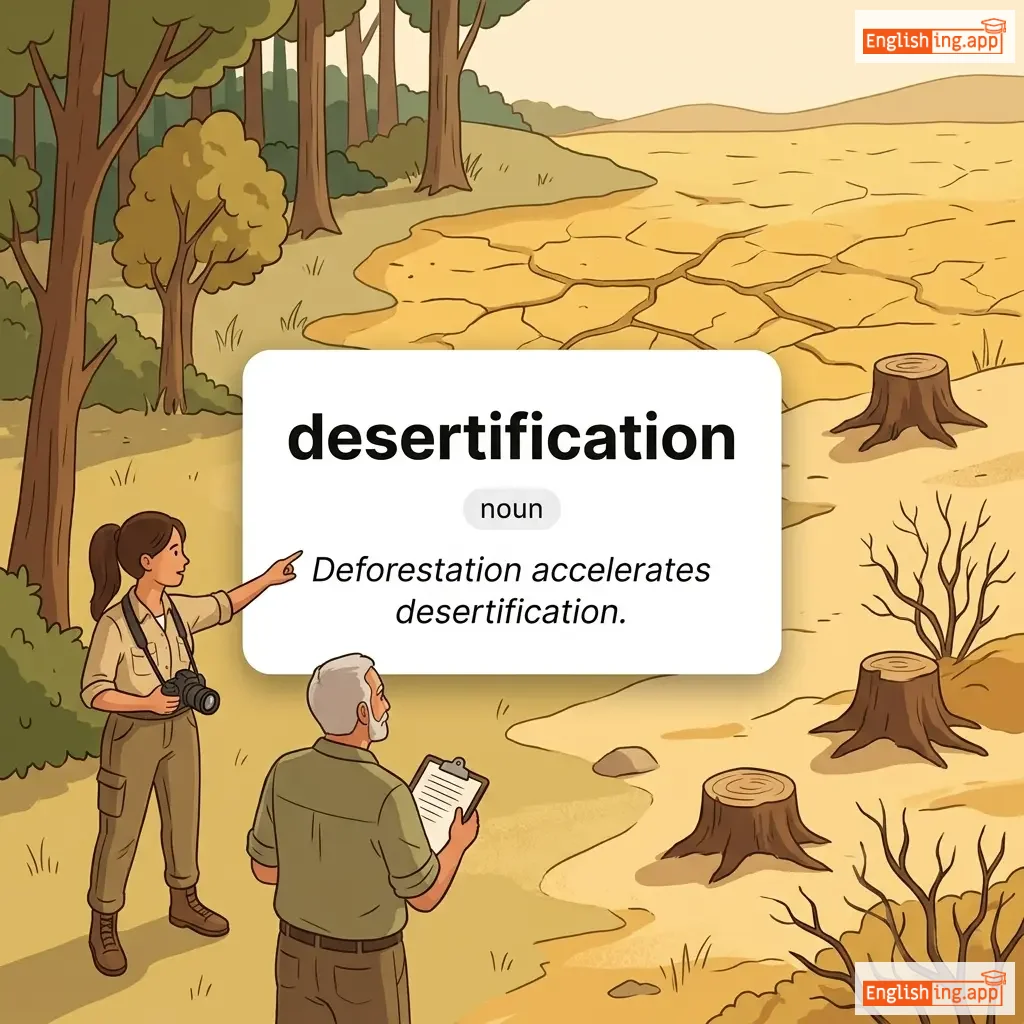
desertification definition card — visual illustration of the meaning
noun
dɪˌzɝː.t̬ə.fɪˈkeɪ.ʃən
砂漠化 (sabaku ka)

The process by which fertile land becomes desert, typically as a result of drought, deforestation, or inappropriate agriculture.

"Deforestation accelerates desertification."

"森林伐採は砂漠化を加速させます。" (Shinrin bassai wa sabaku ka wo kasoku sasemasu.)
noun
/dɪˈzɜːrts/ (noun: reward or punishment deserved)
誰かが得るべきもの、特に罰や報酬 (dareka ga eru beki mono, tokuni batsu ya hoshū)

what someone deserves, especially punishment or reward

"He finally got his just deserts for cheating in the exam."

"彼は試験でカンニングをして、ついに自分の正当な報いを受けました。" (kare wa shiken de kanningu o shite, tsuini jibun no seitō na mukui o ukemashita.)
verb
/dɪˈzɜːrv/
値する (kesuru)

To be worthy of something, usually a reward or punishment.

"She worked hard and deserves recognition."

"彼女は一生懸命働き、認められる価値がある。" (Kanojo wa isshōkenmei hataraki, mitomerareru kachi ga aru.)
noun
/ˈdɛsɪkənt/
乾燥剤 (kansōzai)

a substance that absorbs moisture and keeps things dry

"Silica gel packets are commonly used as a desiccant in packaging."

"シリカゲルのパケットは、パッケージングで乾燥剤として一般的に使用されます。" (Shirika gero no paketto wa, pakkējingu de kansōzai toshite ippanteki ni shiyō saremasu.)
desiccate definition card — visual illustration of the meaning
verb
/ˈdɛsɪkeɪt/
乾燥させる (kansou saseru)

to dry up completely or remove the moisture from something

"The hot sun can quickly desiccate plants in the desert."

"暑い太陽は砂漠の植物をすぐに乾燥させることができます。" (Atsui taiyō wa sabaku no shokubutsu o sugu ni kansō saseru koto ga dekimasu.)
adjective
/ˈdɛsɪkeɪtɪd/
乾燥した (kansō shita)

completely dried, having had all moisture removed

"The museum displayed desiccated specimens of plants."

"博物館は乾燥した植物標本を展示した。" (Hakubutsukan wa kansō shita shokubutsu hyōhon o tenji shita.)
noun
/dɪˌsɪdəˈreɪtəm/
必要な物 (hitsuyou na mono)

something that is desired or considered necessary

"For many students, financial aid is a desideratum."

"多くの学生にとって、経済援助は必要な物です。" (Ookuno gakusei ni totte, keizai enjo wa hitsuyou na mono desu.)
verb
/dɪˈzaɪn/

to plan and create something with a particular purpose or look

"She will design the new company logo."

verb
/ˈdɛzɪɡneɪt/
指名する (shimei suru)

to officially assign, appoint, or indicate something or someone

"The committee will designate a new chairperson next week."

"委員会は来週、新しい会長を指名する予定です。" (Iinkai wa raishū, atarashī kaichō o shimei suru yotei desu.)
noun
/ˌdez.ɪɡˈneɪ.ʃən/
任命; 役職; 職位; ステータス (ninmei, yakushoku, shokui, suteetasu)

the action of choosing someone for a position; a name, title, or official status

"His designation as team leader came with additional responsibilities and authority."

"チームリーダーとしての彼の任命は、追加の責任と権限を伴っていました。" (chiimu riidaa toshite no kare no ninmei wa, tsuika no sekinin to kenri o tomonatte imashita.)
noun
/dɪˈzaɪnər/
デザイナー (dezainā)

a person who plans and creates the form or structure of something

"The fashion designer presented her new collection."

"ファッションデザイナーは新しいコレクションを発表しました。" (Fasshion dezainā wa atarashī korekushon o happyō shimashita.)
adjective
/dɪˈzaɪərəbl/
望ましい (nozomashii)

worth having or wanting; attractive

"The location of the house was highly desirable, with great views."

"その家の場所は非常に望ましく、素晴らしい景色がありました。" (Sono ie no basho wa hijō ni nozomashiku, subarashī keshiki ga arimashita.)
noun, verb
/dɪˈzaɪər/
欲望 (yokubou)

a strong feeling of wanting something or wishing for something to happen

"He has a strong desire to travel the world."

"彼は世界を旅行したいという強い欲望を持っています。" (Kare wa sekai o ryokou shitai to iu tsuyoi yokubou o motteimasu.)
verb
/dɪˈzɪst/

to stop doing something, especially an action considered wrong or undesirable

"The judge ordered the company to desist from unfair practices."

noun
/dɪˈsɪstəns/
停止 (teishi)

The act of stopping or ceasing from some action or behavior.

"The court urged his desistance from further unlawful activities."

"裁判所は彼にさらなる違法行為から停止するよう促しました。" (Saibansho wa kare ni sarana iru ihō kōi kara teishi suru yō unagashimashita.)
noun
/dɛsk/
(tsukue)

a piece of furniture with a flat surface used for writing or working

"The books are on the desk."

"本は机の上にあります。" (Hon wa tsukue no ue ni arimasu.)
noun
/ˈdɛsktɒp/

a computer designed to be used on a desk, typically with a separate monitor, keyboard, and mouse

"I keep my documents on the desktop for easy access."

adjective
/ˈdɛsələt/
荒廃した (kouhai shita)

Empty, bleak, and without people; feeling very sad and lonely.

"The once lively town now stood desolate after the flood."

"かつて賑やかだった町は洪水の後、荒廃して立っていた。" (Katsute nigiyaka datta machi wa kouzui no ato, kouhai shite tatte ita.)
noun
/dɪˈspɛər/

The complete loss or absence of hope.

"She was in deep despair after losing her job."

adjective
/dɪˈsperɪŋ/
絶望的な (zetsubō-teki na)

feeling hopeless; in despair

"She felt despairing after losing her job."

"彼女は仕事を失った後、絶望的な気持ちだった。" (Kanojo wa shigoto o ushinatta ato, zetsubō-teki na kimochi datta.)
noun
/ˌdɛspəˈrɑːdoʊ/

A bold, reckless, or dangerous person, often a criminal.

"The sheriff was determined to capture the desperado who terrorized the town."

adjective
/ˈdɛspərət/
絶望的 (zetsubōteki)

Feeling or showing a hopeless sense that a situation is so bad as to be impossible to deal with.

"He was desperate to find a job before his savings ran out."

"彼は貯金が尽きる前に仕事を見つけることに必死だった。" (Kare wa chokin ga tsukiru mae ni shigoto o mitsukeru koto ni hisshi datta.)
adverb
/ˈdɛspərətli/
必死に (hisshi ni)

in a way that shows despair or great need

"He called for help desperately after the accident."

"事故後、彼は必死に助けを求めた。" (Jiko go, kare wa hisshi ni tasuke o motometa.)
adjective
/dɪˈspɪkəbl/
卑劣な (hiretsuna)

Deserving hatred and contempt; vile or shameful.

"His despicable actions shocked the entire community."
"彼の卑劣な行動はコミュニティ全体を驚かせました。" (Kare no hiretsuna kōdō wa komyuniti zentai o odorokasemashita.)
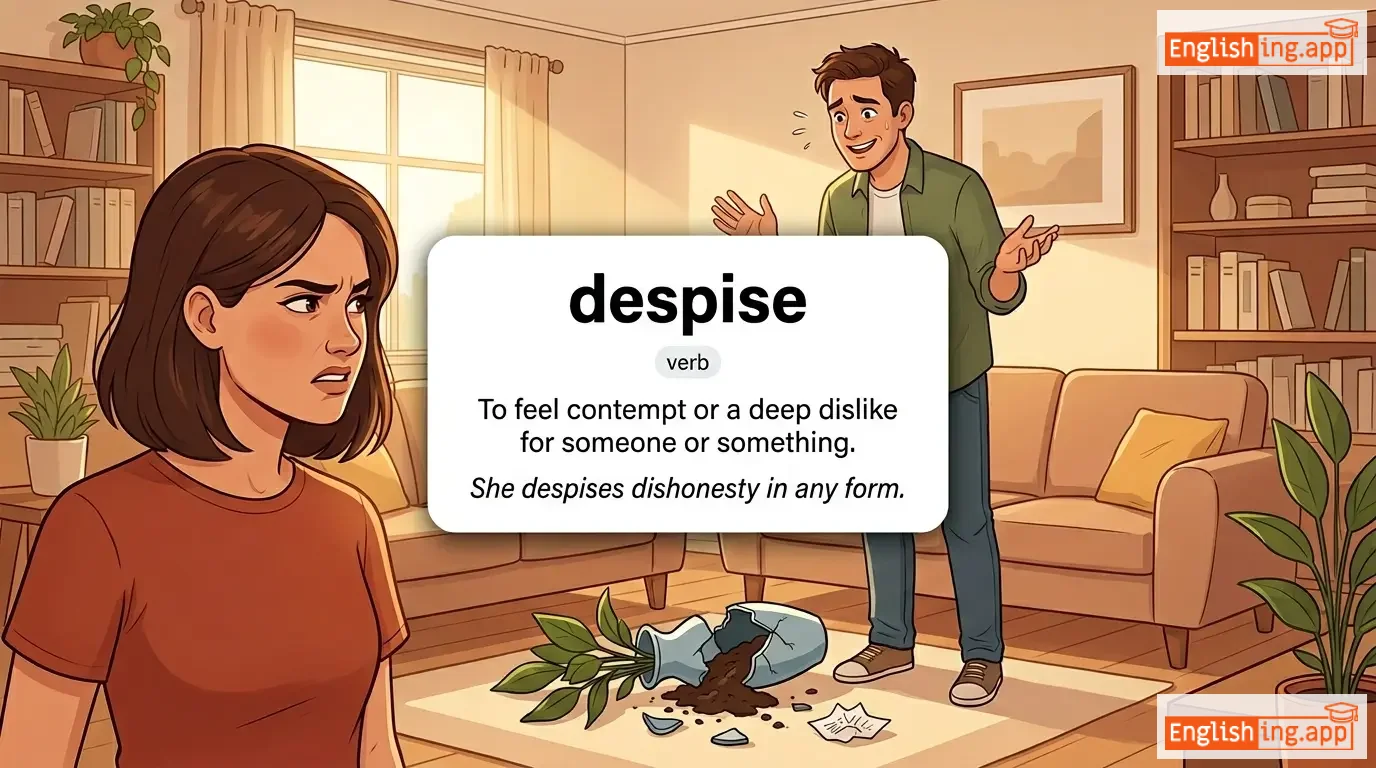
despise definition card — visual illustration of the meaning
verb
/dɪˈspaɪz/
軽蔑する (keibetsu suru)

To feel contempt or a deep dislike for someone or something.

"She despises dishonesty in any form."

"彼女はどんな形の不正も軽蔑している。" (Kanojo wa donna katachi no fusei mo keibetsu shite iru.)
preposition
/dɪˈspaɪt/
にもかかわらず (nimo kakawarazu)

Without being affected by; in spite of.

"He continued his work despite the difficulties."

"困難にもかかわらず、彼は仕事を続けました。" (Konnan nimo kakawarazu, kare wa shigoto wo tsuzukemashita.)
verb
/dɪˈspɔɪl/
略奪する (ryakudatsu suru)

To steal or violently remove valuable possessions from a place.

"The invaders despoiled the village during the war."

"侵略者は戦争中に村を略奪しました。" (Shinryakusha wa sensō-chū ni mura o ryakudatsu shimashita.)
noun
/dɪˈspɔɪlər/
略奪者 (ryakudatsusha)

A person who robs, plunders, or violently takes things from others.

"The despoilers left the city in ruins."

"略奪者たちは街を廃墟にした。" (Ryakudatsusha-tachi wa machi o haikyo ni shita.)
verb
/dɪˈspɒnd/
落ち込む (ochikomu)

to lose confidence or hope; to become dejected

"After repeated failures, he began to despond."

"繰り返しの失敗の後、彼は落ち込むようになった。" (Kurikaeshi no shippai no ato, kare wa ochikomu you ni natta.)
adjective
/dɪˈspɒndənt/

feeling or showing deep hopelessness or discouragement

"She felt despondent after losing her job."

noun
/ˈdɛspɒt/
暴君 (bōkun)

a ruler with absolute power, often ruling in a cruel or oppressive way

"The despot ruled the nation with fear and violence."

"暴君は恐怖と暴力で国を支配した。" (Bōkun wa kyōfu to bōryoku de kuni o shihai shita.)
adjective
/dɛˈspɒtɪk/
専制的な (sensetekina)

exercising power in a cruel, oppressive, or authoritarian way

"The king’s despotic rule left the people in misery."

"王の専制的な支配は人々を苦しめた。" (Ō no sensetekina shihai wa hitobito o kurushimeta.)
noun
/ˈdɛspətɪzəm/
専制政治 (sensei seiji)

absolute power exercised in a cruel and oppressive way

"The people revolted against the era of despotism."

"人々は専制政治の時代に反乱を起こしました。" (Hitobito wa sensei seiji no jidai ni hanran o okoshimashita.)
noun
/dɪˈzɜːrt/
デザート (dezāto)

the sweet course eaten at the end of a meal

"We had ice cream for dessert after dinner."

"夕食後にデザートとしてアイスクリームを食べました。" (Yūshoku go ni dezāto to shite aisukurīmu o tabemashita.)
noun
/ˌdɛstɪˈneɪʃən/
目的地 (mokutekichi)

the place to which someone or something is going or being sent

"Paris is a popular tourist destination."

"パリは人気のある観光地です。" (Pari wa ninki no aru kankōchi desu.)
noun
/ˈdɛstəni/
運命 (unmei)

The events that will necessarily happen to a particular person or thing in the future; fate.

"She believed it was her destiny to become a doctor."

"彼女は医者になることが自分の運命だと信じていた。" (Kanojo wa isha ni naru koto ga jibun no unmei da to shinjite ita.)
adjective
/ˈdɛstɪˌtuːt/
困窮した (konkyū shita)

extremely poor and lacking the means to provide for oneself

"The earthquake left many families destitute."
"地震は多くの家族を困窮させた。" (Jishin wa ōku no kazoku o konkyū saseta.)
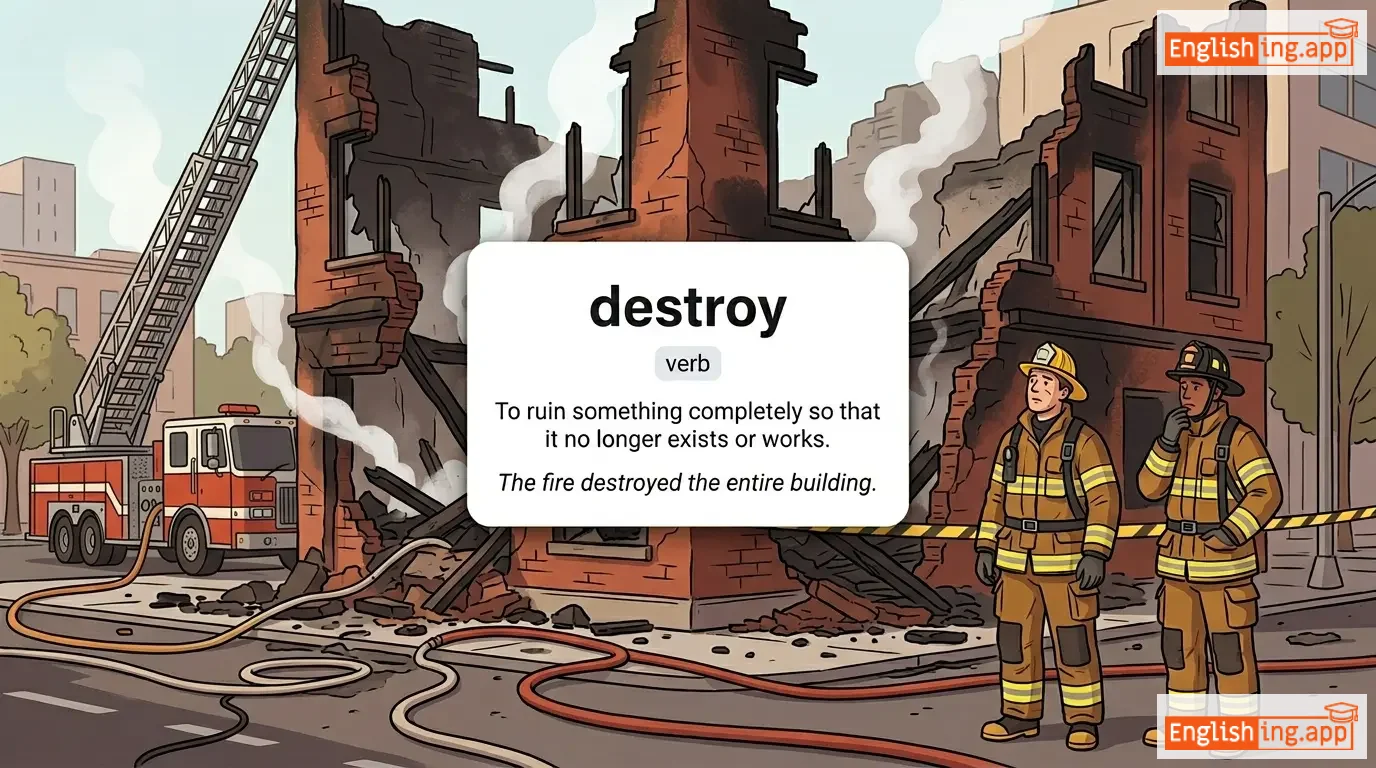
destroy definition card — visual illustration of the meaning
verb
/dɪˈstrɔɪ/
破壊する (hakai suru)

To ruin something completely so that it no longer exists or works.

"The fire destroyed the entire building."

"火事が建物全体を破壊した。" (Kaji ga tatemono zentai o hakai shita.)