वोकैबुलरीज

इंग्लिश वोकैबुलरी डिस्कवर, लर्न और मास्टर करें

verb
/prɪˈzjuːm/
अनुमान लगाना (anumaan lagana)

To suppose something is true without proof; to take for granted.

"I presume she has already left for the meeting."

"मैं अनुमान लगाता हूँ कि वह पहले ही मीटिंग के लिए जा चुकी है।" (Main anumaan lagata hoon ki woh pehle hi meeting ke liye ja chuki hai.)
noun
/prɪˈzʌmpʃən/
कल्पना (kalpana)

An idea believed to be true without proof; an assumption or act of overconfidence.

"The presumption of his guilt was unfair."

"उसका दोषी होने का अनुमान अनुचित था।" (uska doshi hone ka anuman anuchit tha.)
adjective
/prɪˈzʌmptɪv/
अनुमानित (anumanit)

Based on probability or assumption rather than proof.

"She is the presumptive nominee for the party."

"वह पार्टी के लिए अनुमानित उम्मीदवार है।" (vah party ke liye anumanit ummidvaar hai.)
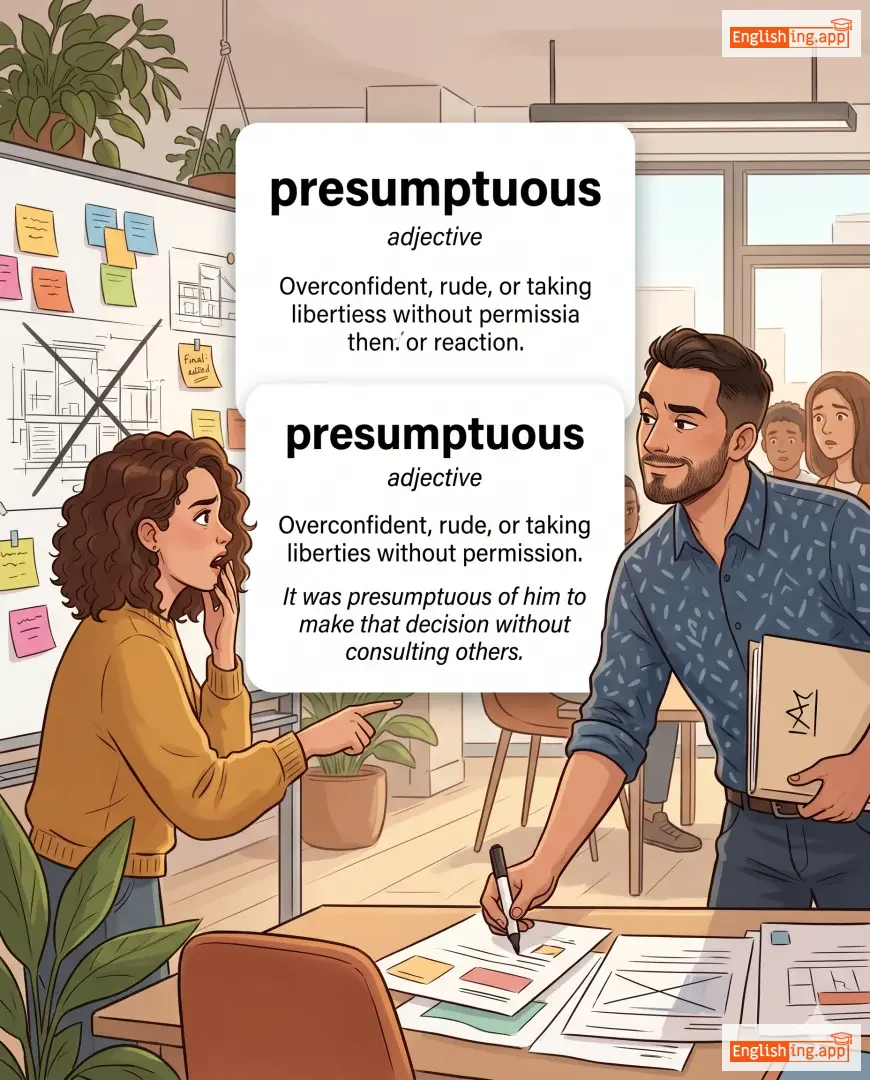
presumptuous definition card — visual illustration of the meaning
adjective
/prɪˈzʌmp.tʃu.əs/
अत्यधिक आत्मविश्वासी (atyadhik atmavishwasi)

Overconfident, rude, or taking liberties without permission.

"It was presumptuous of him to make that decision without consulting others."

"उसका बिना किसी से सलाह लिए वह निर्णय लेना अत्यधिक आत्मविश्वासपूर्ण था।" (uska bina kisi se salah liye vah nirnay lena atyadhik atmavishwaspoornt tha.)
noun
/prɪˈtens/
बना हुआ दिखावा (pretens)

an attempt to make something that is not the case appear true

"He made no pretence of being interested in the conversation."

"उसने बातचीत में रुचि रखने का कोई बनावटी दिखावा नहीं किया।" (usne baatcheet mein ruchi rakhne ka koi banavati dikhawa nahi kiya.)
verb
/prɪˈtɛnd/
ढोंग करना (dhong karna)

To act as if something is true when it is not.

"The children pretended to be superheroes."

"बच्चों ने सुपरहीरो बनने का ढोंग किया।" (bachchon ne superhero banne ka dhong kiya.)
noun
/ˈpriː.tɛns/ or /prɪˈtɛns/
नकली, बहाना (nakli, bahana)

A false appearance or claim; an act of pretending.

"His kindness was only a pretense to gain trust."

"उसकी दयालुता केवल विश्वास हासिल करने के लिए एक बहाना था।" (uski dayaulat keval vishwas hasil karne ke liye ek bahana tha.)
noun
/prɪˈtɛnʃən/
दावा, भ्रामक दिखावा (daava, bhraamak dikhawa)

A claim or assertion to something, often without justification; an attempt to impress by showing greater importance or talent than is actually possessed.

"His pretension to be an expert was quickly exposed."

"उसका विशेषज्ञ होने का दावा जल्दी ही उजागर हो गया।" (uska visheshagya hone ka daava jaldi hi ujagar ho gaya.)
adjective
/prɪˈtɛnʃəs/
ढोंगी (dhongi)

Attempting to impress by affecting greater importance, talent, culture, etc., than is actually possessed.

"The restaurant was stylish but far too pretentious for my taste."

"रेस्टोरेंट स्टाइलिश था, लेकिन मेरे स्वाद के लिए वह बहुत ढोंगी था।" (restaurant stylish tha, lekin mere swaad ke liye vah bahut dhongi tha.)
adjective
/ˌpriːtərˈnætʃərəl/
अलौकिक (aloukik)

Beyond what is normal or natural; extraordinary or supernatural.

"She had a preternatural ability to remain calm in any crisis."

"वह किसी भी संकट में शांत रहने की असाधारण क्षमता रखती थी।" (vah kisi bhi sankat mein shaant rehne ki asadharan kshamata rakhti thi.)
noun
/ˈpriːtɛkst/
बहाना, झूठा कारण (bahana, jhootha kaaran)

A false reason given to hide the real purpose or motive.

"He went out on the pretext of buying groceries."

"वह किराने का सामान खरीदने के बहाने बाहर गया।" (vah kiraane ka samaan kharidne ke bahaane baahar gaya.)
adjective
/ˈprɪti/
सुंदर (sundar)

Attractive in a delicate way without being truly beautiful.

"She looked pretty in her new dress."

"वह अपनी नई ड्रेस में सुंदर लग रही थी।" (Vah apni nai dress mein sundar lag rahi thi.)
verb
/prɪˈveɪl/
विजयी होना (vijayi hona)

To prove more powerful or superior; to be widespread or common.

"Justice will always prevail over injustice."

"न्याय हमेशा अन्याय पर विजयी होगा।" (nyay hamesha anyay par vijayi hoga.)
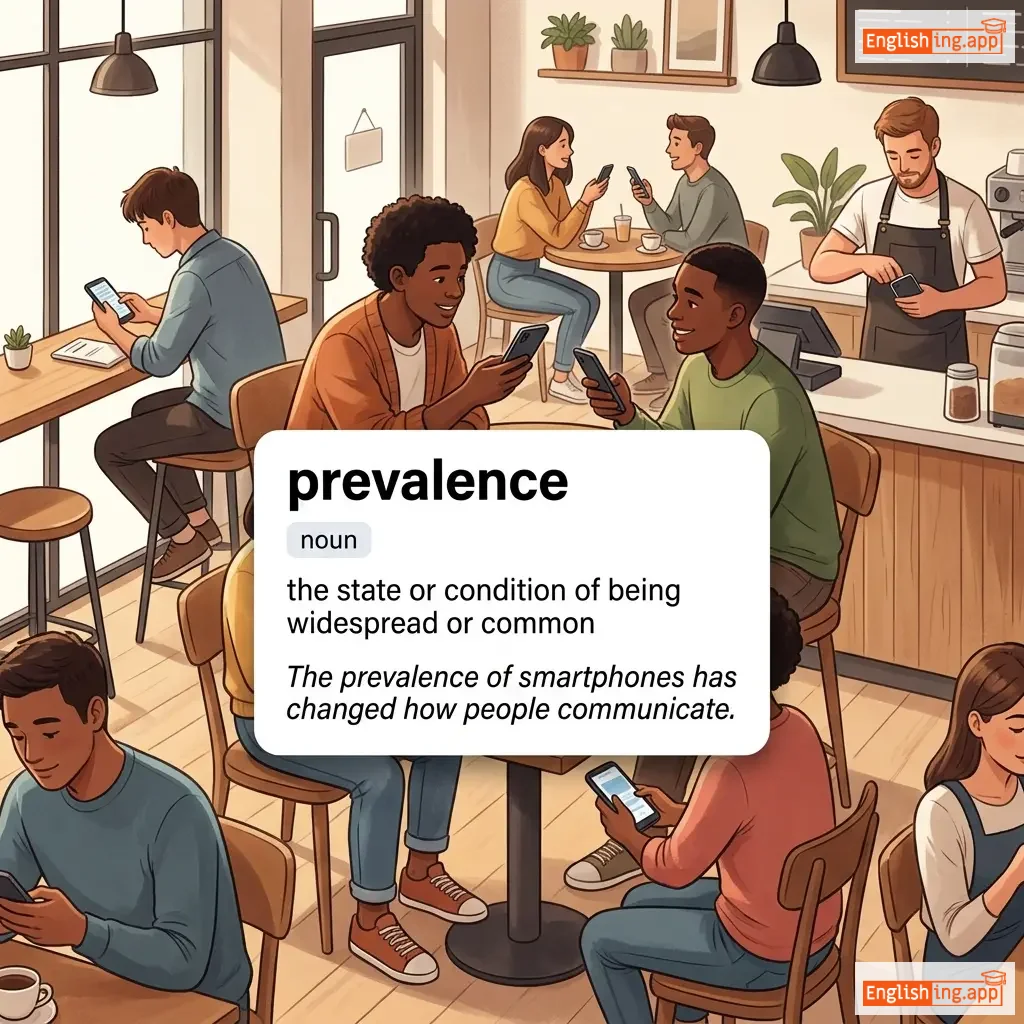
prevalence definition card — visual illustration of the meaning
noun
/ˈprɛvələns/
प्रचलन (prachalan)

the state or condition of being widespread or common

"The prevalence of smartphones has changed how people communicate."

"स्मार्टफोन्स का प्रचलन ने लोगों के संवाद करने के तरीके को बदल दिया है।" (smartphones ka prachalan ne logon ke samvaad karne ke tareeke ko badal diya hai.)
adjective
/ˈprɛvələnt/
व्यापक (vyapak)

widespread or commonly occurring

"Flu is prevalent during the winter season."

"सर्दी के मौसम में फ्लू प्रचलित है।" (sardi ke mausam mein flu prachalit hai.)
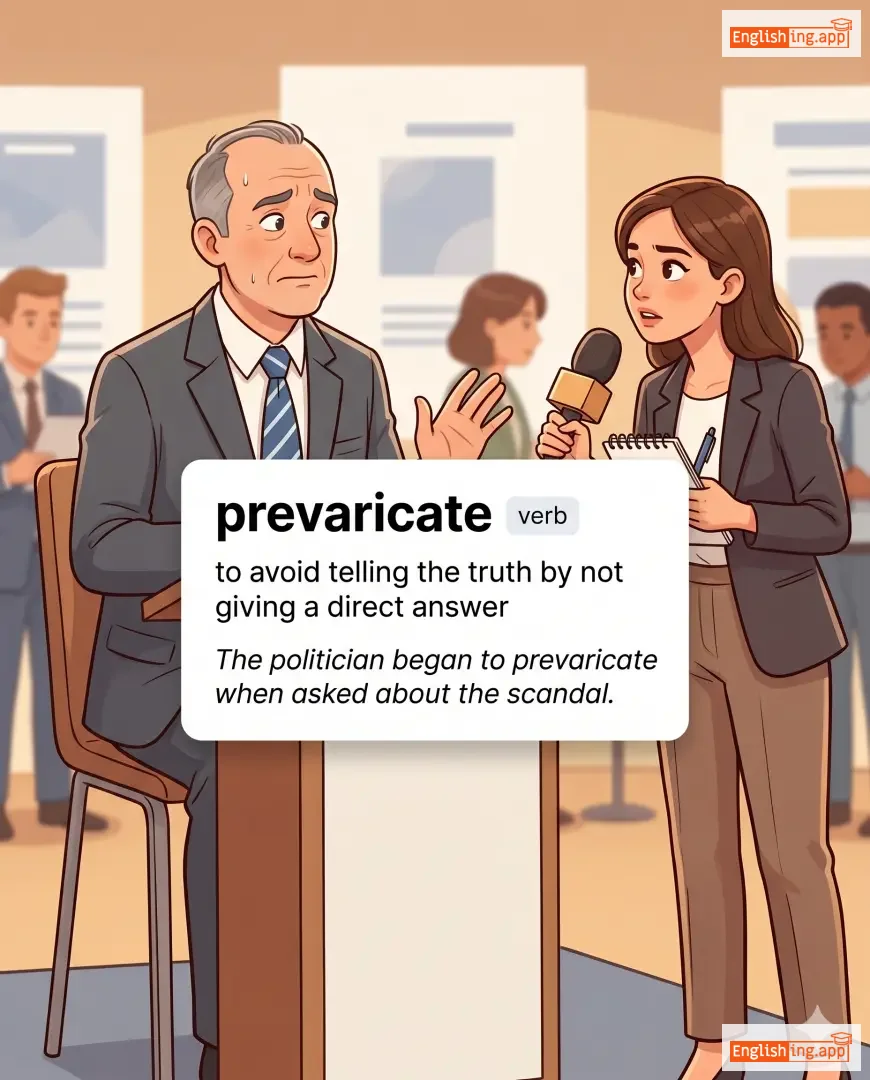
prevaricate definition card — visual illustration of the meaning
verb
/prɪˈværɪkeɪt/
सच न बताना (sach na batana)

to avoid telling the truth by not giving a direct answer

"The politician began to prevaricate when asked about the scandal."

"राजनेता ने स्कैंडल के बारे में पूछे जाने पर सच बताने से बचना शुरू कर दिया।" (raajneeta ne scandal ke baare mein pooche jaane par sach batane se bachna shuru kar diya.)
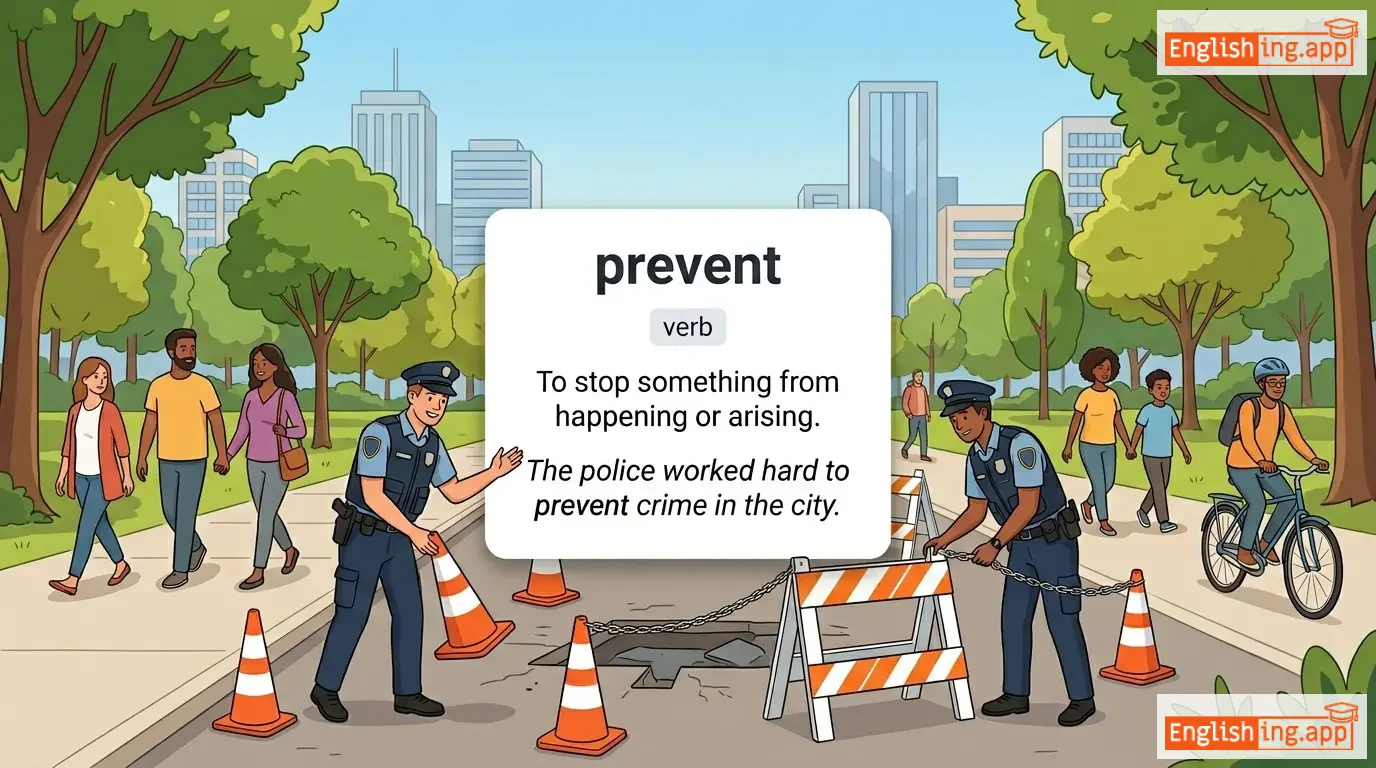
prevent definition card — visual illustration of the meaning
verb
/prɪˈvɛnt/
रोकना (rokna)

To stop something from happening or arising.

"The police worked hard to prevent crime in the city."

"पुलिस ने शहर में अपराध रोकने के लिए कड़ी मेहनत की।" (Police ne shahar mein aparadh rokne ke liye kadi mehnat ki.)
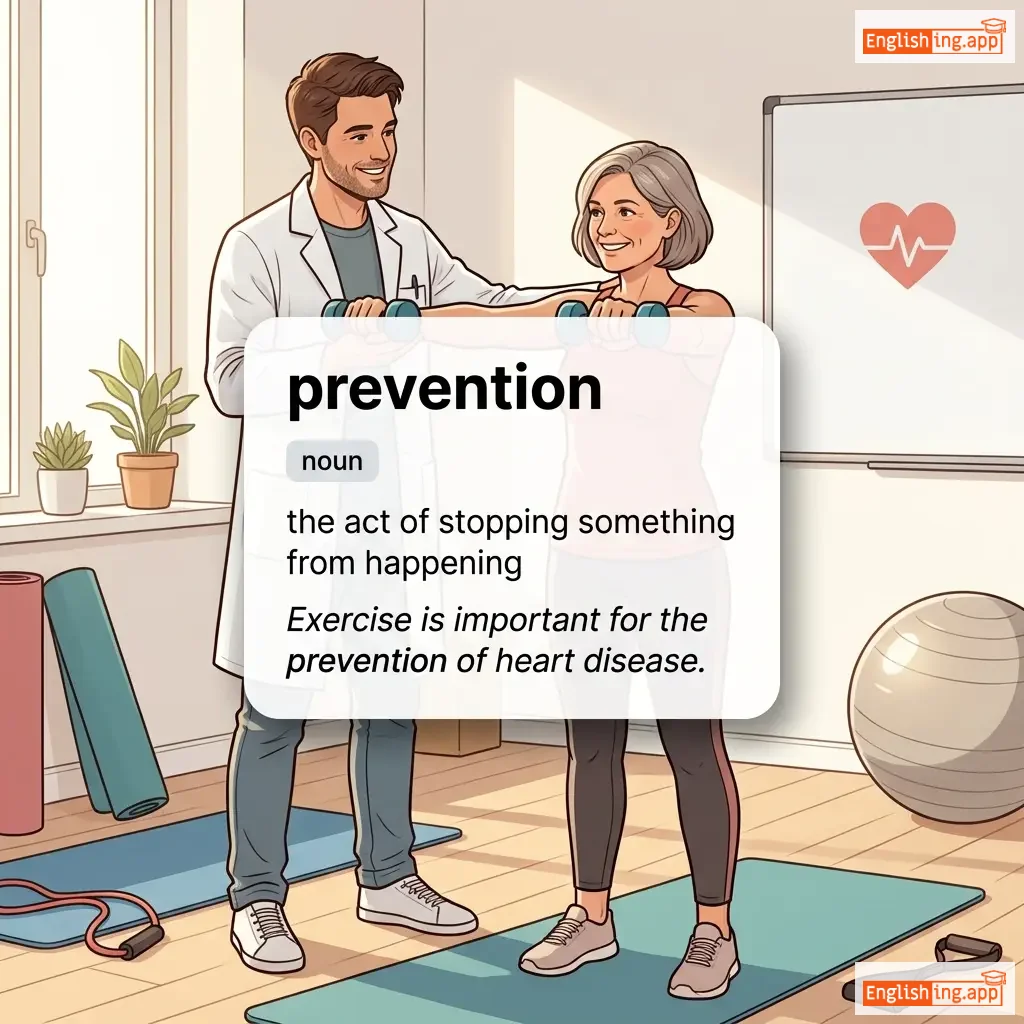
prevention definition card — visual illustration of the meaning
noun
/prɪˈvɛnʃən/
रोकथाम (roktham)

the act of stopping something from happening

"Exercise is important for the prevention of heart disease."

"हृदय रोग की रोकथाम के लिए व्यायाम महत्वपूर्ण है।" (hriday rog ki roktham ke liye vyayam mahatvapurn hai.)
adjective
/prɪˈventɪv/
रोकथाम करनेवाला; रोगों से बचाव के लिए डिज़ाइन किया गया (priventiv)

designed to prevent something from happening; protective against disease

"Regular exercise is a preventive measure against heart disease."

"नियमित व्यायाम दिल की बीमारी से बचाव के लिए एक रोकथाम उपाय है।" (niyamit vyaayam dil ki bimari se bachav ke liye ek roktham upay hai)
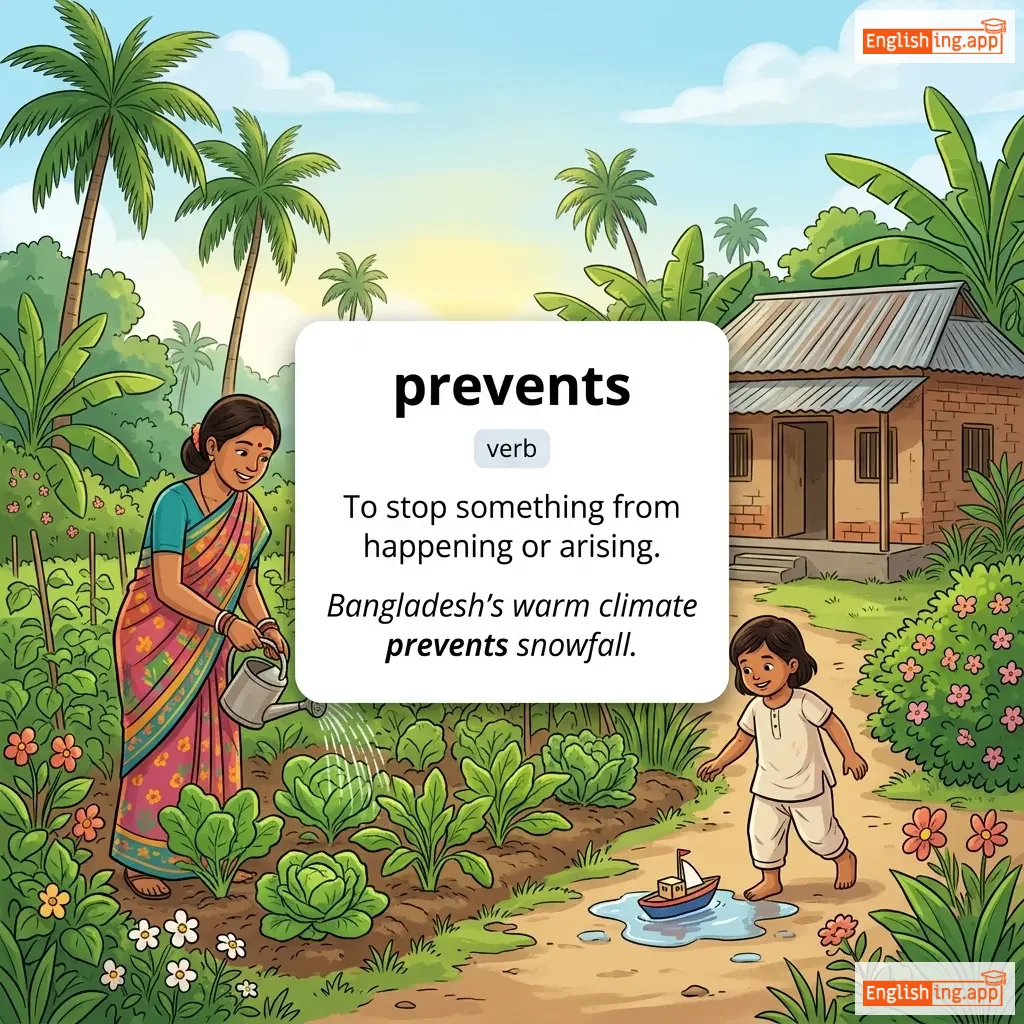
prevents definition card — visual illustration of the meaning
verb
প্রিভেন্টস
रोकता है (rokta hai)

To stop something from happening or arising.

"Bangladesh's warm climate prevents snowfall."

"बांगलादेश की गर्म जलवायु हिमपात को रोकती है।" (Bangladesh ki garm jalvayu himpaat ko rokti hai.)
adjective
/ˈpriːviəs/
पूर्ववर्ती (purvavarti)

Existing or happening before the present time.

"He referred to the previous meeting to explain his point."

"वह अपनी बात समझाने के लिए पिछले बैठक का संदर्भ दे रहा था।" (Vah apni baat samjhane ke liye pichle baithak ka sandarbh de raha tha.)
adverb
/ˈpriːviəsli/
पूर्व में (purv mein)

at an earlier time or before now

"She had previously worked at a bank before starting her own business."

"वह एक बैंक में पहले काम कर चुकी थी, अपने खुद के व्यवसाय की शुरुआत करने से पहले।" (Vah ek bank mein pahle kaam kar chuki thi, apne khud ke vyavsay ki shuruat karne se pahle.)
noun/verb
/preɪ/
शिकार (shikar)

an animal hunted by another for food; to hunt and feed on

"Lions prey on zebras in the wild."

"सिंह जंगली में ज़ेब्राओं का शिकार करते हैं।" (Singh jangli mein zebron ka shikar karte hain.)
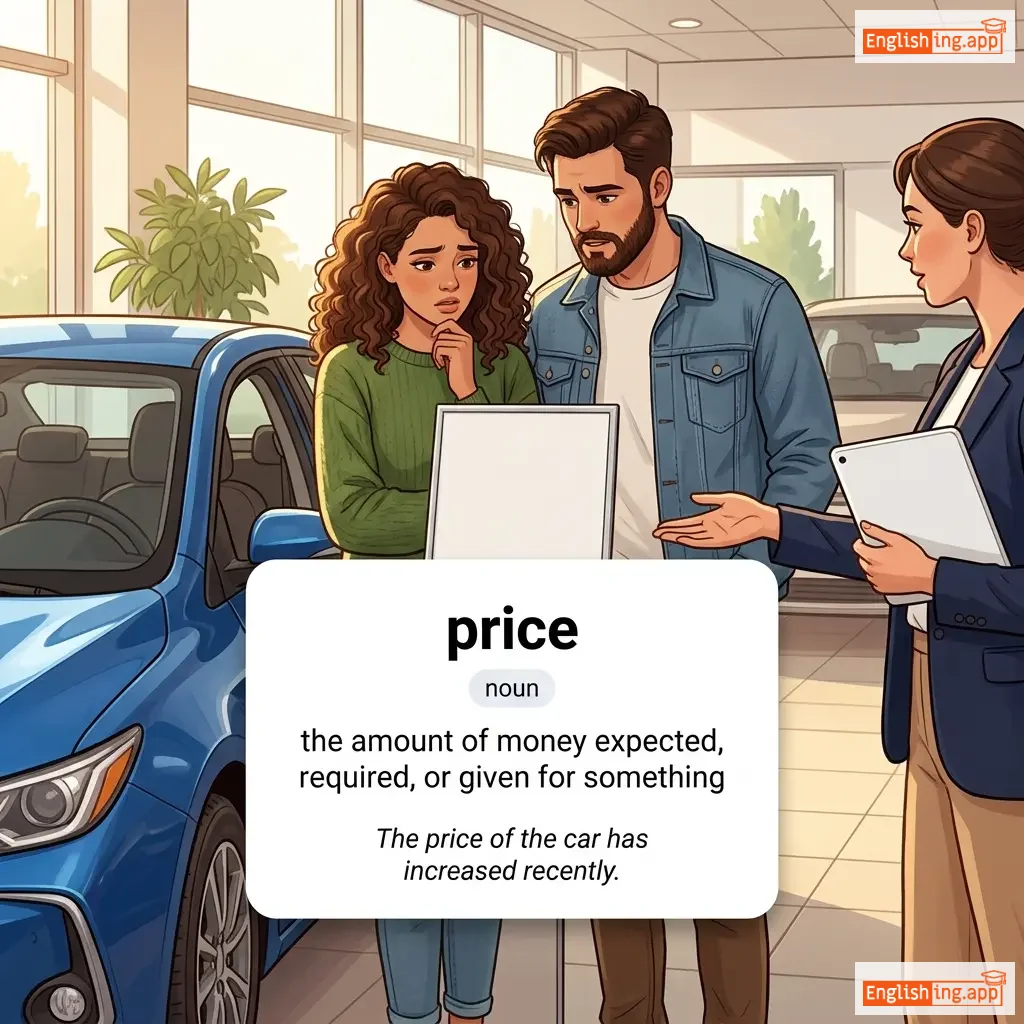
price definition card — visual illustration of the meaning
noun
/praɪs/
कीमत (keemat)

the amount of money expected, required, or given for something

"The price of the car has increased recently."

"कार की कीमत हाल ही में बढ़ी है।" (Car ki keemat haal hi mein badhi hai.)
adjective
/ˈpraɪs.ləs/
मूल्यहीन; अत्यधिक मूल्यवान (mulyahin; atyadhik mulyavan)

extremely valuable; invaluable; beyond price

"Her grandmother's antique jewelry is absolutely priceless."

"उसकी दादी की प्राचीन गहनों की कीमत अविश्वसनीय है।" (uski dadi ki pracheen gahon ki keemat avishwasniya hai.)
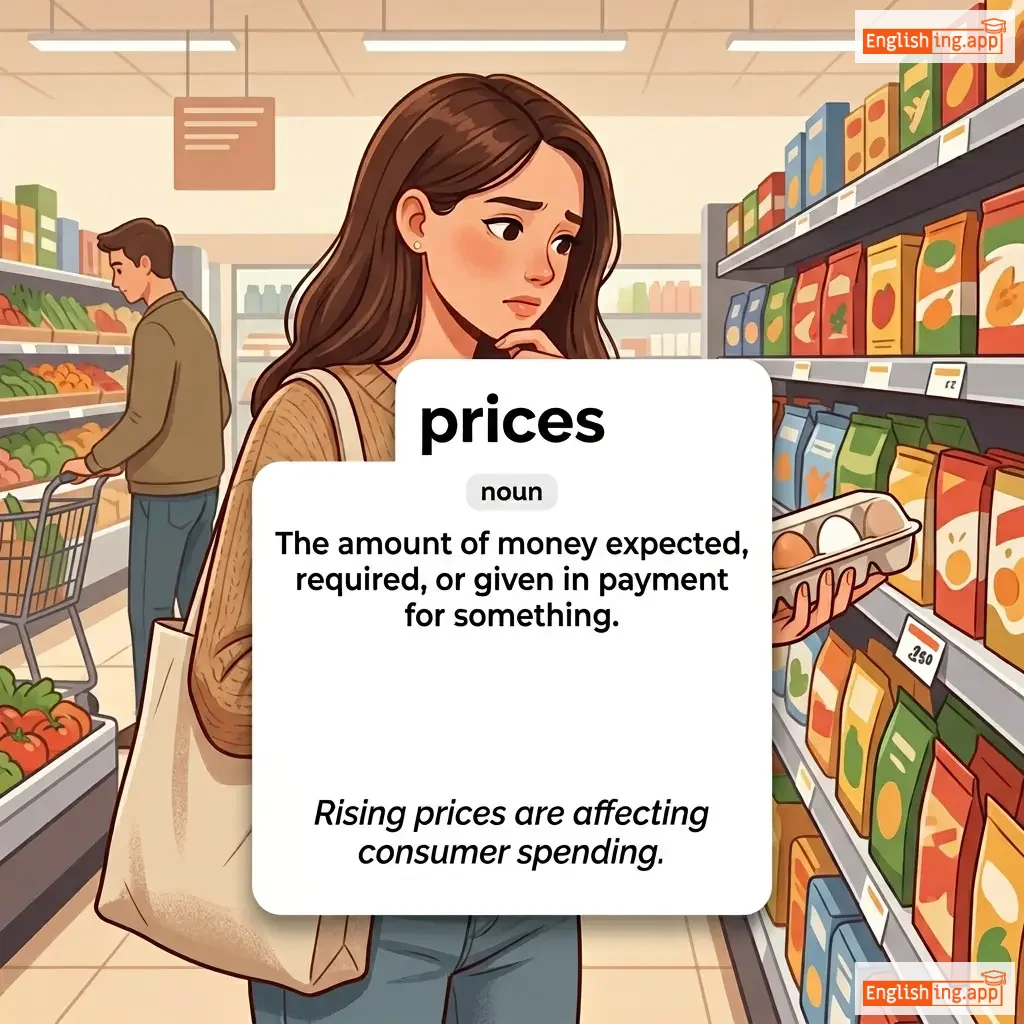
prices definition card — visual illustration of the meaning
noun
ˈpraɪsɪz
कीमतें, दाम (keematain, daam)

The amount of money expected, required, or given in payment for something.

"Rising prices are affecting consumer spending."

"बढ़ती कीमतें उपभोक्ता खर्च को प्रभावित कर रही हैं।" (Badhati keematein upbhokta kharch ko prabhavit kar rahi hain.)
verb
/ˈprɪkəl/
चुभना (chubhna)

to cause a slight stinging or tingling sensation on the skin

"Her skin began to prickle in the cold wind."

"ठंडी हवा में उसकी त्वचा चुभने जैसी लगने लगी।" (Thandi hawa mein uski twacha chubhne jaisi lagne lagi.)
pride definition card — visual illustration of the meaning
noun
/praɪd/
अहम् (aham)

a feeling of deep pleasure or satisfaction derived from one's own achievements

"He took pride in his work and always aimed for perfection."

"वह अपने काम पर गर्व करता था और हमेशा परिपूर्णता के लिए लक्ष्य करता था।" (Vah apne kaam par garv karta tha aur hamesha paripurnata ke liye lakshya karta tha.)
noun
/priːst/
पादरी (padri)

a person who performs religious duties and ceremonies

"The priest blessed the congregation during the Sunday service."

"पादरी ने रविवार की सेवा के दौरान समुदाय को आशीर्वाद दिया।" (Padri ne ravivaar ki seva ke dauran samudaay ko aashirvaad diya.)
adjective
/ˈprɪɡɪʃ/
अत्यधिक नैतिक और आत्मनिर्भर (atyadhik naitik aur aatmanirbhar)

self-righteously moralistic and superior

"He came across as priggish when correcting everyone's manners."

"वह जब सभी के शिष्टाचार को सुधारने की कोशिश करता था, तो वह अत्यधिक नैतिक और आत्मनिर्भर लगता था।" (Vah jab sabhi ke shishtachar ko sudharne ki koshish karta tha, to vah atyadhik naitik aur aatmanirbhar lagta tha.)
adjective
/prɪm/
अत्यधिक शालीन और उचित (atyadhik shaleen aur uchit)

stiffly formal and proper in appearance or behavior

"She looked prim in her neatly pressed dress."

"वह अपनी सलीके से प्रेस की हुई ड्रेस में प्रिम दिख रही थी।" (Vah apni salike se press ki hui dress mein prim dikh rahi thi.)
adjective
/ˈpraɪvət/
निजी (niji)

belonging to or for the use of one particular person or group

"She enjoys her private time away from work."

"वह काम से दूर अपना निजी समय पसंद करती है।" (Wah kaam se door apna niji samay pasand karti hai.)
noun
/ˈprɪn.tər/
मुद्रक (mudrak)

a person whose job is printing books, newspapers, or other materials; a machine that prints documents

"The printer delivered the wedding invitations on time."

"मुद्रक ने समय पर शादी के निमंत्रण भेजे।" (mudrak ne samay par shaadi ke nimantran bheje.)
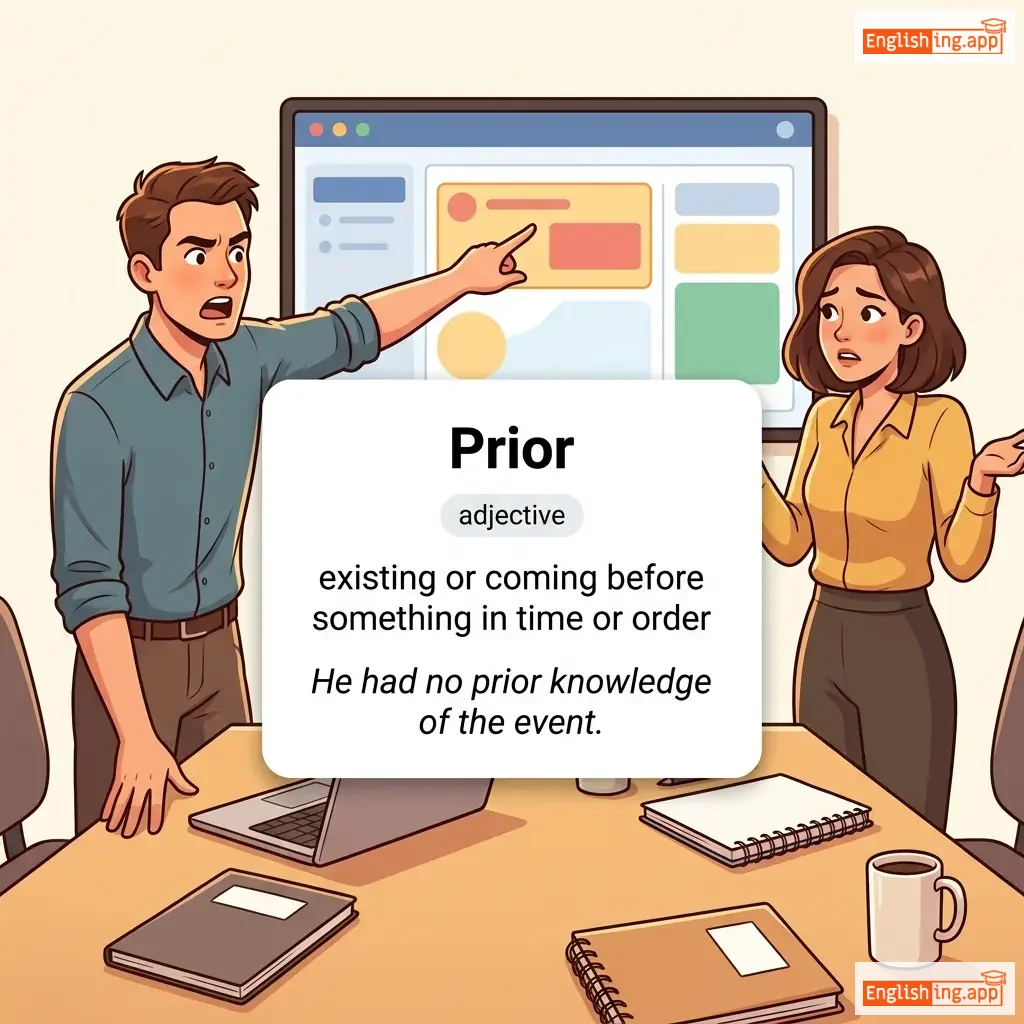
Prior definition card — visual illustration of the meaning
adjective
/ˈpraɪər/
पूर्व (purv)

existing or coming before something in time or order

"He had no prior knowledge of the event."

"उसे इस घटना के बारे में पहले से कोई जानकारी नहीं थी।" (Use is ghatna ke baare mein pehle se koi jaankari nahi thi.)
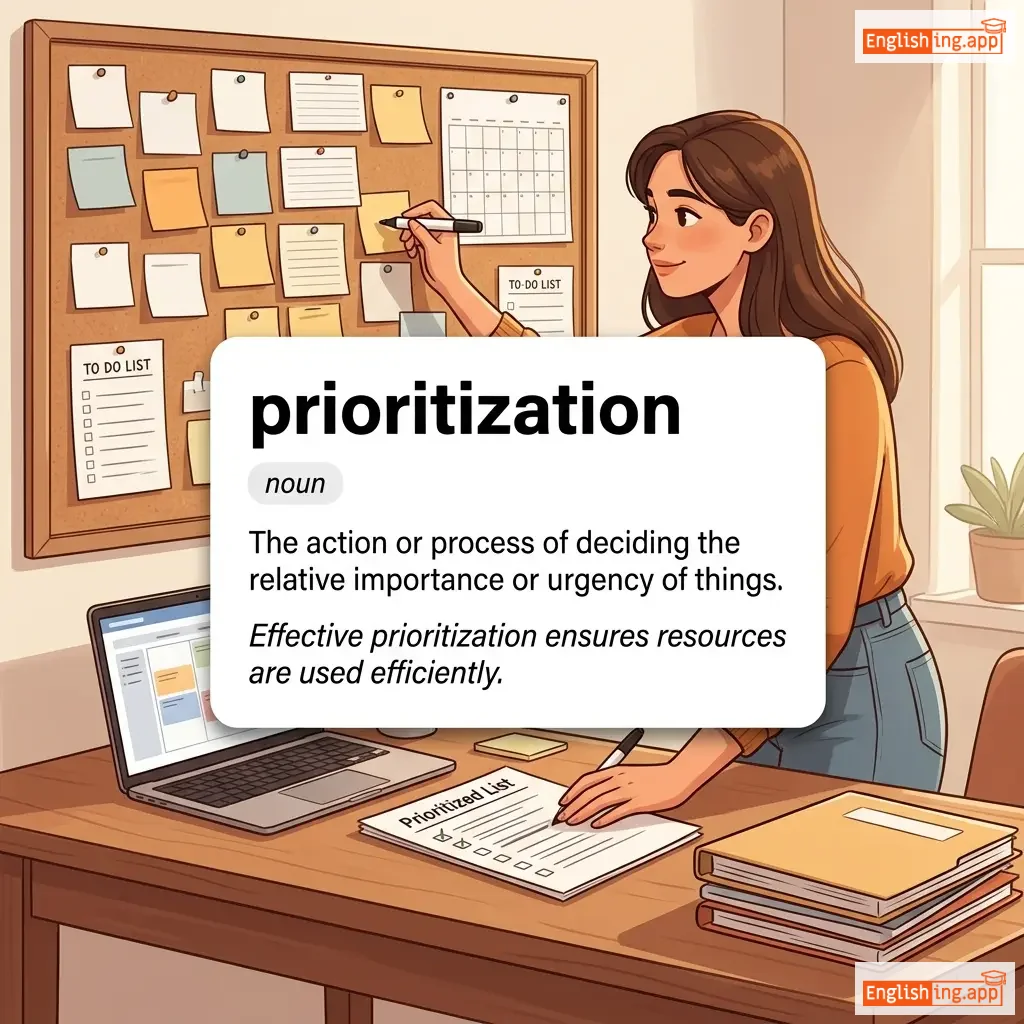
prioritization definition card — visual illustration of the meaning
noun
ˌpraɪɔːrɪtaɪˈzeɪʃən
प्राथमिकता निर्धारण (prathmikta nirdharan)

The action or process of deciding the relative importance or urgency of things.

"Effective prioritization ensures resources are used efficiently."

"प्रभावी प्राथमिकता निर्धारण सुनिश्चित करता है कि संसाधन कुशलतापूर्वक उपयोग किए जा रहे हैं।" (Prabhavi prathmikta nirdharan sunishchit karta hai ki sansadhan kushaltapurvak upyog kiye ja rahe hain.)
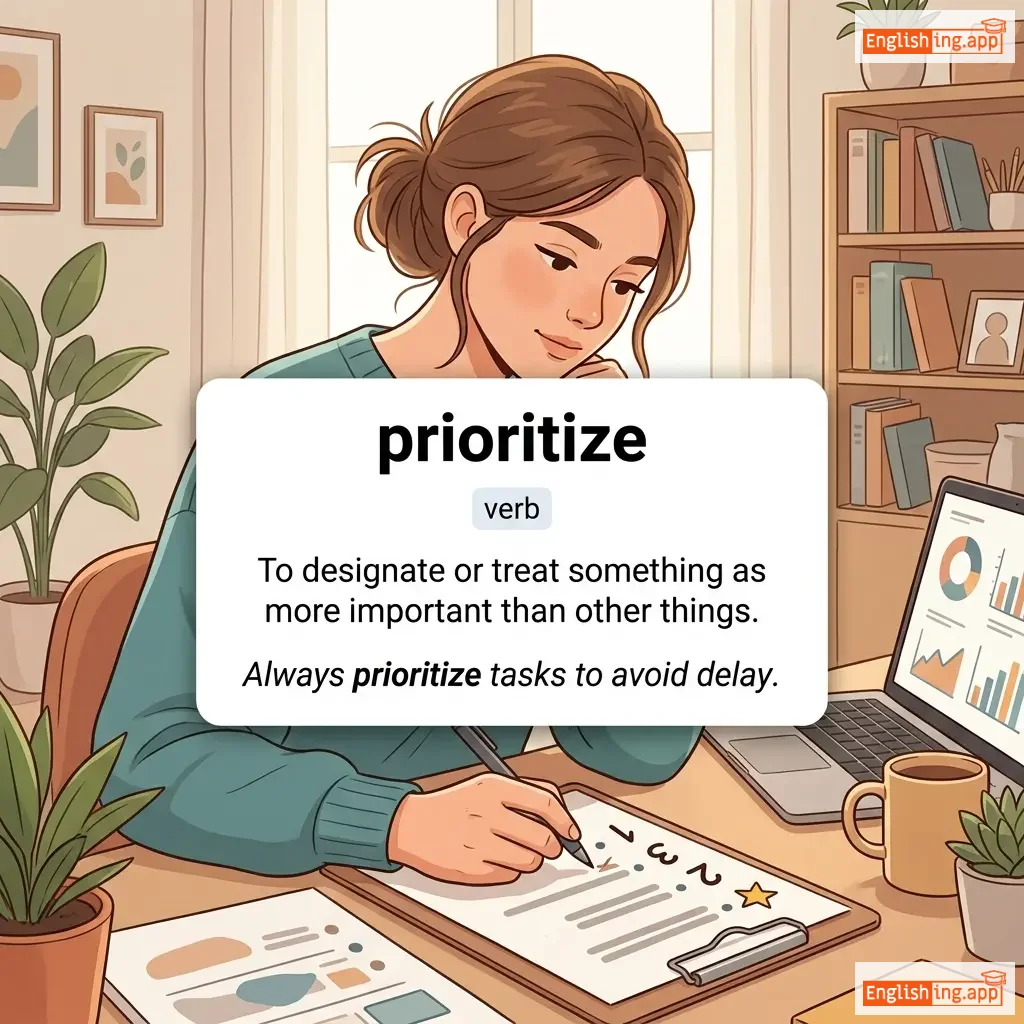
prioritize definition card — visual illustration of the meaning
verb
/praɪˈɔːrətaɪz/
प्राथमिकता देना (prathmikta dena)

To designate or treat something as more important than other things.

"Always prioritize tasks to avoid delay."

"हमेशा कामों को प्राथमिकता दें ताकि कोई देरी न हो।" (Hamesha kaamon ko prathmikta den taaki koi deri na ho.)
noun
/praɪˈɒrɪti/
प्राथमिकता (prathmikta)

Something that is regarded as more important than other things.

"Safety is the top priority in this company."

"इस कंपनी में सुरक्षा सबसे महत्वपूर्ण प्राथमिकता है।" (Is company mein suraksha sabse mahatvapurn prathmikta hai.)
noun
/ˈpraɪəri/
मठ (math)

a small monastery or convent governed by a prior or prioress

"The old priory was converted into a museum."

"पुराना प्रायोरी एक संग्रहालय में बदल दिया गया था।" (Purana priory ek sangrahalay mein badal diya gaya tha.)
noun
/ˈprɪzən/
जेल (jel)

a building where people are kept as punishment for a crime or while waiting for trial

"He was sent to prison for his crimes."

"उसे उसके अपराधों के लिए जेल भेजा गया था।" (Use uske apradhon ke liye jel bheja gaya tha.)
noun
/ˈprɪzənər/
कैदी (kaidi)

a person who is in prison

"The prisoner was granted parole after serving 10 years."

"कैदी को 10 साल की सजा काटने के बाद पैरोल दी गई।" (Kaidi ko 10 saal ki saza kaatne ke baad parol di gayi.)
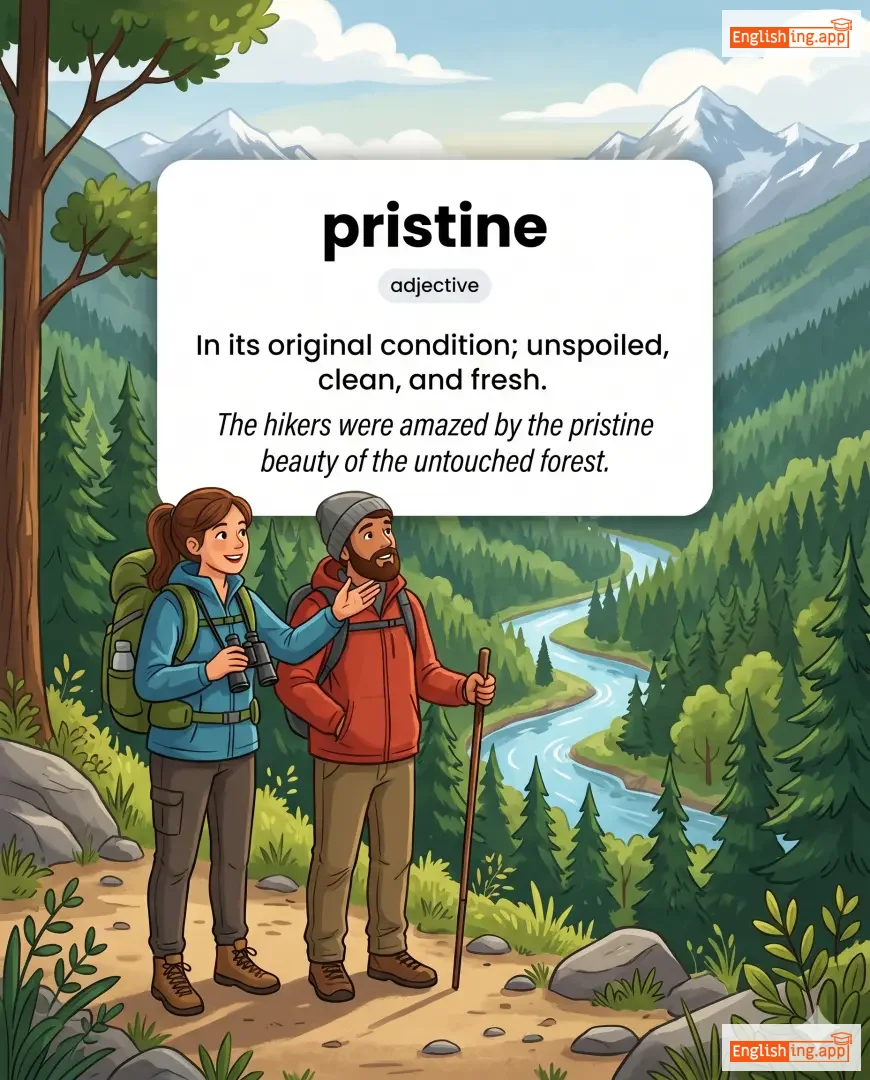
pristine definition card — visual illustration of the meaning
adjective
/ˈprɪstiːn/
अक्षत, शुद्ध (akkhat, shuddh)

In its original condition; unspoiled, clean, and fresh.

"The hikers were amazed by the pristine beauty of the untouched forest."

"हाइकर्स अचंभित हो गए थे जब उन्होंने अनछुई जंगली सौंदर्य को देखा।" (Haikers achambhit ho gaye the jab unhone anchhui jangli saundarya ko dekha.)
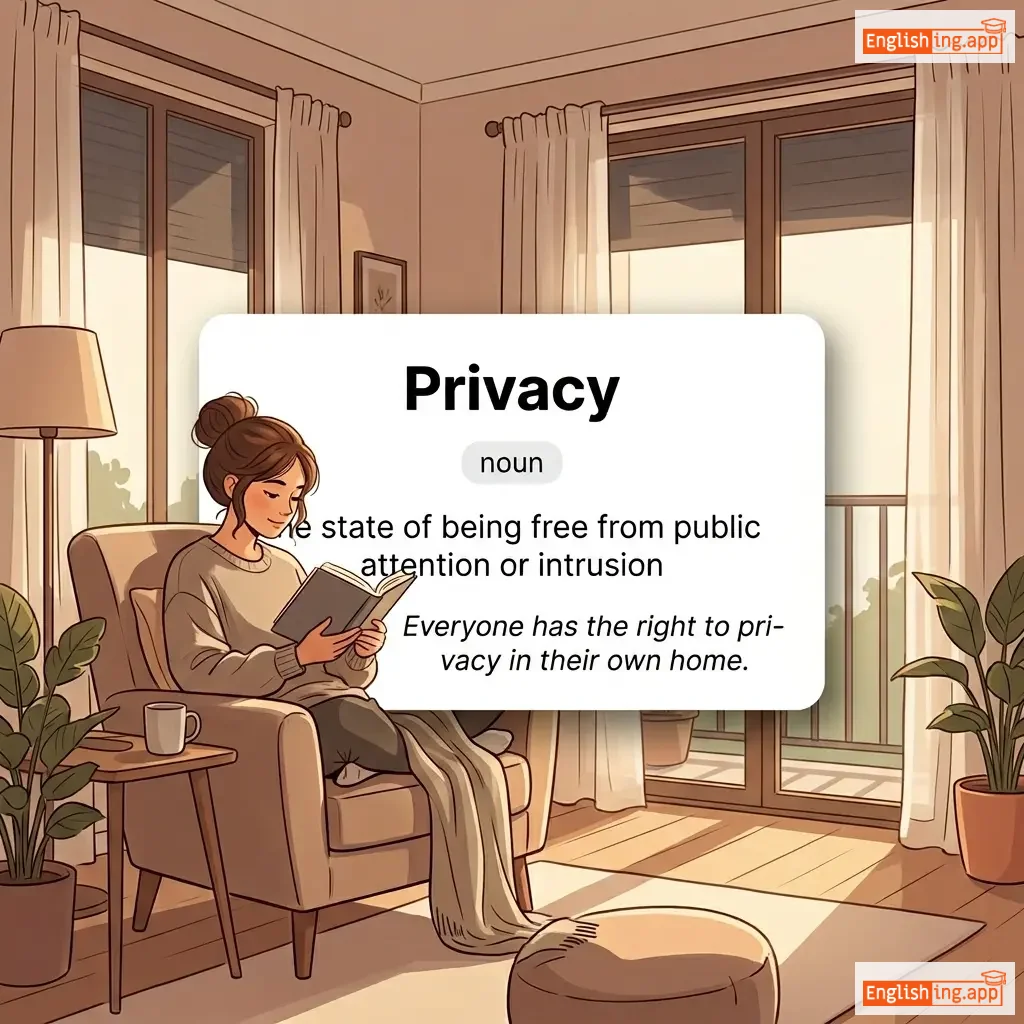
Privacy definition card — visual illustration of the meaning
noun
/ˈpraɪvəsi/
गोपनीयता (gopaneeyata)

the state of being free from public attention or intrusion

"Everyone has the right to privacy in their own home."

"हर किसी को अपने घर में गोपनीयता का अधिकार है।" (Har kisi ko apne ghar mein gopaneeyata ka adhikar hai.)
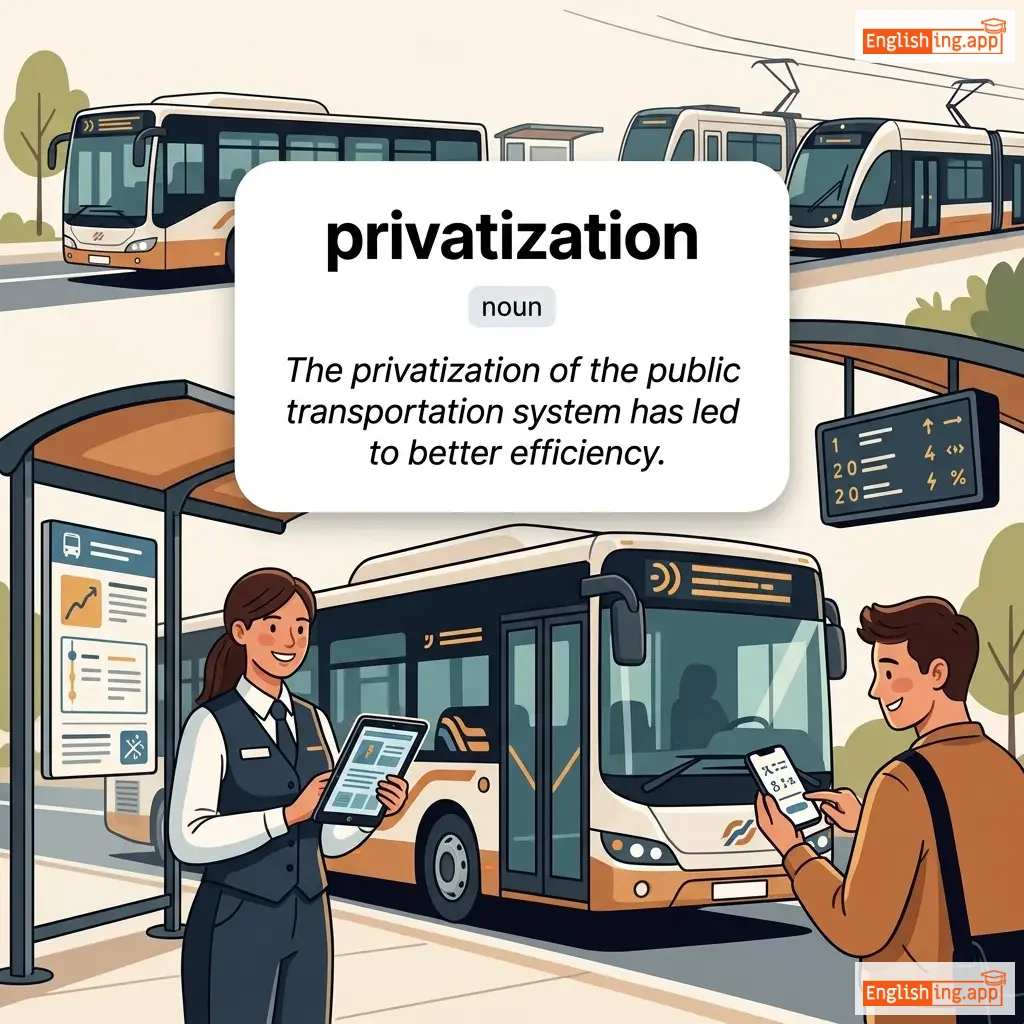
privatization definition card — visual illustration of the meaning
noun
/ˌpraɪvətəˈzeɪʃən/
निजीकरण (niji karan)

the process of transferring ownership of a business, industry, or service from the public sector to the private sector

"The privatization of the public transportation system has led to better efficiency."

"जन परिवहन प्रणाली का निजीकरण बेहतर दक्षता की ओर बढ़ा है।" (Jan parivahan pranali ka niji karan behtar dakshata ki aur badha hai.)
adjective
/ˈprɪvi/
गोपनीय जानकारी वाला (gopniya jankari wala)

having access to secret or private knowledge

"She was privy to the confidential discussions."

"वह गोपनीय चर्चाओं से अवगत थी।" (Vah gopniya charchao se avagat thi.)
noun
/ˈprɪvɪti/
निजी संबंध, अनुबंध संबंध (niji sambandh, anubandh sambandh)

A close, private, or special relationship; in law, the direct connection between parties to a contract.

"There was no privity of contract between the supplier and the customer."

"सप्लायर और ग्राहक के बीच अनुबंध का कोई निजी संबंध नहीं था।" (supplier aur grahak ke beech anubandh ka koi niji sambandh nahi tha.)
adjective
/ˈprɪv.ə.lɪdʒd/
विशेषाधिकार प्राप्त (privilijed)

having special advantages; favored; elite

"She comes from a privileged background with many opportunities."

"उसकी पृष्ठभूमि विशेषाधिकार प्राप्त है और उसके पास कई अवसर हैं." (uski prishthabhumi visheshadhikar praapt hai aur uske paas kai avsar hain)
noun
/ˈprɪvəlɪdʒ/
विशेष अधिकार, लाभ (vishesh adhikar, labh)

A special right, advantage, or immunity granted or available only to a particular person or group.

"Education is considered a privilege in many developing countries."

"शिक्षा को कई विकासशील देशों में एक विशेष अधिकार माना जाता है।" (Shiksha ko kai vikasheel deshon mein ek vishesh adhikar maana jaata hai.)
adverb
/ˈpraɪvətli/
निजी रूप से (niji roop se)

in a private way; not in public or not shared with others

"She spoke to him privately about the issue."

"उसने मुद्दे के बारे में निजी रूप से उससे बात की।" (Usne mudde ke baare mein niji roop se usse baat ki.)
noun
/ˈpraɪ.vət ˈtuː.tər/
निजी ट्यूटर (niji tutor)

a teacher who gives individual instruction to a student outside of regular school

"The private tutor helped the student improve his math skills."

"निजी ट्यूटर ने छात्र की गणित क्षमताओं को सुधारने में मदद की।" (niji tutor ne chhatra ki ganit kshamataon ko sudharne mein madad ki)
noun
/ˌpraɪvəˈtɪə/
निजी जहाज (niji jahaj)

A privately owned armed ship authorized by a government to attack enemy ships during war.

"The privateer captured several enemy vessels during the conflict."

"प्राइवेटियर ने संघर्ष के दौरान कई शत्रु जहाजों को कब्जा कर लिया।" (Privateer ne sangharsh ke dauran kai shatru jahazon ko kabza kar liya.)