वोकैबुलरीज

इंग्लिश वोकैबुलरी डिस्कवर, लर्न और मास्टर करें

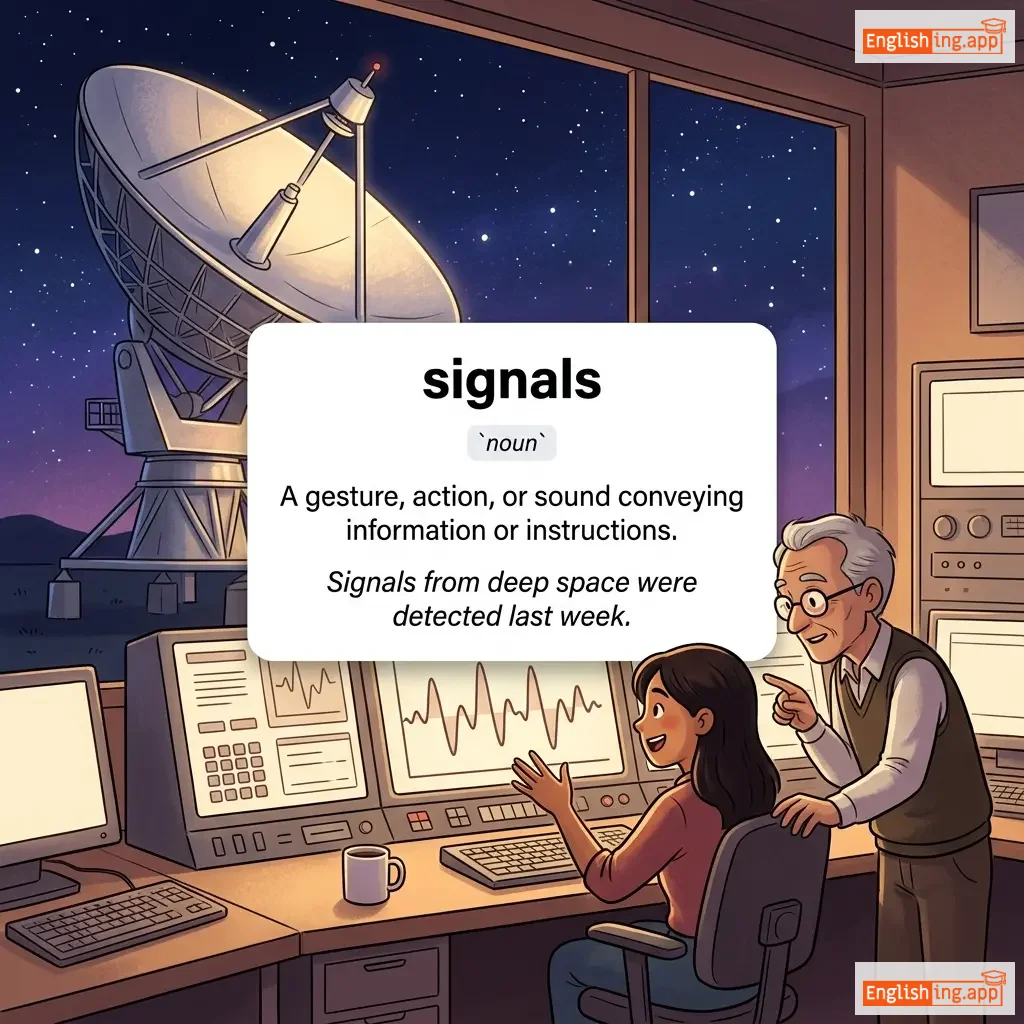
signals definition card — visual illustration of the meaning
noun
/ˈsɪɡ.nəlz/
संकेत (sanket)

A gesture, action, or sound conveying information or instructions.

"Signals from deep space were detected last week."

"गहरे अंतरिक्ष से सिग्नल्स पिछले सप्ताह पाए गए थे।" (Gahare antariksh se signals pichle saptah paye gaye the.)
noun
/ˈsɪɡ.nə.tʃər/
हस्ताक्षर (hastakshar)

a person's name written by themselves, often as a form of identification or authorization

"She signed the contract with her elegant signature."

"उसने अपने सुंदर हस्ताक्षर के साथ अनुबंध पर साइन किया।" (Usne apne sundar hastakshar ke saath anubandh par sign kiya.)
noun
/sɪɡˈnɪfɪkəns/
महत्व (mahatva)

the quality of being important, meaningful, or worthy of attention

"The significance of the discovery was recognized worldwide."

"इस खोज का महत्व दुनिया भर में पहचाना गया था।" (Is khoj ka mahatva duniya bhar mein pehchana gaya tha.)
significant definition card — visual illustration of the meaning
adjective
/sɪɡˈnɪfɪkənt/
महत्वपूर्ण (mahatvapurn)

important, meaningful, or having a noticeable effect

"The company made a significant investment in new technology."

"कंपनी ने नई तकनीकी में एक महत्वपूर्ण निवेश किया।" (Kampani ne nai takneeki mein ek mahatvapurn nivesh kiya.)
adverb
/sɪɡˈnɪfɪkəntli/
महत्वपूर्ण रूप से (mahatvapoorn roop se)

in a way that is large or important enough to have an effect

"The economy has significantly improved over the last decade."

"अर्थव्यवस्था पिछले दशक में महत्वपूर्ण रूप से सुधरी है।" (Arthavyavastha pichhle dashak mein mahatvapoorn roop se sudhri hai.)
noun
/ˌsɪɡnɪfɪˈkeɪʃən/
अर्थ (arth)

the meaning or sense conveyed by a word, action, or symbol

"The signification of the gesture was misunderstood."

"उस इशारे का अर्थ गलत समझा गया था।" (Us ishaare ka arth galat samjha gaya tha.)
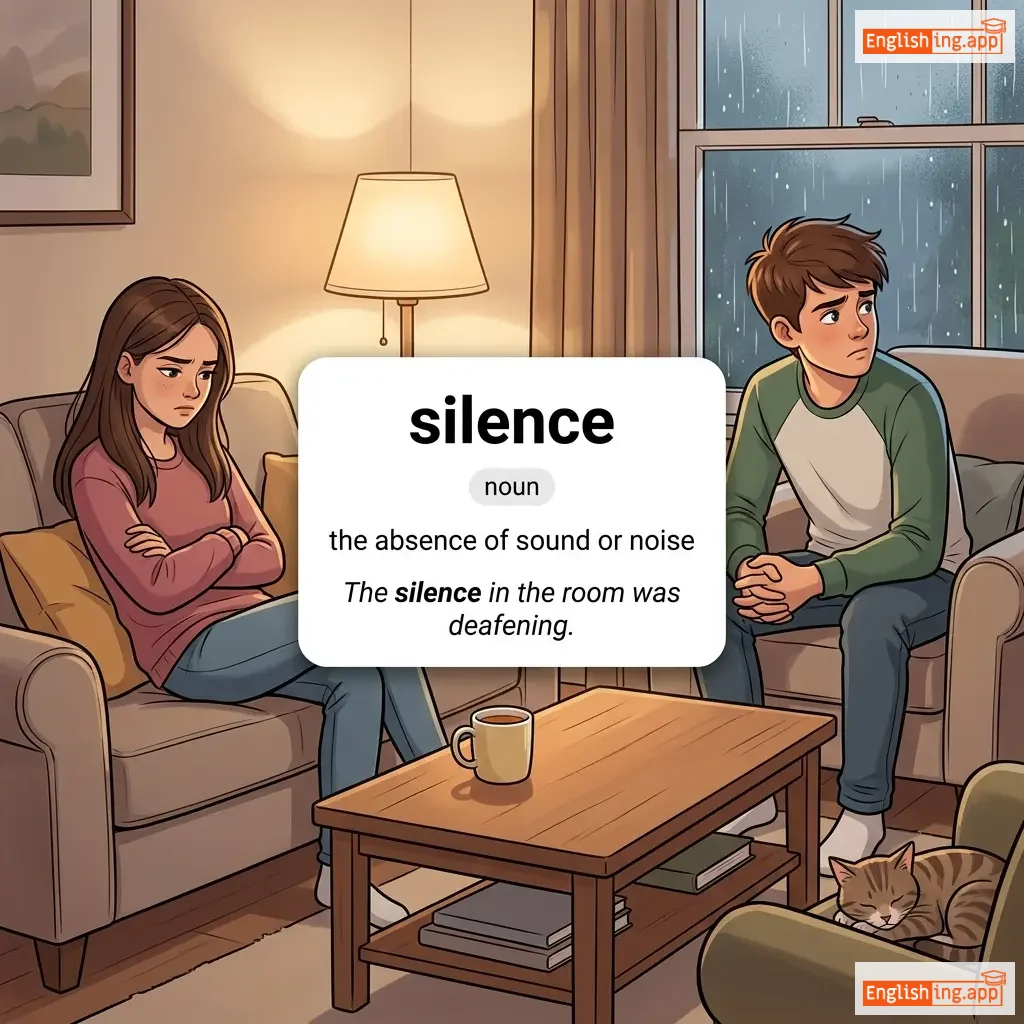
silence definition card — visual illustration of the meaning
noun
/ˈsaɪləns/
मौन (maun)

the absence of sound or noise

"The silence in the room was deafening."

"कमरे में मौन था जो कान फाड़ने वाला था।" (Kamre mein maun tha jo kaan faadne wala tha.)
adjective
/ˈsaɪlənt/
मौन (maun)

not speaking or making noise

"The room was silent as everyone waited for the announcement."

"कमरा मौन था जैसे सभी घोषणा के लिए इंतजार कर रहे थे।" (Kamra maun tha jaise sabhi ghoshna ke liye intezar kar rahe the.)
noun
/sɪlk/
रेशम (resham)

a fine, smooth fabric made from the threads produced by silkworms

"The dress was made of pure silk."

"उस ड्रेस को शुद्ध रेशम से बनाया गया था।" (Us dress ko shuddh resham se banaya gaya tha.)
noun
/sɪlk klɔːθ/
रेशमी कपड़ा (reshami kapda)

fabric made from natural fibers produced by silkworms

"The bride wore a beautiful dress made of silk cloth."

"दुल्हन ने रेशमी कपड़ा से बनी एक सुंदर ड्रेस पहनी थी।" (dulhan ne reshami kapda se bani ek sundar dress pehni thi.)
noun
/ˈsɪlk.wɜːrm/
रेशम कीट (resham keet)

the caterpillar of a moth that produces silk fibers used to make silk fabric

"Silkworms feed on mulberry leaves to produce silk."

"रेशम कीट तूत के पत्तों पर खिलाते हैं और रेशम उत्पन्न करते हैं।" (resham keet toot ke patton par khilate hain aur resham utpann karte hain)
adjective
/ˈsɪlkən/
रेशमी; मुलायम; चिकना; (silken)

made of silk; smooth and soft like silk

"She wore a beautiful silken dress to the party."

"वह पार्टी में एक सुंदर रेशमी ड्रेस पहनकर आई।" (vah party mein ek sundar reshmi dress pehankar aayi.)
adjective
/ˈsɪli/
मूर्ख (murkh)

showing a lack of good sense; foolish or playful

"He made a silly mistake on the test."

"उसने परीक्षा में एक मूर्खता भरी गलती की।" (Usne pariksha mein ek murkhta bhari galti ki.)
noun
/sɪlt/
कीचड़ (keechad)

Fine sand, clay, or other material carried by running water and deposited as a sediment.

"The river deposited layers of silt along its banks."

"नदी ने अपनी तटरेखाओं के साथ कीचड़ की परतें जमा की।" (Nadi ne apni tatrekhaon ke saath keechad ki paratein jama ki.)
noun, adjective
/ˈsɪlvər/
चांदी (chaandi)

a shiny gray-white metal, often used for coins, jewelry, and decoration

"She wore a beautiful silver necklace for the party."

"उसने पार्टी के लिए एक सुंदर चांदी की हार पहना।" (Usne party ke liye ek sundar chaandi ki haar pehna.)
noun
/ˈsɪlvər kɑrp/
रजत मछली (rajat machhli)

a large freshwater fish with silvery scales, commonly farmed for food

"Silver carp is widely cultivated in fish farms across Asia."

"रजत मछली एशिया भर में मछली के खेतों में व्यापक रूप से पाली जाती है।" (rajat machhli eshiya bhar me machhli ke kheton me vyapak roop se pali jati hai.)
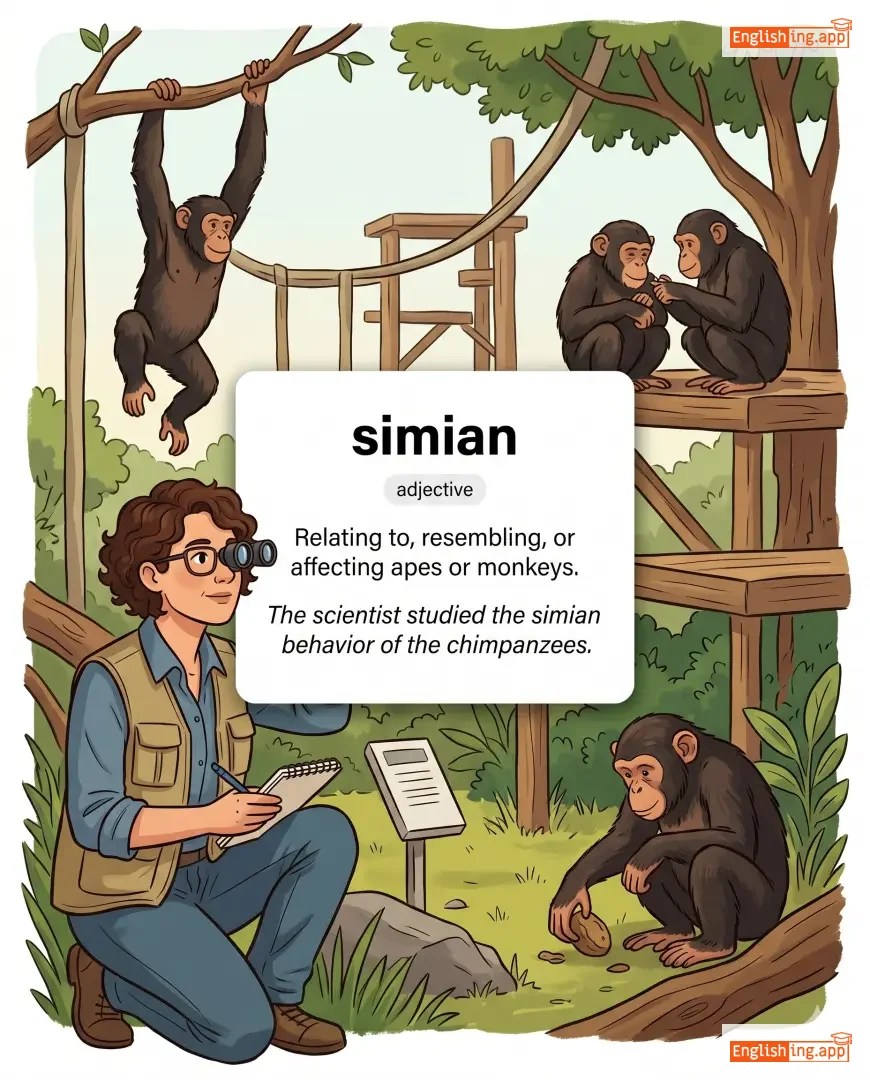
simian definition card — visual illustration of the meaning
adjective
/ˈsɪmiən/
मनुष्य से मिलता-जुलता (manushya se milta-julta)

Relating to, resembling, or affecting apes or monkeys.

"The scientist studied the simian behavior of the chimpanzees."

"वैज्ञानिक ने चिम्पांजी के मानव जैसे व्यवहार का अध्ययन किया।" (Vaigyanik ne chimpanzee ke manushya jaise vyavhaar ka adhyayan kiya.)
adjective
/ˈsɪmɪlər/
समान (samaan)

Having a resemblance in appearance, character, or quantity, without being identical.

"The twins wore similar clothes to the party."

"जुड़वां बच्चों ने पार्टी में समान कपड़े पहने थे।" (Judwa bachon ne party mein samaan kapde pehene the.)
noun
/ˌsɪmɪˈlærəti/
सादृश्य (sadrishya)

the state of being alike or having characteristics in common

"There is a strong similarity between the two paintings."

"दो पेंटिंग्स के बीच एक मजबूत समानता है।" (Do paintings ke beech ek majboot samanata hai.)
adverb
/ˈsɪmɪlərli/
समान रूप से (samaan roop se)

in a similar way

"Similarly, we can achieve success with dedication and hard work."

"समान रूप से, हम समर्पण और कड़ी मेहनत के साथ सफलता प्राप्त कर सकते हैं।" (Samaan roop se, hum samarpan aur kathin mehnat ke saath safalta prapt kar sakte hain.)
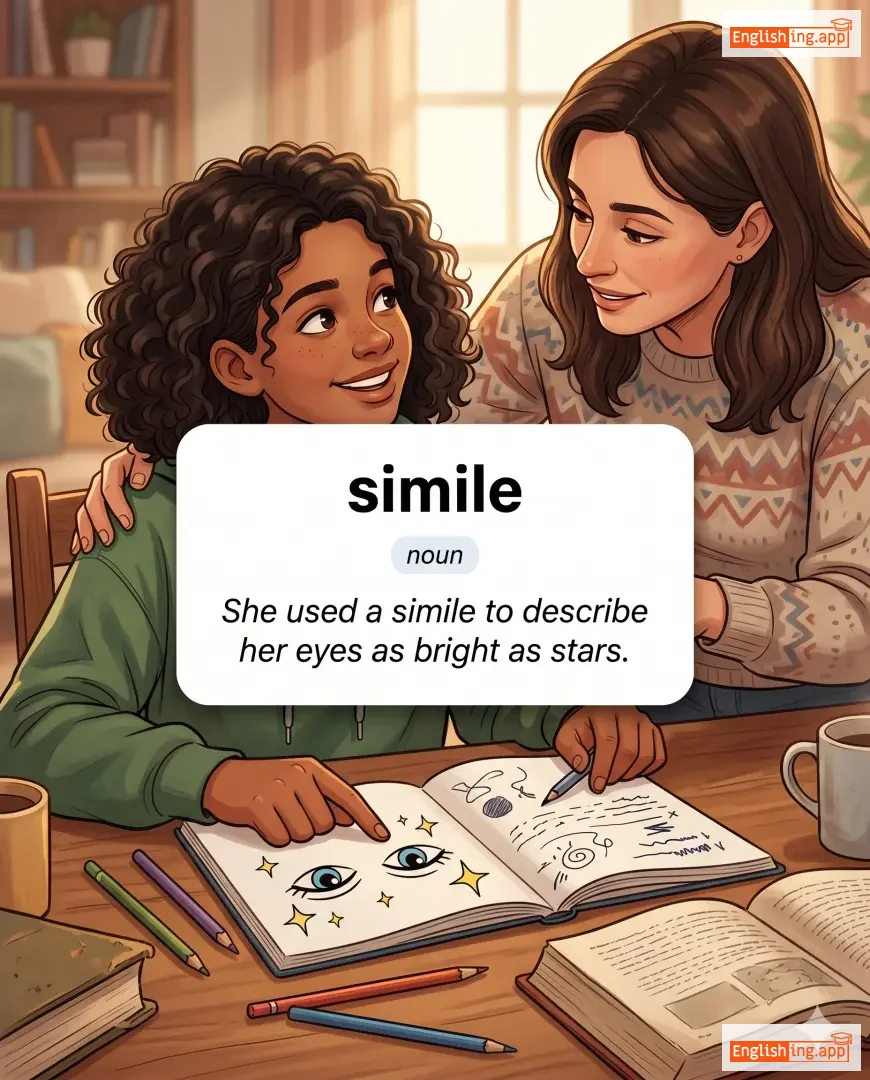
simile definition card — visual illustration of the meaning
noun
/ˈsɪməli/
उपमा (upma)

A figure of speech involving the comparison of one thing with another using 'like' or 'as'.

"She used a simile to describe her eyes as bright as stars."

"उसने अपनी आँखों को सितारों के समान चमकदार बताने के लिए एक उपमा का प्रयोग किया।" (Usne apni aankhon ko sitaron ke saman chamakdaar batane ke liye ek upma ka prayog kiya.)
noun
/sɪˈmɪlɪˌtjuːd/
सादृश्यता (sadrishyata)

The quality or state of being similar; resemblance or likeness.

"There is a striking similitude between the two paintings."

"दो पेंटिंग्स के बीच एक उत्तेजक सादृश्यता है।" (Do paintings ke beech ek uttejak sadrishyata hai.)
verb
/ˈsɪmpər/
बेवकूफी से हंसना (bewakoofi se hansna)

to smile in a silly, self-conscious, or affected way

"She simpered at his compliment, clearly embarrassed."

"वह उसके प्रति प्रशंसा पर बेवकूफी से हंसी, स्पष्ट रूप से शर्मिंदा थी।" (Vah uske prati prashansa par bewakoofi se hansi, spasht roop se sharminda thi.)
Simple definition card — visual illustration of the meaning
adjective
/ˈsɪmpəl/
सरल (sarl)

easy to understand or do; not complicated

"The instructions were simple and easy to follow."

"निर्देश सरल थे और अनुसरण करना आसान था।" (Nirdesh saral the aur anusaran karna aasan tha.)
noun
/ˈsɪmpəltən/
मूर्ख व्यक्ति (moorkh vyakti)

a foolish or gullible person

"They treated him like a simpleton who could not understand anything complex."

"उन्होंने उसे एक मूर्ख व्यक्ति की तरह ट्रीट किया जो कुछ भी जटिल नहीं समझ सकता था।" (Unhone use ek moorkh vyakti ki tarah treat kiya jo kuch bhi jatil nahi samajh sakta tha.)
noun
/sɪmˈplɪsɪti/
सरलता; स्पष्टता (sarlata; spashtata)

the quality of being simple; lack of complexity or intricacy

"The beauty of the design lies in its simplicity."

"डिजाइन की सुंदरता इसकी सरलता में निहित है।" (design ki sundarta iski sarlata mein nihit hai.)
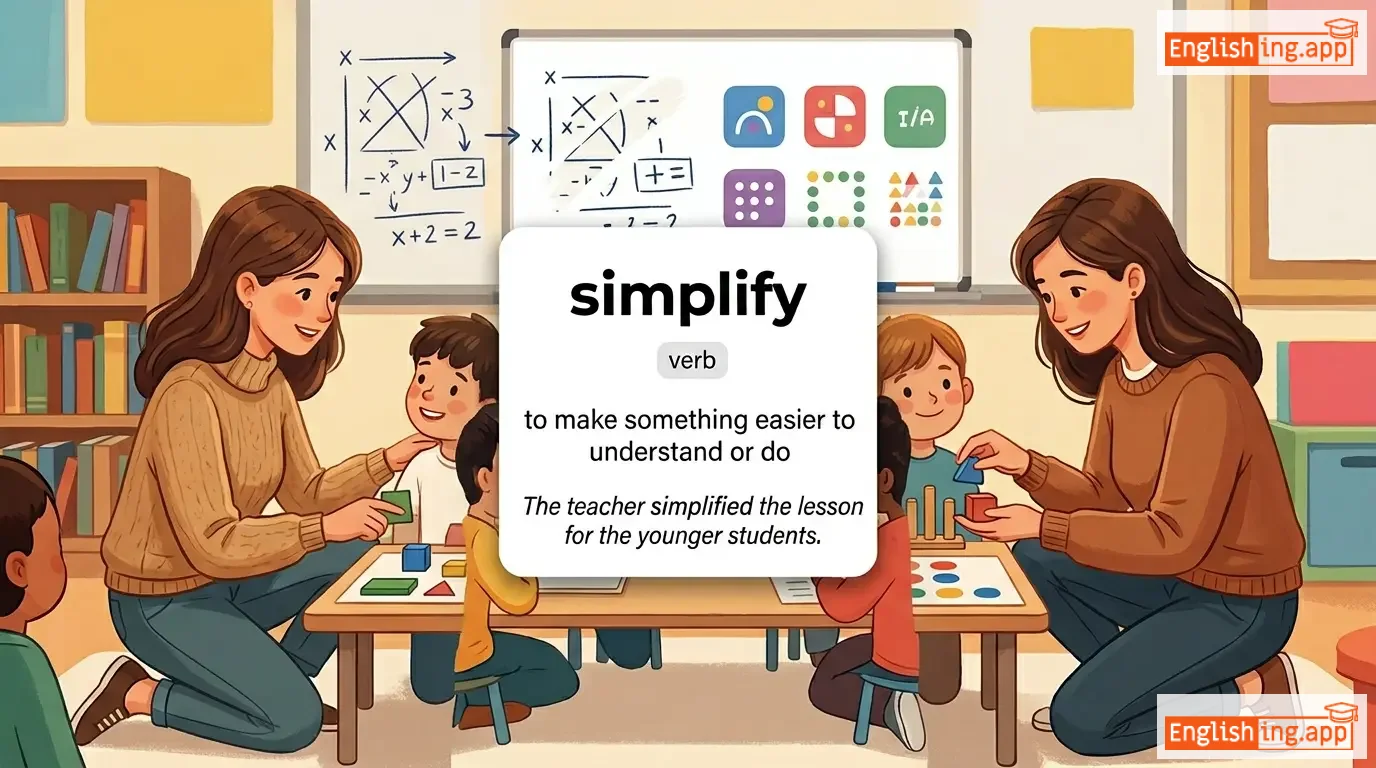
simplify definition card — visual illustration of the meaning
verb
/ˈsɪmplɪˌfaɪ/
सरल बनाना (sarl banana)

to make something easier to understand or do

"The teacher simplified the lesson for the younger students."

"शिक्षक ने छोटे छात्रों के लिए पाठ को सरल बना दिया।" (Shikshak ne chhote chhatron ke liye path ko saral bana diya.)
adjective
/sɪmˈplɪstɪk/
अत्यधिक सरलित (atyadhik saralit)

treating complex issues as if they were much simpler than they really are

"His explanation was too simplistic and ignored key details."

"उसकी व्याख्या अत्यधिक सरलित थी और महत्वपूर्ण विवरणों की अनदेखी की थी।" (Uski vyakhya atyadhik saralit thi aur mahatvapurn vivaron ki andekhi ki thi.)
adverb
/ˈsɪmpli/
सरलता से (sarlata se)

in a clear and easy to understand manner

"She explained the concept simply and clearly."

"उसने उस अवधारणा को सरलता से और स्पष्ट रूप से समझाया।" (Usne us avdharana ko sarlata se aur spasht roop se samjhaya.)
noun
/ˌsɪmjʊˈleɪkrəm/
अनुकरण (anukaran)

an image or representation of someone or something; a superficial likeness

"The statue was only a simulacrum of the ancient god."

"प्रतिमा केवल प्राचीन देवता का अनुकरण थी।" (Pratima keval prachin devta ka anukaran thi.)
verb
/ˈsɪmjʊˌleɪt/
अनुकरण करना (anukaran karna)

to imitate the appearance, character, or behavior of something; to pretend or reproduce conditions artificially

"The pilot had to simulate an emergency landing during training."

"पायलट को प्रशिक्षण के दौरान एक आपातकालीन लैंडिंग का अनुकरण करना पड़ा।" (Pailat ko prashikshan ke dauran ek aapatkalin landing ka anukaran karna pada.)
simulated definition card — visual illustration of the meaning
adjective
/ˈsɪm.jʊ.leɪ.tɪd/
अनुकरणीय (anukaraniya)

Artificially created to look real but not actually real.

"The pilot trained in a simulated flight environment."

"पायलट एक अनुकरणीय उड़ान वातावरण में प्रशिक्षित हुआ।" (Pilot ek anukaraniya udan vatavaran mein prashikshit hua.)
noun
/saɪz/
आकार (aakaar)

the physical dimensions, proportions, or magnitude of something

"This shirt is too small in size for me."

"यह शर्ट मेरे लिए आकार में बहुत छोटी है।" (Yeh shirt mere liye aakaar mein bahut chhoti hai.)
noun
/ˈsaɪrən/
सायरन (sairen)

A device that makes a loud prolonged sound as a signal or warning; in mythology, a creature that lures sailors with enchanting songs.

"The police car passed with its siren blaring."

"पुलिस की कार अपनी सायरन की आवाज़ के साथ पास हुई।" (Police ki car apni sairen ki aawaz ke saath paas hui.)
noun
/sɪˈrɒkoʊ/
गर्म, शुष्क हवा (garm, shushk hawa)

A hot, dry wind blowing from North Africa across the Mediterranean to southern Europe.

"The sirocco made the city unbearably hot and dusty."

"सिरोक्को ने शहर को असहनीय गर्म और धूल भरा बना दिया।" (Sirocco ne shahar ko asahniya garm aur dhool bhara bana diya.)
noun
/ˈsɪstər/
बहन (bahan)

a female sibling; a girl or woman in relation to other children of her parents

"My sister is coming to visit us next week."

"मेरी बहन अगले सप्ताह हमसे मिलने आ रही है।" (meri bahan agle saptah humse milne aa rahi hai)
noun
/ˈsɪstərhʊd/
बहनें का संबंध (bahnen ka sambandh)

The relationship between sisters, or a community of women united by shared experiences or goals.

"The feminist movement created a strong sense of sisterhood among women."

"नारीवादी आंदोलन ने महिलाओं के बीच बहनें के संबंध का एक मजबूत एहसास पैदा किया।" (Naareevaadee aandolan ne mahilaon ke beech behne ke sambandh ka ek majboot ehsaas paida kiya.)
verb
/sɪt/
बैठना (baithna)

to rest with the body supported by the buttocks, often in a chair or on the ground

"Please sit down and relax for a while."

"कृपया बैठ जाइए और थोड़ी देर आराम कीजिए।" (Kripya baith jaiye aur thodi der aaram kijiye.)
noun
/sɪˈtɑːr/
सितार (sitar)

a traditional Indian stringed musical instrument with a long neck and resonating body

"The sitar creates beautiful ragas in Indian classical music."

"सितार भारतीय शास्त्रीय संगीत में सुंदर राग उत्पन्न करता है।" (sitar bhartiya shastriya sangeet mein sundar raag utpann karta hai)
noun
/saɪt/
स्थान (sthan)

a location or place, often used for a specific purpose, such as a construction site or a website

"The construction site is ready for the next phase of the project."

"निर्माण स्थल अगली परियोजना चरण के लिए तैयार है।" (Nirman sthal agli pariyojna charan ke liye tayar hai.)
adjective
/ˈsɪtʃueɪtɪd/
स्थित (sthit)

located in a particular place or position

"The hotel is situated near the beach."

"होटल समुद्र तट के पास स्थित है।" (Hotel samudra tat ke paas sthit hai.)
noun
/ˌsɪtʃʊˈeɪʃən/
स्थिति (stithi)

a set of circumstances or state of affairs at a particular time

"The situation at work became difficult after the new policies were introduced."

"नए नीतियों के लागू होने के बाद कार्यस्थल की स्थिति कठिन हो गई।" (Naye neetiyon ke laagu hone ke baad karyasthal ki sthiti kathin ho gayi.)
noun
/sɪks/
छह (chhah)

the number 6

"There are six apples on the table."

"टेबल पर छह सेब हैं।" (Tebal par chhah seb hain.)
adjective
/sɪksθ/
छठा (chhatha)

coming after the fifth in order, position, or rank

"He finished the race in sixth place."

"वह दौड़ में छठे स्थान पर समाप्त हुआ।" (Vah daud mein chhathe sthan par samaapt hua.)
noun
/skɪf/
छोटा नाव (chhota naav)

a small, light boat usually for one person

"The fisherman paddled his skiff across the lake."

"मछुआरे ने अपनी छोटी नाव को झील के पार पैडल किया।" (Machhuaare ne apni chhoti naav ko jheel ke paar pedal kiya.)
adjective
/ˈskɛtʃi/
अधूरा (adhura)

not thorough or detailed; suspicious or unsafe

"The details of the project were still sketchy."

"प्रोजेक्ट के विवरण अभी भी अधूरे थे।" (Project ke vivaran abhi bhi adhure the.)
verb
/skiː/
स्की करना (ski karna)

to glide over snow on skis

"We went skiing in the Alps last winter."

"हम पिछले सर्दी में आल्प्स में स्की करने गए थे।" (Hum pichle sardi mein Alps mein ski karne gaye the.)
sketch definition card — visual illustration of the meaning
noun
/skɛtʃ/
रूपरेखा (rooprekha)

a simple, rough drawing or outline

"He made a quick sketch of the landscape."

"उसने परिदृश्य का एक त्वरित रूपरेखा बनाई।" (Usne paridrishya ka ek tvarit rooprekha banayi.)
adjective
/ˈskɪlfʊl/
कुशल; निपुण; माहिर (kushal; nipun; maahir)

having or showing skill; expert and accomplished

"The skilful surgeon performed the operation with great precision."

"कुशल सर्जन ने ऑपरेशन को उच्च सटीकता के साथ किया।" (kushal surgeon ne operation ko uchch sathikta ke saath kiya.)
noun
/ˌsɪmjuˈleɪʃən/
अनुकरण (anukaran)

the imitation of a situation or process

"The simulation helped the students understand the complex theory."

"सिमुलेशन ने छात्रों को जटिल सिद्धांत समझने में मदद की।" (Simulation ne chhatron ko jatil siddhant samajhne mein madad ki.)