वोकैबुलरीज

इंग्लिश वोकैबुलरी डिस्कवर, लर्न और मास्टर करें

noun
/ˈboʊlər/
बॉलर (bolar)

a person who delivers the ball in cricket; also a type of hard felt hat with a rounded crown

"The bowler took three wickets in the first over."

"बॉलर ने पहले ओवर में तीन विकेट लिए।" (bolar ne pehle over mein teen wicket liye.)
noun
/əˈwɛərnəs/

knowledge or perception of a situation, fact, or issue

"Public awareness of climate change is increasing."

adjective
/əˈwɒʃ/
पानी से भरा हुआ (pani se bhara hua)

covered or flooded with water or something in large quantities

"The market was awash with cheap imported goods."

"बाजार सस्ते आयातित सामान से अवाश था।" (Bazar saste ayatith saman se awash tha.)
🏃‍♂️

Away (अवे)

adverb
/əˈweɪ/
दूर (door)

at a distance from a particular place, person, or thing

"She walked away without saying a word."

"वह बिना एक शब्द कहे चली गई।" (Vah bina ek shabd kahe chali gayi.)
noun
/ɔː/
आश्चर्य (aashcharya)

a feeling of deep respect mixed with fear or wonder

"The children looked at the fireworks in awe."

"बच्चे आतिशबाजी को आश्चर्य से देख रहे थे।" (Bacche aatishbazi ko aashcharya se dekh rahe the.)
adjective
/ˈɔːfəl/
भयानक (bhayanak)

very bad or unpleasant

"The weather was awful during our trip."

"हमारी यात्रा के दौरान मौसम भयानक था।" (Hamari yatra ke dauran mausam bhayanak tha.)
adverb
/ˈɔːfəli/
बहुत ज़्यादा (bahut zyada)

in a very great degree; extremely; in a way that is very bad or unpleasant

"I am awfully glad to see you again."

"तुमसे फिर मिलकर मैं बहुत ज़्यादा खुश हूँ।" (tumse phir milkar main bahut zyada khush hoon)
adjective
/ˈɔːkwəd/
अजीब (ajeeb)

causing or feeling embarrassment; difficult to deal with

"There was an awkward silence after his joke."

"उसकी जोक के बाद एक अजीब खामोशी थी।" (Uski joke ke baad ek ajeeb khamoshi thi.)
noun
/ɔːl/
आल (aal)

a small pointed tool used for making holes, especially in leather

"The cobbler used an awl to punch holes in the leather."

"जूते वाले ने चमड़े में छेद करने के लिए आल का इस्तेमाल किया।" (Joote wale ne chamde mein chhed karne ke liye aal ka istemal kiya.)
noun
/ˈɔːnɪŋ/
छतरी (chhatri)

a sheet of canvas or material stretched on a frame to shelter a place from the sun or rain

"We sat under the awning to avoid the heavy rain."

"हम भारी बारिश से बचने के लिए छतरी के नीचे बैठे थे।" (Hum bhaari baarish se bachne ke liye chhatri ke neeche baithe the.)
adverb
/əˈraɪ/
गलत (galat)

away from the expected or proper direction; wrong or amiss

"The plan went awry when the weather suddenly changed."

"मौसम अचानक बदलने पर योजना गलत हो गई।" (Mausam achanak badalne par yojana galat ho gayi.)
noun
/æks/
axes (axes)

a tool with a heavy blade for cutting wood

"The lumberjack swung his axe to chop the tree."

"लकड़हारा पेड़ काटने के लिए अपनी कुल्हाड़ी घुमा रहा था।" (lakadhara ped kaatne ke liye apni kulhaadi ghuma raha tha.)
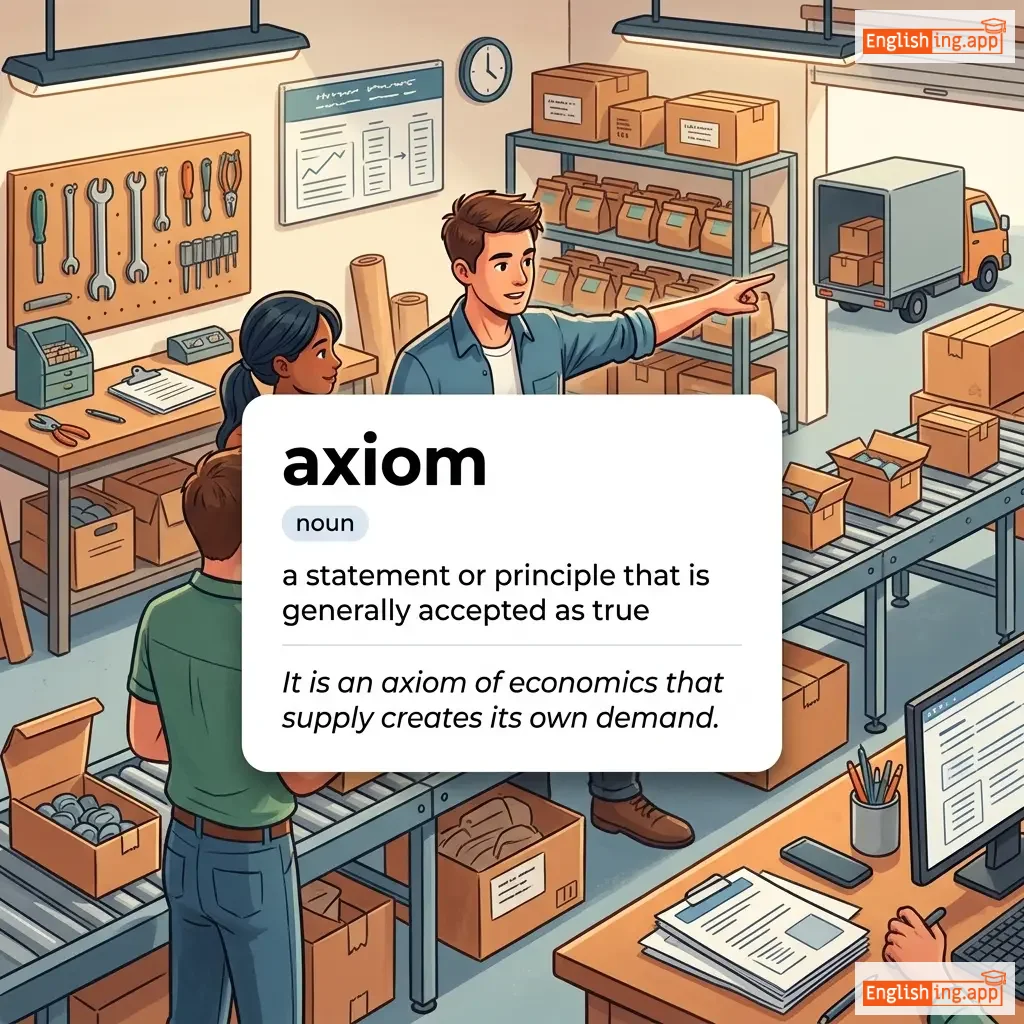
axiom definition card — visual illustration of the meaning
noun
/ˈæk.si.əm/
सिद्धांत (siddhant)

a statement or principle that is generally accepted as true

"It is an axiom of economics that supply creates its own demand."

"यह एक आर्थिक सिद्धांत है कि आपूर्ति अपनी मांग उत्पन्न करती है।" (Yeh ek aarthik siddhant hai ki aapoorti apni maang utpann karti hai.)
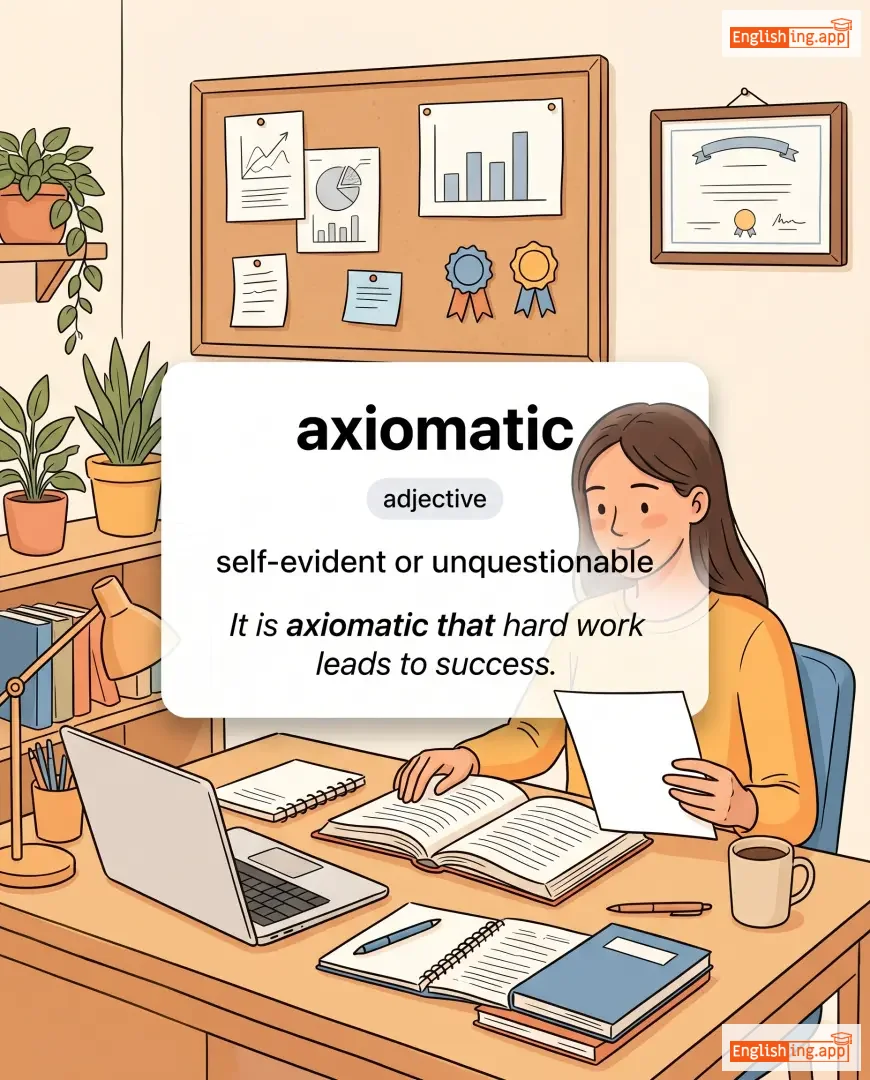
axiomatic definition card — visual illustration of the meaning
adjective
/ˌæk.si.əˈmæt.ɪk/
स्वत:सिद्ध (svatah-siddh)

self-evident or unquestionable

"It is axiomatic that hard work leads to success."

"यह स्वत:सिद्ध है कि कठिन परिश्रम सफलता की ओर ले जाता है।" (Yeh svatah-siddh hai ki kathin parishram safalta ki or le jata hai.)
noun
/aɪ/
हाँ (haan)

an affirmative vote or expression of agreement

"The committee voted aye on the proposal."

"कमिटी ने प्रस्ताव पर हाँ वोट किया।" (Kumiti ne prastaav par haan vote kiya.)
noun
/əˈzeɪ.li.ə/
अज़ालिया फूल (azaliya phool)

a flowering shrub with brightly colored blooms, often grown ornamentally

"The garden was full of blooming azaleas in spring."

"बग़ीचे में वसंत में अज़ालिया फूल खिले हुए थे।" (Bagiche mein vasant mein azaliya phool khile huye the.)
adjective
/ˈæʒər/
आज़्योर (aazyor)

A bright blue color like that of a clear sky.

"The clear sky was painted in a deep shade of azure."

"साफ आसमान गहरे आज़्योर रंग में रंगा हुआ था।" (saaf aasman gahare aazyor rang mein ranga hua tha.)
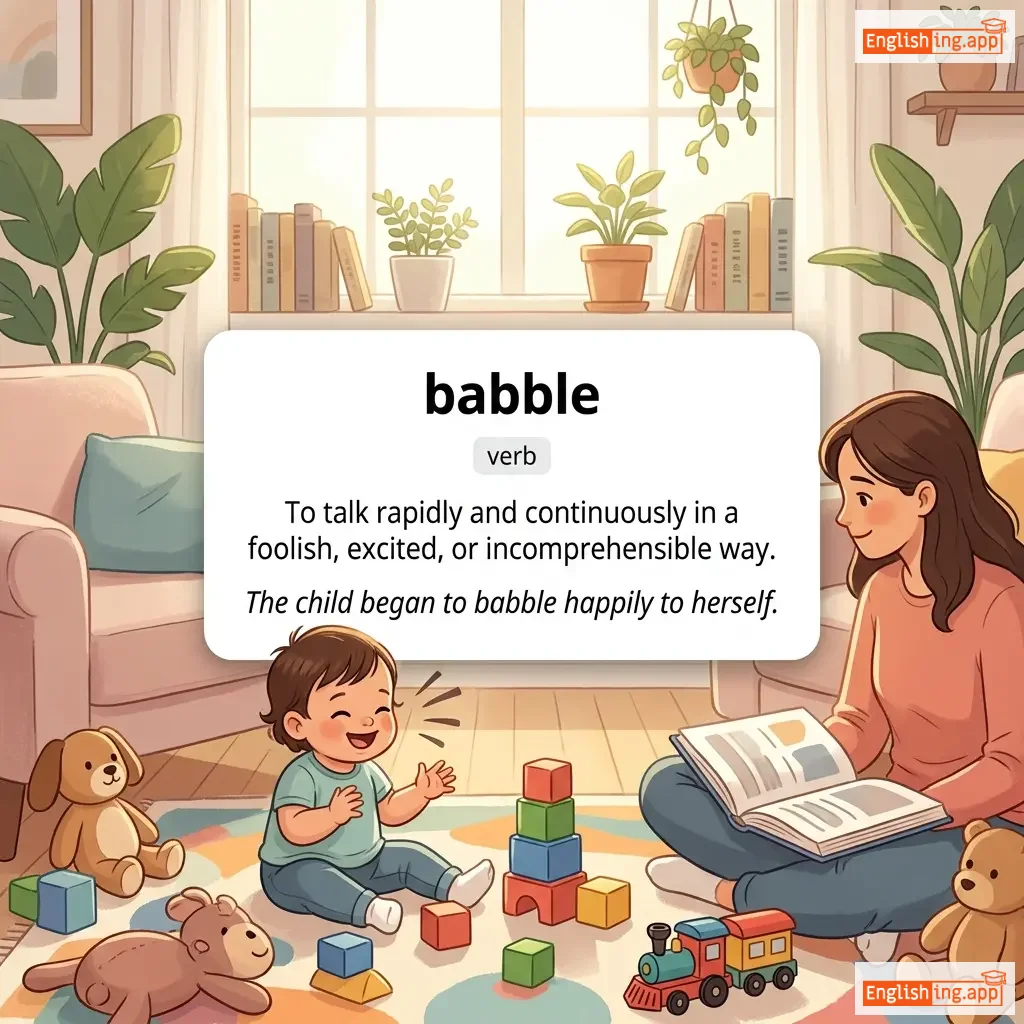
babble definition card — visual illustration of the meaning
verb
/ˈbæbəl/
अर्थहीन बकबक करना (arthheen bakbak karna)

To talk rapidly and continuously in a foolish, excited, or incomprehensible way.

"The child began to babble happily to herself."

"बच्ची खुशी से खुद से बकबक करने लगी।" (bachchi khushi se khud se bakbak karne lagi.)
noun
/bəˈbuːn/
बबून (baboon)

a large African and Arabian primate with a dog-like snout and colorful buttocks

"The baboon troop gathered around the watering hole in the savanna."

"बबून का झुंड सवाना में पानी के गड्ढे के चारों ओर इकट्ठा हुआ।" (baboon ka jhund savana mein paani ke gaddhe ke chaaron or ikattha hua.)
noun
/ˈbeɪbi/
शिशु (shishu)

a very young child, especially one newly or recently born

"The baby is sleeping peacefully in the crib."

"बच्चा शांति से पालने में सो रहा है।" (bachcha shanti se paalne mein so raha hai.)
noun
/ˈbækənæl/
उत्तेजक पार्टी (uttejak party)

A noisy party involving drinking and revelry.

"The festival turned into a wild bacchanal by midnight."

"त्योहार आधी रात तक एक उन्मत्त उत्तेजक पार्टी में बदल गया।" (Tyohar aadhi raat tak ek unmatt uttejak party mein badal gaya.)
noun
/ˌbækəˈneɪliə/
मदिरापान और आनंद के साथ रोमानी उत्सव (madirapan aur anand ke saath romani utsav)

A Roman festival of Bacchus celebrated with dancing, drinking, and revelry; any occasion of wild and drunken revelry.

"The novel describes the party as a bacchanalia of excess and joy."

"उपन्यास पार्टी का वर्णन अत्यधिकता और आनंद के एक मदिरापान और खुशी के उत्सव के रूप में करता है।" (Upanyas party ka varnan atyantata aur anand ke ek madirapan aur khushi ke utsav ke roop mein karta hai.)
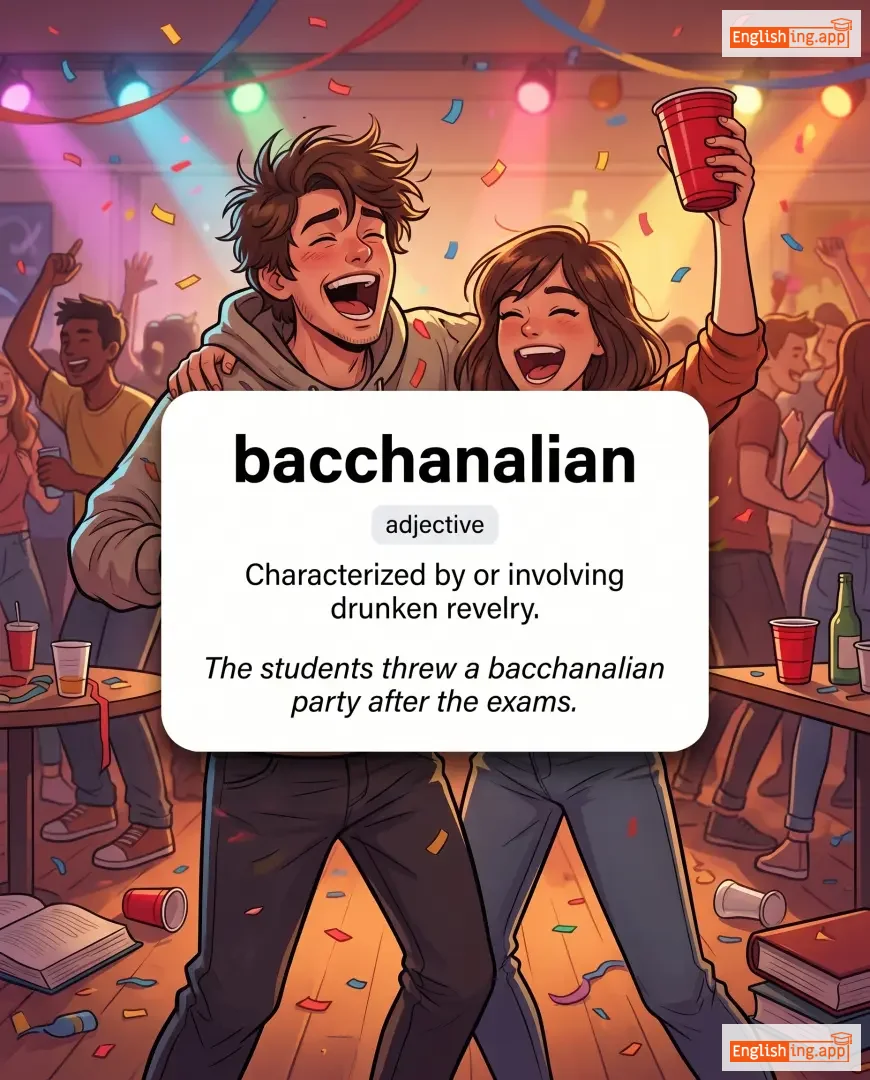
bacchanalian definition card — visual illustration of the meaning
adjective
/ˌbækəˈneɪliən/
मदिरापान से संबंधित (madhirapan se sambandhit)

Characterized by or involving drunken revelry.

"The students threw a bacchanalian party after the exams."

"छात्रों ने परीक्षा के बाद एक मदिरापान से संबंधित पार्टी आयोजित की।" (Chhatron ne pariksha ke baad ek madhirapan se sambandhit party aayojit ki.)
noun
/ˈbætʃələr/
अविवाहित पुरुष; स्नातक (avivahit purush; snatak)

an unmarried man; a person who holds a first degree from a university

"He remained a bachelor all his life and earned a bachelor's degree in engineering."

"वह अपना जीवन एक बैचलर के रूप में जीते रहे और इंजीनियरिंग में स्नातक डिग्री प्राप्त की।" (Wah apna jeevan ek bachelor ke roop mein jeete rahe aur engineering mein snatak degree prapt ki.)
noun/verb/adverb/adjective
/bæk/
पीठ / लौटना (peeth / lautna)

the rear surface of the human body; to support; to return to a place

"He turned back to help his friend."

"वह अपने दोस्त की मदद करने के लिए पीछे मुड़ा।" (Wah apne dost ki madad karne ke liye peeche mudha.)
phrasal verb
/bæk ʌp/
समर्थन करना; डेटा की प्रति बनाना; पीछे हटना (samarthan karna; data ki prati banana; pichhe hatna)

to support or help someone; to make a copy of data for safety; to move backward

"Please back up your files before updating the system."

"सिस्टम अपडेट करने से पहले अपनी फाइलों का बैक अप लें।" (system update karne se pehle apni files ka back up len)
verb
/ˈbækbaɪt/
पीठ पीछे बुराई करना (peeth peeche burai karna)

to speak negatively about someone who is not present; to slander behind someone’s back

"It is wrong to backbite your colleagues behind their backs."

"सहकर्मियों की पीठ पीछे बुराई करना गलत है।" (sahkarmiyon ki peeth peeche burai karna galat hai)
noun
/ˈbækboʊn/
रीढ़ की हड्डी (reed ki haddi)

the spine; the chief support or mainstay; strength of character

"Education is the backbone of a nation."

"शिक्षा एक राष्ट्र की रीढ़ की हड्डी है।" (Shiksha ek rashtr ki reed ki haddi hai.)
noun
/ˈbækdrɒp/
पृष्ठभूमि (prishthabhoomi)

a painted cloth or other structure used behind a stage

"The backdrop for the play was a beautiful mountain scene."

"नाटक के लिए बैकरॉप एक सुंदर पर्वत दृश्य था।" (Natak ke liye backdrop ek sundar parvat drishya tha.)
noun
/ˈbækɡraʊnd/
पृष्ठभूमि (prishthabhoomi)

the circumstances, environment, or past history of a person or thing; the part behind the main subject in an image

"She comes from a strong academic background."

"वह एक मजबूत शैक्षिक पृष्ठभूमि से आती है।" (Woh ek majboot shaikshik prishthabhoomi se aati hai.)
adjective
/ˈbækˌhændɪd/
अप्रत्यक्ष या व्यंग्यात्मक (aprtyaksh ya vyangyatak)

Indirect or sarcastic, often appearing as praise but actually insulting.

"She gave him a backhanded compliment about his work."

"उसने उसके काम पर एक व्यंग्यात्मक प्रशंसा दी।" (Usne uske kaam par ek vyangyatak prashansa di.)
noun
/ˈbækɪŋ/
समर्थन (samarthan)

support or approval for a plan, person, or idea

"The project received strong backing from the investors."

"प्रकल्प को निवेशकों से मजबूत समर्थन मिला।" (Prakalp ko niveshkon se majboot samarthan mila.)
noun
/ˈbækˌsaɪd/
पीछे (peeche)

the rear part or surface of something; informal term for the buttocks

"The kids slid down the hill on their backside."

"बच्चे पहाड़ से अपने पिछवाड़े पर स्लाइड कर गए।" (Bachche pahaad se apne pichwade par slide kar gaye.)
verb
/ˈbækˌslaɪd/
पतन (patan)

To relapse into bad habits, undesirable practices, or moral decline.

"After months of progress, he began to backslide into old habits."

"कुछ महीनों की प्रगति के बाद, वह पुराने आदतों में वापस लौटने लगा।" (Kuch mahino ki pragati ke baad, vah purane aadaton mein wapas lautne laga.)
noun
/ˈbækʌp/
बैकअप (backup)

a copy of data stored separately to protect against loss

"Make sure to have a backup of your important files."

"अपने महत्वपूर्ण फ़ाइलों का बैकअप रखें।" (Apne mahatvapurn files ka backup rakhen.)
adverb
/ˈbækwərdz/
पीछे की ओर (peeche ki or)

Toward the back or in the reverse direction.

"He accidentally fell backwards into the chair."

"वह गलती से पीछे की ओर कुर्सी में गिर गया।" (Wah galti se peeche ki or kursi mein gir gaya.)
noun
/ˌbækˈjɑːrd/
खुशी (khushi)

an area of land behind a house, typically used for recreation or gardening

"The children played football in the backyard."

"वह जब पुरस्कार प्राप्त करती तो अपनी खुशी छिपा नहीं पाई।" (Vah jab puraskar prapt karti to apni khushi chhupa nahi pai.)
adjective
/beɪˈkoʊniən/
बेकनियन (Baconian)

Relating to the philosopher Francis Bacon or his method of scientific reasoning.

"The researcher followed a Baconian approach to observation and experimentation."

"शोधकर्ता ने अवलोकन और प्रयोगात्मकता के लिए बेकोनियन दृष्टिकोण अपनाया।" (Shodhakarta ne avlokan aur prayogatmakta ke liye Baconian drishtikon apnaya.)
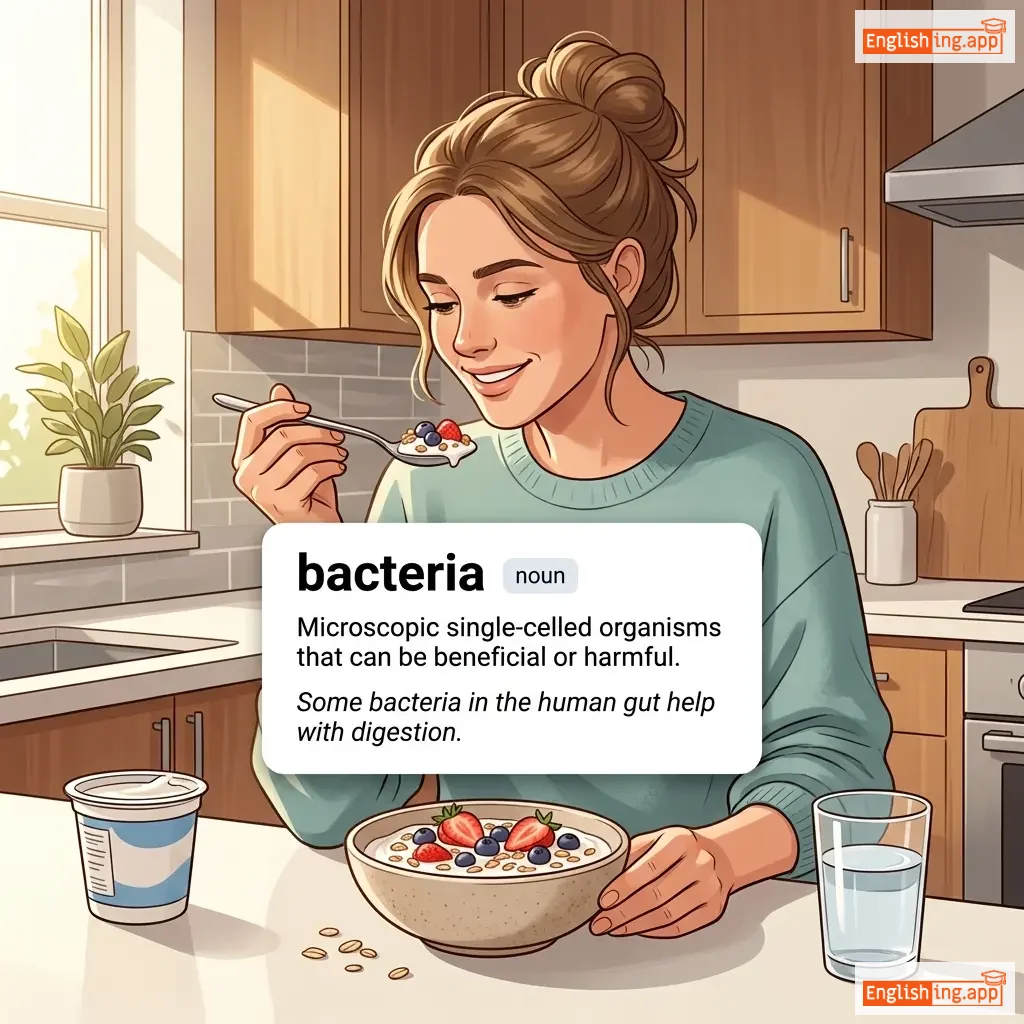
bacteria definition card — visual illustration of the meaning
noun
/bækˈtɪəriə/
बैक्टीरिया (bacteria)

Microscopic single-celled organisms that can be beneficial or harmful.

"Some bacteria in the human gut help with digestion."

"कुछ बैक्टीरिया मानव आंत में पाचन में मदद करते हैं।" (Kuch bacteria manav aant mein pachan mein madad karte hain.)
noun
/bækˈtɪəriəm/
बैटीरिया (bakteria)

A single microscopic organism belonging to the group of bacteria.

"The doctor explained that a single bacterium can multiply rapidly under the right conditions."

"डॉक्टर ने समझाया कि एकल बैक्टीरियम सही परिस्थितियों में तेजी से बढ़ सकता है।" (Doktor ne samjhaya ki ekal bakterium sahi paristhitiyon mein tezi se badh sakta hai.)
adjective
/bæd/
खराब (kharab)

not good; unpleasant, harmful, or of poor quality

"The milk smells bad, so don’t drink it."

"दूध बुरा महकता है, इसलिए इसे मत पीना।" (Doodh bura mahakta hai, isliye ise mat peena.)
noun
/bædʒ/
बैज (baij)

A small emblem or sign worn to show membership, authority, or achievement.

"The police officer showed his badge to identify himself."

"पुलिस अधिकारी ने अपनी बैज से खुद को पहचाना।" (Police adhikari ne apni baij se khud ko pehchana.)
verb
/ˈbædʒər/
परेशान करना, तंग करना (pareshan karna, tang karna)

To repeatedly ask or annoy someone with demands or questions.

"The reporter kept badgering the politician with questions."

"रिपोर्टर ने राजनेता को सवालों से परेशान किया।" (Reporter ne rajneeta ko sawalon se pareshan kiya.)
noun
/ˌbædɪˈnɑːʒ/
हंसी मजाक, मज़ेदार बातचीत (hansi mazak, mazedar baatcheet)

Playful and humorous conversation; banter.

"The friends enjoyed a light badinage over coffee."

"दोस्तों ने कॉफ़ी पर हल्की हंसी मजाक का आनंद लिया।" (Doston ne coffee par halki hansi mazak ka anand liya.)
adverb
/ˈbædli/
बुरी तरह से (buri tarah se)

in a way that is not good; poorly or severely

"He performed badly in the exam."

"उसने परीक्षा में बुरी तरह से प्रदर्शन किया।" (Usne pariksha mein buri tarah se pradarshan kiya.)
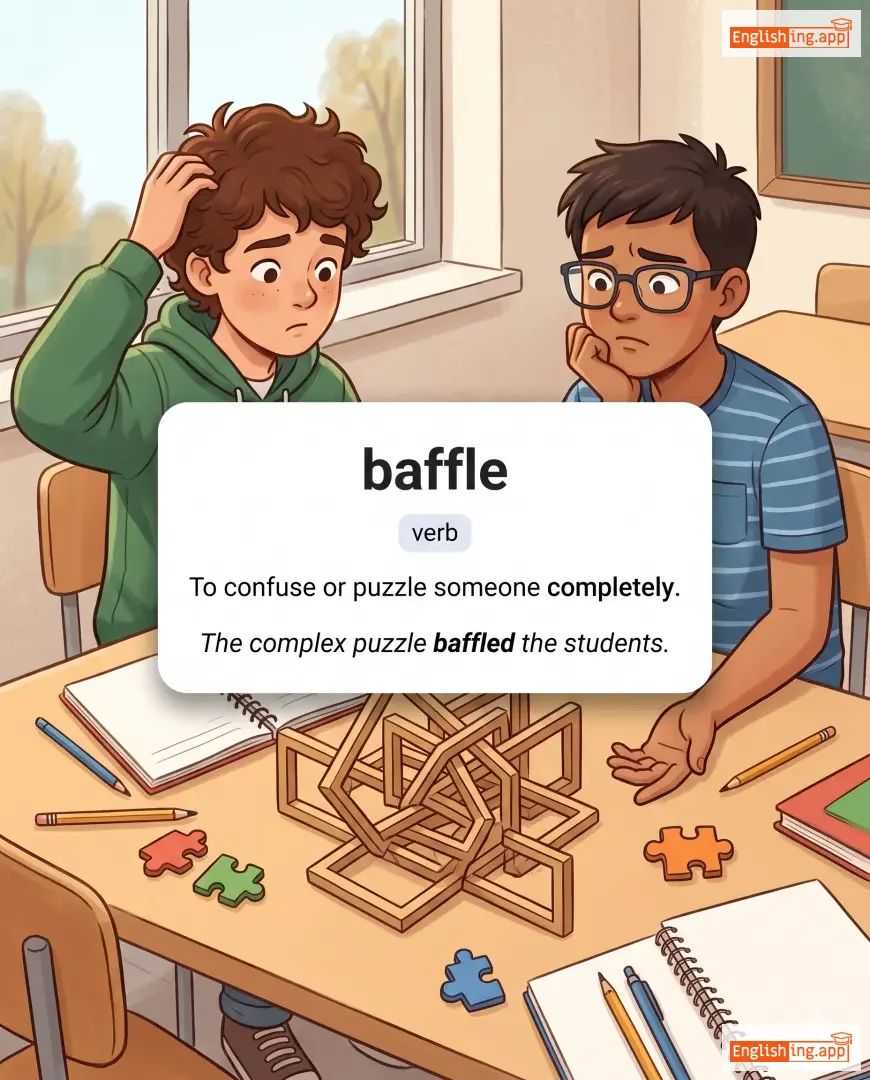
baffle definition card — visual illustration of the meaning
verb
/ˈbæfəl/
भ्रमित करना (bharmit karna)

To confuse or puzzle someone completely.

"The complex puzzle baffled the students."

"जटिल पहेली ने छात्रों को पूरी तरह से भ्रमित कर दिया।" (Jatil paheli ne chhatron ko puri tarah se bhramit kar diya.)
noun
/bæɡ/
बैग (bag)

a container made of flexible material, used for carrying items

"She carried her books in a bag."

"उसने अपनी किताबों को एक बैग में रखा।" (Usne apni kitaabon ko ek bag mein rakha.)
noun
/ˈbæɡɪdʒ/
सामान; यात्रा का सामान; (samaan; yatra ka samaan;)

suitcases and bags containing personal belongings; past experiences or problems that affect behavior

"Please collect your baggage from the conveyor belt at the airport."

"कृपया एयरपोर्ट पर कन्वेयर बेल्ट से अपना बैगेज ले लीजिए।" (Kripya airport par conveyor belt se apna baggage le lijiye.)
noun
/beɪl/
जमानत (jamanat)

the temporary release of an accused person awaiting trial, often with a financial guarantee

"He was granted bail after his arrest."

"उसे गिरफ्तारी के बाद जमानत मिल गई।" (Use girftari ke baad jamanat mil gayi.)
noun
/ˌbeɪˈliː/
जमानत में वस्तु प्राप्त करने वाला (jamanat mein vastu prapt karne wala)

a person or party who temporarily receives possession of goods or property from another under a legal agreement

"The bailee must take reasonable care of the goods while they are in his possession."

"बेइली को वस्तुओं की उचित देखभाल करनी चाहिए।" (beili ko vastuon ki uchit dekhbhaal karni chahiye)