Vocabularios

Descubra, aprenda y domine el vocabulario en inglés

noun
/ˈboʊlər/
lanzador (lanzador)

a person who delivers the ball in cricket; also a type of hard felt hat with a rounded crown

"The bowler took three wickets in the first over."

"El lanzador tomó tres wickets en el primer over." (El lanzador tomo tres wickets en el primer over.)
noun
/əˈwɛərnəs/
conciencia (uhwearness)

knowledge or perception of a situation, fact, or issue

"Public awareness of climate change is increasing."

"La conciencia pública sobre el cambio climático está aumentando." (La conciencia publica sobre el cambio climatico esta aumentando.)
adjective
/əˈwɒʃ/
inundado (inundado)

covered or flooded with water or something in large quantities

"The market was awash with cheap imported goods."

"El mercado estaba inundado de productos importados baratos." (El mercado estaba inundado de productos importados baratos.)
🏃‍♂️

Away (ah-weh)

adverb
/əˈweɪ/
lejos (lejos)

at a distance from a particular place, person, or thing

"She walked away without saying a word."

"Ella se alejó sin decir una palabra." (Ella se alejó sin decir una palabra.)
noun
/ɔː/
asombro (asombro)

a feeling of deep respect mixed with fear or wonder

"The children looked at the fireworks in awe."

"Los niños miraban los fuegos artificiales con asombro." (Los niños miraban los fuegos artificiales con asombro.)
adjective
/ˈɔːfəl/
horrible (horrible)

very bad or unpleasant

"The weather was awful during our trip."

"El clima fue horrible durante nuestro viaje." (El clima fue horrible durante nuestro viaje.)
adverb
/ˈɔːfəli/
terriblemente (terriblemente)

in a very great degree; extremely; in a way that is very bad or unpleasant

"I am awfully glad to see you again."

"Estoy terriblemente contento de verte otra vez." (estoy terriblemente contento de verte otra vez)
adjective
/ˈɔːkwəd/
incómodo (incomodo)

causing or feeling embarrassment; difficult to deal with

"There was an awkward silence after his joke."

"Hubo un silencio incómodo después de su broma." (Hubo un silencio incomodo despues de su broma.)
🛠️

awl (ól)

noun
/ɔːl/
punzón (punzon)

a small pointed tool used for making holes, especially in leather

"The cobbler used an awl to punch holes in the leather."

"El zapatero usó un punzón para hacer agujeros en el cuero." (El zapatero uso un punzon para hacer agujeros en el cuero.)
noun
/ˈɔːnɪŋ/
toldo (toldo)

a sheet of canvas or material stretched on a frame to shelter a place from the sun or rain

"We sat under the awning to avoid the heavy rain."

"Nos sentamos debajo del toldo para evitar la lluvia intensa." (Nos sentamos debajo del toldo para evitar la lluvia intensa.)
adverb
/əˈraɪ/
equivocado (equivocado)

away from the expected or proper direction; wrong or amiss

"The plan went awry when the weather suddenly changed."

"El plan salió mal cuando el clima cambió repentinamente." (El plan salió mal cuando el clima cambió repentinamente.)
noun
/æks/
hacha (hacha)

a tool with a heavy blade for cutting wood

"The lumberjack swung his axe to chop the tree."

"El leñador balanceó su hacha para cortar el árbol." (El leñador balanceó su hacha para cortar el árbol.)
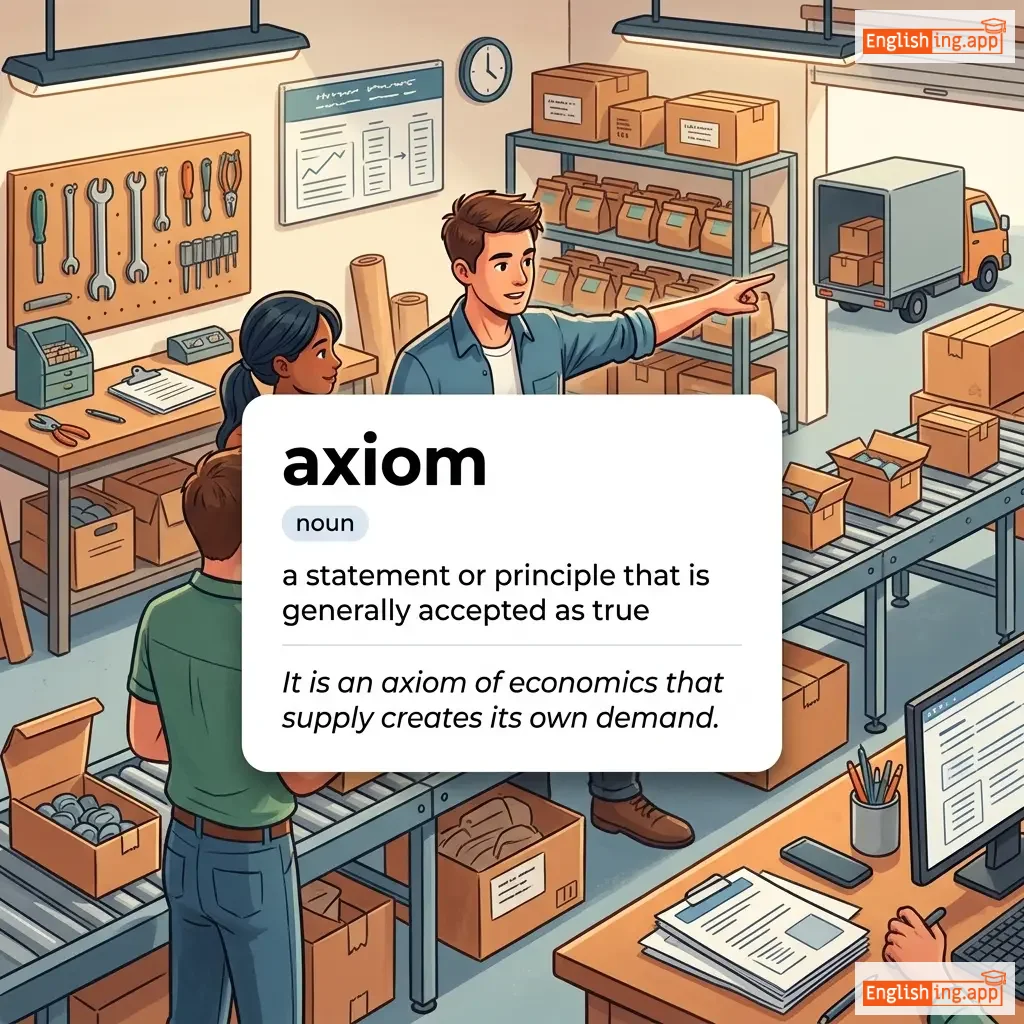
axiom definition card — visual illustration of the meaning
noun
/ˈæk.si.əm/
axioma (axioma)

a statement or principle that is generally accepted as true

"It is an axiom of economics that supply creates its own demand."

"Es un axioma de la economía que la oferta crea su propia demanda." (Es un axioma de la economia que la oferta crea su propia demanda.)
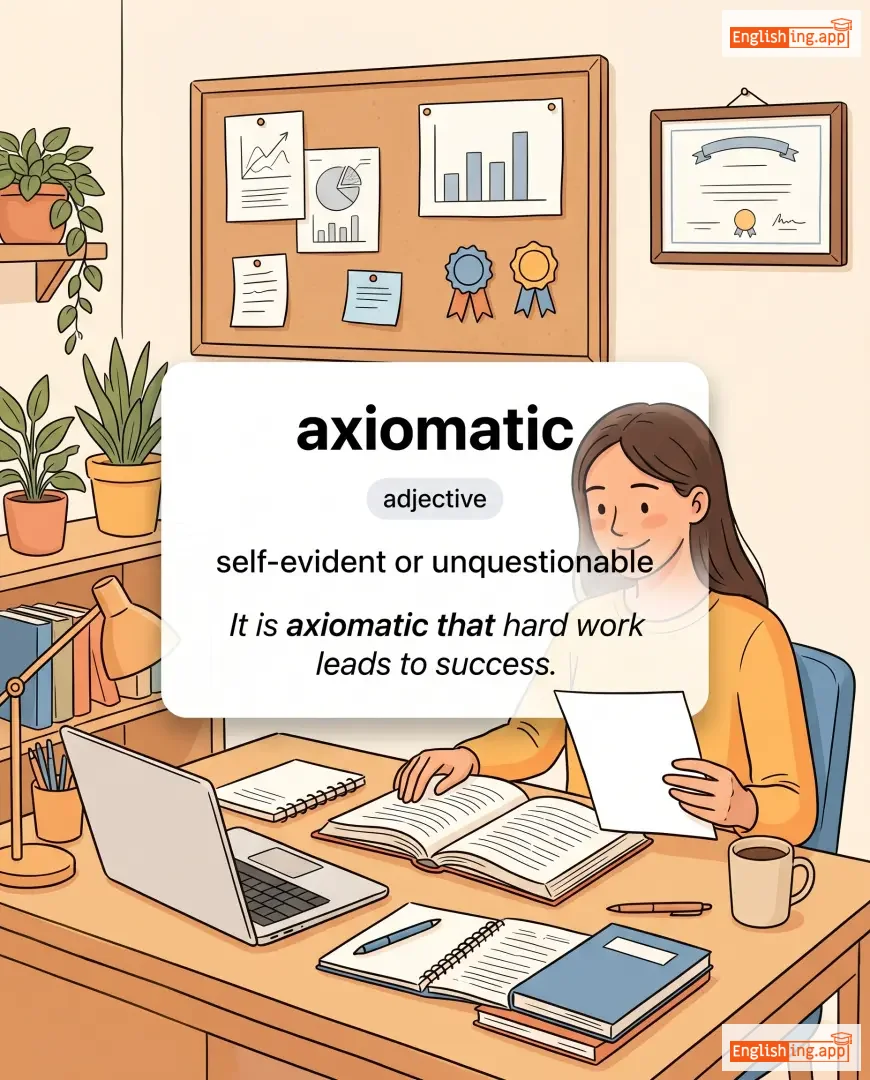
axiomatic definition card — visual illustration of the meaning
adjective
/ˌæk.si.əˈmæt.ɪk/
axiomático (axiomático)

self-evident or unquestionable

"It is axiomatic that hard work leads to success."

"Es axioma que el trabajo duro lleva al éxito." (Es axioma que el trabajo duro lleva al éxito.)
noun
/aɪ/
(si)

an affirmative vote or expression of agreement

"The committee voted aye on the proposal."

"El comité votó sí en la propuesta." (El comite voto si en la propuesta.)
noun
/əˈzeɪ.li.ə/
azalea (azalea)

a flowering shrub with brightly colored blooms, often grown ornamentally

"The garden was full of blooming azaleas in spring."

"El jardín estaba lleno de azaleas floreciendo en primavera." (El jardín estaba lleno de azaleas floreciendo en primavera.)
adjective
/ˈæʒər/
azur (azur)

A bright blue color like that of a clear sky.

"The clear sky was painted in a deep shade of azure."

"El cielo claro fue pintado con un profundo tono de azul." (El cielo claro fue pintado con un profundo tono de azul.)
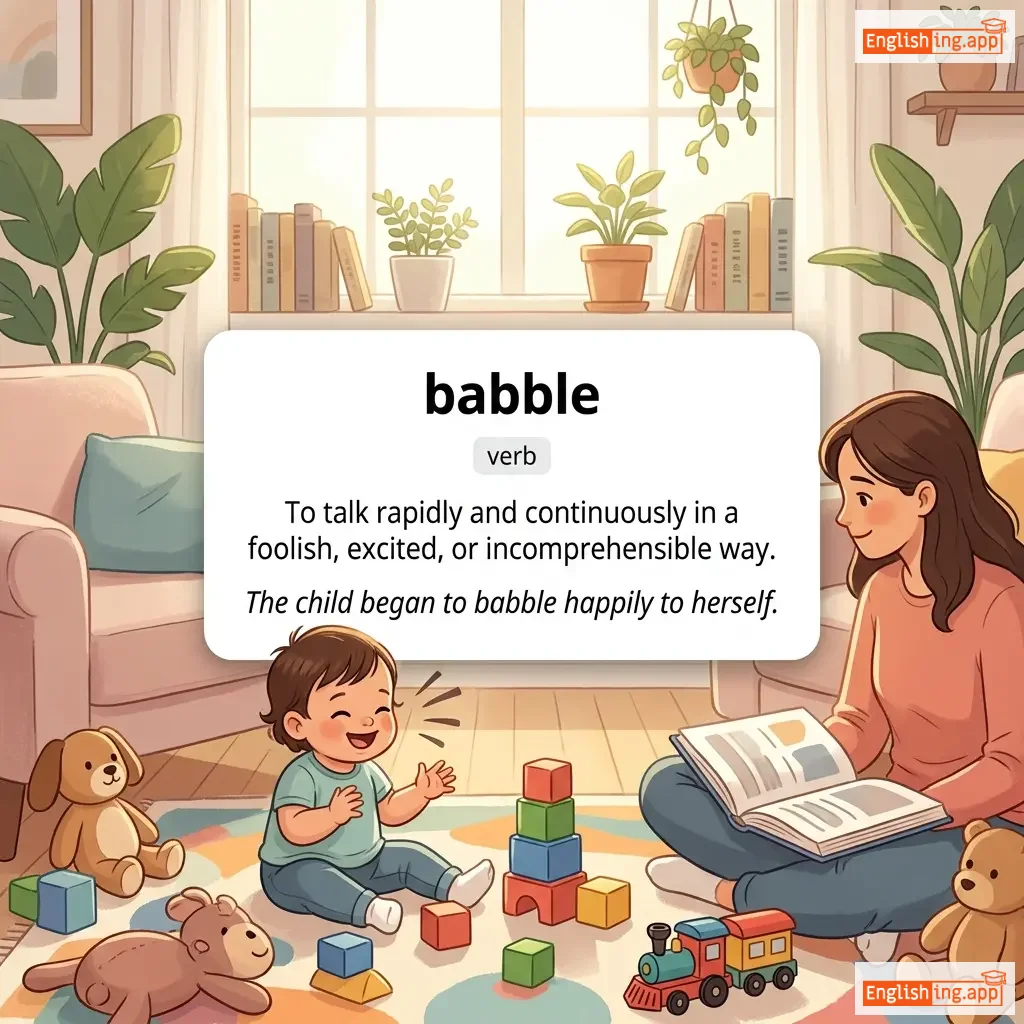
babble definition card — visual illustration of the meaning
verb
/ˈbæbəl/
hablar de manera ininteligible (hablar de manera ininteligible)

To talk rapidly and continuously in a foolish, excited, or incomprehensible way.

"The child began to babble happily to herself."

"La niña comenzó a balbucear felizmente para ella misma." (La niña comenzó a balbucear felizmente para ella misma.)
noun
/bəˈbuːn/
babuino (babuino)

a large African and Arabian primate with a dog-like snout and colorful buttocks

"The baboon troop gathered around the watering hole in the savanna."

"El grupo de babuinos se reunió alrededor del agujero de agua en la sabana." (El grupo de babuinos se reunió alrededor del agujero de agua en la sabana.)
noun
/ˈbeɪbi/
bebé (bebe)

a very young child, especially one newly or recently born

"The baby is sleeping peacefully in the crib."

"El bebé está durmiendo pacíficamente en la cuna." (El bebe esta durmiendo pacificamente en la cuna.)
noun
/ˈbækənæl/
fiesta salvaje (fiesta salvaje)

A noisy party involving drinking and revelry.

"The festival turned into a wild bacchanal by midnight."

"El festival se convirtió en una fiesta salvaje a medianoche." (El festival se convirtió en una fiesta salvaje a medianoche.)
noun
/ˌbækəˈneɪliə/
fiesta desenfrenada (fiesta desenfrenada)

A Roman festival of Bacchus celebrated with dancing, drinking, and revelry; any occasion of wild and drunken revelry.

"The novel describes the party as a bacchanalia of excess and joy."

"La novela describe la fiesta como una bacanal de exceso y alegría." (La novela describe la fiesta como una bacanal de exceso y alegría.)
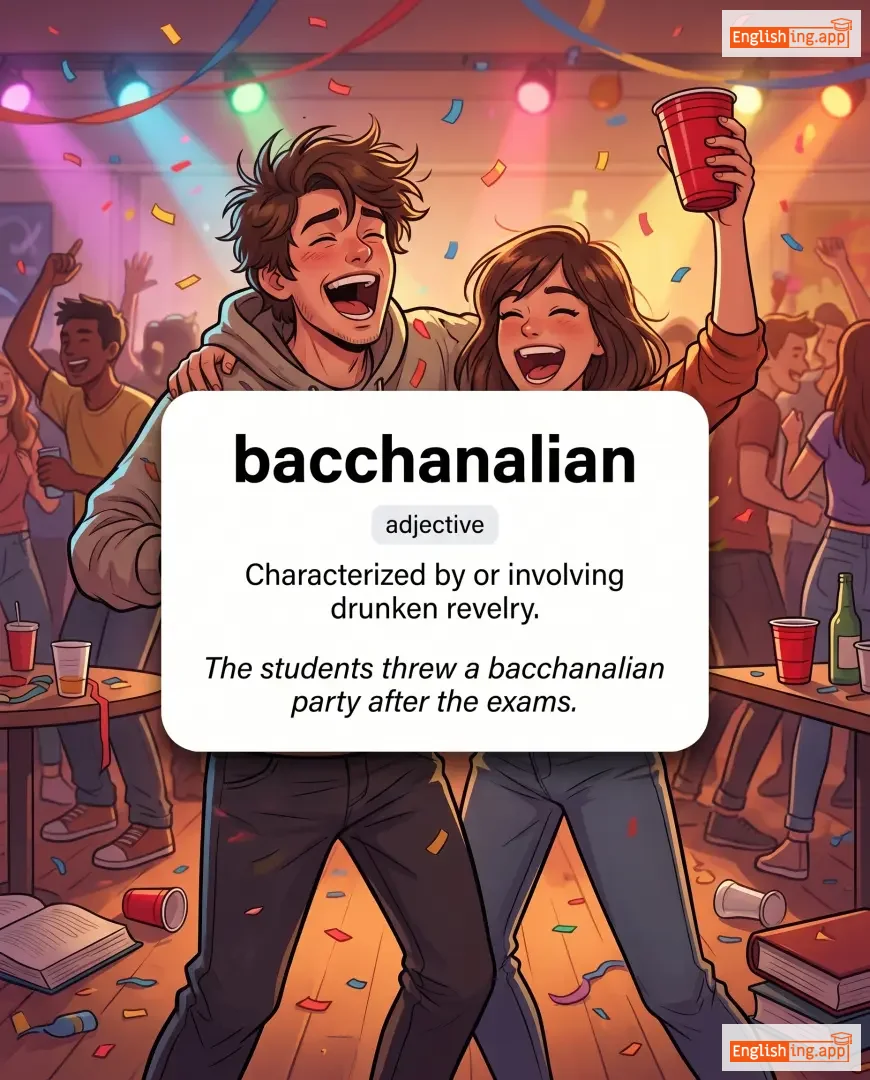
bacchanalian definition card — visual illustration of the meaning
adjective
/ˌbækəˈneɪliən/
relacionado con la embriaguez (relacionado con la embriaguez)

Characterized by or involving drunken revelry.

"The students threw a bacchanalian party after the exams."

"Los estudiantes organizaron una fiesta relacionada con la embriaguez después de los exámenes." (Los estudiantes organizaron una fiesta relacionada con la embriaguez después de los exámenes.)
noun
/ˈbætʃələr/
soltero; persona que tiene un título universitario (soltero; persona que tiene un titulo universitario)

an unmarried man; a person who holds a first degree from a university

"He remained a bachelor all his life and earned a bachelor's degree in engineering."

"Él siguió siendo soltero toda su vida y obtuvo un título de ingeniería." (Él siguió siendo soltero toda su vida y obtuvo un título de ingeniería.)
noun/verb/adverb/adjective
/bæk/
espalda / regresar (espalda / regresar)

the rear surface of the human body; to support; to return to a place

"He turned back to help his friend."

"Él se dio la vuelta para ayudar a su amigo." (Él se dio la vuelta para ayudar a su amigo.)
phrasal verb
/bæk ʌp/
respaldar; hacer una copia de seguridad; retroceder (respaldar; hacer una copia de seguridad; retroceder)

to support or help someone; to make a copy of data for safety; to move backward

"Please back up your files before updating the system."

"Por favor, haz una copia de seguridad de tus archivos antes de actualizar el sistema." (Por favor, haz una copia de seguridad de tus archivos antes de actualizar el sistema)
verb
/ˈbækbaɪt/
hablar mal a espaldas (hablar mal a espaldas)

to speak negatively about someone who is not present; to slander behind someone’s back

"It is wrong to backbite your colleagues behind their backs."

"Está mal hablar mal de tus colegas a sus espaldas." (Esta mal hablar mal de tus colegas a sus espaldas)
noun
/ˈbækboʊn/
columna vertebral (columna vertebral)

the spine; the chief support or mainstay; strength of character

"Education is the backbone of a nation."

"La educación es la columna vertebral de una nación." (La educación es la columna vertebral de una nación.)
noun
/ˈbækdrɒp/
fondo (fondo)

a painted cloth or other structure used behind a stage

"The backdrop for the play was a beautiful mountain scene."

"El fondo para la obra de teatro era una hermosa escena montañosa." (El fondo para la obra de teatro era una hermosa escena montañosa.)
noun
/ˈbækɡraʊnd/
fondo (fondo)

the circumstances, environment, or past history of a person or thing; the part behind the main subject in an image

"She comes from a strong academic background."

"Ella viene de un fuerte fondo académico." (Ella viene de un fuerte fondo académico.)
adjective
/ˈbækˌhændɪd/
indirecto o sarcástico (indirecto o sarcastico)

Indirect or sarcastic, often appearing as praise but actually insulting.

"She gave him a backhanded compliment about his work."

"Ella le dio un elogio indirecto sobre su trabajo." (Ella le dio un elogio indirecto sobre su trabajo.)
noun
/ˈbækɪŋ/
apoyo (apoyo)

support or approval for a plan, person, or idea

"The project received strong backing from the investors."

"El proyecto recibió un fuerte apoyo de los inversores." (El proyecto recibio un fuerte apoyo de los inversores.)
noun
/ˈbækˌsaɪd/
parte trasera (parte trasera)

the rear part or surface of something; informal term for the buttocks

"The kids slid down the hill on their backside."

"Los niños bajaron la colina en su parte trasera." (Los niños bajaron la colina en su parte trasera.)
verb
/ˈbækˌslaɪd/
retroceder (retroceder)

To relapse into bad habits, undesirable practices, or moral decline.

"After months of progress, he began to backslide into old habits."

"Después de meses de progreso, empezó a retroceder hacia viejos hábitos." (Después de meses de progreso, empezó a retroceder hacia viejos hábitos.)
noun
/ˈbækʌp/
copia de seguridad (copia de seguridad)

a copy of data stored separately to protect against loss

"Make sure to have a backup of your important files."

"Asegúrate de tener una copia de seguridad de tus archivos importantes." (Asegurate de tener una copia de seguridad de tus archivos importantes.)
adverb
/ˈbækwərdz/
hacia atrás (hacia atras)

Toward the back or in the reverse direction.

"He accidentally fell backwards into the chair."

"Él accidentalmente cayó hacia atrás en la silla." (El accidentalmente cayo hacia atras en la silla.)
noun
/ˌbækˈjɑːrd/
felicidad (felicidad)

an area of land behind a house, typically used for recreation or gardening

"The children played football in the backyard."

"Ella no pudo ocultar su felicidad cuando recibió el premio." (Ella no pudo ocultar su felicidad cuando recibió el premio.)
adjective
/beɪˈkoʊniən/
baconiano (baconiano)

Relating to the philosopher Francis Bacon or his method of scientific reasoning.

"The researcher followed a Baconian approach to observation and experimentation."

"El investigador siguió un enfoque baconiano de observación y experimentación." (El investigador siguió un enfoque baconiano de observación y experimentación.)
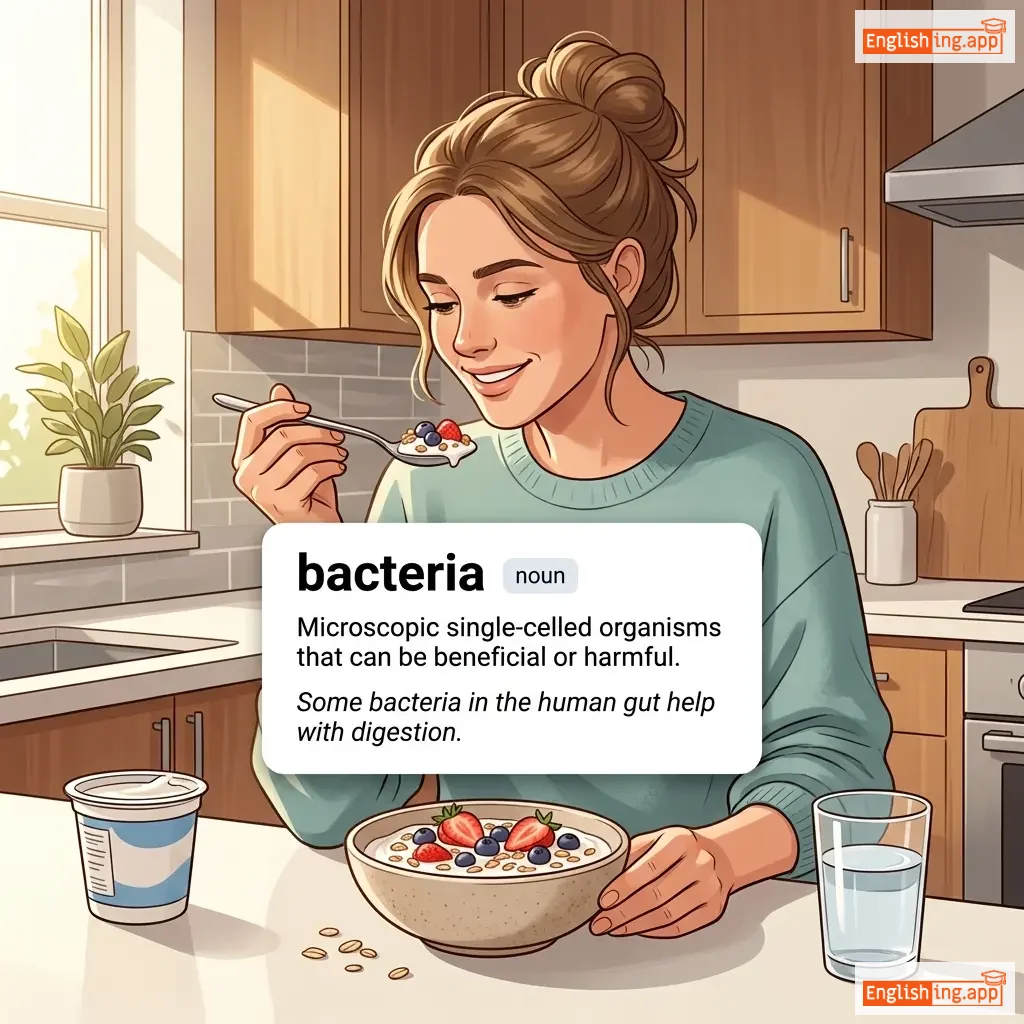
bacteria definition card — visual illustration of the meaning
noun
/bækˈtɪəriə/
bacteria (bacteria)

Microscopic single-celled organisms that can be beneficial or harmful.

"Some bacteria in the human gut help with digestion."

"Algunas bacterias en el intestino humano ayudan con la digestión." (Algunas bacterias en el intestino humano ayudan con la digestion.)
noun
/bækˈtɪəriəm/
bacteria (bacteria)

A single microscopic organism belonging to the group of bacteria.

"The doctor explained that a single bacterium can multiply rapidly under the right conditions."

"El doctor explicó que un solo bacterium puede multiplicarse rápidamente bajo las condiciones adecuadas." (El doctor explico que un solo bacterium puede multiplicarse rapidamente bajo las condiciones adecuadas.)
adjective
/bæd/
malo (malo)

not good; unpleasant, harmful, or of poor quality

"The milk smells bad, so don’t drink it."

"La leche huele mal, así que no la bebas." (La leche huele mal, asi que no la bebas.)
noun
/bædʒ/
insignia (insignia)

A small emblem or sign worn to show membership, authority, or achievement.

"The police officer showed his badge to identify himself."

"El oficial de policía mostró su insignia para identificarse." (El oficial de policía mostró su insignia para identificarse.)
verb
/ˈbædʒər/
molestar, acosar (molestar, acosar)

To repeatedly ask or annoy someone with demands or questions.

"The reporter kept badgering the politician with questions."

"El reportero seguía molestando al político con preguntas." (El reportero seguía molestando al político con preguntas.)
noun
/ˌbædɪˈnɑːʒ/
burlas, conversación juguetona (burlas, conversacion juguetona)

Playful and humorous conversation; banter.

"The friends enjoyed a light badinage over coffee."

"Los amigos disfrutaron de una ligera burlas con el café." (Los amigos disfrutaron de una ligera burlas con el café.)
adverb
/ˈbædli/
malamente (malamente)

in a way that is not good; poorly or severely

"He performed badly in the exam."

"Él hizo un mal desempeño en el examen." (Él hizo un mal desempeño en el examen.)
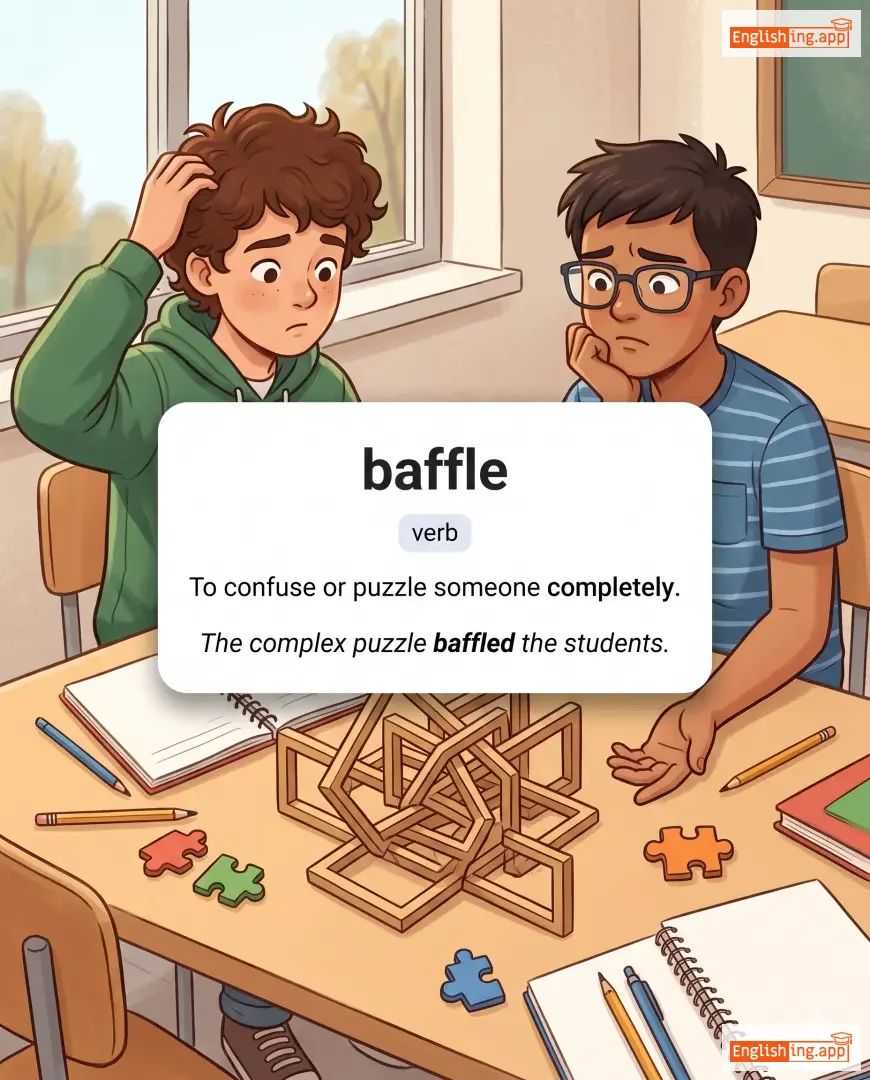
baffle definition card — visual illustration of the meaning
verb
/ˈbæfəl/
desconcertar (desconcertar)

To confuse or puzzle someone completely.

"The complex puzzle baffled the students."

"El rompecabezas complejo desconcertó a los estudiantes." (El rompecabezas complejo desconcertó a los estudiantes.)
noun
/bæɡ/
bolsa (bolsa)

a container made of flexible material, used for carrying items

"She carried her books in a bag."

"Ella llevó sus libros en una bolsa." (Ella llevó sus libros en una bolsa.)
noun
/ˈbæɡɪdʒ/
equipaje; pertenencias personales; (equipaje; pertenencias personales;)

suitcases and bags containing personal belongings; past experiences or problems that affect behavior

"Please collect your baggage from the conveyor belt at the airport."

"Por favor, recoja su equipaje en la cinta transportadora en el aeropuerto." (Por favor, recoja su equipaje en la cinta transportadora en el aeropuerto.)
noun
/beɪl/
fianza (fianza)

the temporary release of an accused person awaiting trial, often with a financial guarantee

"He was granted bail after his arrest."

"Le otorgaron la fianza después de su arresto." (Le otorgaron la fianza despues de su arresto.)
noun
/ˌbeɪˈliː/
depositario (depositario)

a person or party who temporarily receives possession of goods or property from another under a legal agreement

"The bailee must take reasonable care of the goods while they are in his possession."

"El depositario debe cuidar adecuadamente los bienes." (el depositario debe cuidar adecuadamente los bienes)