Vocabularios

Descubra, aprenda y domine el vocabulario en inglés

noun
/ˈboʊ.ə/
boa constrictora (boa constrictora)

a large non-venomous snake that kills prey by constriction

"The boa constrictor wrapped around its prey."

"El boa constrictor se envolvió alrededor de su presa." (el boa constrictora se envolvió alrededor de su presa)
noun
/bɔːrd/
tabla; junta directiva (bord)

a flat, thin, rectangular piece of material such as wood; also a group of people managing an organization

"The board decided to increase the budget."

"La junta decidió aumentar el presupuesto." (La junta decidio aumentar el presupuesto.)
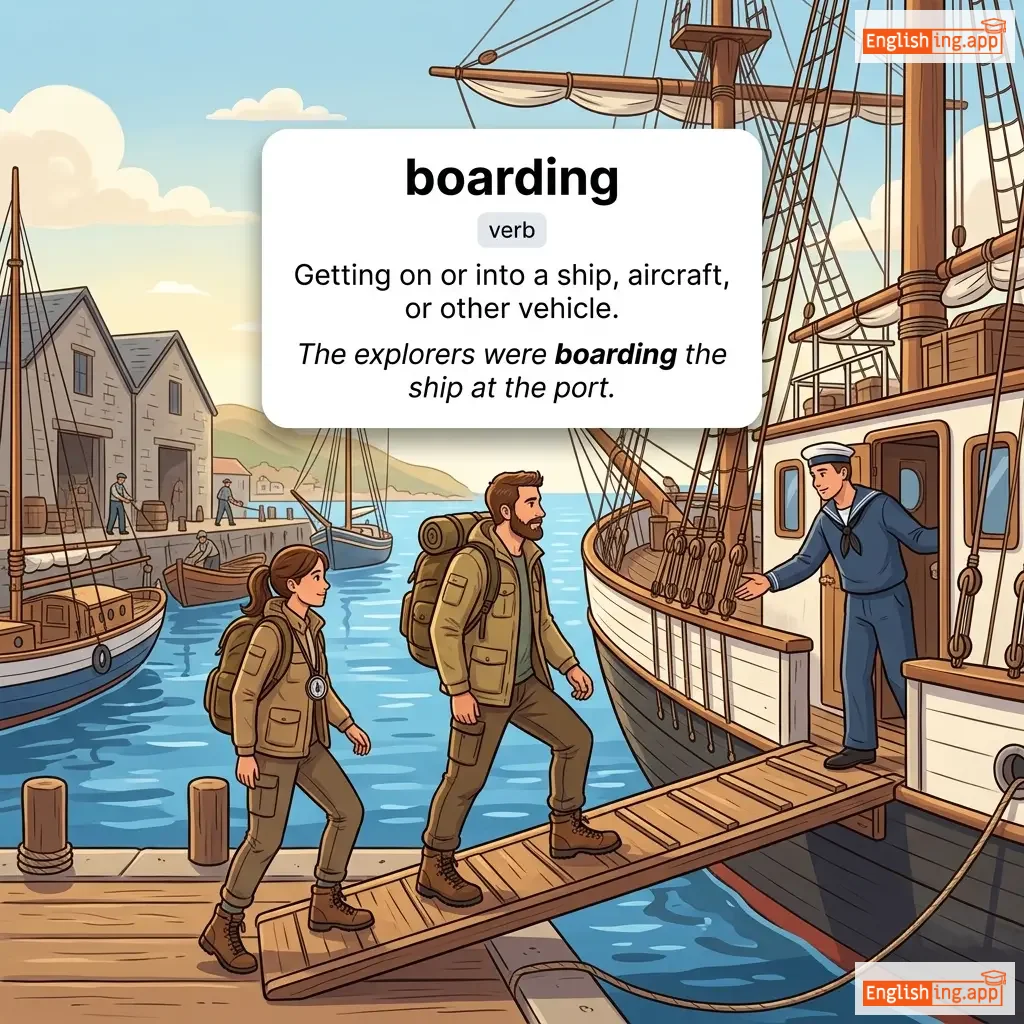
boarding definition card — visual illustration of the meaning
verb
/ˈbɔːrdɪŋ/
embarcar (embarcar)

Getting on or into a ship, aircraft, or other vehicle.

"The explorers were boarding the ship at the port."

"Los exploradores estaban embarcando en el barco en el puerto." (Los exploradores estaban embarcando en el barco en el puerto.)
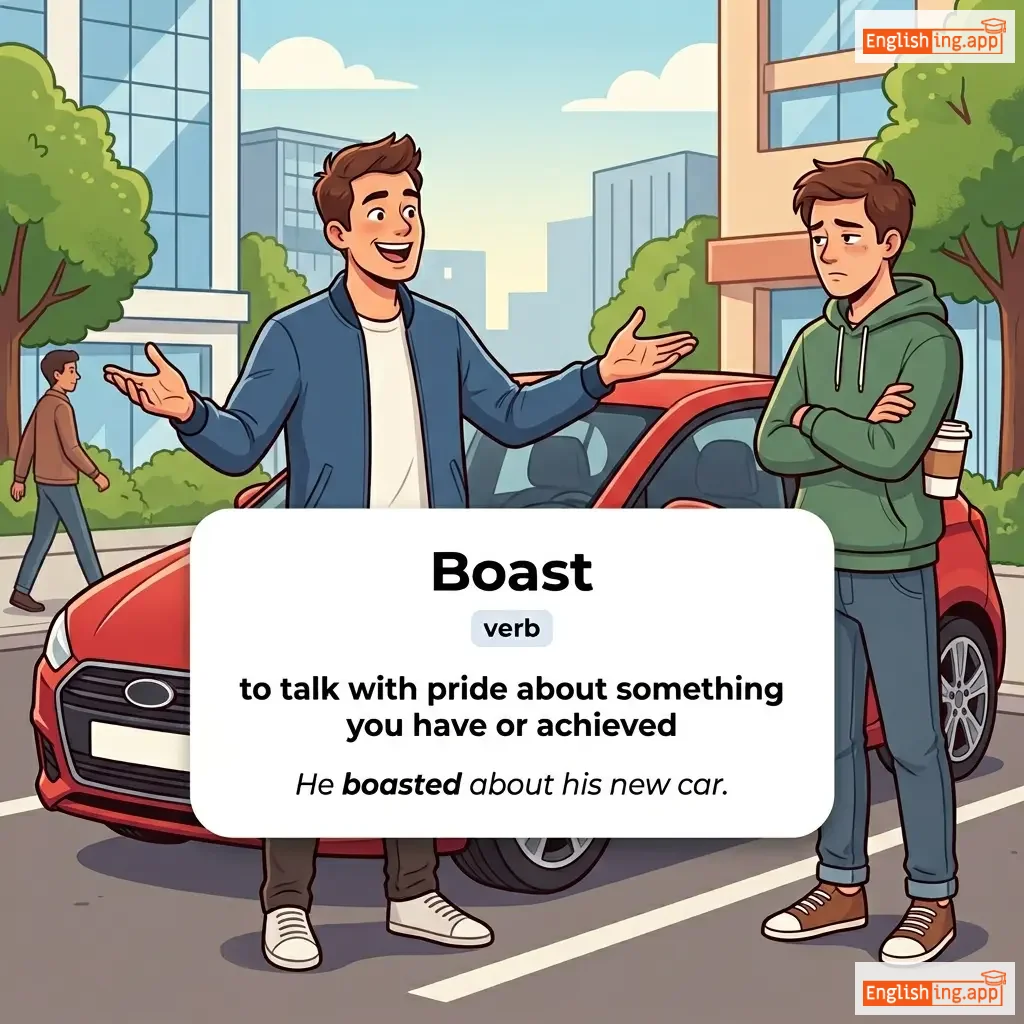
Boast definition card — visual illustration of the meaning
verb
/boʊst/
alardear (alardear)

to talk with pride about something you have or achieved

"He boasted about his new car."

"Él se jactó de su coche nuevo." (Él se jactó de su coche nuevo.)
noun
/boʊt/
barco (barco)

a small vessel used for traveling on water

"They took a boat across the river."

"Tomaron un barco a través del río." (Tomaron un barco a traves del rio.)
noun
/ˈboʊsən/
oficial de barco (oficial de barco)

a ship's officer in charge of equipment and the crew

"The boatswain supervised the sailors on deck."

"El bótzuén supervisó a los marineros en la cubierta." (El bótzuén supervisó a los marineros en la cubierta.)
noun, verb
/bɒb/
balancearse (balancearse)

a short sudden movement up and down; to move quickly up and down

"The small boat began to bob on the waves."

"El pequeño barco comenzó a balancearse en las olas." (El pequeno barco comenzo a balancearse en las olas)
verb
/boʊd/
presagiar (presagiar)

to be an omen of a particular outcome, often something bad

"The dark clouds bode a heavy storm."

"Las nubes oscuras presagian una tormenta fuerte." (Las nubes oscuras presagian una tormenta fuerte.)
noun
/ˈbɒdɪs/
corpiño (corpino)

the part of a woman's dress that covers the body from the neck to the waist

"She wore a dress with an embroidered bodice."

"Ella llevaba un vestido con un corpiño bordado." (Ella llevaba un vestido con un corpiño bordado.)
adjective
/ˈbɒdɪli/
corporal (corporal)

relating to or concerning the body

"He suffered bodily harm in the accident."

"Él sufrió daño corporal en el accidente." (Él sufrió daño corporal en el accidente.)
noun
/ˈbɒdi/
cuerpo (cuerpo)

the physical structure of a person or animal

"Exercise helps keep the body healthy."

"El ejercicio ayuda a mantener el cuerpo saludable." (El ejercicio ayuda a mantener el cuerpo saludable.)
noun
/ˈbɒdiɡɑːrd/
guardaespaldas (guardaespaldas)

a person employed to protect someone from harm

"The celebrity arrived with her bodyguard."

"La celebridad llegó con su guardaespaldas." (La celebridad llegó con su guardaespaldas.)
noun
/bɒɡ/
pantano (pantano)

an area of wet, spongy ground; a swamp or marsh

"The hikers got stuck in a bog."

"Los excursionistas se quedaron atrapados en un pantano." (Los excursionistas se quedaron atrapados en un pantano.)
verb
/ˈbɒɡəl/
asombrar (asombrar)

to overwhelm or confuse; to be astonished or puzzled by something

"The complexity of the puzzle boggled his mind."

"La complejidad del rompecabezas asombró su mente." (La complejidad del rompecabezas asombró su mente.)
adjective
/ˈboʊɡəs/
falso (falso)

false, fake, or not genuine

"The police arrested him for using a bogus ID card."

"La policía lo arrestó por usar una tarjeta de identificación falsa." (La policia lo arrestó por usar una tarjeta de identificación falsa.)
adjective
/boʊˈhiːmiən/
bohemio (bohemio)

unconventional, artistic, and free-spirited in lifestyle or appearance

"She decorated her apartment in a bohemian style with colorful fabrics."

"Decoró su apartamento con un estilo bohemio usando telas coloridas." (Decoro su apartamento con un estilo bohemio usando telas coloridas.)
verb
/bɔɪl/
hervir (hervir)

to heat a liquid until it starts to bubble and turn into vapor.

"Please boil some water for tea."

"Por favor, hierve un poco de agua para el té." (Por favor, hierve un poco de agua para el te.)
adjective
/bɔɪld/
hervido (hervido)

cooked in boiling water

"She served boiled eggs for breakfast."

"Ella sirvió huevos cocidos para el desayuno." (Ella sirvió huevos cocidos para el desayuno.)
adjective
/ˈbɔɪstərəs/
bullicioso (bullicioso)

noisy, energetic, and cheerful; rowdy

"The children were boisterous during the birthday party."

"Los niños estaban bulliciosos durante la fiesta de cumpleaños." (Los ninos estaban bulliciosos durante la fiesta de cumpleaños.)
adjective
/boʊld/
audaz (audaz)

showing courage, confidence, or willingness to take risks

"She made a bold decision to start her own business."

"Ella tomó una audaz decisión de iniciar su propio negocio." (Ella tomo una audaz decision de iniciar su propio negocio.)
adverb
/ˈbəʊld.li/
valientemente; sin miedo (valientemente; sin miedo)

in a confident and brave way; without fear

"She boldly stepped forward to face the challenge."

"Ella dio un paso adelante con valentía para enfrentar el desafío." (Ella dio un paso adelante con valentía para enfrentar el desafío.)
noun
/ˈboʊld.nəs/
valentía; audacia (valentia, audacia)

willingness to take risks; confidence and courage in behavior

"Her boldness in confronting the problem impressed everyone."

"Su valentía al enfrentar el problema impresionó a todos." (Su valentia al enfrentar el problema impresiono a todos.)
noun
/boʊl/
tronco de árbol (tronco de arbol)

the trunk of a tree

"The bole of the tree was thick and strong."

"El tronco del árbol era grueso y fuerte." (El tronco del arbol era grueso y fuerte.)
noun
/bəˈlɛəroʊ/
bolero (un baile español o una chaqueta corta abierta al frente) (bolero)

A Spanish dance in slow triple time, or a short jacket open at the front.

"The dancers performed a passionate bolero at the festival."

"Los bailarines realizaron un bolero apasionado en el festival." (Los bailarines realizaron un bolero apasionado en el festival.)
noun
/boʊl/
cápsula redonda de semillas (como las de algodón o lino) (bol)

The rounded seed capsule of plants such as cotton or flax.

"The farmer examined the cotton boll to check its quality."

"El agricultor examinó el bol de algodón para verificar su calidad." (El agricultor examino el bol de algodon para verificar su calidad.)
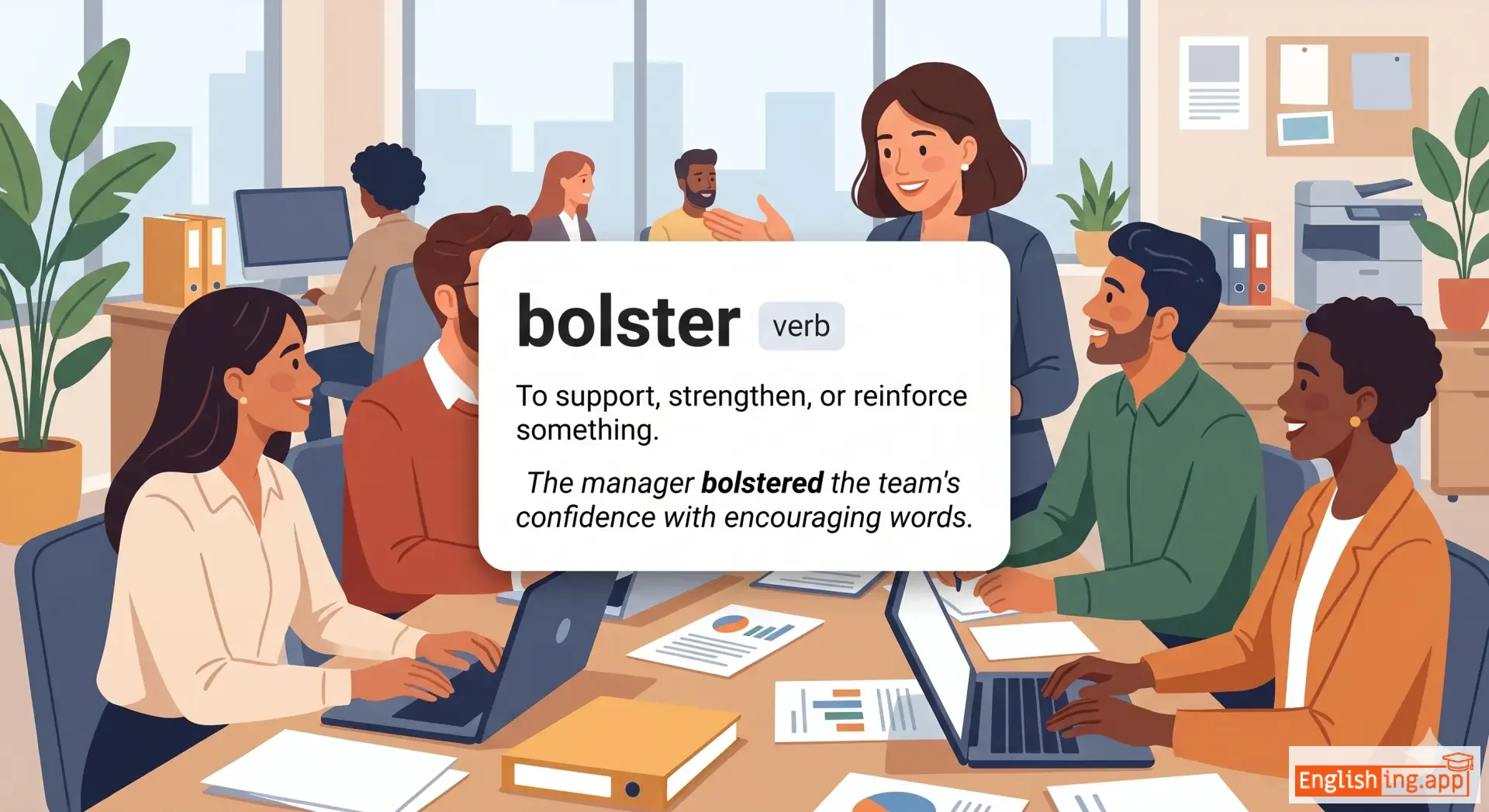
bolster definition card — visual illustration of the meaning
verb
/ˈboʊlstər/
fortalecer, apoyar (bolster)

To support, strengthen, or reinforce something.

"The manager bolstered the team's confidence with encouraging words."

"El gerente fortaleció la confianza del equipo con palabras alentadoras." (El gerente fortaleció la confianza del equipo con palabras alentadoras.)
verb
/boʊlt/
correr de repente; asegurar algo con un perno (bolt)

To move suddenly and quickly; also to fasten something with a bolt.

"The horse bolted from the stable after hearing a loud noise."

"El caballo salió disparado del establo al escuchar un ruido fuerte." (El caballo salio disparado del establo al escuchar un ruido fuerte.)
noun/verb
/bɑːm/
bomba (bomba)

A weapon that explodes; also to attack with bombs or to fail badly.

"The city was bombed heavily during the war."

"La ciudad fue bombardeada fuertemente durante la guerra." (La ciudad fue bombardeada fuertemente durante la guerra.)
verb
/bɒmˈbɑːrd/
bombardear (bombardear)

to attack continuously with bombs, questions, or other forces

"Reporters bombarded the minister with difficult questions."

"Los reporteros bombardearon al ministro con preguntas difíciles." (Los reporteros bombardearon al ministro con preguntas difíciles.)
noun
/ˌbɒmbərˈdɪər/
bombardero (bombardero)

a member of a bomber crew responsible for releasing bombs

"The bombardier released the bombs with precision."

"El bombardero soltó las bombas con precisión." (El bombardero solto las bombas con precision.)
noun
/bɒmˈbɑːrdmənt/
bombardeo (bombardeo)

a continuous attack with bombs or other projectiles

"The city endured a heavy bombardment during the war."

"La ciudad soportó un fuerte bombardeo durante la guerra." (La ciudad soportó un fuerte bombardeo durante la guerra.)
noun
/ˈbɒmbæst/
lenguaje pomposo (lenguaje pomposo)

speech or writing that is overly pompous and inflated

"His campaign speech was full of bombast but lacked real substance."

"Su discurso de campaña estaba lleno de bombast, pero carecía de sustancia real." (Su discurso de campaña estaba lleno de bombast, pero carecía de sustancia real.)
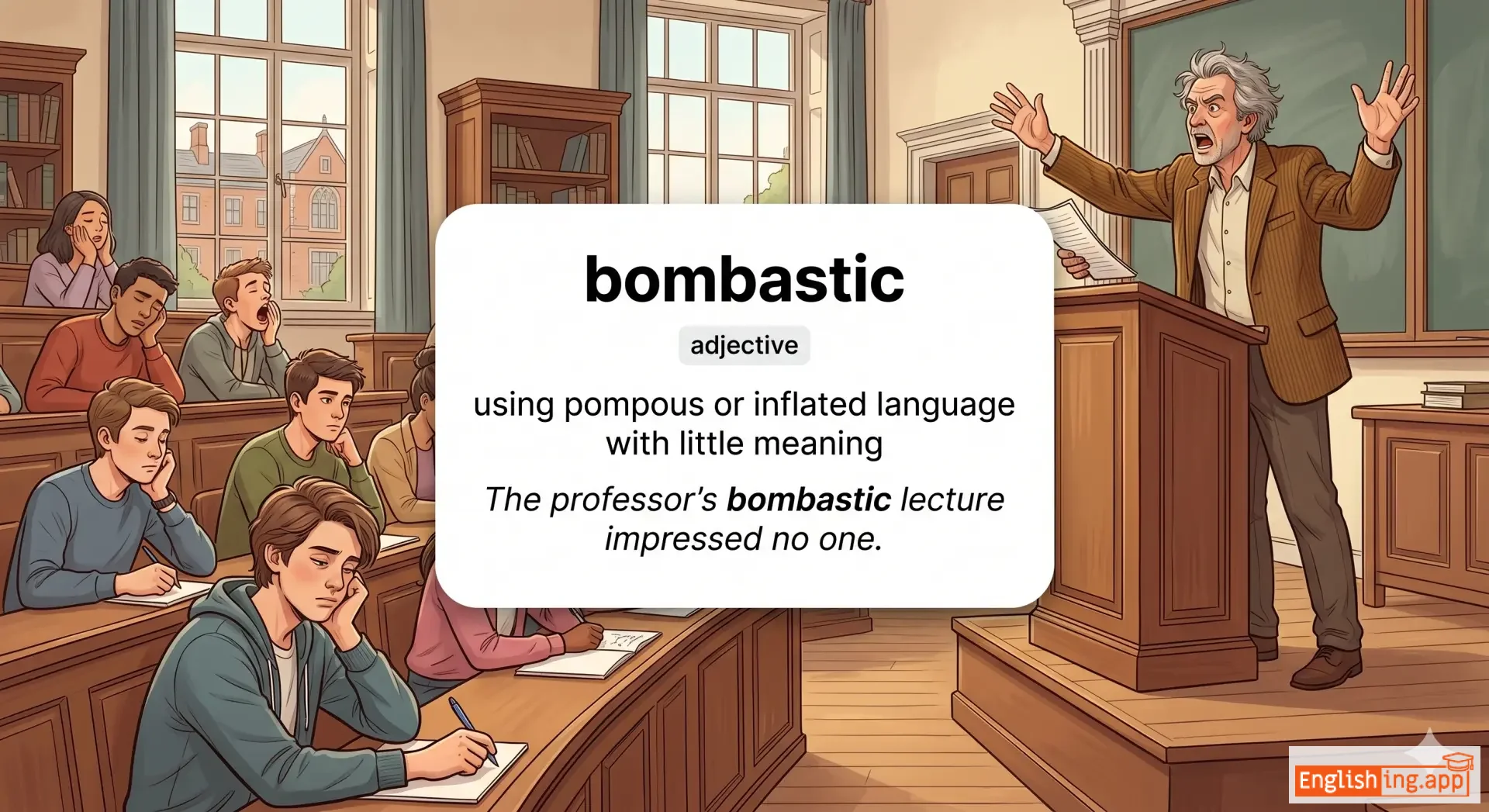
bombastic definition card — visual illustration of the meaning
adjective
/bɒmˈbæstɪk/
pomposo (pomposo)

using pompous or inflated language with little meaning

"The professor’s bombastic lecture impressed no one."

"La conferencia pomposa del profesor no impresionó a nadie." (La conferencia pomposa del profesor no impresionó a nadie.)
noun
/bɒmˈbeɪ dʌk/
pez bombay (pez bombay)

a type of lizardfish found in coastal waters, commonly eaten dried and salted in South Asia

"Bombay duck is a popular delicacy when dried and fried."

"El pez Bombay es un manjar popular cuando se seca y se fríe." (el pez bombay es un manjar popular cuando se seca y se frie)
noun
/ˈbɒmər/
bombardero (bombardero)

military aircraft designed to drop bombs on targets

"The bomber squadron flew over the city at dawn."

"El escuadrón de bombarderos voló sobre la ciudad al amanecer." (el escuadron de bombarderos volo sobre la ciudad al amanecer.)
noun
/ˈbɒmɪŋ/
bombardeo (bombardeo)

an attack using bombs or explosives

"The city was devastated by the bombing."

"La ciudad fue devastada por el bombardeo." (La ciudad fue devastada por el bombardeo.)
adjective
/ˌboʊnəˈfaɪdi/
genuino; auténtico; legítimo (genuino; autentico; legitimo)

genuine; authentic; legitimate

"She is a bonafide expert in her field."

"Ella es una experta genuina en su campo." (Ella es una experta genuina en su campo.)
noun
/bəˈnæn.zə/
situación o evento que crea un aumento repentino en la riqueza, la buena suerte o las ganancias (situacion o evento que crea un aumento repentino en la riqueza, la buena suerte o las ganancias)

a situation or event that creates a sudden increase in wealth, good fortune, or profits

"The oil discovery was a bonanza for the small country."

"El descubrimiento de petróleo fue una bonanza para el pequeño país." (El descubrimiento de petroleo fue una bonanza para el pequeno pais.)
noun
/bɒnd/
vínculo (vinculo)

a connection or relationship between people or things

"The sisters share a close bond."

"Las hermanas comparten un vínculo cercano." (Las hermanas comparten un vinculo cercano.)
noun
/ˈbɑn.dɪdʒ/
esclavitud; cautiverio (esclavitud, cautiverio)

the state of being a slave; the state of being under the control of a force or influence

"The people fought to escape from the bondage of oppression."

"La gente luchaba para escapar de la esclavitud de la opresión." (La gente luchaba para escapar de la esclavitud de la opresión.)
noun
/boʊn/
hueso (ueso)

the hard parts of a skeleton that form the structure of the body

"The dog buried a bone in the garden."

"El perro enterró un hueso en el jardín." (El perro enterró un hueso en el jardín.)
noun
/ˈbɒnəmi/
bonhomía (bonhomia)

Cheerful friendliness and geniality.

"The meeting was filled with laughter and bonhomie."

"La reunión estaba llena de risas y bonhomía." (La reunion estaba llena de risas y bonhomia.)
adjective
/ˈbɒni/
hermoso; bonito; alegre (hermoso; bonito; alegre)

cheerful; pretty; attractive

"The bonny child played happily in the garden."

"El niño bonito jugó felizmente en el jardín." (El niño bonito jugó felizmente en el jardín.)
noun
/ˈbəʊnəs/
bono (bono)

an extra payment or reward given in addition to what is usual or expected.

"Employees received a year-end bonus for their hard work."

"Los empleados recibieron un bono al final del año por su arduo trabajo." (Los empleados recibieron un bono al final del año por su arduo trabajo.)
verb/noun
/buː/
grito de desaprobación/sonido de advertencia (grito de desaprobacion/sonido de advertencia)

To show disapproval by shouting 'boo'; or a sound made to surprise or scare.

"The audience began to boo the bad performance."

"La audiencia comenzó a abuchear la mala actuación." (la audiencia comenzo a abuchear la mala actuacion.)
noun
/buːb/
tonto; pecho (coloquial) (tonto; pecho)

a foolish or clumsy person; an informal and sometimes rude term for a woman's breast

"He felt like a complete boob after forgetting the meeting."

"Se sintió como un completo tonto después de olvidar la reunión." (se sintio como un completo tonto despues de olvidar la reunion)
noun
/ˈbuːbi/
tonto (tonto)

a foolish or gullible person; a silly individual

"He felt like a booby after making such a simple mistake."

"Se sintió como un tonto después de cometer un error tan simple." (Se sintio como un tonto despues de cometer un error tan simple)
noun, verb
/bʊk/
libro / hacer una reserva (libro / hacer una reserva)

A set of written, printed, or blank pages fastened together; to arrange for someone to have a seat, room, or ticket in advance.

"I booked a table at the restaurant for dinner."

"Reservé una mesa en el restaurante para la cena." (Reservé una mesa en el restaurante para la cena.)
noun
/bʊk ˈbaɪn.dər/
encuadernador de libros (encuadernador de libros)

a person whose job is to fasten the pages of books together and put covers on them

"The old book binder carefully restored the antique manuscript."

"El viejo encuadernador restauró cuidadosamente el antiguo manuscrito." (El viejo encuadernador restauro cuidadosamente el antiguo manuscrito.)
noun
/bʊk ˈsel.ər/
librero (librero)

a person who sells books, especially as a business

"The book seller recommended a great novel for my summer reading."

"El librero recomendó una gran novela para mi lectura de verano." (El librero recomendó una gran novela para mi lectura de verano.)