वोकैबुलरीज

इंग्लिश वोकैबुलरी डिस्कवर, लर्न और मास्टर करें

adjective
/pəˈrɛntəl/
मातापिता से संबंधित (matapita se sambandhit)

relating to a parent or parents; characteristic of a mother or father

"Parental guidance is important for a child's development."

"बच्चे के विकास के लिए माता-पिता का मार्गदर्शन महत्वपूर्ण है।" (Bacche ke vikas ke liye mata-pita ka margdarshan mahatvapurn hai.)
noun
/ˈpɛrəntɪdʒ/
वंशावली (vanshavali)

The identity and origins of one's parents; descent or lineage.

"Her noble parentage gave her access to the royal court."

"उसकी शाही वंशावली ने उसे शाही दरबार में प्रवेश का अवसर दिया।" (Uski shahī vanshavali ne use shahī darbar mein pravesh ka avsar diya.)
parent definition card — visual illustration of the meaning
noun
/ˈpɛərənt/
माता-पिता (mata-pita)

a mother or father of a person or animal

"Both of his parents are teachers."

"उसके दोनों माता-पिता शिक्षक हैं।" (Uske dono mata-pita shikshak hain.)
noun
/ˌpærəˈɡɔːrɪk/
ओपियम युक्त औषधि (opiyam yukt aushadhi)

a medicine containing opium, once used to relieve pain and diarrhea

"Doctors once prescribed paregoric to treat diarrhea in children."

"डॉक्टर पहले बच्चों को दस्त के इलाज के लिए पैरेगोरिक लिखते थे।" (Doktor pehle bachchon ko dast ke ilaaj ke liye paregoric likhte the.)
verb
/per/
छीलना (cheelna)

to cut away the outer covering or reduce something gradually

"She pared the apple before eating it."

"वह खाने से पहले सेब का छिलका उतार रही थी।" (Vah khane se pehle seb ka chilka utar rahi thi.)
adjective
/ˈpɑːr.dən.ə.bəl/
क्षमापनीय (kshamapneey)

able to be forgiven; excusable

"His mistake was pardonable given the difficult circumstances."

"उसकी गलती माफ की जा सकती थी, क्योंकि परिस्थितियाँ कठिन थीं।" (uski galti maaf ki ja sakti thi, kyunki paristhitiyan kathin thi.)
noun
/ˈpɑr.dən/
माफी; क्षमा; (maafi)

forgiveness; the action of forgiving or being forgiven for an error or offense

"I beg your pardon for interrupting the meeting."

"बैठक को बाधित करने के लिए मैं आपसे माफी चाहता हूँ।" (baithak ko baadhit karne ke liye main aapse maafi chahta hoon.)
noun
/ˈpɑːrtʃmənt/
चर्मपत्र (charmapatra)

a thin material made from animal skin, used in the past for writing

"The ancient manuscript was written on parchment."

"प्राचीन पांडुलिपि चर्मपत्र पर लिखी गई थी।" (Prachin pandulipi charmpatra par likhi gayi thi.)
adjective
/pɑːrtʃt/
बेहद प्यासा (behad pyasa)

extremely dry, especially because of heat or thirst

"After walking in the desert, he was parched with thirst."

"मरुस्थल में चलने के बाद, वह प्यास से बेहद प्यासा था।" (Marusthal mein chalne ke baad, wah pyas se behad pyasa tha.)
verb
/pɑːrtʃ/
सूखा देना (sookha dena)

to make something extremely dry, especially by exposure to heat

"The scorching sun began to parch the fields."

"तपती धूप ने खेतों को सूखा देना शुरू कर दिया।" (tapti dhoop ne kheton ko sookha dena shuru kar diya.)
noun
/ˈpɑr.səl/
पार्सल; पैकेट (paarsal; paaket)

an object or collection of objects wrapped in paper for carrying or sending by mail; a piece of land

"The postman delivered a parcel to our door."

"पोस्टमैन ने हमारे दरवाजे तक एक पार्सल पहुँचाया।" (postman ne hamare darwaje tak ek paarsal pahunchaya.)
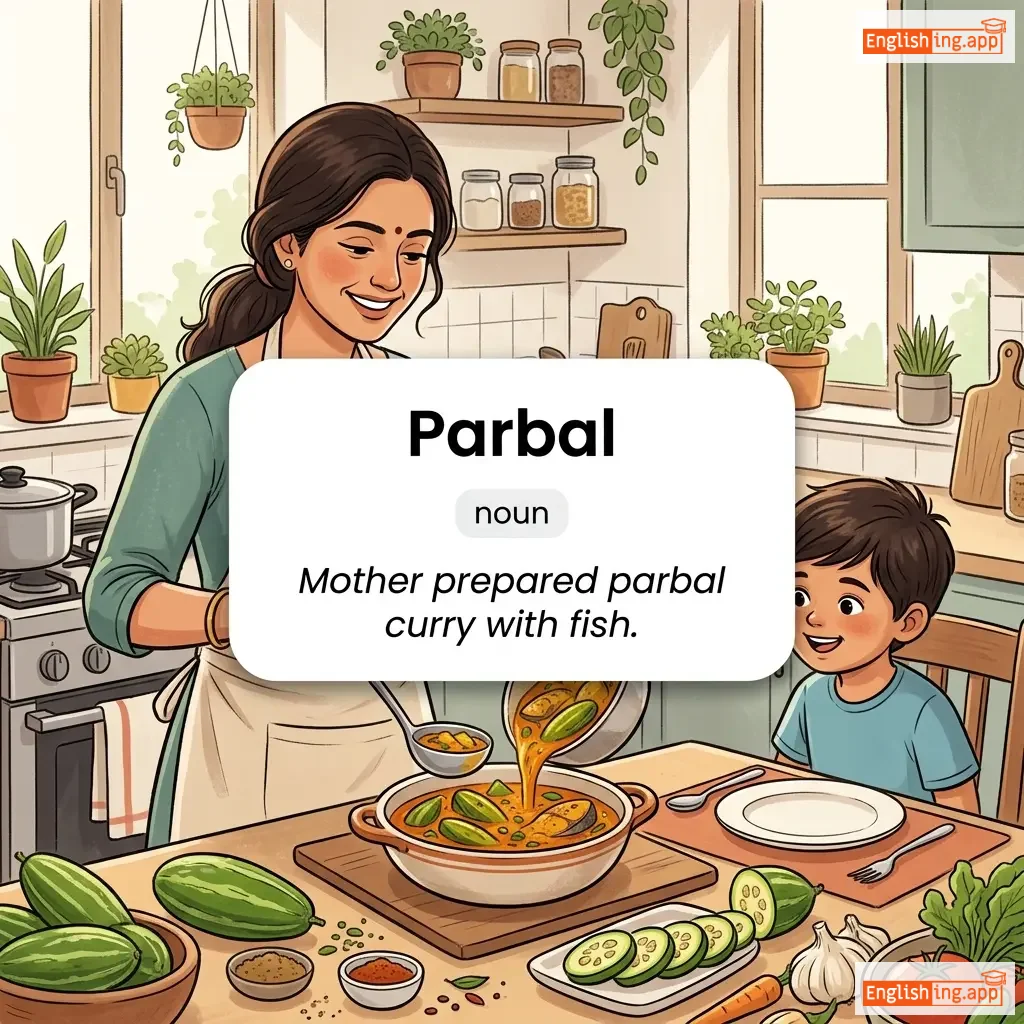
Parbal definition card — visual illustration of the meaning
noun
/ˈpɑr.bəl/
पारबल (parbal)

A green vegetable also known as pointed gourd, commonly used in South Asian cuisine

"Mother prepared parbal curry with fish."

"माँ ने मछली के साथ पारबल करी तैयार की।" (ma ne machhli ke saath parbal kari tayar ki)
noun
/ˈpærəsaɪt/
परजीवी (parjivi)

An organism that lives in or on another organism and benefits at the host’s expense.

"The parasite weakened the tree by feeding on its nutrients."

"परजीवी ने अपने पोषक से पोषक तत्व खाकर पेड़ को कमजोर कर दिया" (Parjivi ne apne poshak se poshak tatva khakar ped ko kamzor kar diya)
verb
/ˈpærəfreɪz/
सुख (sukh)

To express the meaning of something using different words, often to make it clearer.

"The teacher asked the students to paraphrase the poem in their own words."

"वह पुरस्कार मिलने पर अपनी खुशी को छिपा नहीं सकी।" (vah puraskar milne par apni khushi ko chhupa nahi sakee.)
noun
/ˌpærəfəˈneɪliə/
सामग्री (saamagri)

Miscellaneous articles, especially equipment needed for a particular activity.

"The fisherman carried all his fishing paraphernalia in a large box."

"मछुआरे ने अपना सारा मछली पकड़ने का सामान एक बड़े बॉक्स में रखा था।" (Machhuaare ne apna saara machhli pakadne ka saamaan ek bade box mein rakha tha.)
adjective
/ˈpær.ə.nɔɪd/
अवास्तविक डर या संदेह होना (avastavik dar ya sandeh hona)

having an unreasonable fear or suspicion of others

"She became paranoid after hearing strange noises outside."

"अजीब आवाजें सुनने के बाद वह डर से भर गई।" (ajeeb aawazein sunne ke baad vah dar se bhar gayi.)
noun
/ˈpærəpɛt/
सुरक्षात्मक दीवार (surakshatmak deewar)

A low protective wall along the edge of a roof, balcony, or bridge.

"The soldier hid behind the parapet for protection."

"सैनिक सुरक्षा के लिए पैरापेट के पीछे छिप गया था।" (Sainik suraksha ke liye parapet ke peeche chhip gaya tha.)
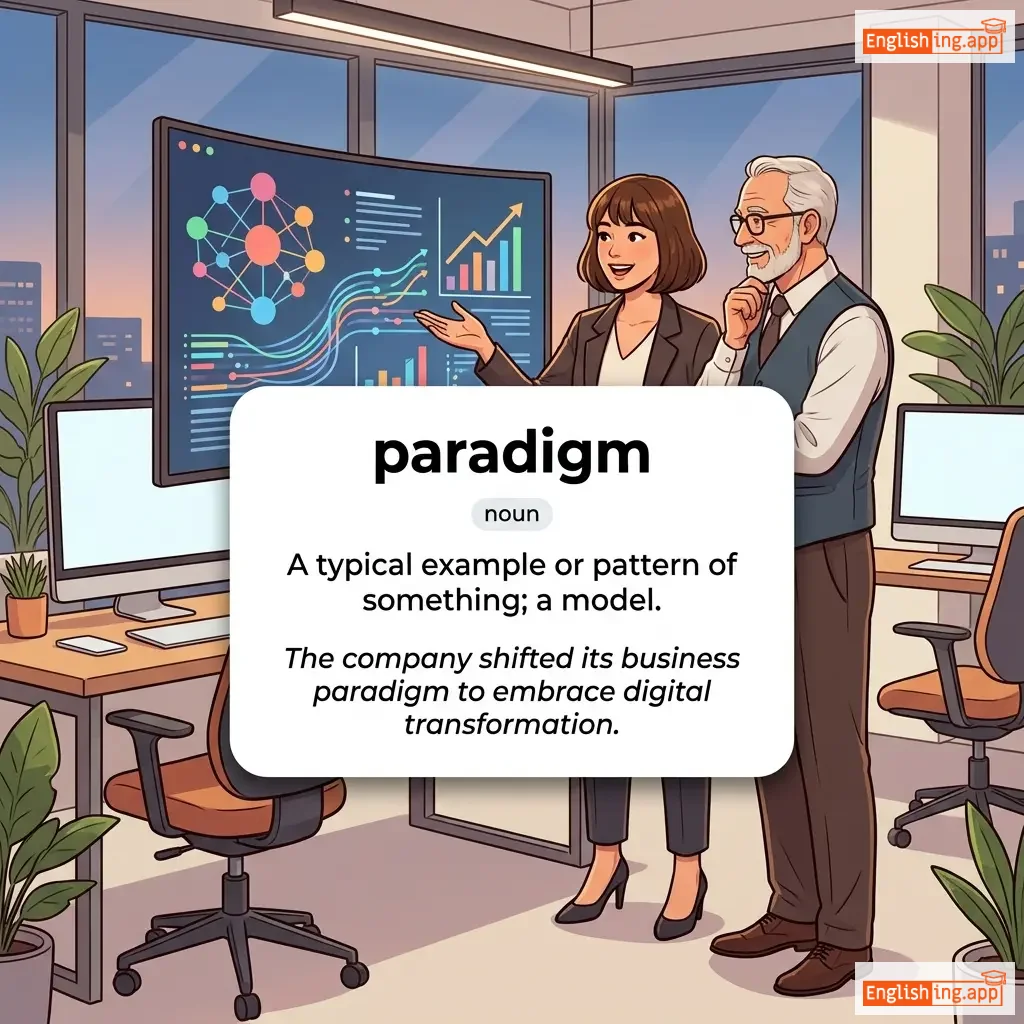
paradigm definition card — visual illustration of the meaning
noun
/ˈpærədaɪm/
मॉडल (model)

A typical example or pattern of something; a model.

"The company shifted its business paradigm to embrace digital transformation."

"कंपनी ने डिजिटल परिवर्तन को अपनाने के लिए अपने व्यापार के मॉडल को बदल दिया।" (Company ne digital parivartan ko apnane ke liye apne vyapar ke model ko badal diya.)
adjective
/ˌpærəˈdɪɡmətɪk/
आदर्शात्मक (adarshatmak)

Serving as a typical example or model of something.

"Her success story is paradigmatic of the opportunities education can provide."

"उसकी सफलता की कहानी वह अवसरों का आदर्श उदाहरण है, जो शिक्षा प्रदान कर सकती है।" (Uski safalta ki kahani vah avsaron ka adarsh udaharan hai, jo shiksha pradan kar sakti hai.)
noun
/ˈpærədaɪs/
स्वर्ग (swarg)

An ideal or perfect place of happiness; often thought of as heaven.

"The tropical island felt like a true paradise."

"उष्णकटिबंधीय द्वीप एक सच्चे स्वर्ग की तरह महसूस हो रहा था।" (ushnkatibandhiy dweep ek sachche swarg ki tarah mahsus ho raha tha.)
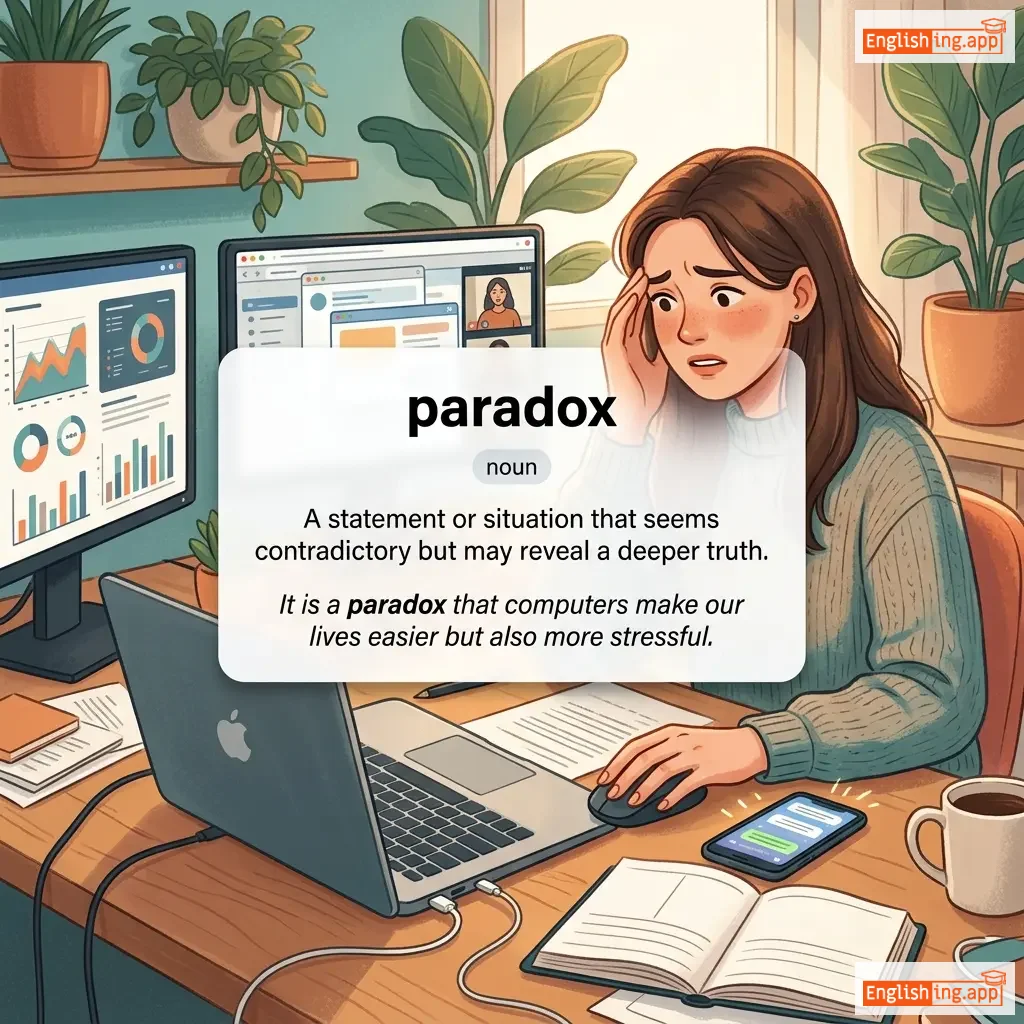
paradox definition card — visual illustration of the meaning
noun
/ˈpærədɒks/
विरोधाभास (virodhabhaas)

A statement or situation that seems contradictory but may reveal a deeper truth.

"It is a paradox that computers make our lives easier but also more stressful."

"यह एक विरोधाभास है कि कंप्यूटर हमारे जीवन को सरल बनाते हैं, लेकिन साथ ही अधिक तनावपूर्ण भी करते हैं।" (Yeh ek virodhabhaas hai ki computer hamare jeevan ko saral banate hain, lekin saath hi adhik tanavpoorn bhi karte hain.)
adjective
/ˌpærəˈdɒksɪkəl/
विरोधाभासी (virodhabhasi)

Seemingly contradictory or opposed to common sense, yet possibly true.

"It is paradoxical that standing is often more tiring than walking."

"यह विरोधाभासी है कि खड़ा होना अक्सर चलने से अधिक थकाऊ होता है।" (Yah virodhabhasi hai ki khada hona aksar chalne se adhik thakau hota hai.)
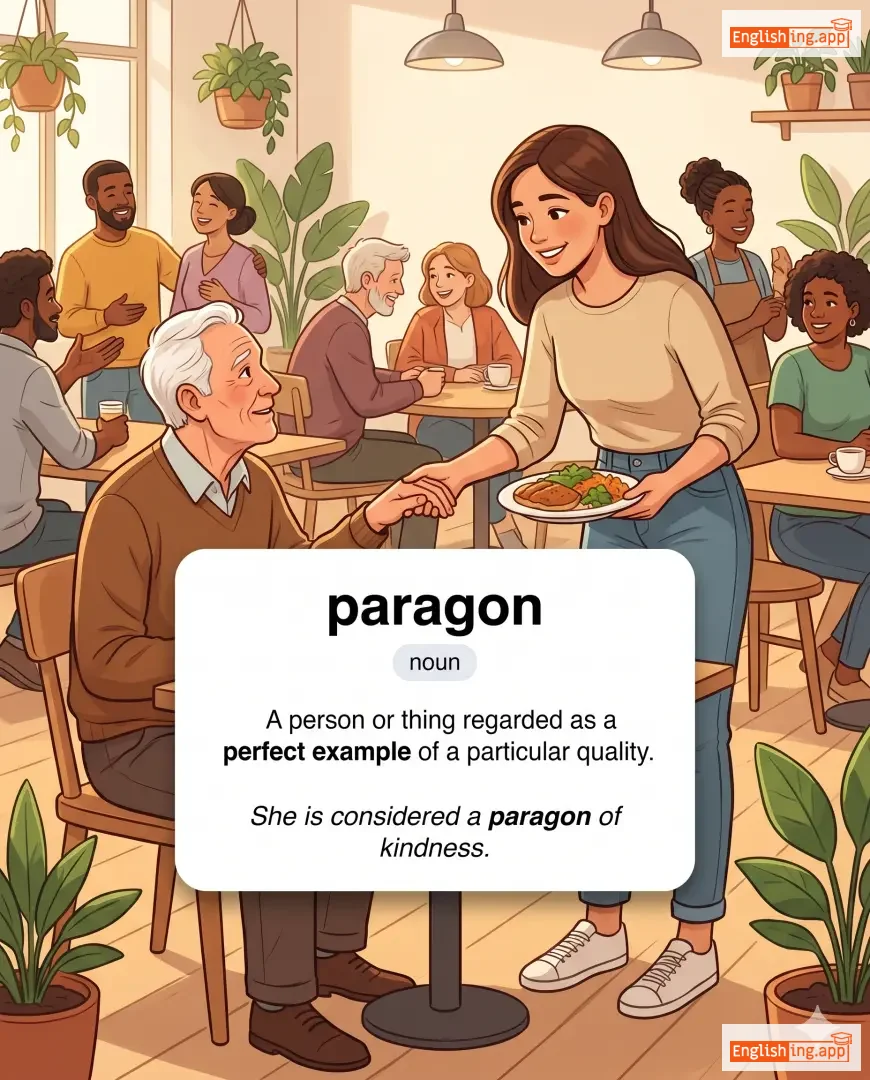
paragon definition card — visual illustration of the meaning
noun
/ˈpærəɡɒn/
आदर्श (adarsh)

A person or thing regarded as a perfect example of a particular quality.

"She is considered a paragon of kindness."

"उसे दया का आदर्श माना जाता है।" (Use daya ka adarsh maana jaata hai.)
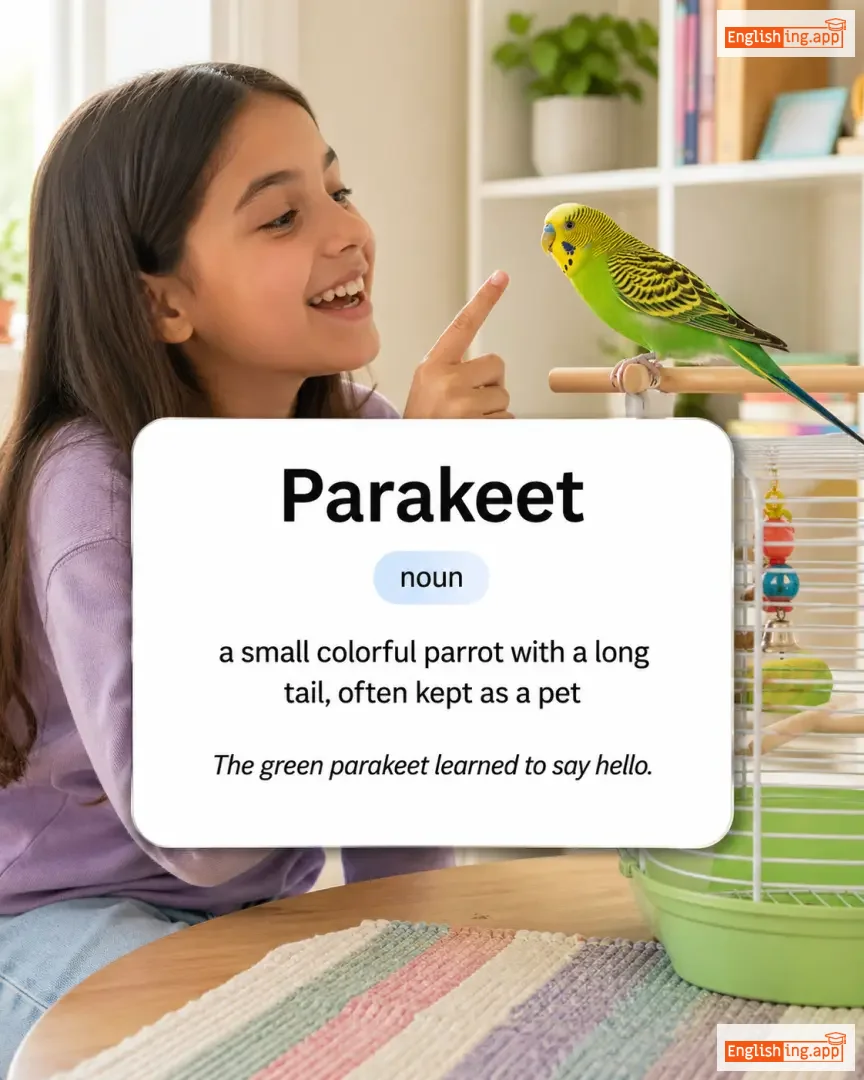
Parakeet definition card — visual illustration of the meaning
noun
/ˈpær.ə.kiːt/
तोता (tota)

a small colorful parrot with a long tail, often kept as a pet

"The green parakeet learned to say hello."

"हरी तोता हेलो कहना सीख गया।" (hari tota hello kehna seekh gaya.)
noun, adjective, verb
/ˈpærəˌlɛl/
समांतर (samantar)

Lines, objects, or events that are side by side and never meet; similarity or comparison.

"The road runs parallel to the railway."

"सड़क रेलवे के समानांतर चलती है।" (Sadak railway ke samanantar chalti hai.)
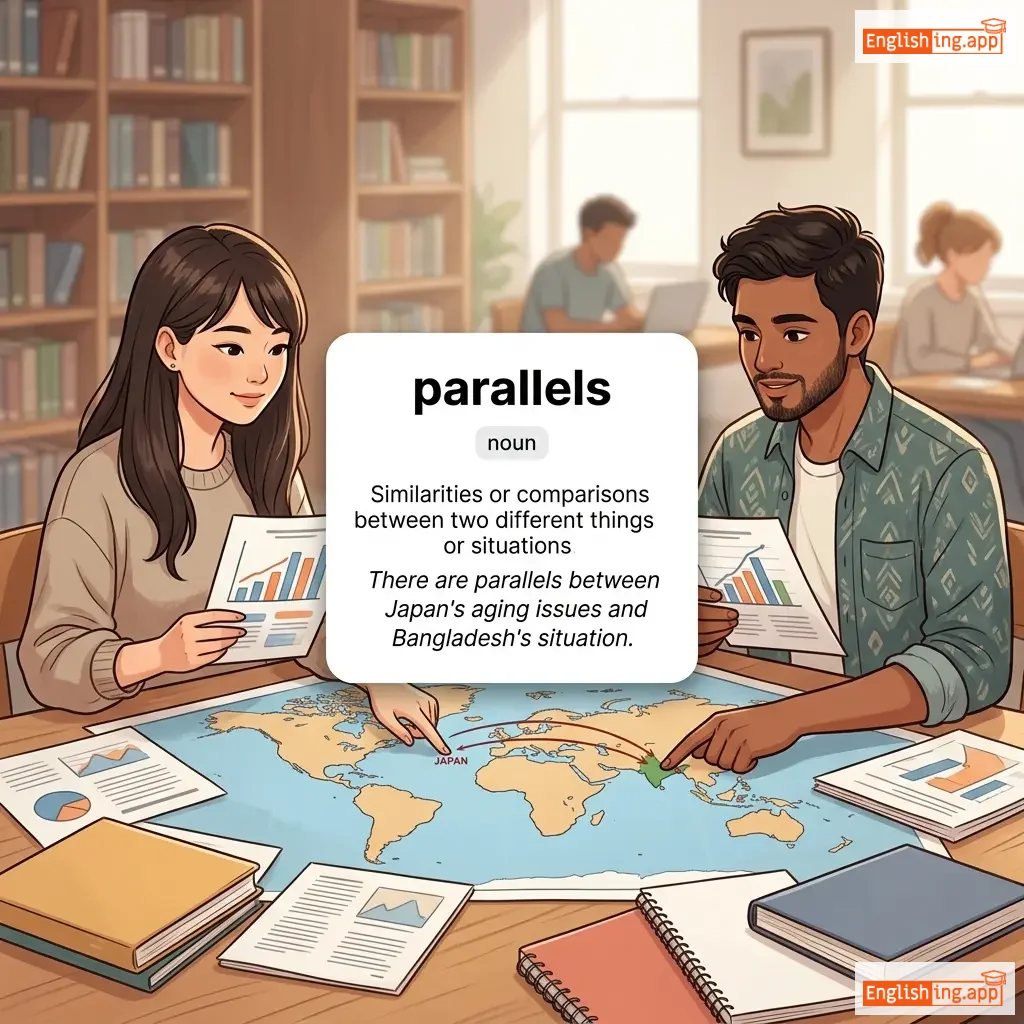
parallels definition card — visual illustration of the meaning
noun
ˈpærəˌlɛlz
समानताएँ (samaantayein)

Similarities or comparisons between two different things or situations

"There are parallels between Japan's aging issues and Bangladesh's situation."

"यहां जापान की उम्र बढ़ने की समस्याओं और बांगलादेश की स्थिति के बीच समानताएँ हैं।" (Yahan Japan ki umra badhne ki samasyaon aur Bangladesh ki sthiti ke beech samaantayein hain.)
noun
/pəˈræləsɪs/
लकवा (lakva)

Loss of the ability to move in part or most of the body, typically as a result of illness or injury.

"The accident left him with partial paralysis."

"दुर्घटना के कारण उसे आंशिक लकवा हो गया था।" (Durghatna ke karan use aanshik lakva ho gaya tha.)
verb
/ˈpærəlaɪz/
अक्षम करना (aksham karna)

to cause someone or something to lose the ability to move or function normally

"The sudden shock seemed to paralyze him."

"अचानक झटका उसे अक्षम कर गया।" (Achanak jhatka use aksham kar gaya.)
noun
/pəˈræmɪtər/
परिमाण (parimaan)

a limit, boundary, or measurable factor that defines or determines something

"We need to set clear parameters for this project."

"हमें इस परियोजना के लिए स्पष्ट सीमाएँ निर्धारित करनी होंगी।" (Humein is pariyojna ke liye spasht seemaayein nirdharit karni hongi.)
adjective
/ˈpærəmaʊnt/
अत्यंत महत्वपूर्ण (atyant mahatvapurn)

more important than anything else; supreme

"Safety is of paramount importance in this factory."

"इस फैक्ट्री में सुरक्षा अत्यंत महत्वपूर्ण है।" (Is factory mein suraksha atyant mahatvapurn hai.)
noun
/ˈpærəmʊr/
प्रेमी (premee)

a lover, especially an illicit one

"The secret paramour was finally revealed."

"गुप्त प्रेमी अंततः प्रकट हुआ।" (Gupt premee antatah prakat hua.)
noun
/ˌpærəˈnɔɪə/
अवास्तविक और लगातार यह महसूस होना कि लोग आपको नुकसान पहुँचाने की कोशिश कर रहे हैं या हमेशा आपको देख रहे हैं (avasthavik aur lagatar yah mahsus hona ki log aapko nuksan pahunchane ki koshish kar rahe hain ya hamesha aapko dekh rahe hain)

an irrational and persistent feeling that people are 'out to get you' or are constantly watching you

"His constant paranoia made it hard for him to trust anyone."

"उसका लगातार डर उसे किसी पर भी विश्वास करने नहीं देता था।" (Uska lagatar dar use kisi par bhi vishwas karne nahi deta tha.)
noun
/ˌpærəˈnɔɪæk/
पागलपंथी व्यक्ति (paganpanthi vyakti)

A person who suffers from paranoia or exhibits extreme, irrational distrust and suspicion.

"The paranoiac refused to leave his house, fearing everyone was against him."

"पागलपंथी व्यक्ति अपने घर से बाहर जाने से इनकार कर दिया, क्योंकि उसे डर था कि सभी लोग उसके खिलाफ थे।" (Paganpanthi vyakti apne ghar se bahar jane se inkar kar diya, kyonki use dar tha ki sabhi log uske khilaf the.)
noun
/ˈpærəˌlɛlɪzəm/
समानांतरवाद (samaantarvaad)

The state of being parallel or similar; in literature, the use of components in a sentence that are grammatically the same or similar in construction.

"The writer used parallelism to give rhythm to his prose."

"लेखक ने अपनी गद्य में लय देने के लिए समानांतरवाद का उपयोग किया।" (Lekhak ne apni gadya mein lay dene ke liye samaantarvaad ka upyog kiya.)
👩‍🎓

Nun (नन)

noun
/nʌn/
नन (nan)

a woman who has taken vows in a religious order and lives in a convent

"The nun taught at the local Catholic school."

"नन ने स्थानीय कैथोलिक स्कूल में पढ़ाया।" (nan ne sthaniya katholik school mein padhaya.)
noun
/njuːˈmɪzmətɪst/
नमिस्मैटिस्ट (numismatist)

A person who studies or collects coins, paper currency, and medals.

"The numismatist displayed his rare coin collection at the exhibition."

"नमिस्मैटिस्ट ने अपनी दुर्लभ सिक्का संग्रह प्रदर्शनी में दिखाई" (Numismatist ne apni durlabh sikka sangrah pradarshani mein dikhai)
adjective
/ˌnjuːmɪzˈmætɪk/
नमिस्मैटिक (numismatik)

relating to the study or collection of coins, currency, and medals

"He has a numismatic collection of rare coins from around the world."

"उसके पास दुनिया भर के दुर्लभ सिक्कों का एक संग्रह है।" (Uske paas duniya bhar ke durlabh sikko ka ek sangrah hai.)
adjective
/ˈnjuːmɪnəs/
आध्यात्मिक (adhyatmik)

having a strong spiritual or mysterious quality

"The temple had a numinous atmosphere that inspired awe."

"मंदिर में एक आध्यात्मिक वातावरण था जिसने श्रद्धा को प्रेरित किया।" (Mandir mein ek adhyatmik vatavaran tha jisne shraddha ko prerit kiya.)
adjective
/ˈnjuːmərəs/
असंख्य (asankhya)

existing in large numbers; many

"There are numerous opportunities for growth in this field."

"वहाँ इस क्षेत्र में विकास के लिए असंख्य अवसर हैं।" (Vahan is kshetra mein vikas ke liye asankhya avsar hain.)
adjective
/njuːˈmɛrɪkəl/
संख्यात्मक (sankhyatmak)

relating to or expressed in numbers

"The report provides numerical data on population growth."

"रिपोर्ट जनसंख्या वृद्धि पर संख्यात्मक डेटा प्रदान करती है।" (Report jansankhya vruddhi par sankhyatmak data pradan karti hai.)
noun
/ˌnjuːməˈreɪʃən/
संख्यांकन (sankhyankan)

the action or process of counting or assigning numbers

"The teacher explained the basics of numeration to the students."

"शिक्षक ने छात्रों को संख्यांकन के मूल सिद्धांत समझाए।" (Shikshak ne chhatron ko sankhyankan ke mool siddhant samjhaye.)
adjective
/ˈnjuː.mər.ə.bəl/
गणनीय; गिना जा सकने योग्य (gananiya; gina ja sakne yogya)

capable of being counted; countable

"The stars in the sky are not numerable."

"आसमान में तारे न्यूमरेबल नहीं हैं।" (aasman mein taare numerable nahin hain)
verb
/nʌdʒ/
कोहनी से हल्का धक्का (kohani se halka dhakka)

To push someone gently, usually with your elbow, in order to attract attention.

"She nudged him to be quiet during the meeting."

"मीटिंग के दौरान उसने उसे चुप रहने के लिए हल्के से कोहनी से धक्का दिया।" (Meeting ke dauran usne use chup rehne ke liye halkese kohani se dhakka diya.)
verb
/ˈnuːkliˌeɪt/
केंद्रीकरण करना (kendrikaran karna)

to form into a nucleus or bring together into a central part

"The droplets began to nucleate around tiny particles in the air."

"ड्रॉपलेट्स ने छोटे कणों के चारों ओर न्यूक्लिएट करना शुरू किया।" (Droplets ne chhote kanon ke charon aur nucleate karna shuru kiya.)
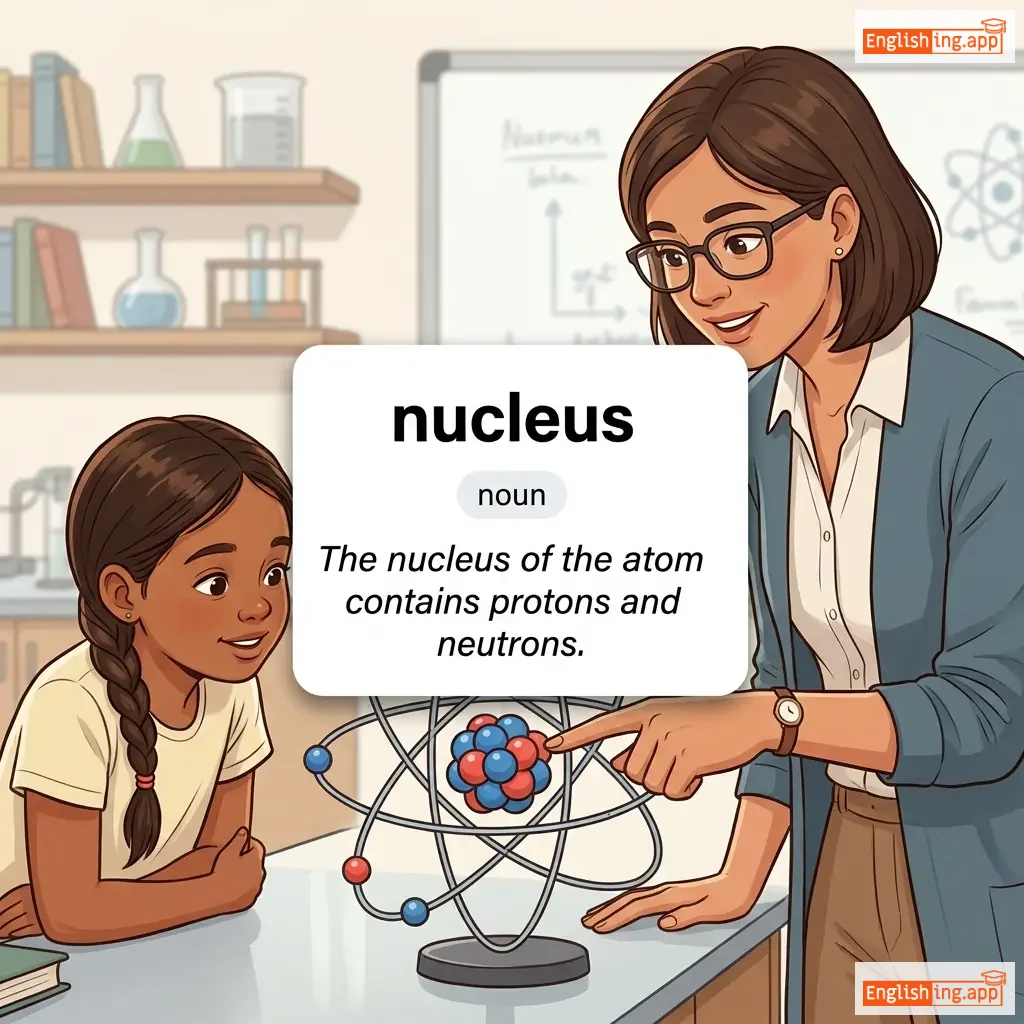
nucleus definition card — visual illustration of the meaning
noun
/ˈnjuː.kli.əs/
केंद्रक (kendrak)

The central and most important part of something, forming the basis for its activity and growth; in biology, the central part of a cell.

"The nucleus of the atom contains protons and neutrons."

"एटम का केंद्रक प्रोटॉन्स और न्यूट्रॉन्स से भरा होता है।" (Atom ka kendrak proton aur neutron se bhara hota hai.)
adjective
/nuːd/
नग्न (nagn)

Wearing no clothes; naked.

"The artist painted a nude model."

"कलाकार ने एक नग्न मॉडल का चित्रण किया।" (Kalakar ne ek nagn model ka chitraan kiya.)
noun
/ˈnjuː.səns/
परेशानी (pareshani)

A person, thing, or situation that causes inconvenience or annoyance.

"The loud construction noise was a nuisance to the neighbors."

"ऊँची निर्माण शोर पड़ोसियों के लिए एक परेशानी थी।" (Unchi nirman shor padosiyon ke liye ek pareshani thi.)
nullify definition card — visual illustration of the meaning
verb
/ˈnʌlɪfaɪ/
अप्रभावी करना (aprabhaavi karna)

to make legally null and void; to cancel or invalidate

"The contract was nullified due to fraud."

"ठगी के कारण अनुबंध रद्द कर दिया गया था।" (Thagi ke karan anubandh radd kar diya gaya tha.)
noun
/ˈnʌmbər/
संख्या (sankhya)

a mathematical value used to count, measure, or label

"She gave me her phone number."

"उसने मुझे अपना फोन नंबर दिया।" (Usne mujhe apna phone number diya.)
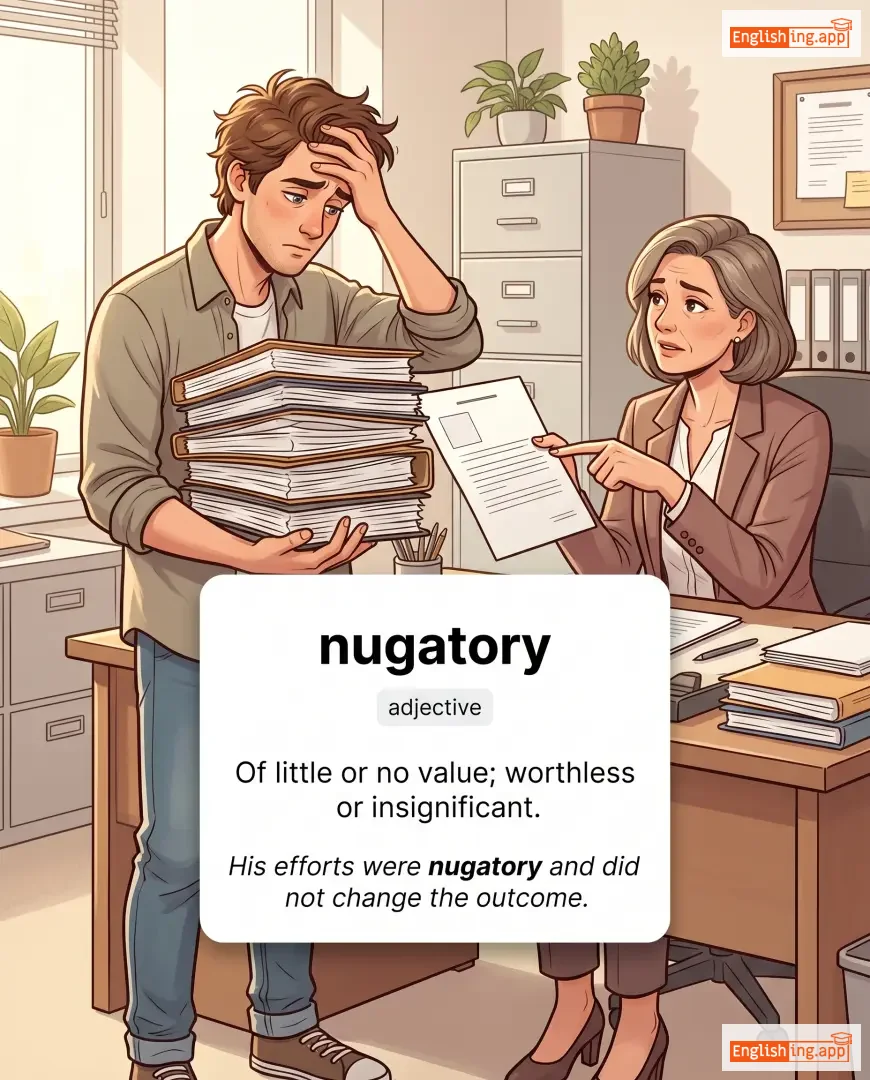
nugatory definition card — visual illustration of the meaning
adjective
/ˈnjuː.ɡə.tɔːr.i/
निरर्थक (nirarthak)

Of little or no value; worthless or insignificant.

"His efforts were nugatory and did not change the outcome."

"उसके प्रयास निरर्थक थे और परिणाम नहीं बदला।" (Uske prayaas nirarthak the aur parinaam nahi badla.)