वोकैबुलरीज

इंग्लिश वोकैबुलरी डिस्कवर, लर्न और मास्टर करें

noun
/ˈnoʊvə/
नोवा (एक तारा जो अचानक अपनी चमक में भारी वृद्धि दिखाता है और फिर धीरे-धीरे अपनी मूल स्थिति में लौटता है) (nova)

A star showing a sudden large increase in brightness and then slowly returning to its original state

"Astronomers observed a bright nova in the sky."

"खगोलशास्त्रियों ने आकाश में एक चमकदार नोवा देखा।" (Khagolashastriyon ne aakash mein ek chamakdar nova dekha.)
noun/adjective
/ˈnɒvəl/
उपन्यास / नया (upanyas / naya)

A long fictional narrative; also something new or unusual.

"She spent the weekend reading a historical novel."

"वह सप्ताहांत में एक ऐतिहासिक उपन्यास पढ़ रही थी।" (Vah saptahant mein ek aitihasik upanyas padh rahi thi.)
noun
/ˈnɒvəlɪst/
उपन्यासकार (upanyaskaar)

a person who writes novels

"The novelist spent years writing his new book."

"उपन्यासकार ने अपनी नई किताब लिखने में सालों बिताए।" (Upanyaskaar ne apni nai kitaab likhne mein saalon bitaye.)
noun
/ˌnɒvəˈlɛt/
नवलेटा (navleta)

A short novel or long short story.

"The author published a novellette as a preview of her upcoming series."

"लेखक ने अपनी आगामी श्रृंखला के पूर्वावलोकन के रूप में एक नवलेटा प्रकाशित किया।" (Lekhak ne apni aagami shrunkhala ke purvavlokan ke roop mein ek navleta prakaashit kiya.)
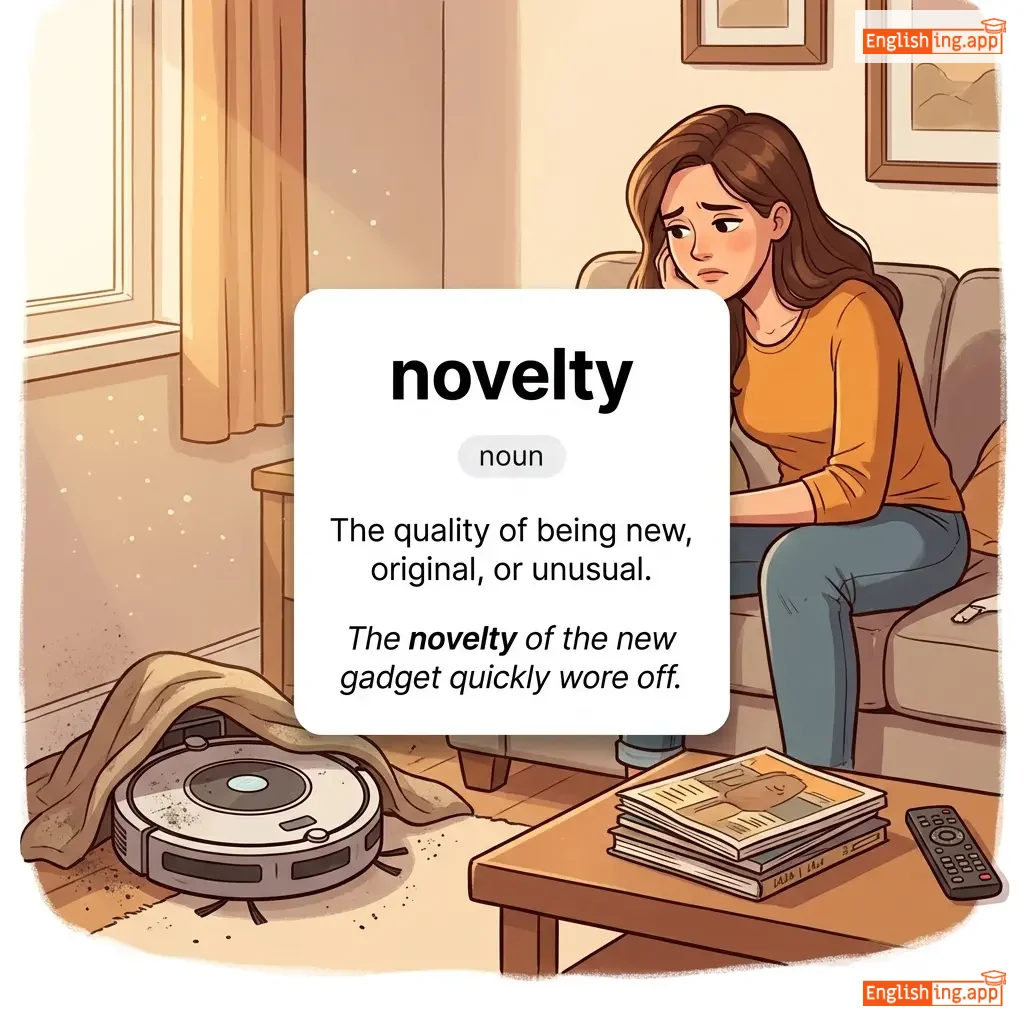
novelty definition card — visual illustration of the meaning
noun
/ˈnɒvəlti/
नवीनता (navinta)

The quality of being new, original, or unusual.

"The novelty of the new gadget quickly wore off."

"नए गैजेट की नवीनता जल्दी ही खत्म हो गई।" (Naye gadget ki navinta jaldi hi khatam ho gayi.)
noun
/noʊˈvɛmbər/
नवंबर (navambar)

the eleventh month of the year in the Gregorian calendar

"November is often cool and quiet before winter begins."

"नवंबर आमतौर पर सर्दी शुरू होने से पहले ठंडा और शांत होता है।" (navambar aamtaur par sardi shuru hone se pahle thanda aur shant hota hai)
noun
/ˈnɒvɪs/
शिक्षार्थी (shiksharthi)

A person new to or inexperienced in a field or activity.

"He is still a novice at playing the guitar."

"वह अब भी गिटार बजाने में एक नोविस है।" (Vah ab bhi guitar bajane mein ek novice hai.)
now definition card — visual illustration of the meaning
adverb
/naʊ/
अब (ab)

at the present moment or time

"I am studying now."

"मैं अभी पढ़ाई कर रहा हूँ।" (Main abhi padhai kar raha hoon.)
adverb
/ˈnaʊədeɪz/
आजकल; वर्तमान समय में; (ajkal; vartaman samay mein)

at the present time; in these times

"Now-a-days, people prefer online shopping."

"आजकल लोग ऑनलाइन शॉपिंग करना पसंद करते हैं।" (ajkal log online shopping karna pasand karte hain)
adverb
/ˈnaʊədeɪz/
आजकल (ajkal)

At the present time; in contrast with the past.

"Nowadays, many people prefer shopping online."

"आजकल, कई लोग ऑनलाइन खरीदारी करना पसंद करते हैं।" (Ajkal, kai log online kharidari karna pasand karte hain.)
adverb
/ˈnoʊˌwɛr/
कहीं नहीं (kahin nahin)

in or to no place; not anywhere

"The missing keys were nowhere to be found."

"गुम हुई चाबियाँ कहीं नहीं मिल रही थीं।" (Gum hui chaabiyan kahin nahin mil rahi thi.)
adjective
/ˈnɑːkʃəs/
हानिकारक (hanikarak)

harmful, poisonous, or very unpleasant

"The factory released noxious fumes into the air."

"फैक्ट्री ने हवा में हानिकारक धुएं को छोड़ दिया।" (Factory ne hawa mein hanikarak dhuein ko chhod diya.)
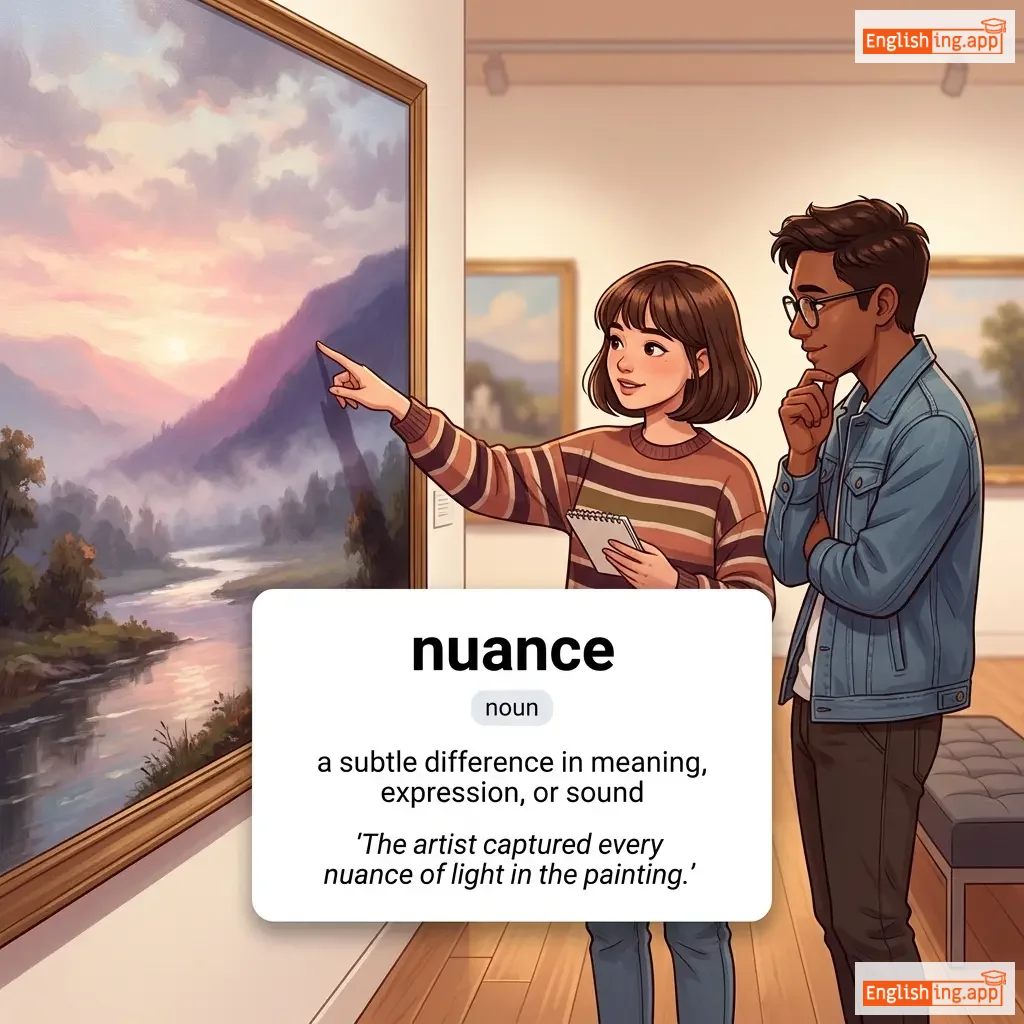
nuance definition card — visual illustration of the meaning
noun
/ˈnuːˌɑːns/
सूक्ष्म अंतर (sookshm antar)

a subtle difference in meaning, expression, or sound

"The artist captured every nuance of light in the painting."

"कलाकार ने पेंटिंग में हर सूक्ष्म अंतर को पकड़ा।" (Kalaakar ne painting mein har sookshm antar ko pakda.)
adjective
ˈnuː.ɑːnst
सूक्ष्म भिन्नताओं से युक्त (sookshm bhinnataon se yukt)

Characterized by subtle shades of meaning or expression; having or characterized by subtle and often appealingly complex qualities.

"His argument was nuanced and well-structured."

"उसका तर्क सूक्ष्म और सुव्यवस्थित था।" (Uska tark sookshm aur suvyavasthit tha.)
adjective
/ˈnjuːbaɪl/
किशोरी (kishori)

of a young woman, sexually mature and suitable for marriage

"The village was celebrating the festival with its nubile maidens dancing."

"गाँव ने अपने किशोरी कन्याओं के साथ त्योहार मनाया।" (Gaon ne apne kishori kanyaon ke saath tyohaar manaya.)
adjective
/ˈnuːkliər/
न्यूक्लियर (nuclear)

relating to the nucleus of an atom or to nuclear energy

"The country is developing nuclear energy."

"देश परमाणु ऊर्जा विकसित कर रहा है।" (Desh parmanu urja viksit kar raha hai.)
verb
/ˈnuːkliˌeɪt/
केंद्रीकरण करना (kendrikaran karna)

to form into a nucleus or bring together into a central part

"The droplets began to nucleate around tiny particles in the air."

"ड्रॉपलेट्स ने छोटे कणों के चारों ओर न्यूक्लिएट करना शुरू किया।" (Droplets ne chhote kanon ke charon aur nucleate karna shuru kiya.)
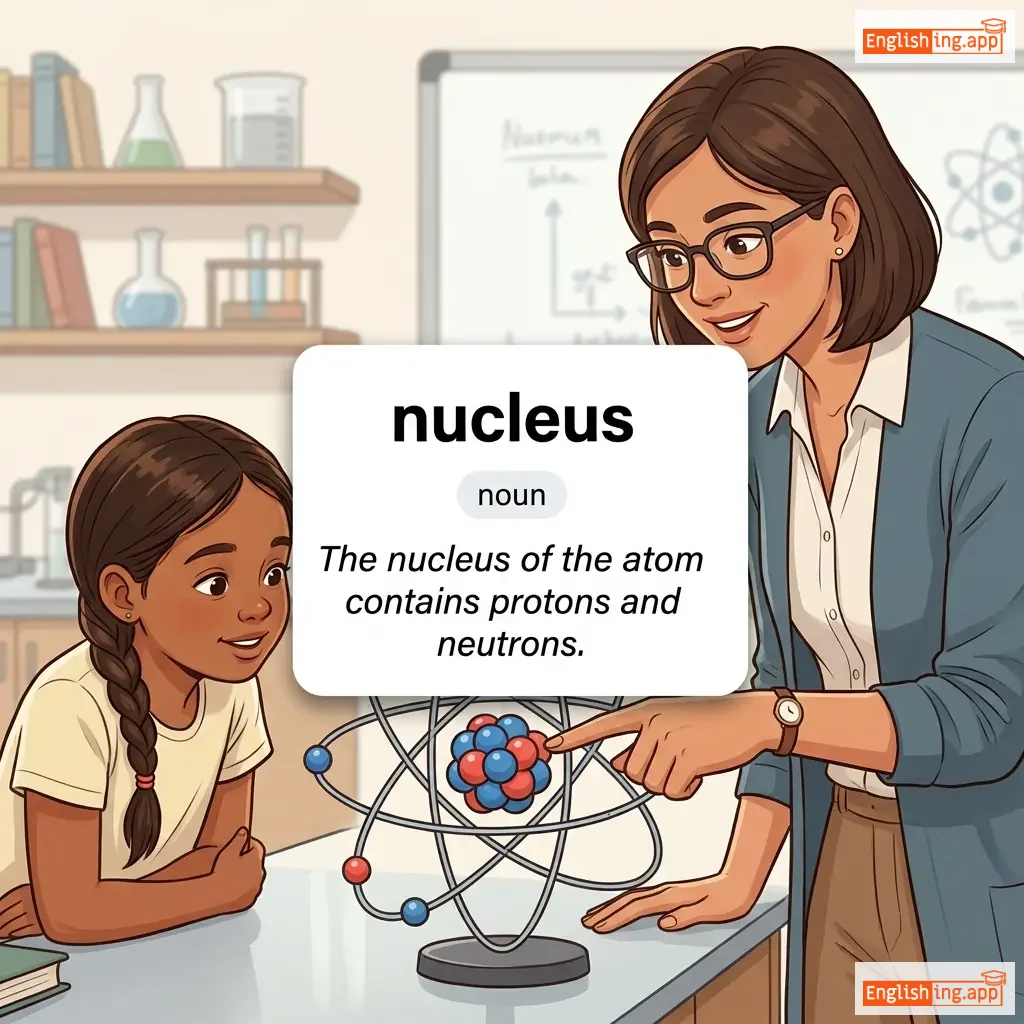
nucleus definition card — visual illustration of the meaning
noun
/ˈnjuː.kli.əs/
केंद्रक (kendrak)

The central and most important part of something, forming the basis for its activity and growth; in biology, the central part of a cell.

"The nucleus of the atom contains protons and neutrons."

"एटम का केंद्रक प्रोटॉन्स और न्यूट्रॉन्स से भरा होता है।" (Atom ka kendrak proton aur neutron se bhara hota hai.)
adjective
/nuːd/
नग्न (nagn)

Wearing no clothes; naked.

"The artist painted a nude model."

"कलाकार ने एक नग्न मॉडल का चित्रण किया।" (Kalakar ne ek nagn model ka chitraan kiya.)
verb
/nʌdʒ/
कोहनी से हल्का धक्का (kohani se halka dhakka)

To push someone gently, usually with your elbow, in order to attract attention.

"She nudged him to be quiet during the meeting."

"मीटिंग के दौरान उसने उसे चुप रहने के लिए हल्के से कोहनी से धक्का दिया।" (Meeting ke dauran usne use chup rehne ke liye halkese kohani se dhakka diya.)
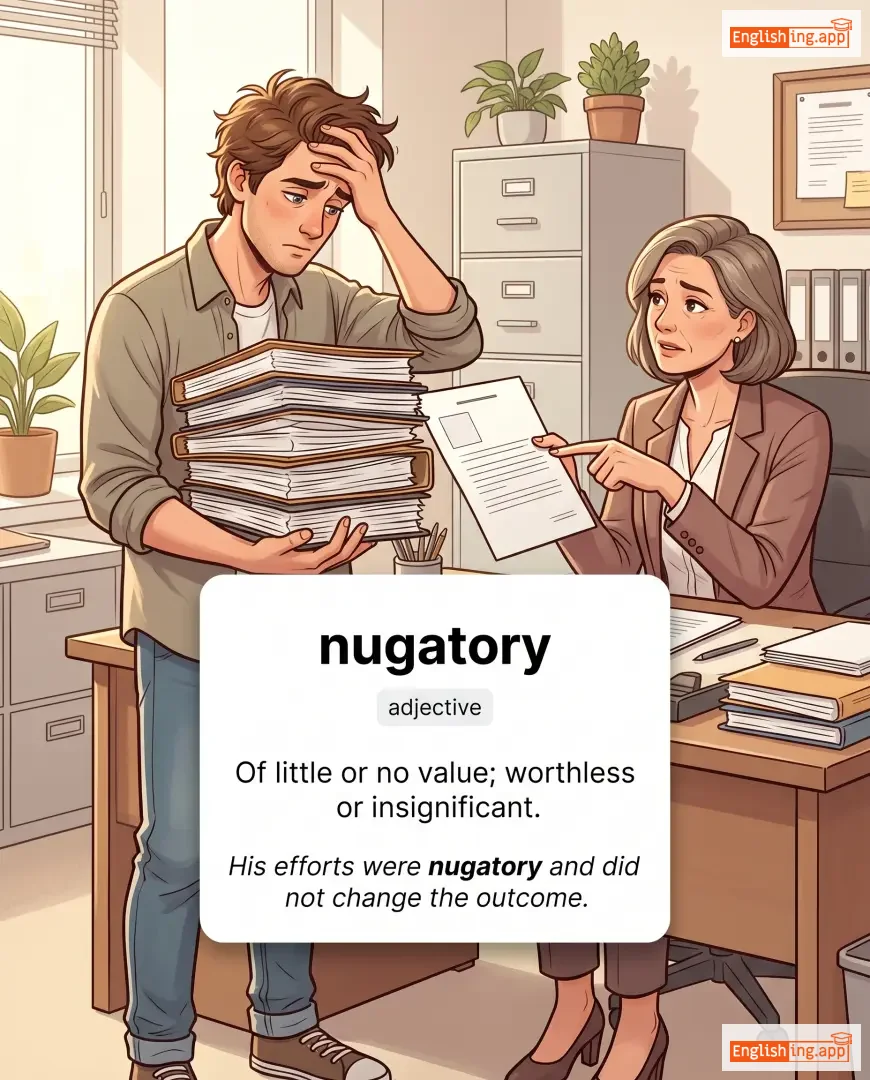
nugatory definition card — visual illustration of the meaning
adjective
/ˈnjuː.ɡə.tɔːr.i/
निरर्थक (nirarthak)

Of little or no value; worthless or insignificant.

"His efforts were nugatory and did not change the outcome."

"उसके प्रयास निरर्थक थे और परिणाम नहीं बदला।" (Uske prayaas nirarthak the aur parinaam nahi badla.)
noun
/ˈnjuː.səns/
परेशानी (pareshani)

A person, thing, or situation that causes inconvenience or annoyance.

"The loud construction noise was a nuisance to the neighbors."

"ऊँची निर्माण शोर पड़ोसियों के लिए एक परेशानी थी।" (Unchi nirman shor padosiyon ke liye ek pareshani thi.)
nullify definition card — visual illustration of the meaning
verb
/ˈnʌlɪfaɪ/
अप्रभावी करना (aprabhaavi karna)

to make legally null and void; to cancel or invalidate

"The contract was nullified due to fraud."

"ठगी के कारण अनुबंध रद्द कर दिया गया था।" (Thagi ke karan anubandh radd kar diya gaya tha.)
noun
/ˈnʌmbər/
संख्या (sankhya)

a mathematical value used to count, measure, or label

"She gave me her phone number."

"उसने मुझे अपना फोन नंबर दिया।" (Usne mujhe apna phone number diya.)
adjective
/ˈnjuː.mər.ə.bəl/
गणनीय; गिना जा सकने योग्य (gananiya; gina ja sakne yogya)

capable of being counted; countable

"The stars in the sky are not numerable."

"आसमान में तारे न्यूमरेबल नहीं हैं।" (aasman mein taare numerable nahin hain)
noun
/ˌnjuːməˈreɪʃən/
संख्यांकन (sankhyankan)

the action or process of counting or assigning numbers

"The teacher explained the basics of numeration to the students."

"शिक्षक ने छात्रों को संख्यांकन के मूल सिद्धांत समझाए।" (Shikshak ne chhatron ko sankhyankan ke mool siddhant samjhaye.)
adjective
/njuːˈmɛrɪkəl/
संख्यात्मक (sankhyatmak)

relating to or expressed in numbers

"The report provides numerical data on population growth."

"रिपोर्ट जनसंख्या वृद्धि पर संख्यात्मक डेटा प्रदान करती है।" (Report jansankhya vruddhi par sankhyatmak data pradan karti hai.)
adjective
/ˈnjuːmərəs/
असंख्य (asankhya)

existing in large numbers; many

"There are numerous opportunities for growth in this field."

"वहाँ इस क्षेत्र में विकास के लिए असंख्य अवसर हैं।" (Vahan is kshetra mein vikas ke liye asankhya avsar hain.)
adjective
/ˈnjuːmɪnəs/
आध्यात्मिक (adhyatmik)

having a strong spiritual or mysterious quality

"The temple had a numinous atmosphere that inspired awe."

"मंदिर में एक आध्यात्मिक वातावरण था जिसने श्रद्धा को प्रेरित किया।" (Mandir mein ek adhyatmik vatavaran tha jisne shraddha ko prerit kiya.)
adjective
/ˌnjuːmɪzˈmætɪk/
नमिस्मैटिक (numismatik)

relating to the study or collection of coins, currency, and medals

"He has a numismatic collection of rare coins from around the world."

"उसके पास दुनिया भर के दुर्लभ सिक्कों का एक संग्रह है।" (Uske paas duniya bhar ke durlabh sikko ka ek sangrah hai.)
noun
/njuːˈmɪzmətɪst/
नमिस्मैटिस्ट (numismatist)

A person who studies or collects coins, paper currency, and medals.

"The numismatist displayed his rare coin collection at the exhibition."

"नमिस्मैटिस्ट ने अपनी दुर्लभ सिक्का संग्रह प्रदर्शनी में दिखाई" (Numismatist ne apni durlabh sikka sangrah pradarshani mein dikhai)
👩‍🎓

Nun (नन)

noun
/nʌn/
नन (nan)

a woman who has taken vows in a religious order and lives in a convent

"The nun taught at the local Catholic school."

"नन ने स्थानीय कैथोलिक स्कूल में पढ़ाया।" (nan ne sthaniya katholik school mein padhaya.)
noun
/ˈnʌnəri/
ननरी (nannari)

A convent or building where nuns live and work.

"She decided to join the nunnery to devote her life to spiritual practice."

"उसने आध्यात्मिक अभ्यास में अपनी ज़िन्दगी समर्पित करने के लिए ननरी में शामिल होने का फैसला किया।" (Usne adhyatmik abhyas mein apni zindagi samarpit karne ke liye nannari mein shamil hone ka faisla kiya.)
adjective
/ˈnʌpʃəl/
वैवाहिक (vaivahik)

Relating to marriage or weddings.

"The couple prepared for their nuptial ceremony with great joy."

"जोड़े ने खुशी के साथ अपनी वैवाहिक समारोह की तैयारी की।" (Jode ne khushi ke saath apni vaivahik samaroah ki taiyari ki.)
nurse definition card — visual illustration of the meaning
noun, verb
/nɜːrs/
नर्स, सेविका (nars, sevika)

A person trained to care for the sick; to take care of someone or something.

"The nurse comforted the patient during the operation."

"ऑपरेशन के दौरान नर्स ने मरीज को सांत्वना दी।" (Operation ke dauran nars ne mareez ko santvana di.)
noun
/ˈnɜːrsəri/
पालन पोषण कक्ष (paalan poshan kaksh)

a room or place where young children are cared for

"She works in a nursery, taking care of infants."

"वह नर्सरी में काम करती है, शिशुओं की देखभाल करती है।" (Woh nursari mein kaam karti hai, shishuo ki dekhbhal karti hai.)
noun
/ˈnɜːrsɪŋ/
नर्सिंग (narsing)

the profession or practice of caring for the sick or injured

"She is studying nursing to become a healthcare professional."

"वह एक स्वास्थ्य देखभाल पेशेवर बनने के लिए नर्सिंग पढ़ाई कर रही है।" (Wah ek swasthya dekhbhaal peshewar banne ke liye nursing padhai kar rahi hai.)
verb, noun
/ˈnɜːrtʃər/
पालन-पोषण करना (palan-poshan karna)

To care for and encourage the growth or development of someone or something.

"Parents should nurture their children's talents."

"माता-पिता को अपने बच्चों की प्रतिभाओं को पालन-पोषण करना चाहिए।" (Mata-pita ko apne bachon ki pratibhayon ko palan-poshan karna chahiye.)
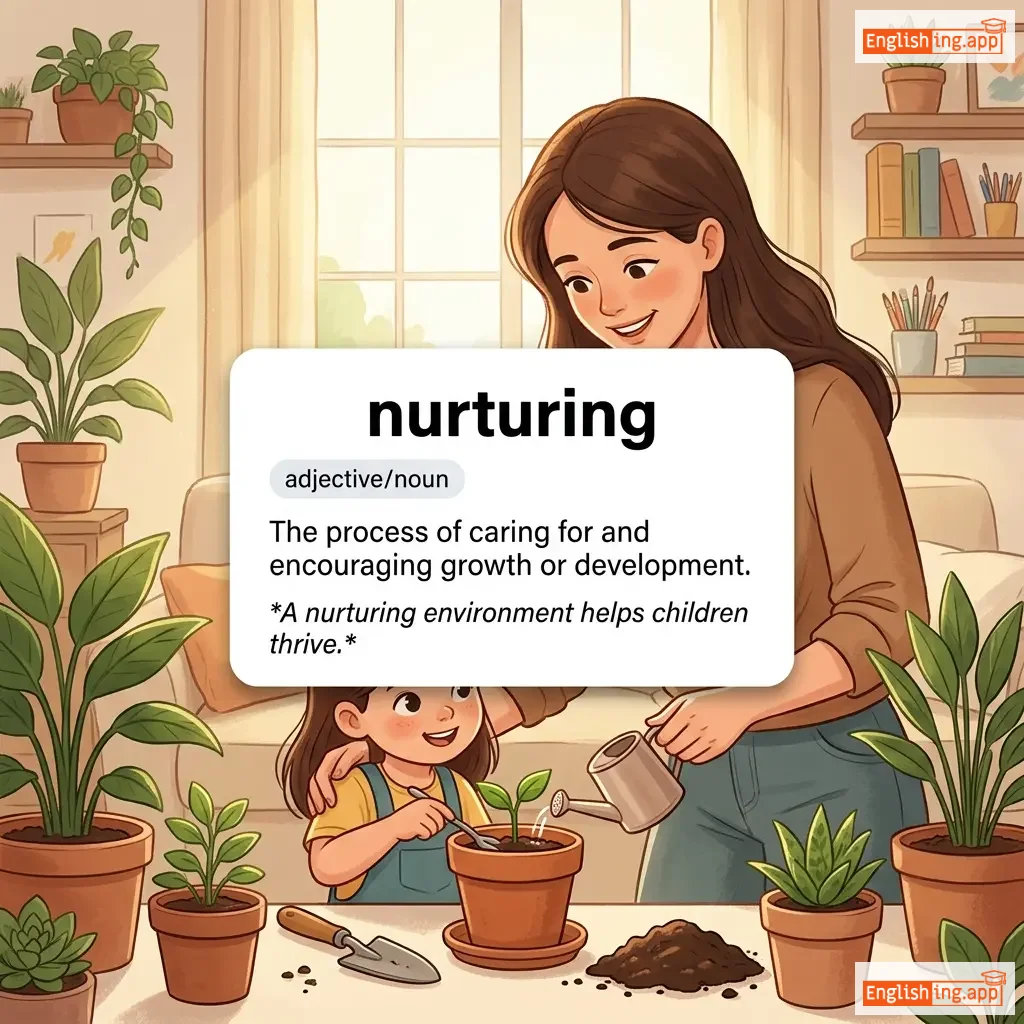
nurturing definition card — visual illustration of the meaning
adjective/noun
/ˈnɜːr.tʃɚ.ɪŋ/
पालन-पोषण, देखभाल, विकास (palan-poshan, dekhbhal, vikas)

The process of caring for and encouraging growth or development.

"A nurturing environment helps children thrive."

"एक नर्चरिंग पर्यावरण बच्चों को पनपने में मदद करता है।" (Ek nurturing paryavaran bachcho ko panapne mein madad karta hai.)
noun
/nʌt/
बदाम (badaam)

a hard-shelled fruit that contains a seed, or a small metal piece used in machinery

"She ate a peanut, which is a type of nut."

"उसने एक मूंगफली खाया, जो एक प्रकार का नट है।" (Usne ek moongphali khaya, jo ek prakar ka nut hai.)
Nut meg definition card — visual illustration of the meaning
noun
/ˈnʌt.meg/
जायफल (jayphal)

a spice made from the seed of the fruit of an evergreen tree, used in cooking and baking

"The recipe called for a teaspoon of ground nutmeg to flavor the custard."

"रेसिपी में कस्टर्ड को स्वाद देने के लिए एक चम्मच पिसा हुआ जायफल चाहिए था।" (resipi mein custard ko swad dene ke liye ek chammach pisa hua jayphal chahiye tha)
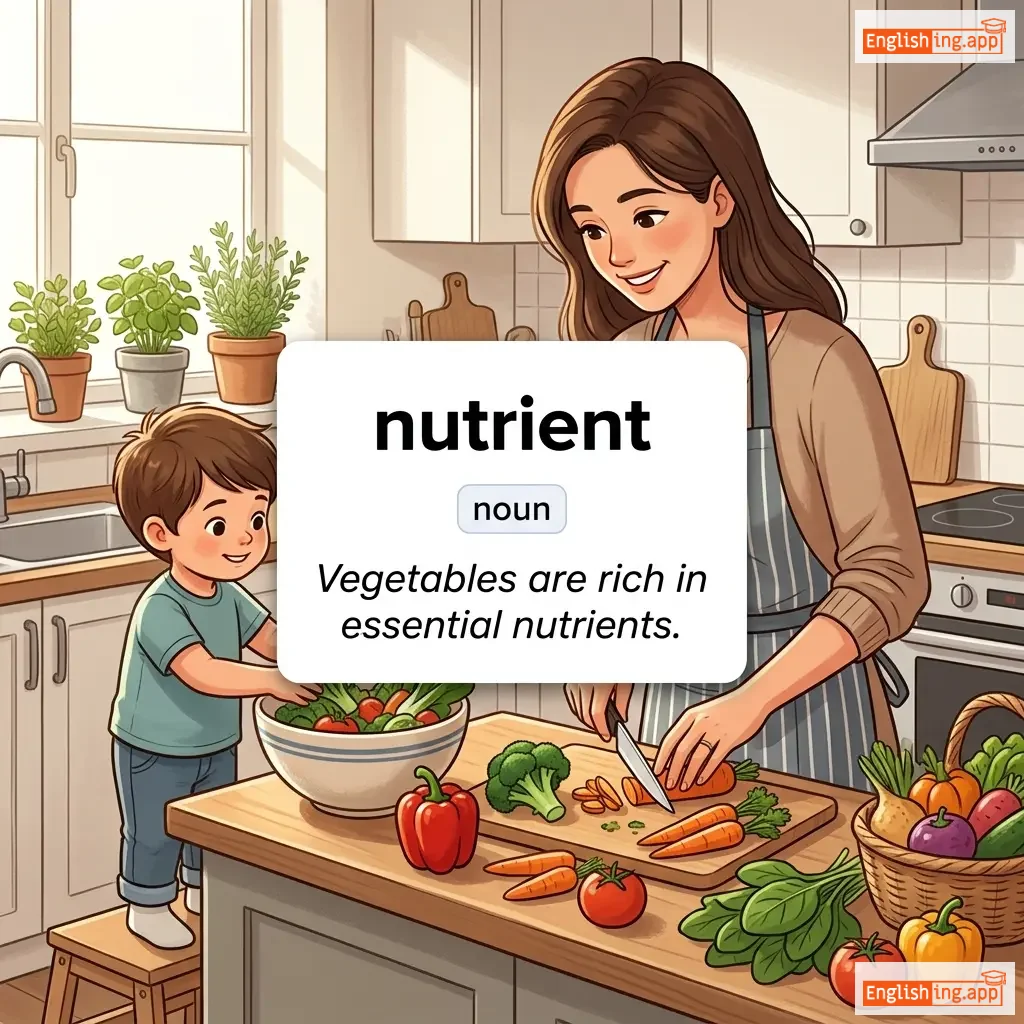
nutrient definition card — visual illustration of the meaning
noun
/ˈnjuː.tri.ənt/
पोषक तत्व (poshak tatva)

A substance that provides nourishment essential for growth and the maintenance of life.

"Vegetables are rich in essential nutrients."

"सब्जियाँ आवश्यक पोषक तत्वों से भरपूर होती हैं।" (Sabziyan aavashyak poshak tatvon se bharpoor hoti hain.)
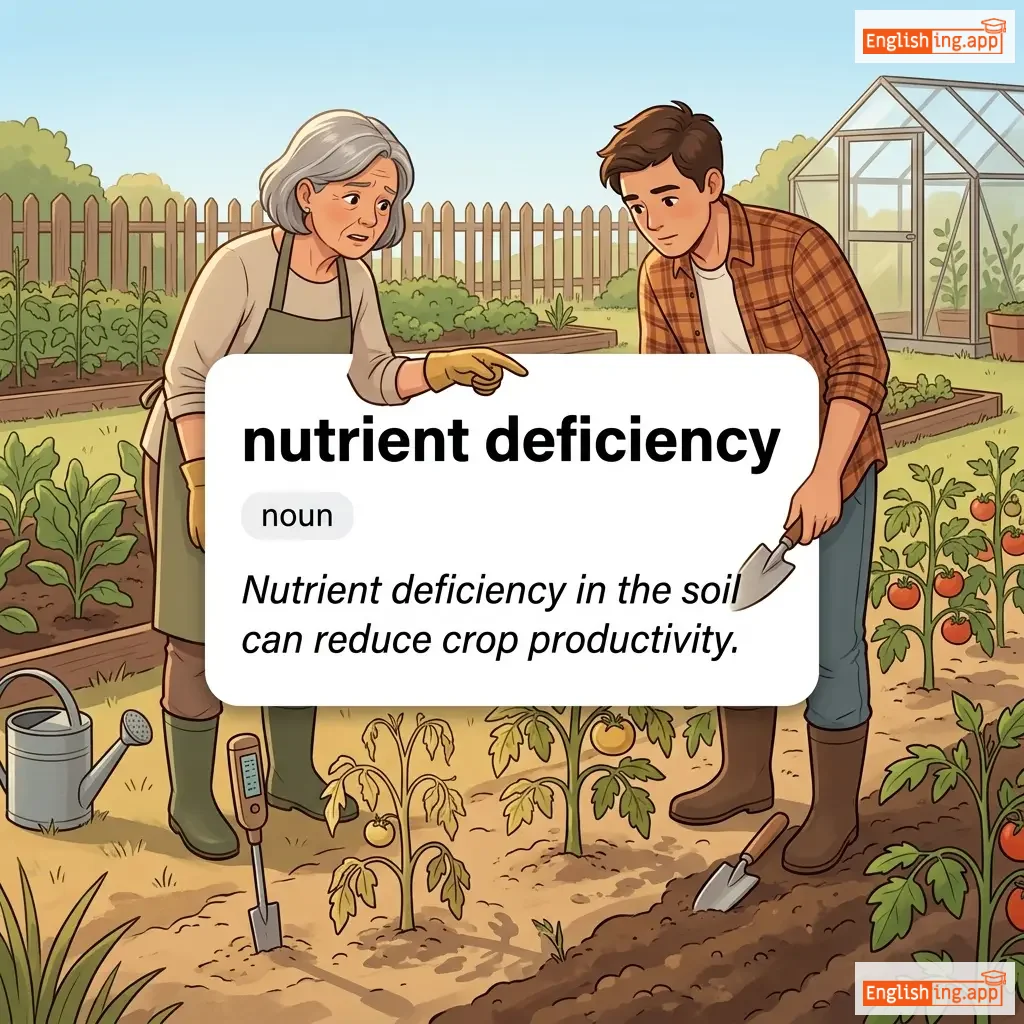
nutrient deficiency definition card — visual illustration of the meaning
noun
/ˈnjuːtrɪənt dɪˈfɪʃənsi/
पोषक तत्वों की कमी (poshak tatvon ki kami)

A lack of essential nutrients required for healthy plant growth, which can result in poor crop development, reduced yields, and increased susceptibility to diseases.

"Nutrient deficiency in the soil can reduce crop productivity."

"मिट्टी में पोषक तत्वों की कमी फसल की उत्पादकता को घटा सकती है।" (Mitti mein poshak tatvon ki kami fasal ki utpadakta ko ghata sakti hai.)
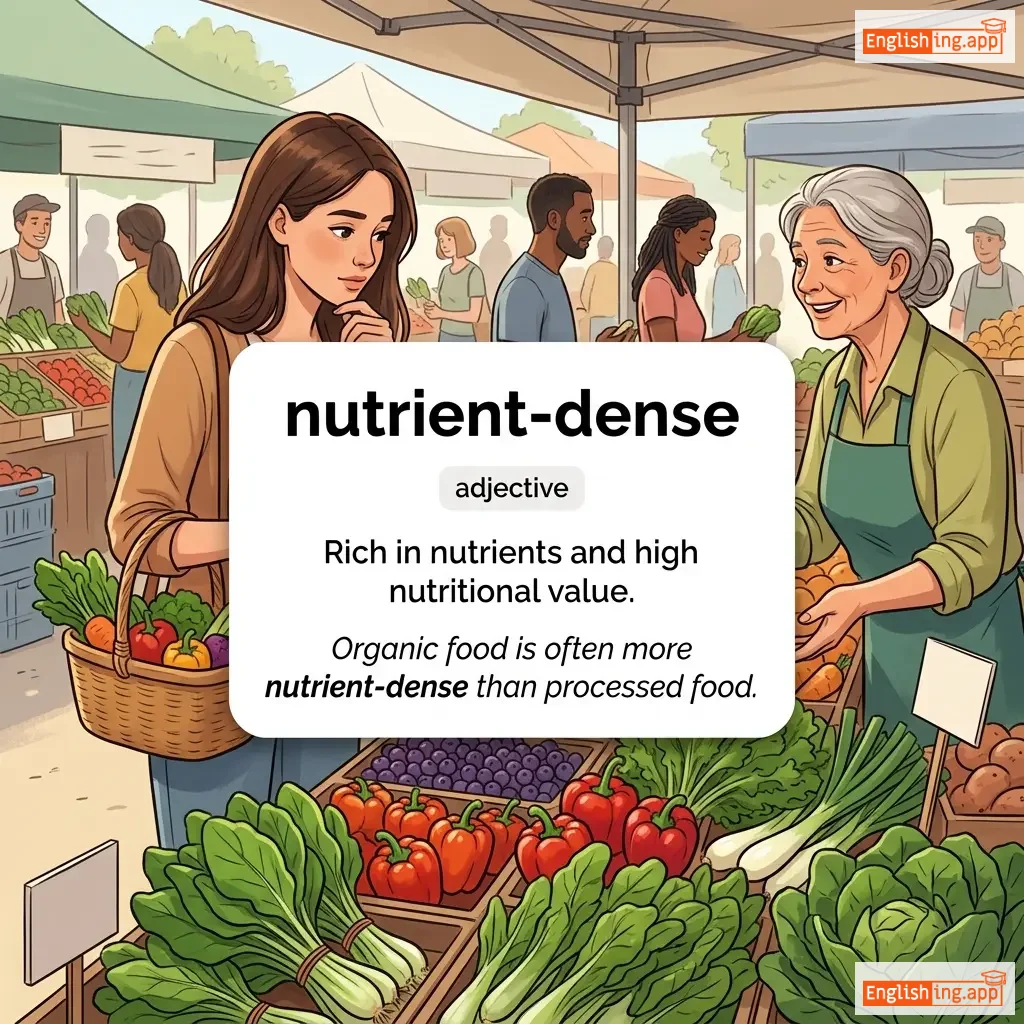
nutrient-dense definition card — visual illustration of the meaning
adjective
/ˈnjuː.tri.ənt dɛns/
पोषक तत्वों से भरपूर (poshak tatvon se bharpoor)

Rich in nutrients and high nutritional value.

"Organic food is often more nutrient-dense than processed food."

"जैविक खाद्य अक्सर प्रसंस्कृत खाद्य से अधिक पोषक तत्वों से भरपूर होते हैं।" (Jaivik khadya aksar prasanskrut khadya se adhik poshak tatvon se bharpoor hote hain.)
noun
/ˈnjuː.trɪ.mənt/
पोषण (poshan)

Something that nourishes; sustenance or food.

"The soil provides nutriment to the plants."

"मिट्टी पौधों को पोषण प्रदान करती है।" (Mitti paudhon ko poshan pradan karti hai.)
noun
/njuːˈtrɪʃ.ən/
पोषण (poshan)

The process of providing or obtaining the food necessary for health and growth.

"Good nutrition is vital for a healthy life."

"अच्छा पोषण एक स्वस्थ जीवन के लिए अत्यंत महत्वपूर्ण है।" (Accha poshan ek swasth jeevan ke liye atyant mahatvapurn hai.)
adjective
/njuːˈtrɪʃ.əs/
पोषणकारी (poshankari)

Providing nourishment; health-giving.

"Milk is a nutritious drink for children."

"दूध बच्चों के लिए एक पोषणकारी पेय है।" (Doodh bachchon ke liye ek poshankari pey hai.)
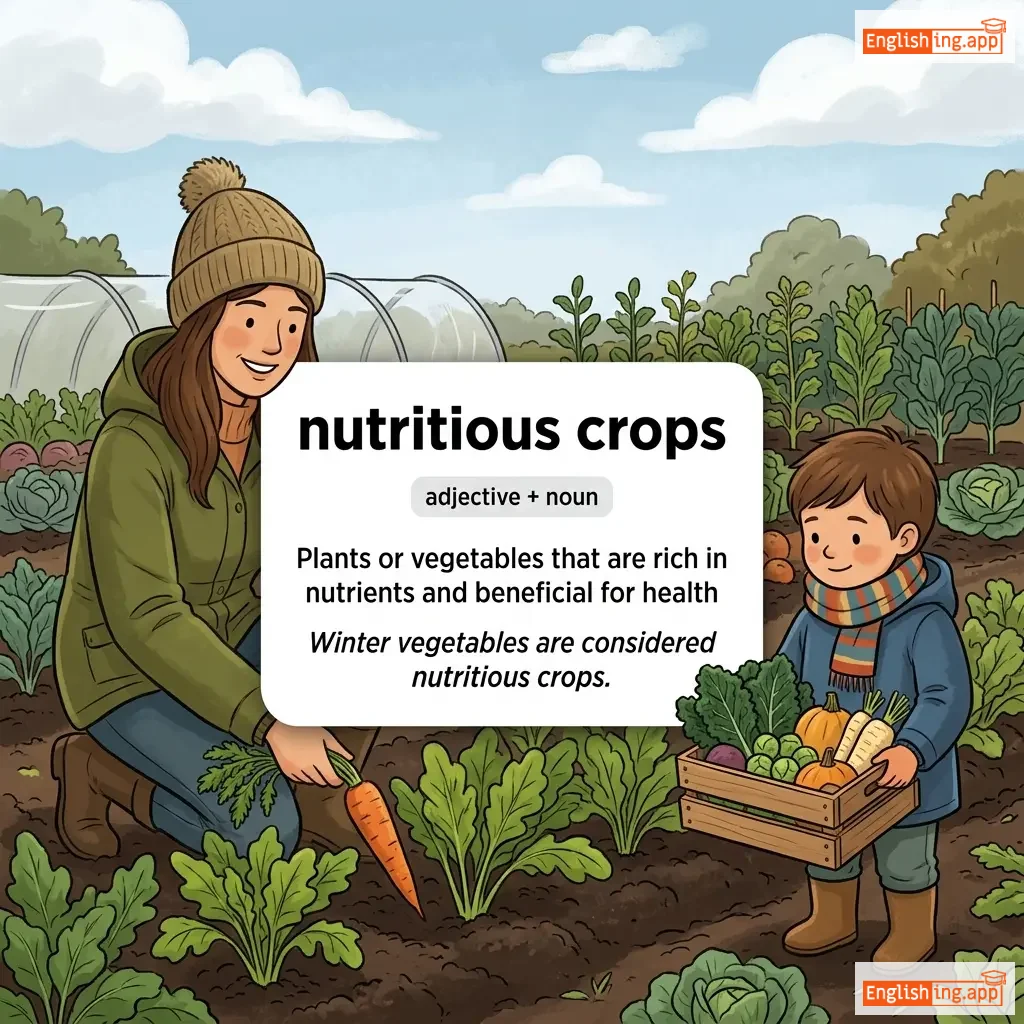
nutritious crops definition card — visual illustration of the meaning
adjective + noun
njuˈtrɪʃəs krɒps
पोषणकारी फसलें (poshankaari faslen)

Plants or vegetables that are rich in nutrients and beneficial for health

"Winter vegetables are considered nutritious crops."

"सर्दियों की सब्जियां पोषणकारी फसलें मानी जाती हैं।" (Sardiyon ki sabziyaan poshankari faslen maani jaati hain.)
adjective, verb
/əbˈskjʊr/
अस्पष्ट (aspasht)

Not clearly expressed or understood; to make something difficult to see or understand.

"The meaning of the poem was obscure to most readers."

"कविता का अर्थ अधिकांश पाठकों के लिए अस्पष्ट था।" (Kavita ka arth adhikansh pathako ke liye aspasht tha.)
noun
/ˈɒbsɪkwiːz/
अंत्येष्टि संस्कार (antyeshti sanskar)

Funeral rites or ceremonies.

"The obsequies for the late leader drew thousands of mourners."

"वह नेता के अंतिम संस्कार में हजारों शोक व्यक्तियों ने भाग लिया।" (Vah neta ke antim sanskar mein hazaron shok vyaktiyon ne bhag liya.)