Vocabulaires

Découvrez, apprenez et maîtrisez le vocabulaire anglais

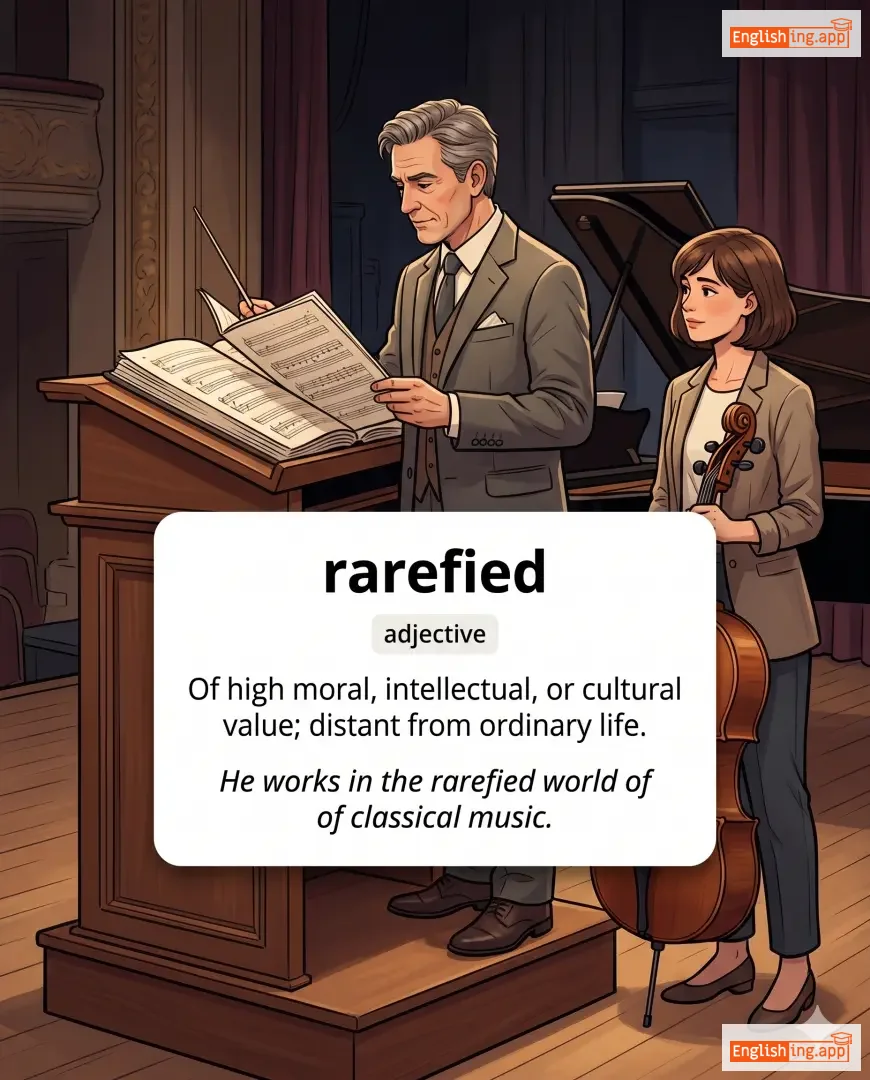
rarefied definition card — visual illustration of the meaning
adjective
/ˈreə.rɪ.faɪd/
rarefié (rarefie)

Of high moral, intellectual, or cultural value; distant from ordinary life.

"He works in the rarefied world of classical music."

"Il travaille dans le monde rarefié de la musique classique." (Il travaille dans le monde rarefie de la musique classique.)
verb
/ˈreə.rɪ.faɪ/
raréfier, affiner (rarefier, affiner)

To make something less dense or more refined.

"The air rarefies as you climb higher into the mountains."

"L'air se raréfie à mesure que vous montez plus haut dans les montagnes." (L'air se rarefie a mesure que vous montez plus haut dans les montagnes.)
adverb
/ˈrɛə(r)li/
rarement (rarement)

not often, infrequently

"She rarely eats sweets because of her diet."

"Elle mange rarement des bonbons à cause de son régime." (Elle mange rarement des bonbons à cause de son régime.)
noun
/ˈrerəti/
l'état d'être rare; quelque chose qui est peu commun ou rare (l'etat d'etre rare; quelque chose qui est peu commun ou rare)

the state of being rare; something that is uncommon or scarce

"The antique vase was a rarity worth thousands of dollars."

"Le vase antique était une rareté valant des milliers de dollars." (Le vase antique etait une rarete valant des milliers de dollars.)
adjective
/ræʃ/
précipité, imprudent (precipite, imprudent)

Acting quickly without careful consideration; reckless.

"It was a rash decision to invest without research."

"C'était une décision imprudente d'investir sans recherche." (C'etait une decision imprudente d'investir sans recherche.)
verb
/ræsp/
parler d'une voix rugueuse ou râper avec un bruit grossier (parler d'une voix rugueuse ou raper avec un bruit grossier)

to speak in a rough, harsh voice or to scrape with a coarse sound

"He rasped out a warning before collapsing."

"Il a râpé un avertissement avant de s'effondrer." (Il a rape un avertissement avant de s'effondrer.)
noun
/ræt/
rat (rat)

a small rodent that resembles a large mouse, often considered a pest

"A rat ran across the kitchen floor last night."

"Un rat a couru sur le sol de la cuisine hier soir." (Un rat a couru sur le sol de la cuisine hier soir.)
😮‍💨

raspy (raspi)

adjective
/ˈræspi/
rude (rude)

having a harsh, rough, or grating sound

"His raspy voice revealed years of smoking."

"Sa voix rude révélait des années de tabagisme." (Sa voix rude révélait des années de tabagisme.)
noun
/ˌrɪəlɪˈzeɪʃən/
réalisation (realisation)

the act of becoming fully aware of something as a fact

"Her realization of the problem helped solve the issue."

"Sa réalisation du problème a aidé à résoudre la question." (Sa realisation du probleme a aide a resoudre la question.)
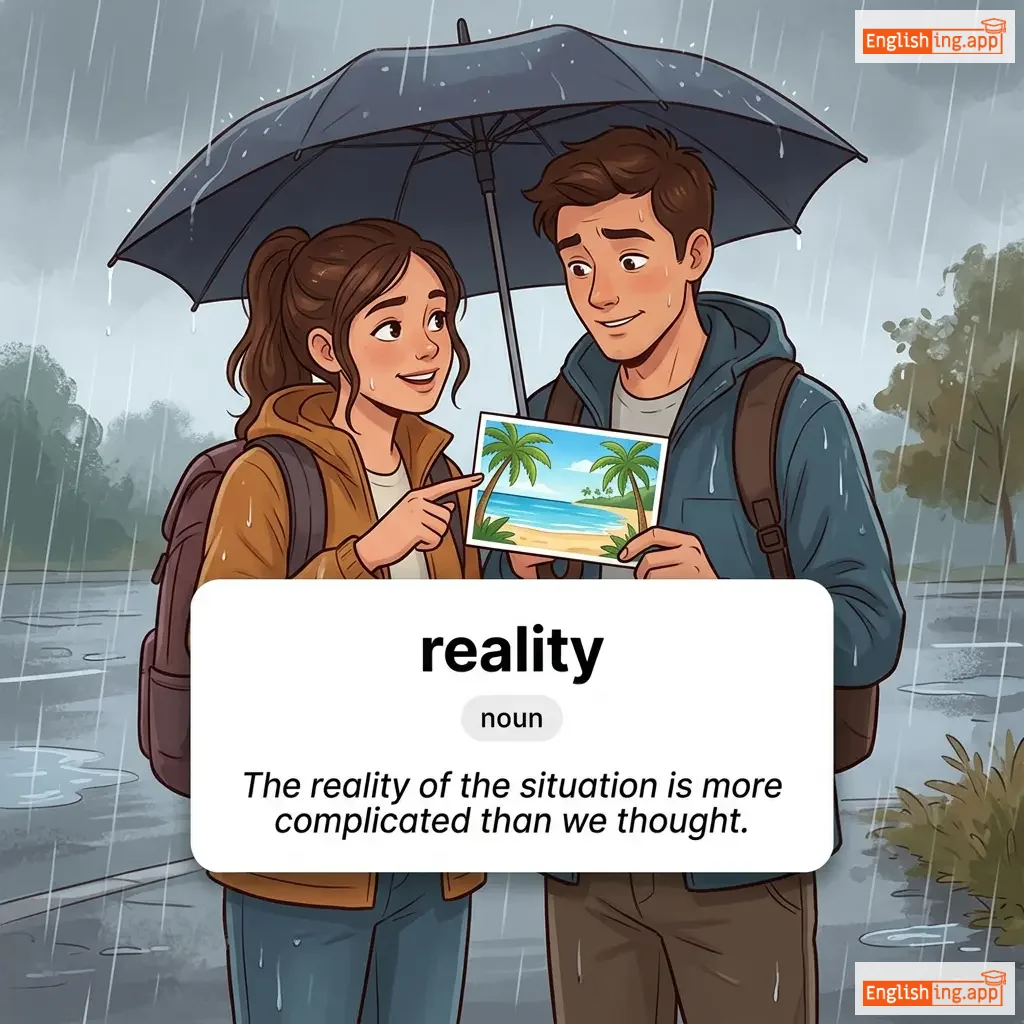
reality definition card — visual illustration of the meaning
noun
/riˈæləti/
réalité (realite)

the state of things as they actually exist, rather than as they may appear or might be imagined

"The reality of the situation is more complicated than we thought."

"La réalité de la situation est plus compliquée que ce que nous pensions." (La realite de la situation est plus compliquee que ce que nous pensions.)
adjective
/ˌriːəˈlɪstɪk/
réaliste (realiste)

having or showing a sensible and practical idea of what can be achieved or expected

"She gave a realistic estimate of the project's cost."

"Elle a donné une estimation réaliste du coût du projet." (Elle a donné une estimation réaliste du coût du projet.)
noun
/ˈrɪə.lɪ.zəm/
réalisme (réalisme)

The quality of representing things as they are; a practical or factual view.

"Her paintings are admired for their realism."

"Ses peintures sont admirées pour leur réalisme." (Ses peintures sont admirées pour leur réalisme.)
adjective
/riːəl/
réel (reel)

actually existing or happening; true and not imagined

"This is the real deal, no gimmicks."

"C'est le vrai sujet, sans artifice." (C'est le vrai sujet, sans artifice.)
verb
/ˌriːəˈfɜːrm/
réaffirmer (reaffirmer)

To state again strongly; to confirm or strengthen a statement or belief.

"The president reaffirmed his commitment to education reform."

"Le président a réaffirmé son engagement envers la réforme de l’éducation." (Le president a reaffirme son engagement envers la reforme de l education.)
adjective
/ˈrɛd.i/
prêt (pret)

Prepared or available for use or action.

"She was ready to leave for the airport."

"Elle était prête à partir pour l'aéroport." (Elle etait prete a partir pour l'aeroport.)
noun
/ˌriː.əˈdʒʌst.mənt/
réajustement (reajustement)

The act of changing or correcting something again to make it suitable or balanced.

"After moving to a new city, he went through a period of readjustment."

"Après avoir déménagé dans une nouvelle ville, il a traversé une période de réajustement." (Apres avoir demenage dans une nouvelle ville, il a traverse une periode de reajustement.)
verb
/ˌriːəˈdʒʌst/
réajuster (reajuster)

To change or move something again in order to achieve a better fit, condition, or balance.

"He readjusted the chair to make it more comfortable."

"Il a réajusté la chaise pour la rendre plus confortable." (Il a réajusté la chaise pour la rendre plus confortable.)
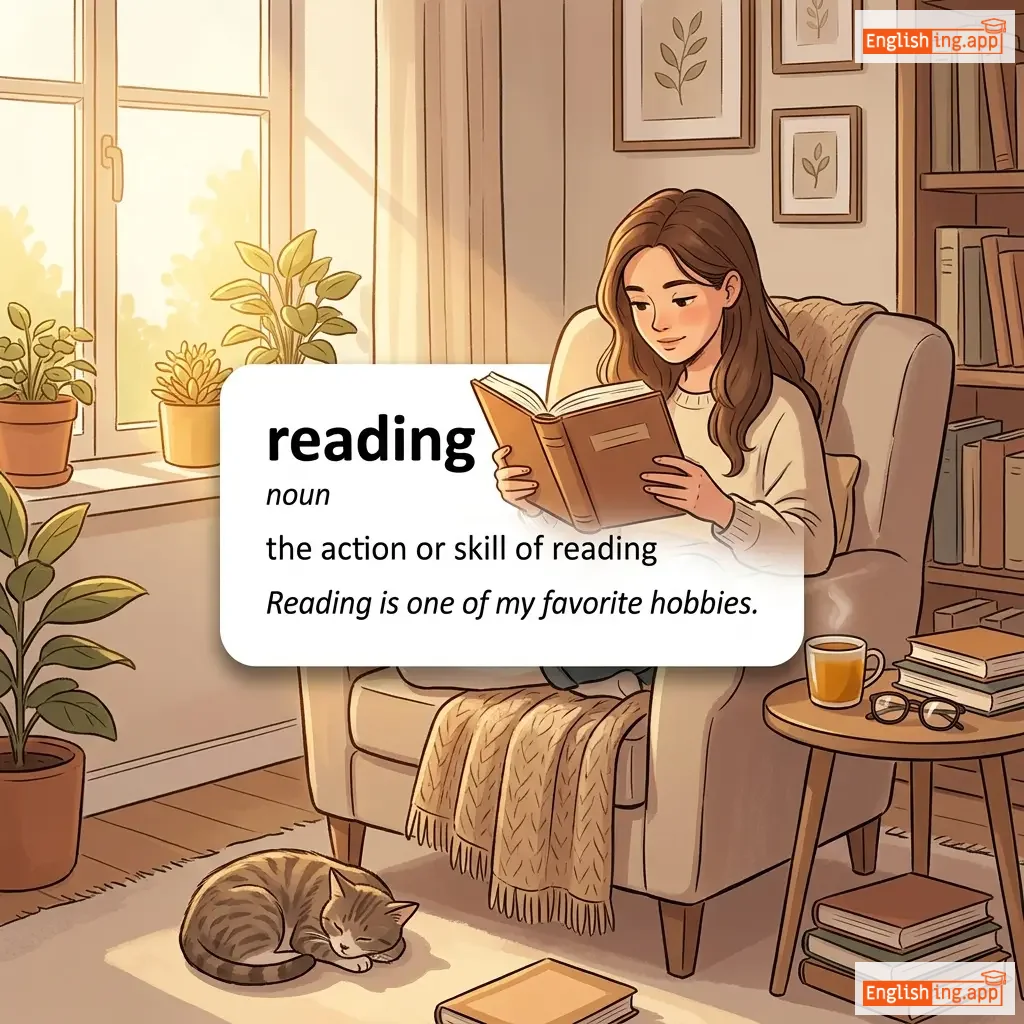
reading definition card — visual illustration of the meaning
noun
/ˈriːdɪŋ/
lecture (lecture)

the action or skill of reading

"Reading is one of my favorite hobbies."

"La lecture est l'un de mes passe-temps préférés." (La lecture est l'un de mes passe-temps préférés.)
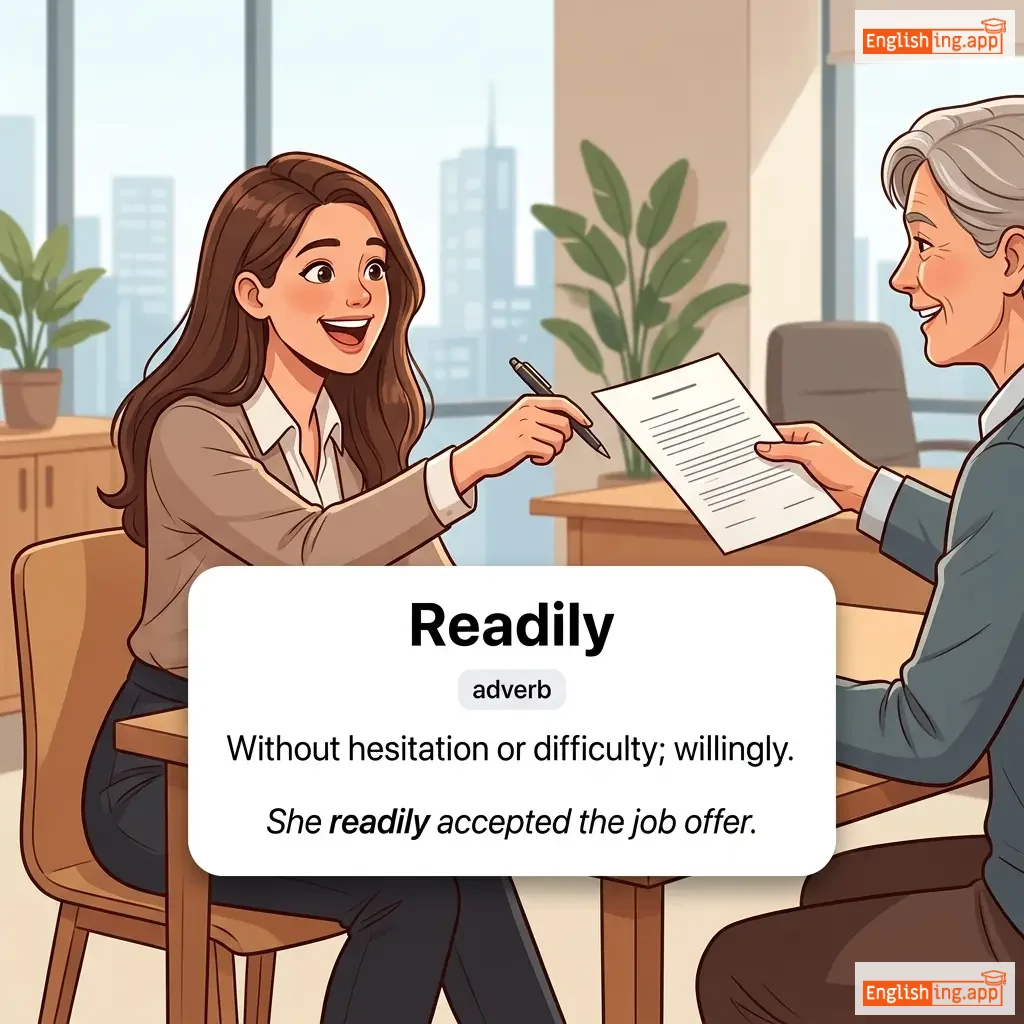
Readily definition card — visual illustration of the meaning
adverb
/ˈrɛdəli/
facilement (facilement)

Without hesitation or difficulty; willingly.

"She readily accepted the job offer."

"Elle a accepté l'offre d'emploi facilement." (Elle a accepté l'offre d'emploi facilement.)
noun
/ˈriːdər/
lecteur (lecteur)

a person who reads or who is capable of reading

"She is a fast reader, finishing books in a day."

"Elle est une lectrice rapide, terminant des livres en un jour." (Elle est une lectrice rapide, terminant des livres en un jour.)
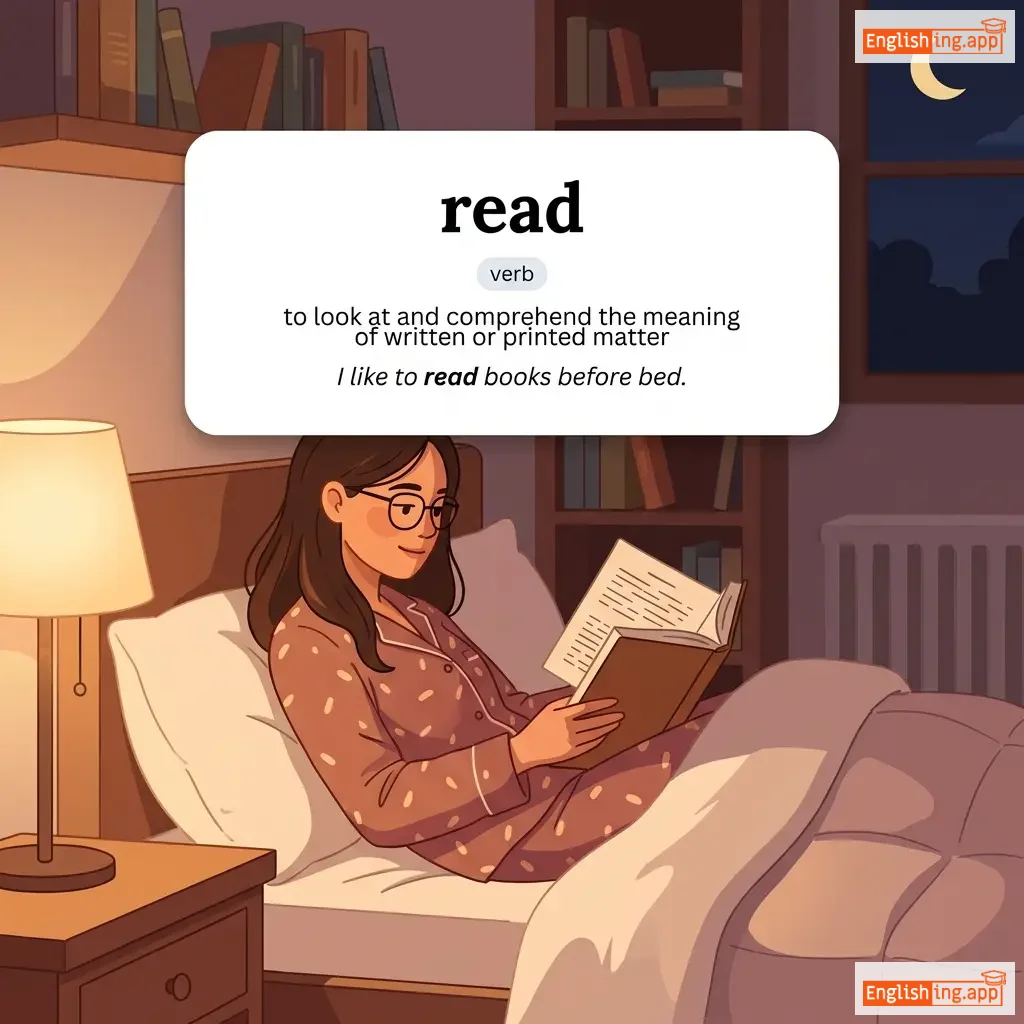
read definition card — visual illustration of the meaning
verb
/riːd/
lire (lire)

to look at and comprehend the meaning of written or printed matter

"I like to read books before bed."

"J'aime lire des livres avant de me coucher." (J'aime lire des livres avant de me coucher.)
adjective
/riˈæk.tɪv/
réactif; chimiquement actif (reactif; chimiquement actif)

responding to situations rather than initiating them; chemically active

"The company took a reactive approach to customer complaints."

"L'entreprise a adopté une approche réactive face aux plaintes des clients." (L'entreprise a adopté une approche réactive face aux plaintes des clients.)
adjective
/riˈækʃəˌneri/
réactionnaire (reactionnaire)

Opposing political or social progress or reform; extremely conservative.

"The group took a reactionary stance against the new policies."

"Le groupe a adopté une position réactionnaire contre les nouvelles politiques." (Le groupe a adopté une position réactionnaire contre les nouvelles politiques.)
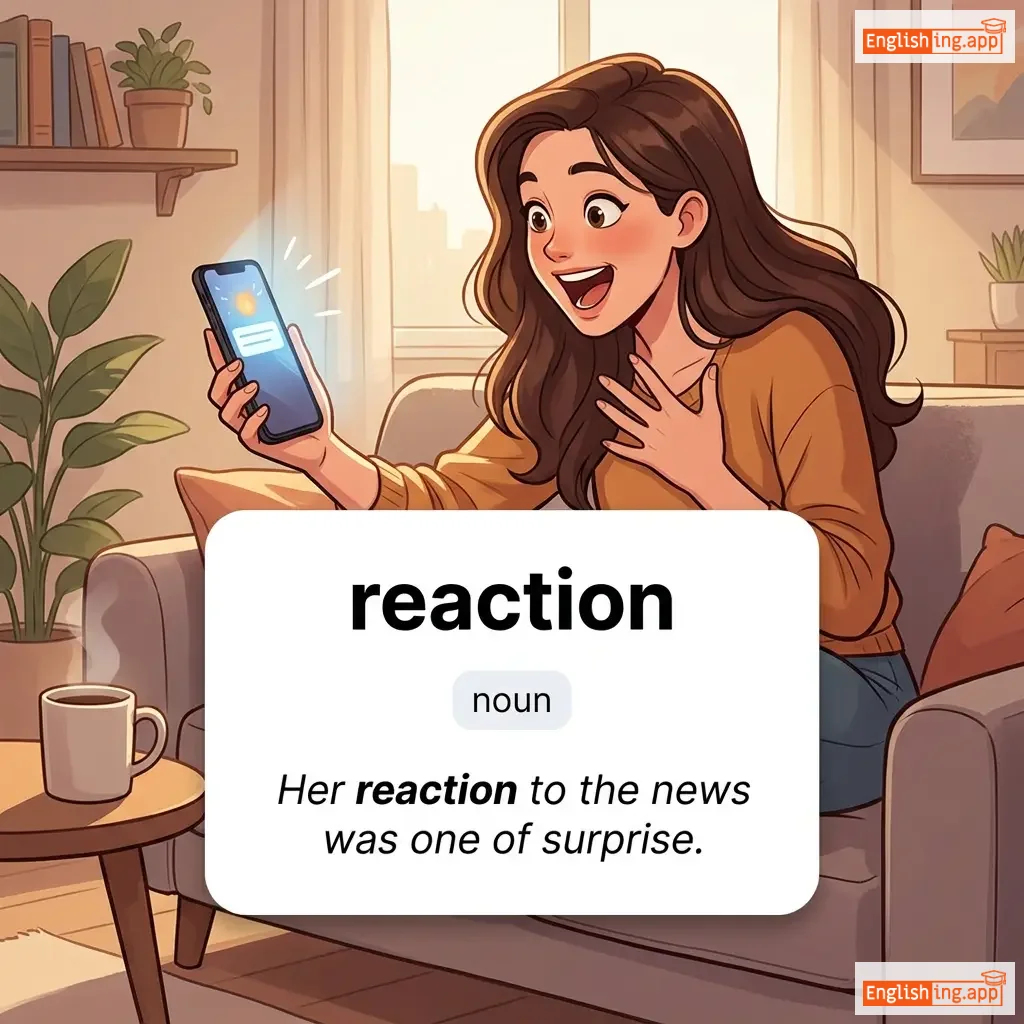
reaction definition card — visual illustration of the meaning
noun
/riˈækʃən/
réaction (reaction)

A response to a situation, event, or stimulus; also a chemical change involving reactants and products.

"Her reaction to the news was one of surprise."

"Sa réaction à la nouvelle a été de la surprise." (Sa reaction a la nouvelle a ete de la surprise.)
noun
/riˈæktənt/
réactif (reactif)

A substance that takes part in and undergoes change during a chemical reaction.

"Oxygen is a reactant in the process of combustion."

"L'oxygène est un réactif dans le processus de combustion." (L'oxygene est un reactif dans le processus de combustion.)
verb
/riˈækt/
réagir (reagir)

to respond or behave in a particular way to something

"She reacted angrily when she heard the news."

"Elle a réagi avec colère lorsqu'elle a entendu la nouvelle." (Elle a réagi avec colère lorsqu'elle a entendu la nouvelle.)
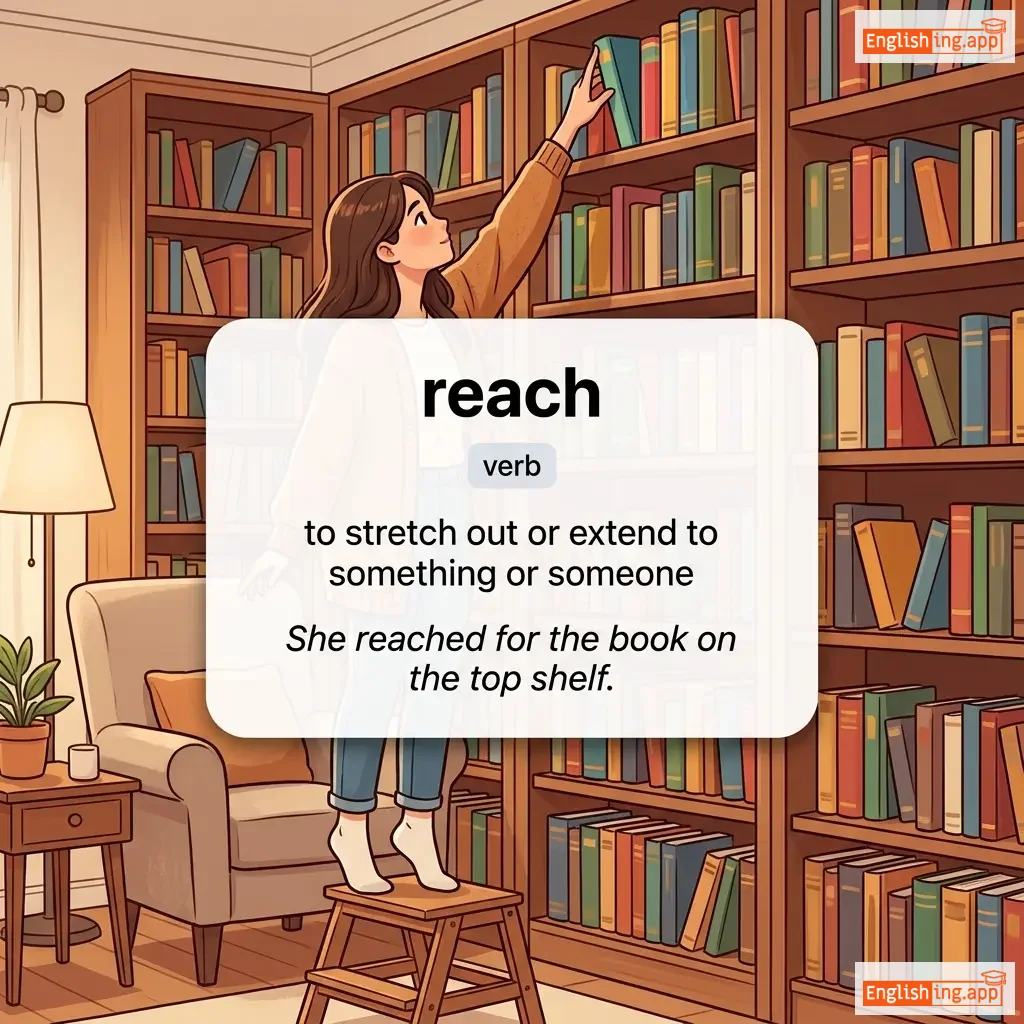
reach definition card — visual illustration of the meaning
verb
/riːtʃ/
atteindre (atteindre)

to stretch out or extend to something or someone

"She reached for the book on the top shelf."

"Elle a tendu la main pour atteindre le livre sur l'étagère du dessus." (Elle a tendu la main pour atteindre le livre sur l'étagère du dessus.)
preposition
/riː/
concernant (concernant)

concerning or about (used in formal letters or emails)

"The letter was sent re your recent application."

"La lettre a été envoyée concernant votre récente candidature." (La lettre a été envoyée concernant votre récente candidature.)
noun
/ˈreɪ.zər/
rasoir (rasoir)

a sharp-edged instrument used for shaving hair from the skin

"He shaved his beard with a sharp razor."

"Il s'est rasé la barbe avec un rasoir tranchant." (Il s'est rasé la barbe avec un rasoir tranchant.)
verb
/reɪz/
raser (raser)

To completely destroy or demolish something, especially a building.

"The old factory was razed to make way for new apartments."

"L'ancienne usine a été rasée pour faire place à de nouveaux appartements." (L'ancienne usine a été rasée pour faire place à de nouveaux appartements.)
noun
/reɪ/
rayon (rayon)

a narrow beam of light, heat, or radiation

"A ray of sunlight broke through the clouds."

"Un rayon de lumière du soleil a percé les nuages." (Un rayon de lumière du soleil a percé les nuages.)
noun
/rɔ ˈtɜrmərɪk/
curcuma frais (curcuma frais)

fresh unprocessed root of the turmeric plant used as a spice and medicine

"Grate raw turmeric into the curry for authentic flavor."

"Râpez du curcuma frais dans le curry pour une saveur authentique." (Rapez du curcuma frais dans le curry pour une saveur authentique)
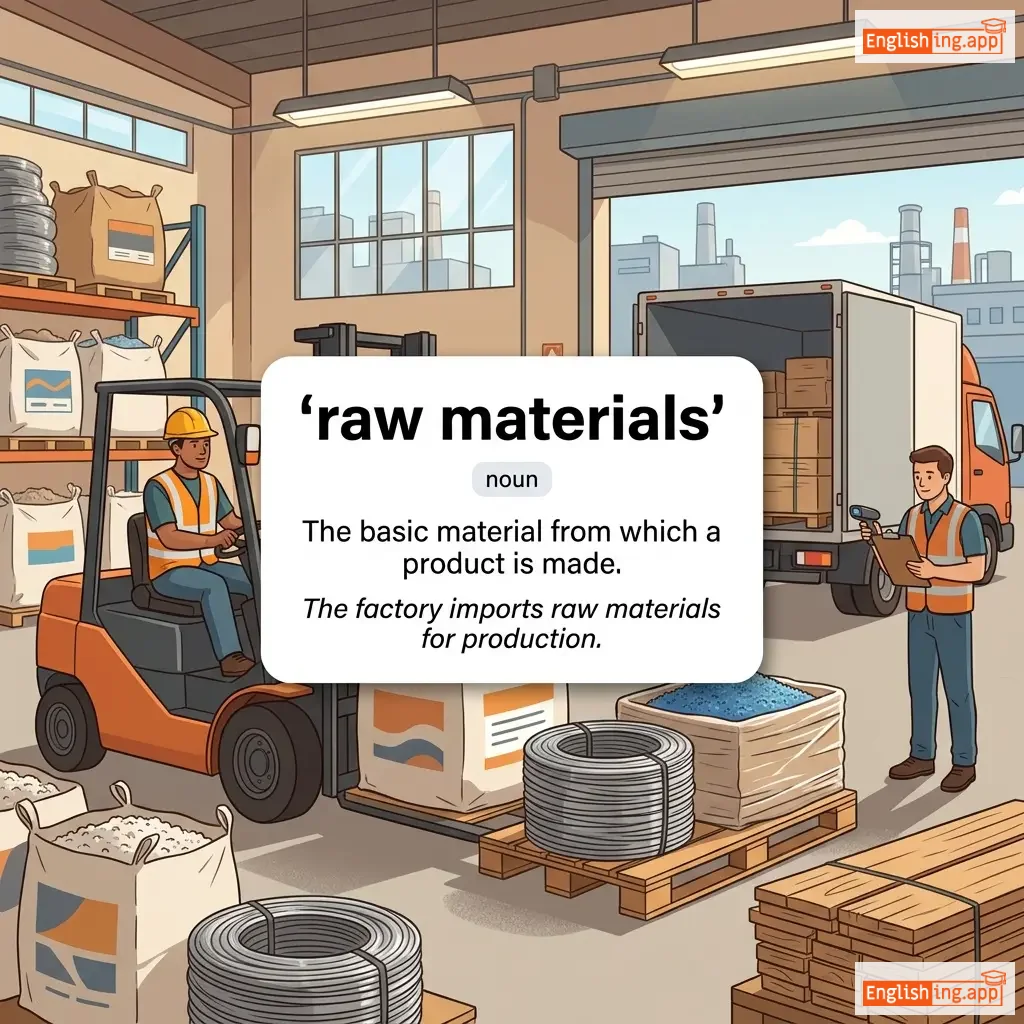
raw materials definition card — visual illustration of the meaning
noun
rɔː mətɪˈrɪəlz
matières premières (matieres premieres)

The basic material from which a product is made.

"The factory imports raw materials for production."

"L'usine importe des matières premières pour la production." (L'usine importe des matieres premieres pour la production.)
verb
/ˈrævɪʃ/
envoûter (envouter)

To fill with intense delight; to captivate or enchant.

"The beauty of the sunset ravished the travelers."

"La beauté du coucher du soleil envoûta les voyageurs." (La beaute du coucher du soleil envouta les voyageurs.)
adjective
/rɔː/
cru (kru)

not cooked or processed; in its natural state

"She ate raw vegetables for lunch."

"Elle a mangé des légumes crus pour le déjeuner." (Elle a mangé des légumes crus pour le déjeuner.)
noun
/reɪt/
taux (taux)

the cost or price of something, or the amount at which something happens

"The rate of inflation is increasing every year."

"Le taux d'inflation augmente chaque année." (Le taux d'inflation augmente chaque année.)
adverb
/ˈræðər/
dans la plupart des cas (dans la plupart des cas)

to a certain extent or degree

"I would rather stay home than go out."

"Je préférerais rester à la maison plutôt que de sortir." (Je préférerais rester à la maison plutôt que de sortir.)
adverb
/ˈrɪəli/
vraiment (reeli)

used to emphasize a statement or description

"She really enjoyed the movie last night."

"Elle a vraiment aimé le film hier soir." (Elle a vraiment aime le film hier soir.)
noun
/ˌrætɪfɪˈkeɪʃən/
ratification (ratifikasyon)

the action of signing or giving formal consent to a treaty, contract, or agreement

"The treaty required ratification by both countries' parliaments."

"Le traité nécessitait la ratification par les parlements des deux pays." (Le traite necessitait la ratification par les parlements des deux pays.)
verb
/ˈrætɪfaɪ/
ratifier (ratifier)

to approve or confirm something officially, usually by law or formal consent

"The government ratified the trade agreement."

"Le gouvernement a ratifié l'accord commercial." (Le gouvernement a ratifié l'accord commercial.)
noun
/ˈreɪtɪŋ/
évaluation (evaluation)

an evaluation or assessment, usually numerical

"The movie received a high rating from critics."

"Le film a reçu une haute évaluation de la part des critiques." (Le film a recu une haute evaluation de la part des critiques.)
noun
/ˈreɪʃoʊ/
rapport (rapport)

a relationship between two numbers showing how many times the first number contains the second

"The ratio of boys to girls in the class is 2:1."

"Le rapport entre les garçons et les filles dans la classe est de 2:1." (Le rapport entre les garçons et les filles dans la classe est de 2:1.)
noun
/ˌræʃioʊsɪˈneɪʃən/
raisonnement (raisonnement)

the process of reasoning or logical thinking

"His ratiocination impressed the judges during the debate."

"Son raisonnement a impressionné les juges pendant le débat." (Son raisonnement a impressionné les juges pendant le débat.)
noun
/ˈræʃən/
ration (rasyon)

a fixed amount of something, especially food, officially allowed to each person

"During the war, each family received a weekly ration of rice."

"Pendant la guerre, chaque famille recevait une ration hebdomadaire de riz." (Pendant la guerre, chaque famille recevait une ration hebdomadaire de riz.)
adjective
/ˈræʃənəl/
rationnel (rationnel)

based on or in accordance with reason or logic

"She made a rational decision after considering all the facts."

"Elle a pris une décision rationnelle après avoir considéré tous les faits." (Elle a pris une decision rationnelle apres avoir considere tous les faits.)
noun
/ˌræʃəˈnæl/
raison sous-jacente (raison sous-jacente)

the underlying reason or explanation for something

"The rationale behind his decision was clearly explained."

"La raison derrière sa décision a été clairement expliquée." (La raison derriere sa decision a ete clairement expliquee.)
noun
/ˈræʃənəlɪzəm/
rationalisme (rationalisme)

a belief or theory that opinions and actions should be based on reason and knowledge rather than religious belief or emotion

"Rationalism emphasizes logic and reasoning over faith."

"Le rationalisme met l'accent sur la logique et le raisonnement plutôt que sur la foi." (Le rationalisme met l'accent sur la logique et le raisonnement plutot que sur la foi.)
noun
/ˈreɪ.vən/
corbeau (korbo)

a large, black bird with a thick bill and harsh croaking voice

"The raven perched on the old oak tree and cawed loudly."

"Le corbeau s’est perché sur le vieux chêne et a croassé bruyamment." (le korbo set perche sur le vieux shen e a kroase bruyaman)
adjective
/ˈrævənɪŋ/
affamé et avide (affamé et avide)

Extremely hungry and greedy; voracious.

"The ravening wolves circled the camp."

"Les loups affamés ont encerclé le camp." (Les loups affamés ont encerclé le camp.)
adjective
/ˈrævənəs/
affamé (affame)

Extremely hungry; famished.

"After the long hike, she was ravenous and ate quickly."

"Après la longue randonnée, elle était affamée et a mangé rapidement." (Apres la longue randonnee, elle etait affamee et a mange rapidement.)