Vocabulaires

Découvrez, apprenez et maîtrisez le vocabulaire anglais

noun
/riːm/
rame (rame)

A large quantity of paper (typically 500 sheets); informally, a large amount of something.

"The office ordered ten reams of paper."

"Le bureau a commandé dix rames de papier." (Le bureau a commandé dix rames de papier.)
noun
/rɛlm/
domaine (domen)

A kingdom or domain; a field or area of activity or interest.

"He is well known in the realm of science."

"Il est bien connu dans le domaine de la science." (Il est bien connu dans le domaine de la science.)
verb
/ˈreɪn.dʒɪŋ/
varier (varier)

Extending or varying between limits.

"The temperatures are ranging from 15 to 30 degrees this week."

"Les températures varient de 15 à 30 degrés cette semaine." (Les temperatures varient de 15 à 30 degrés cette semaine.)
verb
/ræsp/
parler d'une voix rugueuse ou râper avec un bruit grossier (parler d'une voix rugueuse ou raper avec un bruit grossier)

to speak in a rough, harsh voice or to scrape with a coarse sound

"He rasped out a warning before collapsing."

"Il a râpé un avertissement avant de s'effondrer." (Il a rape un avertissement avant de s'effondrer.)
adjective
/ræʃ/
précipité, imprudent (precipite, imprudent)

Acting quickly without careful consideration; reckless.

"It was a rash decision to invest without research."

"C'était une décision imprudente d'investir sans recherche." (C'etait une decision imprudente d'investir sans recherche.)
noun
/ˈrerəti/
l'état d'être rare; quelque chose qui est peu commun ou rare (l'etat d'etre rare; quelque chose qui est peu commun ou rare)

the state of being rare; something that is uncommon or scarce

"The antique vase was a rarity worth thousands of dollars."

"Le vase antique était une rareté valant des milliers de dollars." (Le vase antique etait une rarete valant des milliers de dollars.)
adverb
/ˈrɛə(r)li/
rarement (rarement)

not often, infrequently

"She rarely eats sweets because of her diet."

"Elle mange rarement des bonbons à cause de son régime." (Elle mange rarement des bonbons à cause de son régime.)
verb
/ˈreə.rɪ.faɪ/
raréfier, affiner (rarefier, affiner)

To make something less dense or more refined.

"The air rarefies as you climb higher into the mountains."

"L'air se raréfie à mesure que vous montez plus haut dans les montagnes." (L'air se rarefie a mesure que vous montez plus haut dans les montagnes.)
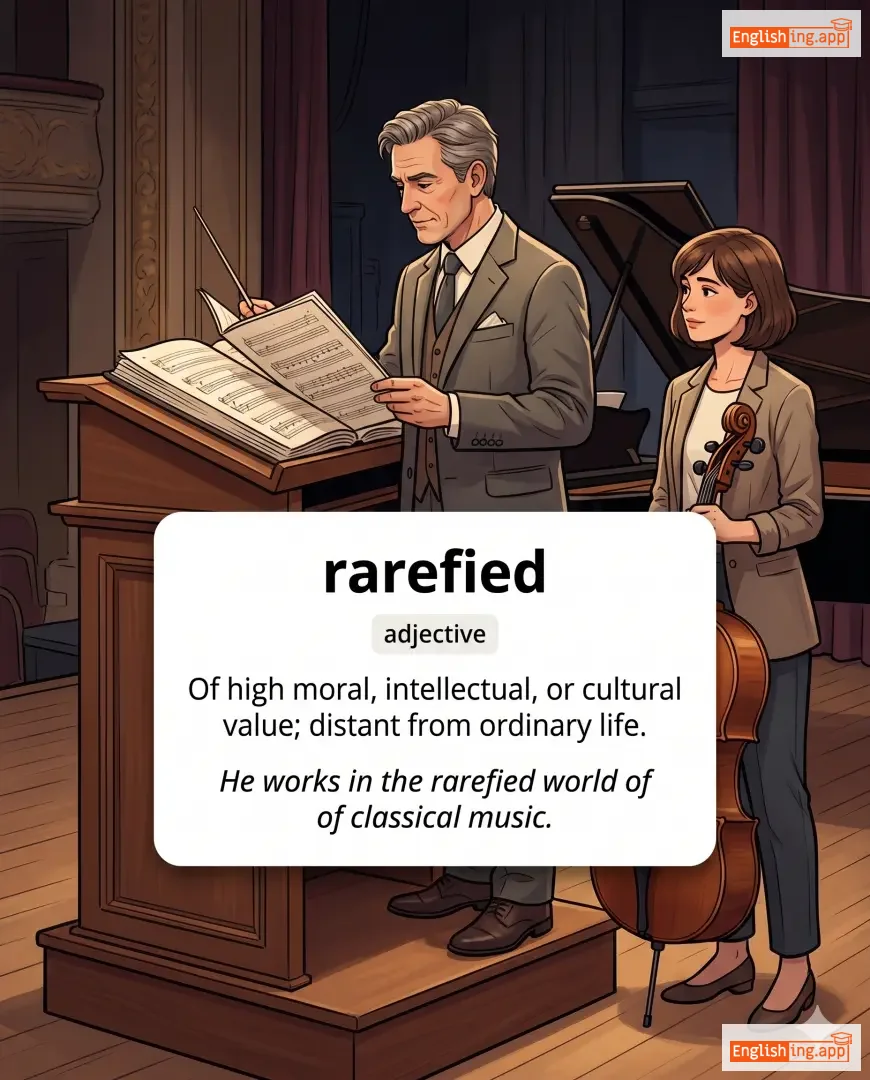
rarefied definition card — visual illustration of the meaning
adjective
/ˈreə.rɪ.faɪd/
rarefié (rarefie)

Of high moral, intellectual, or cultural value; distant from ordinary life.

"He works in the rarefied world of classical music."

"Il travaille dans le monde rarefié de la musique classique." (Il travaille dans le monde rarefie de la musique classique.)
adjective
/reər/
rare (rare)

Unusual or uncommon; not occurring often.

"This species of bird is extremely rare."

"Cette espèce d'oiseau est extrêmement rare." (Cette espèce d'oiseau est extrêmement rare.)
noun
/ˈræp.tʃər/
extase, ravissement (extase, ravissement)

A feeling of intense joy, delight, or ecstasy.

"She listened to the music in rapture."

"Elle écoutait la musique avec extase." (Elle ecoutait la musique avec extase.)
adjective
/ræpˈtɔːriəl/
rapace (rapace)

Relating to birds of prey or predatory behavior.

"The eagle is a raptorial bird with sharp talons."

"L'aigle est un oiseau de proie avec des serres acérées." (L'aigle est un oiseau de proie avec des serres acérées.)
adjective
/ræpt/
absorbé (absorbé)

Completely absorbed or fascinated by something.

"She listened with rapt attention to the speaker’s words."

"Elle écoutait avec une attention absorbée les paroles du locuteur." (Elle écoutait avec une attention absorbée les paroles du locuteur.)
noun
/ræpˈskæliən/
personne espiègle (personne espiègle)

A mischievous or cheeky person; a rascal.

"The little rapscallion hid his brother’s shoes as a prank."

"Le petit rapscallion a caché les chaussures de son frère pour une farce." (Le petit rapscallion a caché les chaussures de son frère pour une farce.)
noun
/ˌræproʊʃˈmɑːn/
réconciliation (reconciliation)

The establishment or resumption of harmonious relations.

"The two countries signed an agreement that marked a new rapprochement."

"Les deux pays ont signé un accord marquant un nouveau rapprochement." (Les deux pays ont signé un accord marquant un nouveau rapprochement.)
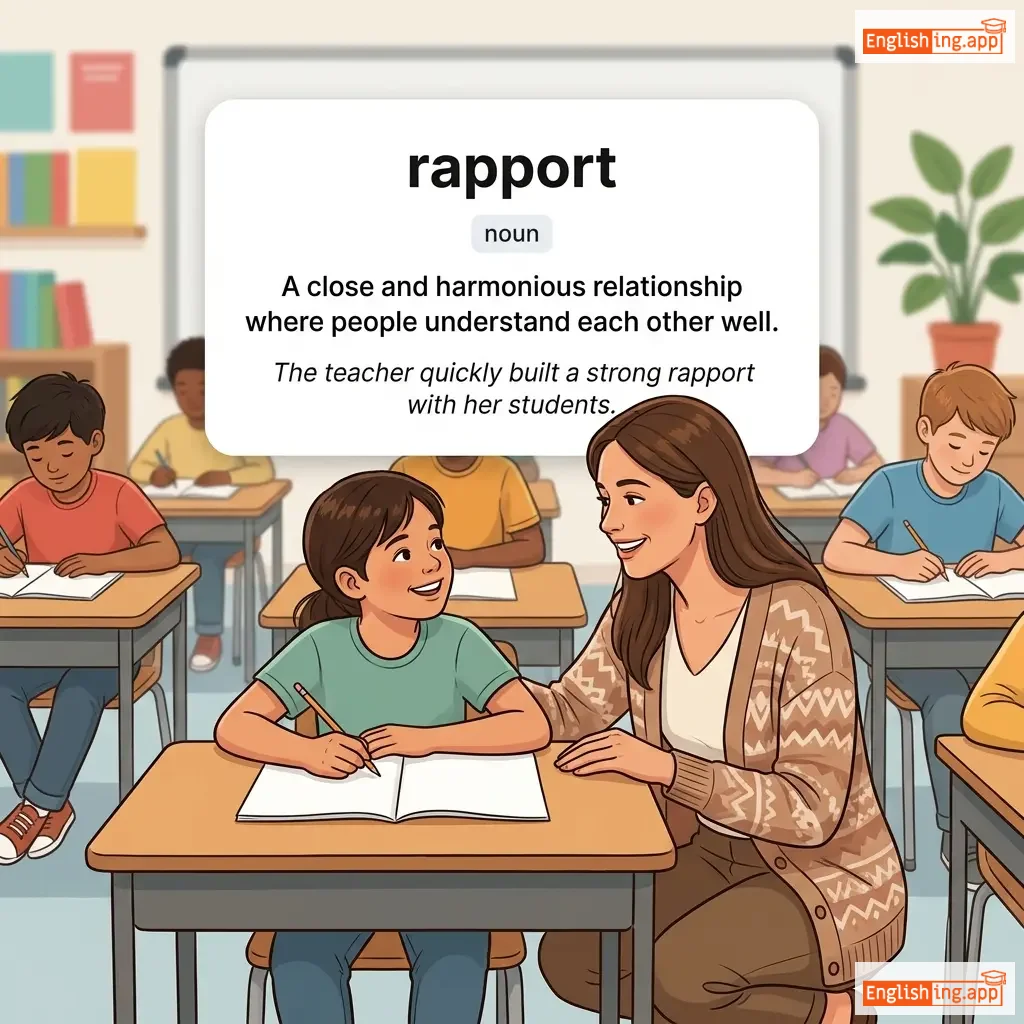
rapport definition card — visual illustration of the meaning
noun
/ræˈpɔːr/
relation (relation)

A close and harmonious relationship where people understand each other well.

"The teacher quickly built a strong rapport with her students."

"L'enseignant a rapidement établi une relation forte avec ses élèves." (L'enseignant a rapidement etabli une relation forte avec ses eleves.)
noun
/ˈræp.aɪn/
pillages (pillages)

the violent seizure of someone's property

"The war was marked by rapine and destruction."

"La guerre a été marquée par des pillages et des destructions." (La guerre a été marquée par des pillages et des destructions.)
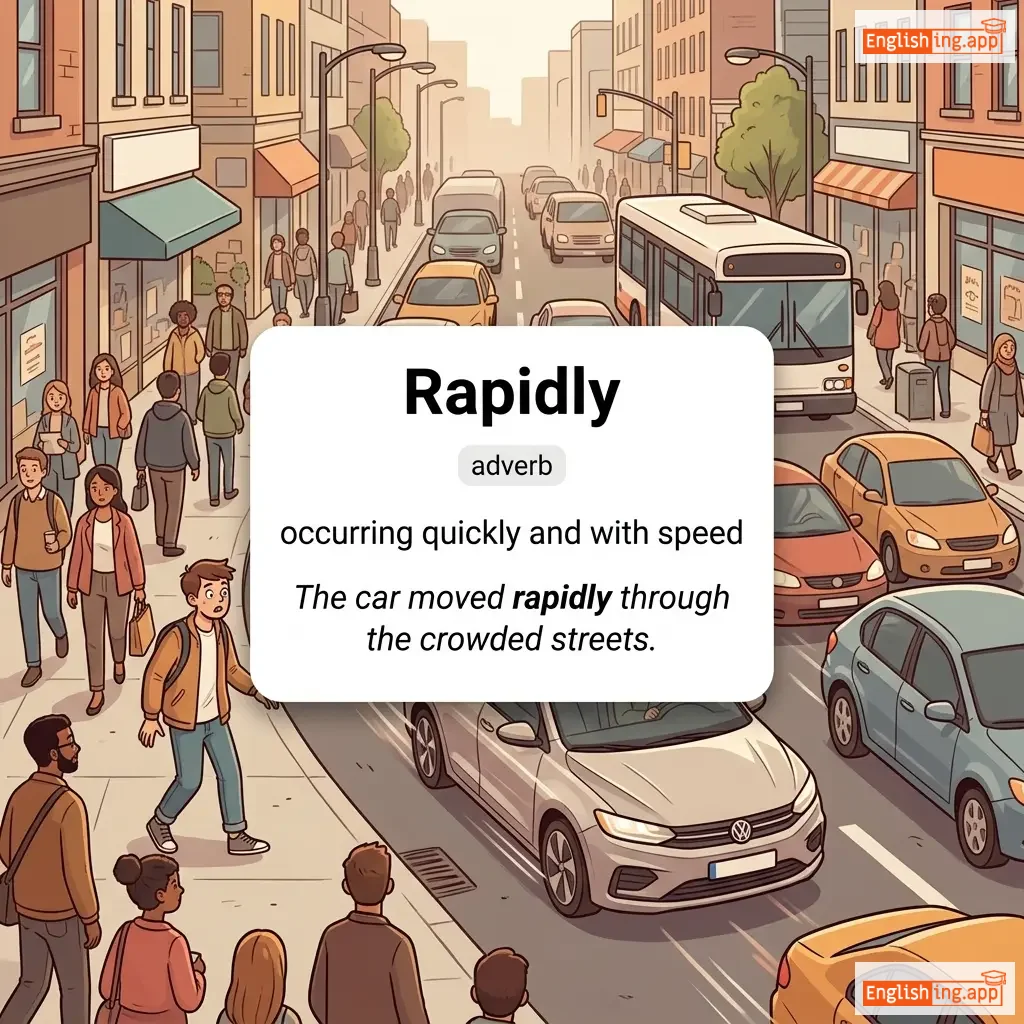
Rapidly definition card — visual illustration of the meaning
adverb
/ˈræpɪdli/
rapidement (rapidement)

occurring quickly and with speed

"The car moved rapidly through the crowded streets."

"La voiture a circulé rapidement à travers les rues bondées." (La voiture a circulé rapidement à travers les rues bondées.)
noun
/rəˈpɪdəti/
rapidité (rapidite)

The quality of moving or happening quickly; swiftness or speed.

"The rapidity of technological change is astonishing."

"La rapidité du changement technologique est étonnante." (La rapidité du changement technologique est étonnante.)
adjective
/ˈræp.ɪd/
rapide (rapide)

happening quickly or in a short time

"The company experienced rapid growth last year."

"L'entreprise a connu une croissance rapide l'année dernière." (L'entreprise a connu une croissance rapide l'année dernière.)
verb
/reɪp/
viol (viol)

to force someone to have sexual intercourse without their consent

"The law strictly punishes those who commit rape."

"La loi punit sévèrement ceux qui commettent un viol." (La loi punit sévèrement ceux qui commettent un viol.)
adjective
/rəˈpeɪ.ʃəs/
avidité (avidi-te)

having an extreme desire to take things for oneself, greedy

"The rapacious landlord raised the rent without reason."

"Le propriétaire avide a augmenté le loyer sans raison." (Le propriétaire avide a augmenté le loyer sans raison.)
verb
/rænt/
rager (rager)

to speak or shout in an angry, uncontrolled way

"He ranted about the unfair treatment at work."

"Il a crié à propos du traitement injuste au travail." (Il a crié à propos du traitement injuste au travail.)
verb
/ˈræn.sæk/
mettre à sac (mettre à sac)

to search a place roughly and steal or damage things

"Burglars ransacked the house while the family was away."

"Les cambrioleurs ont mis à sac la maison pendant que la famille était absente." (Les cambrioleurs ont mis à sac la maison pendant que la famille était absente.)
noun, verb
/ræŋks/
rangs (rangs)

Positions within a group, especially in a hierarchy or organization.

"He quickly moved up the ranks of the army."

"Il a rapidement grimpé dans les rangs de l'armée." (Il a rapidement grimpé dans les rangs de l'armée.)
verb
/ˈræŋ.kəl/
agacer (agacer)

To cause continuing annoyance or resentment.

"His unfair criticism continued to rankle her for days."

"Sa critique injuste a continué de la contrarier pendant des jours." (Sa critique injuste a continué de la contrarier pendant des jours.)
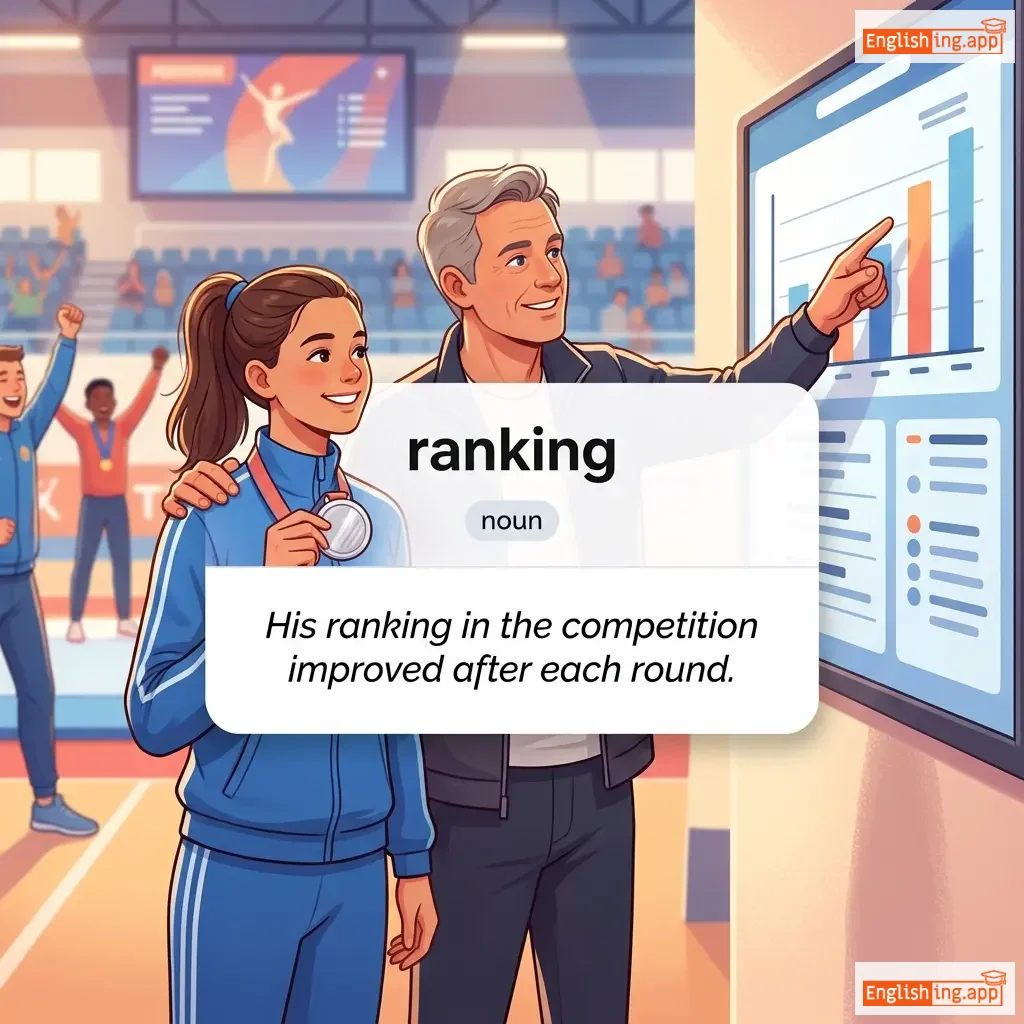
ranking definition card — visual illustration of the meaning
noun
/ˈræŋkɪŋ/
classement (classement)

a position in a list or hierarchy, especially in terms of performance or importance

"His ranking in the competition improved after each round."

"Son classement dans la compétition s'est amélioré après chaque tour." (Son classement dans la competition s'est ameliore apres chaque tour.)
noun, verb, adjective
/ræŋk/
rang (rang)

A position in a hierarchy; to place in order according to importance or quality.

"She quickly rose to a senior rank in the company."

"Elle a rapidement atteint un rang supérieur dans l'entreprise." (Elle a rapidement atteint un rang superieur dans l'entreprise.)
noun
/ræŋˈɡuːn ˈkriːpər/
Rangoon creeper (Rangoon creeper)

A climbing vine with fragrant flowers that change color from white to pink to red

"The Rangoon creeper covered the entire fence with its sweet-smelling flowers."

"Le Rangoon creeper a couvert toute la clôture avec ses fleurs parfumées." (Le Rangoon creeper a couvert toute la clôture avec ses fleurs parfumées.)
adjective
/ˈreɪ.moʊs/
ramifié (ramifie)

having many branches.

"The ramose tree shaded the entire garden."

"L'arbre ramifié ombragea tout le jardin." (L'arbre ramifie ombragea tout le jardin.)
adjective
/ˈreɪ.ni/
pluvieux (pluvieux)

characterized by rain; wet from rain; having much rain

"It was a rainy day, so we stayed indoors."

"C'était un jour pluvieux, alors nous sommes restés à l'intérieur." (C'était un jour pluvieux, alors nous sommes restés à l'intérieur.)
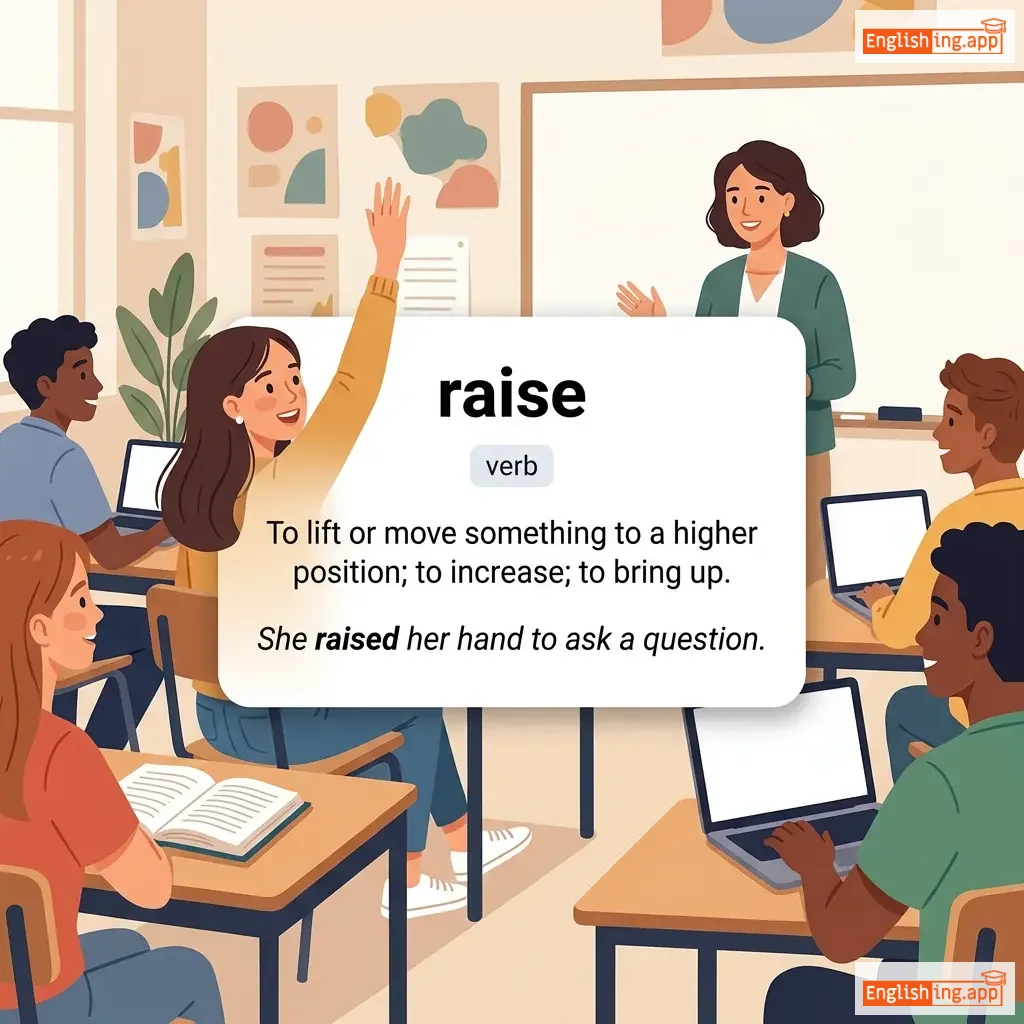
raise definition card — visual illustration of the meaning
verb
/reɪz/
élever / augmenter (elever / augmenter)

To lift or move something to a higher position; to increase; to bring up.

"She raised her hand to ask a question."

"Elle leva la main pour poser une question." (Elle leva la main pour poser une question.)
noun
/ˈreɪ.zən/
raisin sec (raisin sec)

a dried grape, often eaten as a snack or used in cooking and baking

"She added raisins to the cake batter for extra sweetness."

"Elle a ajouté des raisins secs à la pâte à gâteau pour plus de douceur." (Elle a ajoute des raisins secs a la pate a gateau pour plus de douceur.)
noun
/ˈreɪ.zɪnz/
raisins secs (raisins secs)

dried grapes, often used in cooking and baking

"She added raisins to the oatmeal cookies for extra sweetness."

"Elle a ajouté des raisins secs aux biscuits à l'avoine pour plus de douceur." (Elle a ajouté des raisins secs aux biscuits à l'avoine pour plus de douceur.)
verb
/reɪk/
ramasser avec un râteau; gratter ou lisser une surface (ramasser avec un râteau; gratter ou lisser une surface)

to collect or gather with a rake; to scrape or smooth a surface

"He raked the leaves into a pile."

"Il a rassemblé les feuilles dans un tas." (Il a rassemblé les feuilles dans un tas.)
adjective
/ˈreɪ.kɪʃ/
d'apparence élégante, confiante et légèrement déshonorée (d'apparence elegante, confiante et legerement deshonoree)

having a stylish, confident, and slightly disreputable appearance

"He walked in with a rakish smile and tilted hat."

"Il entra avec un sourire rakish et un chapeau incliné." (Il entra avec un sourire rakish et un chapeau incline.)
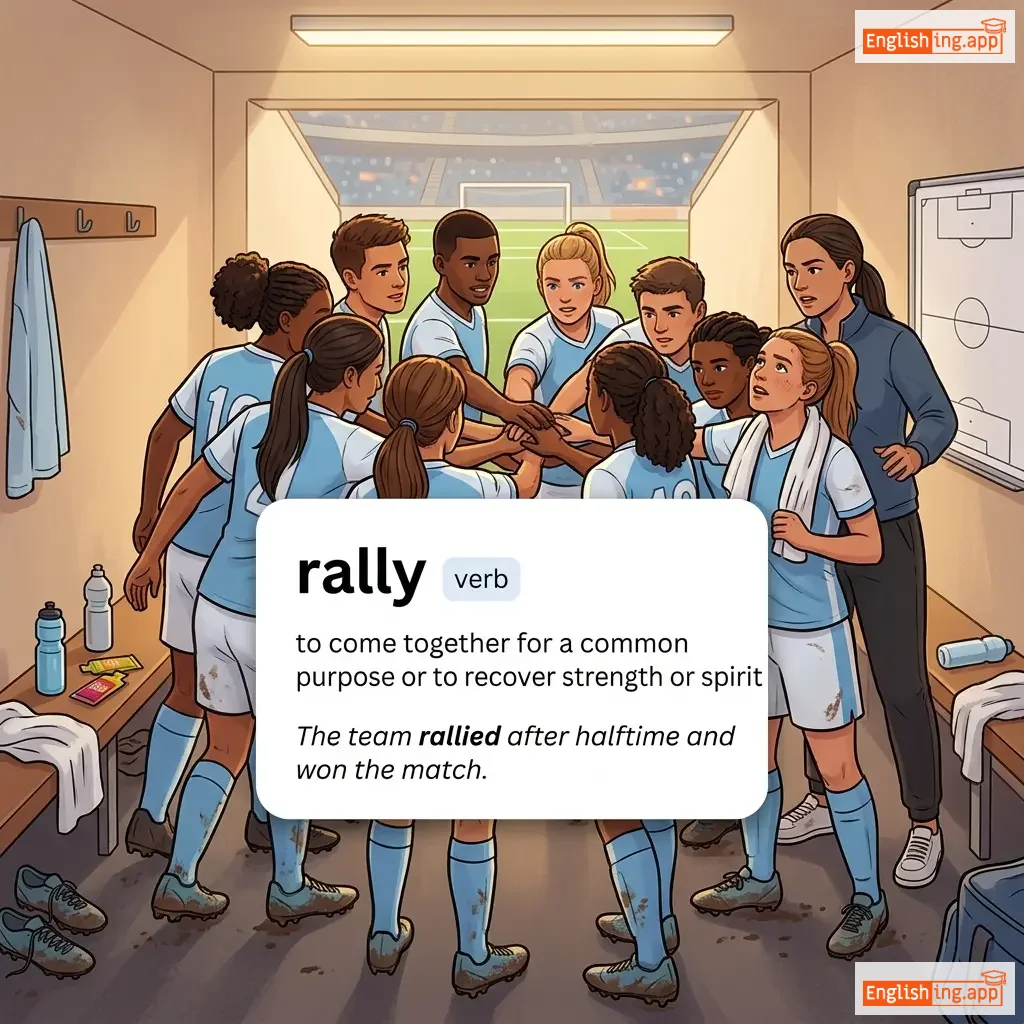
rally definition card — visual illustration of the meaning
verb
/ˈræl.i/
se rassembler / se regagner en force (se rassembler / se regagner en force)

to come together for a common purpose or to recover strength or spirit

"The team rallied after halftime and won the match."

"L'équipe s'est redressée après la mi-temps et a gagné le match." (L'equipe s'est redressee apres la mi-temps et a gagne le match.)
verb
/ræm/
heurter (heurter)

to strike or push something with great force

"The truck rammed into the wall."

"Le camion a percuté le mur." (Le camion a percuté le mur.)
verb
/ˈræm.bəl/
parler ou écrire pendant longtemps de manière confuse ou sans conséquence; marcher pour le plaisir sans itinéraire fixe (parler ou écrire pendant longtemps de manière confuse ou sans conséquence; marcher pour le plaisir sans itinéraire fixe)

to talk or write at length in a confused or inconsequential way; to walk for pleasure without a fixed route.

"He rambled on about his childhood for hours."

"Il a parlé pendant des heures de son enfance de manière confuse." (Il a parlé pendant des heures de son enfance de manière confuse.)
adjective
/ræmˈbʌŋk.ʃəs/
bruyant (bruyant)

boisterous, energetic, and difficult to control.

"The rambunctious children filled the house with noise."

"Les enfants bruyants ont rempli la maison de bruit." (Les enfants bruyants ont rempli la maison de bruit.)
noun
/ræmˈbuːtən/
ramboutan (ramboutan)

a tropical fruit with red spiky skin and white translucent sweet flesh similar to litchi

"The rambutan looks scary with its hairy skin but tastes very sweet inside."

"Le rambutan a l'air effrayant avec sa peau poilue, mais il a un goût très sucré à l'intérieur." (Le rambutan a l'air effrayant avec sa peau poilue, mais il a un goût très sucré à l'intérieur.)
noun
/ˌræm.ɪ.fɪˈkeɪ.ʃən/
conséquence (consequence)

a consequence of an action or event, often complex or unwelcome.

"The new law has serious social ramifications."

"La nouvelle loi a de graves conséquences sociales." (La nouvelle loi a de graves consequences sociales.)
verb
/ˈræm.ɪ.faɪ/
se ramifier (se ramifier)

to spread or branch out into divisions or subdivisions.

"The river ramifies into several smaller streams."

"Le fleuve se ramifie en plusieurs petits ruisseaux." (Le fleuve se ramifie en plusieurs petits ruisseaux.)
verb
/ˈræn.də.maɪz/
aléatoiriser (aleatoriser)

To make something happen in a random order or manner.

"The software can randomize the order of questions."

"Le logiciel peut randomiser l'ordre des questions." (Le logiciel peut randomiser l'ordre des questions.)
noun
/ˈræŋ.kər/
rancune (rancune)

A feeling of deep and bitter anger or resentment.

"There was a rancor between the two rivals that never faded."

"Il y avait une rancune entre les deux rivaux qui ne s'est jamais estompée." (Il y avait une rancune entre les deux rivaux qui ne s'est jamais estompée.)
adjective
/ˈræŋ.kər.əs/
rancunier (rancunier)

Characterized by bitterness or resentment.

"Their rancorous debate lasted for hours."

"Leurs débats rancuniers ont duré des heures." (Leurs débats rancuniers ont duré des heures.)
adjective
/ˈræn.dəm/
aléatoire (aleatoire)

Made, done, or happening without method or conscious decision.

"He made a random choice from the menu."

"Il a fait un choix aléatoire dans le menu." (Il a fait un choix aleatoire dans le menu.)
adjective
/ˈrænsɪd/
rance (rance)

having a bad taste or smell due to being old or spoiled (especially fats or oils)

"The butter had gone rancid after being left out too long."

"Le beurre était devenu rance après être resté trop longtemps dehors." (Le beurre était devenu rance après être resté trop longtemps dehors.)
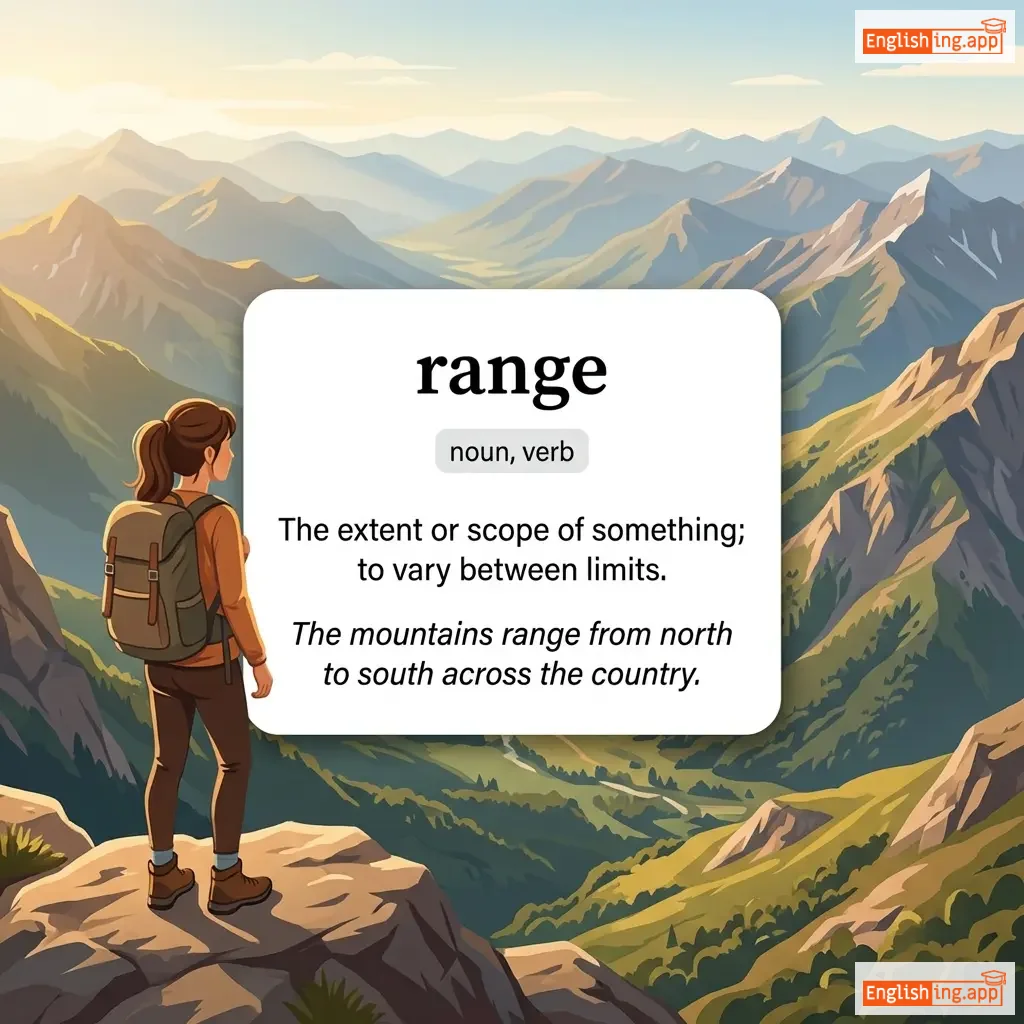
range definition card — visual illustration of the meaning
noun, verb
/reɪndʒ/
plage, portée (plage, portee)

The extent or scope of something; to vary between limits.

"The mountains range from north to south across the country."

"Les montagnes s'étendent du nord au sud à travers le pays." (Les montagnes s'étendent du nord au sud à travers le pays.)
noun
/ˈreɪn.dʒər/
garde forestier (garde forestier)

A person responsible for protecting and managing forests, parks, or natural areas.

"The park ranger guided the tourists through the forest trail."

"Le garde forestier a guidé les touristes à travers le sentier forestier." (Le garde forestier a guidé les touristes à travers le sentier forestier.)