वोकैबुलरीज

इंग्लिश वोकैबुलरी डिस्कवर, लर्न और मास्टर करें

noun
/riːm/
रीम / कागज का एक बड़ा ढेर (reem / kaghaz ka ek bada dher)

A large quantity of paper (typically 500 sheets); informally, a large amount of something.

"The office ordered ten reams of paper."

"दफ्तर ने दस रीम कागज का आदेश दिया।" (Daftar ne das reem kaghaz ka aadesh diya.)
👑

realm

noun
/rɛlm/

A kingdom or domain; a field or area of activity or interest.

"He is well known in the realm of science."

verb
/ˈreɪn.dʒɪŋ/
रेंजिंग (ranging)

Extending or varying between limits.

"The temperatures are ranging from 15 to 30 degrees this week."

"इस हफ्ते तापमान 15 से 30 डिग्री के बीच रेंजिंग हो रहा है।" (Is hafte taapmaan 15 se 30 degree ke beech ranging ho raha hai.)
verb
/ræsp/
कर्कश आवाज में बोलना या खुरचना (karkash awaaz mein bolna ya khurchna)

to speak in a rough, harsh voice or to scrape with a coarse sound

"He rasped out a warning before collapsing."

"उसने गिरने से पहले एक चेतावनी कर्कश आवाज में दी।" (Usne girne se pehle ek chetawani karkash awaaz mein di.)
adjective
/ræʃ/
आवेगपूर्ण, लापरवाह (avegpoorn, laparwaha)

Acting quickly without careful consideration; reckless.

"It was a rash decision to invest without research."

"यह बिना शोध किए निवेश करने का एक लापरवाह निर्णय था।" (Yeh bina shodh kiye nivesh karne ka ek laparwaha nirnay tha.)
noun
/ˈrerəti/
दुर्लभता; कुछ असामान्य या दुर्लभ वस्तु (durlabhta; kuch asamanya ya durlabh vastu)

the state of being rare; something that is uncommon or scarce

"The antique vase was a rarity worth thousands of dollars."

"प्राचीन फूलदान एक दुर्लभ वस्तु थी, जिसकी कीमत हजारों डॉलर थी।" (prachin phooldan ek durlabh vastu thi, jiska keemat hazaron dollar thi.)
adverb
/ˈrɛə(r)li/
कभी-कभी (kabhi-kabhi)

not often, infrequently

"She rarely eats sweets because of her diet."

"वह अपने आहार के कारण बहुत कम मिठाई खाती है।" (Woh apne aahar ke kaaran bahut kam mithai khati hai.)
verb
/ˈreə.rɪ.faɪ/
पतला करना, शुद्ध करना (patla karna, shuddh karna)

To make something less dense or more refined.

"The air rarefies as you climb higher into the mountains."

"जैसे जैसे आप पहाड़ों में ऊपर चढ़ते हैं, हवा पतली होती जाती है।" (Jaise jaise aap pahadon mein upar chadte hain, hawa patli hoti jaati hai.)
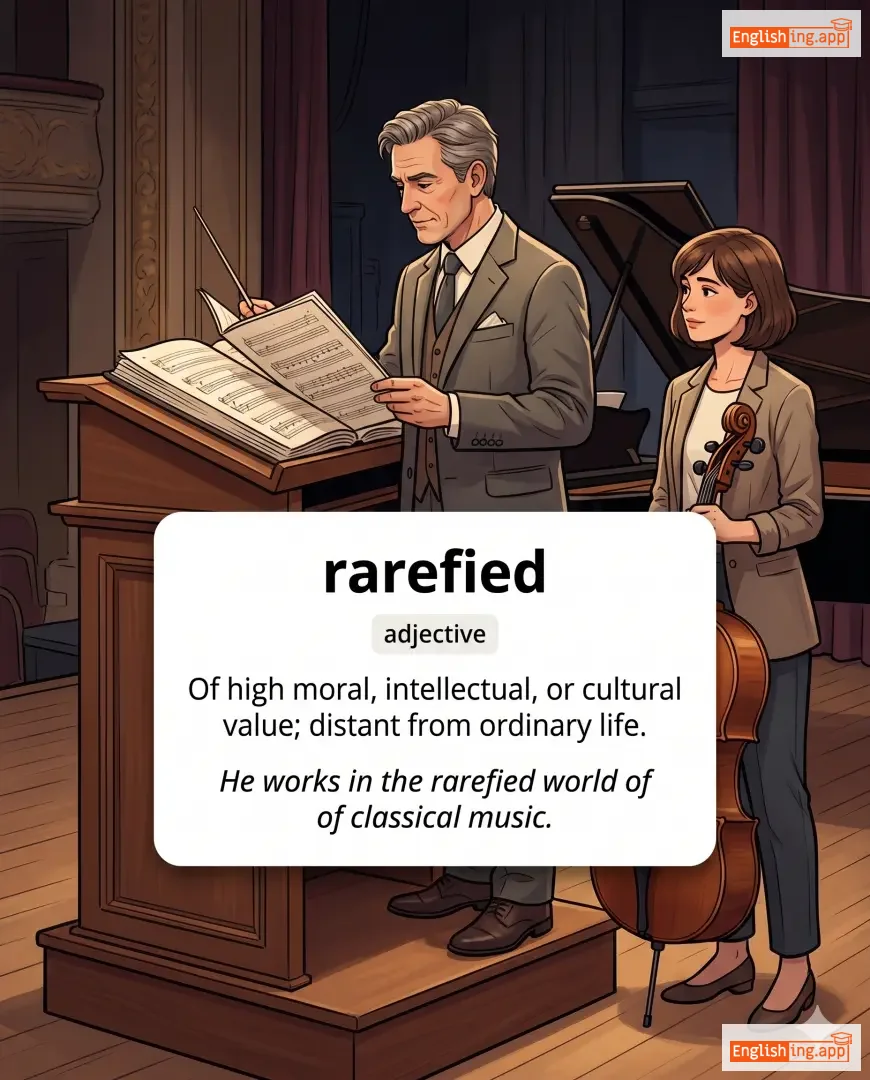
rarefied definition card — visual illustration of the meaning
adjective
/ˈreə.rɪ.faɪd/
उच्च-स्तरीय (rarefied)

Of high moral, intellectual, or cultural value; distant from ordinary life.

"He works in the rarefied world of classical music."

"वह शास्त्रीय संगीत की उच्च-स्तरीय दुनिया में काम करता है." (vah shaastriya sangeet ki uchh-stariya duniya mein kaam karta hai.)
adjective
/reər/
दुर्लभ (durlabh)

Unusual or uncommon; not occurring often.

"This species of bird is extremely rare."

"यह पक्षी की प्रजाति अत्यधिक दुर्लभ है।" (Yeh pakshi ki prajati atyadhik durlabh hai.)
noun
/ˈræp.tʃər/
आनंद, उल्लास (anand, ullas)

A feeling of intense joy, delight, or ecstasy.

"She listened to the music in rapture."

"वह संगीत को आनंद से सुन रही थी।" (Woh sangeet ko anand se sun rahi thi.)
adjective
/ræpˈtɔːriəl/
शिकारी (shikari)

Relating to birds of prey or predatory behavior.

"The eagle is a raptorial bird with sharp talons."

"गिद्ध एक शिकारी पक्षी है जिसकी तेज पंजे होते हैं।" (Giddh ek shikari pakshi hai jiske tez panje hote hain.)
adjective
/ræpt/
मनोयोगी (manoyogi)

Completely absorbed or fascinated by something.

"She listened with rapt attention to the speaker’s words."

"वह वक्ता के शब्दों को पूरी तन्मयता से सुन रही थी।" (Wah vaktā ke shabdon ko pūrī tanmayatā se sun rahī thī.)
noun
/ræpˈskæliən/
शरारती व्यक्ति (shararti vyakti)

A mischievous or cheeky person; a rascal.

"The little rapscallion hid his brother’s shoes as a prank."

"द छोटे रैप्सकैलियन ने अपने भाई के जूते शरारत के रूप में छिपा दिए।" (Da chhote rapscallion ne apne bhai ke jute shararat ke roop mein chhupa diye.)
noun
/ˌræproʊʃˈmɑːn/
संपर्क पुनर्स्थापना (sampark punarsthapna)

The establishment or resumption of harmonious relations.

"The two countries signed an agreement that marked a new rapprochement."

"दो देशों ने एक समझौते पर हस्ताक्षर किए जो एक नए संबंध पुनर्स्थापना को चिह्नित करता है।" (Do desho ne ek samjhote par hastakshar kiye jo ek naye sambandh punarsthapna ko chihnit karta hai.)
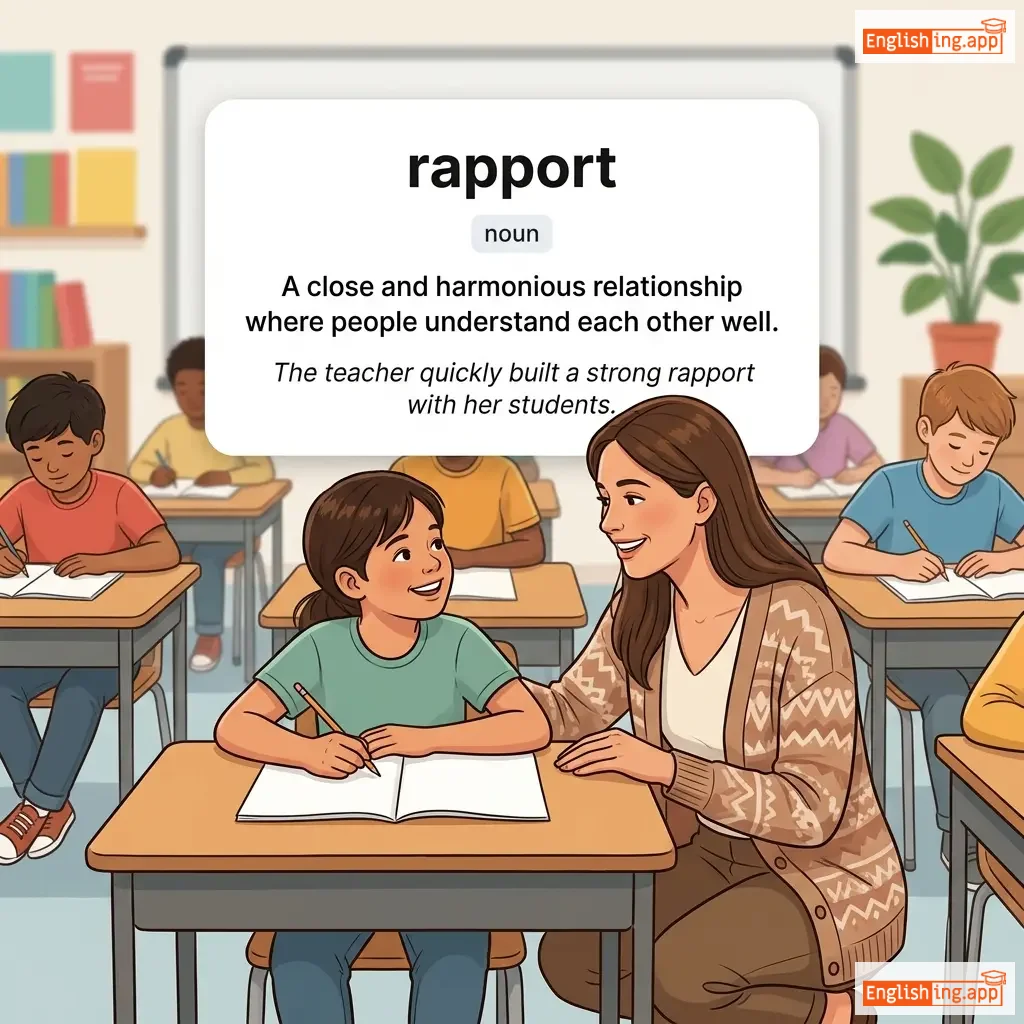
rapport definition card — visual illustration of the meaning
noun
/ræˈpɔːr/
रिश्ता (rishta)

A close and harmonious relationship where people understand each other well.

"The teacher quickly built a strong rapport with her students."

"शिक्षक ने अपने छात्रों के साथ जल्दी से एक मजबूत रिश्ता स्थापित किया।" (Shikshak ne apne chatron ke saath jaldi se ek majboot rishta sthaapit kiya.)
noun
/ˈræp.aɪn/
लूटपाट (lootpaat)

the violent seizure of someone's property

"The war was marked by rapine and destruction."

"युद्ध को लूटपाट और विध्वंस से चिह्नित किया गया था।" (Yuddh ko lootpaat aur vidhvans se chihnit kiya gaya tha.)
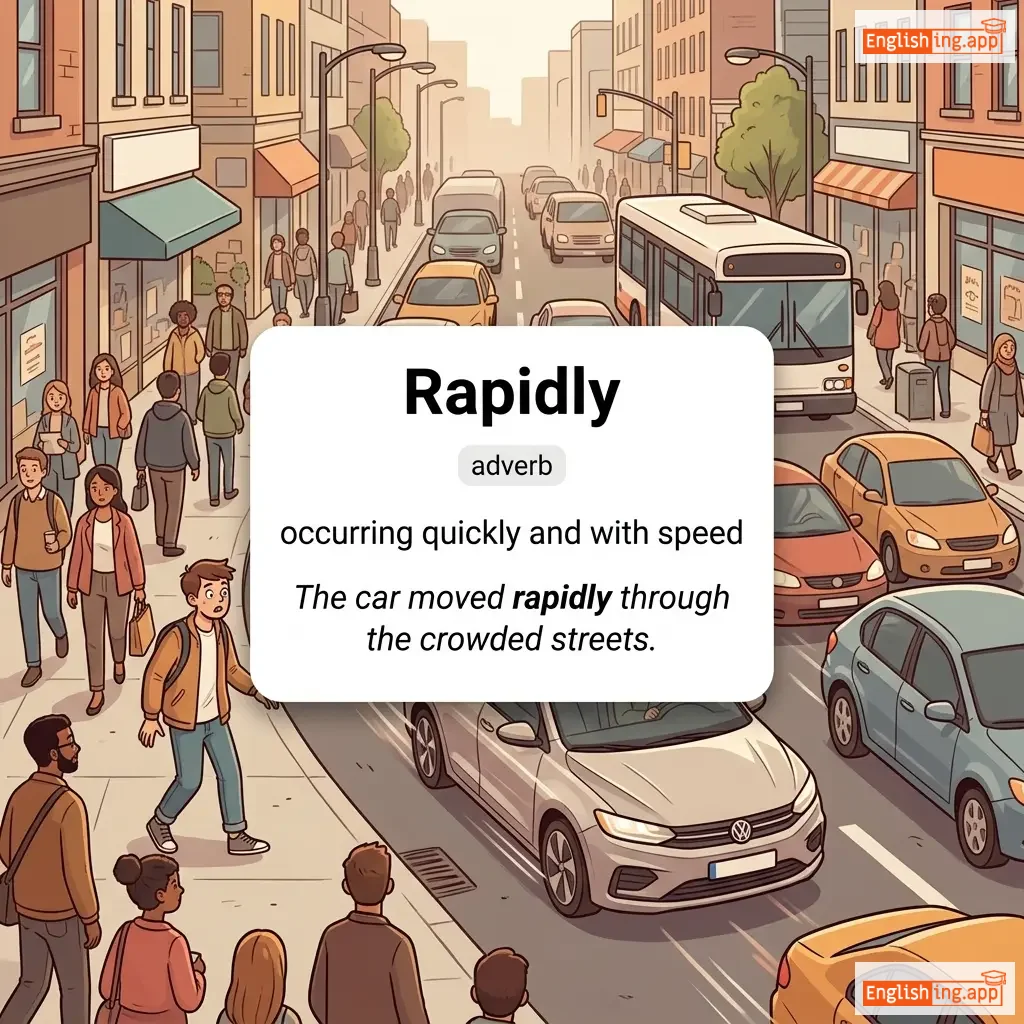
Rapidly definition card — visual illustration of the meaning
adverb
/ˈræpɪdli/
तेज़ी से (tezī se)

occurring quickly and with speed

"The car moved rapidly through the crowded streets."

"कार भीड़-भाड़ वाली सड़कों पर तेजी से चली गई।" (Kār bhīṛ-bhāṛ wālī saṛkon par tezī se chalī ga'ī.)
noun
/rəˈpɪdəti/
तीव्रता (teevrata)

The quality of moving or happening quickly; swiftness or speed.

"The rapidity of technological change is astonishing."

"प्रौद्योगिकी परिवर्तन की तीव्रता चमत्कारी है।" (Proudyogiki parivartan ki teevrata chamatkaari hai.)
adjective
/ˈræp.ɪd/
तेज (tej)

happening quickly or in a short time

"The company experienced rapid growth last year."

"कंपनी ने पिछले साल तेज वृद्धि अनुभव की।" (Kampani ne pichhle saal tej vruddhi anubhav ki.)
verb
/reɪp/
बलात्कार करना (balatkar karna)

to force someone to have sexual intercourse without their consent

"The law strictly punishes those who commit rape."

"कानून बलात्कार करने वालों को कड़ी सजा देता है।" (Kanoon balatkar karne walon ko kadhi saza deta hai.)
adjective
/rəˈpeɪ.ʃəs/
लालची (laalchi)

having an extreme desire to take things for oneself, greedy

"The rapacious landlord raised the rent without reason."

"लालची मकान मालिक ने बिना वजह किराया बढ़ा दिया।" (Laalchi makan malik ne bina wajah kiraya badha diya.)
verb
/rænt/
गुस्से में चिल्लाना (gusse mein chillana)

to speak or shout in an angry, uncontrolled way

"He ranted about the unfair treatment at work."

"उसने काम पर अन्यायपूर्ण व्यवहार के बारे में गुस्से में चिल्लाया।" (Usne kaam par anyaypoorvak vyavhaar ke baare mein gusse mein chillaya.)
verb
/ˈræn.sæk/
लूटपाट करना (lootpaat karna)

to search a place roughly and steal or damage things

"Burglars ransacked the house while the family was away."

"चोरों ने परिवार के बाहर होने के दौरान घर को लूट लिया।" (Choron ne parivar ke bahar hone ke dauran ghar ko loot liya.)
noun, verb
/ræŋks/
रैंक (rank)

Positions within a group, especially in a hierarchy or organization.

"He quickly moved up the ranks of the army."

"वह जल्दी से सेना में रैंक के भीतर ऊपर बढ़ गया।" (Vah jaldi se sena mein rank ke bheetar upar badh gaya.)
verb
/ˈræŋ.kəl/
चिढ़ाना (chidhana)

To cause continuing annoyance or resentment.

"His unfair criticism continued to rankle her for days."

"उसकी नाइंसाफ़ आलोचना उसे कई दिनों तक चिढ़ाती रही।" (Uski nainsaaf alochna use kai dinon tak chidhati rahi.)
ranking definition card — visual illustration of the meaning
noun
/ˈræŋkɪŋ/
रैंकिंग (ranking)

a position in a list or hierarchy, especially in terms of performance or importance

"His ranking in the competition improved after each round."

"प्रत्येक राउंड के बाद प्रतियोगिता में उसकी रैंकिंग में सुधार हुआ।" (Pratyek round ke baad pratijogita mein uski ranking mein sudhaar hua.)
noun, verb, adjective
/ræŋk/
रैंक (rank)

A position in a hierarchy; to place in order according to importance or quality.

"She quickly rose to a senior rank in the company."

"वह जल्दी ही कंपनी में एक वरिष्ठ रैंक पर पहुंच गई।" (Wah jaldi hi company mein ek varishth rank par pahunch gayi.)
noun
/ræŋˈɡuːn ˈkriːpər/
रंगून क्रीपर (rangoon creeper)

A climbing vine with fragrant flowers that change color from white to pink to red

"The Rangoon creeper covered the entire fence with its sweet-smelling flowers."

"रंगून क्रीपर ने अपनी मीठी खुशबू वाले फूलों से पूरी बाड़ को ढक लिया था।" (rangoon creeper ne apni meethi khushboo wale phoolon se puri baad ko dhak liya tha.)
adjective
/ˈreɪ.moʊs/
विभागों वाला (vibhagon wala)

having many branches.

"The ramose tree shaded the entire garden."

"वह शाखाओं वाला पेड़ पूरे बगीचे को छाँव दे रहा था।" (vah shaakhaon wala ped poore bageeche ko chhaav de raha tha.)
adjective
/ˈreɪ.ni/
वर्षाजनक (varshaajanak)

characterized by rain; wet from rain; having much rain

"It was a rainy day, so we stayed indoors."

"यह एक वर्षा वाला दिन था, इसलिए हम घर के अंदर रहे।" (yah ek varsha wala din tha, isliye hum ghar ke andar rahe.)
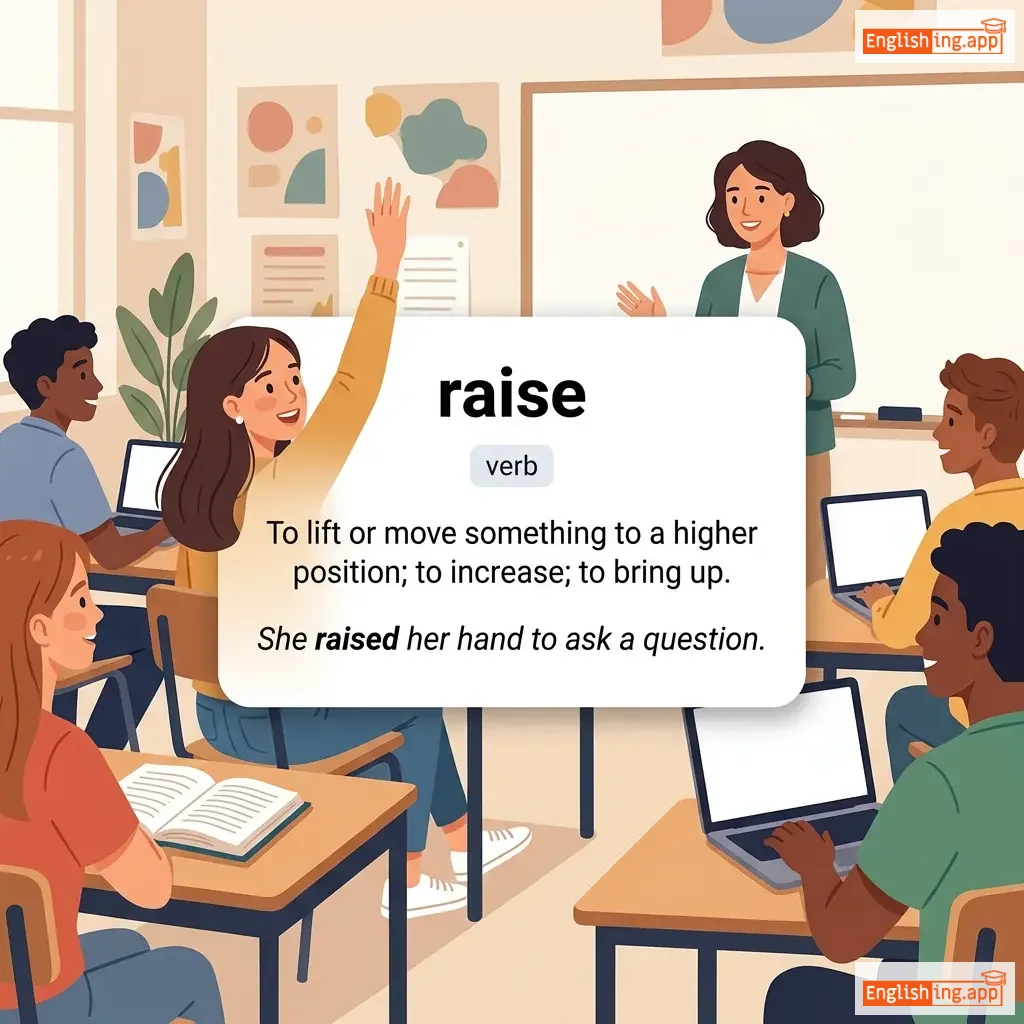
raise definition card — visual illustration of the meaning
verb
/reɪz/
उठाना / बढ़ाना (uthana / badhana)

To lift or move something to a higher position; to increase; to bring up.

"She raised her hand to ask a question."

"उसने सवाल पूछने के लिए अपना हाथ उठाया।" (Usne sawal poochne ke liye apna haath uthaya.)
noun
/ˈreɪ.zən/
किशमिश (kishmish)

a dried grape, often eaten as a snack or used in cooking and baking

"She added raisins to the cake batter for extra sweetness."

"उसने केक के बैटर में अतिरिक्त मिठास के लिए किशमिश डाली।" (Usne cake ke batter mein atirikt mithas ke liye kishmish daali.)
noun
/ˈreɪ.zɪnz/
किशमिश (kishmish)

dried grapes, often used in cooking and baking

"She added raisins to the oatmeal cookies for extra sweetness."

"उसने ओटमील कुकीज़ में अतिरिक्त मिठास के लिए किशमिश डाली।" (usne otmeal cookies mein atirikt mithas ke liye kishmish daali)
verb
/reɪk/
पत्तियां इकट्ठा करने का यंत्र से इकट्ठा करना (pattiyan ikattha karne ka yantra se ikattha karna)

to collect or gather with a rake; to scrape or smooth a surface

"He raked the leaves into a pile."

"उसने पत्तियों को एक ढेर में इकट्ठा किया।" (Usne pattiyon ko ek dher mein ikattha kiya.)
adjective
/ˈreɪ.kɪʃ/
स्टाइलिश, आत्मविश्वास से भरा और हल्का सा विवादास्पद रूप (stailish, atmvishwas se bhara aur halka sa vivaadaspad roop)

having a stylish, confident, and slightly disreputable appearance

"He walked in with a rakish smile and tilted hat."

"वह एक रेकिश मुस्कान और झुकी हुई टोपी के साथ अंदर आया।" (Vah ek rekish muskaan aur jhuki hui topi ke saath andar aaya.)
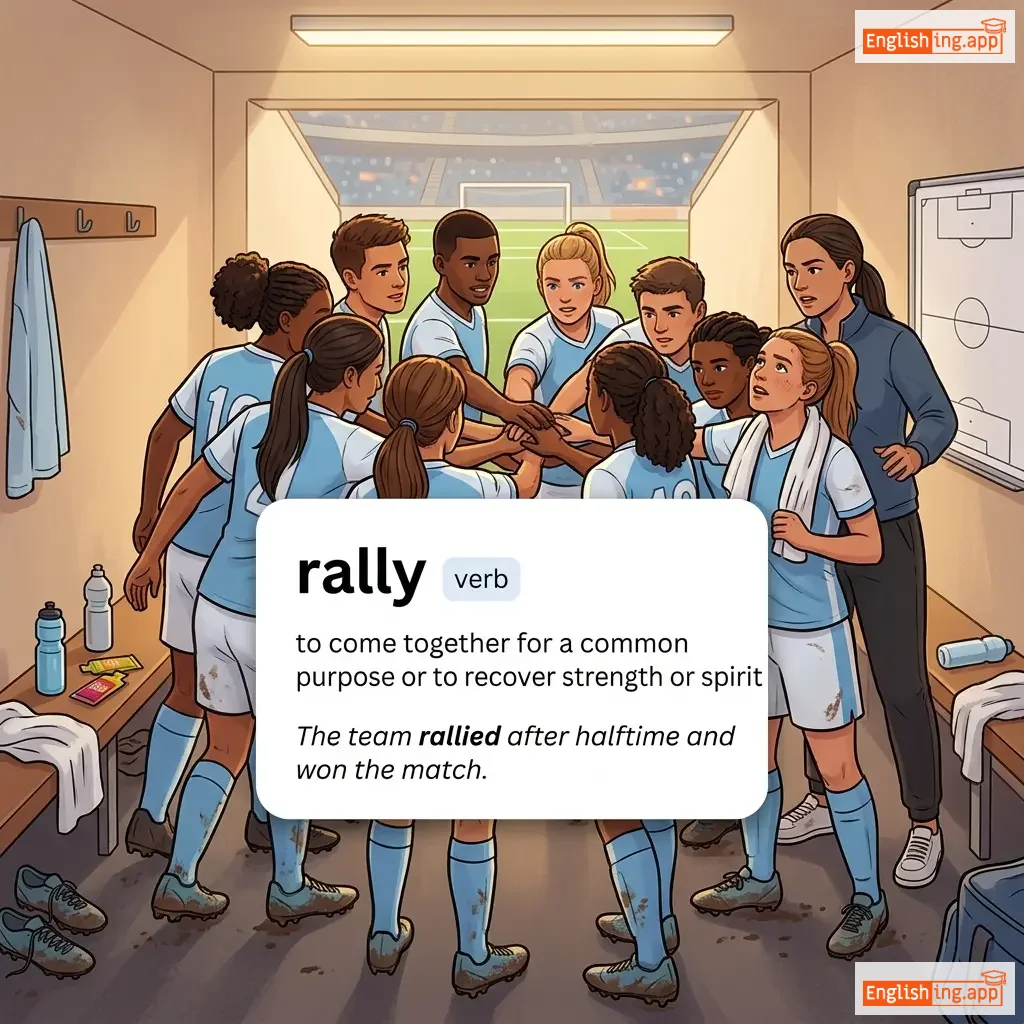
rally definition card — visual illustration of the meaning
verb
/ˈræl.i/
संगठित होना / पुनः शक्ति प्राप्त करना (sangathit hona / punah shakti prapt karna)

to come together for a common purpose or to recover strength or spirit

"The team rallied after halftime and won the match."

"टीम हाफटाइम के बाद rally की और मैच जीत लिया।" (Team halftime ke baad rally ki aur match jeet liya.)
verb
/ræm/
धक्का मारना (dhakka marna)

to strike or push something with great force

"The truck rammed into the wall."

"ट्रक ने दीवार में ज़ोर से टक्कर मारी।" (Truck ne deewar mein zor se takkar maari.)
verb
/ˈræm.bəl/
लंबे समय तक उलझनपूर्ण या बेमानी तरीके से बोलना या लिखना; बिना निश्चित रास्ते के लिए घूमना (lambe samay tak uljhanpurn ya bemani tareeke se bolna ya likhna; bina nishchit raste ke liye ghoomna)

to talk or write at length in a confused or inconsequential way; to walk for pleasure without a fixed route.

"He rambled on about his childhood for hours."

"वह घंटे भर अपने बचपन के बारे में उलझनपूर्ण तरीके से बोलता रहा।" (Wah ghante bhar apne bachpan ke baare mein uljhanpurn tareeke se bolta raha.)
adjective
/ræmˈbʌŋk.ʃəs/
अशांत (ashant)

boisterous, energetic, and difficult to control.

"The rambunctious children filled the house with noise."

"शरारती बच्चे घर को शोर से भर रहे थे।" (Shararati bachche ghar ko shor se bhar rahe the.)
noun
/ræmˈbuːtən/
रामबुटान (rambutan)

a tropical fruit with red spiky skin and white translucent sweet flesh similar to litchi

"The rambutan looks scary with its hairy skin but tastes very sweet inside."

"रैम्बूटान अपनी बालों वाली त्वचा के साथ डरावना दिखता है, लेकिन अंदर बहुत मीठा स्वाद होता है।" (rambutan apni balon wali tvacha ke saath daravna dikhata hai, lekin andar bahut meetha swaad hota hai.)
noun
/ˌræm.ɪ.fɪˈkeɪ.ʃən/
परिणाम (parinaam)

a consequence of an action or event, often complex or unwelcome.

"The new law has serious social ramifications."

"नए कानून के गंभीर सामाजिक परिणाम हैं।" (Naye kanoon ke gambhir samajik parinaam hain.)
verb
/ˈræm.ɪ.faɪ/
शाखाओं में फैलना (shaakhon mein phailna)

to spread or branch out into divisions or subdivisions.

"The river ramifies into several smaller streams."

"नदी कई छोटे-छोटे धाराओं में फैल जाती है।" (Nadi kai chhote-chhote dhaaron mein phail jaati hai.)
verb
/ˈræn.də.maɪz/
रैंडमाइज़ करना (randomize karna)

To make something happen in a random order or manner.

"The software can randomize the order of questions."

"सॉफ़्टवेयर प्रश्नों के क्रम को रैन्डमाइज़ कर सकता है।" (Software prashnon ke kram ko randomize kar sakta hai.)
noun
/ˈræŋ.kər/
द्वेष (dvesh)

A feeling of deep and bitter anger or resentment.

"There was a rancor between the two rivals that never faded."

"दो प्रतिद्वंद्वियों के बीच एक द्वेष था जो कभी नहीं फीका पड़ा।" (Do pratidvandviyon ke beech ek dvesh tha jo kabhi nahi feeka pada.)
adjective
/ˈræŋ.kər.əs/
कड़वाहट से भरा हुआ (kadwahat se bhara hua)

Characterized by bitterness or resentment.

"Their rancorous debate lasted for hours."

"उनकी कड़वी बहस घंटों तक चली।" (Unki kadvi bahas ghanton tak chali.)
adjective
/ˈræn.dəm/
रैंडम (random)

Made, done, or happening without method or conscious decision.

"He made a random choice from the menu."

"उसने मेनू से एक रैंडम चयन किया।" (Usne menu se ek random chayan kiya.)
adjective
/ˈrænsɪd/
बासी (basi)

having a bad taste or smell due to being old or spoiled (especially fats or oils)

"The butter had gone rancid after being left out too long."

"मक्खन बहुत देर बाहर रखा था, जिससे वह बासी हो गया था।" (Makkhan bahut der baahar rakha tha, jisse vah basi ho gaya tha.)
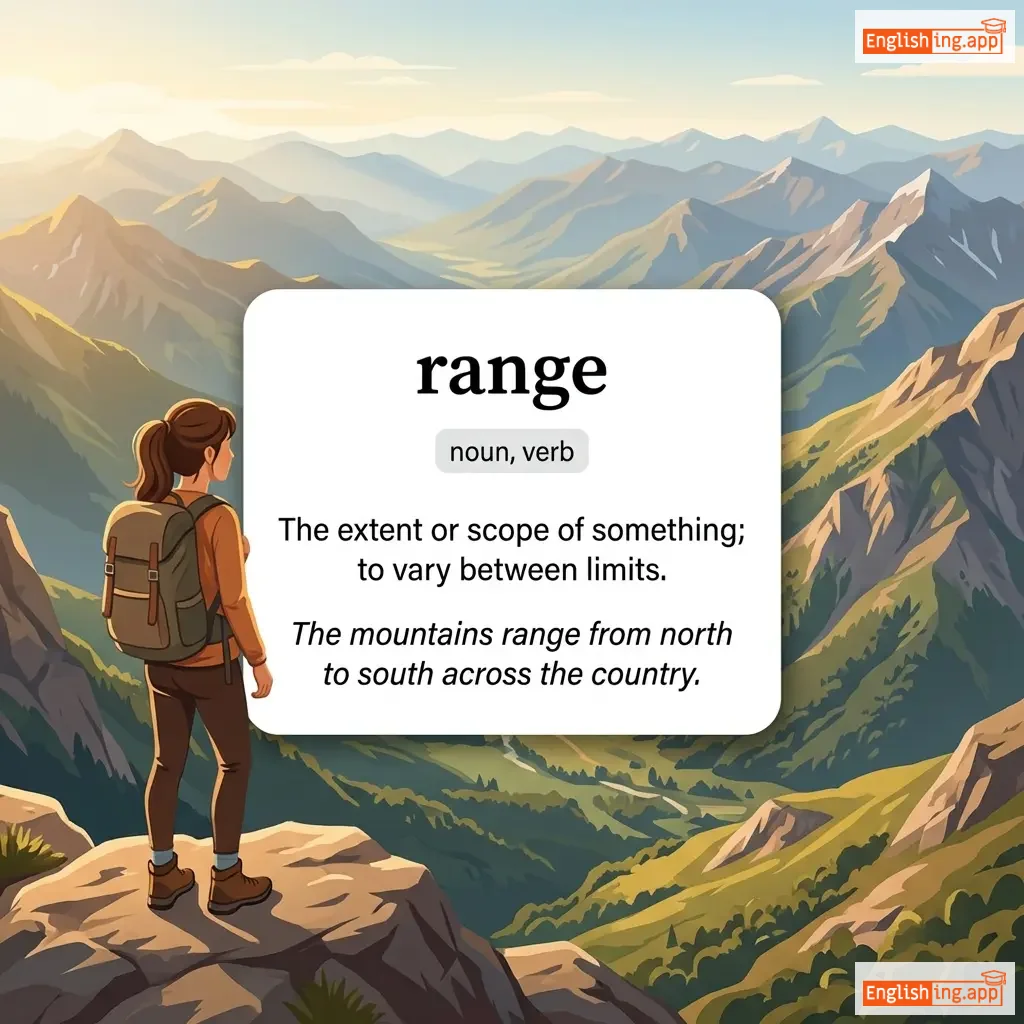
range definition card — visual illustration of the meaning
noun, verb
/reɪndʒ/
रेंज, सीमा (range, seema)

The extent or scope of something; to vary between limits.

"The mountains range from north to south across the country."

"पहाड़ देशभर में उत्तर से दक्षिण तक फैले हुए हैं।" (Pahaad desh bhar mein uttar se dakshin tak phailay huay hain.)
noun
/ˈreɪn.dʒər/
वन रक्षक (van rakshak)

A person responsible for protecting and managing forests, parks, or natural areas.

"The park ranger guided the tourists through the forest trail."

"पार्क रेंजर ने पर्यटकों को जंगल के रास्ते पर मार्गदर्शन किया।" (Park ranger ne paryatakoon ko jangal ke raste par margdarshan kiya.)