Vocabularios

Descubra, aprenda y domine el vocabulario en inglés

noun
/ˈherˌdrɛsər/
peluquero; peluquera (peluquero; peluquera)

a person whose job is to cut, style, and treat hair

"The hairdresser gave me a stylish haircut before the wedding."

"El peluquero me hizo un corte de pelo elegante antes de la boda." (El peluquero me hizo un corte de pelo elegante antes de la boda)
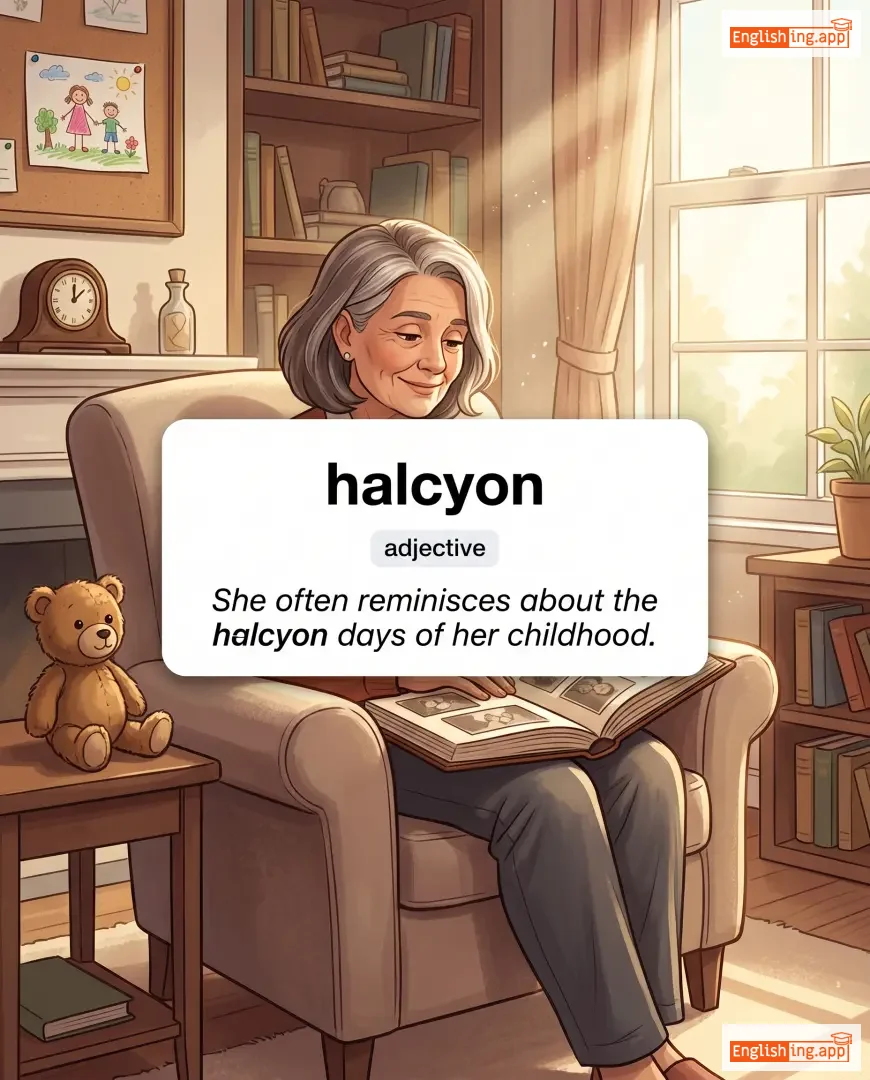
halcyon definition card — visual illustration of the meaning
adjective
/ˈhæl.si.ən/
sereno (sereno)

calm, peaceful, and happy; denoting a period of time in the past that was idyllically happy and peaceful

"She often reminisces about the halcyon days of her childhood."

"Ella a menudo recuerda los días serenos de su niñez." (Ella a menudo recuerda los días serenos de su niñez.)
adjective
/heɪl/
sano (sano)

strong and healthy, especially of an elderly person

"Despite his age, the man remained hale and active."

"A pesar de su edad, el hombre se mantuvo saludable y activo." (A pesar de su edad, el hombre se mantuvo saludable y activo.)
noun, adjective
/hæf/
mitad (mitad)

one of two equal parts of something

"He ate half of the cake."

"Él comió la mitad del pastel." (El comio la mitad del pastel.)
adjective
/ˌhæfˈbeɪkt/
a medias tintas (a medias tintas)

poorly thought out or badly planned

"The manager quickly rejected his half-baked proposal."

"El gerente rápidamente rechazó su propuesta a medias tintas." (El gerente rapidamente rechazo su propuesta a medias tintas.)
adjective
/ˌhæfˈhɑːr.tɪd/
desinteresado (desinteresado)

lacking enthusiasm or determination; unenthusiastic

"His halfhearted attempt to study did not bring good results."

"Su intento desinteresado de estudiar no dio buenos resultados." (Su intento desinteresado de estudiar no dio buenos resultados.)
adverb
/ˌhæfˈweɪ/
a mitad de camino (a mitad de camino)

at or to a point equal in distance between two points

"We met halfway between the two towns."

"Nos encontramos a mitad de camino entre las dos ciudades." (Nos encontramos a mitad de camino entre las dos ciudades.)
🏛️

Hall (jal)

noun
/hɔːl/
salón (salon)

a large room or building for public gatherings, events, or passage

"The graduation ceremony was held in the university hall."

"La ceremonia de graduación se celebró en el salón de la universidad." (La ceremonia de graduacion se celebro en el salon de la universidad.)
noun
/ˈhɔːl.mɑːrk/
marca distintiva (marca distintiva)

a typical characteristic or feature of someone or something

"Honesty is the hallmark of a good leader."

"La honestidad es la marca distintiva de un buen líder." (La honestidad es la marca distintiva de un buen lider.)
verb
/ˈhæloʊ/
santificar (santificar)

to honor as holy; to make sacred or greatly respected

"The ancient temple was hallowed by centuries of worship."

"El antiguo templo fue santificado por siglos de adoración." (El antiguo templo fue santificado por siglos de adoración.)
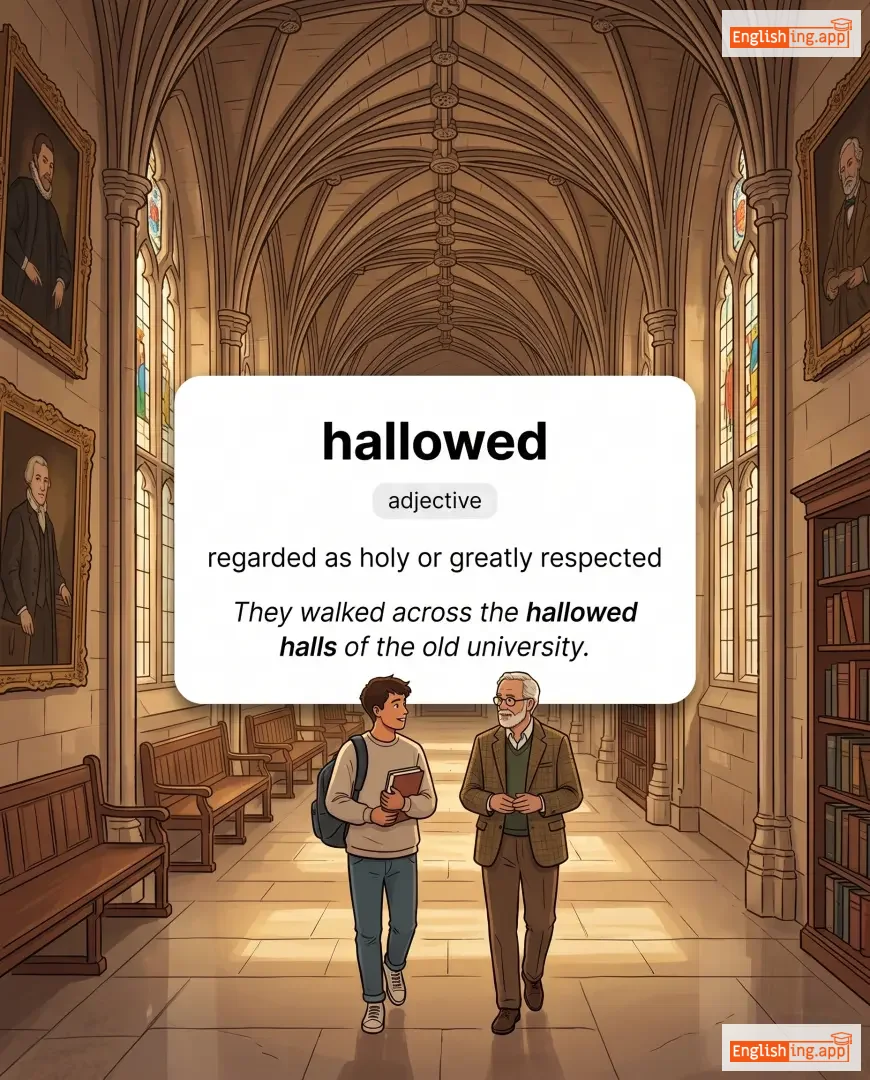
hallowed definition card — visual illustration of the meaning
adjective
/ˈhæloʊd/
sagrado (sagrado)

regarded as holy or greatly respected

"They walked across the hallowed halls of the old university."

"Cruzaron los sagrados pasillos de la vieja universidad." (Cruzaron los sagrados pasillos de la vieja universidad.)
verb
/həˈluːsɪneɪt/
alucinar (alucinar)

to see, hear, or sense things that are not actually present, often due to illness or drugs

"After taking the medicine, he began to hallucinate strange shapes."

"Después de tomar la medicina, comenzó a alucinar formas extrañas." (Despuès de tomar la medicina, comenzo a alucinar formas extrañas.)
noun
/həˌluːsɪˈneɪʃən/
alucinación (alucinacion)

a false perception of objects or events, usually caused by mental illness or drugs

"After the medication, he began to experience vivid hallucinations."

"Después de la medicación, comenzó a experimentar alucinaciones vívidas." (despues de la medicacion, comenzo a experimentar alucinaciones vividas.)
noun
/ˈhɔːlweɪ/
pasillo (pasillo)

a corridor in a building that connects rooms

"The kids left their shoes in the hallway."

"Los niños dejaron sus zapatos en el pasillo." (Los niños dejaron sus zapatos en el pasillo.)
verb
/hɔːlt/
detener (detener)

to stop or bring to a stop

"The train suddenly halted at the station."

"El tren se detuvo repentinamente en la estación." (El tren se detuvo repentinamente en la estación.)
adjective
/ˈhɔːltɪŋ/
vacilante (vacilante)

slow and hesitant, especially due to lack of confidence

"She gave a halting reply during the interview."

"Ella dio una respuesta vacilante durante la entrevista." (Ella dio una respuesta vacilante durante la entrevista.)
adjective
/ˈhæm ˌhændɪd/
torpe (torpe)

clumsy or inept in handling things or situations

"His ham-handed attempt to fix the computer made it worse."

"Su intento torpe de arreglar la computadora lo empeoró." (Su intento torpe de arreglar la computadora lo empeoró.)
noun
/ˈhæm.lət/
pequeña aldea (pequena aldea)

a small rural settlement, smaller than a village; a small community

"The tiny hamlet nestled in the valley had only a dozen houses and one small church."

"La pequeña aldea enclavada en el valle tenía solo una docena de casas y una pequeña iglesia." (La pequena aldea enclavada en el valle tenia solo una docena de casas y una pequena iglesia.)
noun, verb
/ˈhæmər/
martillo (martillo)

a tool with a heavy metal head used for breaking things or driving in nails; to hit something forcefully with a hammer or similar object.

"He used a hammer to fix the broken chair."

"Él usó un martillo para arreglar la silla rota." (Él usó un martillo para arreglar la silla rota.)
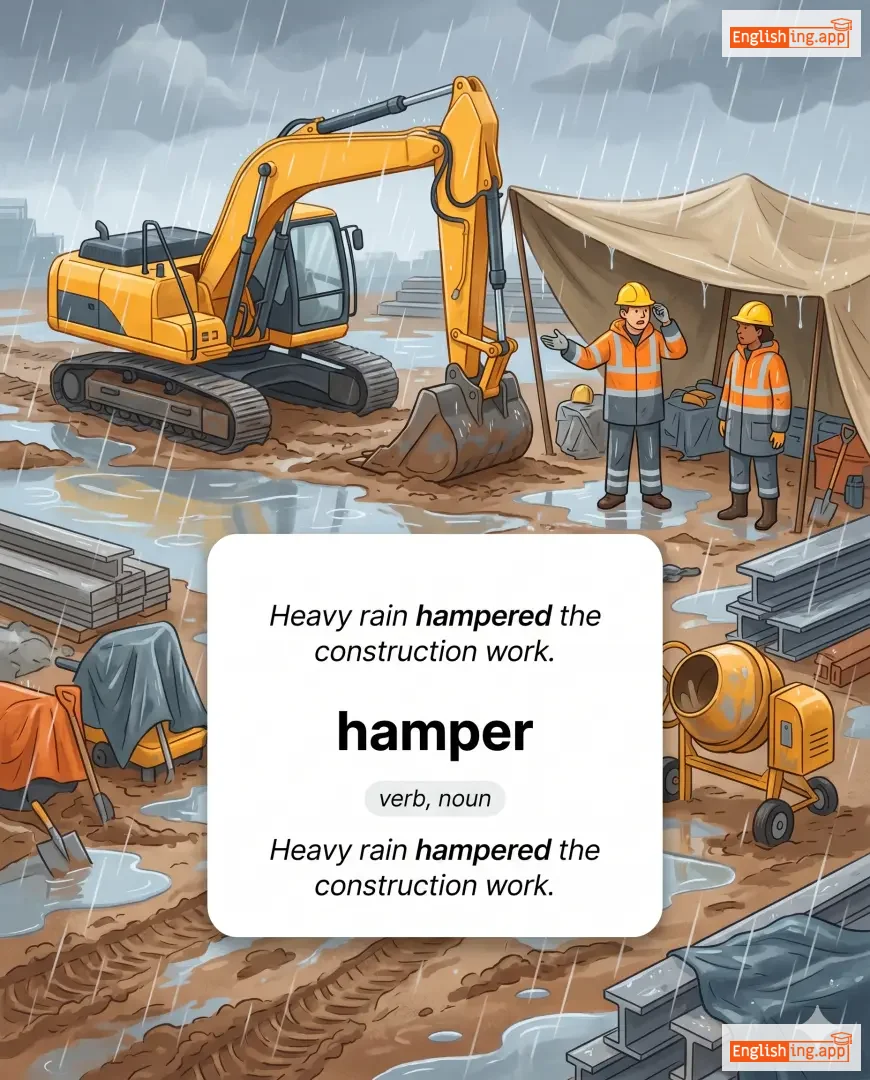
hamper definition card — visual illustration of the meaning
verb, noun
/ˈhæmpər/
obstruir, canasta para ropa (obstruir, canasta para ropa)

to prevent or slow down the progress of something; also, a basket with a lid, typically for laundry.

"Heavy rain hampered the construction work."

"La lluvia fuerte dificultó el trabajo de construcción." (La lluvia fuerte dificultó el trabajo de construcción.)
noun, verb
/ˈhæmstrɪŋ/
tendón en la parte posterior del muslo; como verbo, dificultar o restringir severamente la efectividad de alguien o algo (tendon en la parte posterior del muslo; como verbo, dificultar o restringir severamente la efectividad de alguien o algo)

a tendon at the back of the thigh; as a verb, to cripple or severely restrict the effectiveness of someone or something.

"Budget cuts hamstrung the organization’s plans."

"Los recortes presupuestarios han debilitado los planes de la organización." (Los recortes presupuestarios han debilitado los planes de la organización.)
verb (past tense, past participle), adjective
/ˈhæmstrʌŋ/
cojo o debilitado (koho o debilitao)

crippled or severely restricted in movement or progress.

"The team was hamstrung by lack of resources."

"El equipo fue limitado por la falta de recursos." (El equipo fue limitado por la falta de recursos.)
noun, verb
/hænd/
mano (mano)

the part of the body at the end of the arm used for holding things

"She raised her hand to ask a question."

"Ella levantó su mano para hacer una pregunta." (Ella levantó su mano para hacer una pregunta.)
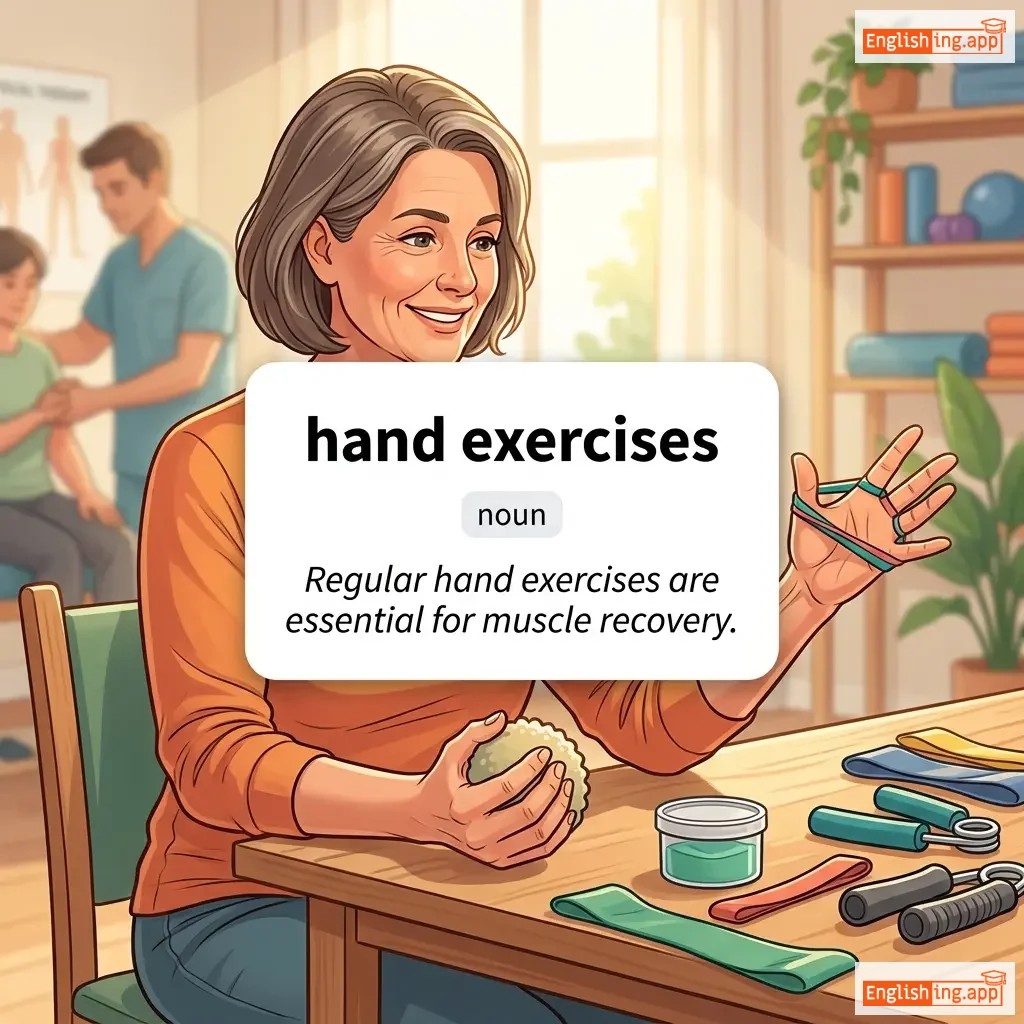
hand exercises definition card — visual illustration of the meaning
noun
হ্যান্ড এক্সারসাইজেস
ejercicios de mano (ejercicios de mano)

Physical activities designed to strengthen, stretch, and improve the flexibility of hand and finger muscles.

"Regular hand exercises are essential for muscle recovery."

"Los ejercicios regulares de mano son esenciales para la recuperación muscular." (Los ejercicios regulares de mano son esenciales para la recuperación muscular.)
noun
/ˈhænd ˌrɪŋɪŋ/
preocupación excesiva (preocupacion excesiva)

excessive worry or concern expressed in a visible or dramatic way.

"There was much hand-wringing over the political crisis."

"Había mucha preocupación dramática sobre la crisis política." (Habia mucha preocupacion dramatica sobre la crisis politica.)
noun
/ˈhænd.fʊl/
un puñado (un punyado)

the amount of something that can be held in one hand; a small number

"She took a handful of nuts."

"Ella tomó un puñado de nueces." (Ella tomo un punyado de nueces.)
noun
/ˈhæn.di.krɑːft/
artesanía (artesania)

an activity involving the making of decorative domestic or other objects with the hands; handmade artistic work

"The local market featured beautiful handicrafts made by skilled artisans from the region."

"El mercado local presentó hermosas artesanías hechas por hábiles artesanos de la región." (El mercado local presento hermosas artesanias hechas por habiles artesanos de la region.)
noun
/ˈhæŋ.kər.tʃɪf/
pañuelo (pañuelo)

a small piece of cloth used for wiping the nose or face

"She always carries a clean handkerchief in her purse."

"Ella siempre lleva un pañuelo limpio en su bolso." (Ella siempre lleva un pañuelo limpio en su bolso.)
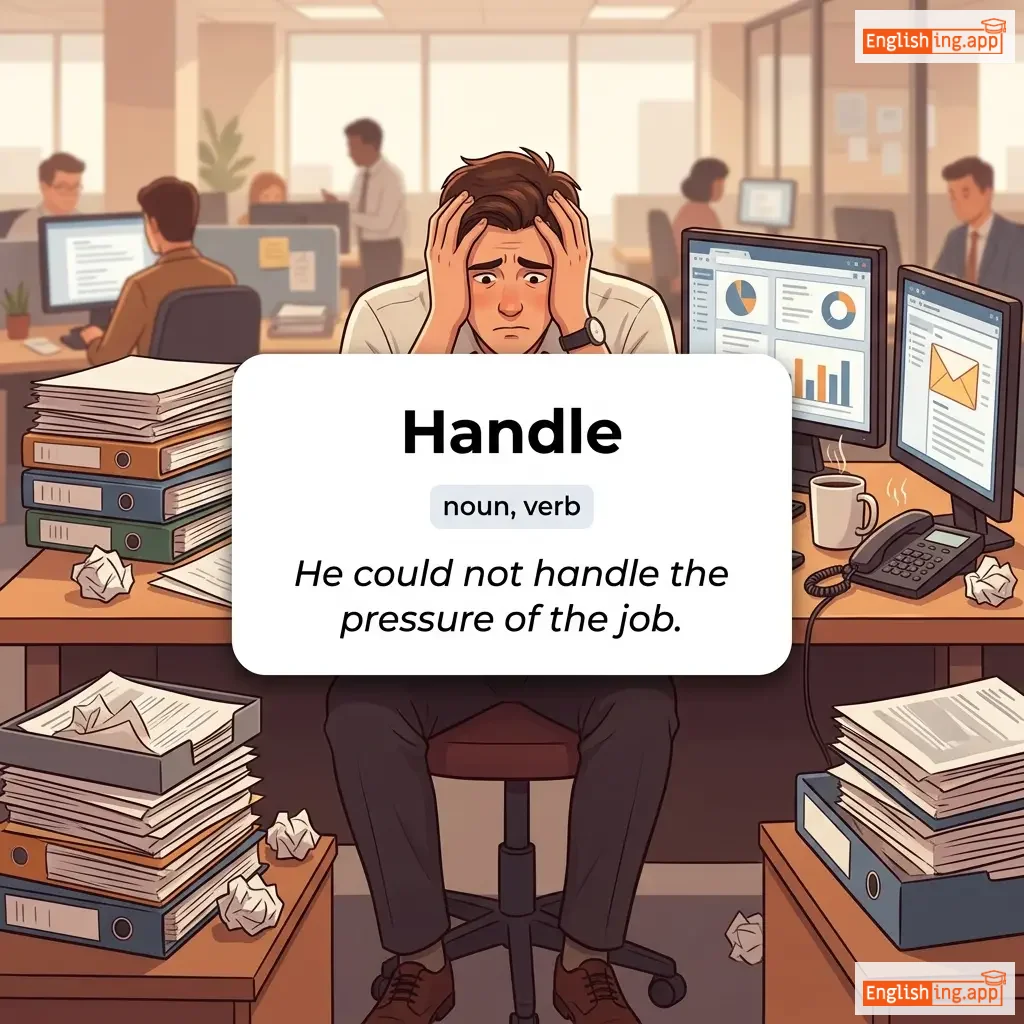
Handle definition card — visual illustration of the meaning
noun, verb
/ˈhændl̩/
mango / manejar (mango / manejar)

the part of an object designed to be held in the hand; to deal with or manage a situation

"He could not handle the pressure of the job."

"Él no pudo manejar la presión del trabajo." (El no pudo manejar la presion del trabajo.)
noun
/ˈhændlɪŋ/
manejo (manejo)

the act of managing or dealing with something or someone

"His handling of the situation was impressive."

"Su manejo de la situación fue impresionante." (Su manejo de la situación fue impresionante.)
adjective
/ˈhæn.səm/
felicidad (felicidad)

attractive in appearance, usually referring to men; also can mean generous or impressive in size.

"He looked very handsome in his new suit."

"No pudo ocultar su felicidad cuando recibió el premio." (No pudo ocultar su felicidad cuando recibió el premio.)
noun
/ˈhændˌraɪ.tɪŋ/
letra manuscrita (letra manuscrita)

the style or manner of writing by hand.

"Her handwriting is very neat and easy to read."

"Su letra manuscrita es muy clara y fácil de leer." (Su letra manuscrita es muy clara y fácil de leer.)
adjective
/ˈhændi/
fácil de usar (facil de usar)

convenient to use or easily accessible; skillful with the hands

"This pocket knife is very handy when you go camping."

"Este cuchillo de bolsillo es muy útil cuando vas de camping." (Este cuchillo de bolsillo es muy util cuando vas de camping.)
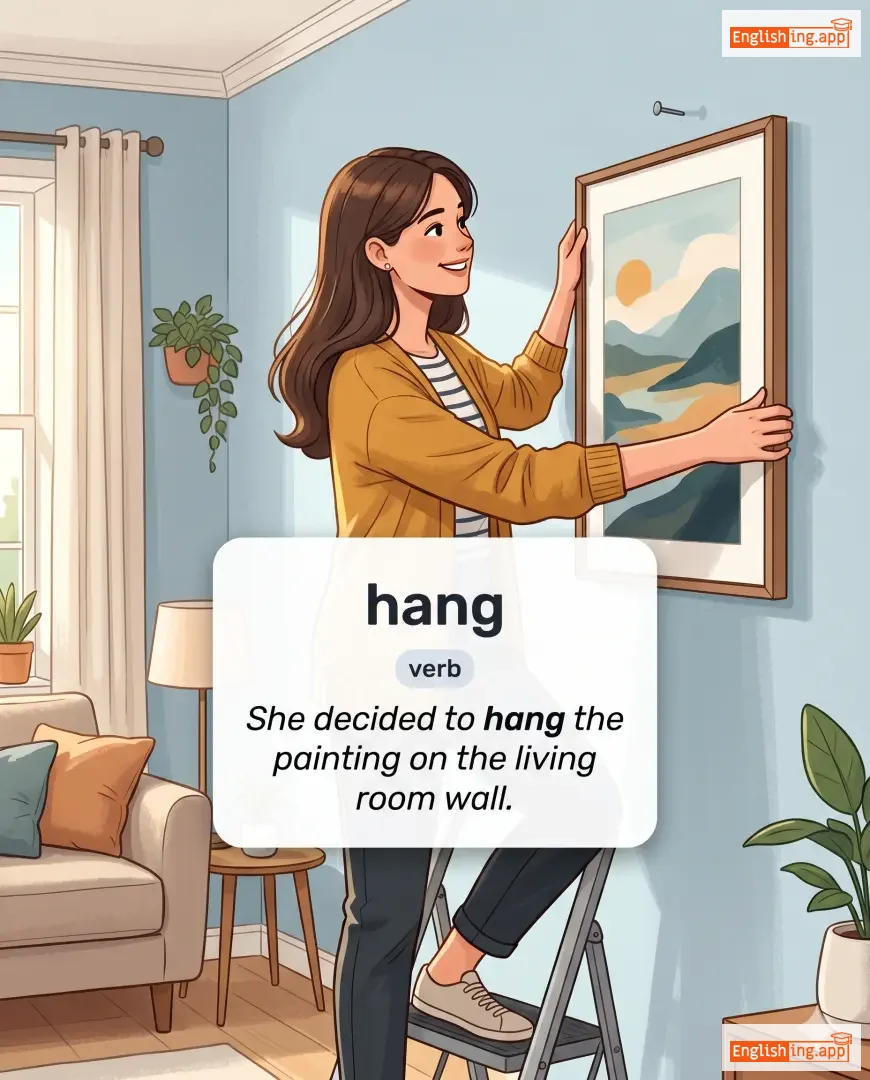
hang definition card — visual illustration of the meaning
verb
/hæŋ/
colgar (colgar)

to suspend or attach something from above so that it moves freely or is supported

"She decided to hang the painting on the living room wall."

"Ella decidió colgar el cuadro en la pared de la sala." (Ella decidió colgar el cuadro en la pared de la sala.)
noun
/ˈhæŋ.ər/
hangar (hangar)

a large building with extensive floor area, typically for housing aircraft; an aircraft shelter

"The airplane was stored safely in the hangar during the severe thunderstorm."

"El avión fue guardado de forma segura en el hangar durante la tormenta severa." (El avion fue guardado de forma segura en el hangar durante la tormenta severa.)
adjective
/ˈhæŋ.dɔːɡ/
avergonzado (avergonzado)

looking or feeling ashamed, guilty, or defeated.

"He gave me a hangdog look after being caught lying."

"Él me dio una mirada avergonzada después de ser atrapado mintiendo." (El me dio una mirada avergonzada despues de ser atrapado mintiendo.)
noun
/ˈhæŋ.ər/
percha (percha)

a shaped piece of wood, plastic, or metal with a hook at the top, used to hang up clothes

"She hung her dress on a wooden hanger to prevent it from getting wrinkled."

"Colgó su vestido en una percha de madera para evitar que se arrugara." (Colgo su vestido en una percha de madera para evitar que se arrugara.)
noun
/ˌhæŋ.ər ˈɒn/
parásito (parasito)

a person who spends time with a powerful or famous person to gain benefits.

"The celebrity was always surrounded by hangers-on."

"La celebridad siempre estaba rodeada de parásitos." (La celebridad siempre estaba rodeada de parasitos.)
noun
/ˈhæŋ.kər/
anhelo, deseo (anhelo, deseo)

a feeling of yearning or craving; a strong desire for something

"After years abroad, she developed a deep hanker for her homeland's traditional cuisine."

"Después de años en el extranjero, desarrolló un profundo deseo por la comida tradicional de su tierra natal." (Despues de anos en el extranjero, desarrollo un profundo deseo por la comida tradicional de su tierra natal.)
noun
/ˈhæŋ.kər.ɪŋ/
anhelo (anhelo)

a strong desire or craving for something.

"She had a hankering for chocolate late at night."

"Ella tenía un anhelo por chocolate a altas horas de la noche." (Ella tenía un anhelo por chocolate a altas horas de la noche.)
noun
/ˌhæŋ.ki ˈpæŋ.ki/
fraude; actividad sospechosa; comportamiento poco ético; engaño (fraude; actividad sospechosa; comportamiento poco etico; engano)

dishonest or suspicious activity; unethical behavior; trickery or deception

"The audit revealed some hanky-panky in the company's financial records."

"La auditoría reveló algo de fraude en los registros financieros de la empresa." (La auditoria revelo algo de fraude en los registros financieros de la empresa.)
noun
/hæp/
suerte, fortuna, azar (suerte, fortuna, azar)

luck, fortune, or chance occurrence

"By sheer hap, he discovered the old letter hidden in the drawer."

"Por pura suerte, descubrió la vieja carta escondida en el cajón." (Por pura suerte, descubrió la vieja carta escondida en el cajón.)
adjective
/hæpˈhæzərd/
desordenado, aleatorio (desordenado, aleatorio)

lacking any obvious order or organization; random

"The books were stacked in a haphazard way on the table."

"Los libros estaban apilados de manera desordenada sobre la mesa." (Los libros estaban apilados de manera desordenada sobre la mesa.)
adjective
/ˈhæpləs/
desdichado, desafortunado (desdichado, desafortunado)

unfortunate, unlucky, deserving pity

"The hapless traveler lost his passport on the very first day."

"El desdichado viajero perdió su pasaporte en el primer día." (El desdichado viajero perdió su pasaporte en el primer día.)
verb
/ˈhæpən/
ocurrir (ocurrir)

to take place or occur, usually by chance

"Accidents can happen at any time."

"Los accidentes pueden ocurrir en cualquier momento." (Los accidentes pueden ocurrir en cualquier momento.)
adverb
/ˈhæpɪli/
felizmente (felizmente)

in a happy manner; with pleasure or satisfaction

"The children played happily in the garden."

"Los niños jugaron felizmente en el jardín." (Los niños jugaron felizmente en el jardín.)
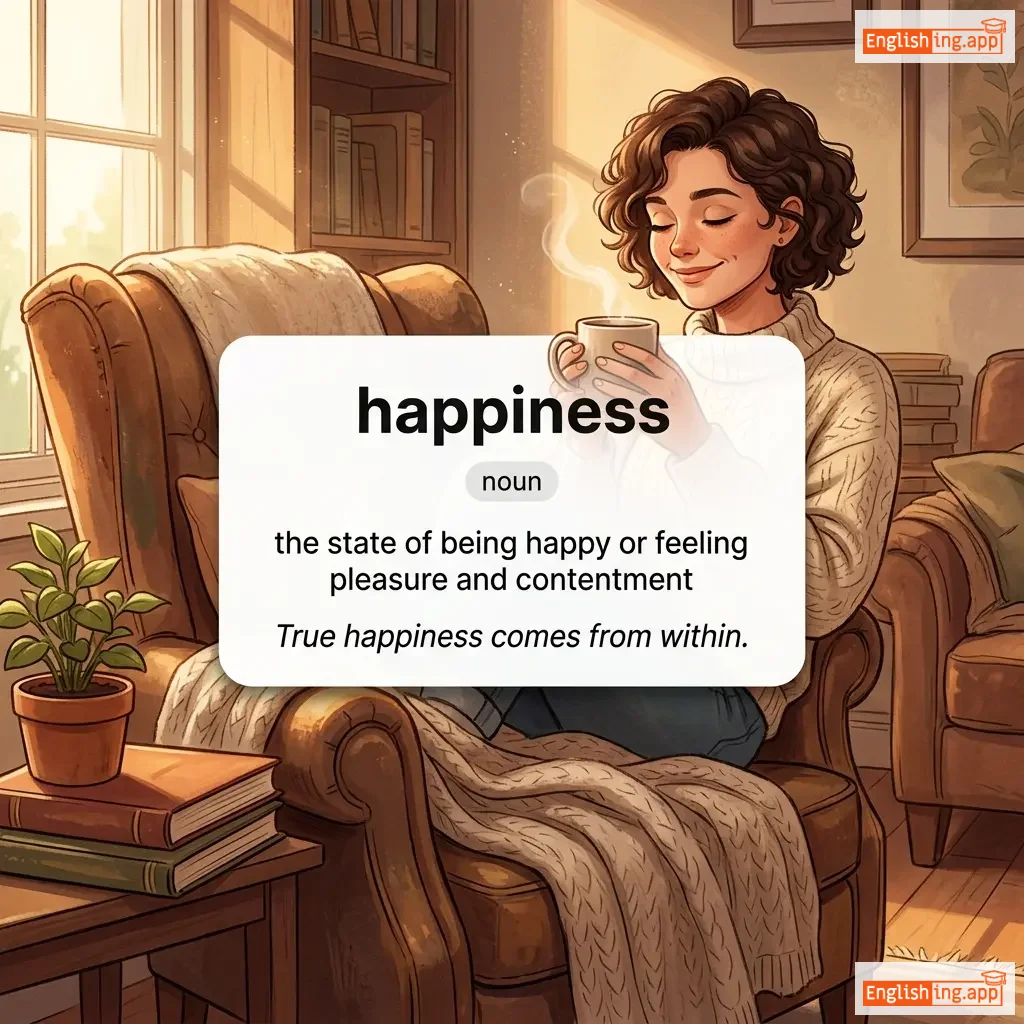
happiness definition card — visual illustration of the meaning
noun
/ˈhæpinəs/
felicidad (felicidad)

the state of being happy or feeling pleasure and contentment

"True happiness comes from within."

"La verdadera felicidad viene desde adentro." (La verdadera felicidad viene desde adentro.)
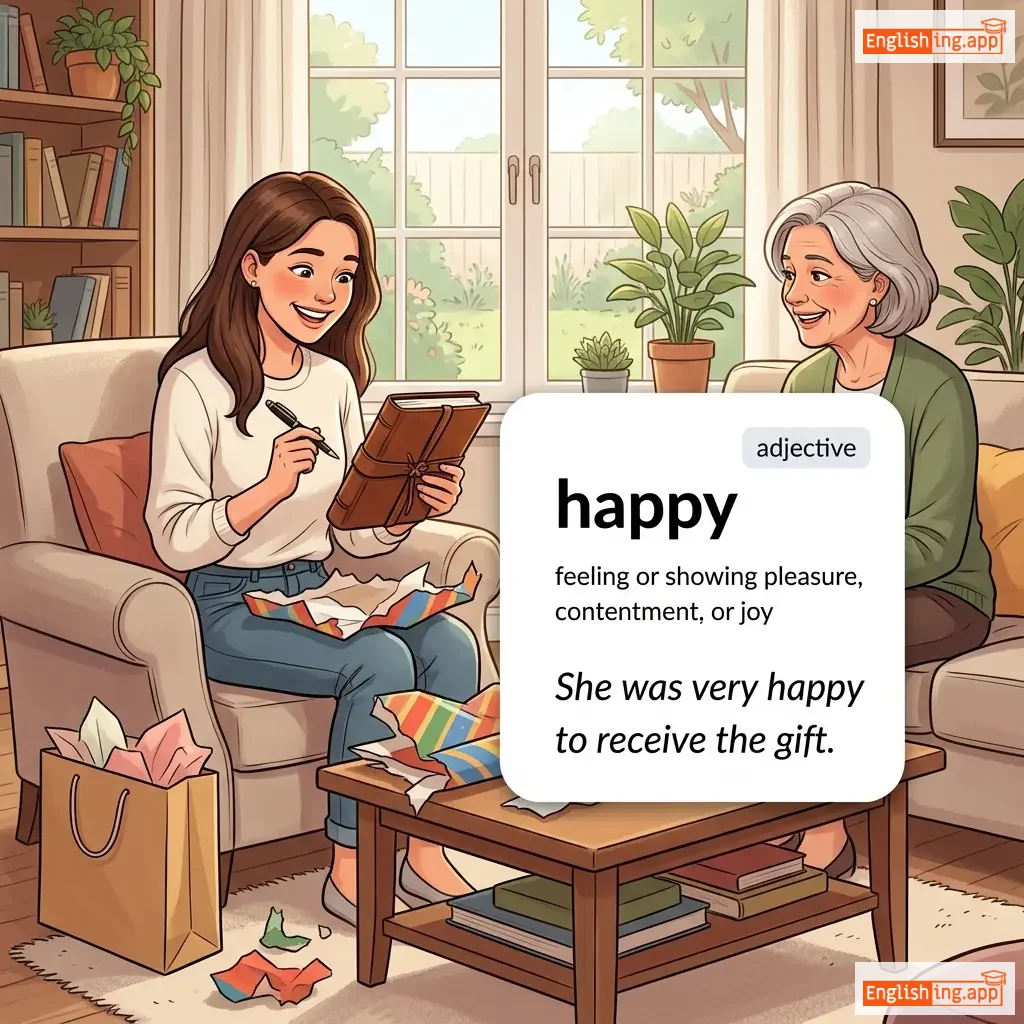
happy definition card — visual illustration of the meaning
adjective
/ˈhæpi/
feliz (feliz)

feeling or showing pleasure, contentment, or joy

"She was very happy to receive the gift."

"Ella estaba muy feliz de recibir el regalo." (Ella estaba muy feliz de recibir el regalo.)
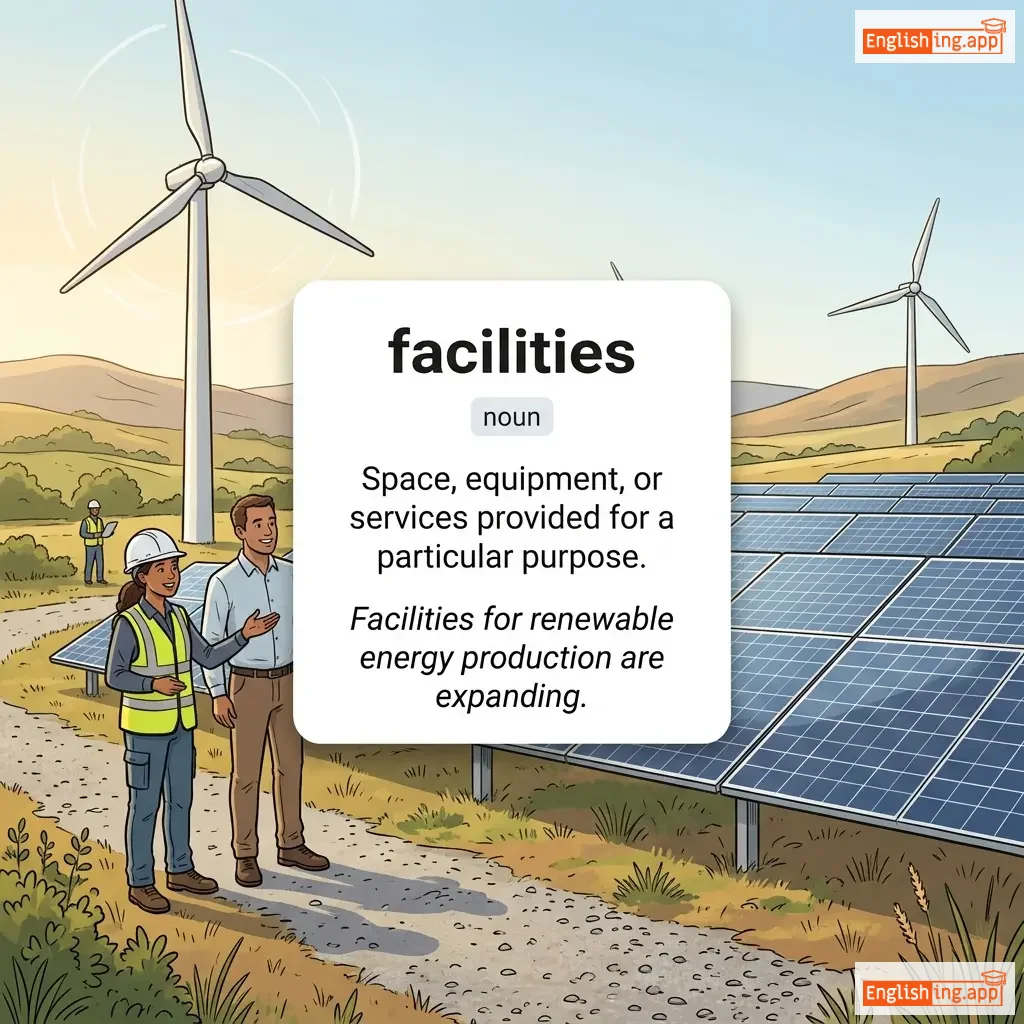
facilities definition card — visual illustration of the meaning
noun
fəˈsɪl.ɪ.tiz
instalaciones (instalaciones)

Space, equipment, or services provided for a particular purpose.

"Facilities for renewable energy production are expanding."

"Las instalaciones para la producción de energía renovable están en expansión." (Las instalaciones para la producción de energía renovable están en expansión.)
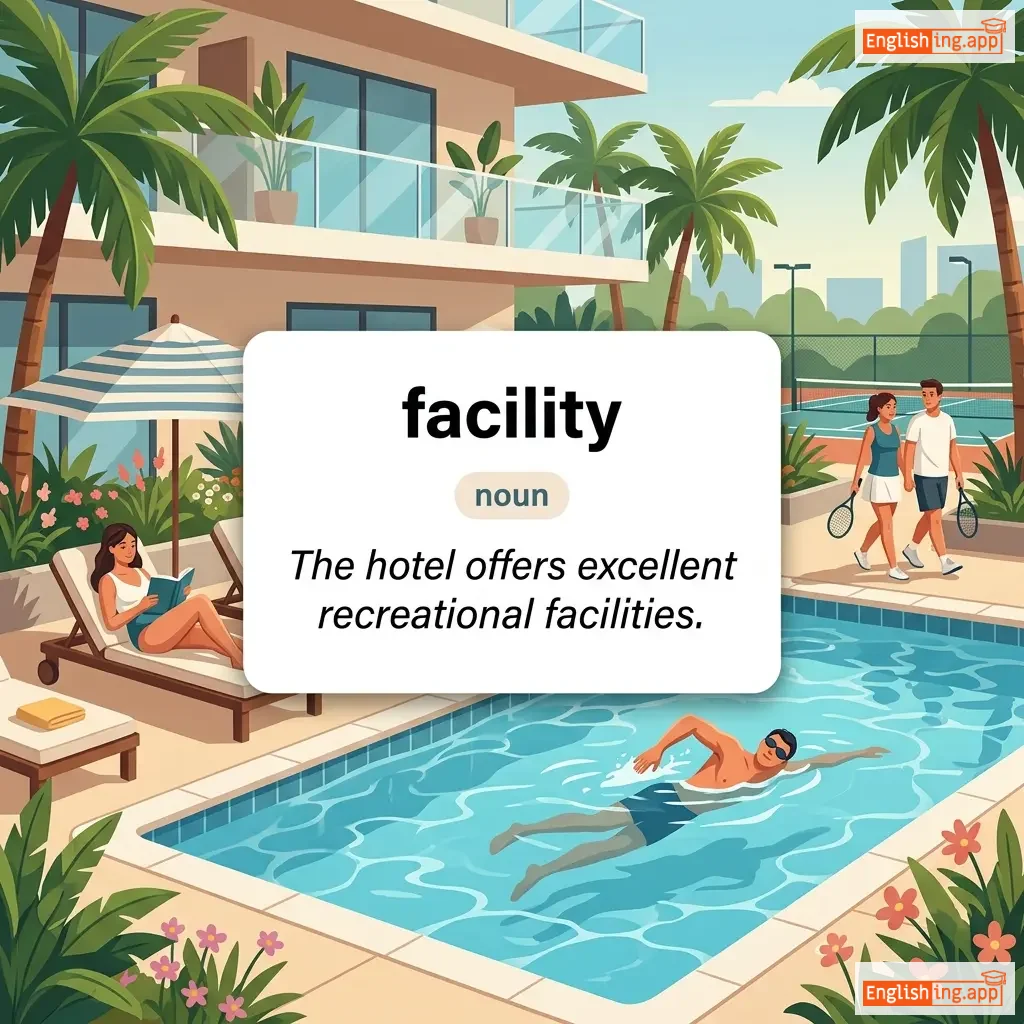
facility definition card — visual illustration of the meaning
noun
/fəˈsɪləti/
facilidad, servicio o equipo provisto para un propósito específico (facilidad, servicio o equipo provisto para un proposito especifico)

a place, service, or equipment provided for a particular purpose; ease in doing something

"The hotel offers excellent recreational facilities."

"El hotel ofrece excelentes instalaciones recreativas." (El hotel ofrece excelentes instalaciones recreativas.)