Vocabularios

Descubra, aprenda y domine el vocabulario en inglés

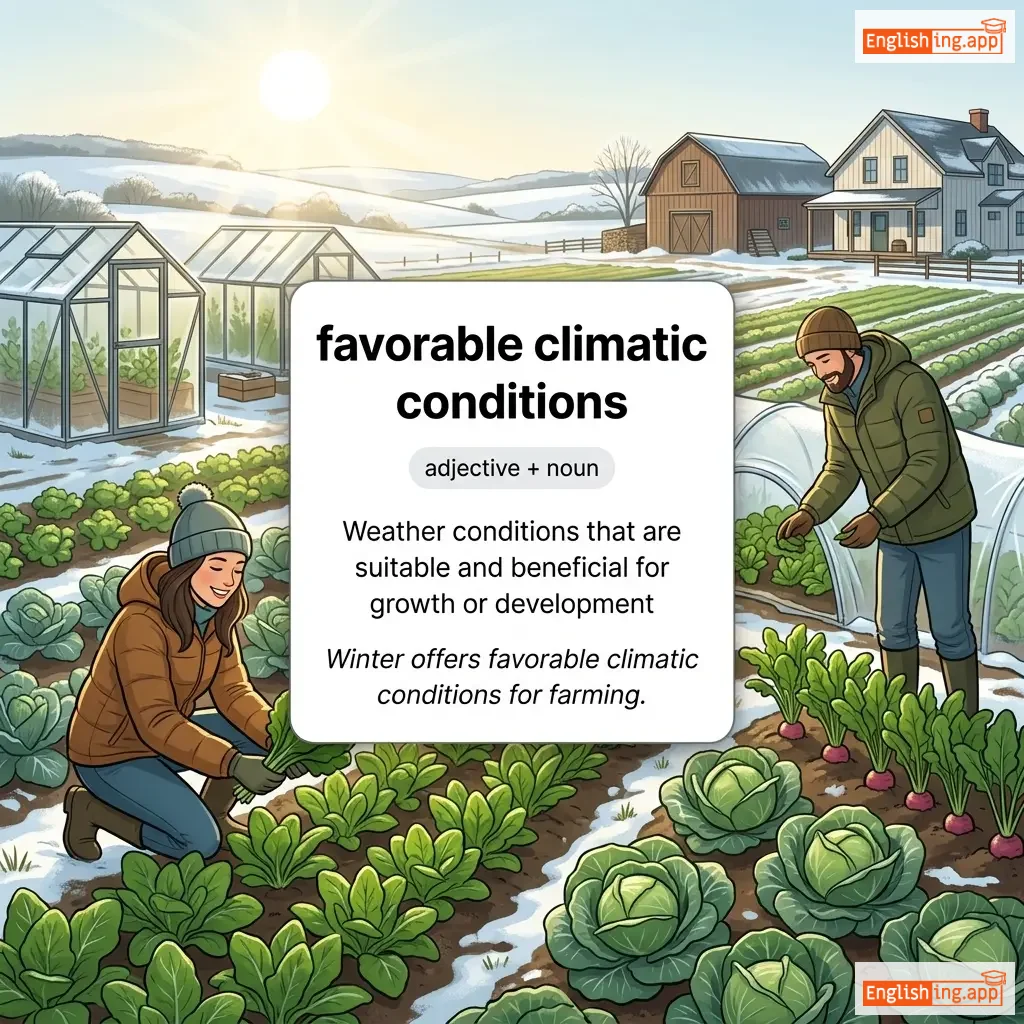
favorable climatic conditions definition card — visual illustration of the meaning
adjective + noun
ˈfeɪvərəbəl klaɪˈmætɪk kənˈdɪʃənz
condiciones climáticas favorables (condiciones climáticas favorables)

Weather conditions that are suitable and beneficial for growth or development

"Winter offers favorable climatic conditions for farming."

"El invierno ofrece condiciones climáticas favorables para la agricultura." (El invierno ofrece condiciones climáticas favorables para la agricultura.)
adjective, noun
/ˈfeɪvərɪt/
favorito (favorito)

Preferred over all others; something or someone especially liked.

"Chocolate is my favorite ice cream flavor."

"El chocolate es mi sabor de helado favorito." (El chocolate es mi sabor de helado favorito.)
noun
/ˈfeɪvərɪtɪzəm/
favoritismo (favoritismo)

the practice of giving unfair preferential treatment to one person or group

"The manager was accused of favoritism towards certain employees."

"El gerente fue acusado de favoritismo hacia ciertos empleados." (El gerente fue acusado de favoritismo hacia ciertos empleados.)
noun
/ˈfeɪ.vər/
favor; ayuda; bondad (favor, ayuda, bondad)

approval, support, or liking for someone or something; a kind or helpful act

"Could you do me a favour and help me move this heavy box?"

"¿Podrías hacerme un favor y ayudarme a mover esta caja pesada?" (¿Podrias hacerme un favor y ayudarme a mover esta caja pesada?)
adjective
/ˈfeɪvərəbl/
favorable (favorable)

Expressing approval, support, or positivity; advantageous or beneficial

"The weather conditions were favourable for the outdoor event."

"Las condiciones climáticas fueron favorables para el evento al aire libre." (Las condiciones climaticas fueron favorables para el evento al aire libre.)
verb
/fɔːn/
adular (adular)

to show exaggerated flattery or affection; to seek favor by servile behavior

"He fawned over the boss to get a promotion."

"Él aduló al jefe para conseguir una promoción." (Él aduló al jefe para conseguir una promoción.)
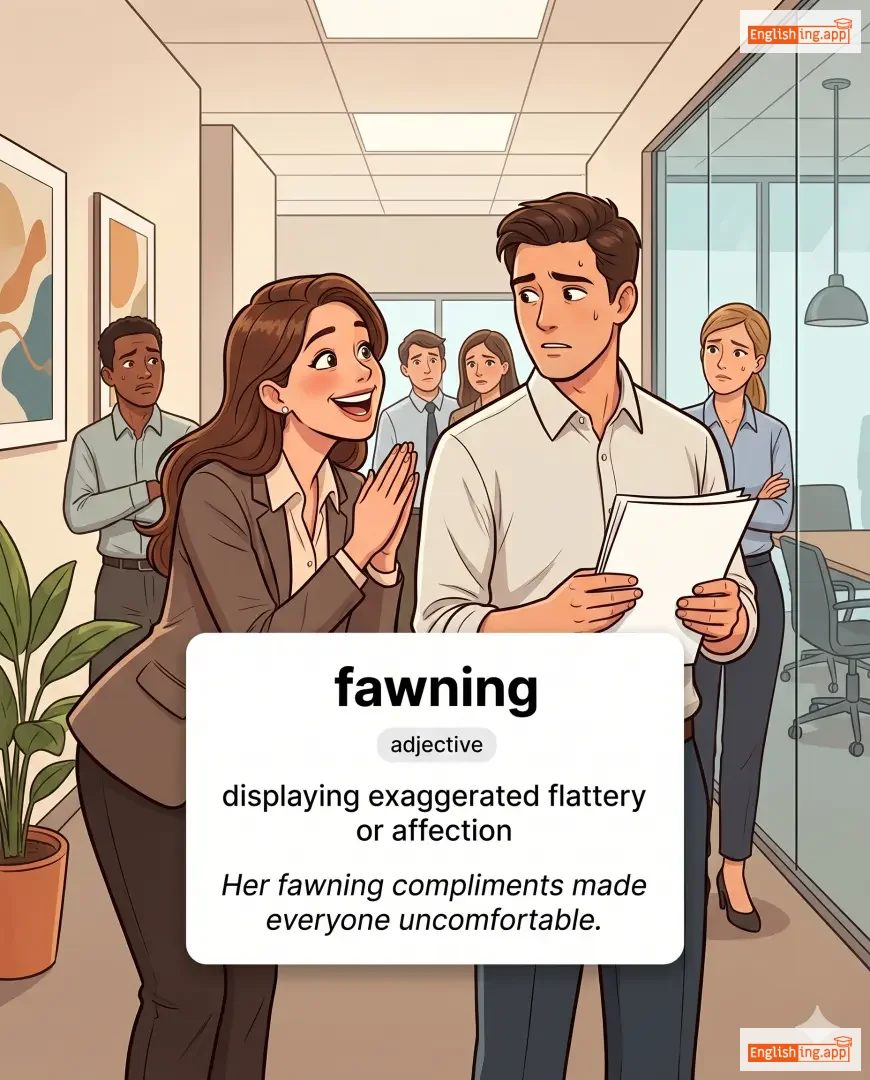
fawning definition card — visual illustration of the meaning
adjective
/ˈfɔːnɪŋ/
adulador excesivo (adulador excesivo)

displaying exaggerated flattery or affection

"Her fawning compliments made everyone uncomfortable."

"Sus adulaciones excesivas hicieron que todos se sintieran incómodos." (Sus adulaciones excesivas hicieron que todos se sintieran incómodos.)
verb
/feɪz/
perturbar (perturbar)

to disturb or disconcert someone; to cause to feel unsettled

"She was not fazed by the unexpected question."

"Ella no se perturbó por la pregunta inesperada." (Ella no se perturbó por la pregunta inesperada.)
noun
/ˈfiːəlti/
fidelidad y lealtad (fidelidad y lealtad)

loyalty or allegiance, especially to a sovereign or lord

"The knight swore fealty to his king."

"El caballero juró fidelidad a su rey." (El caballero juro fidelidad a su rey.)
Fear definition card — visual illustration of the meaning
noun, verb
/fɪr/
miedo (miedo)

An unpleasant emotion caused by the belief that someone or something is dangerous.

"She has a fear of flying."

"Ella tiene miedo de volar." (ella tiene miedo de volar.)
adjective
/ˈfɪr.fəl/
temeroso (temeroso)

feeling afraid or showing fear

"She was fearful of walking alone at night."

"Ella tenía miedo de caminar sola por la noche." (Ella tenia miedo de caminar sola por la noche.)
feasibility definition card — visual illustration of the meaning
noun
ˌfiː.zəˈbɪl.ə.ti
viabilidad, factibilidad, posibilidad (viabilidad, factibilidad, posibilidad)

Possibility, practicality, viability.

"The feasibility study proved the project viable."

"El estudio de viabilidad demostró que el proyecto era viable." (El estudio de viabilidad demostró que el proyecto era viable.)
adjective
/ˈfiːzəbl/
factible (factible)

possible to do easily or conveniently; practical and workable

"It is feasible to complete the project within two months."

"Es factible completar el proyecto dentro de dos meses." (Es factible completar el proyecto dentro de dos meses.)
noun
/fiːst/
banquete; festín (banquete, festin)

a large meal, typically one in celebration of something; an annual religious celebration

"The wedding feast included traditional dishes from both families' cultures."

"El banquete de la boda incluyó platos tradicionales de las culturas de ambas familias." (El banquete de la boda incluyo platos tradicionales de las culturas de ambas familias.)
noun
/fiːt/
hazaña (hazana)

an achievement that requires great courage, skill, or strength

"Climbing Mount Everest was a remarkable feat."

"Escalar el monte Everest fue una hazaña notable." (Escalar el monte Everest fue una hazaña notable.)
noun
/ˈfɛðər/
pluma (pluma)

a light, soft structure that covers a bird’s body and enables it to fly

"The bird lost a small feather while flying through the trees."

"El pájaro perdió una pequeña pluma mientras volaba entre los árboles." (El pajaro perdio una pequena pluma mientras volaba entre los arboles.)
noun
/ˈfiːtʃər/
característica (caracteristica)

a distinctive attribute or aspect of something; a characteristic

"The new phone has a unique camera feature."

"El nuevo teléfono tiene una característica única de cámara." (El nuevo telefono tiene una caracteristica unica de camara.)
adjective
/ˈfiːbraɪl/
febril, excitado (febril, excitado)

having or showing the symptoms of a fever; or highly excitable or agitated

"The patient was in a febrile state with high temperature."

"El paciente estaba en un estado febril con alta temperatura." (El paciente estaba en un estado febril con alta temperatura.)
noun
/ˈfɛb.ruˌɛr.i/
febrero (febrero)

The second month of the year in the Gregorian calendar, typically having 28 days, or 29 in a leap year.

"My birthday is in February, so I always look forward to this month."

"Mi cumpleaños es en febrero, así que siempre espero con ansias este mes." (Mi cumpleanos es en febrero, asi que siempre espero con ansias este mes)
adjective
/ˈfɛkləs/
inepto, irresponsable (inepto, irresponsable)

lacking initiative or strength of character; irresponsible

"His feckless attitude at work caused several missed deadlines."

"Su actitud inepta en el trabajo causó varios plazos perdidos." (Su actitud inepta en el trabajo causo varios plazos perdidos.)
adjective
/ˈfiːkənd/
fértil, productivo (fertil, productivo)

producing or capable of producing an abundance of offspring or new growth; fertile

"The fecund soil produced a bountiful harvest this year."

"El suelo fértil produjo una cosecha abundante este año." (El suelo fertil produjo una cosecha abundante este ano.)
noun
/fiːˈkʌndɪti/
fecundidad, fertilidad (fecundidad, fertilidad)

the ability to produce an abundance of offspring or new growth; fertility

"The fecundity of the river delta supports diverse wildlife."

"La fecundidad del delta del río apoya la diversidad de la vida silvestre." (La fecundidad del delta del río apoya la diversidad de la vida silvestre.)
adjective
/ˈfɛdərəl/
federal (federal)

Relating to the central government of a federation.

"The federal government passed a new law on healthcare."

"El gobierno federal aprobó una nueva ley sobre atención sanitaria." (El gobierno federal aprobó una nueva ley sobre atención sanitaria.)
verb
/ˈfɛdərət/
federar (federar)

to unite in a league or federation; to form an alliance

"Several states federated to create a stronger union."

"Varios estados se federaron para crear una unión más fuerte." (Varios estados se federaron para crear una unión más fuerte.)
noun
/fiː/
tarifa (tarifa)

A payment made for a service or privilege.

"The lawyer charged a high fee for his services."

"El abogado cobró una tarifa alta por sus servicios." (El abogado cobró una tarifa alta por sus servicios.)
adjective
/ˈfiːbl/
débil, flojo (debil, flojo)

lacking physical strength or vigor; weak

"After the illness, she felt too feeble to stand."

"Después de la enfermedad, se sintió demasiado débil para levantarse." (Despuès de la enfermedad, se sintió demasiado débil para levantarse.)
adjective
/ˈfiːbəlˌmaɪndɪd/
tonto o de mente débil (tonto o de mente debil)

lacking intelligence or mental capacity; foolish or weak-minded

"The feebleminded man struggled to understand basic instructions."

"El hombre de mente débil luchaba por entender instrucciones básicas." (El hombre de mente debil luchaba por entender instrucciones basicas.)
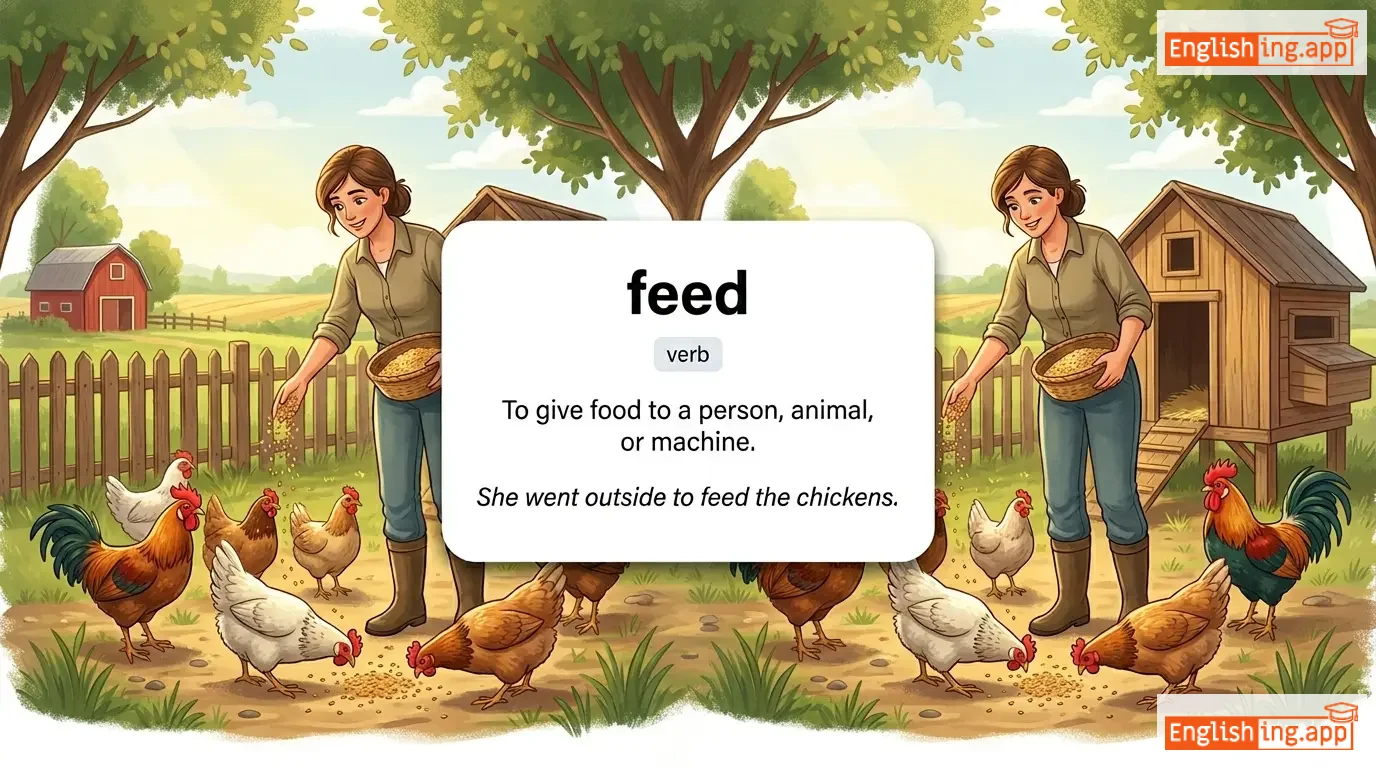
feed definition card — visual illustration of the meaning
verb
/fiːd/
alimentar (alimentar)

To give food to a person, animal, or machine.

"She went outside to feed the chickens."

"ella salió afuera a alimentar a los pollos." (ella salio afuera a alimentar a los pollos.)
noun
/ˈfiːdbæk/
retroalimentación (retroalimentacion)

information or opinions about how well someone is doing something

"She asked her teacher for feedback on her essay."

"Ella pidió a su profesor comentarios sobre su ensayo." (Ella pidió a su profesor comentarios sobre su ensayo.)
Feel definition card — visual illustration of the meaning
verb
/fiːl/
sentir (sentir)

To experience an emotion or physical sensation.

"I feel happy when I listen to music."

"Me siento feliz cuando escucho música." (Me siento feliz cuando escucho musica.)
noun
/ˈfiːlɪŋ/
sentimiento (sentimiento)

An emotional state or physical sensation.

"She had a strange feeling about the place."

"Ella tenía una extraña sensación sobre el lugar." (Ella tenia una extrana sensacion sobre el lugar.)
verb
/feɪn/
fingir, simular (fingir, simular)

to pretend or fake; to give a false appearance of

"She feigned illness to avoid going to work."

"Ella fingió estar enferma para evitar ir a trabajar." (Ella finge estar enferma para evitar ir a trabajar.)
noun
/feɪnt/
finta, movimiento engañoso (finta, movimiento enganoso)

a deceptive or pretended movement, especially in fighting or sports

"The boxer made a feint to the left before striking to the right."

"El boxeador hizo una finta hacia la izquierda antes de golpear hacia la derecha." (El boxeador hizo una finta hacia la izquierda antes de golpear hacia la derecha.)
verb
/fəˈlɪsɪteɪt/
felicitar (felicitar)

to congratulate someone; to express happiness for someone's success

"We felicitated her on winning the award."

"Nosotros felicitamos a ella por ganar el premio." (Nosotros felicitamos a ella por ganar el premio.)
felicitous definition card — visual illustration of the meaning
adjective
/fəˈlɪsɪtəs/
apropiado, adecuado o placentero; marcado por buena suerte o felicidad (apropiado, adecuado o placentero; marcado por buena suerte o felicidad)

well-chosen, appropriate, or pleasing; marked by good fortune or happiness

"She made a felicitous remark that lightened the mood."

"Hizo un comentario apropiado que aligeró el ambiente." (Hizo un comentario apropiado que aligeró el ambiente.)
noun
/fəˈlɪsɪti/
felicidad (felicidad)

intense happiness; the ability to find appropriate expression for one's thoughts

"She was known for her felicity in conversation and cheerful nature."

"Era conocida por su felicidad en las conversaciones y su naturaleza alegre." (Era conocida por su felicidad en las conversaciones y su naturaleza alegre.)
adjective
/ˈfiːlaɪn/
relacionado con los gatos (relacionado con los gatos)

relating to or characteristic of cats

"Her movements were graceful and almost feline in their elegance."

"Sus movimientos eran gráciles y casi felinos en su elegancia." (Sus movimientos eran gráciles y casi felinos en su elegancia.)
verb
/fel/
derribar, talar (derribar, talar)

to cut down a tree; to cause to fall; to strike down

"The lumberjacks felled several trees in the forest today."

"Los leñadores talaron varios árboles en el bosque hoy." (Los leñadores talaron varios árboles en el bosque hoy.)
noun
/ˈfɛloʊ/
compañero (companero)

a person who shares a common situation, interest, or activity with another

"He is a fellow student in my class."

"Él es un compañero de clase en mi clase." (El es un companero de clase en mi clase.)
noun
/ˈfɛlən/
delincuente (delincuente)

a person who has committed a serious crime

"The felon was sentenced to ten years in prison."

"El delincuente fue sentenciado a diez años de prisión." (El delincuente fue sentenciado a diez años de prisión.)
adjective
/fəˈloʊniəs/
relacionado con un delito grave (relacionado con un delito grave)

relating to or involved in serious criminal activity

"He was charged with felonious assault after the incident."

"Fue acusado de asalto grave después del incidente." (Fue acusado de asalto grave después del incidente.)
noun
/ˈfɛləni/
delito grave (delito grave)

a serious crime, usually punishable by imprisonment for more than one year

"He was convicted of a felony and sentenced to ten years in prison."

"Fue condenado por un delito grave y sentenciado a diez años de prisión." (Fue condenado por un delito grave y sentenciado a diez anos de prision.)
noun/adjective
/ˈfiːmeɪl/
hembra (hembra)

a person or animal of the sex that can bear offspring; relating to women or girls

"The female lion protects her cubs fiercely."

"La leona hembra protege a sus cachorros ferozmente." (La leona hembra protege a sus cachorros ferozmente.)
adjective
/ˈfɛmənɪn/
femenino (femenino)

having qualities traditionally associated with women; feminine in nature

"She has a very feminine style of dressing."

"Ella tiene un estilo muy femenino de vestir." (Ella tiene un estilo muy femenino de vestir.)
noun
/ˈfɛmənɪst/
feminista (feminista)

a person who supports equal rights and opportunities for women and men

"She proudly calls herself a feminist and fights for gender equality."

"Ella orgullosamente se llama a sí misma feminista y lucha por la igualdad de género." (Ella orgullosamente se llama a sí misma feminista y lucha por la igualdad de género.)
noun/verb
/fɛns/
cerca (serka)

a barrier, usually made of wood or wire, that surrounds an area; to enclose with a barrier

"They built a fence around the garden."

"Ellos construyeron una cerca alrededor del jardín." (Ellos construyeron una cerca alrededor del jardín.)
noun
/ˈfɛndər/
guardabarros (guardabarros)

a part of a vehicle that frames a wheel well to protect against mud or debris

"The car's fender was dented in the accident."

"El fender del coche se abolló en el accidente." (El fender del coche se abollo en el accidente.)
noun
/ˈfen.jʊ.griːk/
fenogreco (fenogreco)

an herb whose seeds and leaves are used as a spice in cooking

"Fenugreek seeds have a slightly bitter taste and are commonly used in Indian cuisine."

"Las semillas de fenogreco tienen un sabor ligeramente amargo y se utilizan comúnmente en la cocina india." (Las semillas de fenogreco tienen un sabor ligeramente amargo y se utilizan comúnmente en la cocina india.)
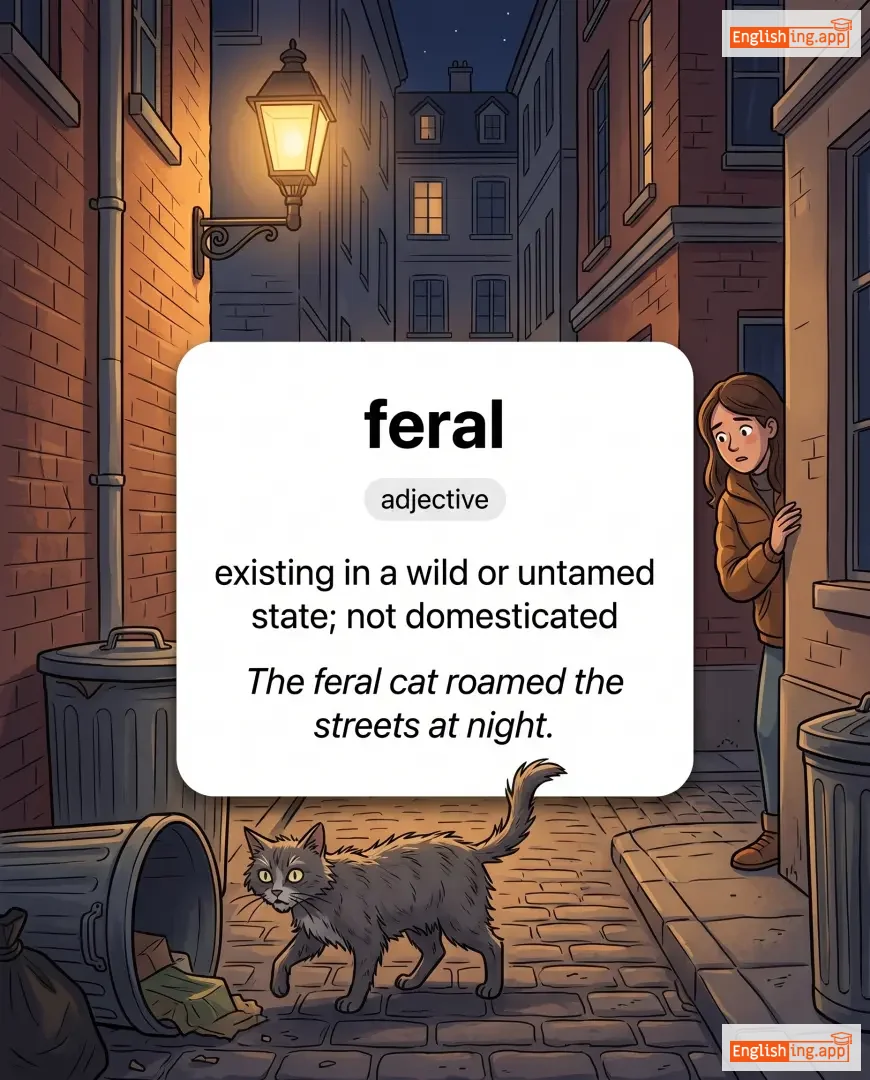
feral definition card — visual illustration of the meaning
adjective
/ˈfɛrəl/
salvaje (salvaje)

existing in a wild or untamed state; not domesticated

"The feral cat roamed the streets at night."

"El gato salvaje rondaba por las calles por la noche." (El gato salvaje rondaba por las calles por la noche.)
verb
/ˈfɜːrmɛnt/
someterse a un proceso químico donde los azúcares se convierten en alcohol o ácido; incitar o agitar el cambio (someterse a un proceso quimico donde los azucares se convierten en alcohol o acido; incitar o agitar el cambio)

to undergo a chemical process where sugars are converted to alcohol or acid; to incite or stir up change

"The grapes are left to ferment for several weeks."

"Las uvas se dejan fermentar durante varias semanas." (Las uvas se dejan fermentar durante varias semanas.)