वोकैबुलरीज

इंग्लिश वोकैबुलरी डिस्कवर, लर्न और मास्टर करें

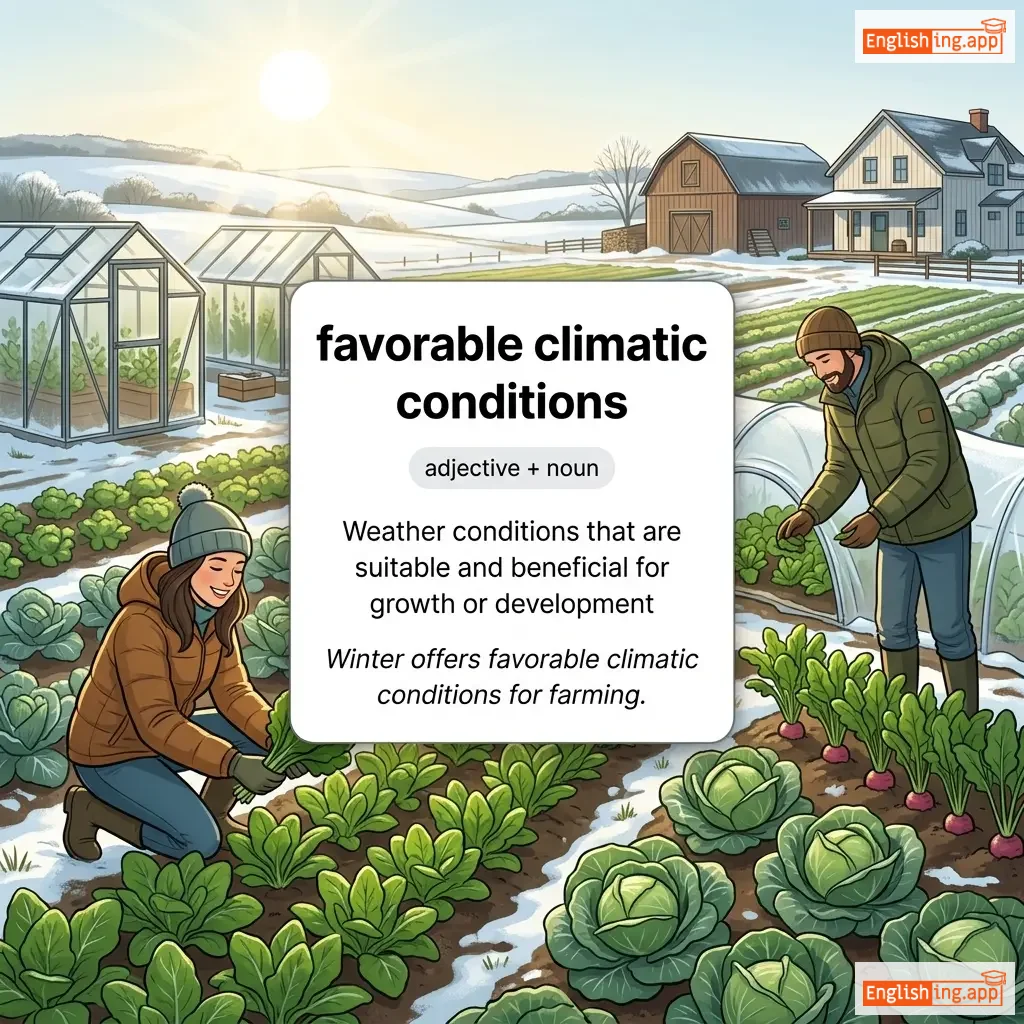
favorable climatic conditions definition card — visual illustration of the meaning
adjective + noun
ˈfeɪvərəbəl klaɪˈmætɪk kənˈdɪʃənz
अनुकूल जलवायु परिस्थितियाँ (anukool jalvaayu paristhitiyan)

Weather conditions that are suitable and beneficial for growth or development

"Winter offers favorable climatic conditions for farming."

"सर्दी कृषि के लिए अनुकूल जलवायु परिस्थितियाँ प्रदान करती है।" (sardi krishi ke liye anukool jalvaayu paristhitiyan pradaan karti hai.)
adjective, noun
/ˈfeɪvərɪt/
पसंदीदा (pasandida)

Preferred over all others; something or someone especially liked.

"Chocolate is my favorite ice cream flavor."

"चॉकलेट मेरी पसंदीदा आइसक्रीम फ्लेवर है।" (chocolate meri pasandida ice cream flavor hai.)
noun
/ˈfeɪvərɪtɪzəm/
पक्षपाती व्यवहार (pakshapati vyavhaar)

the practice of giving unfair preferential treatment to one person or group

"The manager was accused of favoritism towards certain employees."

"प्रबंधक पर कुछ कर्मचारियों के प्रति पक्षपाती होने का आरोप था।" (Prabandhak par kuch karyakariyon ke prati pakshapati hone ka aarop tha.)
noun
/ˈfeɪ.vər/
उपकार; मदद; कृपा (upkaar, madad, kripa)

approval, support, or liking for someone or something; a kind or helpful act

"Could you do me a favour and help me move this heavy box?"

"क्या आप मेरी मदद कर सकते हैं और इस भारी बॉक्स को स्थानांतरित करने में मेरी सहायता कर सकते हैं?" (kya aap meri madad kar sakte hain aur is bhaari box ko sthaanantarit karne mein meri sahayata kar sakte hain?)
adjective
/ˈfeɪvərəbl/
अनुकूल (anukool)

Expressing approval, support, or positivity; advantageous or beneficial

"The weather conditions were favourable for the outdoor event."

"बाहरी कार्यक्रम के लिए मौसम की स्थिति अनुकूल थी।" (bahari karyakram ke liye mausam ki sthiti anukool thi)
verb
/fɔːn/
चापलूसी करना (chaplusi karna)

to show exaggerated flattery or affection; to seek favor by servile behavior

"He fawned over the boss to get a promotion."

"उसने पदोन्नति पाने के लिए बॉस के सामने अत्यधिक चापलूसी की।" (Usne podonnati pane ke liye boss ke samne atiranjit chaplusi ki.)
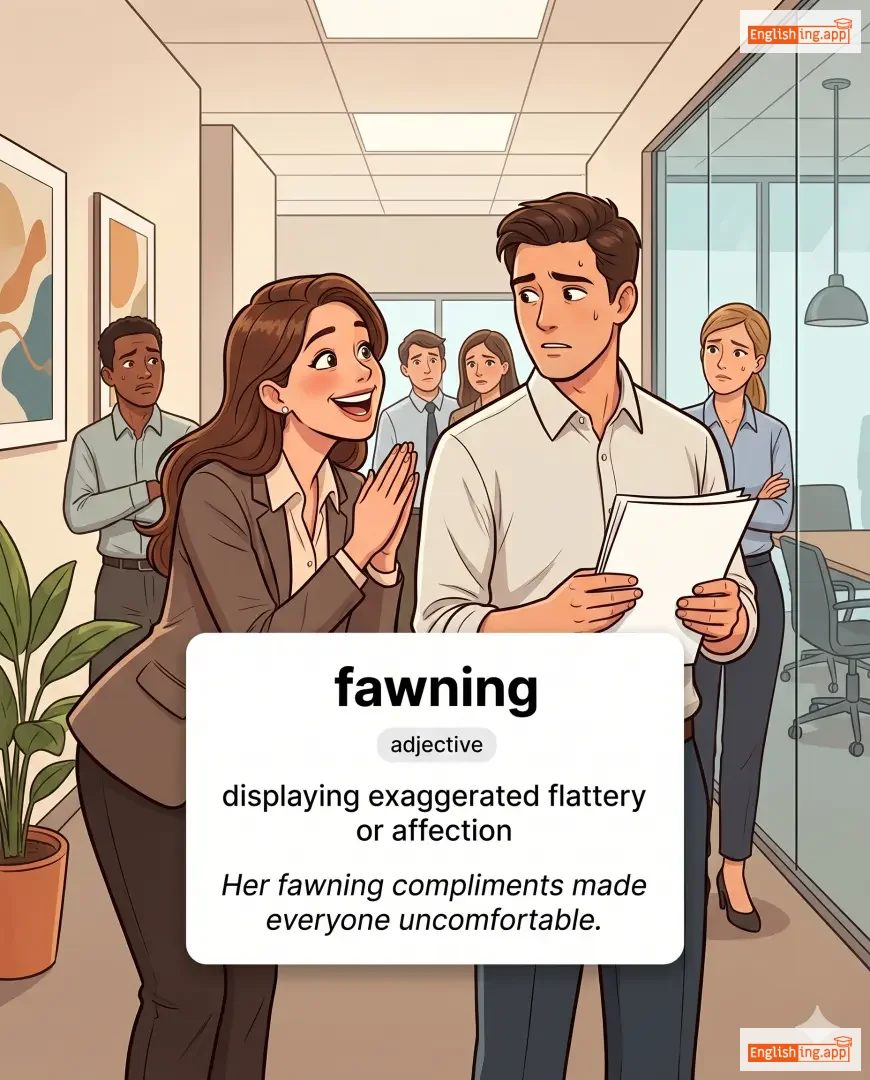
fawning definition card — visual illustration of the meaning
adjective
/ˈfɔːnɪŋ/
अतिरंजित चापलूसी (atiranjit chaaploosi)

displaying exaggerated flattery or affection

"Her fawning compliments made everyone uncomfortable."

"उसकी अतिरंजित चापलूसी ने सभी को असहज कर दिया।" (Uski atiranjit chaaploosi ne sabhi ko asahaj kar diya.)
verb
/feɪz/
परेशान करना (pareshan karna)

to disturb or disconcert someone; to cause to feel unsettled

"She was not fazed by the unexpected question."

"वह अप्रत्याशित सवाल से परेशान नहीं हुई।" (Wah apratyashit sawaal se pareshan nahi hui.)
noun
/ˈfiːəlti/
वफादारी और प्रतिबद्धता (vafadari aur pratibaddhata)

loyalty or allegiance, especially to a sovereign or lord

"The knight swore fealty to his king."

"नाइट ने अपने राजा के प्रति वफादारी की शपथ ली।" (Knight ne apne raja ke prati vafadari ki shapath li.)
Fear definition card — visual illustration of the meaning
noun, verb
/fɪr/
डर (dar)

An unpleasant emotion caused by the belief that someone or something is dangerous.

"She has a fear of flying."

"उसे उड़ने का डर है।" (use udne ka dar hai.)
adjective
/ˈfɪr.fəl/
भयभीत (bhaybheet)

feeling afraid or showing fear

"She was fearful of walking alone at night."

"वह रात में अकेले चलने से डर रही थी।" (Vah raat mein akele chalne se dar rahi thi.)
feasibility definition card — visual illustration of the meaning
noun
ˌfiː.zəˈbɪl.ə.ti
संभावना, व्यवहार्यता, कार्यक्षमता (sambhavna, vyavaharyata, karyakshemtata)

Possibility, practicality, viability.

"The feasibility study proved the project viable."

"फीज़िबिलिटी अध्ययन ने साबित किया कि प्रोजेक्ट व्यवहारिक था।" (Feasibility adhyayan ne sabit kiya ki project vyavaharik tha.)
adjective
/ˈfiːzəbl/
संभव (sambhav)

possible to do easily or conveniently; practical and workable

"It is feasible to complete the project within two months."

"यह परियोजना दो महीने के भीतर पूरा करना संभव है।" (Yeh pariyojana do mahine ke bhitar poora karna sambhav hai.)
noun
/fiːst/
भोजन; उत्सव; (bhojan, utsav)

a large meal, typically one in celebration of something; an annual religious celebration

"The wedding feast included traditional dishes from both families' cultures."

"विवाह भोज में दोनों परिवारों की संस्कृतियों से पारंपरिक व्यंजन शामिल थे।" (vivah bhoj mein donon parivaron ki sanskritiyon se paramparik vyajan shamil the.)
noun
/fiːt/
उपलब्धि (uplabdhi)

an achievement that requires great courage, skill, or strength

"Climbing Mount Everest was a remarkable feat."

"माउंट एवरेस्ट चढ़ाई एक अद्वितीय उपलब्धि थी।" (Mount Everest chadhai ek advitiya uplabdhi thi.)
noun
/ˈfɛðər/
पंख (pankha)

a light, soft structure that covers a bird’s body and enables it to fly

"The bird lost a small feather while flying through the trees."

"पक्षी ने पेड़ों के बीच उड़ते हुए एक छोटा पंख खो दिया।" (Pakshi ne pedon ke beech udte huye ek chhota pankha kho diya.)
noun
/ˈfiːtʃər/
विशेषता (visheshta)

a distinctive attribute or aspect of something; a characteristic

"The new phone has a unique camera feature."

"नए फोन में एक अद्वितीय कैमरा विशेषता है।" (Naye phone mein ek advitiya camera visheshta hai.)
adjective
/ˈfiːbraɪl/
ज्वरग्रस्त, उत्तेजित (jwargrast, uttejit)

having or showing the symptoms of a fever; or highly excitable or agitated

"The patient was in a febrile state with high temperature."

"मरीज़ उच्च तापमान में ज्वरग्रस्त स्थिति में था।" (Mariz uchch tapmaan mein jwargrast sthiti mein tha.)
noun
/ˈfɛb.ruˌɛr.i/
फ़रवरी (farvari)

The second month of the year in the Gregorian calendar, typically having 28 days, or 29 in a leap year.

"My birthday is in February, so I always look forward to this month."

"मेरा जन्मदिन फरवरी में है, इसलिए मैं हमेशा इस महीने का इंतजार करता हूं।" (mera janmdin farvari me hai, isliye main hamesha is mahine ka intezaar karta hoon)
adjective
/ˈfɛkləs/
निराश, गैर जिम्मेदार (niraash, gair zimmedaar)

lacking initiative or strength of character; irresponsible

"His feckless attitude at work caused several missed deadlines."

"उसका निराश रवैया काम के दौरान कई समयसीमाएँ चूका गया।" (Uska niraash ravayya kaam ke dauraan kai samaysimaan chuka gaya.)
adjective
/ˈfiːkənd/
उर्वर, उत्पादनक्षम (urvar, utpadanksham)

producing or capable of producing an abundance of offspring or new growth; fertile

"The fecund soil produced a bountiful harvest this year."

"उर्वर माटी ने इस वर्ष प्रचुर फसल दी।" (Urvar maati ne is varsh prachur fasal di.)
noun
/fiːˈkʌndɪti/
उर्वरता, प्रजनन क्षमता (urvarata, prajanan kshamata)

the ability to produce an abundance of offspring or new growth; fertility

"The fecundity of the river delta supports diverse wildlife."

"नदी के डेल्टा की उर्वरता विभिन्न वन्यजीवों का समर्थन करती है।" (Nadi ke delta ki urvarata vibhinn vanyajeevon ka samarthan karti hai.)
adjective
/ˈfɛdərəl/
फेडरल (federal)

Relating to the central government of a federation.

"The federal government passed a new law on healthcare."

"संघीय सरकार ने स्वास्थ्य देखभाल पर एक नया कानून पास किया।" (Sanghiya sarkar ne swasthya dekhbhaal par ek naya kanoon paas kiya.)
verb
/ˈfɛdərət/
संघटन बनाना (sanghatan banana)

to unite in a league or federation; to form an alliance

"Several states federated to create a stronger union."

"कई राज्य एक मजबूत संघ बनाने के लिए एकजुट हुए।" (Kai rajya ek majboot sangh banane ke liye ekjut hue.)
noun
/fiː/
शुल्क (shulk)

A payment made for a service or privilege.

"The lawyer charged a high fee for his services."

"वकील ने अपनी सेवाओं के लिए उच्च शुल्क लिया।" (vakil ne apni sevaon ke liye uchch shulk liya.)
adjective
/ˈfiːbl/
कमजोर, निर्बल (kamjor, nirbal)

lacking physical strength or vigor; weak

"After the illness, she felt too feeble to stand."

"बीमारी के बाद, वह खड़ा होने के लिए बहुत कमजोर महसूस कर रही थी।" (Bimari ke baad, vah khada hone ke liye bahut kamjor mehsoos kar rahi thi.)
adjective
/ˈfiːbəlˌmaɪndɪd/
मूर्ख या कमजोर दिमाग वाला (murkh ya kamzor dimaag wala)

lacking intelligence or mental capacity; foolish or weak-minded

"The feebleminded man struggled to understand basic instructions."

"कमजोर दिमाग वाला आदमी बुनियादी निर्देशों को समझने में संघर्ष कर रहा था।" (Kamzor dimaag wala aadmi buniyadi nirdeshon ko samajhne mein sangharsh kar raha tha.)
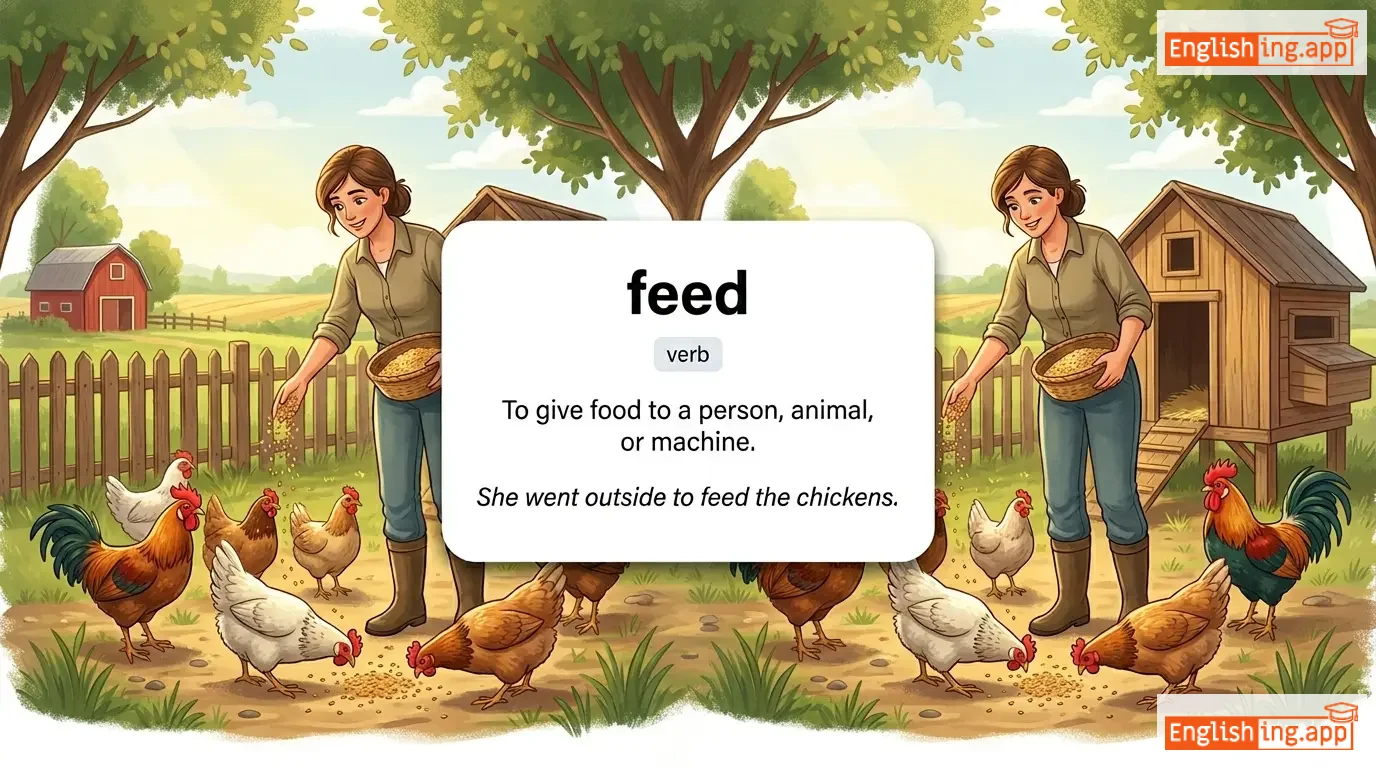
feed definition card — visual illustration of the meaning
verb
/fiːd/
खिलाना (khilana)

To give food to a person, animal, or machine.

"She went outside to feed the chickens."

"वह मुर्गियों को खाना देने बाहर गई।" (vah murgiyon ko khana dene bahar gayi.)
noun
/ˈfiːdbæk/
प्रतिक्रिया (pratikriya)

information or opinions about how well someone is doing something

"She asked her teacher for feedback on her essay."

"उसने अपने निबंध पर फीडबैक के लिए अपने शिक्षक से पूछा।" (Usne apne nibandh par feedback ke liye apne shikshak se poocha.)
Feel definition card — visual illustration of the meaning
verb
/fiːl/
महसूस करना (mahasoos karna)

To experience an emotion or physical sensation.

"I feel happy when I listen to music."

"मैं संगीत सुनते समय खुश महसूस करता हूँ।" (main sangeet sunte samay khush mahasoos karta hoon.)
noun
/ˈfiːlɪŋ/
भावना (bhavana)

An emotional state or physical sensation.

"She had a strange feeling about the place."

"उसे उस स्थान के बारे में एक अजीब भावना थी।" (use us sthan ke baare mein ek ajeeb bhavana thi.)
verb
/feɪn/
बहाना करना, झूठा रूप दिखाना (bahana karna, jhootha roop dikhana)

to pretend or fake; to give a false appearance of

"She feigned illness to avoid going to work."

"उसने काम पर जाने से बचने के लिए बीमारी का बहाना किया।" (Usne kaam par jaane se bachne ke liye beemari ka bahana kiya.)
noun
/feɪnt/
चालाकी, धोखा (chaalaki, dhokha)

a deceptive or pretended movement, especially in fighting or sports

"The boxer made a feint to the left before striking to the right."

"बॉक्सरे ने दाएं तरफ हमला करने से पहले बाएं तरफ चालाकी दिखाई।" (Boxer ne daaye taraf hamla karne se pehle baaye taraf chaalaki dikhayi.)
verb
/fəˈlɪsɪteɪt/
बधाई देना (badhai dena)

to congratulate someone; to express happiness for someone's success

"We felicitated her on winning the award."

"हमने उसे पुरस्कार जीतने पर बधाई दी।" (Hamne use puraskar jeetne par badhai di.)
felicitous definition card — visual illustration of the meaning
adjective
/fəˈlɪsɪtəs/
उचित, उपयुक्त या प्रसन्न; अच्छे भाग्य या खुशी से चिह्नित (uchit, upyukt ya prasann; achhe bhagya ya khushi se chihnit)

well-chosen, appropriate, or pleasing; marked by good fortune or happiness

"She made a felicitous remark that lightened the mood."

"उसने एक उपयुक्त टिप्पणी की जिसने माहौल को हल्का कर दिया।" (Usne ek upyukt tipanni ki jisne mahol ko halka kar diya.)
noun
/fəˈlɪsɪti/
अत्यधिक खुशी (atyadhik khushi)

intense happiness; the ability to find appropriate expression for one's thoughts

"She was known for her felicity in conversation and cheerful nature."

"वह बातचीत में अपनी खुशी और हंसमुख स्वभाव के लिए जानी जाती थी।" (Vah baatcheet mein apni khushi aur hansmukh swabhav ke liye jani jati thi.)
adjective
/ˈfiːlaɪn/
बिल्ली से संबंधित (billi se sambandhit)

relating to or characteristic of cats

"Her movements were graceful and almost feline in their elegance."

"उसकी चाल सुंदर और लगभग बिल्ली जैसी थी।" (Uski chaal sundar aur lagbhag billi jaisi thi.)
verb
/fel/
गिराना, काटना (girana, katna)

to cut down a tree; to cause to fall; to strike down

"The lumberjacks felled several trees in the forest today."

"लकड़हारे ने आज जंगल में कई पेड़ गिरा दिए।" (Lakadhaare ne aaj jangal mein kai ped gira diye.)
noun
/ˈfɛloʊ/
साथी (saathi)

a person who shares a common situation, interest, or activity with another

"He is a fellow student in my class."

"वह मेरी कक्षा में एक साथी छात्र है।" (Vah meri kaksha mein ek saathi chhatra hai.)
noun
/ˈfɛlən/
अपराधी (apraadhi)

a person who has committed a serious crime

"The felon was sentenced to ten years in prison."

"अपराधी को दस साल की सजा सुनाई गई।" (apraadhi ko das saal ki saza sunaayi gayi.)
adjective
/fəˈloʊniəs/
गंभीर अपराध से संबंधित (gambhir aparadh se sambandhit)

relating to or involved in serious criminal activity

"He was charged with felonious assault after the incident."

"घटना के बाद उसे गंभीर हमला करने के आरोप में आरोपित किया गया था।" (Ghatna ke baad use gambhir hamla karne ke aarop mein aaropit kiya gaya tha.)
noun
/ˈfɛləni/
गंभीर अपराध (gambhir apradh)

a serious crime, usually punishable by imprisonment for more than one year

"He was convicted of a felony and sentenced to ten years in prison."

"उसे एक गंभीर अपराध का दोषी पाया गया और दस साल की सजा सुनाई गई।" (Use ek gambhir apradh ka doshi paya gaya aur das saal ki saza sunai gayi.)
noun/adjective
/ˈfiːmeɪl/
महिला (mahila)

a person or animal of the sex that can bear offspring; relating to women or girls

"The female lion protects her cubs fiercely."

"महिला शेरनी अपने शावकों की कड़ी सुरक्षा करती है।" (Mahila sherani apne shavkon ki kadi suraksha karti hai.)
adjective
/ˈfɛmənɪn/
स्त्रीलिंग (strīliṅg)

having qualities traditionally associated with women; feminine in nature

"She has a very feminine style of dressing."

"वह बहुत स्त्रीलिंग कपड़ों का स्टाइल पसंद करती है।" (Vah bahut strīliṅg kapdoṅ kā style pasand kartī hai.)
noun
/ˈfɛmənɪst/
नारीवादी (narivadi)

a person who supports equal rights and opportunities for women and men

"She proudly calls herself a feminist and fights for gender equality."

"वह गर्व से खुद को नारीवादी कहती है और लिंग समानता के लिए संघर्ष करती है।" (Wah garv se khud ko narivadi kahti hai aur ling samanata ke liye sangharsh karti hai.)
noun/verb
/fɛns/
बाड़ (baad)

a barrier, usually made of wood or wire, that surrounds an area; to enclose with a barrier

"They built a fence around the garden."

"उन्होंने बगिया के चारों ओर एक बाड़ बनाई।" (Unhone bagiya ke charon or ek baad banayi.)
noun
/ˈfɛndər/
व्हील का आवरण (wheel ka avaran)

a part of a vehicle that frames a wheel well to protect against mud or debris

"The car's fender was dented in the accident."

"कार का फेंडर दुर्घटना में दब गया था।" (Car ka fender durghatna mein dab gaya tha.)
noun
/ˈfen.jʊ.griːk/
मेथी (methi)

an herb whose seeds and leaves are used as a spice in cooking

"Fenugreek seeds have a slightly bitter taste and are commonly used in Indian cuisine."

"मेथी के दाने में हल्का कड़वापन होता है और यह भारतीय व्यंजनों में आमतौर पर इस्तेमाल किया जाता है।" (methi ke daane mein halka kadwapan hota hai aur yah bhartiya vyajanon mein aam taur par istemal kiya jata hai.)
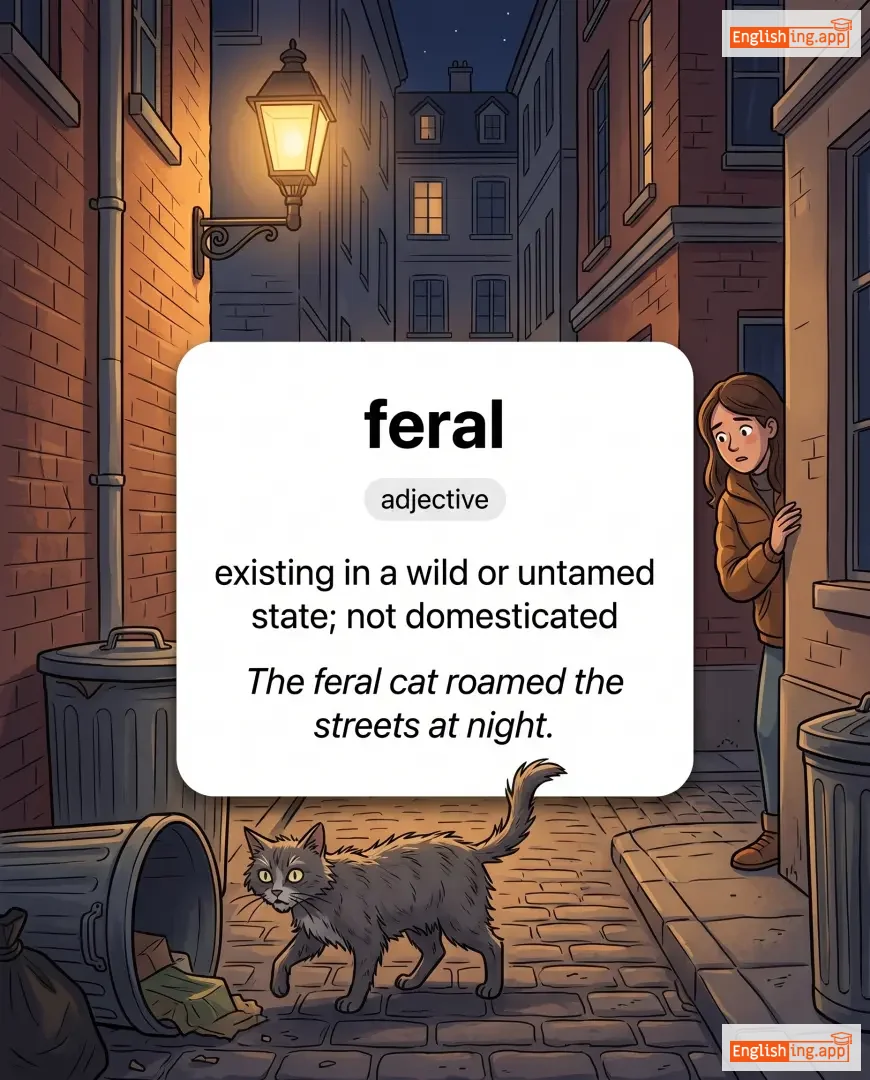
feral definition card — visual illustration of the meaning
adjective
/ˈfɛrəl/
जंगली (jangli)

existing in a wild or untamed state; not domesticated

"The feral cat roamed the streets at night."

"जंगली बिल्ली रात को सड़कों पर घूम रही थी।" (Jangli billi raat ko sadkon par ghoom rahi thi.)
verb
/ˈfɜːrmɛnt/
कमीकी प्रक्रिया में शर्करा को शराब या अम्ल में परिवर्तित करना; बदलाव को प्रेरित या उत्तेजित करना (kemiiki prakriya mein sharkara ko sharab ya amla mein parivartit karna; badlav ko prerit ya uttejit karna)

to undergo a chemical process where sugars are converted to alcohol or acid; to incite or stir up change

"The grapes are left to ferment for several weeks."

"अंगूर को कई हफ्तों तक फरमेंट होने के लिए छोड़ दिया जाता है।" (Angoor ko kai hafton tak ferment hone ke liye chhod diya jaata hai.)