Vocabulaires

Découvrez, apprenez et maîtrisez le vocabulaire anglais

noun
/ˈherˌdrɛsər/
coiffeur; coiffeuse (coiffeur; coiffeuse)

a person whose job is to cut, style, and treat hair

"The hairdresser gave me a stylish haircut before the wedding."

"Le coiffeur m’a fait une coupe élégante avant le mariage." (Le coiffeur m a fait une coupe elegante avant le mariage)
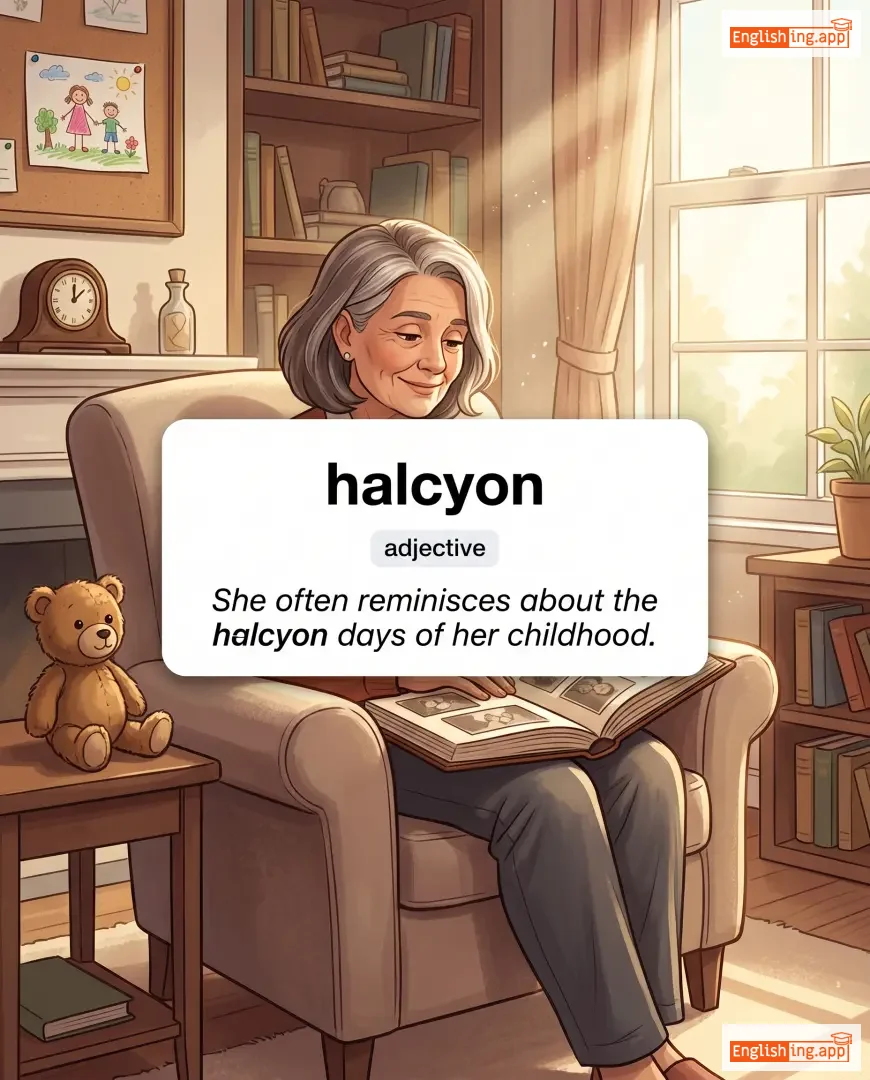
halcyon definition card — visual illustration of the meaning
adjective
/ˈhæl.si.ən/
serein (serein)

calm, peaceful, and happy; denoting a period of time in the past that was idyllically happy and peaceful

"She often reminisces about the halcyon days of her childhood."

"Elle se souvient souvent des jours sereins de son enfance." (Elle se souvient souvent des jours sereins de son enfance.)
adjective
/heɪl/
vital (vital)

strong and healthy, especially of an elderly person

"Despite his age, the man remained hale and active."

"Malgré son âge, l'homme est resté en bonne santé et actif." (Malgré son âge, l'homme est resté en bonne santé et actif.)
noun, adjective
/hæf/
moitié (moitie)

one of two equal parts of something

"He ate half of the cake."

"Il a mangé la moitié du gâteau." (Il a mange la moitie du gateau.)
adjective
/ˌhæfˈbeɪkt/
à moitié cuit (a moitie cuit)

poorly thought out or badly planned

"The manager quickly rejected his half-baked proposal."

"Le manager a rapidement rejeté sa proposition à moitié cuite." (Le manager a rapidement rejete sa proposition a moitie cuite.)
adjective
/ˌhæfˈhɑːr.tɪd/
démotivé (demotive)

lacking enthusiasm or determination; unenthusiastic

"His halfhearted attempt to study did not bring good results."

"Son essai démotivé pour étudier n'a pas donné de bons résultats." (Son essai démotivé pour étudier n'a pas donné de bons résultats.)
adverb
/ˌhæfˈweɪ/
à mi-chemin (a mi-chemin)

at or to a point equal in distance between two points

"We met halfway between the two towns."

"Nous nous sommes rencontrés à mi-chemin entre les deux villes." (Nous nous sommes rencontrés à mi-chemin entre les deux villes.)
noun
/hɔːl/
hall (hall)

a large room or building for public gatherings, events, or passage

"The graduation ceremony was held in the university hall."

"La cérémonie de remise des diplômes a eu lieu dans le hall de l'université." (La ceremonie de remise des diplomes a eu lieu dans le hall de l'universite.)
noun
/ˈhɔːl.mɑːrk/
caractéristique distinctive (caracteristique distinctive)

a typical characteristic or feature of someone or something

"Honesty is the hallmark of a good leader."

"L'honnêteté est la caractéristique distinctive d'un bon leader." (L'honnêteté est la caractéristique distinctive d'un bon leader.)
verb
/ˈhæloʊ/
sanctifier (sanctifier)

to honor as holy; to make sacred or greatly respected

"The ancient temple was hallowed by centuries of worship."

"L'ancien temple a été sanctifié par des siècles de dévotion." (L'ancien temple a été sanctifié par des siècles de dévotion.)
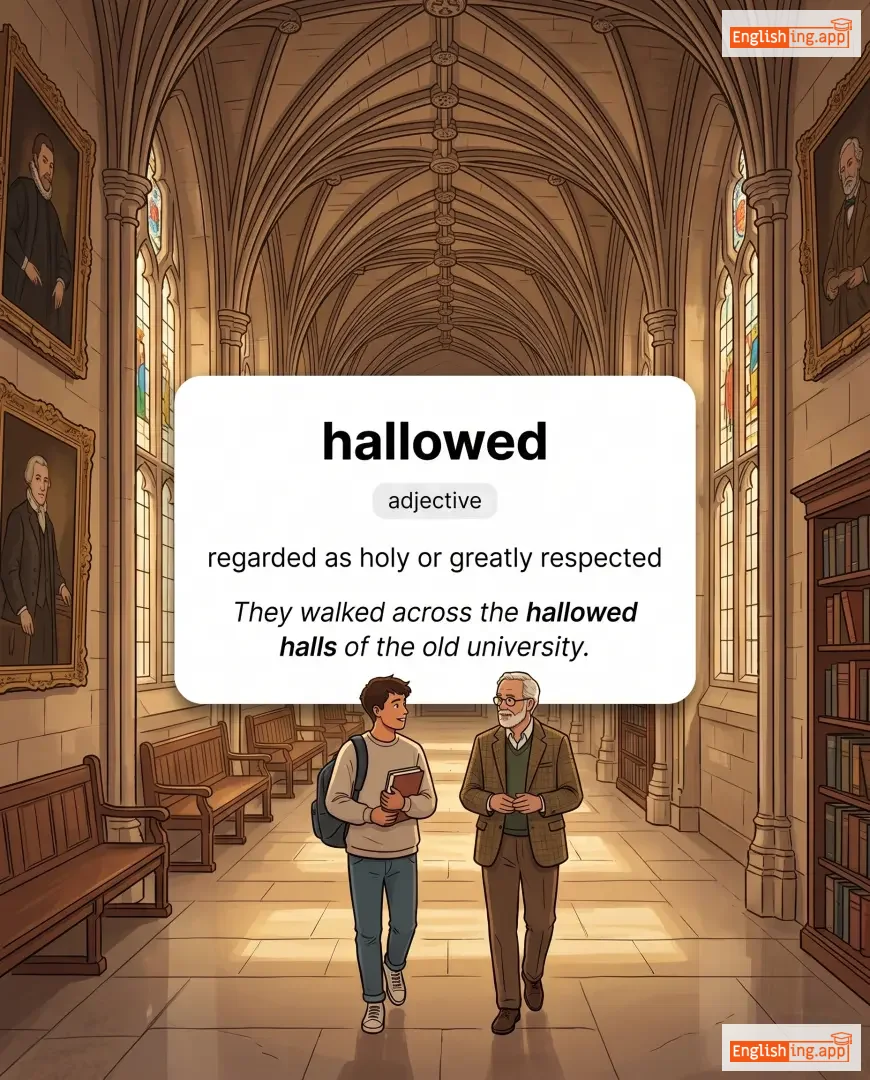
hallowed definition card — visual illustration of the meaning
adjective
/ˈhæloʊd/
sacré (sacre)

regarded as holy or greatly respected

"They walked across the hallowed halls of the old university."

"Ils ont traversé les sacrés couloirs de la vieille université." (Ils ont traverse les sacres couloirs de la vieille universite.)
verb
/həˈluːsɪneɪt/
halluciner (halluciner)

to see, hear, or sense things that are not actually present, often due to illness or drugs

"After taking the medicine, he began to hallucinate strange shapes."

"Après avoir pris le médicament, il a commencé à halluciner des formes étranges." (Apres avoir pris le medicament, il a commence a halluciner des formes etranges.)
noun
/həˌluːsɪˈneɪʃən/
hallucination (hallucination)

a false perception of objects or events, usually caused by mental illness or drugs

"After the medication, he began to experience vivid hallucinations."

"Après le médicament, il a commencé à vivre des hallucinations vives." (Apres le medicament, il a commence a vivre des hallucinations vives.)
noun
/ˈhɔːlweɪ/
couloir (couloir)

a corridor in a building that connects rooms

"The kids left their shoes in the hallway."

"Les enfants ont laissé leurs chaussures dans le couloir." (Les enfants ont laissé leurs chaussures dans le couloir.)
verb
/hɔːlt/
arrêter (arreter)

to stop or bring to a stop

"The train suddenly halted at the station."

"Le train s'est arrêté soudainement à la station." (Le train s'est arrêté soudainement à la station.)
adjective
/ˈhɔːltɪŋ/
hésitant (hesitant)

slow and hesitant, especially due to lack of confidence

"She gave a halting reply during the interview."

"Elle a donné une réponse hésitante lors de l'entretien." (Elle a donné une réponse hésitante lors de l'entretien.)
adjective
/ˈhæm ˌhændɪd/
maladroit (maladroit)

clumsy or inept in handling things or situations

"His ham-handed attempt to fix the computer made it worse."

"Sa tentative maladroite de réparer l'ordinateur l'a empiré." (Sa tentative maladroite de réparer l'ordinateur l'a empiré.)
noun
/ˈhæm.lət/
petit hameau (petit hameau)

a small rural settlement, smaller than a village; a small community

"The tiny hamlet nestled in the valley had only a dozen houses and one small church."

"Le petit hameau niché dans la vallée n'avait qu'une douzaine de maisons et une petite église." (Le petit hameau niche dans la vallee n'avait qu'une douzaine de maisons et une petite eglise.)
noun, verb
/ˈhæmər/
marteau (marteau)

a tool with a heavy metal head used for breaking things or driving in nails; to hit something forcefully with a hammer or similar object.

"He used a hammer to fix the broken chair."

"Il a utilisé un marteau pour réparer la chaise cassée." (Il a utilisé un marteau pour réparer la chaise cassée.)
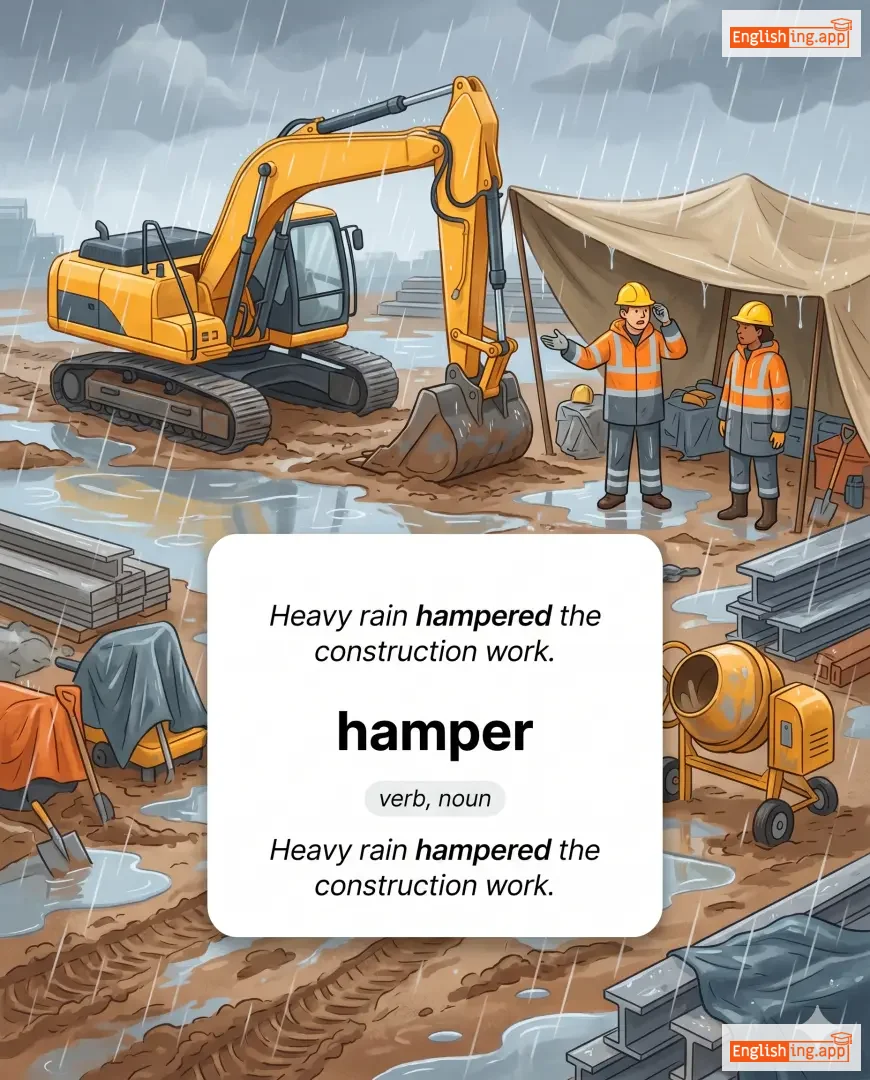
hamper definition card — visual illustration of the meaning
verb, noun
/ˈhæmpər/
entraver, panier à linge (entraver, panier a linge)

to prevent or slow down the progress of something; also, a basket with a lid, typically for laundry.

"Heavy rain hampered the construction work."

"La pluie forte a entravé les travaux de construction." (La pluie forte a entravé les travaux de construction.)
noun, verb
/ˈhæmstrɪŋ/
tendon à l'arrière de la cuisse; en tant que verbe, rendre quelqu'un ou quelque chose inefficace ou l'empêcher de fonctionner efficacement (tendon a l'arriere de la cuisse; en tant que verbe, rendre quelqu'un ou quelque chose inefficace ou l'empecher de fonctionner efficacement)

a tendon at the back of the thigh; as a verb, to cripple or severely restrict the effectiveness of someone or something.

"Budget cuts hamstrung the organization’s plans."

"Les réductions budgétaires ont affaibli les plans de l'organisation." (Les reductions budgetaires ont affaibli les plans de l'organisation.)
verb (past tense, past participle), adjective
/ˈhæmstrʌŋ/
paralysé ou limité (paralyse ou limite)

crippled or severely restricted in movement or progress.

"The team was hamstrung by lack of resources."

"L'équipe était limitée par un manque de ressources." (L'equipe etait limitee par un manque de ressources.)
noun, verb
/hænd/
main (main)

the part of the body at the end of the arm used for holding things

"She raised her hand to ask a question."

"Elle leva sa main pour poser une question." (Elle leva sa main pour poser une question.)
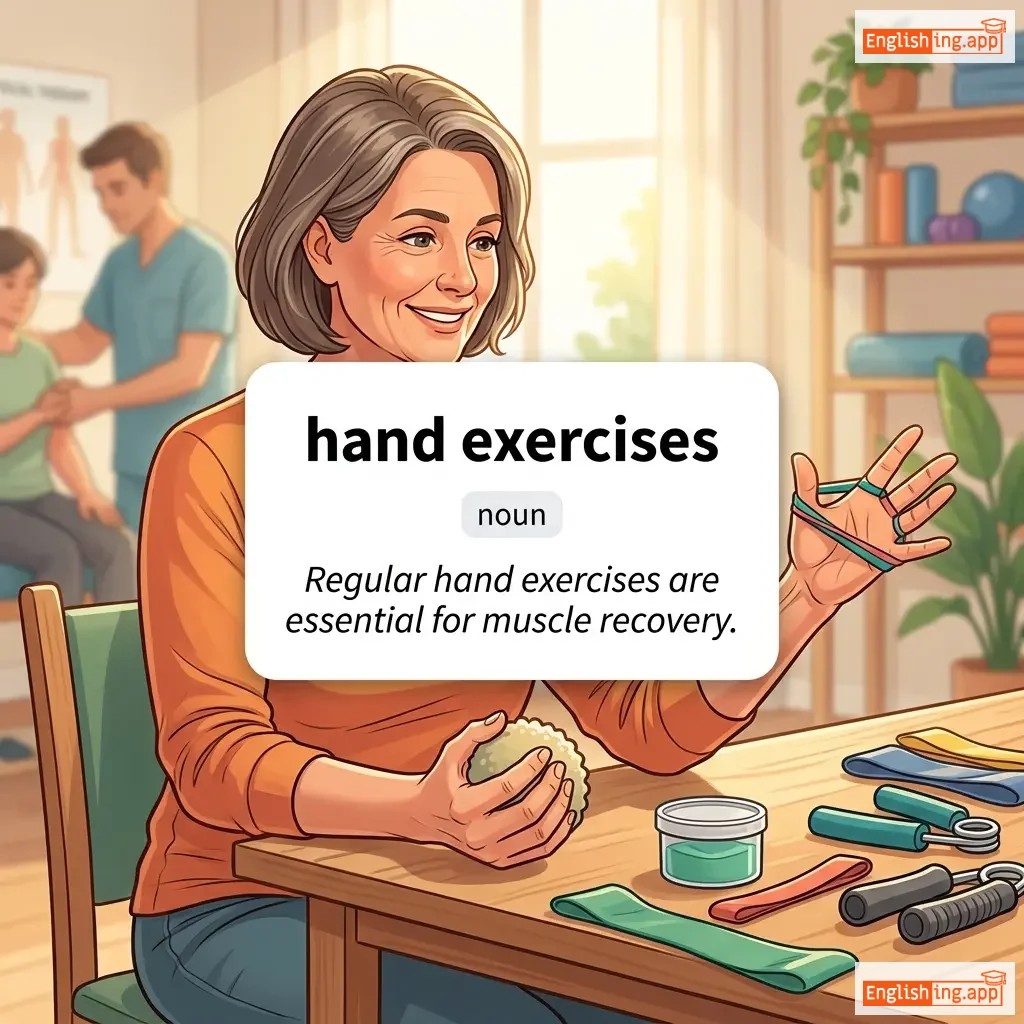
hand exercises definition card — visual illustration of the meaning
noun
হ্যান্ড এক্সারসাইজেস
exercices de main (exercices de main)

Physical activities designed to strengthen, stretch, and improve the flexibility of hand and finger muscles.

"Regular hand exercises are essential for muscle recovery."

"Les exercices réguliers de la main sont essentiels pour la récupération musculaire." (Les exercices réguliers de la main sont essentiels pour la récupération musculaire.)
noun
/ˈhænd ˌrɪŋɪŋ/
inquiétude excessive (inquietude excessive)

excessive worry or concern expressed in a visible or dramatic way.

"There was much hand-wringing over the political crisis."

"Il y avait beaucoup de gestes dramatiques à propos de la crise politique." (Il y avait beaucoup de gestes dramatiques à propos de la crise politique.)
noun
/ˈhænd.fʊl/
une poignée (une poignie)

the amount of something that can be held in one hand; a small number

"She took a handful of nuts."

"Elle a pris une poignée de noix." (Elle a pris une poignee de noix.)
noun
/ˈhæn.di.krɑːft/
artisanat (artisanat)

an activity involving the making of decorative domestic or other objects with the hands; handmade artistic work

"The local market featured beautiful handicrafts made by skilled artisans from the region."

"Le marché local présentait de magnifiques artisanats fabriqués par des artisans qualifiés de la région." (Le marche local presentait de magnifiques artisanats fabriques par des artisans qualifies de la region.)
noun
/ˈhæŋ.kər.tʃɪf/
mouchoir (mouchoir)

a small piece of cloth used for wiping the nose or face

"She always carries a clean handkerchief in her purse."

"Elle porte toujours un mouchoir propre dans son sac à main." (Elle porte toujours un mouchoir propre dans son sac a main.)
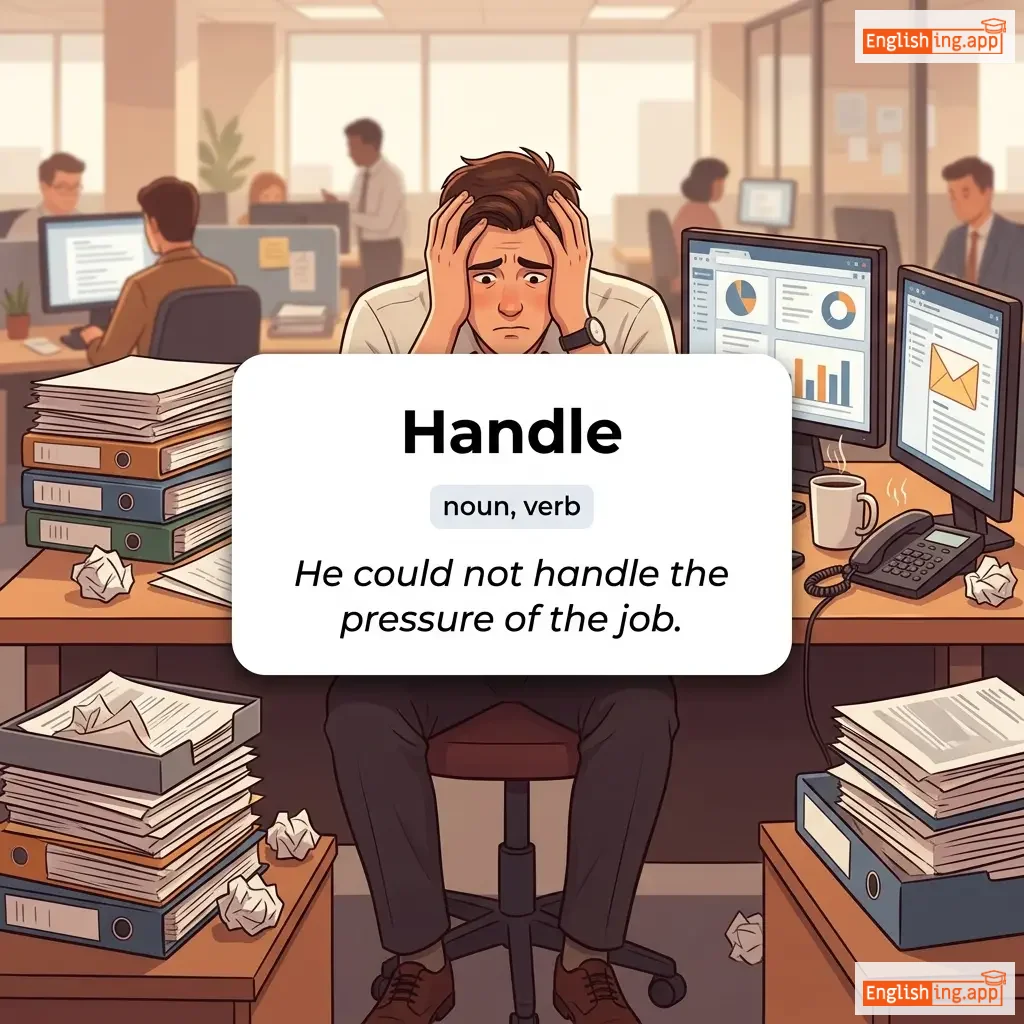
Handle definition card — visual illustration of the meaning
noun, verb
/ˈhændl̩/
poignée / gérer (poignee / gerer)

the part of an object designed to be held in the hand; to deal with or manage a situation

"He could not handle the pressure of the job."

"Il n'a pas pu gérer la pression du travail." (Il n'a pas pu gerer la pression du travail.)
noun
/ˈhændlɪŋ/
gestion (gestion)

the act of managing or dealing with something or someone

"His handling of the situation was impressive."

"Sa gestion de la situation était impressionnante." (Sa gestion de la situation était impressionnante.)
adjective
/ˈhæn.səm/
bonheur (bonheur)

attractive in appearance, usually referring to men; also can mean generous or impressive in size.

"He looked very handsome in his new suit."

"Elle ne pouvait pas cacher son bonheur quand elle a reçu le prix." (Elle ne pouvait pas cacher son bonheur quand elle a reçu le prix.)
noun
/ˈhændˌraɪ.tɪŋ/
écriture manuscrite (ecriture manuscrite)

the style or manner of writing by hand.

"Her handwriting is very neat and easy to read."

"Son écriture manuscrite est très soignée et facile à lire." (Son ecriture manuscrite est tres soigne et facile a lire.)
adjective
/ˈhændi/
facile à utiliser (facile a utiliser)

convenient to use or easily accessible; skillful with the hands

"This pocket knife is very handy when you go camping."

"Ce couteau de poche est très pratique lorsque vous allez camper." (Ce couteau de poche est tres pratique lorsque vous allez camper.)
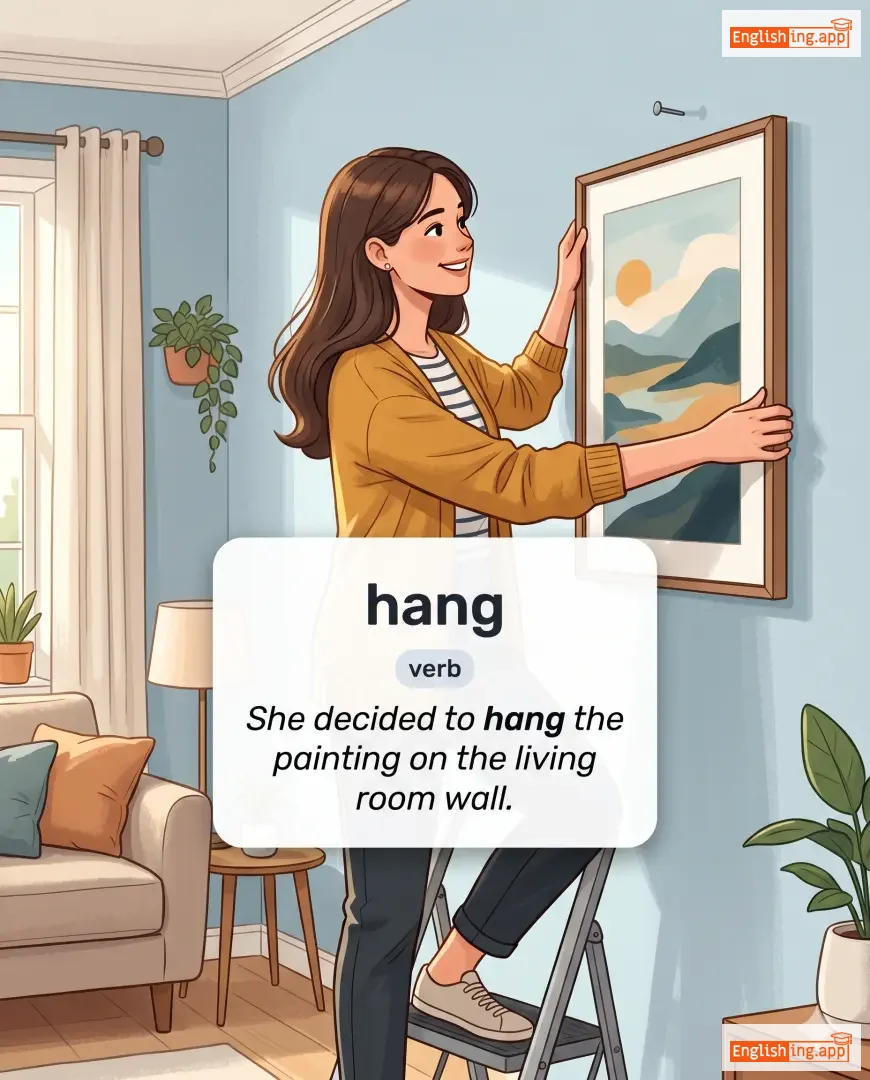
hang definition card — visual illustration of the meaning
verb
/hæŋ/
suspendre (suspendre)

to suspend or attach something from above so that it moves freely or is supported

"She decided to hang the painting on the living room wall."

"Elle a décidé de suspendre le tableau sur le mur du salon." (Elle a décidé de suspendre le tableau sur le mur du salon.)
noun
/ˈhæŋ.ər/
hangar (hangar)

a large building with extensive floor area, typically for housing aircraft; an aircraft shelter

"The airplane was stored safely in the hangar during the severe thunderstorm."

"L'avion a été stocké en toute sécurité dans le hangar pendant le violent orage." (L'avion a ete stocke en toute securite dans le hangar pendant le violent orage.)
adjective
/ˈhæŋ.dɔːɡ/
embarrassé (embarrasse)

looking or feeling ashamed, guilty, or defeated.

"He gave me a hangdog look after being caught lying."

"Il m'a donné un regard embarrassé après avoir été pris en train de mentir." (Il m'a donné un regard embarrassé après avoir été pris en train de mentir.)
noun
/ˈhæŋ.ər/
cintre (cintre)

a shaped piece of wood, plastic, or metal with a hook at the top, used to hang up clothes

"She hung her dress on a wooden hanger to prevent it from getting wrinkled."

"Elle a accroché sa robe sur un cintre en bois pour éviter qu'elle ne se froisse." (Elle a accroché sa robe sur un cintre en bois pour éviter qu'elle ne se froisse.)
noun
/ˌhæŋ.ər ˈɒn/
accro (accro)

a person who spends time with a powerful or famous person to gain benefits.

"The celebrity was always surrounded by hangers-on."

"La célébrité était toujours entourée d'accros." (La célébrité était toujours entourée d'accros.)
noun
/ˈhæŋ.kər/
désir ardent, envie (desir ardent, envie)

a feeling of yearning or craving; a strong desire for something

"After years abroad, she developed a deep hanker for her homeland's traditional cuisine."

"Après des années à l'étranger, elle a développé un profond désir pour la cuisine traditionnelle de sa patrie." (Apres des annees a l'etranger, elle a developpe un profond desir pour la cuisine traditionnelle de sa patrie.)
noun
/ˈhæŋ.kər.ɪŋ/
désir ardent (desir ardent)

a strong desire or craving for something.

"She had a hankering for chocolate late at night."

"Elle avait un désir ardent de chocolat tard dans la nuit." (Elle avait un desir ardent de chocolat tard dans la nuit.)
noun
/ˌhæŋ.ki ˈpæŋ.ki/
escroquerie; activité suspecte; comportement malhonnête; tromperie (escroquerie; activite suspecte; comportement malhonnete; tromperie)

dishonest or suspicious activity; unethical behavior; trickery or deception

"The audit revealed some hanky-panky in the company's financial records."

"L'audit a révélé de la fraude dans les registres financiers de l'entreprise." (L'audit a revele de la fraude dans les registres financiers de l'entreprise.)
noun
/hæp/
chance, fortune, hasard (chance, fortune, hasard)

luck, fortune, or chance occurrence

"By sheer hap, he discovered the old letter hidden in the drawer."

"Par pur hasard, il a découvert la vieille lettre cachée dans le tiroir." (Par pur hasard, il a découvert la vieille lettre cachée dans le tiroir.)
adjective
/hæpˈhæzərd/
désordonné, aléatoire (désordonné, aléatoire)

lacking any obvious order or organization; random

"The books were stacked in a haphazard way on the table."

"Les livres étaient empilés de manière désordonnée sur la table." (Les livres étaient empilés de manière désordonnée sur la table.)
adjective
/ˈhæpləs/
malchanceux, malheureux (malchanceux, malheureux)

unfortunate, unlucky, deserving pity

"The hapless traveler lost his passport on the very first day."

"Le malheureux voyageur a perdu son passeport dès le premier jour." (Le malheureux voyageur a perdu son passeport dès le premier jour.)
verb
/ˈhæpən/
se produire (se produire)

to take place or occur, usually by chance

"Accidents can happen at any time."

"Les accidents peuvent se produire à tout moment." (Les accidents peuvent se produire à tout moment.)
adverb
/ˈhæpɪli/
heureusement (heureusement)

in a happy manner; with pleasure or satisfaction

"The children played happily in the garden."

"Les enfants ont joué heureusement dans le jardin." (Les enfants ont joué heureusement dans le jardin.)
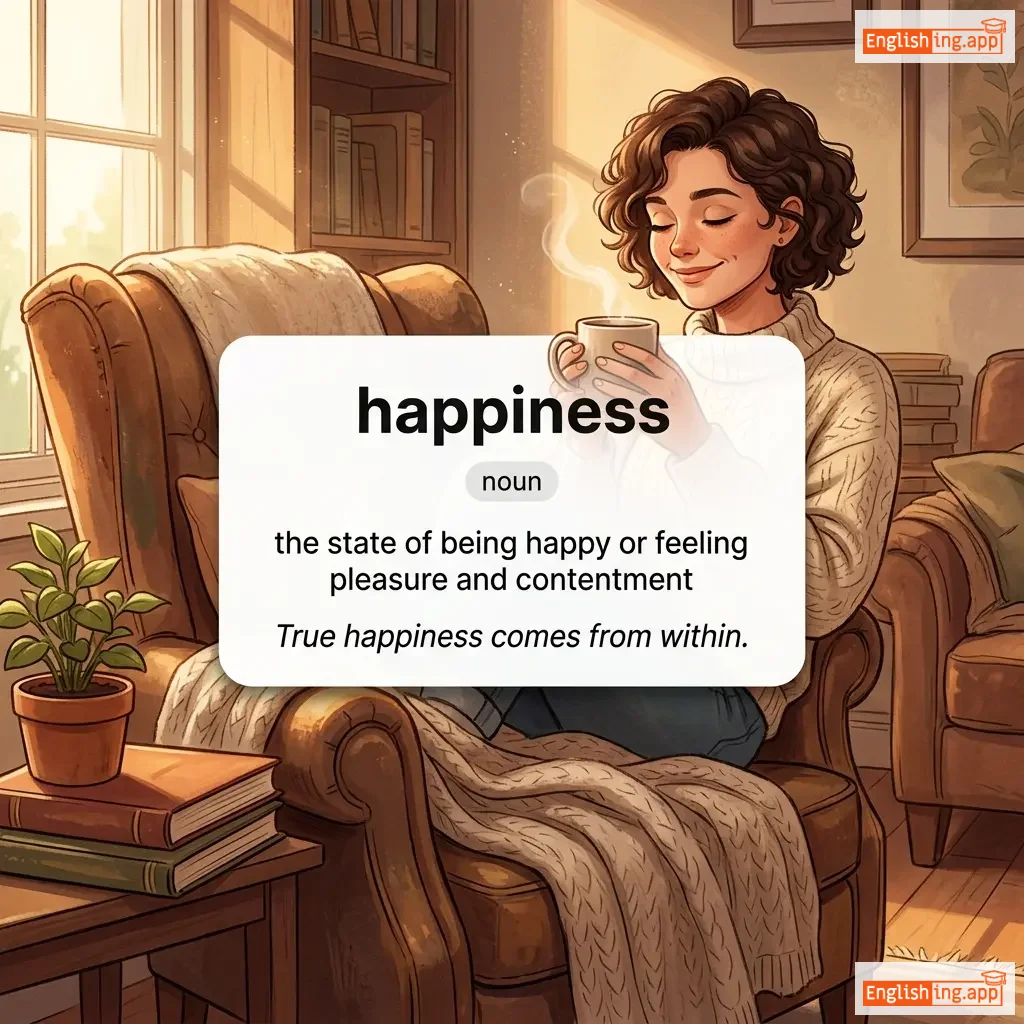
happiness definition card — visual illustration of the meaning
noun
/ˈhæpinəs/
bonheur (bonheur)

the state of being happy or feeling pleasure and contentment

"True happiness comes from within."

"Le vrai bonheur vient de l'intérieur." (Le vrai bonheur vient de l'intérieur.)
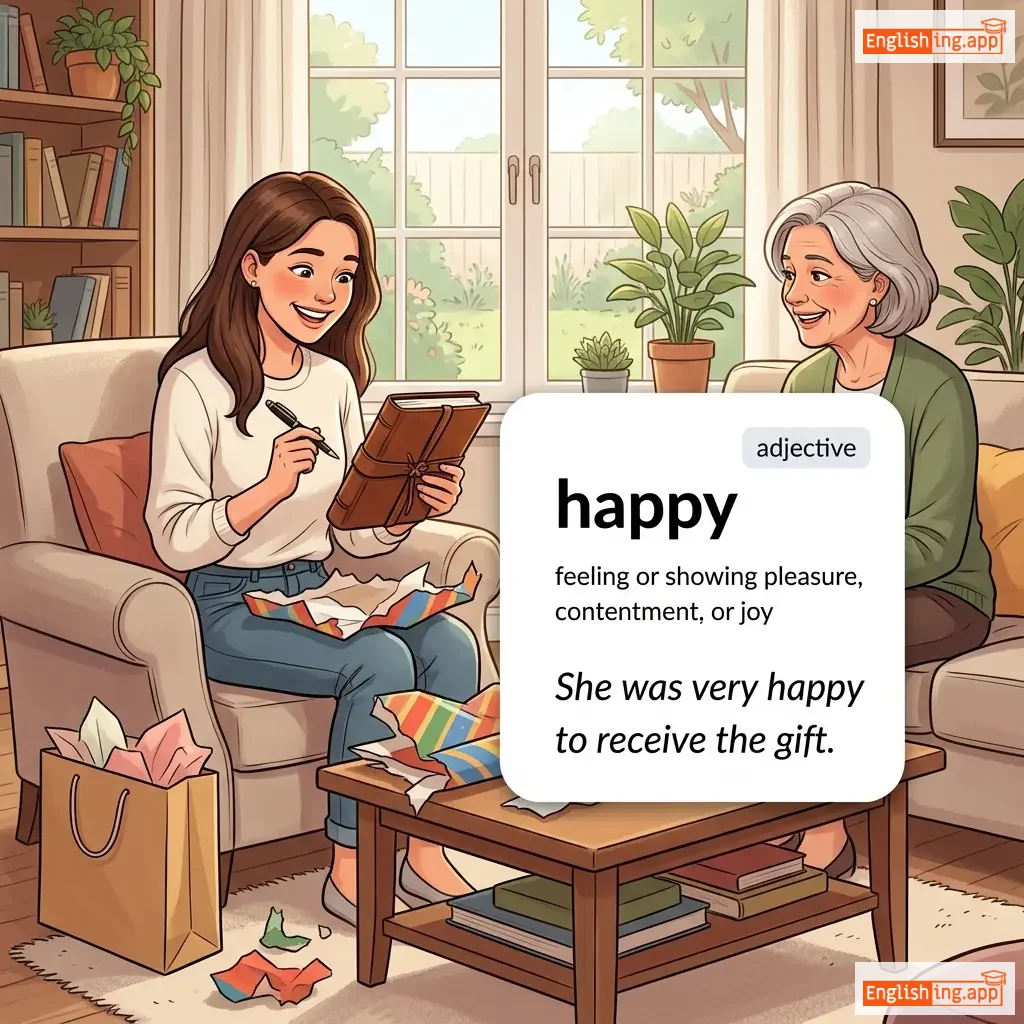
happy definition card — visual illustration of the meaning
adjective
/ˈhæpi/
heureux (heureux)

feeling or showing pleasure, contentment, or joy

"She was very happy to receive the gift."

"Elle était très heureuse de recevoir le cadeau." (Elle était très heureuse de recevoir le cadeau.)
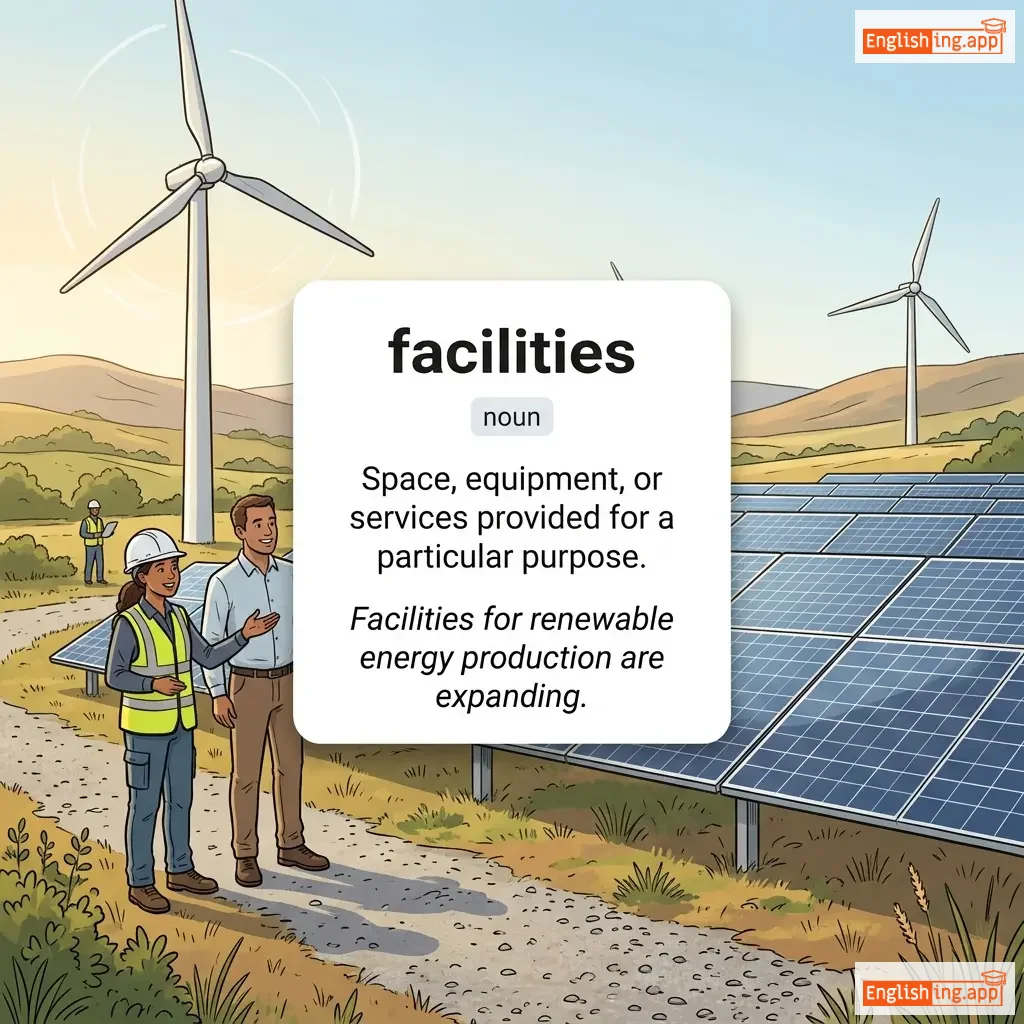
facilities definition card — visual illustration of the meaning
noun
fəˈsɪl.ɪ.tiz
installations (installations)

Space, equipment, or services provided for a particular purpose.

"Facilities for renewable energy production are expanding."

"Les installations pour la production d'énergie renouvelable sont en expansion." (Les installations pour la production d'énergie renouvelable sont en expansion.)
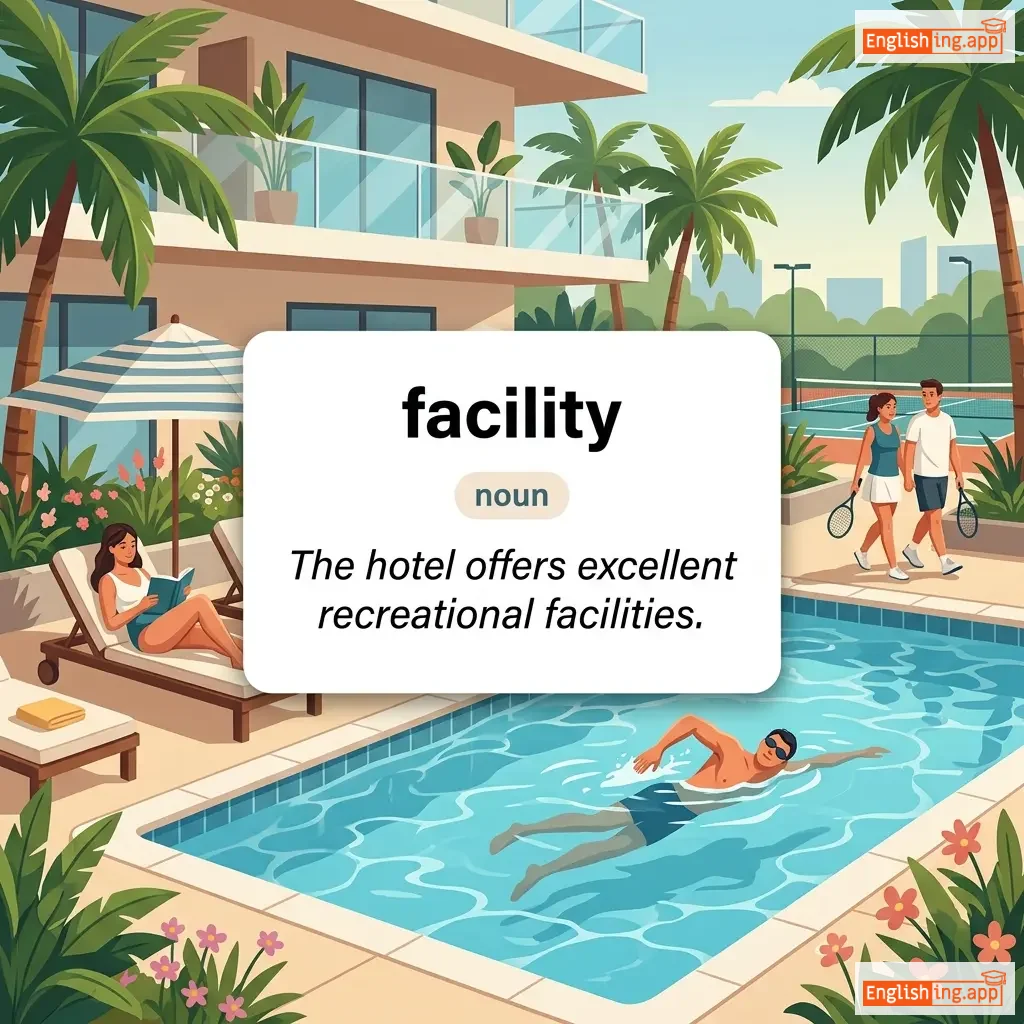
facility definition card — visual illustration of the meaning
noun
/fəˈsɪləti/
facilité, service ou équipement fourni pour un but spécifique (facilite, service ou equipement fourni pour un but specifique)

a place, service, or equipment provided for a particular purpose; ease in doing something

"The hotel offers excellent recreational facilities."

"L'hôtel offre d'excellentes installations récréatives." (L'hotel offre d'excellentes installations recreatives.)