Vocabulaires

Découvrez, apprenez et maîtrisez le vocabulaire anglais

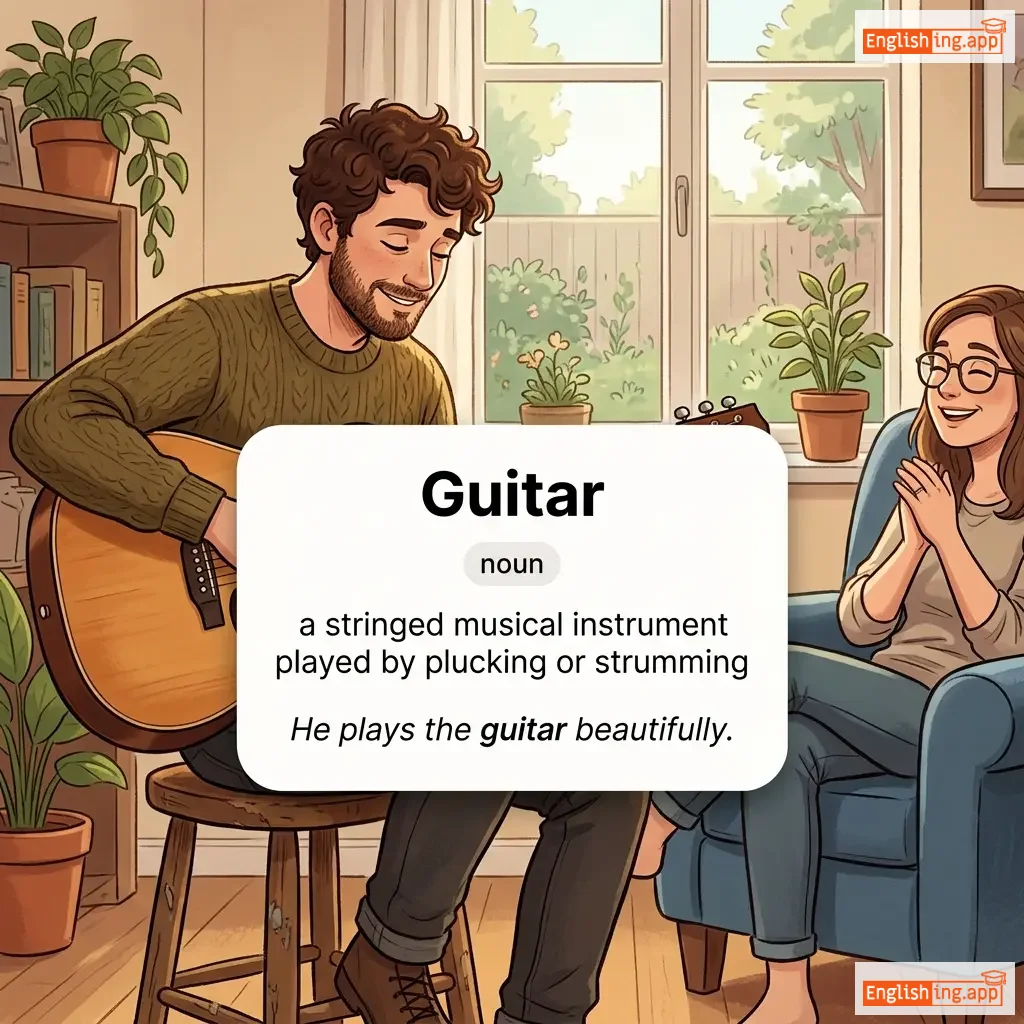
Guitar definition card — visual illustration of the meaning
noun
/ɡɪˈtɑːr/
guitare (guitare)

a stringed musical instrument played by plucking or strumming

"He plays the guitar beautifully."

"Il joue de la guitare magnifiquement." (Il joue de la guitare magnifiquement.)
noun
/ɡʌlf/
golfe (golfe)

a deep inlet of the sea almost surrounded by land; a wide gap or difference between people or groups

"The Persian Gulf is an important waterway for international shipping and oil transport."

"Le golfe Persique est une voie navigable importante pour le transport international de marchandises et de pétrole." (Le golfe Persique est une voie navigable importante pour le transport international de marchandises et de petrole.)
noun, verb
/ɡʌl/
goéland (gul)

A seabird with long wings and usually white and gray feathers; as a verb, to deceive or trick someone.

"The fisherman watched the gulls circle above the boat."

"Le pêcheur regardait les goélands tourner au-dessus du bateau." (Le pecheur regardait les goelands tourner au dessus du bateau.)
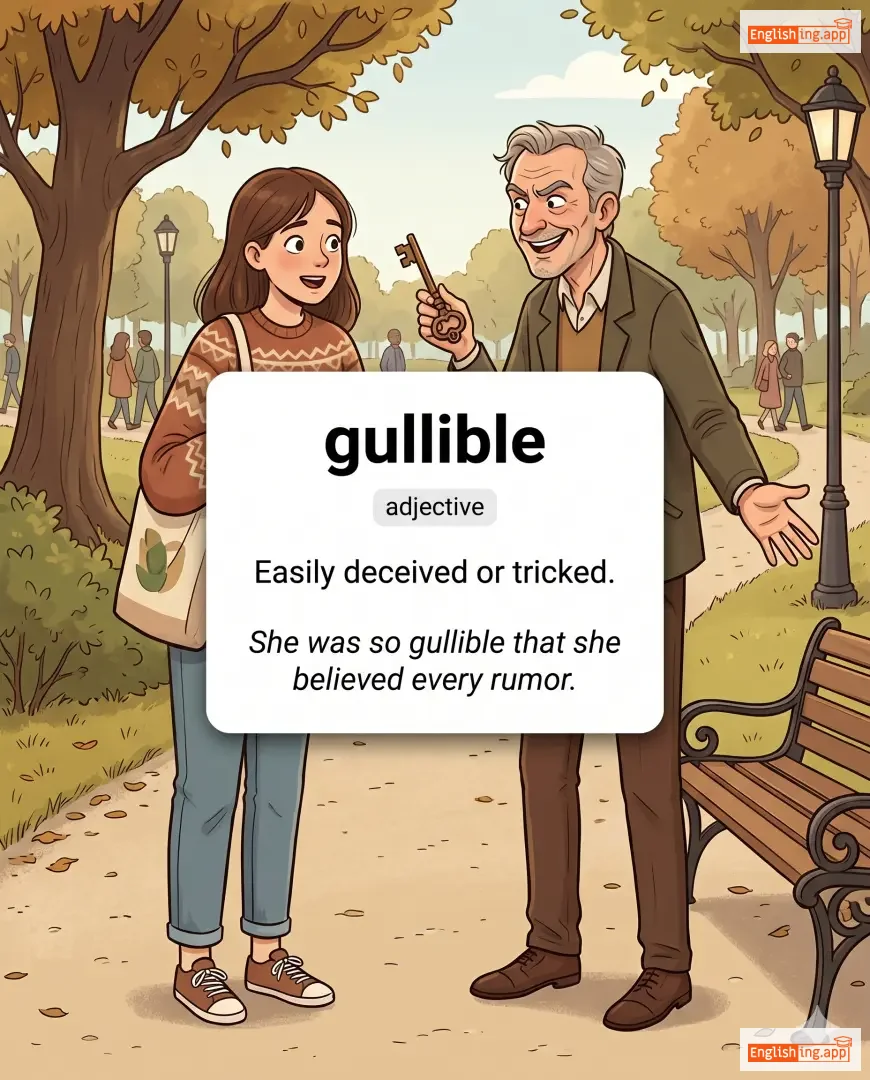
gullible definition card — visual illustration of the meaning
adjective
/ˈɡʌl.ə.bəl/
facilement dupe (facilement dupe)

Easily deceived or tricked.

"She was so gullible that she believed every rumor."

"Elle était tellement crédule qu'elle croyait chaque rumeur." (Elle était tellement crédule qu'elle croyait chaque rumeur.)
noun
/ˈɡʌl.i/
ravin, fossé (ravin, fosse)

A narrow channel or ravine worn away by water.

"After the storm, the road was cut by a deep gully."

"Après la tempête, la route a été coupée par un ravin profond." (Apres la tempête, la route a été coupée par un ravin profond.)
noun, verb
/ɡʌm/
gomme, gencive (gomme, jensiv)

A sticky substance from plants or used as adhesive; also the tissue around teeth.

"He chewed gum while waiting for the bus."

"Il mâchait du chewing-gum en attendant le bus." (Il mâchait du chewing-gum en attendant le bus.)
noun
/ˈɡʌmp.ʃən/
courage, initiative (courage, initiative)

Courage, resourcefulness, or initiative.

"It takes real gumption to start your own business."

"Il faut du vrai courage pour démarrer son propre entreprise." (Il faut du vrai courage pour démarrer son propre entreprise.)
noun
/ɡʌn/
pistolet (pistolet)

a weapon that shoots bullets or other projectiles

"The police officer carried a gun for protection."

"L'officier de police portait un pistolet pour se protéger." (L'officier de police portait un pistolet pour se protéger.)
noun
/ˈɡʌnˌpaʊdər/
poudre à canon (poudre a canon)

explosive powder used in guns and fireworks

"Gunpowder was invented in ancient China."

"La poudre à canon a été inventée dans la Chine ancienne." (La poudre a canon a ete inventee dans la Chine ancienne.)
noun
/ˈɡʌp.i fɪʃ/
poisson guppy (pwason gupi)

a small colorful freshwater fish popular in aquariums, known for its vibrant colors and easy breeding

"The guppy fish is perfect for beginners who want to start an aquarium."

"Le poisson guppy est parfait pour les débutants qui veulent commencer un aquarium." (le pwason gupi e parfett por le debutan ki vulent komonse un aquarium)
verb
/ɡʌʃ/
jaillir (jaillir)

to flow out suddenly and forcefully, or to express something enthusiastically

"Tears began to gush from her eyes."

"Les larmes ont commencé à jaillir de ses yeux." (Les larmes ont commencé à jaillir de ses yeux.)
noun
/ɡʌst/
rafale de vent (rafale de vent)

a sudden strong rush of wind or air

"A sudden gust of wind blew the papers away."

"Une rafale de vent a emporté les papiers." (Une rafale de vent a emporté les papiers.)
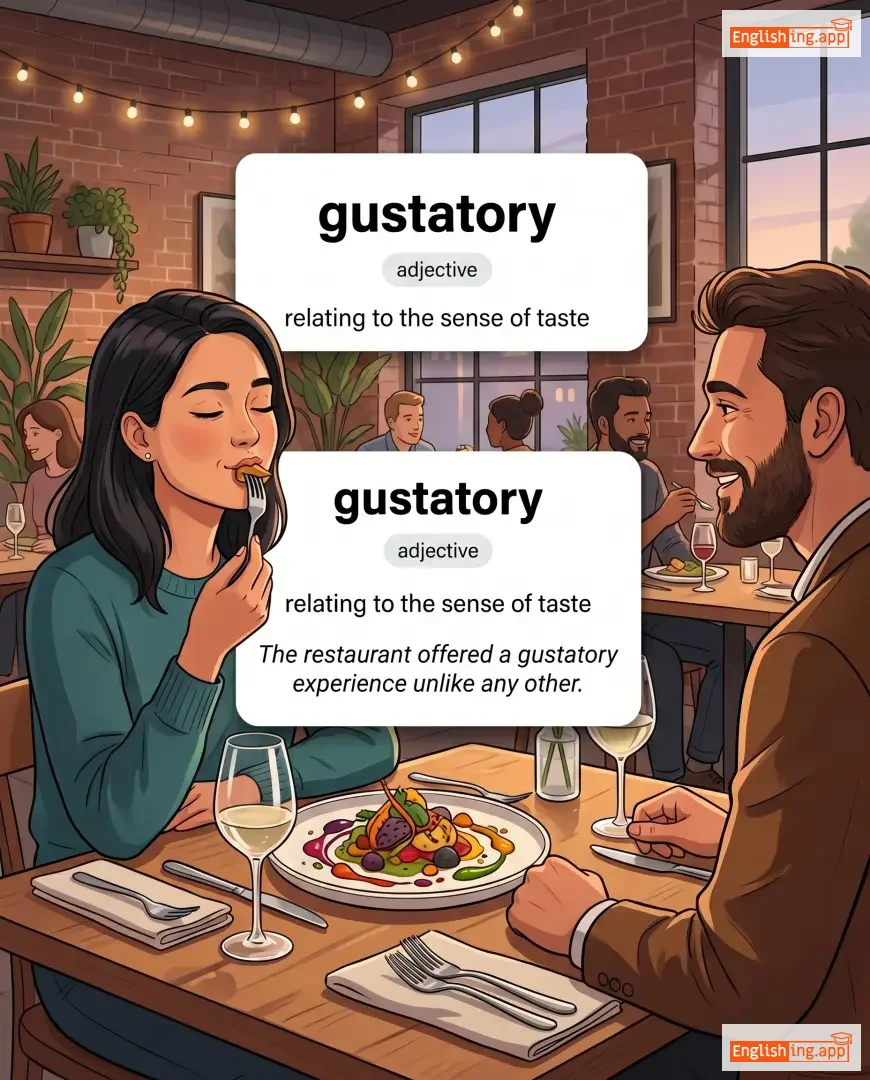
gustatory definition card — visual illustration of the meaning
adjective
/ˈɡʌstəˌtɔːri/
gustatif (gustatif)

relating to the sense of taste

"The restaurant offered a gustatory experience unlike any other."

"Le restaurant a offert une expérience gustative unique." (Le restaurant a offert une expérience gustative unique.)
noun
/ˈɡʌstoʊ/
enthousiasme (enthousiasme)

great enjoyment, energy, or enthusiasm in doing something

"She sang the song with great gusto."

"Elle a chanté la chanson avec beaucoup d'enthousiasme." (Elle a chante la chanson avec beaucoup d'enthousiasme.)
adjective
/ˈɡʌsti/
venteux (venteux)

characterized by strong, sudden bursts of wind

"It was a cold, gusty day by the sea."

"C'était une journée froide et venteuse près de la mer." (C'etait une journee froide et venteuse pres de la mer.)
noun/verb
/ɡʌt/
ventre / courage (ventre / courage)

The stomach or belly; also used for courage, instinct, or to remove the inside of something.

"He had the guts to stand up for his beliefs."

"Il avait le courage de défendre ses croyances." (Il avait le courage de défendre ses croyances.)
noun
/ɡaɪ/
mec (mec)

an informal term for a man; sometimes used to refer to a person in general

"That guy over there is my best friend."

"Ce mec là-bas est mon meilleur ami." (Ce mec là-bas est mon meilleur ami.)
verb
/ˈɡʌzəl/
boire goulûment (boire goulument)

to drink greedily or excessively

"He guzzled three cans of soda in a few minutes."

"Il a bu trois canettes de soda en quelques minutes." (Il a bu trois canettes de soda en quelques minutes.)
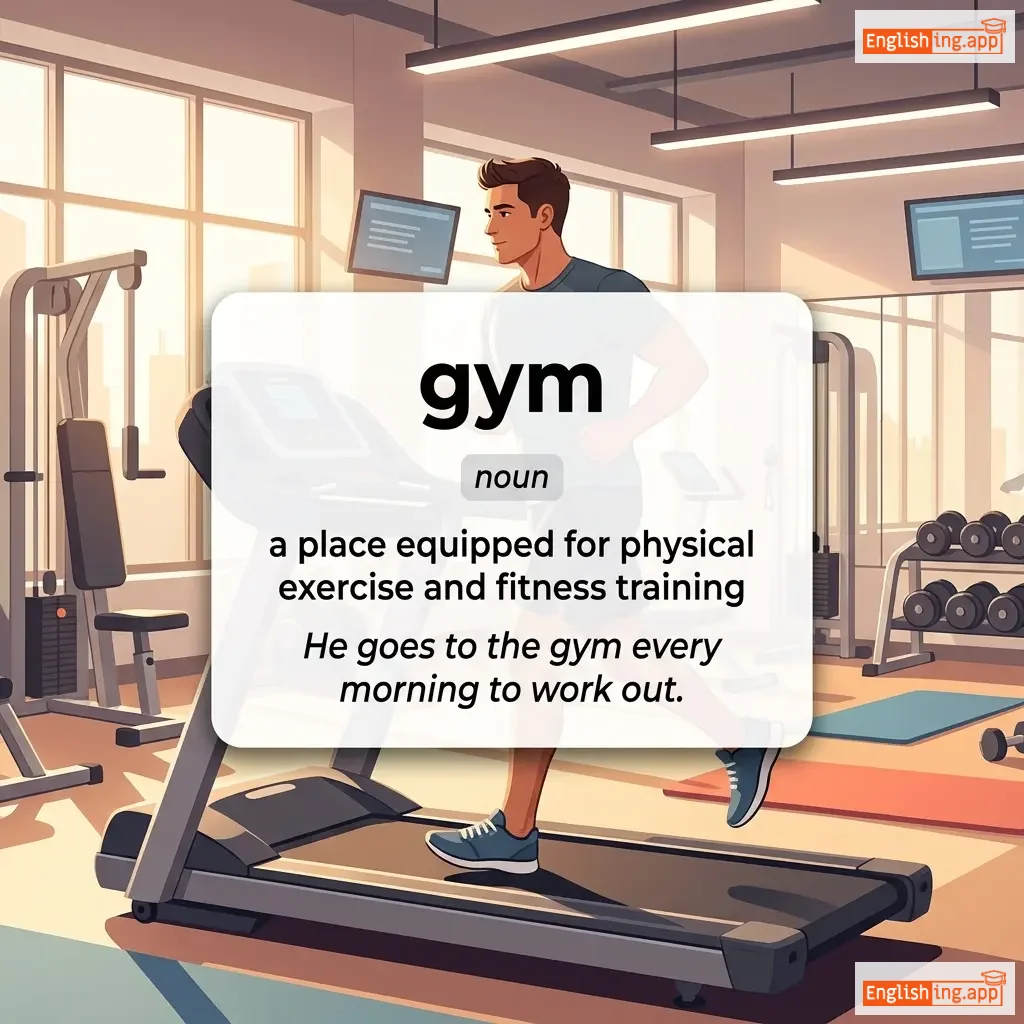
gym definition card — visual illustration of the meaning
🏋️‍♂️

gym (jim)

noun
/dʒɪm/
salle de sport (salle de sport)

a place equipped for physical exercise and fitness training

"He goes to the gym every morning to work out."

"Il va à la salle de sport chaque matin pour faire de l'exercice." (Il va à la salle de sport chaque matin pour faire de l'exercice.)
noun
/ˌɡaɪnəˈkɒkrəsi/
gynécocratie (gynecocratie)

a society or government ruled by women

"The ancient tribe was known for its gynecocracy, where women held all positions of power."

"La tribu ancienne était connue pour sa gynécocratie, où les femmes détenaient toutes les positions de pouvoir." (La tribu ancienne était connue pour sa gynécocratie, où les femmes détenaient toutes les positions de pouvoir.)
noun
/ˌɡaɪnəˈkɒlədʒi/
gynécologie (gynécologie)

the branch of medicine dealing with women's reproductive health

"She decided to specialize in gynecology after medical school."

"Elle a décidé de se spécialiser en gynécologie après l'école de médecine." (Elle a décidé de se spécialiser en gynécologie après l'école de médecine.)
verb
/ˈdʒaɪreɪt/
tourner rapidement (tourner rapidement)

to move or spin quickly in circles

"The dancer gyrated wildly to the rhythm of the drums."

"La danseuse a tourné frénétiquement au rythme des tambours." (La danseuse a tourne frenetiquement au rythme des tambours.)
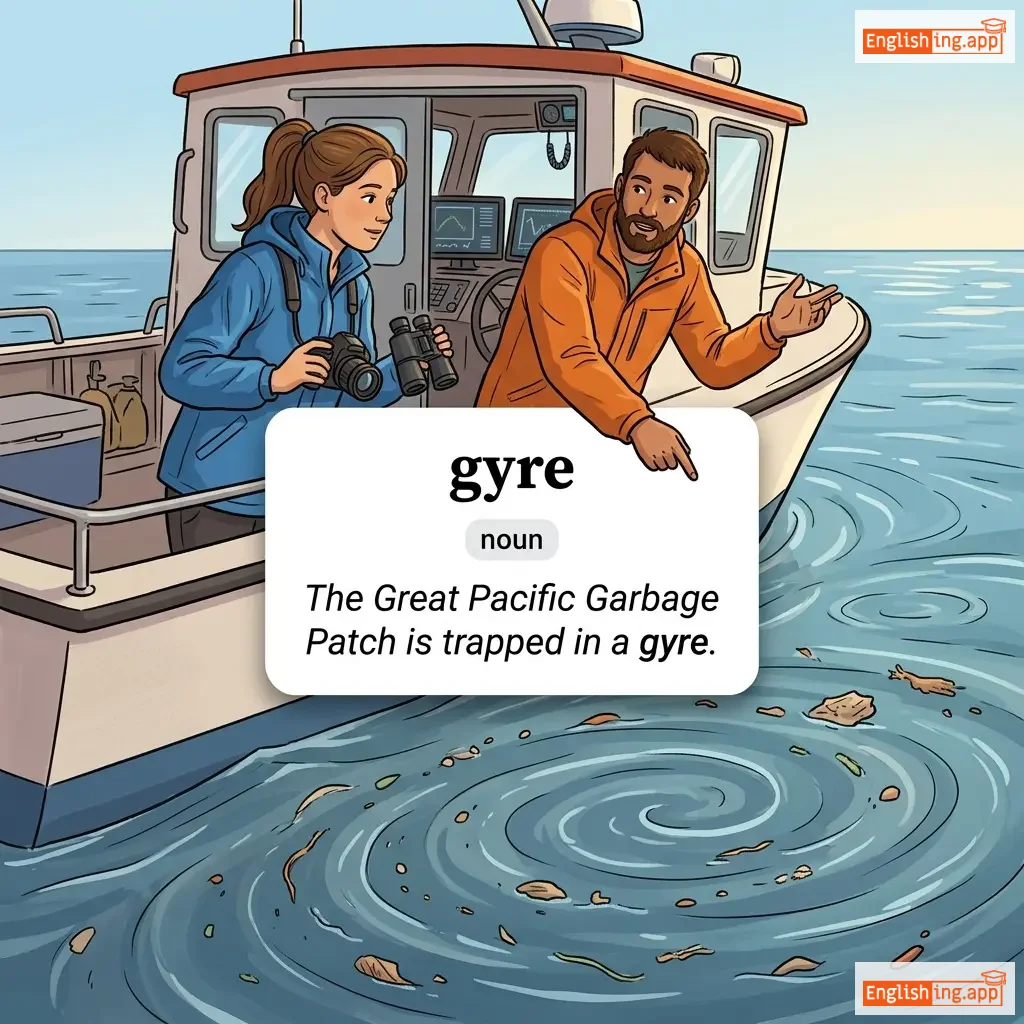
gyre definition card — visual illustration of the meaning
noun
/ˈdʒaɪər/
tourbillon, courant océanique circulaire (tourbillon, courant oceanique circulaire)

A circular or spiral motion or form, especially a giant circular oceanic surface current.

"The Great Pacific Garbage Patch is trapped in a gyre."

"Le grand patch de déchets du Pacifique est coincé dans un tourbillon." (Le grand patch de dechets du Pacifique est coince dans un tourbillon.)
noun
/ˈdʒaɪrəˌskoʊp/
gyroscope (gyroscope)

A device consisting of a wheel or disk mounted so it can spin rapidly and maintain orientation, used for navigation and balance.

"The airplane's navigation system relies on a gyroscope for stability."

"Le système de navigation de l'avion s'appuie sur un gyroscope pour la stabilité." (le systeme de navigation de lavion s appuie sur un gyroscope pour la stabilite)
interjection
/hɑː/
Ha ! (Exclamation de surprise ou de joie) (Ha ! (Exclamation de surprise ou de joie))

used to express amusement, surprise, or triumph

"Ha! I knew you couldn’t resist joining us."

"Ha ! Je savais que tu ne pourrais pas résister à nous rejoindre." (Ha ! Je savais que tu ne pourrais pas resister a nous rejoindre.)
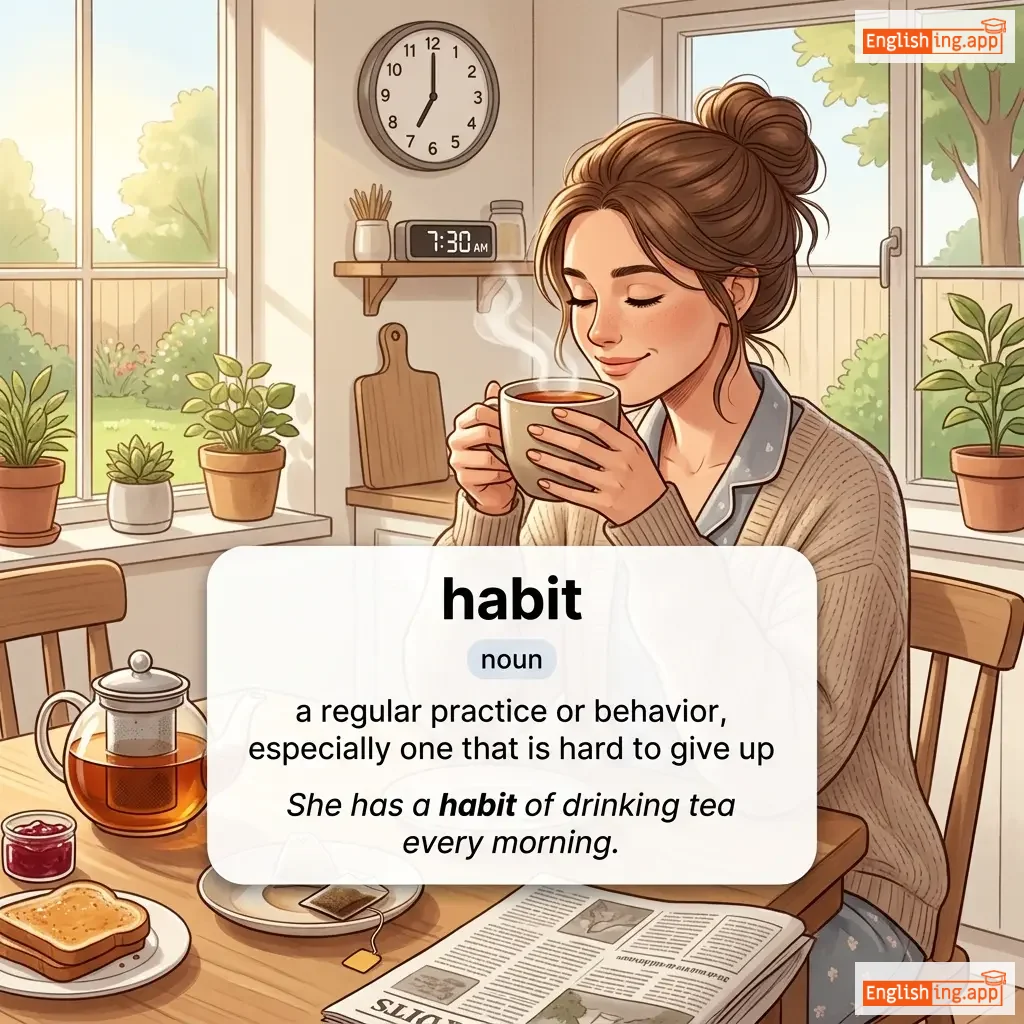
habit definition card — visual illustration of the meaning
noun
/ˈhæb.ɪt/
habitude (habitude)

a regular practice or behavior, especially one that is hard to give up

"She has a habit of drinking tea every morning."

"Elle a l'habitude de boire du thé chaque matin." (Elle a l'habitude de boire du thé chaque matin.)
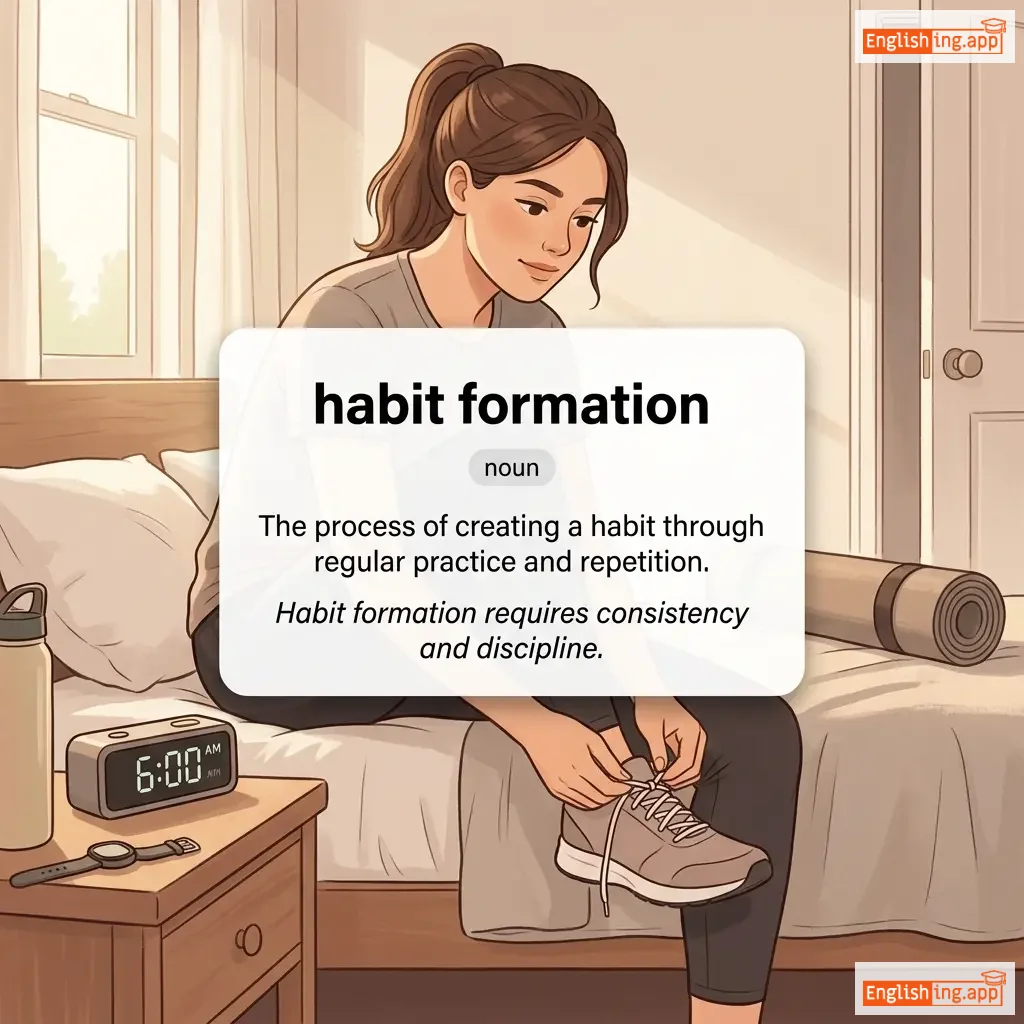
habit formation definition card — visual illustration of the meaning
noun
ˈhæb.ɪt fɔːrˌmeɪ.ʃən
formation d'habitudes (formation d'habitudes)

The process of creating a habit through regular practice and repetition.

"Habit formation requires consistency and discipline."

"La formation des habitudes nécessite de la constance et de la discipline." (La formation des habitudes necessite de la constance et de la discipline.)
adjective
/ˈhæbɪtəbl/
habitable (habitable)

Suitable to live in; capable of sustaining life.

"Scientists are searching for habitable planets beyond our solar system."

"Les scientifiques recherchent des planètes habitables au-delà de notre système solaire." (Les scientifiques recherchent des planètes habitables au-delà de notre système solaire.)
👨‍👩‍👧‍👦

habitant (abitɑ̃)

noun
/ˈhæbɪtənt/
habitant (habitant)

An inhabitant; a person or animal that lives in a particular place.

"The habitants of the village were friendly and welcoming."

"Les habitants du village étaient amicaux et accueillants." (Les habitants du village étaient amicaux et accueillants.)
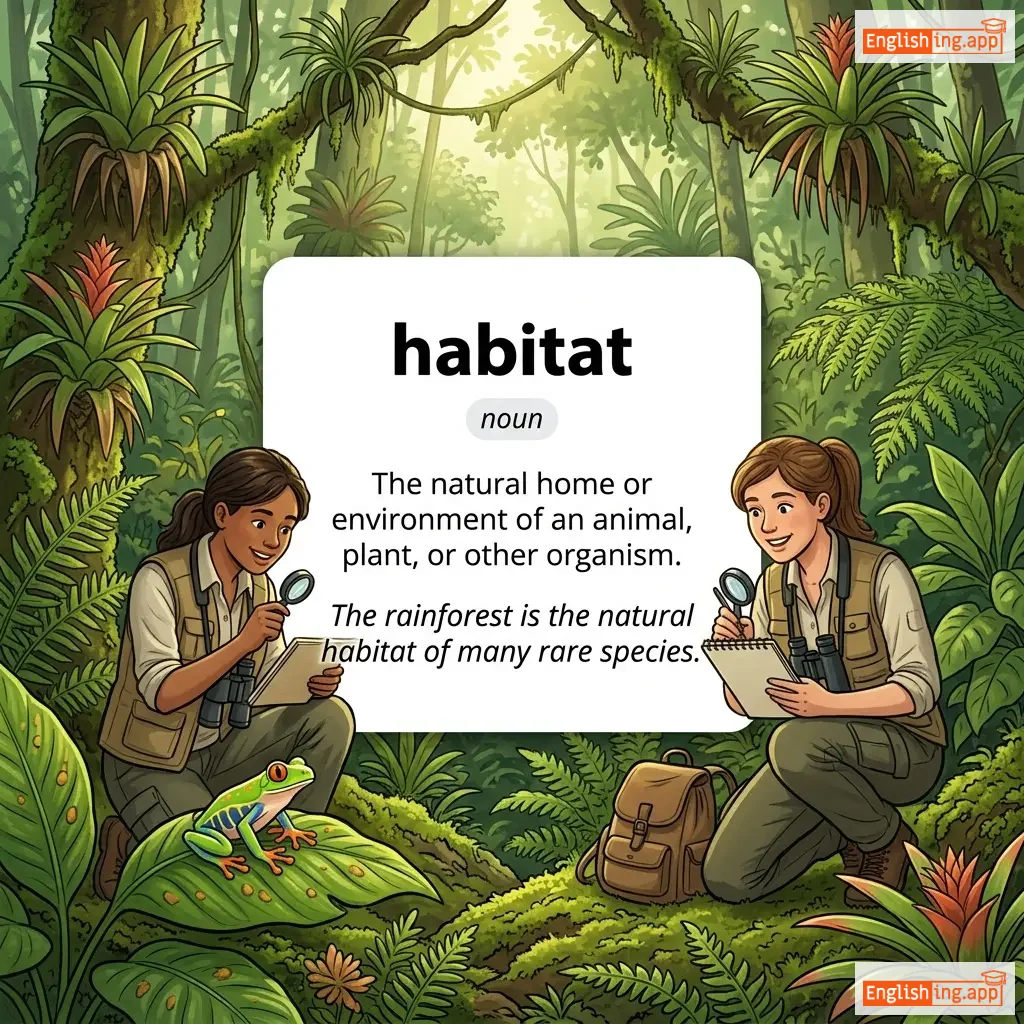
habitat definition card — visual illustration of the meaning
noun
/ˈhæbɪˌtæt/
habitat (habitat)

The natural home or environment of an animal, plant, or other organism.

"The rainforest is the natural habitat of many rare species."

"La forêt tropicale est l'habitat naturel de nombreuses espèces rares." (La forêt tropicale est l'habitat naturel de nombreuses espèces rares.)
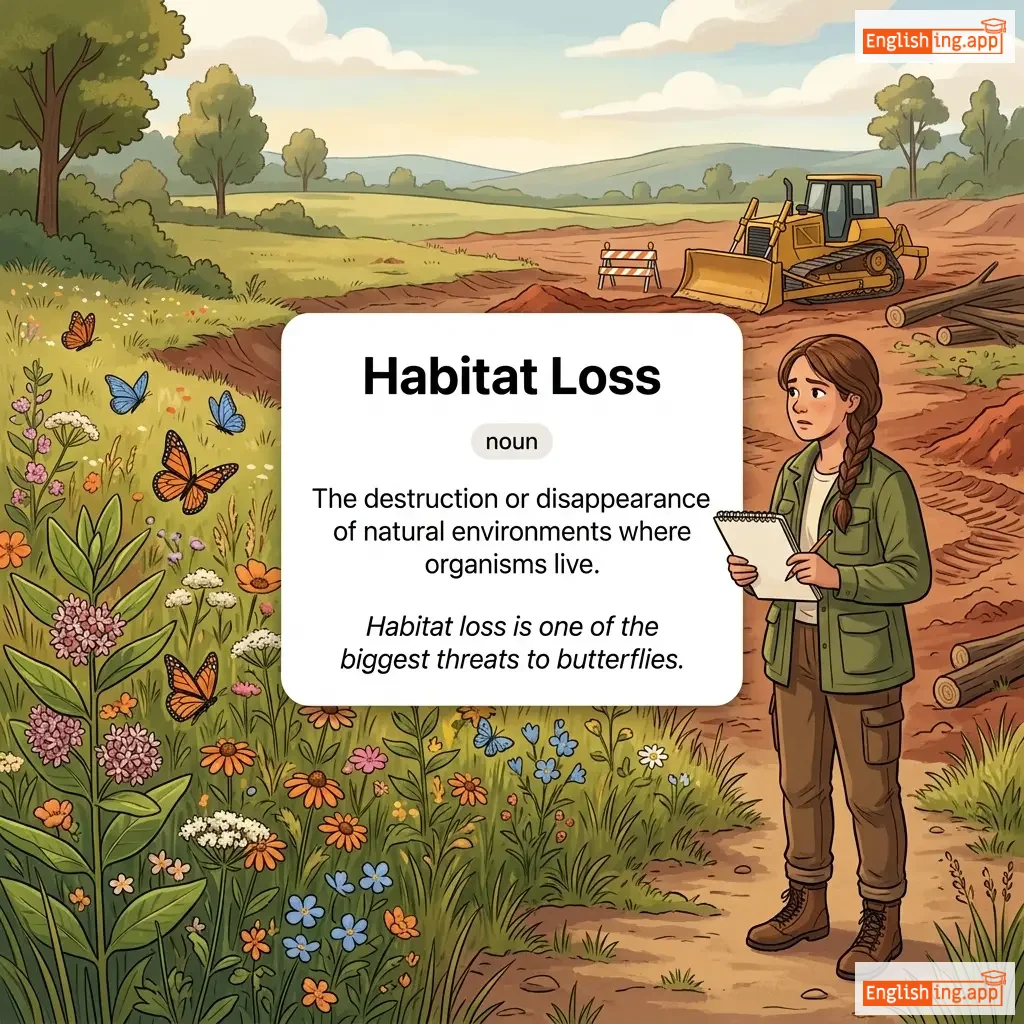
Habitat Loss definition card — visual illustration of the meaning
noun
ˈhæbɪtæt lɒs
perte de l'habitat (perte de l'habitat)

The destruction or disappearance of natural environments where organisms live.

"Habitat loss is one of the biggest threats to butterflies."

"La perte d'habitat est l'une des plus grandes menaces pour les papillons." (La perte d'habitat est l'une des plus grandes menaces pour les papillons.)
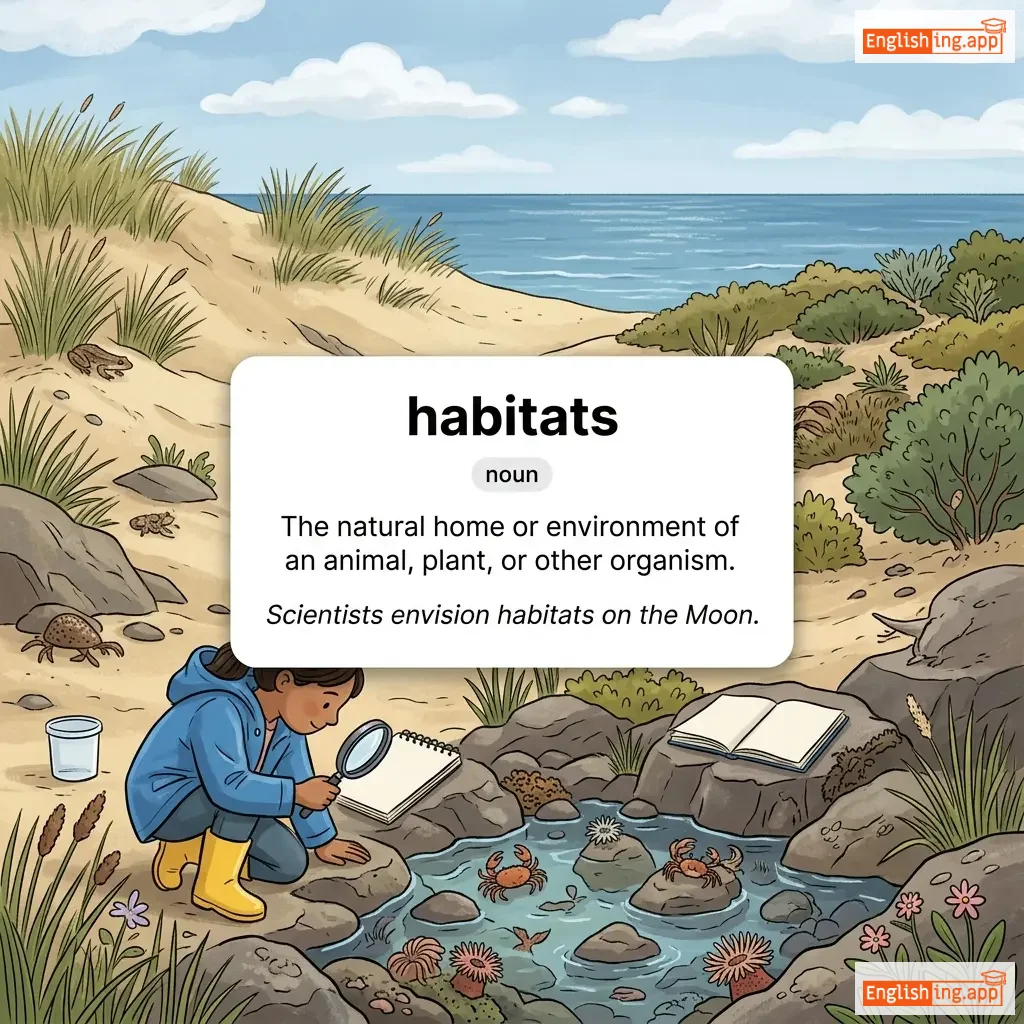
habitats definition card — visual illustration of the meaning
noun
ˈhæb.ɪ.tæts
habitat (habitát)

The natural home or environment of an animal, plant, or other organism.

"Scientists envision habitats on the Moon."

"Les scientifiques imaginent des habitats sur la Lune." (Les scientifiques imaginent des habitats sur la Lune.)
adjective
/həˈbɪtʃuəl/
habituel (habituel)

Done or doing constantly or as a habit; customary.

"He was a habitual latecomer to class."

"Il était un retardataire habituel en classe." (Il était un retardataire habituel en classe.)
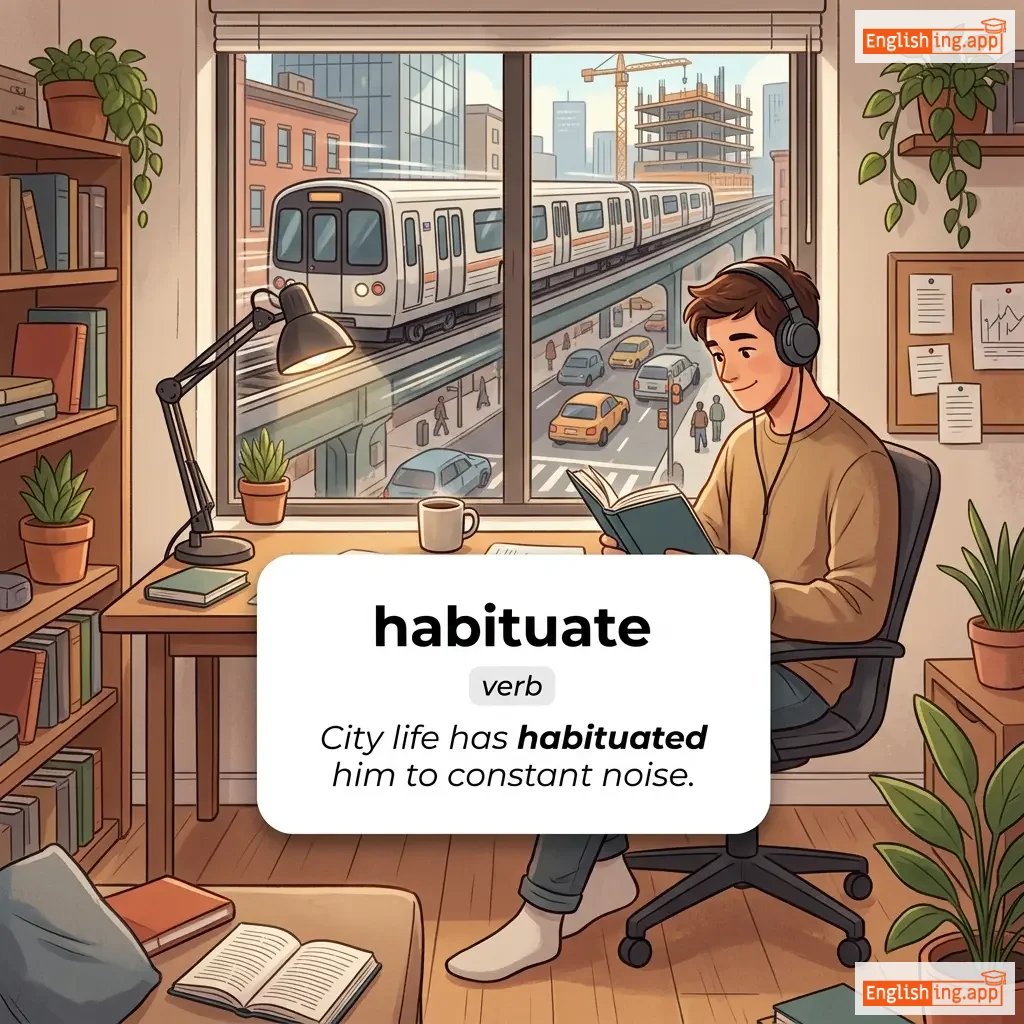
habituate definition card — visual illustration of the meaning
verb
/həˈbɪtʃueɪt/
habituer (habituer)

to accustom someone or oneself to something through frequent exposure or experience

"City life has habituated him to constant noise."

"La vie en ville l'a habitué au bruit constant." (La vie en ville l'a habitué au bruit constant.)
noun
/ˈhæbɪtjuːd/
habitude, coutume (habitude, coutume)

a customary condition or mode of life; habitual practice

"He lived in a quiet habitude, avoiding the noise of the city."

"Il vivait dans une habitude tranquille, évitant le bruit de la ville." (Il vivait dans une habitude tranquille, evitant le bruit de la ville.)
verb
/hæk/
couper, accéder sans autorisation à un système informatique (couper, acceder sans autorisation a un systeme informatique)

to cut or chop roughly; to gain unauthorized access to a computer system

"The programmer managed to hack into the system."

"Le programmeur a réussi à pirater le système." (Le programmeur a reussi a pirater le systeme.)
noun
/ˈhækəlz/
les poils à l'arrière du cou d'un animal qui se dressent lorsqu'il est en colère ou alarmé; figurativement, des sentiments de colère ou de ressentiment (les poils à l'arrière du cou d'un animal qui se dressent lorsqu'il est en colère ou alarmé; figurativement, des sentiments de colère ou de ressentiment)

the hairs on the back of an animal’s neck that rise when it is angry or alarmed; figuratively, feelings of anger or resentment

"His rude comment raised my hackles."

"Son commentaire grossier a levé mes hackles." (Son commentaire grossier a levé mes hackles.)
noun
/ˈhæknɪ/
cheval de location, usé (cheval de location, use)

a horse kept for ordinary riding or hire; also used for something overused or trite

"The old hackney was still pulling the carriage."

"Le vieux cheval de location tirait encore la carriole." (Le vieux cheval de location tirait encore la carriole.)
noun
/ˈhæk.ni ˈkær.ɪdʒ/
voiture de location (voiture de location)

A taxi; a car licensed to carry passengers for hire

"I called a hackney carriage to get to the airport."

"J'ai appelé une voiture de location pour aller à l'aéroport." (J'ai appelé une voiture de location pour aller à l'aéroport.)
adjective
/ˈhæk.nid/
usé (use)

Used too often and therefore lacking originality or freshness.

"The speech was filled with hackneyed phrases that failed to inspire the audience."

"Le discours était rempli de phrases usées qui n'ont pas réussi à inspirer le public." (Le discours était rempli de phrases usées qui n'ont pas réussi à inspirer le public.)
🧙‍♀️

Hag (hɑɡ)

noun
/hæɡ/
sorcière (sorcière)

an ugly old woman, especially a vicious or malicious one; a witch

"In the fairy tale, the wicked hag lived alone in a cottage deep in the forest."

"Dans le conte de fées, la méchante sorcière vivait seule dans une cabane au fond de la forêt." (Dans le conte de fées, la méchante sorcière vivait seule dans une cabane au fond de la forêt.)
adjective
/ˈhæɡ.ərd/
épuisé (epuize)

Looking exhausted, unwell, or worn out, especially from fatigue or suffering.

"After working all night, she looked pale and haggard."

"Après avoir travaillé toute la nuit, elle avait l'air pâle et épuisée." (Apres avoir travaille toute la nuit, elle avait l'air pale et epuisee.)
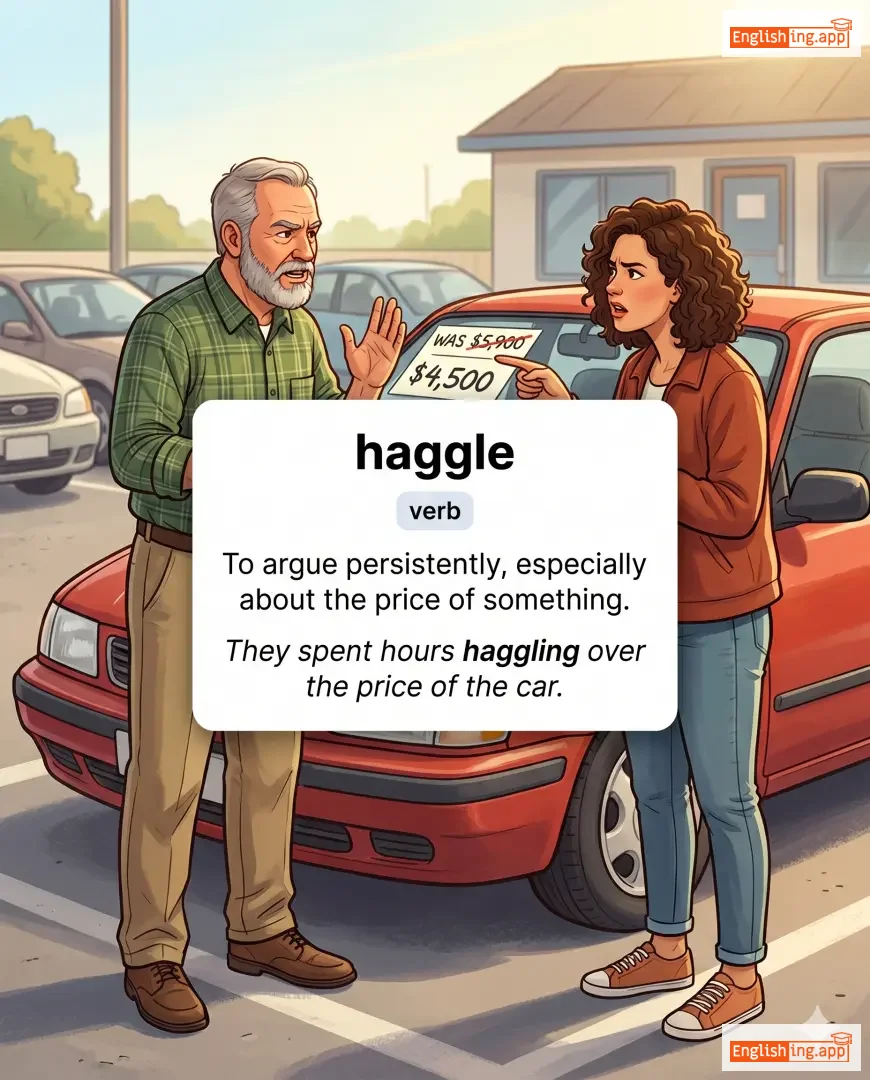
haggle definition card — visual illustration of the meaning
verb
/ˈhæɡ.l̩/
marchander (marchander)

To argue persistently, especially about the price of something.

"They spent hours haggling over the price of the car."

"Ils ont passé des heures à marchander le prix de la voiture." (Ils ont passé des heures à marchander le prix de la voiture.)
adjective
/ˌhæɡ.i.əˈɡræf.ɪk/
excessivement élogieux (excessivement elogieux)

Excessively flattering or idealized, often in a biography or portrayal of someone.

"The documentary was criticized for its hagiographic portrayal of the leader."

"Le documentaire a été critiqué pour sa représentation excessivement élogieuse du leader." (Le documentaire a été critiqué pour sa représentation excessivement élogieuse du leader.)
verb
/heɪl/
saluer / acclamer (saluer / acclamer)

To call out to attract attention or to praise enthusiastically.

"The athlete was hailed as a hero after the victory."

"L'athlète a été acclamé comme un héros après la victoire." (L'athlete a ete acclaime comme un heros apres la victoire.)
noun
/ˈheɪl.stɔːrm/
tempête de grêle (tempete de grele)

a violent storm with hail falling from the sky

"The hailstorm damaged many cars in the parking lot."

"La tempête de grêle a endommagé de nombreuses voitures dans le parking." (La tempête de grêle a endommagé de nombreuses voitures dans le parking.)
noun
/hɛər/
cheveux (cheveux)

the fine threads growing from the skin of humans and animals

"She has long, black hair."

"Elle a les cheveux longs et noirs." (Elle a les cheveux longs et noirs.)
noun
/ˈher ˌpɪn/
épingle à cheveux (epingle a cheveux)

a thin piece of metal or plastic used to hold hair in place

"She used several hair pins to secure her elegant updo."

"Elle a utilisé plusieurs épingles à cheveux pour fixer son élégant chignon." (Elle a utilise plusieurs epingles a cheveux pour fixer son elegant chignon.)
noun
/ˈheəkʌt/
coupe de cheveux (coupe de cheveux)

the act or style of cutting hair

"I got a haircut before the wedding."

"Je me suis fait une coupe de cheveux avant le mariage." (je me suis fait une coupe de cheveux avant le mariage)
noun
/ˈheəˌkʌtər/
coiffeur (coiffeur)

a person whose job is to cut and style hair; barber or hairdresser

"The haircutter gave me a neat and stylish haircut."

"Le coiffeur m’a fait une belle coupe." (le coiffeur ma fait une belle coupe)