語彙集

英単語辞書 | 単語の意味、定義、例文

adjective
/ˈspaɪn.ləs/
勇気がない; 意志が弱い; 臆病 (su-painresu)

lacking courage or determination; weak-willed

"He was too spineless to stand up for his beliefs."

"彼は自分の信念を貫くには、あまりにも臆病すぎた。" (Kare wa jibun no shinnen wo tsuranuku ni wa, amari ni mo okubyou sugita.)
adjective
/ˈspaɪnəs/
棘のある (toge no aru)

Having spines or thorn-like projections

"The spinous cactus was difficult to handle without gloves."

"その棘のあるサボテンは手袋なしでは取り扱いにくかった。" (Sono toge no aru saboten wa tebukuro nashi de wa toriatsukai nikukatta.)
noun
/ˈspɪnstər/
未婚女性 (mikon josei)

An unmarried woman, often one who is older and considered unlikely to marry

"The novel featured a kind-hearted spinster who cared for the village children."

"その小説には、村の子供たちの世話をしていた心優しい未婚女性が登場した。" (Sono shousetsu ni wa, mura no kodomotachi no sewa o shite ita kokoro yasashii mikon josei ga toujou shita.)
adjective
/ˈspaɪni/
とげのある (toge no aru)

covered with or full of spines; having sharp points

"The spiny cactus stood tall in the desert."

"とげのあるサボテンが砂漠の中で高く立っていました。" (Toge no aru saboten ga sabaku no naka de takaku tatte imashita.)
adjective
/ˈspaɪ.rəl/
螺旋 (rasen)

winding in a continuous curve; helical

"The spiral staircase led to the top floor."

"螺旋階段は最上階に通じていました。" (Rasen kaidan wa saijoukai ni tsuujiteimashita.)
noun
/ˈspaɪər/
尖塔 (sentō)

a tall, pointed structure on top of a building, especially a church

"The church spire could be seen from miles away."

"教会の尖塔は遠くから見ることができました。" (Kyōkai no sentō wa tōku kara miru koto ga dekimashita.)
noun
/ˈspɪrɪt/
精神 (seishin)

the non-physical part of a person, regarded as their true self

"Her spirit remained unbroken despite the hardships."

"彼女のスピリットは困難にもかかわらず壊れなかった。" (Kanojo no supiritto wa konnan ni mo kakawarazu kowarenakatta.)
adjective
/ˈspɪrɪtʃuəl/
精神的 (seishinteki)

relating to or affecting the human spirit or soul

"She practices spiritual meditation every morning."

"彼女は毎朝、精神的な瞑想を実践しています。" (Kanojo wa mai asa, seishinteki na meisō o jissen shiteimasu.)
verb
/spɪt/
唾を吐く (taba o haku)

to force liquid, especially saliva, out of the mouth

"He spat on the ground in anger."

"彼は怒りで地面に唾を吐いた。" (Kare wa ikari de jimen ni tuba o haita.)
noun
/spaɪt/
意地悪 (ijiwaru)

a desire to hurt, annoy, or offend someone

"She refused the gift out of spite."

"彼女は意地悪で贈り物を拒否した。" (Kanojo wa ijiwaru de okurimono o kyohi shita.)
noun
/spliːn/
脾臓; 怒り (hizō; ikari)

an organ in the body that produces lymphocytes and filters blood; also refers to bad temper or spite

"He vented his spleen on his coworkers after the meeting."

"会議後、彼は同僚に対して怒りをぶつけました。" (Kaigi go, kare wa dōryō ni taishite ikari o butsukemashita.)
adjective
/ˈsplendɪd/
素晴らしい; 壮大な; 印象的な (subarashii; soudaina; inshou-teki na)

magnificent; excellent; very impressive

"The castle looked splendid in the sunset."

"お城は夕日で素晴らしく見えました。" (O-shiro wa yuhi de subarashiku miemashita.)
adjective
/splɪˈnɛtɪk/
怒りっぽい、意地悪な (ikarippoi, ijiwaru na)

bad-tempered, irritable, spiteful

"His splenetic remarks offended everyone in the room."

"彼の怒りっぽいコメントは部屋の皆を怒らせた。" (Kare no ikarippoi komento wa heya no mina o okorase ta.)
verb
/splaɪs/
接続する (setsuzoku suru)

to join two pieces of rope, film, or other material by weaving or attaching them together

"The technician spliced the two wires to restore the connection."

"技術者は2本のワイヤーを接続して接続を回復しました。" (Gijutsusha wa 2-hon no waiyā o setsuzoku shite setsuzoku o kaifuku shimashita.)
/splɪnt/
添木 (temoku)

A rigid device used to support and immobilize a broken or injured body part.

"The doctor applied a splint to stabilize the patient's broken arm."

"医者は患者の折れた腕を安定させるために添木を使いました。" (Isha wa kanja no oreta ude o antei saseru tame ni temoku o tsukaimashita.)
verb
/splɪt/
分ける (wakeru)

to divide or separate into parts or groups

"He split the log in two with an axe."

"彼は斧で丸太を二つに割った。" (Kare wa ono de maruta o futatsu ni watta.)
verb
/spɔɪl/
台無しにする (dainashi ni suru)

to damage or ruin something

"The rain spoiled the outdoor event."

"雨が屋外イベントを台無しにした。" (Ame ga okugai ibento o dainashi ni shita.)
noun
/ˈspɔɪlˌspɔːrt/
スポイルスポート (supoirusupoto)

A person who ruins other people's enjoyment or fun.

"Don't be a spoilsport and let us enjoy the party."

"スポイルスポートにならないで、パーティーを楽しませてください。" (Supoirusupoto ni naranai de, pātii o tanoshimase te kudasai.)
noun, verb
/spoʊk/
スポーク / 言った (supōku / itta)

As a noun, a bar connecting the center of a wheel to its rim; as the past tense of 'speak'.

"The bicycle's spoke was bent after the accident."

"自転車のスポークは事故後に曲がっていた。" (Jitensha no supōku wa jiko-go ni magatte ita.)
noun
/ˈspəʊksmən/
スポークスマン (supōkusu man)

a person who speaks on behalf of others, especially for a group or organization

"The spokesman addressed the crowd during the rally."

"スポークスマンは集会中に群衆に向かって話した。" (Supōkusuman wa shūkai-chū ni gunshū ni mukatte hanashita.)
noun
/ˈspəʊkspɜːrsən/
スポークスマン (supōkusu man)

a person who speaks on behalf of others or an organization

"The spokesperson addressed the press conference on behalf of the company."

"スポークスマンは会社を代表して記者会見で話しました。" (Supōkusuman wa kaisha o daihyō shite kishakaiken de hanashimashita.)
noun
/ˈspəʊkswɪmən/
広報女性 (kōhō josei)

a woman who speaks on behalf of a group or organization

"The spokeswoman for the company announced the new product."

"その会社の広報女性は新製品を発表した。" (Sono kaisha no kōhō josei wa shin seihin wo happyō shita.)
noun
/ˌspoʊliˈeɪʃən/
破壊 (hakai)

The act of destroying or ruining something, often evidence or property.

"The court punished the company for the spoliation of evidence."

"裁判所は証拠の破壊のために会社を罰しました。" (Saibansho wa shōko no hakai no tame ni kaisha o bashimashita.)
adjective
/ˈspʌndʒi/
スポンジ状 (suponji-jou)

soft and full of holes like a sponge; porous

"The cake had a light and spongy texture."

"ケーキは軽くてスポンジ状の質感がありました。" (Kēki wa karukute suponji-jou no shitsukan ga arimashita.)
noun
/spʌndʒ ɡɔːrd/
スポンジカボチャ (sponji kabocha)

a fibrous gourd that becomes sponge-like when dried, used for cleaning and in cooking when young

"The sponge gourd can be eaten when young or dried to make natural scrubbers."

"スポンジカボチャは若い時に食べることができるか、乾燥させて自然のスポンジを作ることができます。" (Sponji kabocha wa wakai toki ni taberu koto ga dekiru ka, kansou sasete shizen no suponji o tsukuru koto ga dekimasu.)
noun
/ˈspɒnsər/
スポンサー (sponsor)

a person or organization that provides funds for a project or activity in exchange for publicity or support

"The company became the main sponsor of the event."

"その会社はイベントの主要スポンサーとなった。" (Sono kaisha wa ibento no shuyō sponsor to natta.)
noun
/ˈspɒnsəʃɪp/
後援 (kouen)

the act of supporting an event, activity, person, or organization financially or through other resources

"The event was made possible due to the sponsorship of several big companies."
"イベントは、いくつかの大企業の後援のおかげで実現しました。" (Ibento wa, ikutsuka no daikigyou no kouen no okage de jitsugen shimashita.)
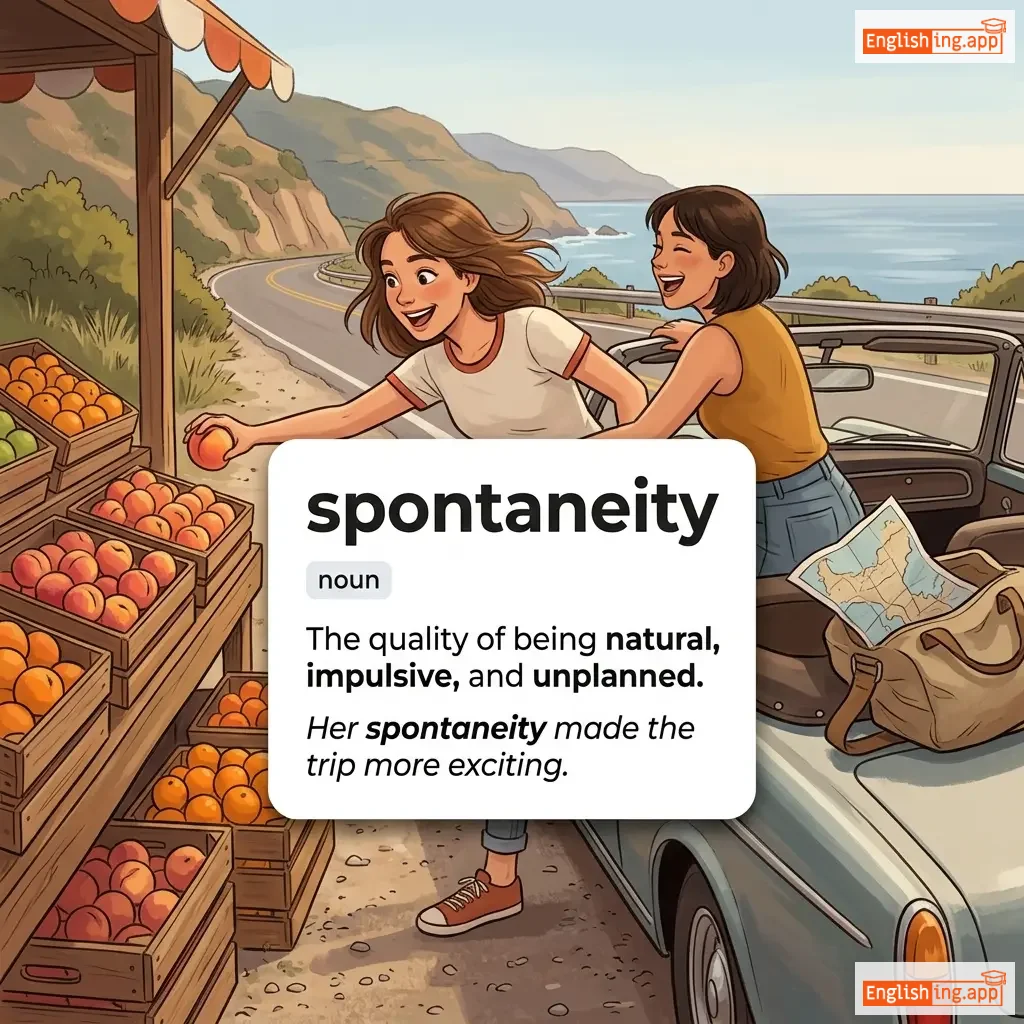
spontaneity definition card — visual illustration of the meaning
noun
/ˌspɑːntəˈneɪəti/
自発性 (jihatsusei)

The quality of being natural, impulsive, and unplanned.

"Her spontaneity made the trip more exciting."

"彼女の自発性は旅行をもっと刺激的にした。" (kanojo no jihatsusei wa ryokou o motto shigekiteki ni shita.)
adjective
/spɒnˈteɪniəs/
自発的 (jihatsuteki)

Happening naturally without planning or external cause; impulsive or unplanned.

"Their spontaneous trip to the mountains turned out to be the highlight of the summer."
"彼らの自発的な山への旅行は夏のハイライトとなった。" (Karera no jihatsuteki na yama e no ryokou wa natsu no hairaito to natta.)
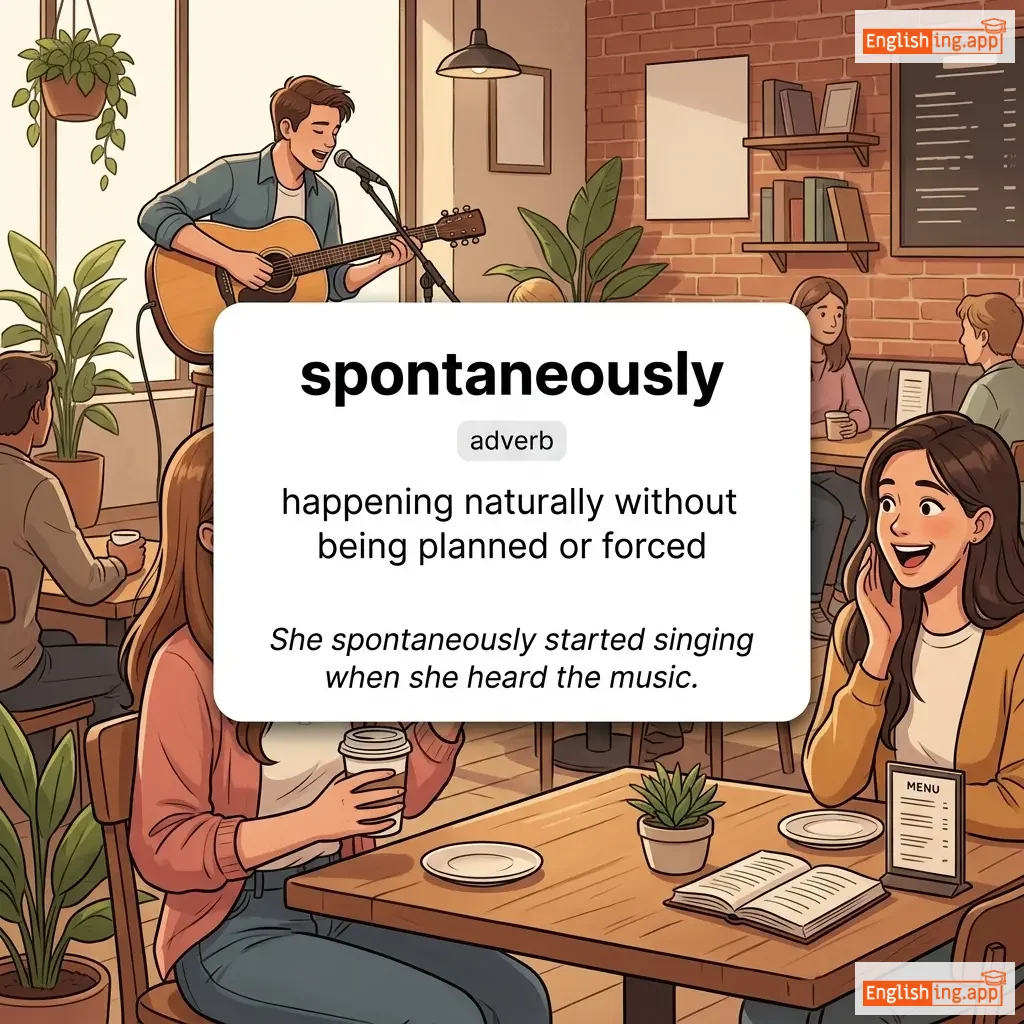
spontaneously definition card — visual illustration of the meaning
adverb
/spɒnˈteɪ.ni.əs.li/
自発的に (jihatsuteki ni)

happening naturally without being planned or forced

"She spontaneously started singing when she heard the music."

"彼女は音楽を聞いて自発的に歌い始めました。" (Kanojo wa ongaku o kiite jihatsuteki ni utai hajimemashita.)
noun/verb
/spuːf/
ユーモアのある模倣 (yūmoa no aru mohō)

A humorous imitation of something, or to trick or parody someone or something.

"The comedian spoofed the politician’s speech to entertain the audience."

"コメディアンは政治家の演説を模倣して観客を楽しませました。" (Komedian wa seijika no enzetsu o mohō shite kankyaku o tanoshimemashita.)
noun
/spuːn/
スプーン (supūn)

a utensil consisting of a small shallow bowl with a handle, used for eating, stirring, or serving food

"She stirred her coffee with a silver spoon."

"彼女は銀のスプーンでコーヒーをかき混ぜました。" (Kanojo wa gin no supūn de kōhī o kakimazemashita.)
noun
/ˈspuːnərɪzəm/
スプーナリズム (supunarizumu)

A verbal error in which the initial sounds of words are swapped to create a humorous effect.

"He made a spoonerism by saying 'queer old dean' instead of 'dear old queen'."
"彼は『変な老院長』と言って『親愛なる老女王』の代わりにスプーナリズムを作った。" (Kare wa 'hen na rōin chō' to itte 'shin'ai naru rō joō' no kawari ni supunarizumu o tsukutta.)
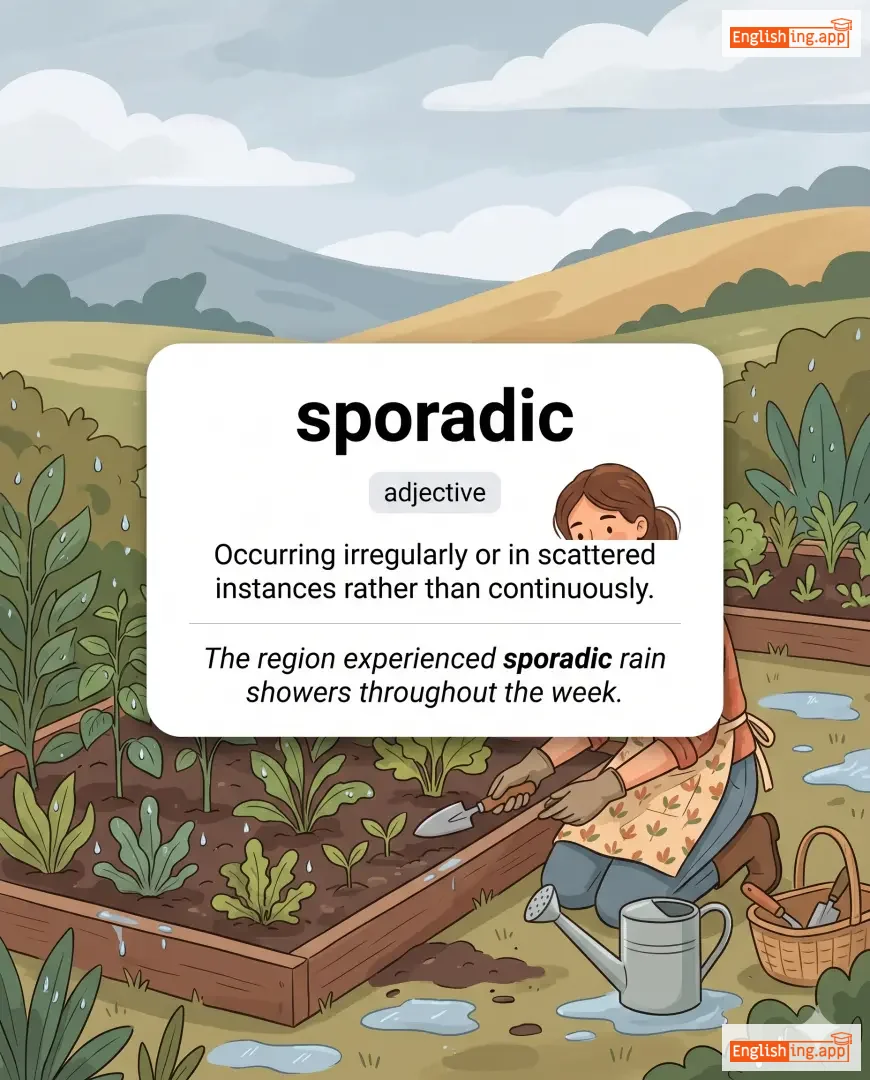
sporadic definition card — visual illustration of the meaning
adjective
/spəˈrædɪk/
散発的 (sanpatsuteki)

Occurring irregularly or in scattered instances rather than continuously.

"The region experienced sporadic rain showers throughout the week."

"その地域は1週間にわたって散発的な雨が降りました。" (Sono chiiki wa 1 shūkan ni watatte sanpatsuteki na ame ga furimashita.)
noun
/spɔːt/
スポーツ (supōtsu)

an activity involving physical exertion and skill in which an individual or team competes against another or others for entertainment

"Football is a popular sport around the world."

"サッカーは世界中で人気のスポーツです。" (Sakkā wa sekaijū de ninki no supōtsu desu.)
adjective
/ˈspɔːrtɪv/
スポーティブ (supōtibu)

Playful, lively, or full of fun.

"The children were in a sportive mood during the picnic."

"子供たちはピクニック中にスポーティブな気分でした。" (Kodomotachi wa pikunikku-chū ni supōtibu na kibun deshita.)
noun
/ˈspɔːrtsmən/
スポーツ選手 (supotsu senshu)

A person who is skilled in sports or enjoys participating in athletic activities.

"He is a true sportsman, always fair and respectful to his opponents."

"彼は本物のスポーツ選手で、常に相手に対して公正で尊敬を示す。" (Kare wa honmono no supotsu senshu de, tsune ni aite ni taishite kousei de sonkei o shimesu.)
noun
/spɒt/
場所 (basho)

a particular place or position

"I found a great spot for a picnic in the park."

"公園でピクニックをするための素晴らしい場所を見つけました。" (Kouen de pikunikku o suru tame no subarashii basho o mitsukemashita.)
noun
/ˈspɒt.laɪt/

a strong beam of light directed onto a particular area; figuratively, public attention

"The singer stood proudly in the spotlight."

adjective
/ˈspɒtɪd/
斑点のある; 見られた; マークされた (hanten no aru; mirareta; māku sareta)

having spots or marks; noticed or seen

"The spotted leopard moved silently through the jungle."

"斑点のあるヒョウはジャングルを静かに歩いた。" (Hanten no aru hyou wa janguru o shizuka ni aruita.)
noun
/ˈspɒt.ɪd sneɪk hed/
カムルチー (kamuruchi)

a type of freshwater fish with spotted markings and an elongated head resembling a snake

"The spotted snake head is a popular fish for aquaculture in South Asia."

"カムルチーは南アジアで人気のある養殖魚です。" (kamuruchi wa minami ajia de ninki no aru yoshokugyo desu)
noun
/spaʊs/
配偶者 (haiguusha)

a person's husband or wife

"Each employee may include their spouse in the health insurance plan."

"各従業員は配偶者を健康保険プランに含めることができます。" (Kaku juugyouin wa haiguusha o kenkou hoken puran ni fukumeru koto ga dekimasu.)
noun, verb
/spreɪn/
捻挫 (nenza)

an injury to a joint in which the ligaments are stretched or torn

"She sprained her ankle while running in the park."

"公園で走っているときに足首をねんざした。" (Kōen de hashitte iru toki ni ashi kubi o nenza shita.)
verb
/spreɪ/
スプレーする (supuree suru)

to apply liquid to something in a fine mist

"She sprayed perfume on her wrist before leaving."

"彼女は出かける前に手首に香水をスプレーしました。" (Kanojo wa dekakeru mae ni tekubi ni kōsui o supurē shimashita.)
verb
/sprɛd/
広げる (hirogeru)

to open or extend something over an area

"She spread the blanket on the grass for a picnic."

"彼女はピクニックのために草の上に毛布を広げました。" (Kanojo wa pikunikku no tame ni kusa no ue ni mōfu o hirogemashita.)
adjective
/ˈspraɪtli/
活発な (kappatsu na)

full of energy and life; lively

"The sprightly old man danced with joy at the wedding."

"活発な老紳士は結婚式で喜びながら踊った。" (Kappatsu na rō shinshi wa kekkonshiki de yorokobi nagara odotta.)
noun
/sprɪŋ/
(haru)

the season between winter and summer when plants begin to grow

"Flowers bloom in the spring."

"春には花が咲きます。" (Haru ni wa hana ga sakimasu.)
verb
/ˈsprɪŋkəl/

to scatter small drops or particles of a substance over a surface

"She sprinkled sugar on top of the cake."

verb, noun
/spraʊt/
発芽する (hatsuga suru)

to begin to grow; to produce new leaves or shoots

"The seeds began to sprout after a few days of rain."

"種は数日間の雨の後に発芽し始めました。" (Tane wa sūjitsukan no ame no ato ni hatsuga shi hajimemashita.)
verb, adjective, noun
/spruːs/
整える / 一種の木 (tonoeru / isshu no ki)

to make neat or tidy in appearance; also refers to an evergreen tree

"He spruced up his room before the guests arrived."

"彼はゲストが到着する前に部屋を整えました。" (Kare wa gesuto ga tōchaku suru mae ni heya o totonoemashita.)