語彙集

英単語辞書 | 単語の意味、定義、例文

noun
/briːz/
軽い風 (karui kaze)

a gentle wind; a light and pleasant current of air.

"A cool breeze came through the window."

"涼しい風が窓から入ってきた。" (Suzushī kaze ga mado kara haitte kita.)
noun
/ˈbriːzˌweɪ/
屋根付き通路 (yane tsuki tsuuro)

A roofed outdoor passage, often connecting two buildings.

"The breezeway connected the house to the garage."

"その通路は家とガレージを繋げていた。" (Sono tsuuro wa ie to gareeji wo tsunagete ita.)
noun
/ˈbrɛviˌɛri/
祈祷書 (kitosho)

A book containing the service for each day, used in Christian liturgy.

"The monk read from the breviary during morning prayers."

"修道士は朝の祈りの間に祈祷書から読んでいました。" (Shūdōshi wa asa no inori no aida ni kitōsho kara yondeimashita.)
✍️

brevity

noun
/ˈbrɛvɪti/

Concise and exact use of words in writing or speech.

"The brevity of the speech kept the audience engaged."

💵

Bribe

verb
/braɪb/

To persuade someone to act in one's favor, typically illegally, by offering money or gifts.

"The official was caught trying to bribe the inspector."

noun
/ˈbrɪk ə ˌbræk/
小さな装飾品 (chiisana shoushokuhin)

Small decorative objects or ornaments, often of little value.

"The shelves were filled with old bric-a-brac from her travels."

"棚は彼女の旅行から持ち帰った古い小さな装飾品でいっぱいだった。" (Tana wa kanojo no ryokou kara mochikaetta furui chiisana shoushokuhin de ippai datta.)
noun
/brɪk/
レンガ (renga)

A rectangular block of clay or similar material used in building walls and other structures.

"The workers laid brick after brick to build the wall."

"作業員たちは壁を作るためにレンガを一つ一つ積み上げていった。" (Sagyouin-tachi wa kabe o tsukuru tame ni renga o hitotsu hitotsu tsumiagete itta.)
noun
/ˈbrɪk.bæt/
レンガの破片; 厳しい批判または非難 (renga no hahen; kibishii hihan matawa hinan)

a piece of brick, especially one used as a missile; harsh criticism or censure

"The angry protesters threw brickbats at the building windows."

"怒った抗議者たちは建物の窓にレンガの破片を投げた。" (Okotta kougisha-tachi wa tatemono no mado ni renga no hahen wo nageta.)
noun
/braɪd/
花嫁 (hanayome)

a woman on her wedding day or just before and after the event

"The bride looked stunning in her white dress."

"花嫁は白いドレスで素晴らしく見えた。" (Hanayome wa shiroi doresu de subarashiku mieteta.)
noun
/ˈbraɪd.ɡrʊm/
新郎 (shinrou)

a man on his wedding day or just before and after the event

"The nervous bridegroom waited at the altar for his bride to arrive."

"緊張した新郎は祭壇で花嫁の到着を待っていた。" (Kinchou shita shinrou wa saidan de hanayome no touchaku o matte ita.)
noun
/brɪdʒ/
(hashi)

A structure built to span a physical obstacle, such as a river or road, for the purpose of providing passage.

"The bridge connects the two cities across the river."
"橋は川を越えて二つの都市を繋げています。" (Hashi wa kawa o koete futatsu no toshi o tsunageteimasu.)
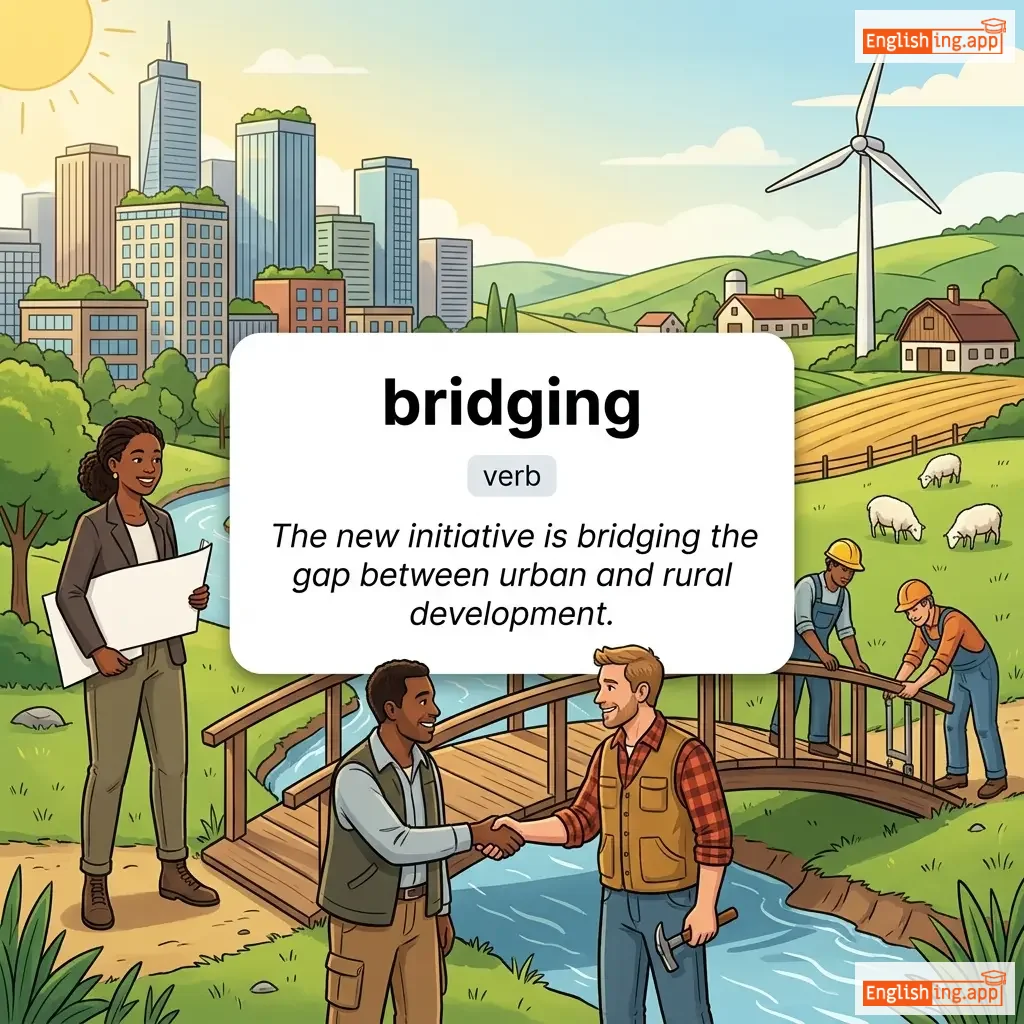
bridging definition card — visual illustration of the meaning
verb
/ˈbrɪdʒɪŋ/
橋を架ける、接続を作る (hashi wo kakeru, setsuzoku wo tsukuru)

The action of building a bridge over something; connecting or reducing the distance between two things.

"The new initiative is bridging the gap between urban and rural development."

"新しい取り組みは都市と農村の開発のギャップを埋めています。" (Atarashī torikumi wa toshi to nōson no kaihatsu no gyappu o umeteimasu.)
noun/verb
/ˈbraɪ.dəl/

A bridle is a piece of equipment used to control a horse; as a verb, it means to show anger or to restrain.

"The rider tightened the bridle before setting off."

adjective, noun, verb
/briːf/
簡潔な (kanketsu na)

Short in duration; a summary of information.

"The manager briefed the team before the meeting."

"マネージャーは会議の前にチームに簡潔な説明を行いました。" (Mane-ja wa kaigi no mae ni chi-mu ni kanketsu na setsumei o okonai mashita.)
adverb
/ˈbriːfli/
簡潔に (kanketsu ni)

For a short time; in a few words.

"She spoke briefly about her travel experience."

"彼女は自分の旅行経験について簡潔に話しました。" (Kanojo wa jibun no ryokō keiken ni tsuite kanketsu ni hanashimashita.)
noun
/brɪˈɡeɪd/
消防隊 (shouboutai)

A large group of people organized for a specific purpose, especially a military unit.

"The fire brigade arrived quickly to put out the flames."

"消防隊は火を消すために迅速に到着しました。" (Shouboutai wa hi wo kesu tame ni jinsoku ni touchakushimashita.)
noun
/ˌbrɪɡ.əˈdɪər/
ブリガディア (brigadia)

A military officer rank, usually commanding a brigade.

"The brigadier inspected the troops before the parade."

"ブリガディアはパレードの前に部隊を視察しました。" (Brigadia wa parēdo no mae ni butai o shisatsu shimashita.)
noun
/ˈbrɪɡ.ənd/
山賊 (sanzoku)

A member of a gang that ambushes and robs people in forests or mountains; a bandit.

"The travelers were attacked by brigands in the mountains."

"旅行者は山中で山賊に襲われました。" (Ryokōsha wa sanchū de sanzoku ni osowaremashita.)
adjective
/braɪt/
明るい (akarui)

Giving out or reflecting a lot of light; intelligent or cheerful.

"The bright sun lit up the entire valley."

"明るい太陽が谷全体を照らしました。" (Akarui taiyou ga tani zentai o terashimashita.)
verb
/ˈbraɪtən/
明るくする (akaruku suru)

to make something lighter or more colorful; to improve mood or make happier

"A few kind words can brighten someone's day."

"優しい言葉は誰かの一日を明るくすることができる。" (yasashii kotoba wa dareka no ichinichi o akaruku suru koto ga dekiru)
adverb
/ˈbraɪtli/
明るく (akaruku)

in a way that gives off a lot of light; in a vivid, cheerful, or intelligent manner

"The stars shone brightly in the clear night sky."

"澄んだ夜空に星が明るく輝いていた。" (Sunda yozora ni hoshi ga akaruku kagayaite ita)
adjective
/ˈbrɪliənt/
素晴らしい (subarashii)

Exceptionally clever, talented, or impressive; very bright or radiant.

"She gave a brilliant performance on stage."

"彼女はステージで素晴らしいパフォーマンスをしました。" (Kanojo wa suteeji de subarashii pafōmansu o shimashita.)
noun/verb
/brɪm/
(fuchi)

The edge of a container; as a verb, to be full to the point of overflowing.

"Her eyes brimmed with tears of joy."

"彼女の目は喜びの涙であふれていました。" (Kanojo no me wa yorokobi no namida de afureteimashita.)
noun
/ˈbrɪmˌstoʊn/

Sulfur, especially when considered as fiery and associated with hell or divine punishment.

"The preacher spoke of fire and brimstone to warn the congregation."

adjective
/ˈbrɪndl̩d/
ぶち模様 (buchimoyou)

Having a brownish or tawny color with streaks or spots of another color.

"The farmer owned a brindled cow with distinctive stripes."

"農家は特徴的なストライプのあるぶち模様の牛を飼っていた。" (Nouka wa tokuchou-teki na sutoraipu no aru buchimoyou no ushi wo katte ita.)
noun
/braɪn/
塩水 (ensui)

Water saturated with salt, often used for preserving food.

"The olives were stored in brine to keep them fresh."
"オリーブは新鮮さを保つために塩水に保存されました。" (Orību wa shinsen-sa o tamotsu tame ni ensui ni hozon saremashita.)
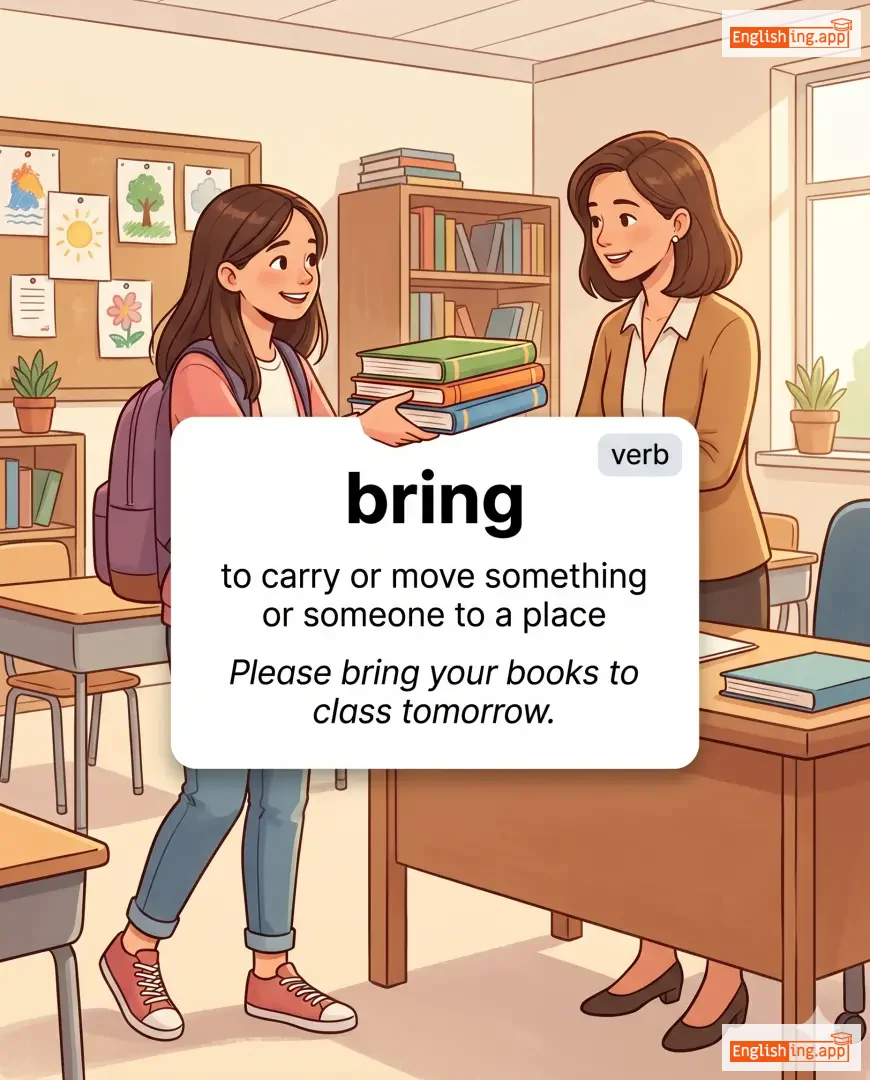
bring definition card — visual illustration of the meaning
verb
/brɪŋ/
持ってくる (mottekuru)

to carry or move something or someone to a place

"Please bring your books to class tomorrow."

"明日、クラスに本を持ってきてください。" (Ashita, kurasu ni hon o mottekite kudasai.)
noun
/ˈbrɪn.dʒəl/
ナス (nasu)

a large purple vegetable that is white inside; also called eggplant

"My mother cooked brinjal curry for lunch."

"母は昼食にナスのカレーを作りました。" (Haha wa chuushoku ni nasu no karee wo tsukurimashita.)
noun
/brɪŋk/
(en)

The edge or point just before a significant event or change.

"The company was on the brink of bankruptcy."

"会社は破産の縁に立っていた。" (Kaisha wa hasan no en ni tatte ita.)
adjective
/brɪsk/
速い (hayai)

Quick, energetic, and active in movement or speech.

"She took a brisk walk in the morning to stay healthy."

"彼女は健康を保つために朝に速い散歩をしました。" (Kanojo wa kenkou wo tamotsu tame ni asa ni hayai sanpo wo shimashita.)
verb, noun
/ˈbrɪsəl/
硬い毛; 怒りで反応する (katai ke; ikari de hannou suru)

to react angrily or defensively; a short stiff hair or fiber

"The cat bristled when it saw the dog."

"猫は犬を見て、毛が逆立った。" (Neko wa inu wo mite, ke ga sakadatta.)
adjective
/ˈbrɪslɪŋ/
逆立ちした; エネルギーに満ちた (sakadachi shita; enerugī ni michita)

full of energy, anger, or excitement; showing bristles standing up

"He entered the room bristling with confidence."

"彼は自信満々で部屋に入った。" (Kare wa jishin manman de heya ni haitta.)
noun
/brɪˈtæniə/
ブリタニア (Buritania)

the personification of Britain, often shown as a woman with a helmet and shield

"Britannia has been a symbol of Britain since Roman times."

"ブリタニアはローマ時代からイギリスの象徴です。" (Buritania wa Roma jidai kara Igirisu no shouchou desu.)
noun
/ˈbrɪtɪˌsɪzəm/
イギリス英語の単語または特徴 (Igirisu Eigo no tango mata wa tokuchou)

a word, phrase, or characteristic feature of British English

"The word 'lorry' is a well-known Briticism."

"'lorry' という言葉はよく知られているブリティシズムです。" ('Lorry' to iu kotoba wa yoku shira rete iru buritishizumu desu.)
adjective
/ˈbrɪtɪʃ/
イギリスの (igirisu no)

relating to Great Britain or its people

"She loves British culture and traditions."

"彼女はイギリスの文化と伝統が大好きです。" (Kanojo wa Igirisu no bunka to dentou ga daisuki desu.)
adjective
/ˈbrɪtl/
壊れやすい (kowareyasui)

easily broken or cracked; hard but liable to break

"The glass was so brittle that it cracked easily."

"ガラスはとても壊れやすくて、簡単に割れました。" (Gurasu wa totemo kowareyasukute, kantan ni waremashita.)
broach definition card — visual illustration of the meaning
verb
/broʊtʃ/
取り上げる (toriageru)

to bring up a subject for discussion

"She decided to broach the topic of salary with her manager."

"彼女はマネージャーと給料の話題を取り上げることに決めました。" (Kanojo wa maneja to kyūryō no wadai wo toriageru koto ni kimemashita.)
adjective
/brɔːd/
広い (hiroi)

wide in extent, range, or scope

"The river is very broad at this point."

"その川はこの地点で非常に広いです。" (Sono kawa wa kono chiten de hijō ni hiroi desu.)
noun
/ˈbrɔːd.bænd/
ブロードバンド (burodobando)

a high-capacity transmission technique using a wide range of frequencies.

"Broadband internet has become a necessity in modern homes."

"ブロードバンドインターネットは現代の家庭で必需品となっています。" (Burodobando intānetto wa gendai no katei de hitsujuhin to natteimasu.)
verb
/ˈbrɔːdˌkæst/
放送する (housou suru)

to transmit a program or information by radio, television, or online media

"The match was broadcast live on television."

"試合はテレビで生放送されました。" (Shiai wa terebi de namahousou saremashita.)
noun
/ˈbrɔːdˌkæstər/
放送者 (housousha)

a person or organization that transmits a broadcast program.

"The broadcaster aired the match live to millions of viewers."

"ブロードキャスターは試合を数百万の視聴者にライブ放送しました。" (Burodokyasutā wa shiai o suuhyaku-man no shichousha ni raibu housou shimashita.)
verb
/ˈbrɔːdən/
広げる (hirogeru)

to make wider or larger in scope; to expand ideas, experience, or understanding

"Travel can broaden your perspective on different cultures."

"旅行は異なる文化への視野を広げてくれる。" (Ryoko wa kotonaru bunka e no shiya o hirogete kureru)
adverb
/ˈbrɔːdli/
広く (hiroku)

in a general or wide manner.

"The rules are broadly similar across all regions."

"ルールはすべての地域で大まかに似ています。" (Ruru wa subete no chiiki de oomakani niteimasu.)
noun
/ˈbrɔːdˌsaɪd/
激しい攻撃 (hageshī kōgeki)

a strong verbal attack or a sheet of paper printed on one side

"The politician launched a broadside against his opponent."

"政治家は相手に対して激しい攻撃を仕掛けました。" (Seijika wa aite ni taishite hageshī kōgeki o shikakemashita.)
noun
/brəˈkeɪd/
刺繍布 (shishū nuno)

a rich fabric woven with a raised pattern, often in gold or silver thread

"She wore a beautiful brocade dress to the wedding."

"彼女は結婚式で美しいブロケイドのドレスを着ていました。" (Kanojo wa kekkonshiki de utsukushī burokeido no doresu o kite imashita.)
noun
/broʊˈʃʊr/
パンフレット (panfuretto)

a small booklet or pamphlet containing information or advertising

"The travel agent gave us a brochure about the holiday package."

"旅行代理店は休暇パッケージについてのパンフレットをくれました。" (Ryokou dairiten wa kyuuka pakkēji ni tsuite no panfuretto o kuremashita.)
noun
/ˈbroʊɡən/
重い靴 (omoi kutsu)

A heavy, sturdy shoe, often made of leather.

"The farmer wore old brogans while working in the field."

"農夫は畑で働いている間、古いブローガンを履いていました。" (Nōfu wa hatake de hataraiteiru aida, furui burōgan o haite imashita.)
noun
/broʊɡ/
丈夫な靴; アクセント (joubu na kutsu; akusento)

A strong outdoor shoe; also a marked accent, especially Irish or Scottish.

"He bought a pair of stylish brogues for the wedding."

"彼は結婚式のためにおしゃれなブローグを買いました。" (Kare wa kekkonshiki no tame ni oshare na buroogu o kaimashita.)
verb
/brɔɪl/
グリルする (guriru suru)

To cook food by direct heat, usually under a grill or over a fire.

"She broiled the chicken until it was golden brown."

"彼女は鶏肉を金色に焼くまで焼いた。" (Kanojo wa toriniku wo kin'iro ni yaku made yaita.)
verb; adjective
/broʊk/
壊した;無一文 (kowashita; muichimon)

past tense of break; having no money or being financially poor

"I broke my phone last night and now I’m completely broke."

"昨夜スマホを壊してしまい、今は無一文です。" (sakuya sumaho o kowashite shimai ima wa muichimon desu)