वोकैबुलरीज

इंग्लिश वोकैबुलरी डिस्कवर, लर्न और मास्टर करें

noun
/ˈroʊ.lɪŋ pɪn/
बेलन (belan)

a cylindrical tool used for rolling out dough or pastry

"Roll the dough flat with a rolling pin."

"बेलन से आटा चपटा करो।" (belan se aata chapta karo.)
adjective, noun
/ˈroʊmən/
रोमन / रोम का नागरिक (roman / rom ka nagrik)

relating to Rome or its people; a citizen of ancient Rome

"The Roman Empire influenced much of modern civilization."

"रोमन साम्राज्य ने आधुनिक सभ्यता के बहुत से हिस्सों को प्रभावित किया।" (Roman samrajya ne adhunic sabhyata ke bahut se hisso ko prabhavit kiya.)
noun
/roʊˈmæns/
रोमांस, प्रेम (romansh, prem)

a feeling of love, especially one that is exciting and mysterious

"Their romance began during a summer trip to Paris."

"उनका रोमांस पेरिस की गर्मी छुट्टी के दौरान शुरू हुआ।" (Unka romansh Paris ki garmi chhutti ke dauran shuru hua.)
adjective
/rəʊˈmæntɪk/
रोमांटिक (romantic)

related to or involving love or feelings of love

"He wrote her a romantic letter for their anniversary."

"उसने उनके सालगिरह पर उसे एक रोमांटिक पत्र लिखा।" (Usne unke salgirah par use ek romantic patra likha.)
verb
/rɒmp/
आनंद में खेलना (anand mein khelna)

to play or move in a lively, carefree, and energetic way

"The children romped happily in the garden."

"बच्चे बग़ीचे में खुशी से खेल रहे थे।" (Bacche bagiche mein khushi se khel rahe the.)
noun
/ˈrɒndoʊ/
संगीत रचना (पुनरावृत्त थीम के साथ) (sangeet rochna (punaravritti theme ke saath))

a musical composition with a recurring leading theme

"The pianist ended the recital with a lively rondo."

"पियानोवादक ने एक जीवंत रोंडो के साथ कार्यक्रम समाप्त किया।" (Piyanavadak ne ek jeevant rondo ke saath karyakram samaapt kiya.)
noun
/ruːd/
क्रूस (krus)

a crucifix, especially one positioned above the entrance to the chancel of a church

"The old church displayed a carved rood above the altar."

"पुरानी चर्च ने वेदी के ऊपर एक उकेरा हुआ क्रूस प्रदर्शित किया था।" (Puraani church ne vedi ke upar ek ukeyra hua kroos prodorshit kiya tha.)
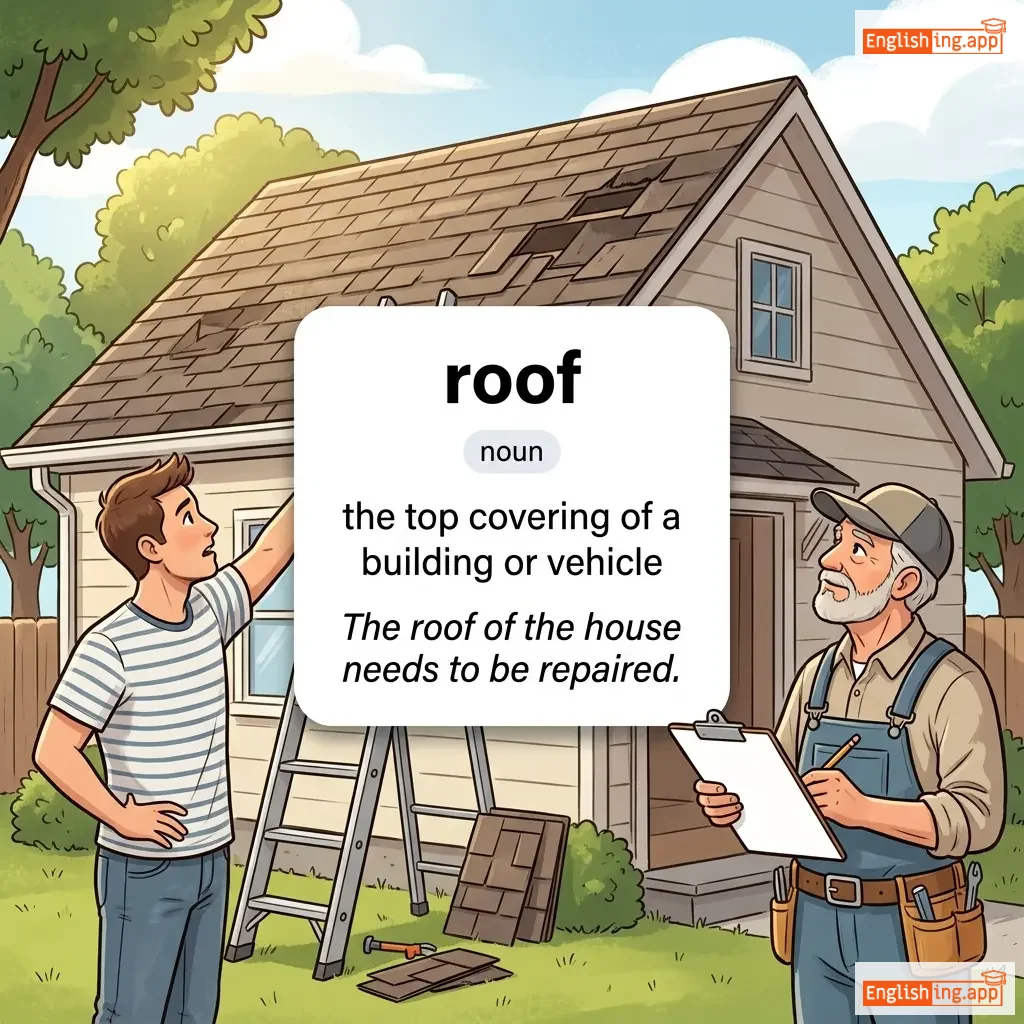
roof definition card — visual illustration of the meaning
noun
/ruːf/
छत (chat)

the top covering of a building or vehicle

"The roof of the house needs to be repaired."

"घर की छत को मरम्मत की आवश्यकता है।" (Ghar ki chat ko marammat ki avashyakta hai.)
noun
/ˈrʊkəri/
पक्षी का बसेरा (pakshi ka basera)

a place where rooks or other birds breed and nest in colonies

"We saw a rookery full of noisy birds near the forest."

"हमने जंगल के पास शोरगुल से भरा एक पक्षी का बसेरा देखा।" (Hamne jangl ke paas shorgul se bhara ek pakshi ka basera dekha.)
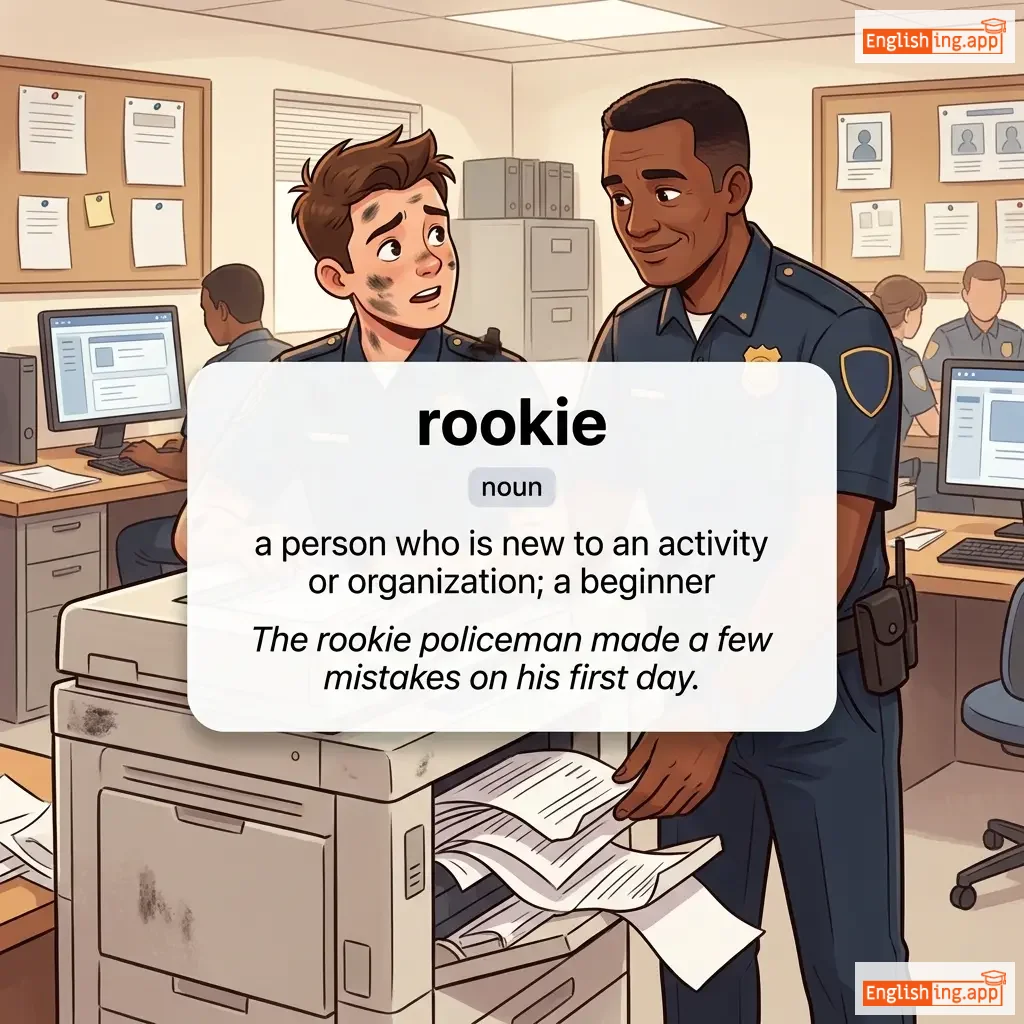
rookie definition card — visual illustration of the meaning
noun
/ˈrʊki/
नवीन (naveen)

a person who is new to an activity or organization; a beginner

"The rookie policeman made a few mistakes on his first day."

"नवीन पुलिसकर्मी ने पहले दिन कुछ गलतियाँ कीं।" (Naveen puliskarmi ne pehle din kuch galtiyan keen.)
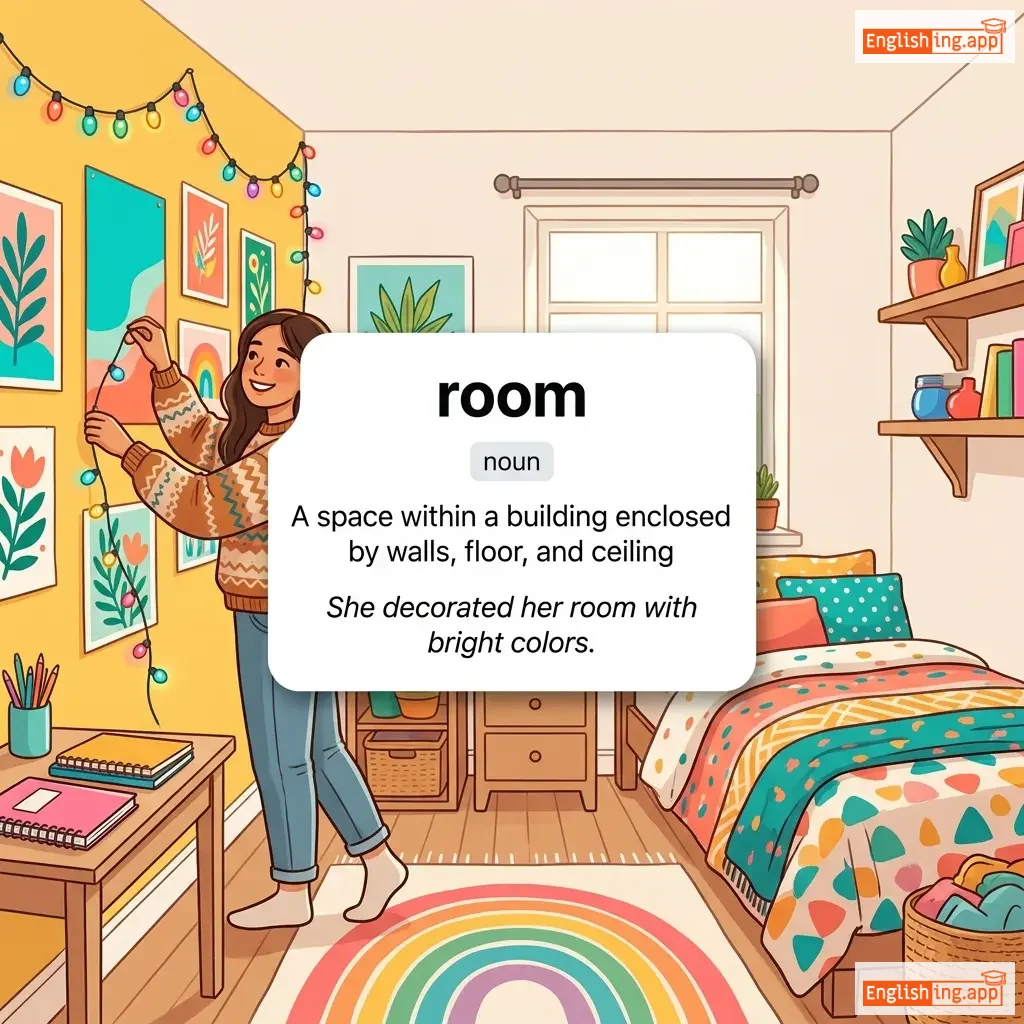
room definition card — visual illustration of the meaning
noun
/ruːm/
कमरा (kamra)

A space within a building enclosed by walls, floor, and ceiling

"She decorated her room with bright colors."

"उसने अपने कमरे को चमकीले रंगों से सजाया।" (usne apne kamre ko chamkile rangon se sajaya.)
adjective
/ˈruː.mi/
विस्तृत; अधिक जगह वाला (vistrit; adhik jagah wala)

spacious; having a lot of room

"The apartment is very roomy with spacious bedrooms."

"अपार्टमेंट बहुत रूमी है जिसमें विशाल बेडरूम हैं।" (apartment bahut roomy hai jismein vishal bedroom hain)
noun
/ˈruːstər/
मुर्गा (murga)

A male domestic chicken, especially one that crows.

"The rooster crowed at dawn, waking up the whole village."

"मुर्गा सुबह-सुबह बांग देता है, पूरे गाँव को जगा देता है।" (murga subah-subah baang deta hai, poore gaon ko jaga deta hai.)
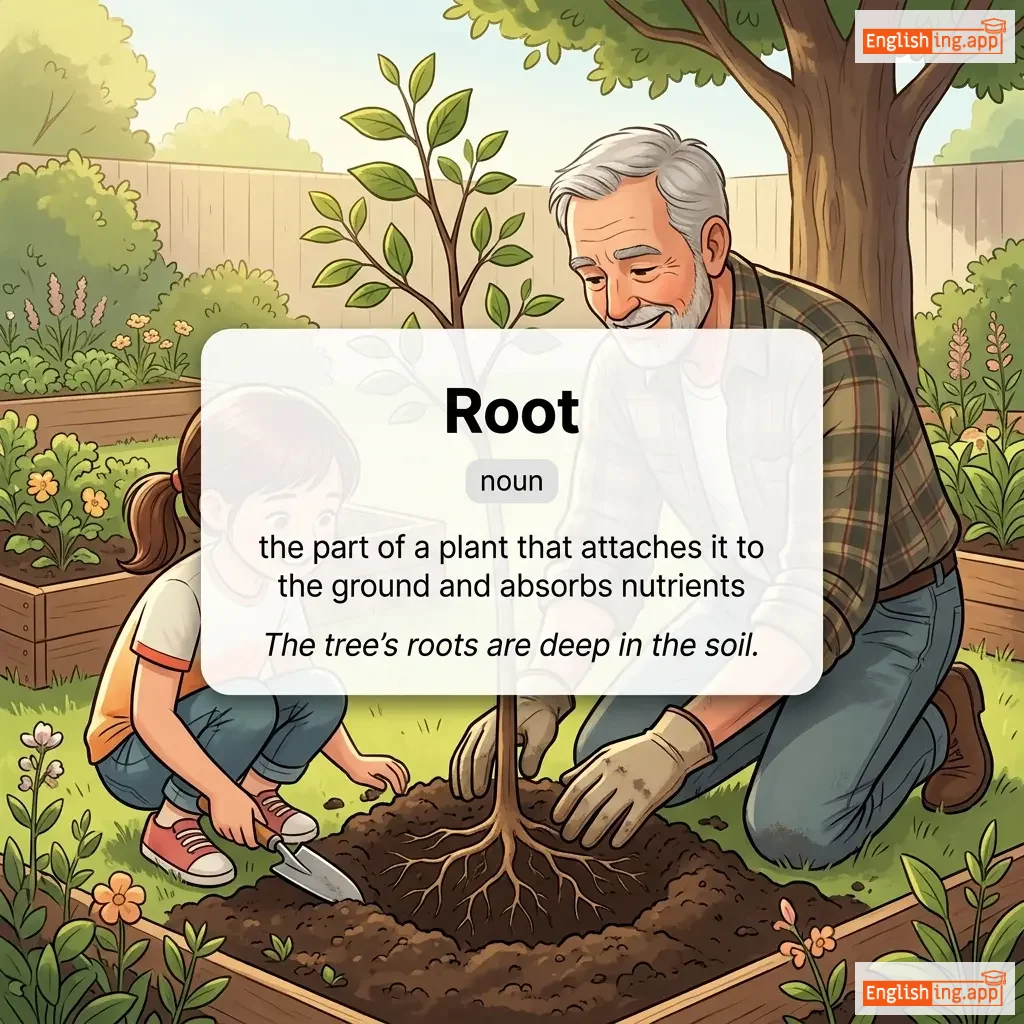
Root definition card — visual illustration of the meaning
noun
/ruːt/
जड़ (jad)

the part of a plant that attaches it to the ground and absorbs nutrients

"The tree's roots are deep in the soil."

"वृक्ष की जड़ें मिट्टी में गहरी हैं।" (Vriksh ki jaden mitti mein gehri hain.)
adjective
/ˈruː.tɪd/
जड़े हुए (rooted)

deeply established; firmly fixed

"His beliefs are deeply rooted in tradition."

"उसके विश्वास परंपरा में गहरे जड़े हुए हैं." (Uske vishwas parampara mein gahare jade hue hain.)
noun
/roʊp/
रस्सी (rassi)

a strong, thick cord made of twisted fibers or strands

"The climbers used a rope to scale the mountain."

"चढ़ाई करने के लिए पर्वतारोहियों ने एक रस्सी का उपयोग किया।" (Chadhai karne ke liye parvatarohiyon ne ek rassi ka upyog kiya.)
ropes definition card — visual illustration of the meaning
noun
roʊps
रस्सियाँ (rassiyan)

A length of thick strong cord made by twisting together strands of hemp, sisal, nylon, or similar material.

"The ropes were tied securely to lift the heavy load."

"भारी सामान उठाने के लिए रस्सियाँ मजबूती से बांधी गई थीं।" (Bhaaree samaan uthaaney ke liye rassiyan majbootee se baandhee gayee theen.)
noun
/roʊz/
गुलाब का फूल (gulaab ka phool)

a type of flowering plant, known for its beautiful and fragrant blooms

"She gave me a rose on my birthday."

"उसने मुझे मेरे जन्मदिन पर एक गुलाब दिया।" (Usne mujhe mere janmadin par ek gulaab diya.)
noun
/roʊz ˈber.i/
गुलाब बेरी (rooz beri)

a type of berry with rose-like characteristics or flavor

"The rose berry has a delicate floral taste that reminds me of roses."

"रोज़ बेरी में एक नाजुक पुष्पीय स्वाद होता है जो मुझे गुलाबों की یاد दिलاتا है।" (rooz beri mein ek naazuk pushpiy swad hota hai jo mujhe gulabon ki yaad dilata hai.)
noun
/ˈroʊz ˈwɔː.tər/
गुलाब जल (gulab jal)

a flavored water made by steeping rose petals in water, used in cooking and cosmetics

"She added a few drops of rose-water to the dessert."

"उसने मिठाई में गुलाब जल की कुछ बूँदें डालीं।" (usne mithai mein gulab jal ki kuch boonden daali.)
adjective
/ˈroʊziət/
गुलाबी, आशावादी (gulabi, ashwadi)

Having a pink color; optimistic or idealistic.

"She looked at the future with roseate optimism."

"उसने भविष्य को रोज़ीएट आशावाद के साथ देखा।" (usne bhavishya ko roseate ashwad ke saath dekha.)
noun
/ˈrɑːstər/
सूची (soochi)

A list or plan showing people’s duties or times when they are scheduled.

"The manager updated the staff roster for next week."

"प्रबंधक ने अगले हफ्ते के लिए कर्मचारी सूची को अपडेट किया।" (prabandhak ne agle hafte ke liye karmchari soochi ko update kiya.)
noun
/ˈrɒstrəm/
मंच (manch)

A raised platform for speakers, performers, or leaders.

"The politician delivered a speech from the rostrum."

"राजनीतिज्ञ ने रॉस्ट्रम से भाषण दिया।" (raajnaitik ne rostrum se bhashan diya.)
verb
/rɒt/
सड़ना (sadna)

to decay or decompose; to become corrupt

"The fruit will rot if left in the sun."

"अगर फल को धूप में छोड़ दिया तो वह सड़ जाएगा।" (Agar phal ko dhoop mein chhod diya to wah sad jaayega)
adjective
/ˈroʊtəri/
घूर्णन संबंधी (ghurnan sambandhi)

Relating to or characterized by rotation; revolving around an axis.

"The machine uses a rotary engine to function efficiently."

"मशीन प्रभावी रूप से काम करने के लिए एक रोटरी इंजन का उपयोग करती है।" (machine prabhavi roop se kaam karne ke liye ek rotary engine ka upyog karti hai.)
verb
/ˈroʊ.teɪt/
घूमना (ghoomna)

to turn around a central point or axis

"The Earth rotates on its axis once every 24 hours."

"पृथ्वी अपने अक्ष के चारों ओर हर 24 घंटे में एक बार घूमती है।" (Prithvi apne aksh ke chaaron aur har 24 ghante mein ek baar ghoomti hai.)
noun
/rəʊˈteɪʃən/
घूमाव (ghoomav)

the action of rotating or turning something around a center or axis

"The rotation of the earth around the sun causes seasons."

"पृथ्वी की धूरी के चारों ओर घूमें से मौसम बदलते हैं।" (Prithvi ki dhuri ke charon or ghoomne se mausam badalte hain.)
noun
/roʊt/
यांत्रिक रूप से रटना (yantrik roop se ratna)

mechanical or habitual repetition, often without understanding

"He learned the poem by rote without understanding its meaning."

"उसने बिना इसके अर्थ को समझे कविता रोट से याद की।" (Usne bina iske arth ko samjhe kavita rot se yaad ki.)
adjective
/ˈrɒt.ən/
सड़ा हुआ; बुरा (sada hua; bura)

decayed; spoiled; bad

"The apple is rotten and should be thrown away."

"सेब सड़ा हुआ है और इसे फेंक देना चाहिए।" (seb sada hua hai aur ise phenk dena chahiye.)
adjective
/roʊˈtʌnd/
गोलाकार (golakar)

round or plump in shape; full in sound

"The rotund cat struggled to climb the fence."

"गोलाकार बिल्ली को बाड़े में चढ़ने में कठिनाई हो रही थी।" (Golakar billi ko baade mein chadhne mein kathinai ho rahi thi.)
noun
/roʊˈtʌn.də/
वृत्ताकार भवन (vruttakar bhavan)

a large circular building or hall, often with a dome

"Tourists gathered inside the grand rotunda of the capitol."

"पर्यटकों ने कैपिटल के भव्य रोटुंडा के अंदर इकट्ठा किया।" (Paryatakon ne capital ke bhavya rotunda ke andar ikattha kiya.)
noun
/roʊˈtʌn.də.ti/
गोलाकारता (golakarta)

the quality of being round or plump

"The rotundity of the balloon made it float gracefully."

"गेंदे की गोलाकारता ने उसे सुंदरता से तैरते हुए बना दिया।" (Gende ki golakarta ne use sundarta se tairte hue bana diya.)
noun
/ruːˈeɪ/
वह व्यक्ति जो भोगविलास में लिप्त होता है (vah vyakti jo bhogvilas mein lipta hota hai)

A man devoted to a life of sensual pleasure; a debauched man.

"The old roue squandered his fortune on gambling and women."

"पुराना वह व्यक्ति अपने सारे पैसे जुआ और महिलाओं पर खर्च कर चुका था।" (Purana vah vyakti apne saare paise jua aur mahilaon par kharch kar chuka tha.)
adjective
/rʌf/
खुरदुरा (khurdura)

having an uneven or irregular surface; not smooth or level

"The road was rough and difficult to drive on."

"सड़क खुरदुरी थी और उस पर ड्राइव करना कठिन था।" (Sadak khurdura thi aur us par drive karna kathin tha.)
adverb
/ˈrʌfli/
लगभग (lagbhag)

in a manner that is not precise or exact; approximately

"He roughly estimated the cost of the project."

"उसने परियोजना की लागत लगभग अनुमानित की।" (Usne pariyojna ki lagat lagbhag anumanit ki.)
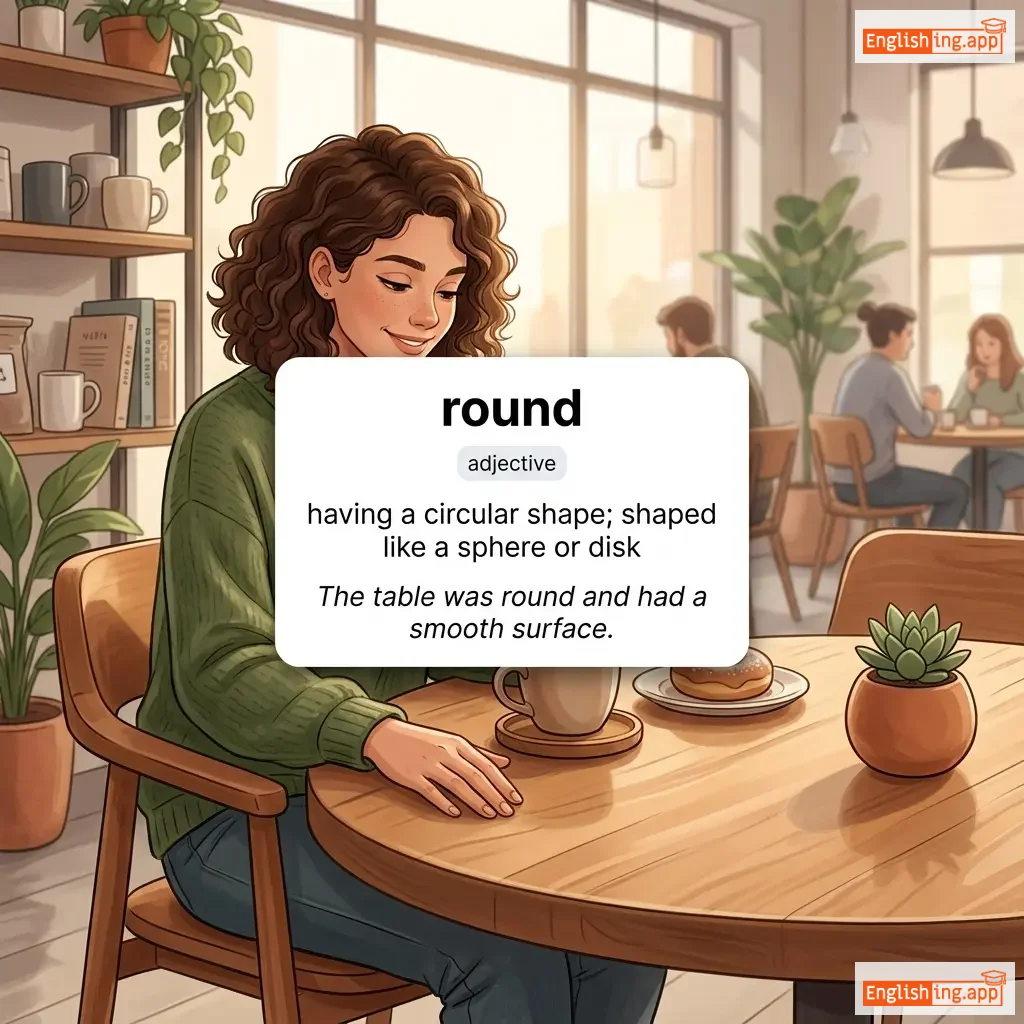
round definition card — visual illustration of the meaning
adjective
/raʊnd/
गोलाकार (golakar)

having a circular shape; shaped like a sphere or disk

"The table was round and had a smooth surface."

"टेबल गोल आकार का था और उसका सतह चिकना था।" (Tebal gol akar ka tha aur uska satah chikna tha.)
verb
/ˈrʌf.l̩/
उलझाना, परेशान करना (uljhana, pareshan karna)

to disturb the smoothness of something; to annoy or upset someone

"The wind ruffled her hair."

"हवा ने उसके बाल उलझा दिए।" (Hawa ne uske baal uljha diye.)
adjective
/ˈrʌdi/
लालिमा (radii)

Having a healthy red color in the face.

"She had a ruddy complexion from working outdoors."

"वह बाहर काम करने से लालिमा से भरी हुई थी।" (vah baahar kaam karne se laalima se bhari hui thi.)
adjective
/ruːd/
असभ्य (asabhya)

Not having or showing respect; impolite

"It was rude of him to interrupt the conversation."

"उसके लिए बातचीत में बाधा डालना असभ्य था।" (uske liye baatcheet mein baadha daalna asabhya tha.)
adverb
/ˈruːdli/
असभ्य तरीके से (asabhya tarike se)

in an impolite or discourteous manner

"He rudely interrupted the speaker during the presentation."

"उसने प्रस्तुति के दौरान वक्ता को असभ्य तरीके से टोक दिया।" (Usne prastuti ke dauran vakta ko asabhya tarike se tok diya.)
noun
/ˈruːdnəs/
अशिष्टता (rud-ness)

the quality of being impolite, discourteous, or offensive in behavior or speech

"His rudeness shocked everyone at the dinner party."

"उसकी अशिष्टता ने डिनर पार्टी में सभी को चौंका दिया।" (uski asishtata ne dinner party mein sabhi ko chauka diya.)
noun
/ˈruːdɪmənt/
मूलभूत शिक्षा (moolbhoot shiksha)

A basic principle, element, or fundamental part of something.

"He learned the rudiments of music before joining the band."

"उसने बैंड में शामिल होने से पहले संगीत की मौलिक शिक्षा सीखी।" (Usne band mein shamil hone se pehle sangeet ki moolbhoot shiksha seekhi.)
adjective
/ˌruːdɪˈmɛntəri/
मूलभूत (moolbhoot)

Involving or limited to basic principles; elementary or simple.

"The village school provided only a rudimentary education."

"गाँव के स्कूल ने केवल एक मौलिक शिक्षा प्रदान की।" (Gaav ke school ne keval ek moolbhoot shiksha pradan ki.)
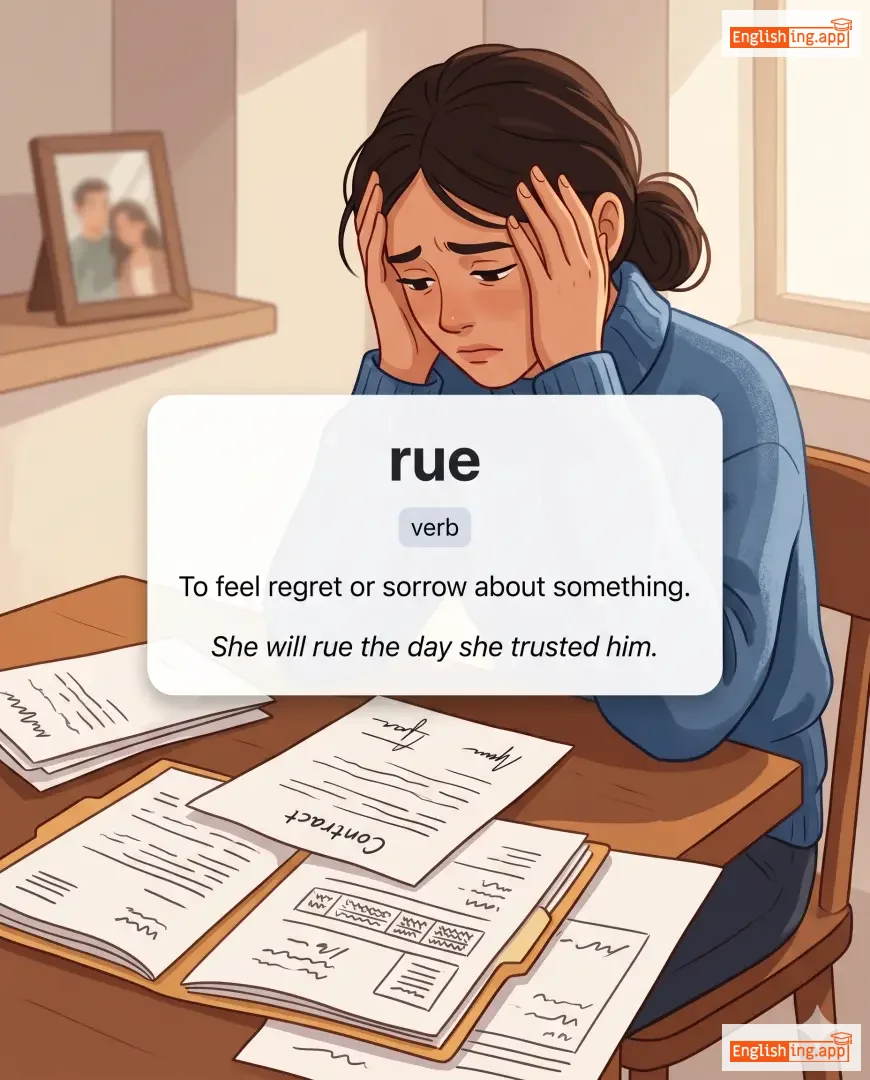
rue definition card — visual illustration of the meaning
verb
/ruː/
पछताना (pachtana)

To feel regret or sorrow about something.

"She will rue the day she trusted him."

"वह उस दिन पछताएगी जब उसने उसे भरोसा किया था।" (Vah us din pachhtayegi jab usne use bharosa kiya tha.)
adjective
/ˈruːfəl/
दुःखित (dukhit)

Expressing sorrow, regret, or pity.

"He gave a rueful smile after losing the match."

"उसने मैच हारने के बाद एक दुःखभरी मुस्कान दी।" (Usne match haarne ke baad ek dukhbhari muskaan di.)
noun
/ˈrʌfiən/
उच्चार (uchchar)

A violent or lawless person; a bully.

"The ruffians vandalized the shop late at night."

"रात में गुंडों ने दुकान को नष्ट कर दिया।" (Raat mein gundo ne dukaan ko nasht kar diya.)
noun
/ˈruːlɪŋ/
फैसला (faisla)

an official decision made by a judge or authority.

"The court’s ruling favored the defendant."

"कोर्ट का फैसला अभियुक्त के पक्ष में था।" (Kourt ka faisla abhiyukt ke paksh mein tha.)
noun
/ruːlz/
नियम (niyam)

explicit principles or regulations governing conduct or procedure within a particular area of activity

"The teacher reminded the students to follow the classroom rules."

"शिक्षक ने छात्रों को कक्षा के नियमों का पालन करने की याद दिलाई।" (Shikshak ne chhatron ko kaksha ke niyamon ka paalan karne ki yaad dilayi.)
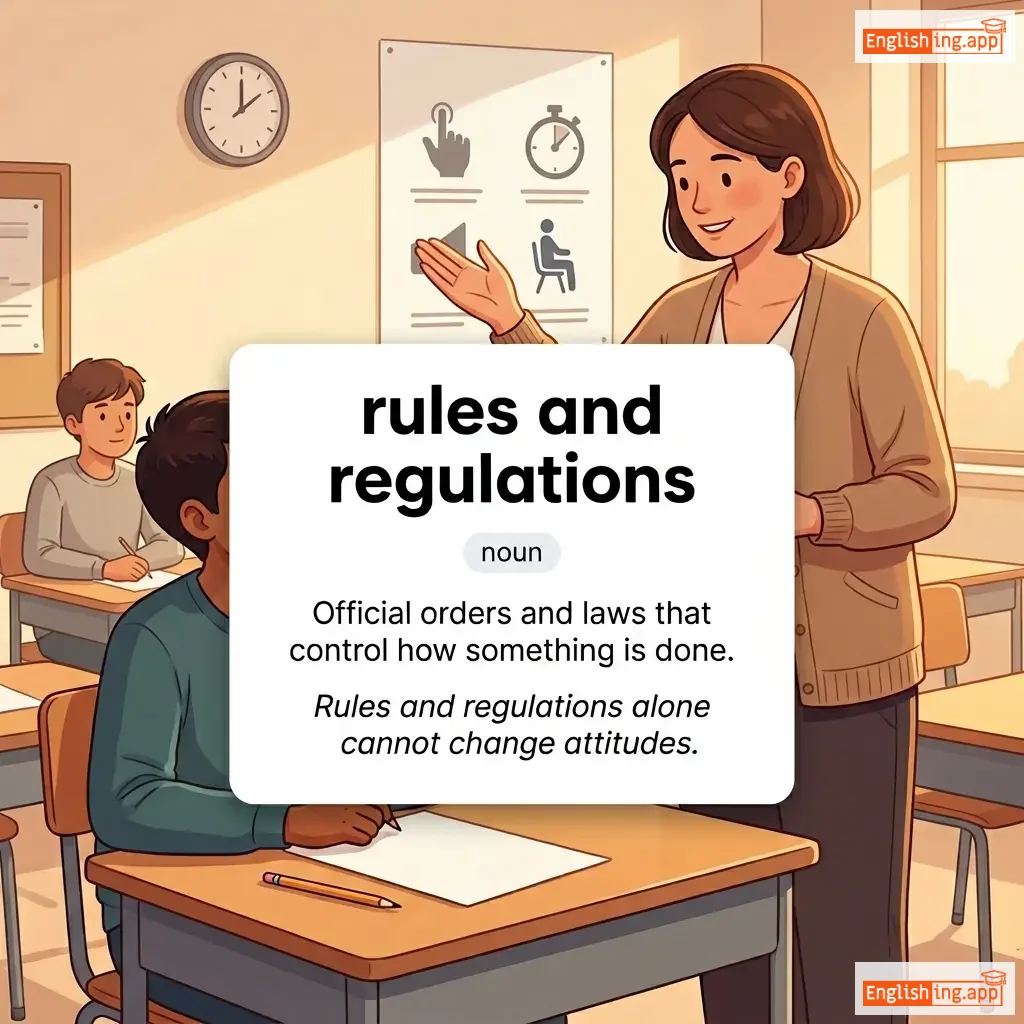
rules and regulations definition card — visual illustration of the meaning
noun
ruːlz ənd ˌrɛɡjʊˈleɪʃənz
नियम और विनियम (niyam aur niyam)

Official orders and laws that control how something is done.

"Rules and regulations alone cannot change attitudes."

"नियम और विनियम अकेले दृष्टिकोण बदल नहीं सकते।" (niyam aur niyam akele drishtikon badal nahin sakte.)
noun
/ˈruːlər/
शासक; मापने वाली रेखा (shasak; mapne wali rekha)

A person who governs or controls a country; a straight-edged tool used for measuring or drawing lines

"The ruler drew a straight line on the paper while the king was a powerful ruler of his kingdom."

"रूलर ने कागज़ पर सीधी रेखा खींची और राजा अपने राज्य का शक्तिशाली शासक था।" (rular ne kagaz par seedhi rekha kheenchii aur raja apne rajya ka shaktishaali shasak tha.)