Vocabularios

Descubra, aprenda y domine el vocabulario en inglés

noun
/ˈroʊ.lɪŋ pɪn/
rodillo (rodillo)

a cylindrical tool used for rolling out dough or pastry

"Roll the dough flat with a rolling pin."

"Extiende la masa con un rodillo." (Extiende la masa con un rodillo.)
adjective, noun
/ˈroʊmən/
romano / ciudadano romano (romano / ciudadano romano)

relating to Rome or its people; a citizen of ancient Rome

"The Roman Empire influenced much of modern civilization."

"El Imperio Romano influyó en gran parte de la civilización moderna." (El Imperio Romano influyó en gran parte de la civilización moderna.)
noun
/roʊˈmæns/
romance, amor (romansh, amor)

a feeling of love, especially one that is exciting and mysterious

"Their romance began during a summer trip to Paris."

"Su romance comenzó durante un viaje de verano a París." (Su romance comenzó durante un viaje de verano a París.)
adjective
/rəʊˈmæntɪk/
romántico (romantico)

related to or involving love or feelings of love

"He wrote her a romantic letter for their anniversary."

"Él le escribió una carta romántica para su aniversario." (El le escribio una carta romantica para su aniversario.)
verb
/rɒmp/
jugar alegremente (jugar alegremente)

to play or move in a lively, carefree, and energetic way

"The children romped happily in the garden."

"Los niños jugaban felices en el jardín." (Los niños jugaban felices en el jardín.)
noun
/ˈrɒndoʊ/
composición musical (con tema recurrente) (composicion musical (con tema recurrente))

a musical composition with a recurring leading theme

"The pianist ended the recital with a lively rondo."

"El pianista terminó el recital con un rondó animado." (El pianista termino el recital con un rondo animado.)
noun
/ruːd/
cruz (kruθ)

a crucifix, especially one positioned above the entrance to the chancel of a church

"The old church displayed a carved rood above the altar."

"La antigua iglesia exhibió una cruz tallada sobre el altar." (La antigua iglesia exhibió una cruz tallada sobre el altar.)
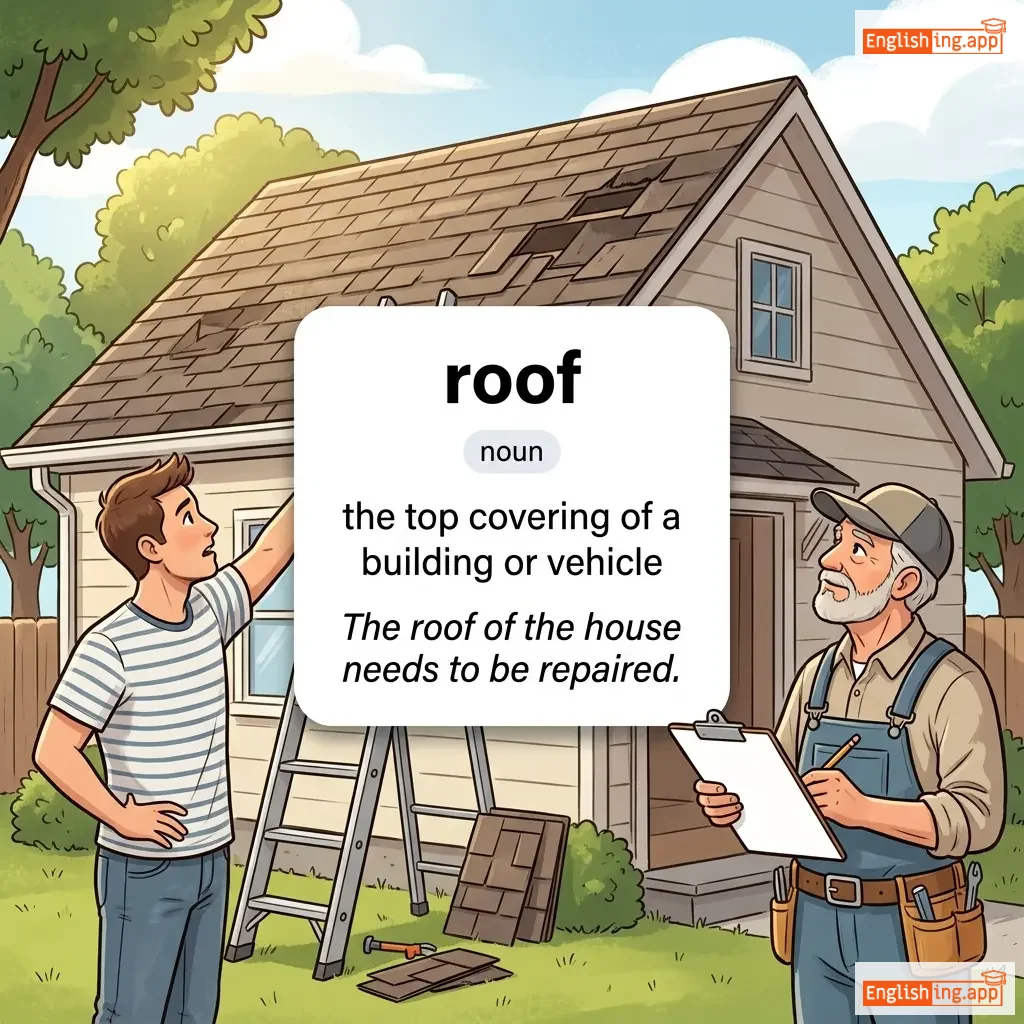
roof definition card — visual illustration of the meaning
noun
/ruːf/
techo (techo)

the top covering of a building or vehicle

"The roof of the house needs to be repaired."

"El techo de la casa necesita ser reparado." (El techo de la casa necesita ser reparado.)
noun
/ˈrʊkəri/
nido de aves (nido de aves)

a place where rooks or other birds breed and nest in colonies

"We saw a rookery full of noisy birds near the forest."

"Vimos un nido de aves lleno de pájaros ruidosos cerca del bosque." (Vimos un nido de aves lleno de pájaros ruidosos cerca del bosque.)
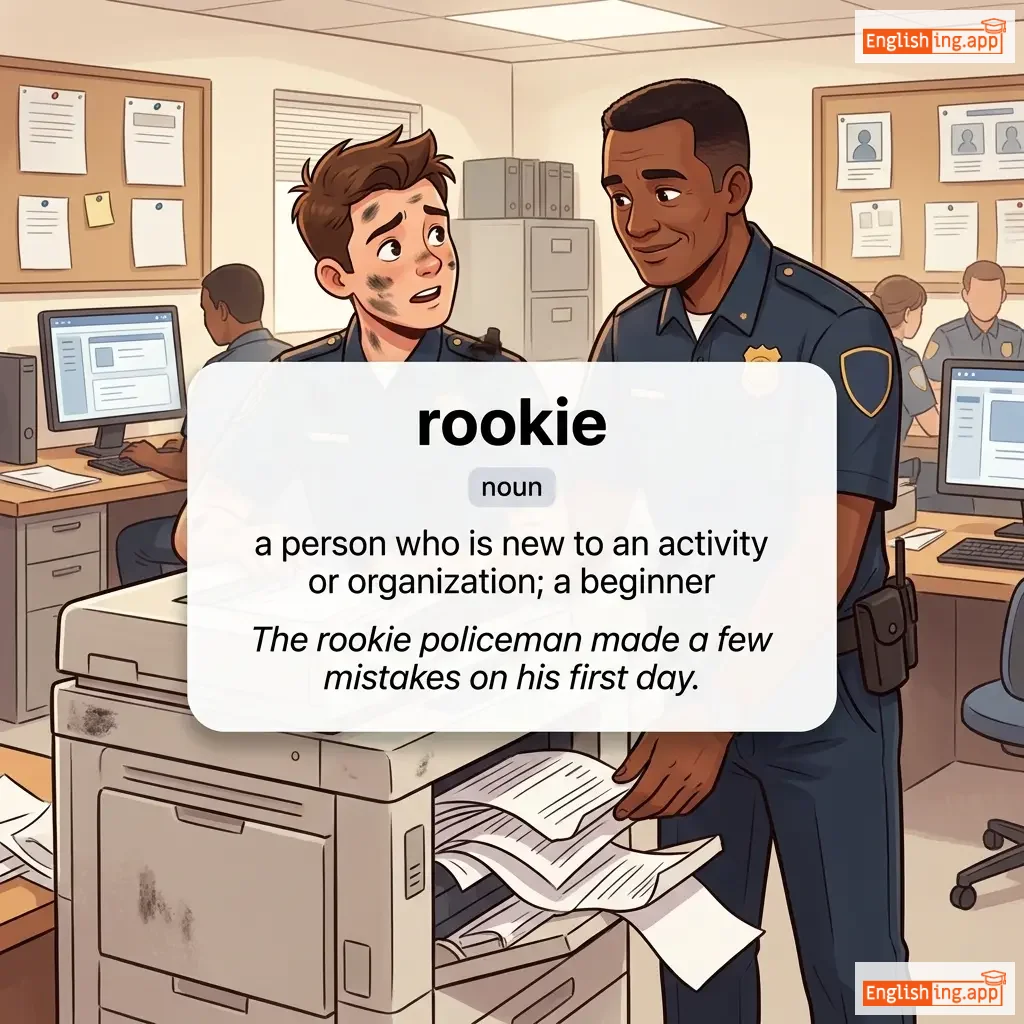
rookie definition card — visual illustration of the meaning
noun
/ˈrʊki/
novato (novato)

a person who is new to an activity or organization; a beginner

"The rookie policeman made a few mistakes on his first day."

"El policía novato cometió algunos errores en su primer día." (El policia novato cometio algunos errores en su primer dia.)
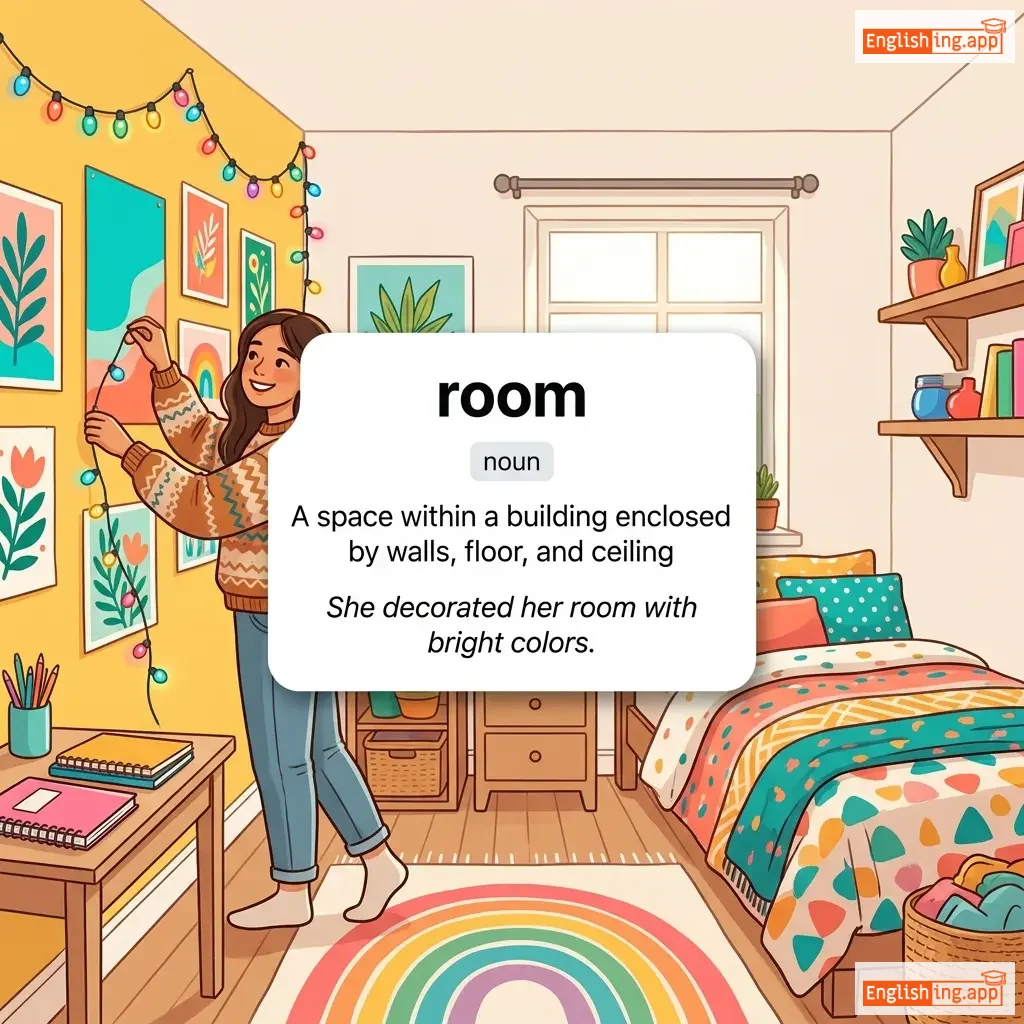
room definition card — visual illustration of the meaning
🛏️

room (rum)

noun
/ruːm/
habitación (habitacion)

A space within a building enclosed by walls, floor, and ceiling

"She decorated her room with bright colors."

"Ella decoró su habitación con colores brillantes." (eya dekoro su habitacion kon kolores brijantes)
adjective
/ˈruː.mi/
espacioso; con mucho espacio (espacioso; con mucho espacio)

spacious; having a lot of room

"The apartment is very roomy with spacious bedrooms."

"El apartamento es muy espacioso con habitaciones grandes." (El apartamento es muy espacioso con habitaciones grandes.)
noun
/ˈruːstər/
gallo (gallo)

A male domestic chicken, especially one that crows.

"The rooster crowed at dawn, waking up the whole village."

"El gallo cantó al amanecer, despertando a toda la aldea." (El gallo cantó al amanecer, despertando a toda la aldea.)
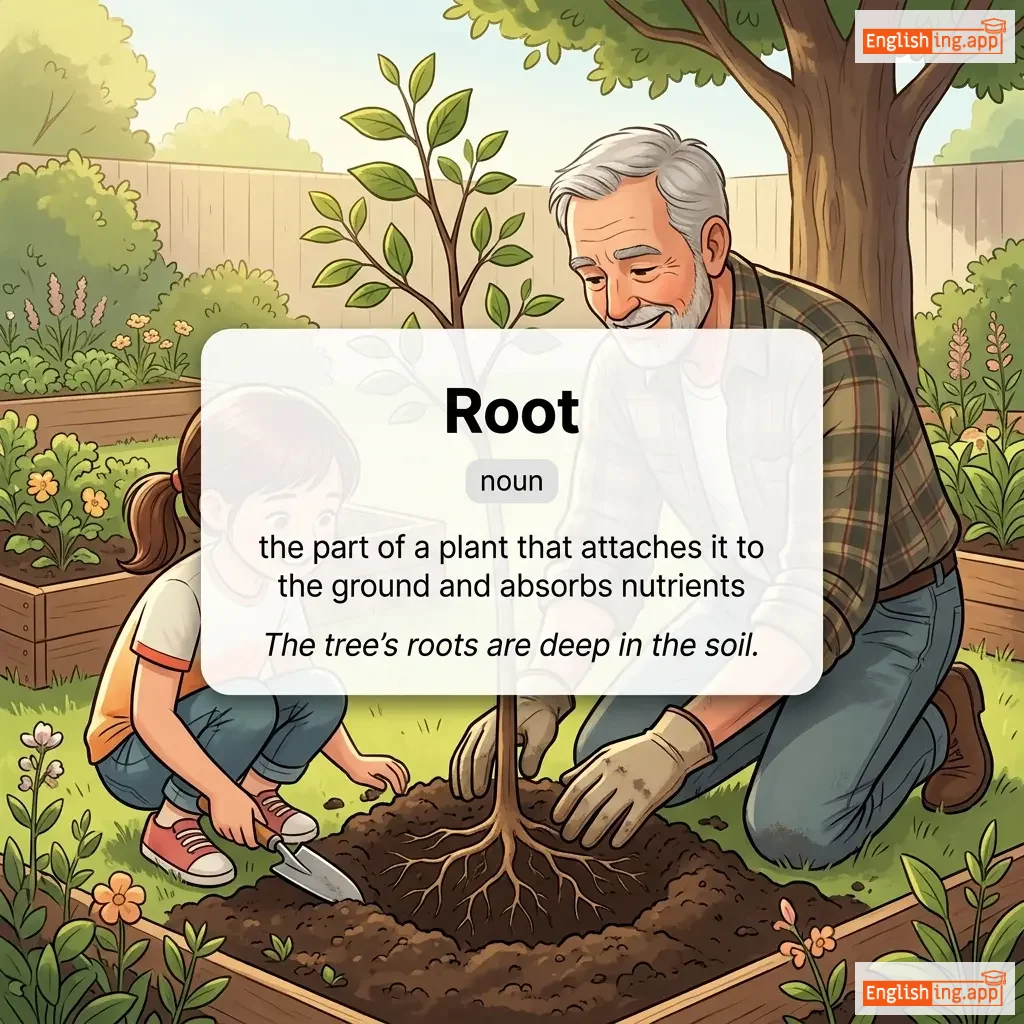
Root definition card — visual illustration of the meaning
noun
/ruːt/
raíz (raiz)

the part of a plant that attaches it to the ground and absorbs nutrients

"The tree's roots are deep in the soil."

"Las raíces del árbol están profundas en el suelo." (Las raices del arbol estan profundas en el suelo.)
adjective
/ˈruː.tɪd/
arraigado (rutid)

deeply established; firmly fixed

"His beliefs are deeply rooted in tradition."

"Sus creencias están profundamente arraigadas en la tradición." (Sus creencias estan profundamente arraigadas en la tradicion.)
noun
/roʊp/
cuerda (cuerta)

a strong, thick cord made of twisted fibers or strands

"The climbers used a rope to scale the mountain."

"Los escaladores usaron una cuerda para escalar la montaña." (Los escaladores usaron una cuerda para escalar la montaña.)
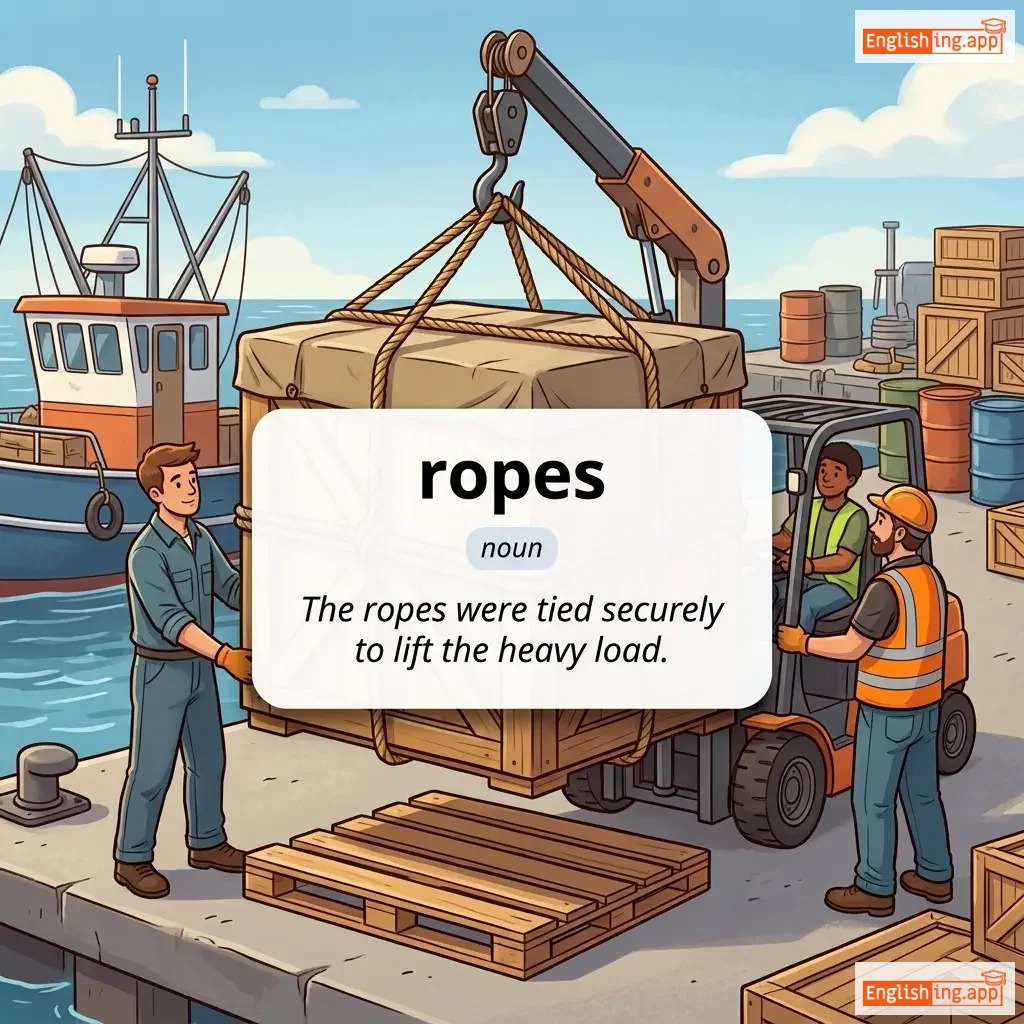
ropes definition card — visual illustration of the meaning
noun
roʊps
cuerdas (cuerdas)

A length of thick strong cord made by twisting together strands of hemp, sisal, nylon, or similar material.

"The ropes were tied securely to lift the heavy load."

"Las cuerdas estaban atadas firmemente para levantar la carga pesada." (Las cuerdas estaban atadas firmemente para levantar la carga pesada.)
noun
/roʊz/
flor de rosa (flor de rosa)

a type of flowering plant, known for its beautiful and fragrant blooms

"She gave me a rose on my birthday."

"Ella me dio una rosa en mi cumpleaños." (Ella me dio una rosa en mi cumpleaños.)
noun
/roʊz ˈber.i/
baya de rosa (rohz beree)

a type of berry with rose-like characteristics or flavor

"The rose berry has a delicate floral taste that reminds me of roses."

"La baya de rosa tiene un sabor floral delicado que me recuerda a las rosas." (La baya de rosa tiene un sabor floral delicado que me recuerda a las rosas.)
noun
/ˈroʊz ˈwɔː.tər/
agua de rosa (agua de rosa)

a flavored water made by steeping rose petals in water, used in cooking and cosmetics

"She added a few drops of rose-water to the dessert."

"Ella añadió unas gotas de agua de rosa al postre." (Ella añadió unas gotas de agua de rosa al postre.)
adjective
/ˈroʊziət/
rosado, optimista (rosado, optimista)

Having a pink color; optimistic or idealistic.

"She looked at the future with roseate optimism."

"Ella miró al futuro con un optimismo rosado." (Ella miro al futuro con un optimismo rosado.)
noun
/ˈrɑːstər/
lista (lista)

A list or plan showing people’s duties or times when they are scheduled.

"The manager updated the staff roster for next week."

"El gerente actualizó la lista del personal para la próxima semana." (El gerente actualizó la lista del personal para la próxima semana.)
noun
/ˈrɒstrəm/
estrado (estrado)

A raised platform for speakers, performers, or leaders.

"The politician delivered a speech from the rostrum."

"El político dio un discurso desde el estrado." (El politico dio un discurso desde el estrado.)
verb
/rɒt/
podrir (podrir)

to decay or decompose; to become corrupt

"The fruit will rot if left in the sun."

"La fruta se pudrirá si se deja al sol." (La fruta se pudrira si se deja al sol)
adjective
/ˈroʊtəri/
rotatorio (rotatorio)

Relating to or characterized by rotation; revolving around an axis.

"The machine uses a rotary engine to function efficiently."

"La máquina usa un motor rotatorio para funcionar eficientemente." (La máquina usa un motor rotatorio para funcionar eficientemente.)
verb
/ˈroʊ.teɪt/
rotar (rotar)

to turn around a central point or axis

"The Earth rotates on its axis once every 24 hours."

"La Tierra rota sobre su eje cada 24 horas." (La Tierra rota sobre su eje cada 24 horas.)
noun
/rəʊˈteɪʃən/
rotación (rotacion)

the action of rotating or turning something around a center or axis

"The rotation of the earth around the sun causes seasons."

"La rotación de la Tierra alrededor del sol causa las estaciones." (La rotacion de la Tierra alrededor del sol causa las estaciones.)
noun
/roʊt/
de memoria (de memoria)

mechanical or habitual repetition, often without understanding

"He learned the poem by rote without understanding its meaning."

"Él aprendió el poema de memoria sin entender su significado." (El aprendió el poema de memoria sin entender su significado.)
adjective
/ˈrɒt.ən/
podrido; malo (podrido; malo)

decayed; spoiled; bad

"The apple is rotten and should be thrown away."

"La manzana está podrida y debe ser tirada." (La manzana está podrida y debe ser tirada.)
adjective
/roʊˈtʌnd/
redondeado (redondeado)

round or plump in shape; full in sound

"The rotund cat struggled to climb the fence."

"El gato redondeado luchaba por subir la valla." (El gato redondeado luchaba por subir la valla.)
noun
/roʊˈtʌn.də/
edificio redondo (edificio redondo)

a large circular building or hall, often with a dome

"Tourists gathered inside the grand rotunda of the capitol."

"Los turistas se reunieron dentro de la gran rotonda del capitolio." (Los turistas se reunieron dentro de la gran rotonda del capitolio.)
noun
/roʊˈtʌn.də.ti/
redondez (redondez)

the quality of being round or plump

"The rotundity of the balloon made it float gracefully."

"La redondez del globo lo hizo flotar elegantemente." (La redondez del globo lo hizo flotar elegantemente.)
noun
/ruːˈeɪ/
un hombre dedicado a una vida de placer sensual (un hombre dedicado a una vida de placer sensual)

A man devoted to a life of sensual pleasure; a debauched man.

"The old roue squandered his fortune on gambling and women."

"El viejo roue malgastó su fortuna en juegos de azar y mujeres." (El viejo roue malgastó su fortuna en juegos de azar y mujeres.)
adjective
/rʌf/
áspero (aspero)

having an uneven or irregular surface; not smooth or level

"The road was rough and difficult to drive on."

"El camino estaba áspero y era difícil de conducir." (El camino estaba aspero y era dificil de conducir.)
adverb
/ˈrʌfli/
aproximadamente (aproximadamente)

in a manner that is not precise or exact; approximately

"He roughly estimated the cost of the project."

"Él estimó aproximadamente el costo del proyecto." (Él estimó aproximadamente el costo del proyecto.)
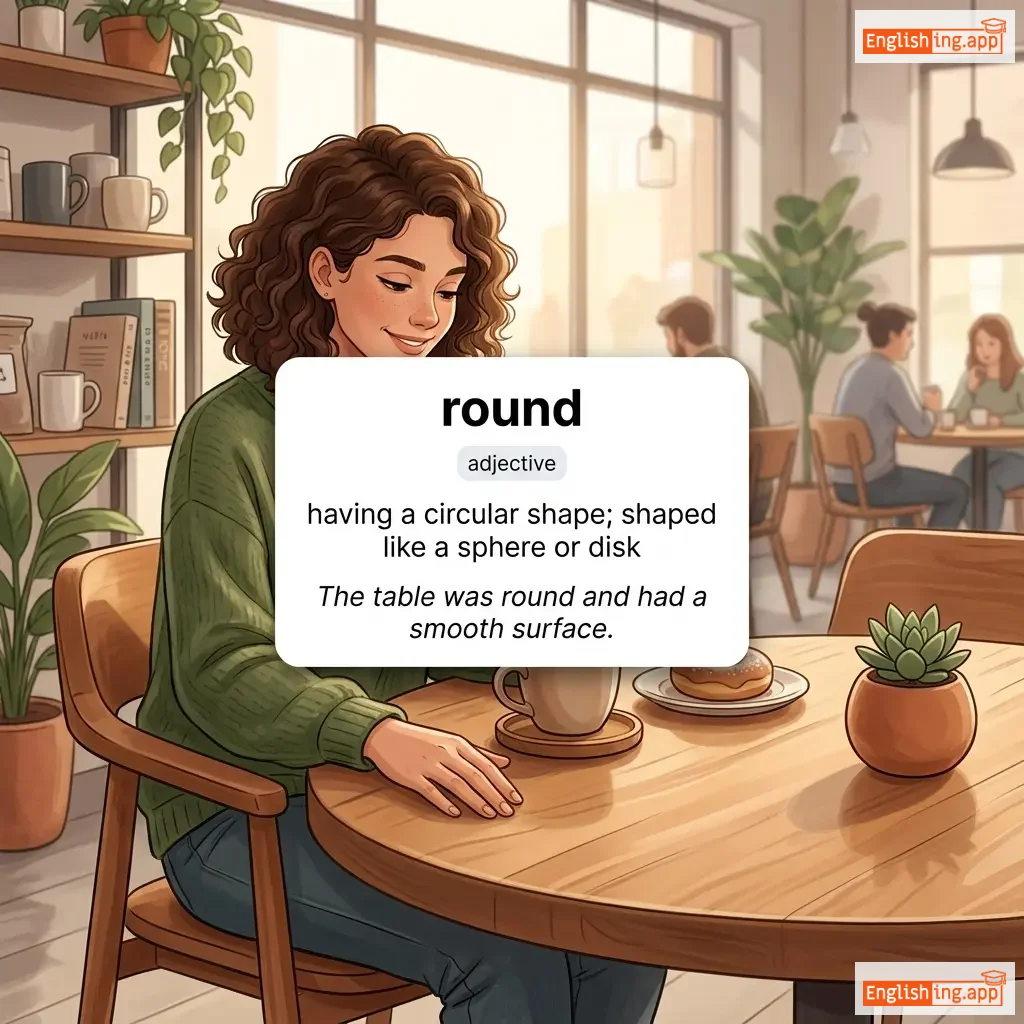
round definition card — visual illustration of the meaning
adjective
/raʊnd/
redondo (redondo)

having a circular shape; shaped like a sphere or disk

"The table was round and had a smooth surface."

"La mesa era redonda y tenía una superficie lisa." (La mesa era redonda y tenía una superficie lisa.)
verb
/ˈrʌf.l̩/
desordenar, molestar (desordenar, molestar)

to disturb the smoothness of something; to annoy or upset someone

"The wind ruffled her hair."

"El viento desordenó su cabello." (El viento desordenó su cabello.)
adjective
/ˈrʌdi/
sonrosado (rudii)

Having a healthy red color in the face.

"She had a ruddy complexion from working outdoors."

"Tenía un rostro sonrosado por trabajar al aire libre." (Tenía un rostro sonrosado por trabajar al aire libre.)
adjective
/ruːd/
grosero (grosero)

Not having or showing respect; impolite

"It was rude of him to interrupt the conversation."

"Fue grosero de su parte interrumpir la conversación." (fue grosero de su parte interrumpir la conversacion.)
adverb
/ˈruːdli/
groseramente (groseramente)

in an impolite or discourteous manner

"He rudely interrupted the speaker during the presentation."

"Interrumpió groseramente al orador durante la presentación." (Interrumpio groseramente al orador durante la presentacion.)
noun
/ˈruːdnəs/
grosería (rud-nes)

the quality of being impolite, discourteous, or offensive in behavior or speech

"His rudeness shocked everyone at the dinner party."

"Su grosería sorprendió a todos en la fiesta de cena." (Su groseria sorprendio a todos en la fiesta de cena.)
noun
/ˈruːdɪmənt/
rudimentos (rudimentos)

A basic principle, element, or fundamental part of something.

"He learned the rudiments of music before joining the band."

"Él aprendió los rudimentos de la música antes de unirse a la banda." (El aprendio los rudimentos de la musica antes de unirse a la banda.)
adjective
/ˌruːdɪˈmɛntəri/
rudimentario (rudimentario)

Involving or limited to basic principles; elementary or simple.

"The village school provided only a rudimentary education."

"La escuela del pueblo solo proporcionaba una educación rudimentaria." (La escuela del pueblo solo proporcionaba una educacion rudimentaria.)
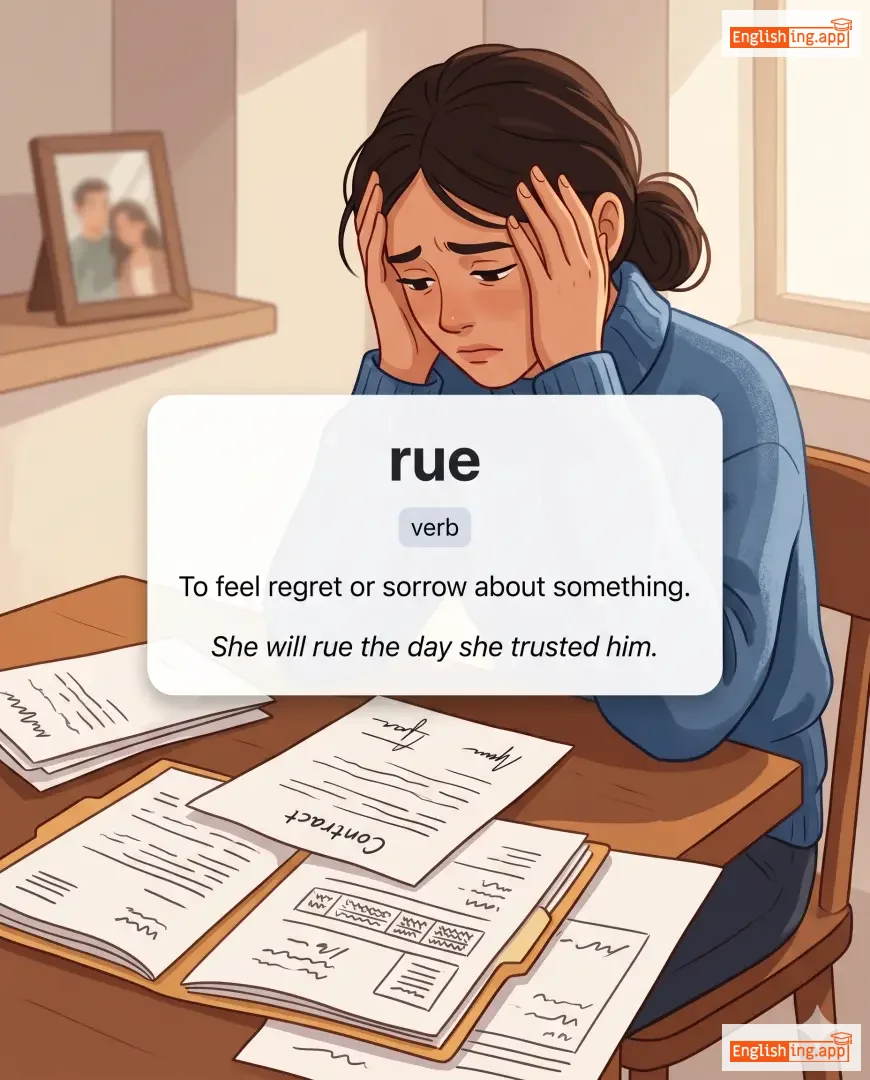
rue definition card — visual illustration of the meaning
verb
/ruː/
lamentar (lamentar)

To feel regret or sorrow about something.

"She will rue the day she trusted him."

"Ella lamentará el día que le dio su confianza." (Ella lamentará el día que le dio su confianza.)
adjective
/ˈruːfəl/
lamentoso (lamentoso)

Expressing sorrow, regret, or pity.

"He gave a rueful smile after losing the match."

"Él dio una sonrisa lamentosa después de perder el partido." (El dio una sonrisa lamentosa despues de perder el partido.)
noun
/ˈrʌfiən/
bribón (bribon)

A violent or lawless person; a bully.

"The ruffians vandalized the shop late at night."

"Los bribones vandalizaron la tienda tarde en la noche." (Los bribones vandalizaron la tienda tarde en la noche.)
noun
/ˈruːlɪŋ/
fallo (fallo)

an official decision made by a judge or authority.

"The court’s ruling favored the defendant."

"El fallo del tribunal favoreció al acusado." (El fallo del tribunal favorecio al acusado.)
noun
/ruːlz/
reglas (reglas)

explicit principles or regulations governing conduct or procedure within a particular area of activity

"The teacher reminded the students to follow the classroom rules."

"El maestro recordó a los estudiantes que siguieran las reglas del aula." (El maestro recordó a los estudiantes que siguieran las reglas del aula.)
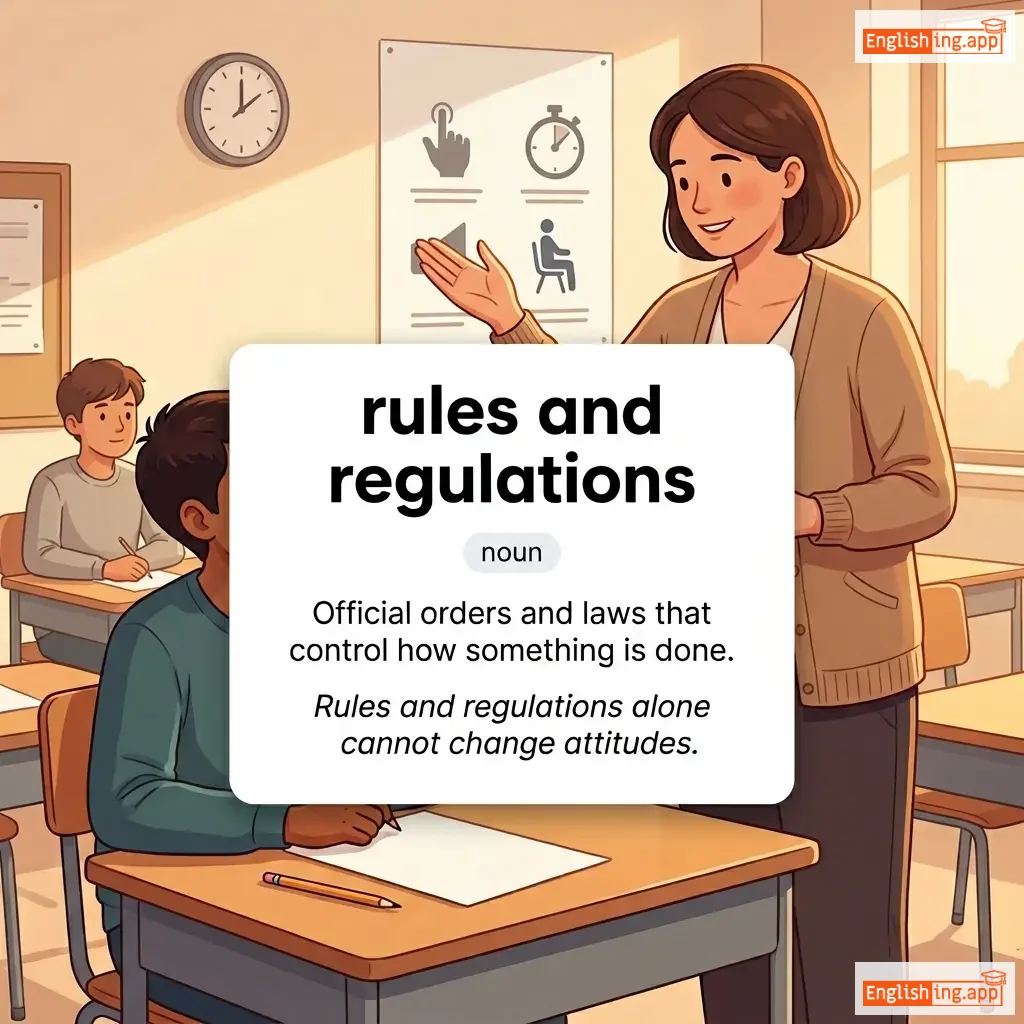
rules and regulations definition card — visual illustration of the meaning
noun
ruːlz ənd ˌrɛɡjʊˈleɪʃənz
reglas y regulaciones (reglas y regulaciones)

Official orders and laws that control how something is done.

"Rules and regulations alone cannot change attitudes."

"Las reglas y regulaciones por sí solas no pueden cambiar actitudes." (Las reglas y regulaciones por sí solas no pueden cambiar actitudes.)
noun
/ˈruːlər/
gobernante; regla (gobernante; regla)

A person who governs or controls a country; a straight-edged tool used for measuring or drawing lines

"The ruler drew a straight line on the paper while the king was a powerful ruler of his kingdom."

"El ruler dibujó una línea recta en el papel mientras el rey era un poderoso ruler de su reino." (El ruler dibujo una linea recta en el papel mientras el rey era un poderoso ruler de su reino.)