Vocabularios

Descubra, aprenda y domine el vocabulario en inglés

noun
/ˈrɛvərəns/
reverencia (reverensia)

deep respect for someone or something

"The students showed reverence to their teacher."

"Los estudiantes mostraron reverencia hacia su maestro." (Los estudiantes mostraron reverencia hacia su maestro.)
noun, adjective
/ˈrɛvərənd/
reverendo, honorable (reverendo, honorable)

A title of respect used for members of the clergy; deserving deep respect.

"The Reverend gave an inspiring sermon at the church."

"El reverendo dio un sermón inspirador en la iglesia." (El reverendo dio un sermon inspirador en la iglesia.)
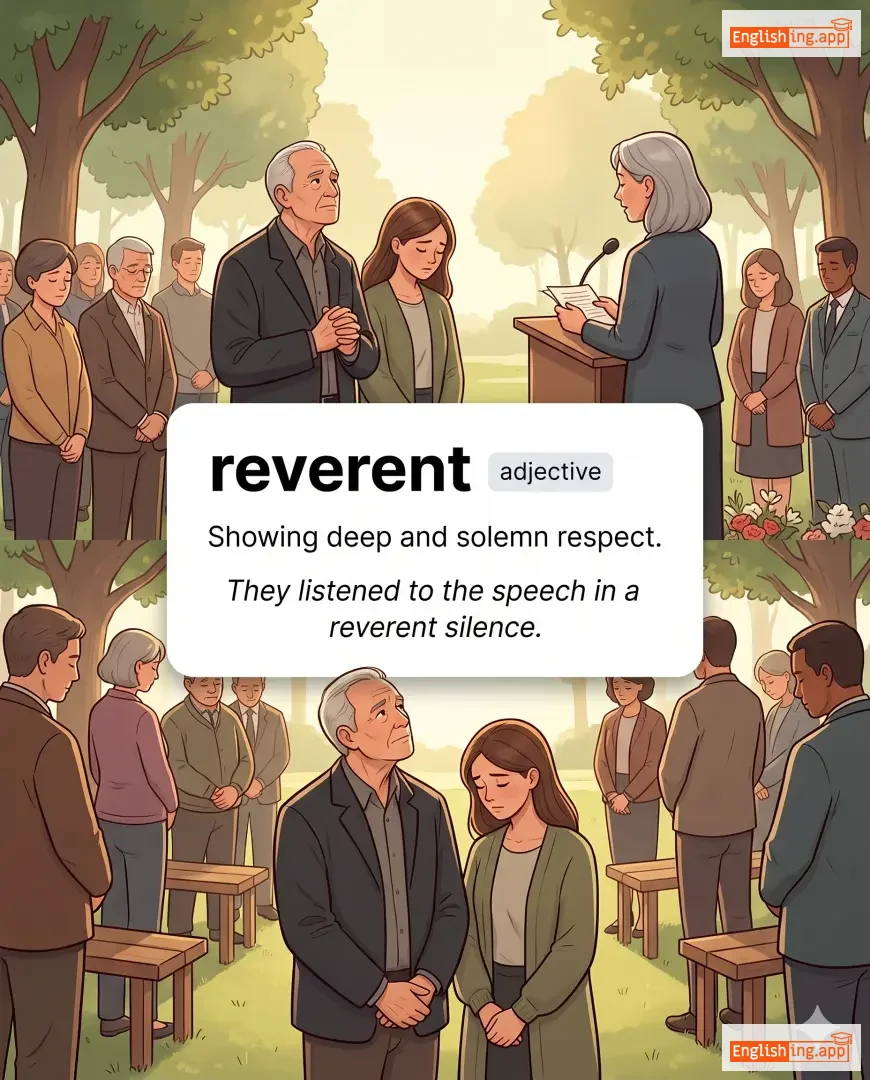
reverent definition card — visual illustration of the meaning
adjective
/ˈrɛvərənt/
reverente (reverente)

Showing deep and solemn respect.

"They listened to the speech in a reverent silence."

"Escucharon el discurso en un silencio reverente." (Escucharon el discurso en un silencio reverente.)
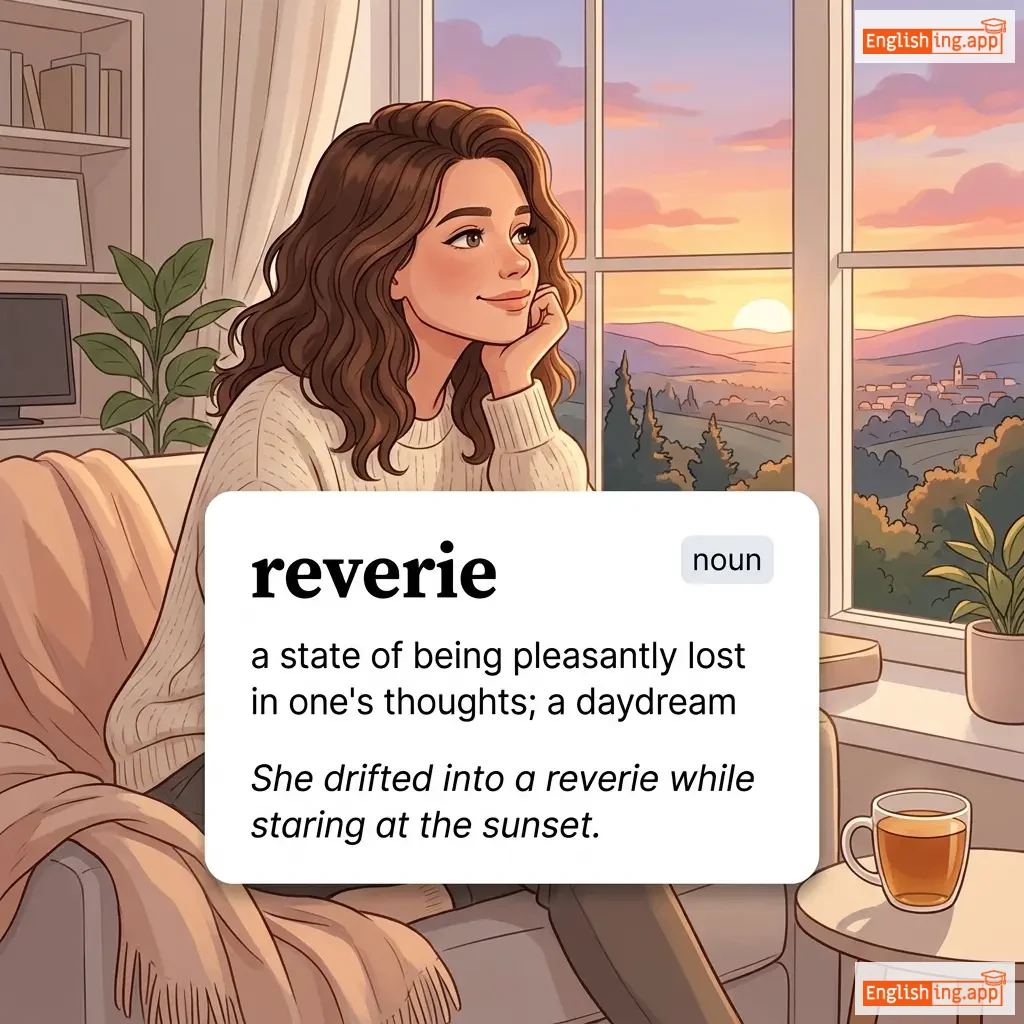
reverie definition card — visual illustration of the meaning
noun
/ˈrɛvəri/
ensoñación (ensonacion)

a state of being pleasantly lost in one's thoughts; a daydream

"She drifted into a reverie while staring at the sunset."

"Ella se sumió en una ensoñación mientras miraba la puesta de sol." (Ella se sumió en una ensoñacion mientras miraba la puesta de sol.)
verb
/rɪˈvɜːs/
invertir (invertir)

to change something to the opposite direction, position, or result

"She quickly reversed the car out of the driveway."

"Ella rápidamente invirtió el coche fuera de la entrada." (Ella rapida mente inverty el coche fuera de la entrada.)
adjective
/rɪˈvɜː.sə.bəl/
reversible (reh beer see ble)

able to be turned the other way around; able to be undone or changed back

"This jacket is reversible and can be worn on both sides."

"Esta chaqueta es reversible y se puede usar por ambos lados." (Esta chaqueta es reversible y se puede usar por ambos lados)
noun
/rɪˈvɜːrʒən/
reversión (reversion)

the act of returning to a previous state or condition

"The new policy marked a reversion to traditional methods."

"La nueva política marcó una reversión a los métodos tradicionales." (La nueva política marcó una reversión a los métodos tradicionales.)
verb
/rɪˈvɜːrt/
volver (volver)

to return to a previous state, condition, or practice

"The system will revert to its original settings after the update."

"El sistema volverá a su configuración original después de la actualización." (El sistema volverá a su configuración original después de la actualización.)
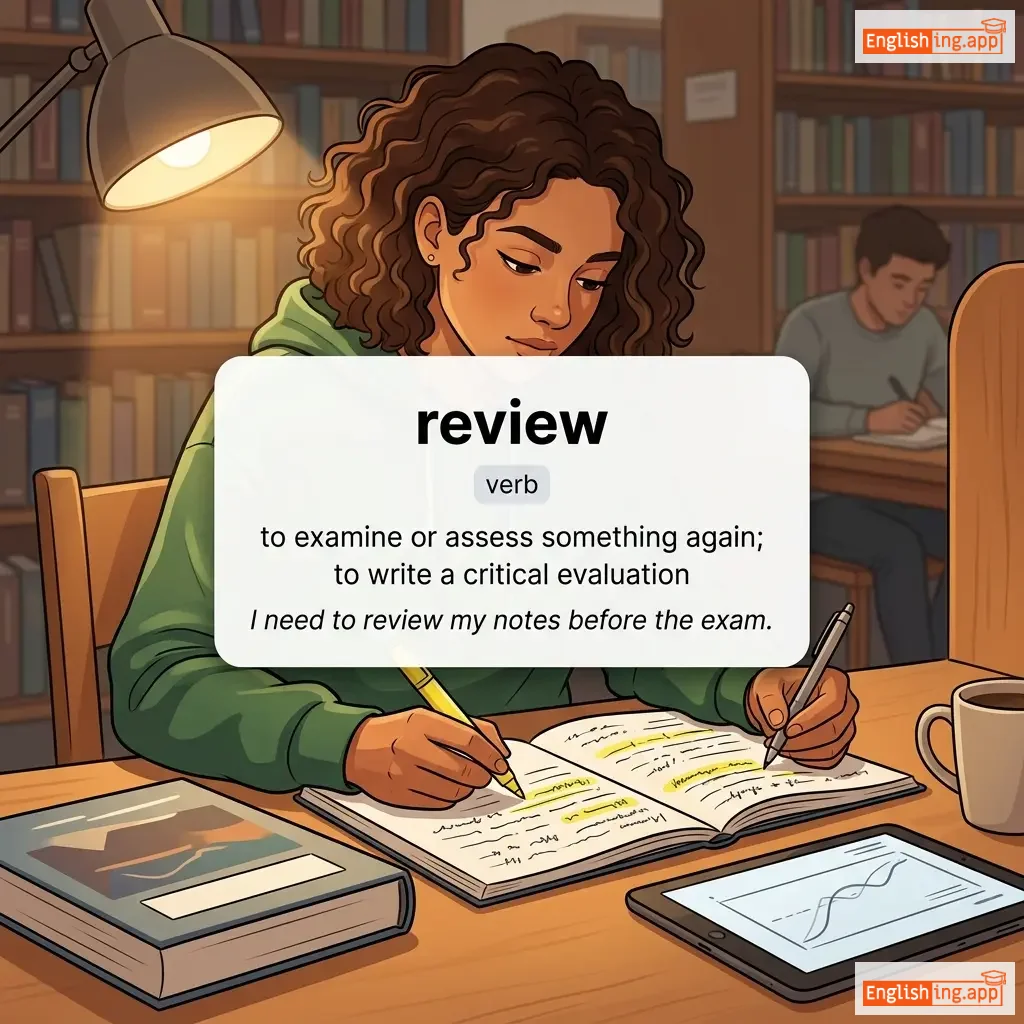
review definition card — visual illustration of the meaning
noun
/rɪˈvjuː/
reseña (reseña)

an evaluation or assessment of something

"I wrote a review of the movie for the blog."

"Escribí una reseña de la película para el blog." (Escribí una reseña de la película para el blog.)
verb
/rɪˈvaɪl/
despreciar (despreciar)

to criticize in an abusive or angrily insulting manner

"The politician was reviled by the public for his corruption."

"El político fue despreciado por el público debido a su corrupción." (El político fue despreciado por el público debido a su corrupción.)
noun
/rɪˈvaɪlər/
insultador (insultador)

a person who criticizes or insults others abusively

"He was known as a reviler of all who opposed him."

"Era conocido como un insultador de todos los que se le oponían." (Era conocido como un insultador de todos los que se le oponían.)
noun
/rɪˈvaɪ.zəl/
revisión (revision)

The act of revising, reviewing, or making changes to something.

"The revisal of the contract took longer than expected."

"La revisión del contrato tomó más tiempo de lo esperado." (La revision del contrato tomo mas tiempo de lo esperado.)
verb
/rɪˈvaɪz/
revisar (revisar)

To change, improve, or update something, especially a written work.

"She had to revise her essay before submission."

"Ella tuvo que revisar su ensayo antes de la entrega." (Ella tuvo que revisar su ensayo antes de la entrega.)
noun
/rɪˈvɪʒən/
revisión (revision)

the action of revising or updating something, typically in preparation for something else

"She made some last-minute revisions to her report before submitting it."

"Ella hizo algunas revisiones de última hora a su informe antes de enviarlo." (Ella hizo algunas revisiones de ultima hora a su informe antes de enviarlo.)
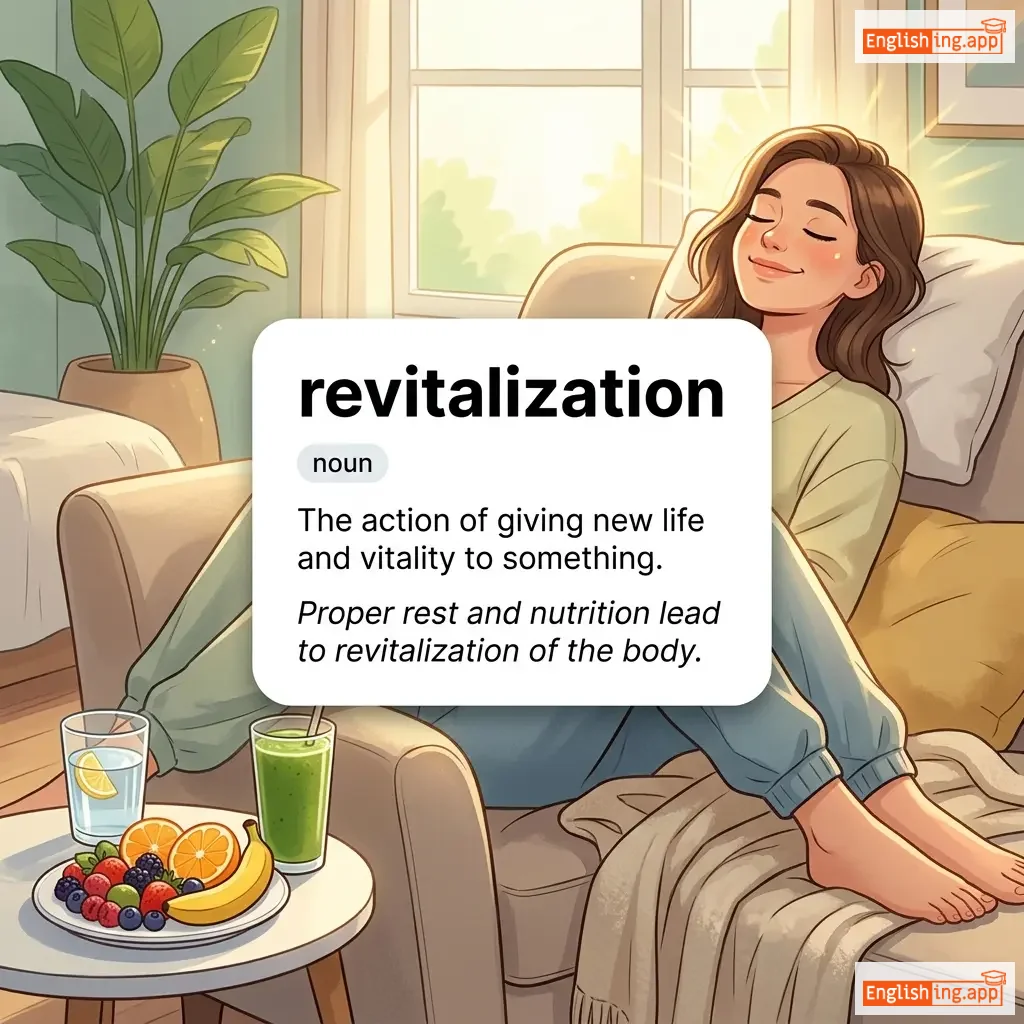
revitalization definition card — visual illustration of the meaning
noun
ˌriːˌvaɪ.təl.aɪˈzeɪ.ʃən
revitalización (revitalizacion)

The action of giving new life and vitality to something.

"Proper rest and nutrition lead to revitalization of the body."

"El descanso adecuado y la nutrición conducen a la revitalización del cuerpo." (El descanso adecuado y la nutrición conducen a la revitalización del cuerpo.)
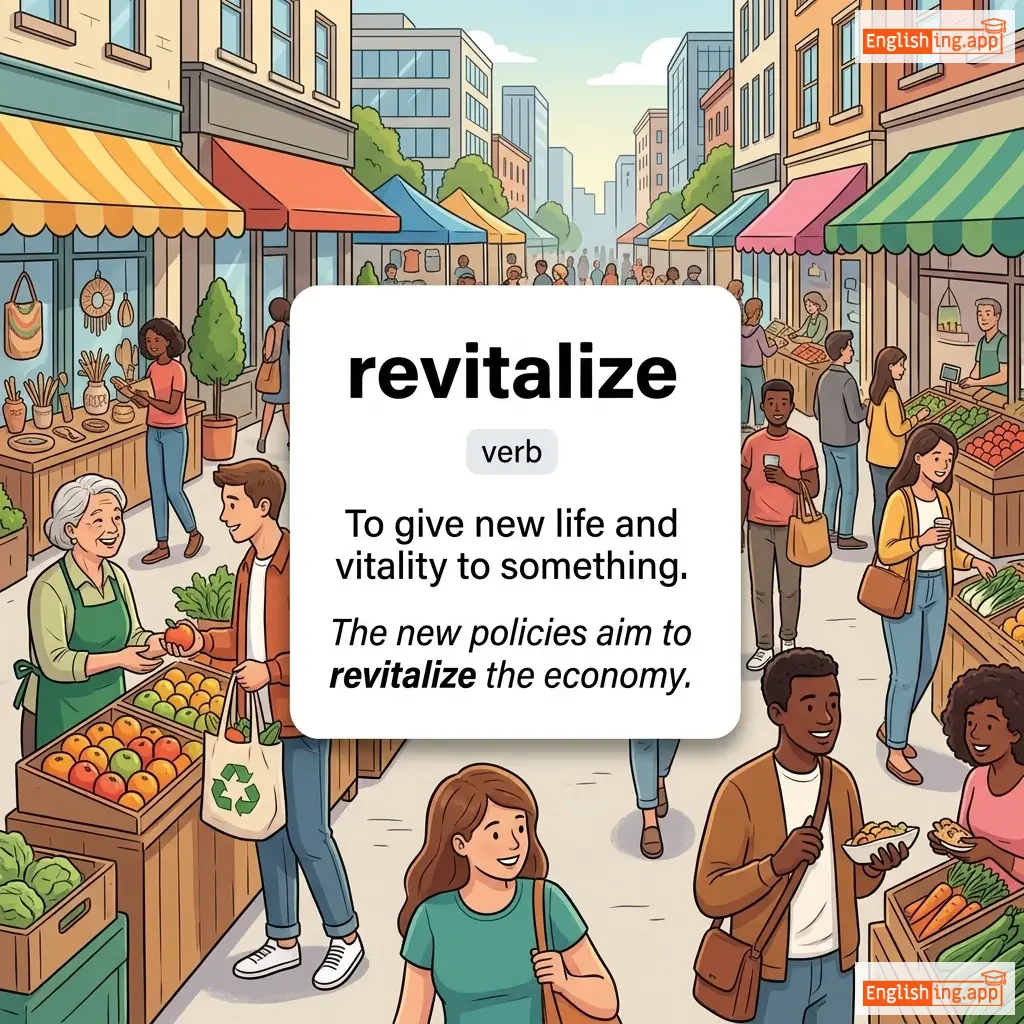
revitalize definition card — visual illustration of the meaning
verb
/ˌriːˈvaɪ.təl.aɪz/
revitalizar (revitalizar)

To give new life and vitality to something.

"The new policies aim to revitalize the economy."

"Las nuevas políticas apuntan a revitalizar la economía." (Las nuevas políticas apuntan a revitalizar la economía.)
noun
/rɪˈvaɪvəl/
renacimiento (renacimiento)

an improvement in the condition or strength of something

"The revival of the old traditions brought a sense of nostalgia."

"El renacimiento de las viejas tradiciones trajo una sensación de nostalgia." (El renacimiento de las viejas tradiciones trajo una sensacion de nostalgia.)
verb
/rɪˈvaɪv/
revivir (revivir)

To bring back to life, consciousness, or activity.

"The paramedics managed to revive the unconscious man."

"Los paramédicos lograron revivir al hombre inconsciente." (Los paramédicos lograron revivir al hombre inconsciente.)
noun
/ˌrɛv.əˈkeɪ.ʃən/
revocación (revocacion)

The act of officially canceling or withdrawing something.

"The court ordered the revocation of his license."

"El tribunal ordenó la revocación de su licencia." (El tribunal ordenó la revocación de su licencia.)
verb
/rɪˈvoʊk/
revocar (revocar)

To officially cancel or withdraw a decision, privilege, or right.

"The government decided to revoke his passport."

"El gobierno decidió revocar su pasaporte." (El gobierno decidió revocar su pasaporte.)
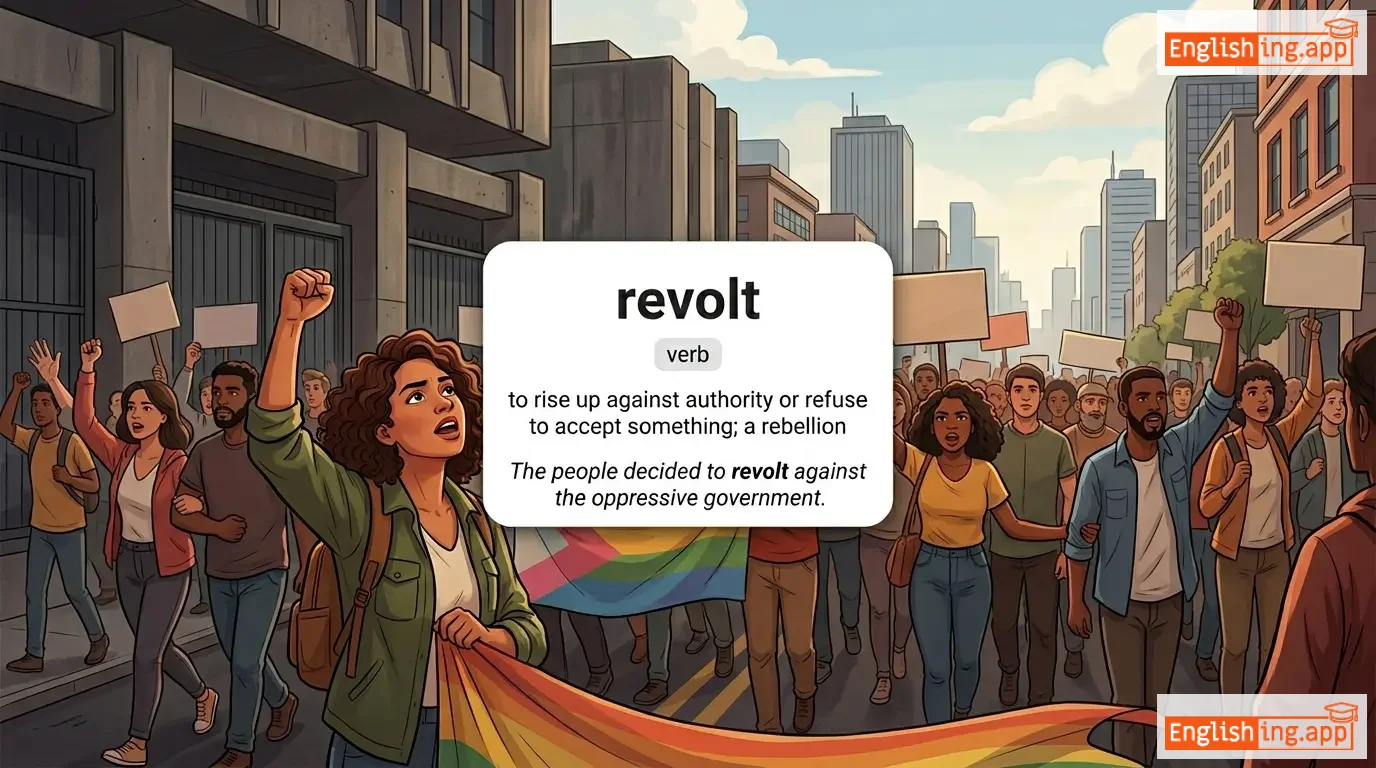
revolt definition card — visual illustration of the meaning
verb
/rɪˈvoʊlt/
revolución (revolucion)

to rise up against authority or refuse to accept something; a rebellion

"The people decided to revolt against the oppressive government."

"La gente decidió levantarse contra el gobierno opresivo." (La gente decidió levantarse contra el gobierno opresivo.)
adjective
/rɪˈvoʊltɪŋ/
repugnante (repugnante)

extremely unpleasant or disgusting

"The smell of the garbage was revolting."

"El olor de la basura era repugnante." (el olor de la basura era repugnante)
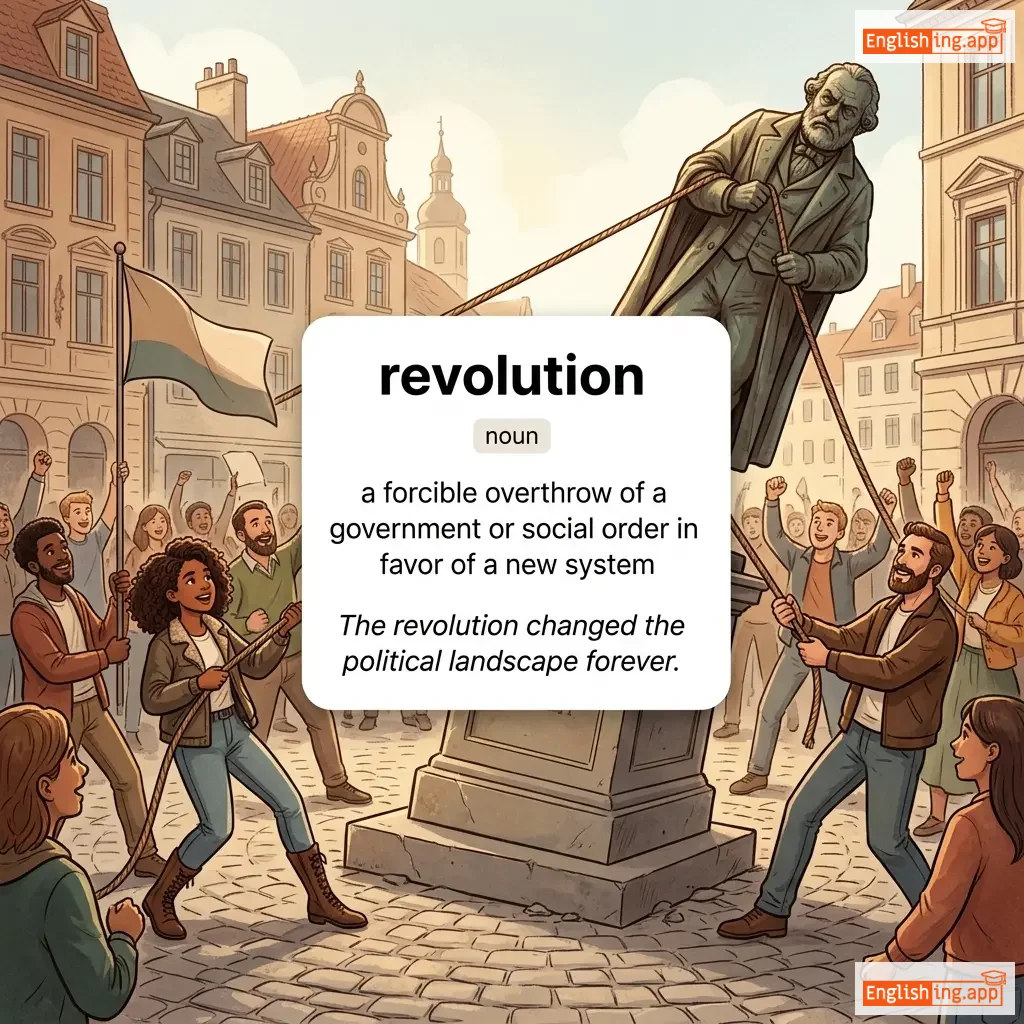
revolution definition card — visual illustration of the meaning
noun
/ˌrɛvəˈluːʃən/
revolución (revolucion)

a forcible overthrow of a government or social order in favor of a new system

"The revolution changed the political landscape forever."

"La revolución cambió el panorama político para siempre." (La revolucion cambio el panorama politico para siempre.)
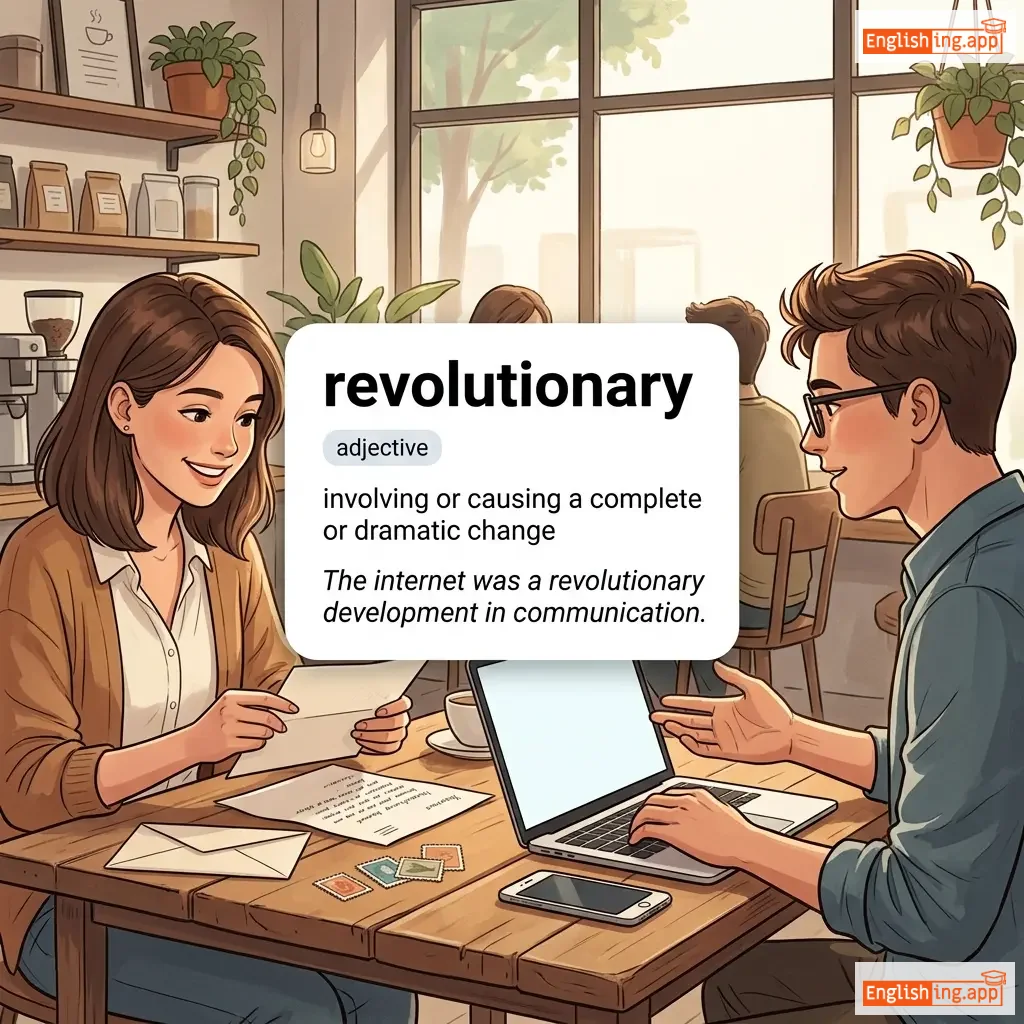
revolutionary definition card — visual illustration of the meaning
adjective
/ˌrɛvəˈluːʃəˌnɛri/
revolucionario (revolucionario)

involving or causing a complete or dramatic change

"The internet was a revolutionary development in communication."

"Internet fue un desarrollo revolucionario en la comunicación." (Internet fue un desarrollo revolucionario en la comunicacion.)
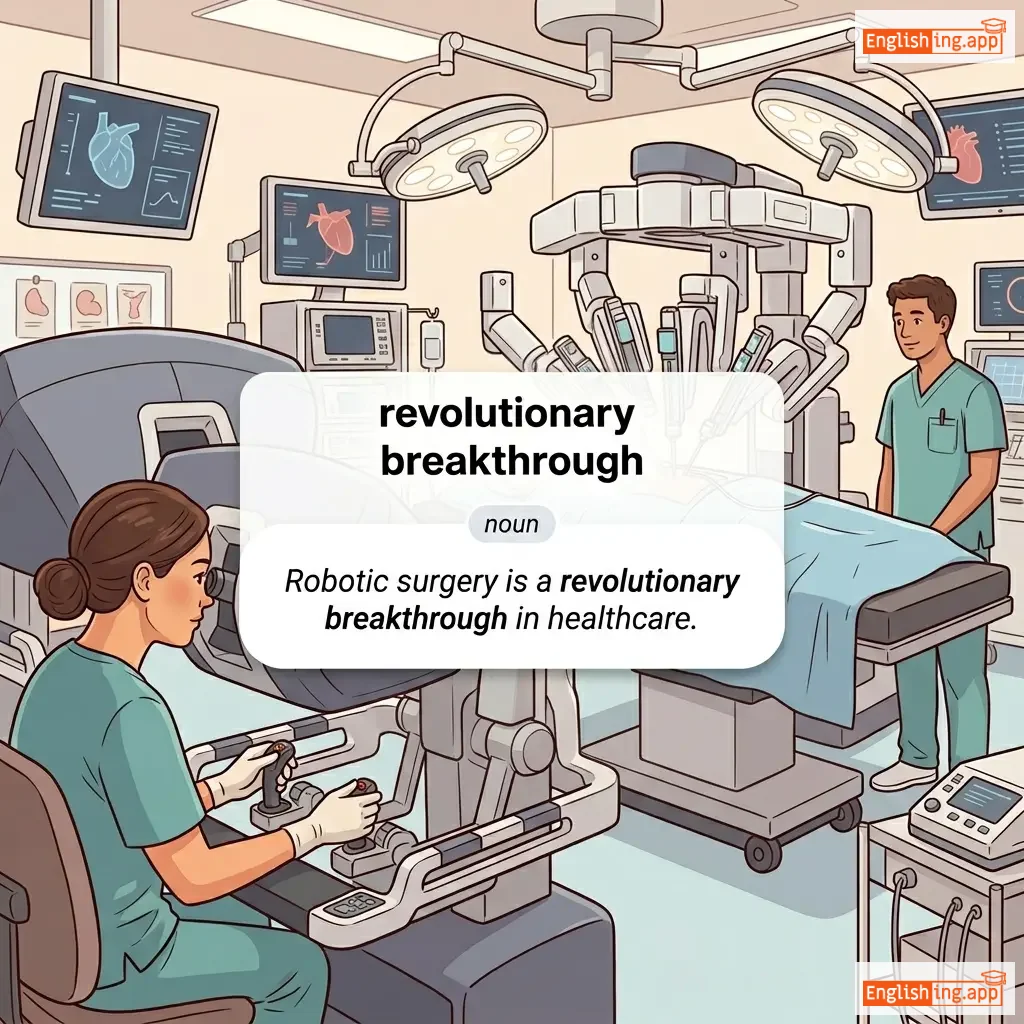
revolutionary breakthrough definition card — visual illustration of the meaning
noun
/ˌrev.əˈluː.ʃən.ər.i ˈbreɪk.θruː/
descubrimiento revolucionario (descubrimiento revolucionario)

A sudden, dramatic, and important discovery or development that changes everything.

"Robotic surgery is a revolutionary breakthrough in healthcare."

"La cirugía robótica es un descubrimiento revolucionario en la atención sanitaria." (La cirugía robótica es un descubrimiento revolucionario en la atención sanitaria.)
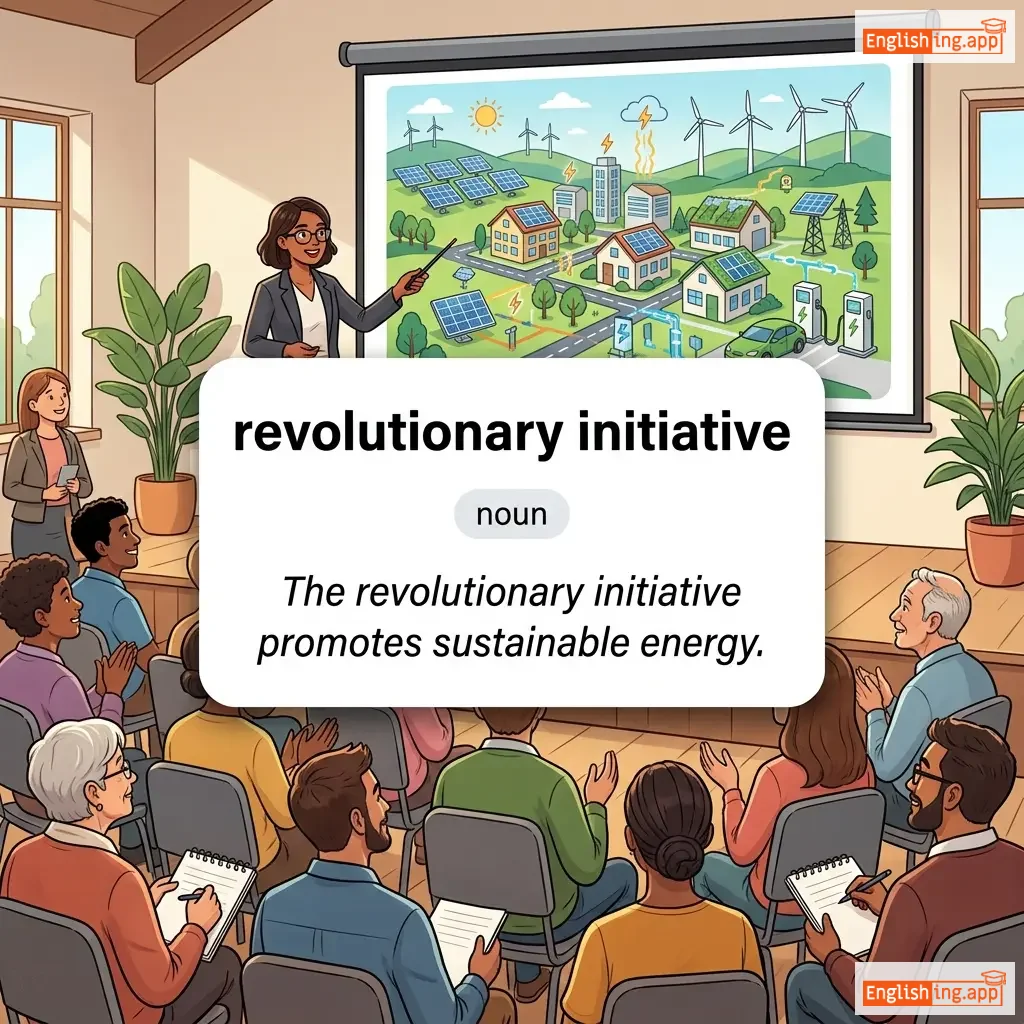
revolutionary initiative definition card — visual illustration of the meaning
noun
ˌrev.əˈluː.ʃən.ər.i ɪˈnɪʃ.ə.tɪv
iniciativa revolucionaria (iniciativa revolucionaria)

A groundbreaking action or plan that brings about significant change or transformation.

"The revolutionary initiative promotes sustainable energy."

"La iniciativa revolucionaria promueve la energía sostenible." (La iniciativa revolucionaria promueve la energia sostenible.)
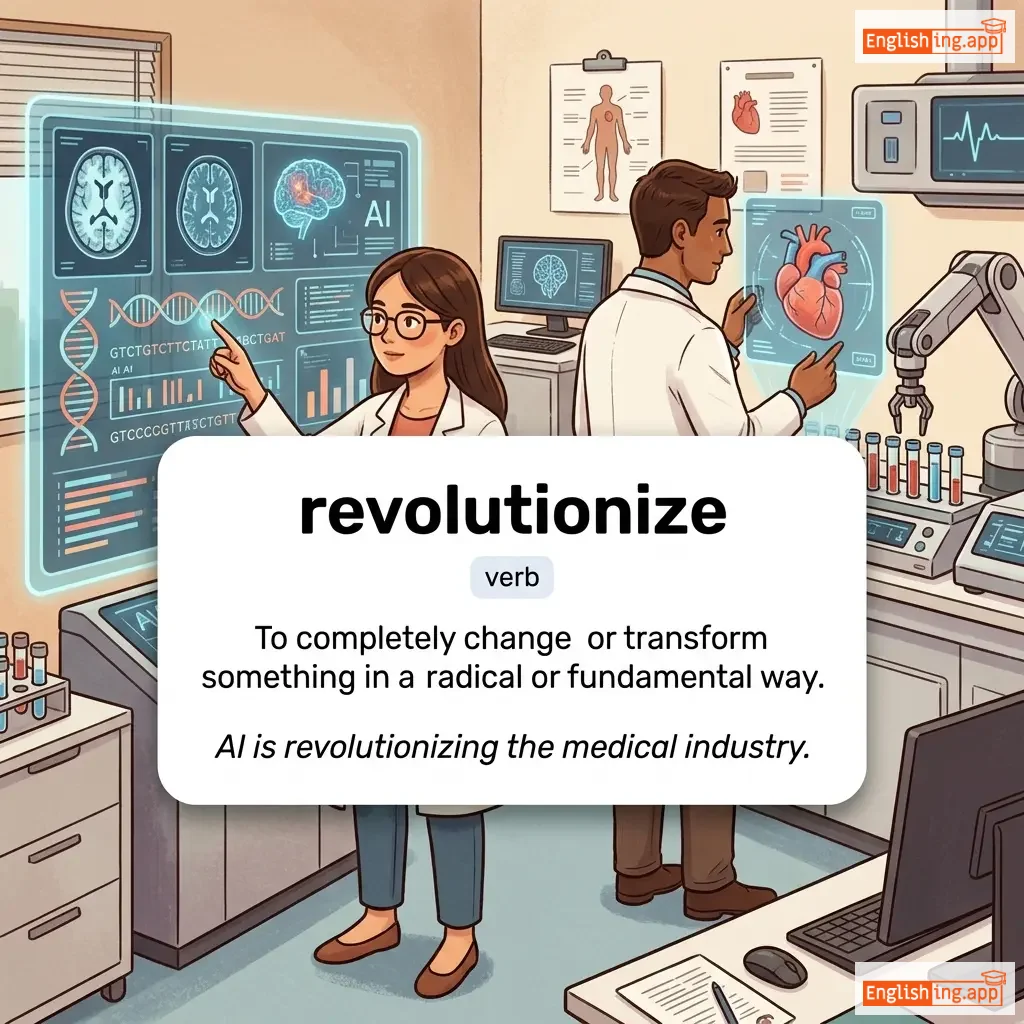
revolutionize definition card — visual illustration of the meaning
verb
ˌrev.əˈluː.ʃən.aɪz
revolucionar (revolucionar)

To completely change or transform something in a radical or fundamental way.

"AI is revolutionizing the medical industry."

"La IA está revolucionando la industria médica." (La IA está revolucionando la industria médica.)
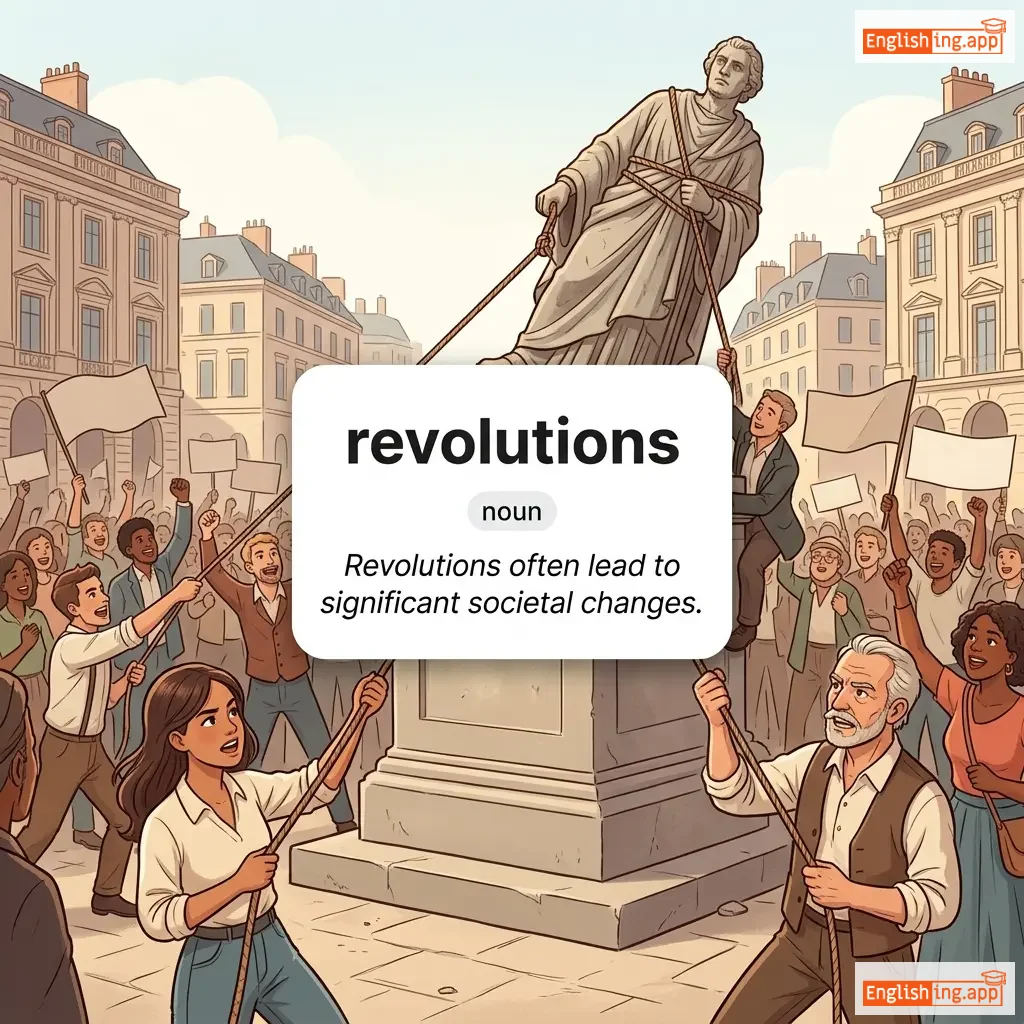
revolutions definition card — visual illustration of the meaning
noun
ˌrev.əˈluː.ʃənz
revoluciones (revoluciones)

Dramatic and wide-reaching changes in political, social, or economic systems, often involving the overthrow of a government or social order.

"Revolutions often lead to significant societal changes."

"Las revoluciones a menudo conducen a cambios sociales significativos." (Las revoluciones a menudo conducen a cambios sociales significativos.)
noun
/rɪˈvɒl.vər/
revólver (revolver)

a pistol with revolving chambers enabling several shots to be fired without reloading

"The detective drew his revolver from its holster."

"El detective sacó su revólver de su funda." (El detective saco su revolver de su funda.)
noun
/rɪˈvʌlʃən/
repulsión (repulsion)

a strong feeling of disgust or repulsion

"She felt revulsion at the sight of the cruel act."

"Ella sintió repulsión al ver el acto cruel." (Ella sintió repulsión al ver el acto cruel.)
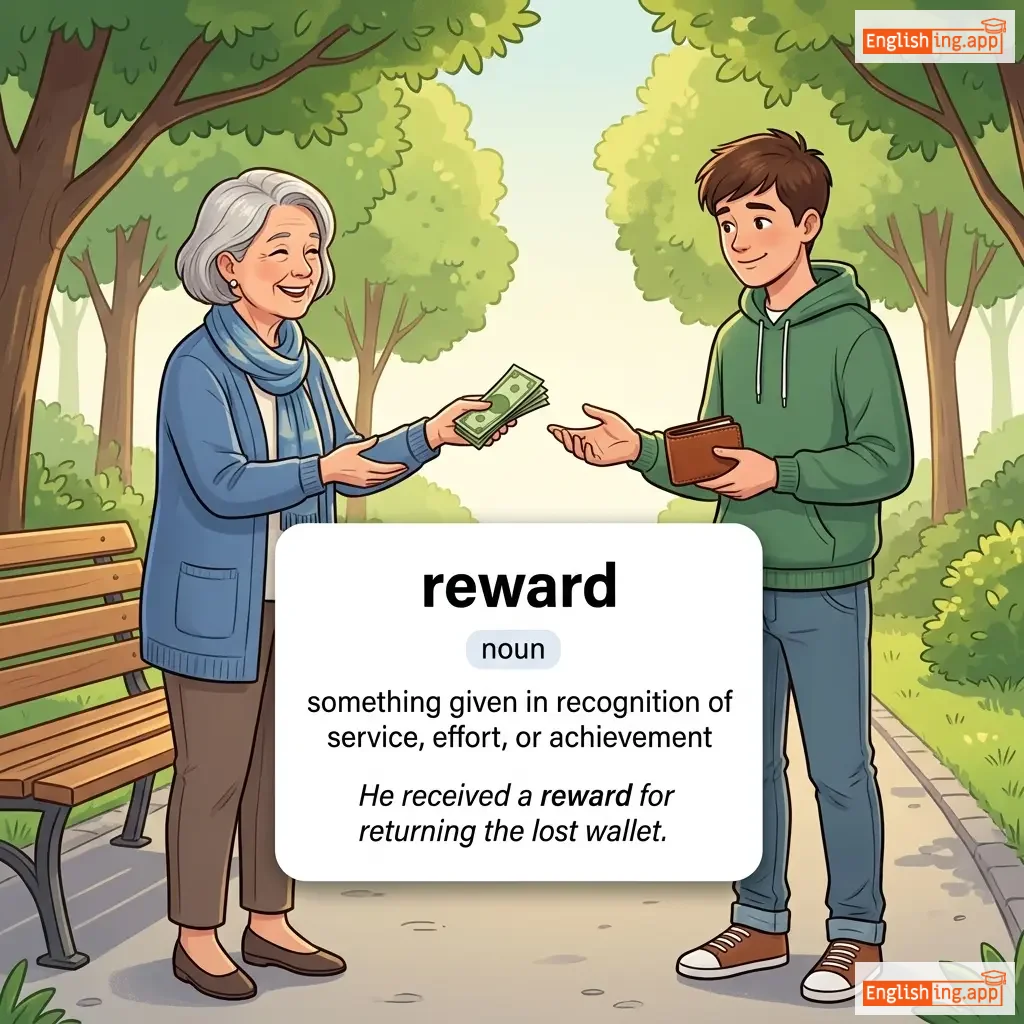
reward definition card — visual illustration of the meaning
noun
/rɪˈwɔːd/
recompensa (recompensa)

something given in recognition of service, effort, or achievement

"He received a reward for returning the lost wallet."

"Recibió una recompensa por devolver la billetera perdida." (Recibió una recompensa por devolver la billetera perdida.)
verb
/ˈræpsəˌdaɪz/
hablar con entusiasmo (hablar con entusiasmo)

to speak or write with great enthusiasm and admiration

"He would often rhapsodize about his travels to Europe."

"Él a menudo hablaba con entusiasmo sobre sus viajes a Europa." (Él a menudo hablaba con entusiasmo sobre sus viajes a Europa.)
noun
/ˈræpsədi/
canción exaltada/elogio (cancion exaltada/elogio)

an expression of great enthusiasm or an epic musical composition

"The singer’s performance was a rhapsody of emotions."

"La actuación del cantante fue una rapsodia de emociones." (La actuacion del cantante fue una rapsodia de emociones.)
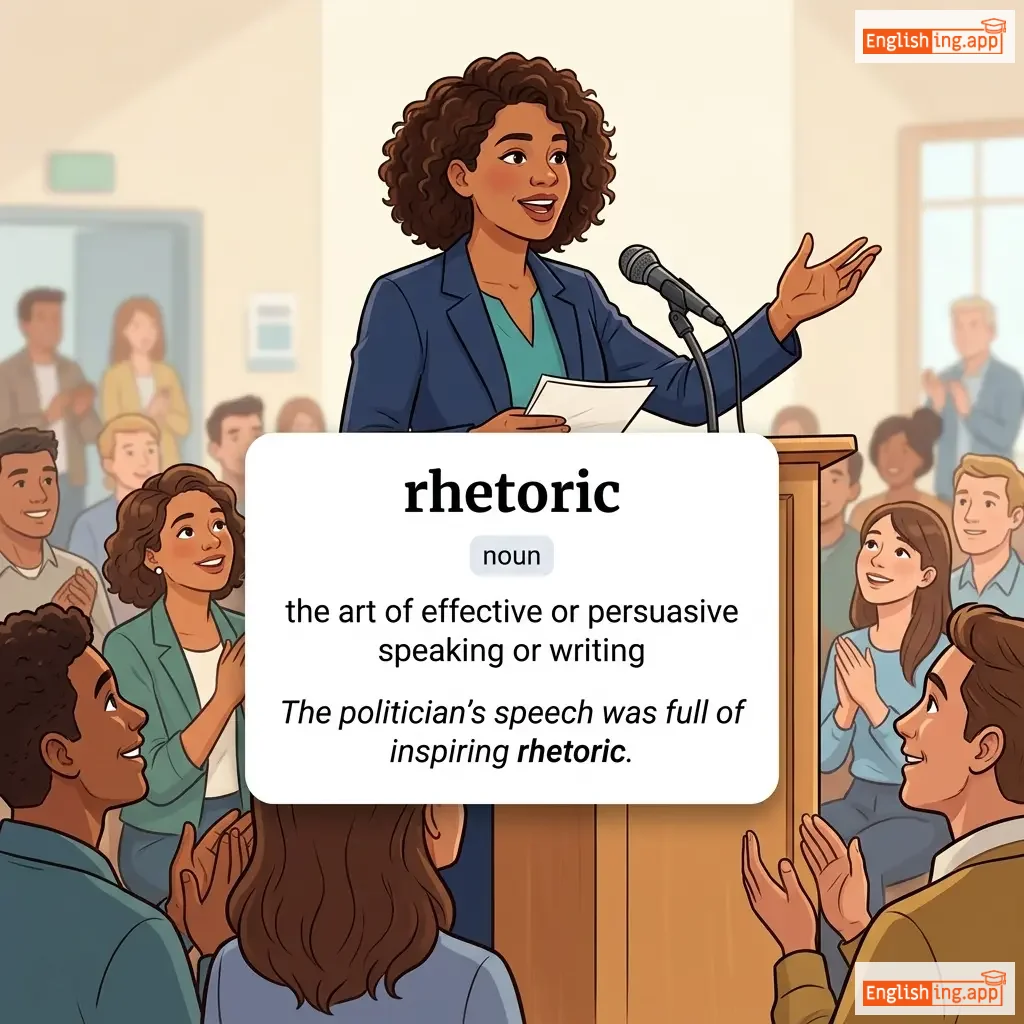
rhetoric definition card — visual illustration of the meaning
noun
/ˈrɛtərɪk/
retórica (retorica)

the art of effective or persuasive speaking or writing

"The politician’s speech was full of inspiring rhetoric."

"El discurso del político estaba lleno de retórica inspiradora." (El discurso del político estaba lleno de retórica inspiradora.)
adjective
/rɪˈtɔːrɪkəl/
retórico (retoriko)

relating to the art of effective or persuasive speaking or writing; often a question asked to make a point rather than get an answer

"He asked a rhetorical question during the debate."

"Hizo una pregunta retórica durante el debate." (Hizo una pregunta retorica durante el debate.)
noun
/ˌrɛtəˈrɪʃən/
orador (orador)

A person who is skilled in the art of rhetoric or persuasive speaking/writing.

"The rhetorician captivated the audience with his eloquence."

"El orador cautivó a la audiencia con su elocuencia." (El orador cautivo a la audiencia con su elocuencia.)
adjective
/ˈruːmi/
lagrimoso (lagrimoso)

Watery, especially referring to the eyes.

"His rheumy eyes showed signs of age and fatigue."

"Sus ojos lagrimosos mostraban signos de edad y fatiga." (Sus ojos lagrimosos mostraban signos de edad y fatiga.)
noun
/raɪˈnɒs.ər.əs/
rinoceronte (rinoceronte)

a large, heavy animal with thick skin and one or two horns on its nose

"The rhinoceros charged through the grassland."

"El rinoceronte cargó a través de la pradera." (El rinoceronte cargó a través de la pradera.)
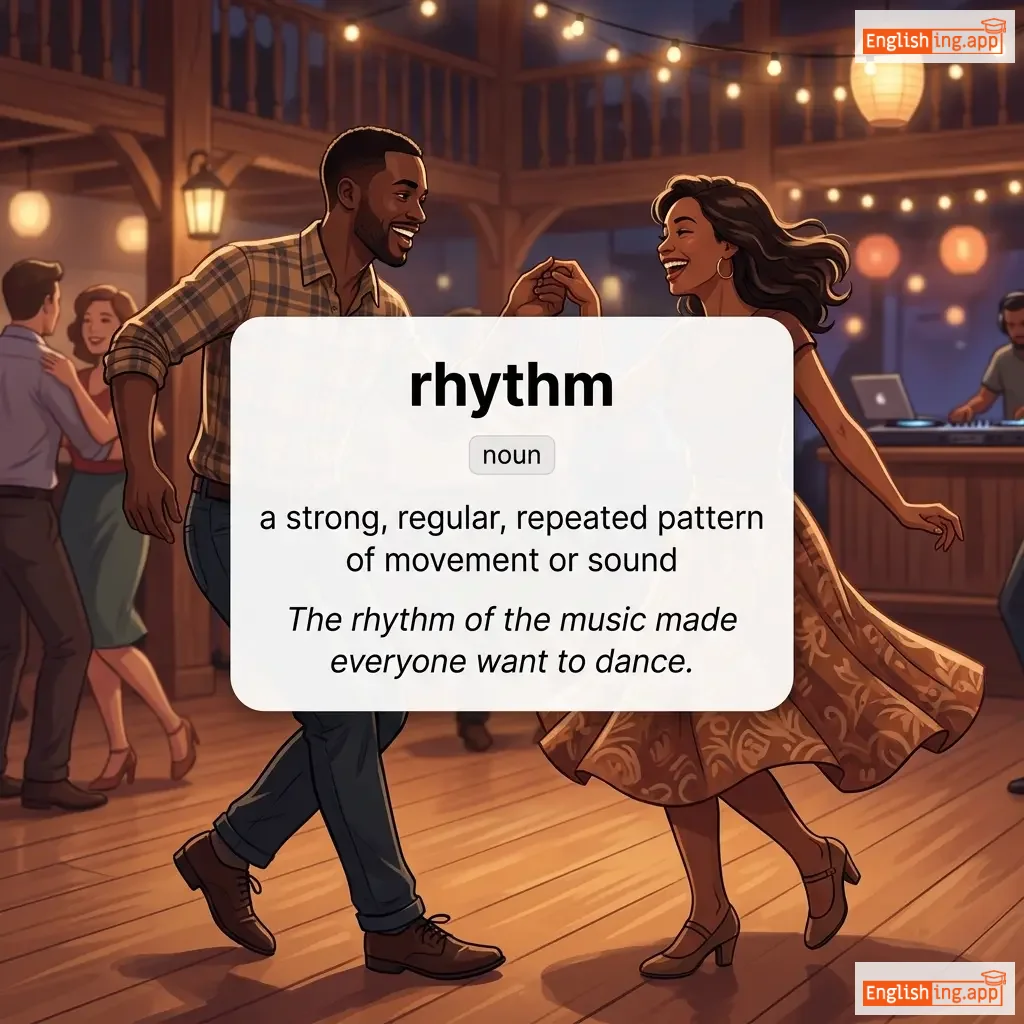
rhythm definition card — visual illustration of the meaning
noun
/ˈrɪðəm/
ritmo (ritmo)

a strong, regular, repeated pattern of movement or sound

"The rhythm of the music made everyone want to dance."

"El ritmo de la música hizo que todos quisieran bailar." (El ritmo de la musica hizo que todos quisieran bailar.)
noun
/rɪb/
costilla (costilla)

one of the curved bones that form the rib cage in humans and animals, protecting the chest organs

"He broke a rib while playing football."

"Se rompió una costilla mientras jugaba al fútbol." (Se rompio una costilla mientras jugaba al futbol)
adjective
/ˈrɪbɔːld/
bromas obscenas (bromas obscenas)

Referring to sexual matters in a humorous or vulgar way.

"The comedian’s ribald jokes made the audience laugh uncomfortably."

"Los chistes obscenos del comediante hicieron reír a la audiencia incómodamente." (Los chistes obscenos del comediante hicieron reír a la audiencia incómodamente.)
noun
/ˈrɪb.ən/
cinta (cinta)

a long, narrow strip of fabric used for tying or decoration

"She tied her hair with a red ribbon."

"Ella ató su cabello con una cinta roja." (Ella ato su cabello con una cinta roja.)
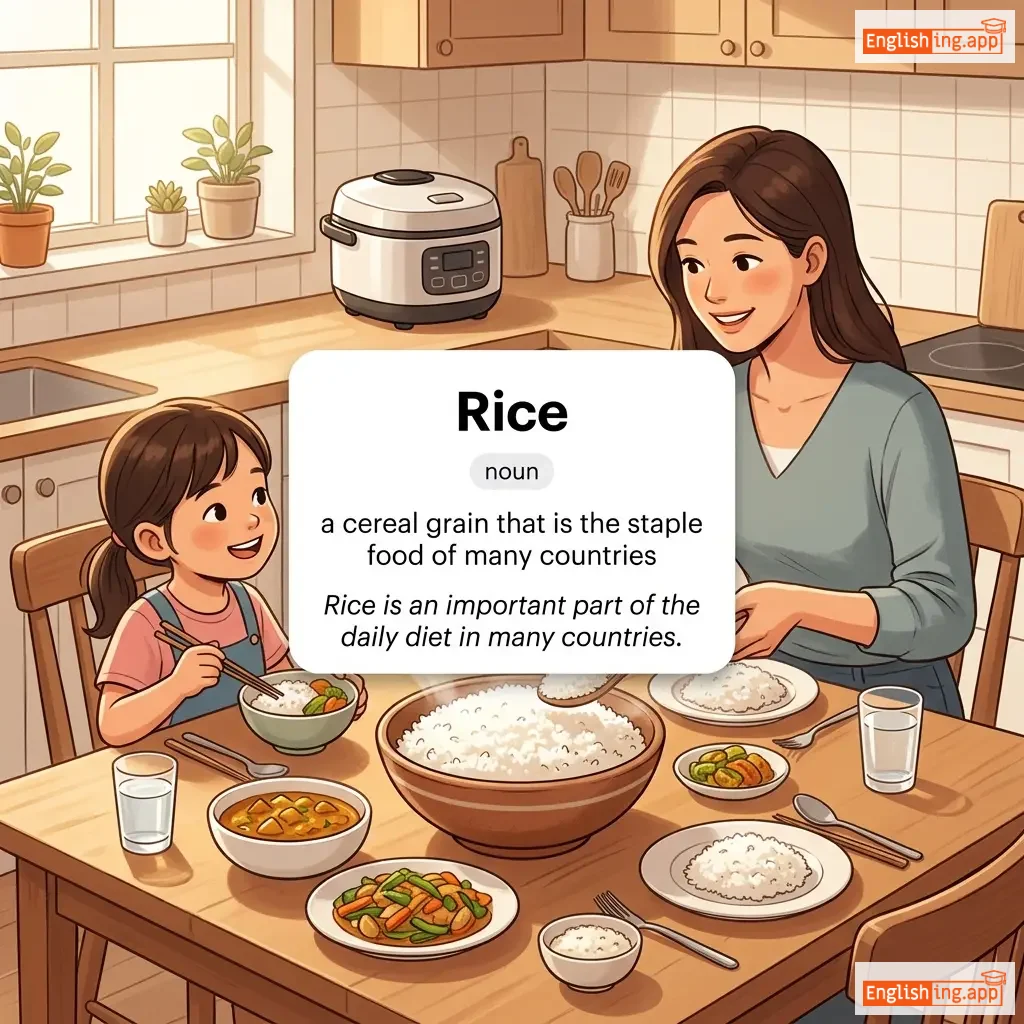
Rice definition card — visual illustration of the meaning
noun
/raɪs/
arroz (arroz)

a cereal grain that is the staple food of many countries

"Rice is an important part of the daily diet in many countries."

"El arroz es una parte importante de la dieta diaria en muchos países." (El arroz es una parte importante de la dieta diaria en muchos países.)
noun
/raɪs ˈkʊkər/
cocedor de arroz eléctrico (cocedor de arroz electrico)

an electric appliance designed to cook rice automatically

"The rice cooker automatically switches off when the rice is perfectly cooked."

"El cocedor de arroz se apaga automáticamente cuando el arroz está perfectamente cocido." (El cocedor de arroz se apaga automaticamente cuando el arroz esta perfectamente cocido)
adjective
/rɪʧ/
rico (reeko)

having a great deal of money or assets

"He became rich after his successful business venture."

"Se volvió rico después de su exitosa aventura empresarial." (Se volvio rico despues de su exitosa aventura empresarial.)
adjective
/ˈrɪkɪti/
deteriorado (deteriorado)

Poorly made and likely to collapse; shaky.

"They crossed a rickety wooden bridge over the river."

"Cruzaron un puente de madera deteriorado sobre el río." (Cruzaron un puente de madera deteriorado sobre el río.)
noun
/ˈrɪk.ʃɔː/
rickshaw (rickshaw)

a light two-wheeled passenger vehicle drawn by one or more people

"We took a rickshaw to reach the busy marketplace."

"Tomamos un rickshaw para llegar al mercado concurrido." (Tomamos un rickshaw para llegar al mercado concurrido.)
verb
/rɪd/
eliminar (eliminar)

to remove or get rid of something

"I need to rid the house of all the clutter."

"Necesito deshacerme del desorden en la casa." (Necesito deshacerme del desorden en la casa.)
verb
/ˈroʊ.teɪt/
rotar (rotar)

to turn around a central point or axis

"The Earth rotates on its axis once every 24 hours."

"La Tierra rota sobre su eje cada 24 horas." (La Tierra rota sobre su eje cada 24 horas.)
verb
/rɒt/
podrir (podrir)

to decay or decompose; to become corrupt

"The fruit will rot if left in the sun."

"La fruta se pudrirá si se deja al sol." (La fruta se pudrira si se deja al sol)