वोकैबुलरीज

इंग्लिश वोकैबुलरी डिस्कवर, लर्न और मास्टर करें

adjective
/ˌsʌplɪˈmɛntəri/
पूरक (poornak)

Additional, completing, or enhancing something else.

"The teacher gave supplementary materials to help the students prepare for exams."

"शिक्षक ने छात्रों को परीक्षा की तैयारी के लिए पूरक सामग्री दी।" (Shikshak ne chhatron ko pariksha ki taiyari ke liye poornak samagri di.)
suppliant definition card — visual illustration of the meaning
adjective
/ˈsʌpliənt/
विनम्र आवेदनकर्ता (vinamra aavedankarta)

Humbly or earnestly asking for something, especially from a person in authority.

"The suppliant man begged for mercy at the king's feet."

"विनम्र व्यक्ति ने राजा के पैरों में दया की भीख माँगी।" (vinamra vyakti ne raja ke pairon mein daya ki bhikh maangi.)
supplicant definition card — visual illustration of the meaning
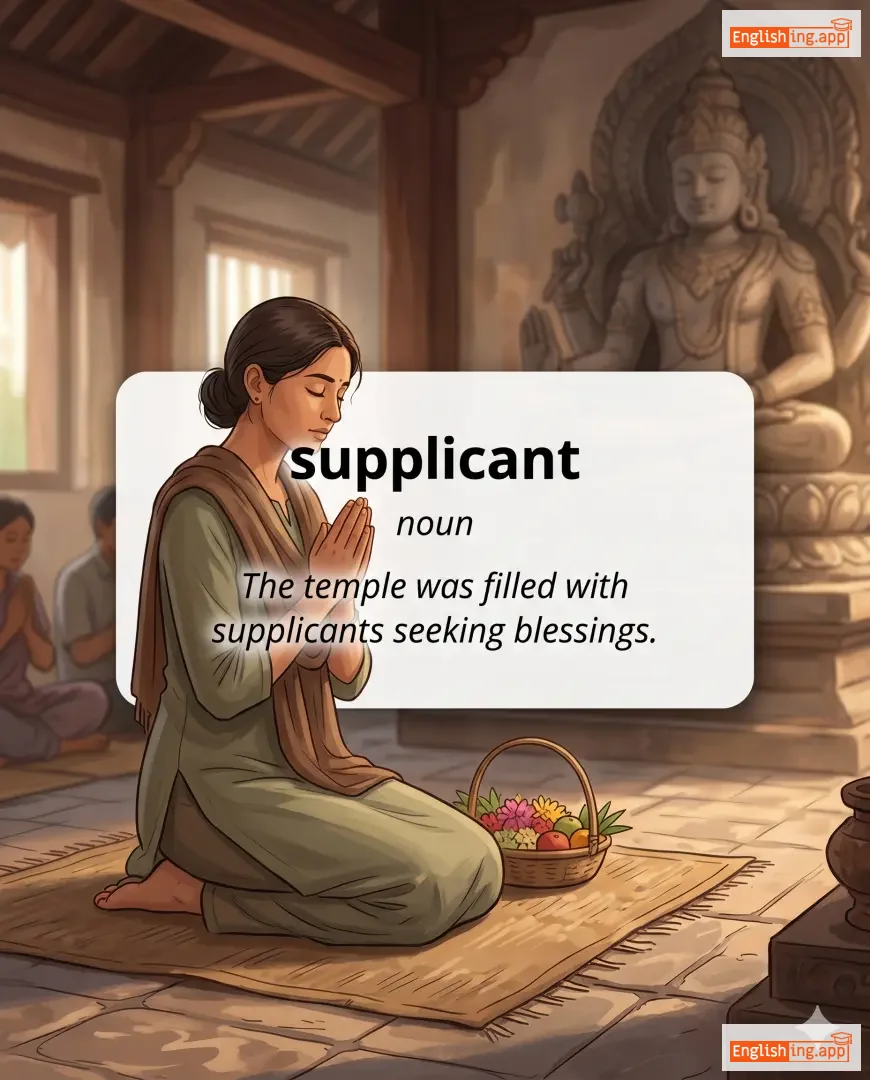
noun
/ˈsʌplɪkənt/
प्रार्थी (prarthi)

A person who humbly or earnestly asks for something, usually from a person of authority.

"The temple was filled with supplicants seeking blessings."

"मंदिर में आशीर्वाद मांगने वाले भक्त थे।" (Mandir mein ashirwad maangne wale bhakt the.)
verb
/ˈsʌplɪˌkeɪt/
प्रार्थना करना (prarthana karna)

To ask for something earnestly or humbly, often in a religious context.

"The villagers supplicated the gods for rain during the drought."

"गांववालों ने सूखे के दौरान बारिश के लिए देवताओं से प्रार्थना की।" (Gaonwalo ne sukhe ke dauran barish ke liye devtaon se prarthana ki.)
noun
/səˈplaɪə(r)/
आपूर्तिकर्ता (aapurtikarta)

a person or company that provides goods or services

"The supplier delivered the products on time."

"आपूर्तिकर्ता ने समय पर उत्पाद वितरित किए।" (Aapurtikarta ne samay par utpad vitrit kiye.)
supply definition card — visual illustration of the meaning
noun
/səˈplaɪ/

the amount of something that is available to be used or consumed

"The store has a limited supply of electronics."

support definition card — visual illustration of the meaning
verb
/səˈpɔːrt/
सपोर्ट (support)

to give assistance or help to someone or something

"They always support each other during difficult times."

"वे हमेशा मुश्किल समय में एक दूसरे का सपोर्ट करते हैं।" (Ve hamesha mushkil samay mein ek doosre ka support karte hain.)
noun
/səˈpɔːtər/
समर्थक (samarthak)

a person who supports someone or something

"She is a strong supporter of the local animal shelter."

"वह स्थानीय पशु आश्रय की एक मजबूत समर्थक है।" (Vah sthaniye pashu ashray ki ek majboot samarthak hai.)
supporting definition card — visual illustration of the meaning
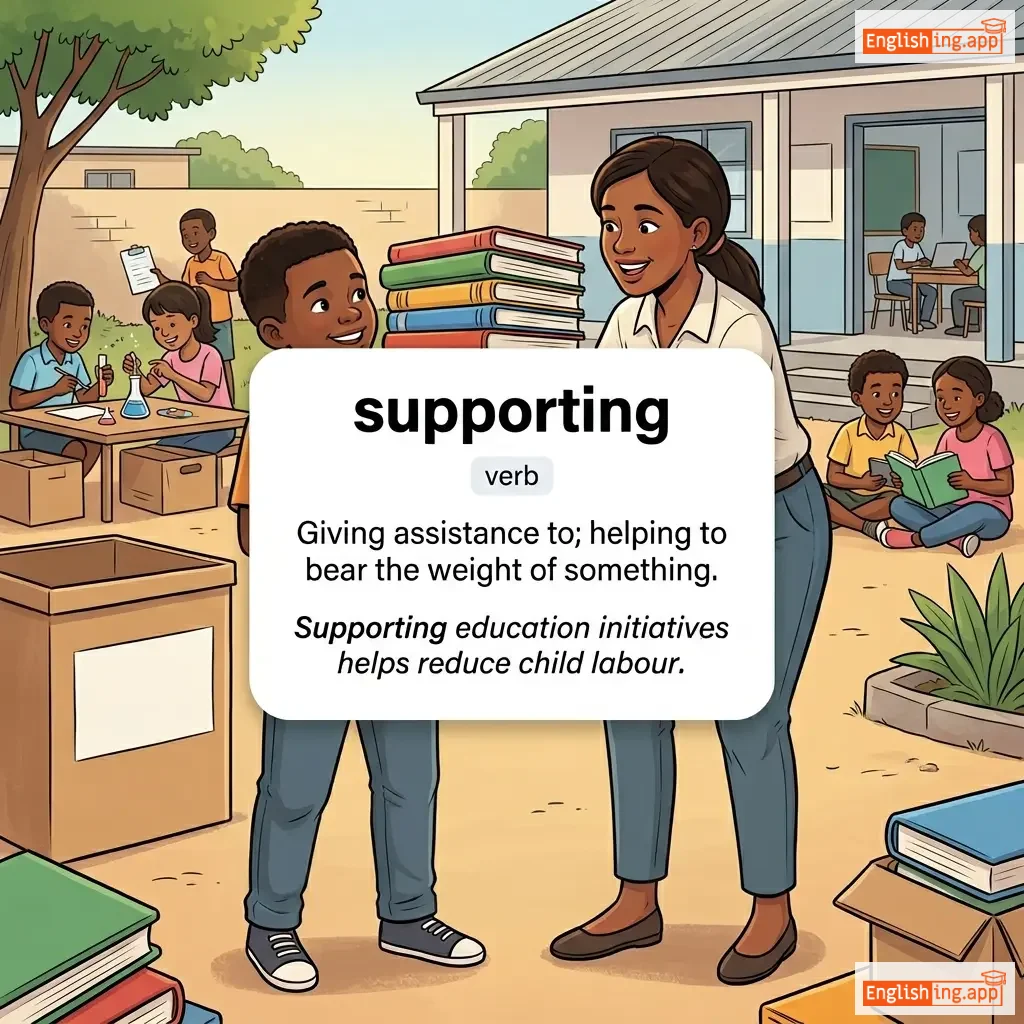
verb
səˈpɔːrtɪŋ
सहायता करना (sahayata karna)

Giving assistance to; helping to bear the weight of something.

"Supporting education initiatives helps reduce child labour."

"शिक्षा पहलों का समर्थन करना बाल श्रम को कम करने में मदद करता है।" (Shiksha pehlon ka samarthan karna baal shram ko kam karne mein madad karta hai.)
adjective
/səˈpɔːtɪv/
समर्थक (samarthak)

providing encouragement or emotional help to someone

"She was very supportive during my difficult times."

"वह मेरे कठिन समय में बहुत सहायक थी।" (Vah mere kathin samay mein bahut sahayak thi.)
verb
/səˈpəʊz/
मान लेना (maan lena)

to assume or believe something is true without proof

"I suppose she will be here soon."

"मैं suppose करता हूँ कि वह जल्दी यहाँ आएगी।" (Main suppose karta hoon ki vah jaldi yahaan aayegi.)
adjective
/səˈpəʊzd/
कहा गया (kaha gaya)

generally believed or assumed, but not necessarily true

"This is the supposed solution to the problem."

"यह समस्या का कहा गया समाधान है।" (Yeh samasya ka kaha gaya samadhan hai.)
adverb
/səˈpəʊzɪdli/
कहा जाता है कि (kaha jata hai ki)

used to show that something is believed or claimed to be true, though it may not be

"He is supposedly the best player on the team."

"कहा जाता है कि वह टीम का सबसे अच्छा खिलाड़ी है।" (kaha jata hai ki vah team ka sabse accha khiladi hai.)
supposition definition card — visual illustration of the meaning
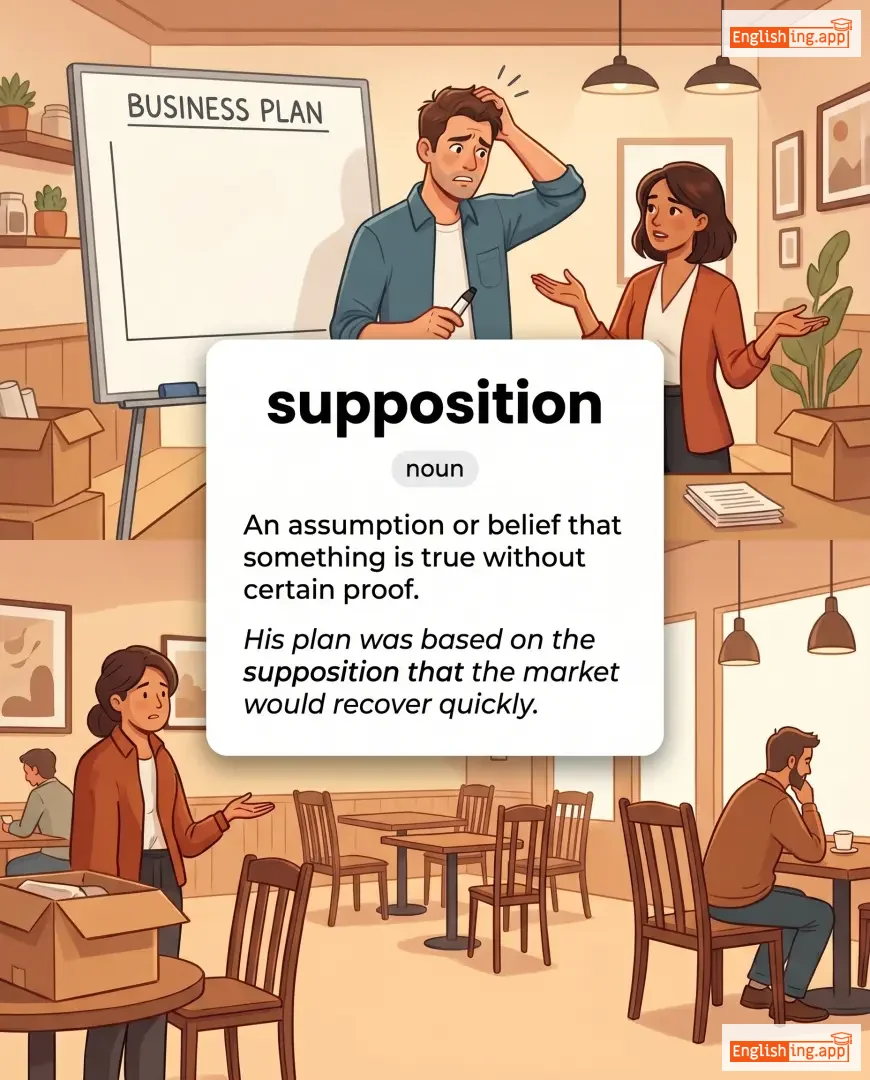
noun
/ˌsʌpəˈzɪʃən/
कल्पना (kalpana)

An assumption or belief that something is true without certain proof.

"His plan was based on the supposition that the market would recover quickly."

"उसकी योजना इस कल्पना पर आधारित थी कि बाजार जल्दी ठीक हो जाएगा।" (Uski yojana is kalpana par aadharit thi ki bazaar jaldi theek ho jayega.)
adjective
/ˌsʌpəzɪˈtɪʃəs/
काल्पनिक (kalpanik)

Based on assumption rather than fact; not genuine or authentic.

"The story turned out to be supposititious, with no evidence to support it."

"कहानी काल्पनिक साबित हुई, इसके समर्थन में कोई प्रमाण नहीं था।" (Kahani kalpanik sabit hui, iske samarthan mein koi pramaan nahi tha.)
suppress definition card — visual illustration of the meaning
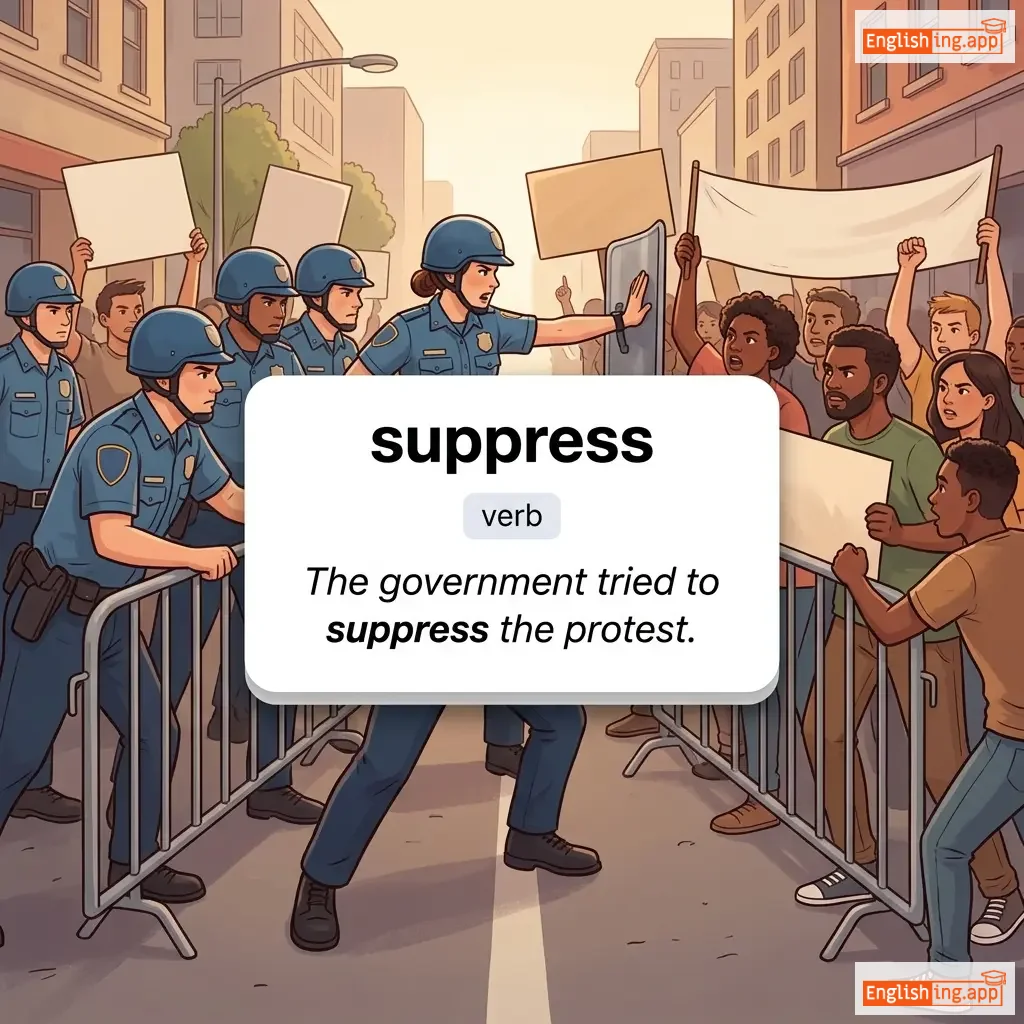
verb
/səˈprɛs/
दबाना (dabana)

to forcibly put an end to something; to restrain or hold back an action, feeling, or development

"The government tried to suppress the protest."

"सरकार ने विरोध को दबाने की कोशिश की।" (Sarkar ne virodh ko dabane ki koshish ki.)
adjective
/səˈprɛsəbl̩/
दबाने योग्य (dabane yogya)

capable of being restrained, controlled, or prevented

"The symptoms of the disease are suppressible with medication."

"रोग के लक्षण दवाइयों से दबाए जा सकते हैं।" (rog ke lakshan davaiyon se dabaye ja sakte hain.)
noun
/səˈprɛʃən/
दमन (daman)

the act of forcibly stopping something or holding back feelings or actions

"The suppression of free speech led to protests."

"स्वतंत्रता की दबाई गई अभिव्यक्ति ने विरोध प्रदर्शन को जन्म दिया।" (Svatantrata ki dabai gayi abhipray ne virodh pradarshan ko janm diya.)
verb
/ˈsʌpjʊˌreɪt/
पस बहना (pas behna)

to form or discharge pus, usually as a result of infection

"The wound began to suppurate after a few days."

"कुछ दिन बाद घाव से पस बहने लगा।" (Kuch din baad ghaav se pas behne laga.)
adjective
/ˌsuːprəˈmʌndeɪn/
अतिरिक्त-भौतिक (atirikt-bhautik)

beyond the physical or ordinary world; transcendent

"The monk spoke of supramundane peace beyond material life."

"संत ने भौतिक जीवन से परे अतिरिक्त-भौतिक शांति के बारे में बात की।" (Sant ne bhoutik jeevan se pare atirikt-bhautik shanti ke baare mein baat ki.)
noun
/suˈpriː.mə.si/
श्रेष्ठता; उच्चतम अधिकार या शक्ति (shreshthata)

the state of being supreme; highest authority or power

"The country established naval supremacy in the region."

"देश ने क्षेत्र में नौसैनिक श्रेष्ठता स्थापित की।" (desh ne kshetra mein nausainik shreshthata sthapit ki)
adjective
/suˈpriːm/
उच्चतम (ucchatam)

highest in rank or authority

"He is the supreme leader of the country."

"वह देश का सर्वोच्च नेता है।" (Vah desh ka sarvochch neta hai.)
noun
/sɜːrˈsiːs/
समाप्ति (samaapti)

a temporary or final ending or stopping of something

"The noise finally came to a surcease after midnight."

"ध्वनि अंततः मध्यरात्रि के बाद समाप्त हो गई।" (Dhvani antatah madhyaraatri ke baad samaapti ho gayi.)
noun
/ˈsɜːrtʃɑːrdʒ/
अतिरिक्त शुल्क (atirikt shulk)

an additional charge or payment added to the usual cost

"The airline ticket had a fuel surcharge added to it."

"एयरलाइन टिकट में एक फ्यूल सरचार्ज जोड़ा गया था।" (Airline ticket mein ek fuel surcharge joda gaya tha.)
adjective
/ʃʊər/ or /ʃɔːr/
निश्चित (nishchit)

Confident about something; without doubt.

"I am sure that he will succeed."

"मैं निश्चित हूँ कि वह सफल होगा।" (Main nishchit hoon ki vah safal hoga.)
adverb
/ˈʃʊəli/
निश्चित रूप से (nishchit roop se)

used to emphasize that something is definitely true or certain

"Surely, he must know about the meeting."

"निश्चित रूप से, उसे बैठक के बारे में जरूर पता होगा।" (Nishchit roop se, use baithak ke baare mein zaroor pata hoga.)
noun
/ˈʃʊərəti/
जमानत (jamanat)

a person who takes responsibility for another's performance of an undertaking, such as appearing in court or paying a debt

"The landlord required a surety before renting the apartment."

"मकान किराए पर देने से पहले मालिक ने जमानत की मांग की।" (Makan kiraye par dene se pehle malik ne jamanat ki maang ki.)
noun
/ˈsɜːfɪs/
सतह (satah)

the outermost layer or boundary of something

"The surface of the water was calm."

"पानी की सतह शांत थी।" (Pani ki sathah shaant thi.)
noun
/ˈsɜːrfɪt/
अधिकता (adhikta)

an excessive amount of something

"There was a surfeit of food at the festival."

"त्योहार में भोजन की अधिकता थी।" (Tyohar mein bhojan ki adhikta thi.)
verb
/sɜːrdʒ/
प्रवाहित होना (pravaahit hona)

to move suddenly and powerfully forward or upward

"The crowd surged forward when the gates opened."

"गेट्स खुलने पर भीड़ अचानक आगे बढ़ी।" (Gets khulne par bheed achanak aage badhi.)
noun
/ˈsɜːdʒən/
सर्जन (sarjan)

a doctor who performs medical operations

"The surgeon performed a complex heart operation."

"सर्जन ने एक जटिल हृदय ऑपरेशन किया।" (Sarjan ne ek jatil hriday operation kiya.)
surgery definition card — visual illustration of the meaning
noun
/ˈsɜːdʒəri/
शल्य चिकित्सा (sarji)

a medical procedure involving the cutting of the body to treat a condition

"She underwent surgery to remove the tumor."

"उसने ट्यूमर निकालने के लिए शल्य चिकित्सा करवाई।" (usne tumor nikaalne ke liye shalya chikitsa karvaee.)
adjective
/ˈsɜːdʒɪkəl/
सर्जरी से संबंधित (surgery se sambandhit)

relating to or involving surgery

"She underwent surgical treatment to repair the damage."

"उसने नुकसान को सुधारने के लिए सर्जिकल उपचार कराया।" (Usne nuksan ko sudharne ke liye surgical upchar karaya.)
noun
/səˈspɛnʃən/
निलंबन (nilamban)

The act of temporarily stopping something; also refers to a system in vehicles that absorbs shock.

"The player received a three-game suspension for misconduct."

"खिलाड़ी को गलत आचरण के लिए तीन मैचों का निलंबन मिला।" (Khiladi ko galat aacharan ke liye teen matchon ka nilamban mila.)
noun
/səˈvaɪvl/
जीवित रहना (jeevit rehna)

the state of continuing to live or exist, typically in difficult conditions

"Survival in the wild can be a challenging experience."

"जंगली इलाके में जीवित रहना एक चुनौतीपूर्ण अनुभव हो सकता है।" (Jangli ilake mein jeevit rehna ek chunautipurn anubhav ho sakta hai.)
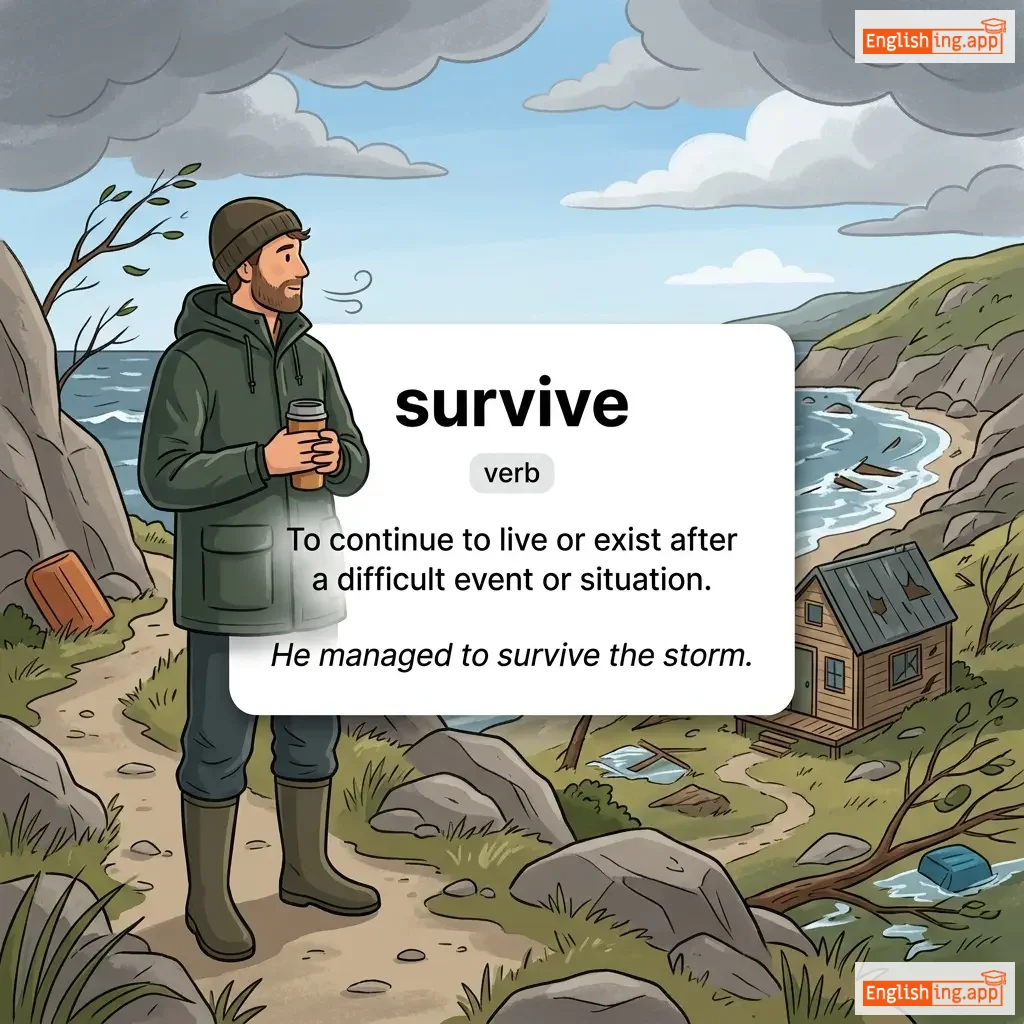
survive definition card — visual illustration of the meaning
verb
/sərˈvaɪv/
बचना (bachna)

To continue to live or exist after a difficult event or situation.

"He managed to survive the storm."

"वह तूफान से बचने में सफल रहा।" (Woh toofan se bachne mein safal raha.)
noun
/sərˈvaɪvə/
सर्वाइवर (survivor)

a person who survives, especially in difficult conditions

"The survivors of the shipwreck were rescued after several days."

"जहाज डूबने के बाद सर्वाइवर को कई दिनों बाद बचा लिया गया।" (Jahaz dubne ke baad survivor ko kai dinon baad bacha liya gaya.)
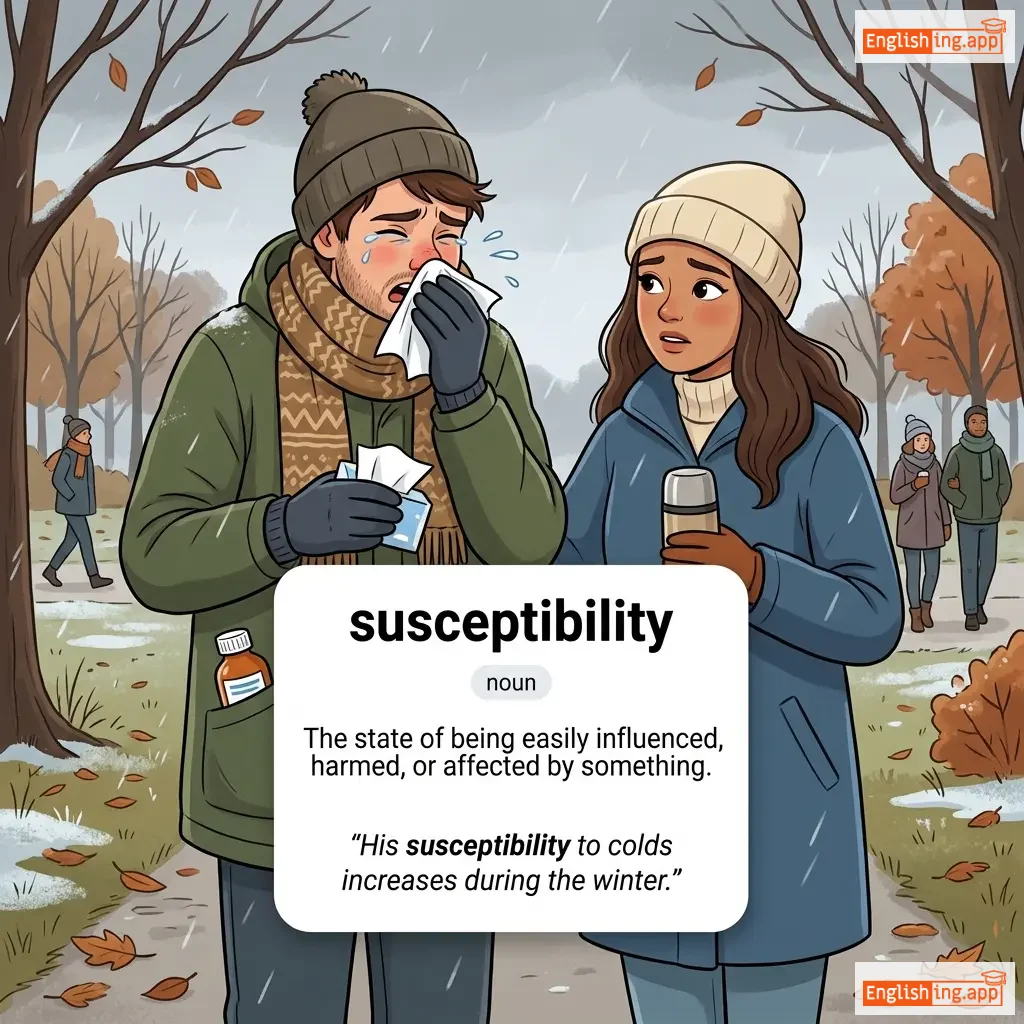
susceptibility definition card — visual illustration of the meaning
noun
/səˌsɛptəˈbɪləti/
संवेदनशीलता (sanvedansheelta)

The state of being easily influenced, harmed, or affected by something.

"His susceptibility to colds increases during the winter."

"सर्दियों में उसके सर्दी जुकाम की संवेदनशीलता बढ़ जाती है।" (Sardiyon mein uske sardi zukam ki sanvedansheelta badh jaati hai.)
susceptible definition card — visual illustration of the meaning
adjective
/səˈsɛptəbl/
संवेदनशील (sensitive)

Likely or liable to be influenced or harmed by a particular thing.

"Children are more susceptible to infections."

"बच्चे संक्रमणों के प्रति अधिक संवेदनशील होते हैं।" (Bachche sankramanon ke prati adhik sanvedansheel hote hain.)
suspect definition card — visual illustration of the meaning
verb, noun, adjective
/səˈspɛkt/ (noun, adj) | /səˈspɛkt/ (verb)
संदेह करना (sandeh karna)

To believe something to be true, likely, or guilty without certain proof.

"The police suspect him of stealing the car."

"पुलिस उसे कार चोरी का संदिग्ध मानती है।" (Police use car chori ka sandigdh maanti hai.)
verb
/səˈspɛnd/
निलंबित करना (nilambit karna)

To temporarily stop something from being active or valid.

"The company decided to suspend his membership."

"कंपनी ने उसके सदस्यता को सस्पेंड करने का निर्णय लिया।" (Kampani ne uske sadasyta ko suspend karne ka nirnay liya.)
adjective, verb (past)
/səˈspɛndɪd/
निलंबित (nilambit)

Temporarily not allowed, stopped, or hanging.

"He was suspended from school for a week."

"वह एक हफ्ते के लिए स्कूल से निलंबित हो गया था।" (vah ek hafte ke liye school se nilambit ho gaya tha.)
noun
/səˈspɛns/
सस्पेंस (saspens)

A state of mental uncertainty, anxiety, or excitement about what may happen next.

"The movie kept the audience in suspense until the very end."

"फिल्म ने दर्शकों को सस्पेंस में रखा, अंत तक।" (Film ne darshako ko suspense mein rakha, ant tak.)
sustainable definition card — visual illustration of the meaning
adjective
/səˈsteɪnəbəl/
सतत (satat)

able to continue over a long period without causing harm to the environment or using up resources

"We must adopt sustainable energy practices."

"हमें सतत ऊर्जा प्रथाओं को अपनाना चाहिए।" (Humein satat urja prathao ko apnana chahiye.)
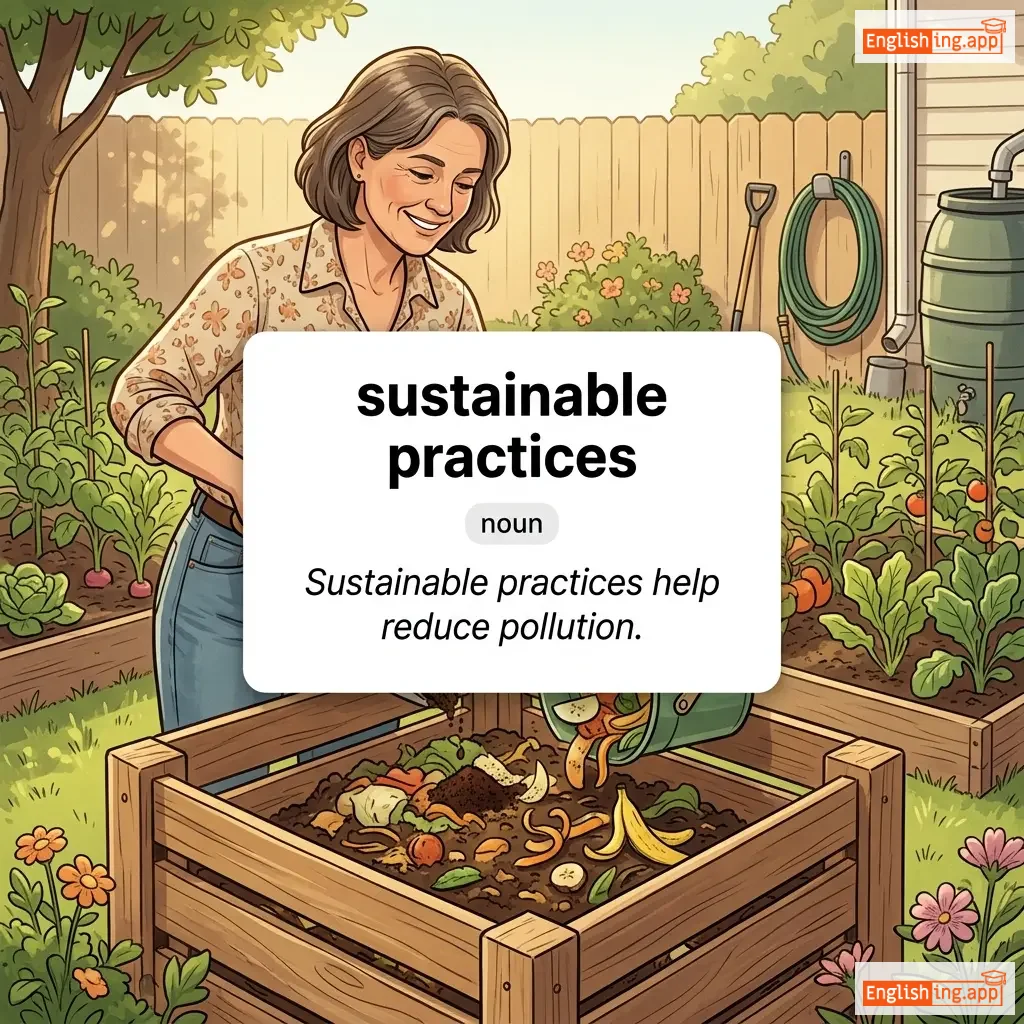
sustainable practices definition card — visual illustration of the meaning
noun
səˈsteɪnəbl ˈpræktɪsɪz
सतत प्रथाएं (sustenebal prakteeses)

Methods or actions that can be maintained long-term without depleting resources or causing environmental harm

"Sustainable practices help reduce pollution."

"सतत प्रथाएं प्रदूषण को कम करने में मदद करती हैं।" (satat prathayein pradushan ko kam karne mein madad karti hain)
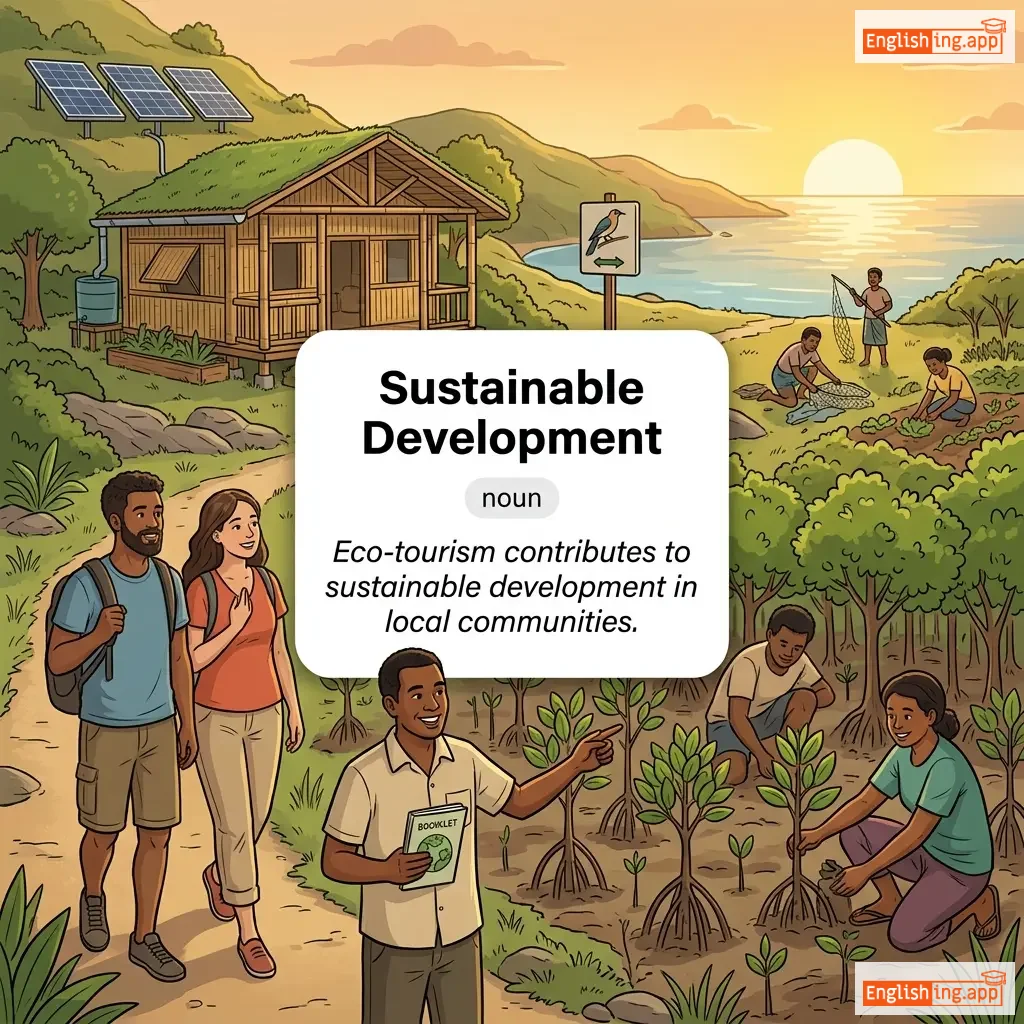
Sustainable Development definition card — visual illustration of the meaning
noun
səˈsteɪnəbl dɪˈvɛləpmənt
सतत विकास (satat vikas)

Development that meets present needs without compromising the ability of future generations to meet their own needs.

"Eco-tourism contributes to sustainable development in local communities."

"इको-टूरिज़्म स्थानीय समुदायों में सतत विकास में योगदान देता है।" (Eco-tourism sthaniya samudaayon mein satat vikas mein yogdan deta hai.)
sustainable and collaborative approach definition card — visual illustration of the meaning
noun
səˈsteɪnəbəl ænd kəˈlæbərətɪv əˈproʊtʃ
सतत और सहयोगात्मक दृष्टिकोण (satat aur sahyogaatmak drishtikon)

A method of working together that can be maintained over time without depleting resources or causing harm.

"A sustainable and collaborative approach is crucial for solving environmental problems."

"पर्यावरणीय समस्याओं को हल करने के लिए एक सतत और सहयोगात्मक दृष्टिकोण महत्वपूर्ण है।" (Paryavarnīya samasyaon ko hal karne ke liye ek satat aur sahyogaatmak drishtikon mahatvapurn hai.)
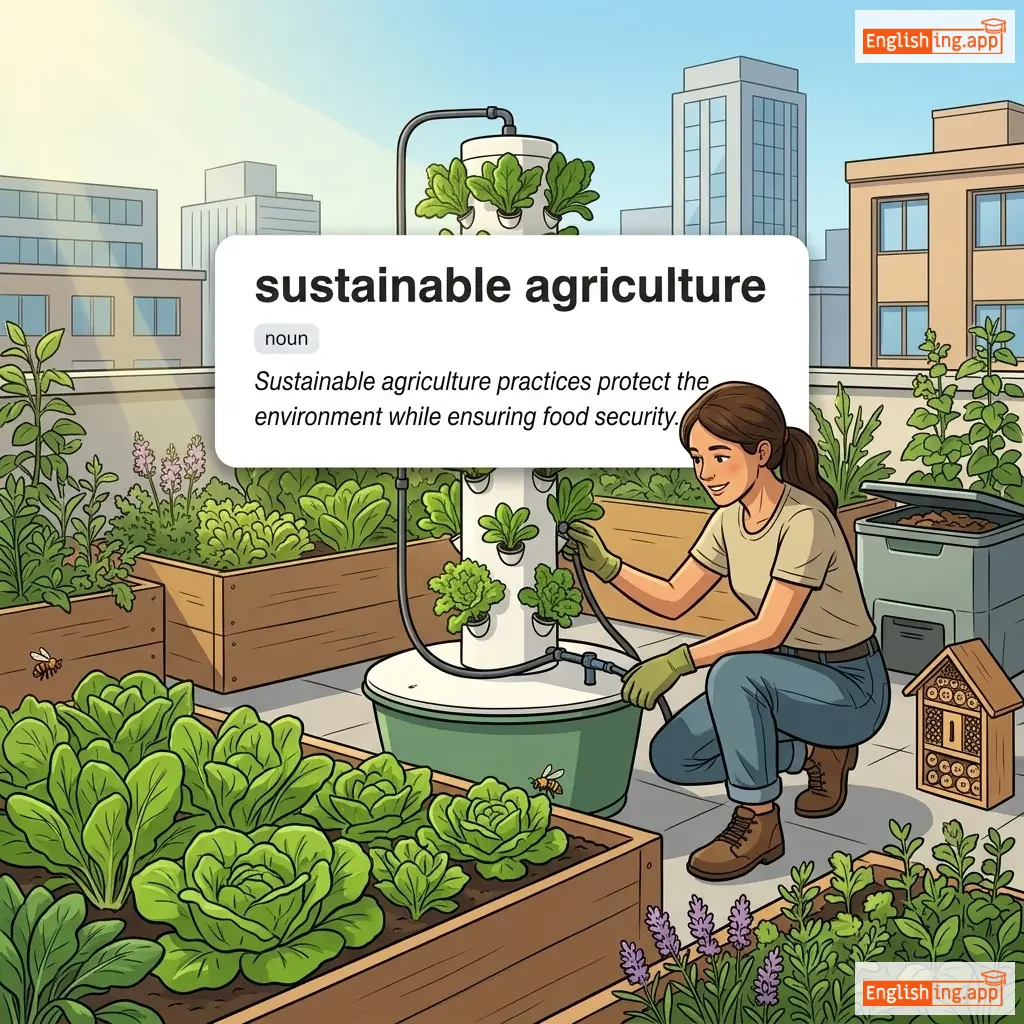
sustainable agriculture definition card — visual illustration of the meaning
noun
/səˈsteɪnəbl ˈæɡrɪkʌltʃər/
सतत कृषि (satat krishi)

Farming practices that meet current food needs while preserving environmental resources and maintaining the ability to produce food for future generations through ecologically sound methods.

"Sustainable agriculture practices protect the environment while ensuring food security."

"सतत कृषि पद्धतियाँ पर्यावरण की रक्षा करते हुए खाद्य सुरक्षा सुनिश्चित करती हैं।" (Satat krishi paddatiyan paryavaran ki raksha karte hue khadya suraksha nishchit karti hain.)
verb
/səˈsteɪn/
संचालित रखना (sanchalit rakhna)

To support, maintain, or keep something going over time.

"The team worked hard to sustain their success."

"टीम ने अपनी सफलता को बनाए रखने के लिए कड़ी मेहनत की।" (Team ne apni safalta ko banaye rakhne ke liye kathin mehnat ki.)
noun
/səˈspɪʃən/
संदेह (sandeh)

a feeling or belief that someone has done something wrong or illegal

"He was arrested on suspicion of theft."

"उसे चोरी के संदेह में गिरफ्तार किया गया था।" (Use chori ke sandeh mein giraftar kiya gaya tha.)