वोकैबुलरीज

इंग्लिश वोकैबुलरी डिस्कवर, लर्न और मास्टर करें

adjective
/səˈprɛsəbl̩/
दबाने योग्य (dabane yogya)

capable of being restrained, controlled, or prevented

"The symptoms of the disease are suppressible with medication."

"रोग के लक्षण दवाइयों से दबाए जा सकते हैं।" (rog ke lakshan davaiyon se dabaye ja sakte hain.)
suppress definition card — visual illustration of the meaning
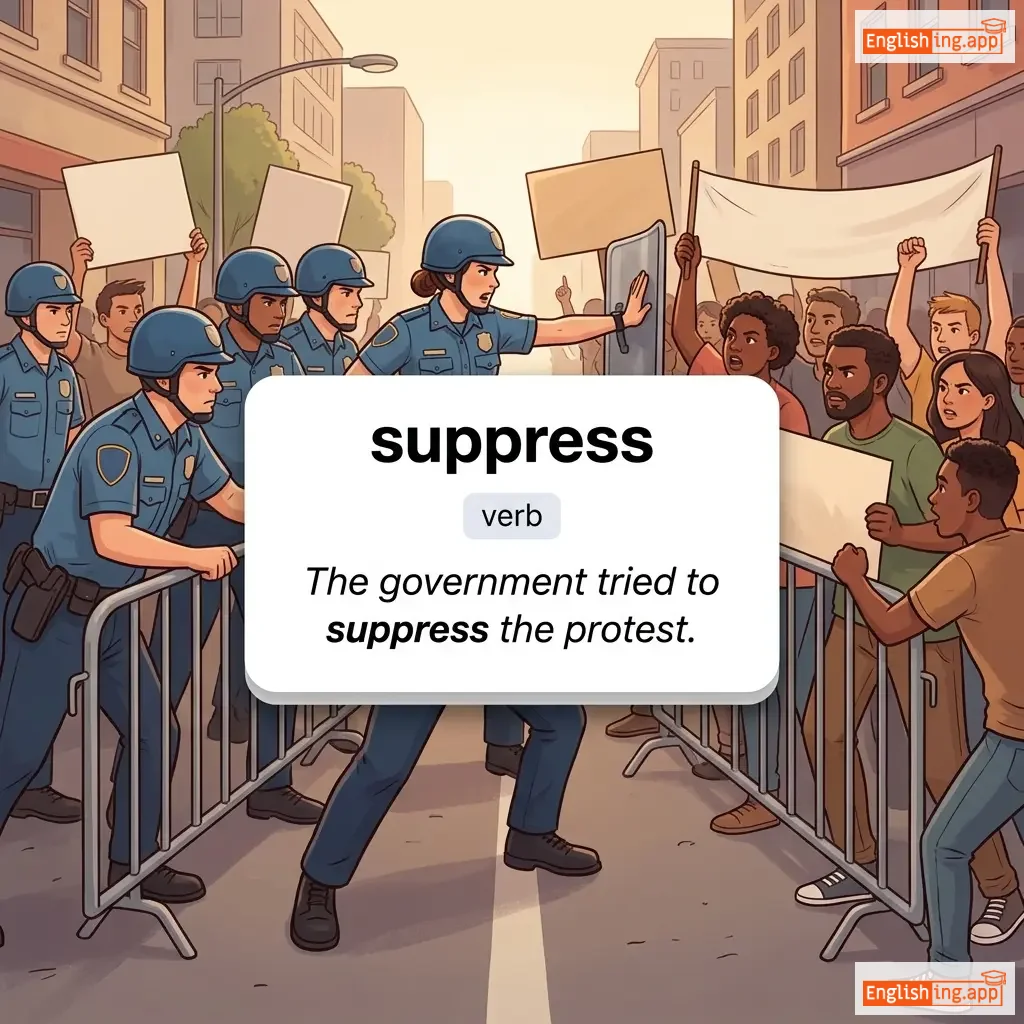
verb
/səˈprɛs/
दबाना (dabana)

to forcibly put an end to something; to restrain or hold back an action, feeling, or development

"The government tried to suppress the protest."

"सरकार ने विरोध को दबाने की कोशिश की।" (Sarkar ne virodh ko dabane ki koshish ki.)
adjective
/ˌsʌpəzɪˈtɪʃəs/
काल्पनिक (kalpanik)

Based on assumption rather than fact; not genuine or authentic.

"The story turned out to be supposititious, with no evidence to support it."

"कहानी काल्पनिक साबित हुई, इसके समर्थन में कोई प्रमाण नहीं था।" (Kahani kalpanik sabit hui, iske samarthan mein koi pramaan nahi tha.)
supposition definition card — visual illustration of the meaning
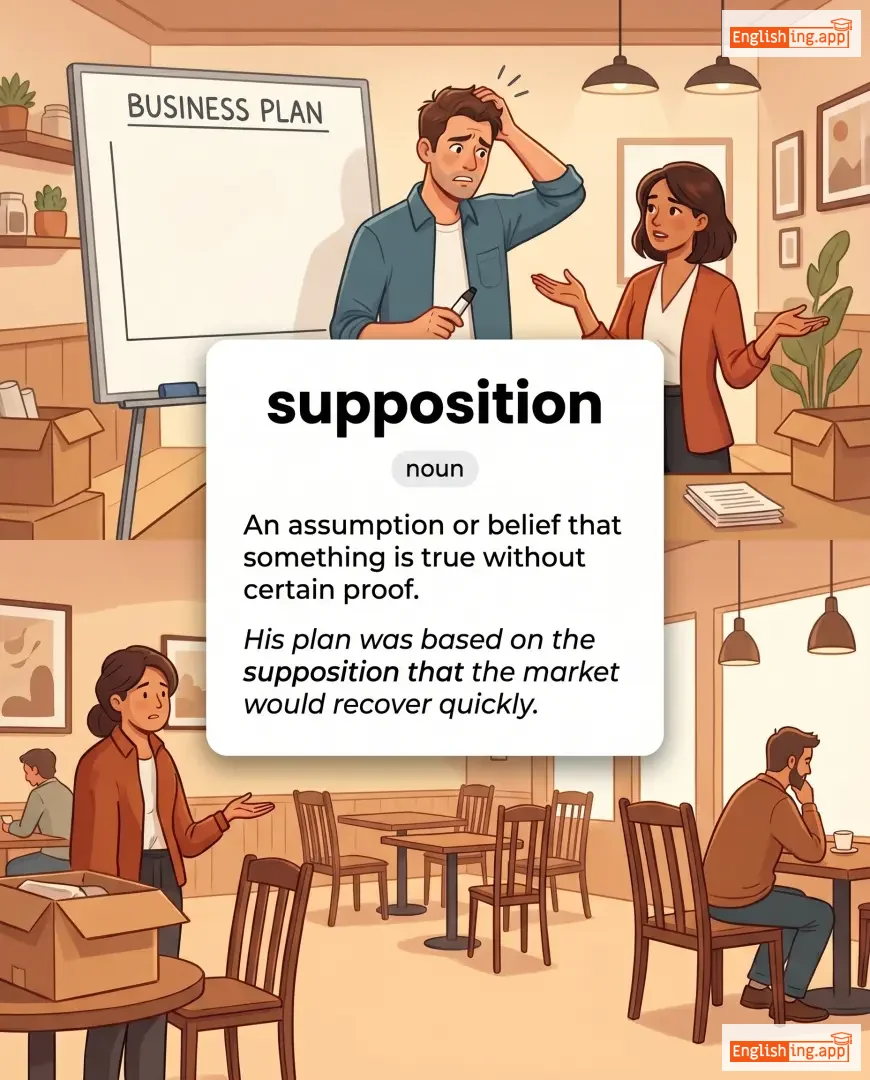
noun
/ˌsʌpəˈzɪʃən/
कल्पना (kalpana)

An assumption or belief that something is true without certain proof.

"His plan was based on the supposition that the market would recover quickly."

"उसकी योजना इस कल्पना पर आधारित थी कि बाजार जल्दी ठीक हो जाएगा।" (Uski yojana is kalpana par aadharit thi ki bazaar jaldi theek ho jayega.)
adverb
/səˈpəʊzɪdli/
कहा जाता है कि (kaha jata hai ki)

used to show that something is believed or claimed to be true, though it may not be

"He is supposedly the best player on the team."

"कहा जाता है कि वह टीम का सबसे अच्छा खिलाड़ी है।" (kaha jata hai ki vah team ka sabse accha khiladi hai.)
adjective
/səˈpəʊzd/
कहा गया (kaha gaya)

generally believed or assumed, but not necessarily true

"This is the supposed solution to the problem."

"यह समस्या का कहा गया समाधान है।" (Yeh samasya ka kaha gaya samadhan hai.)
verb
/səˈpəʊz/
मान लेना (maan lena)

to assume or believe something is true without proof

"I suppose she will be here soon."

"मैं suppose करता हूँ कि वह जल्दी यहाँ आएगी।" (Main suppose karta hoon ki vah jaldi yahaan aayegi.)
adjective
/səˈpɔːtɪv/
समर्थक (samarthak)

providing encouragement or emotional help to someone

"She was very supportive during my difficult times."

"वह मेरे कठिन समय में बहुत सहायक थी।" (Vah mere kathin samay mein bahut sahayak thi.)
supporting definition card — visual illustration of the meaning
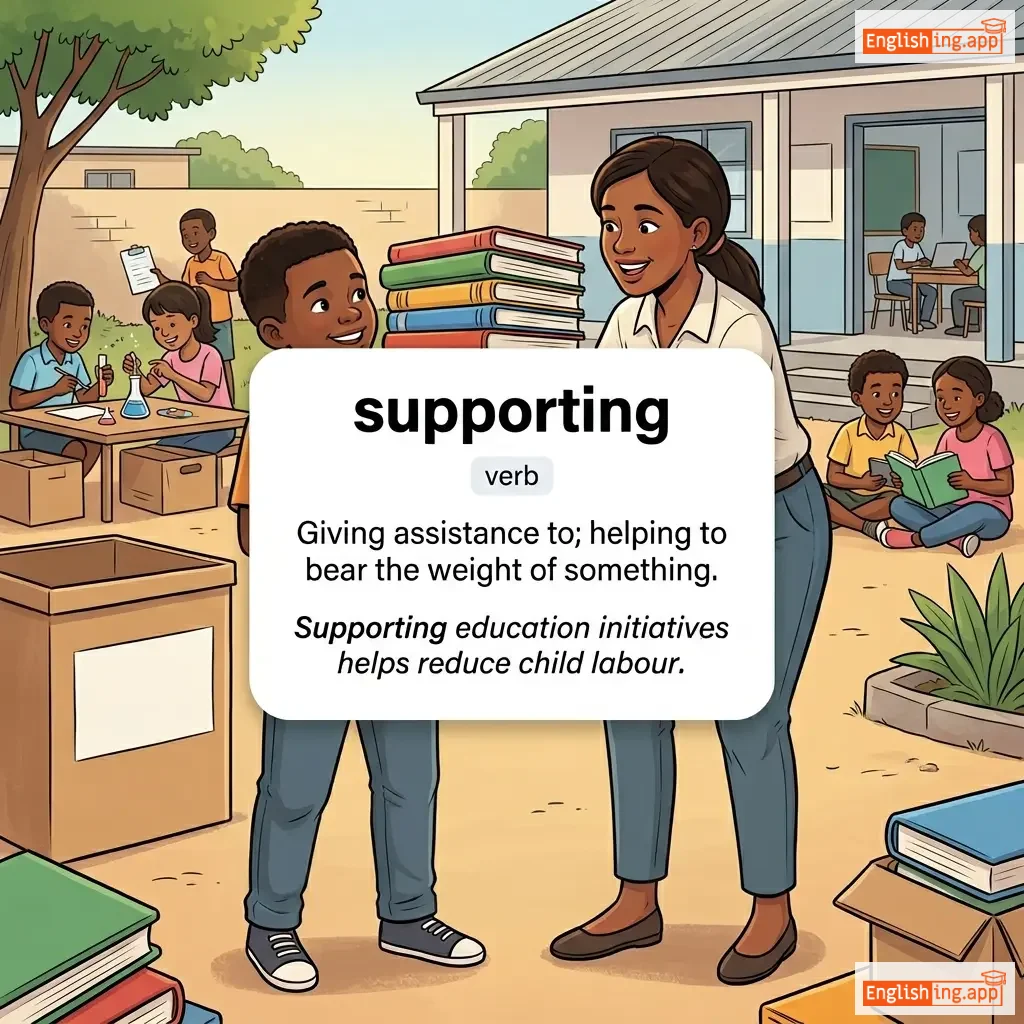
verb
səˈpɔːrtɪŋ
सहायता करना (sahayata karna)

Giving assistance to; helping to bear the weight of something.

"Supporting education initiatives helps reduce child labour."

"शिक्षा पहलों का समर्थन करना बाल श्रम को कम करने में मदद करता है।" (Shiksha pehlon ka samarthan karna baal shram ko kam karne mein madad karta hai.)
noun
/səˈpɔːtər/
समर्थक (samarthak)

a person who supports someone or something

"She is a strong supporter of the local animal shelter."

"वह स्थानीय पशु आश्रय की एक मजबूत समर्थक है।" (Vah sthaniye pashu ashray ki ek majboot samarthak hai.)
support definition card — visual illustration of the meaning
verb
/səˈpɔːrt/
सपोर्ट (support)

to give assistance or help to someone or something

"They always support each other during difficult times."

"वे हमेशा मुश्किल समय में एक दूसरे का सपोर्ट करते हैं।" (Ve hamesha mushkil samay mein ek doosre ka support karte hain.)
supply definition card — visual illustration of the meaning
noun
/səˈplaɪ/

the amount of something that is available to be used or consumed

"The store has a limited supply of electronics."

noun
/səˈplaɪə(r)/
आपूर्तिकर्ता (aapurtikarta)

a person or company that provides goods or services

"The supplier delivered the products on time."

"आपूर्तिकर्ता ने समय पर उत्पाद वितरित किए।" (Aapurtikarta ne samay par utpad vitrit kiye.)
verb
/ˈsʌplɪˌkeɪt/
प्रार्थना करना (prarthana karna)

To ask for something earnestly or humbly, often in a religious context.

"The villagers supplicated the gods for rain during the drought."

"गांववालों ने सूखे के दौरान बारिश के लिए देवताओं से प्रार्थना की।" (Gaonwalo ne sukhe ke dauran barish ke liye devtaon se prarthana ki.)
supplicant definition card — visual illustration of the meaning
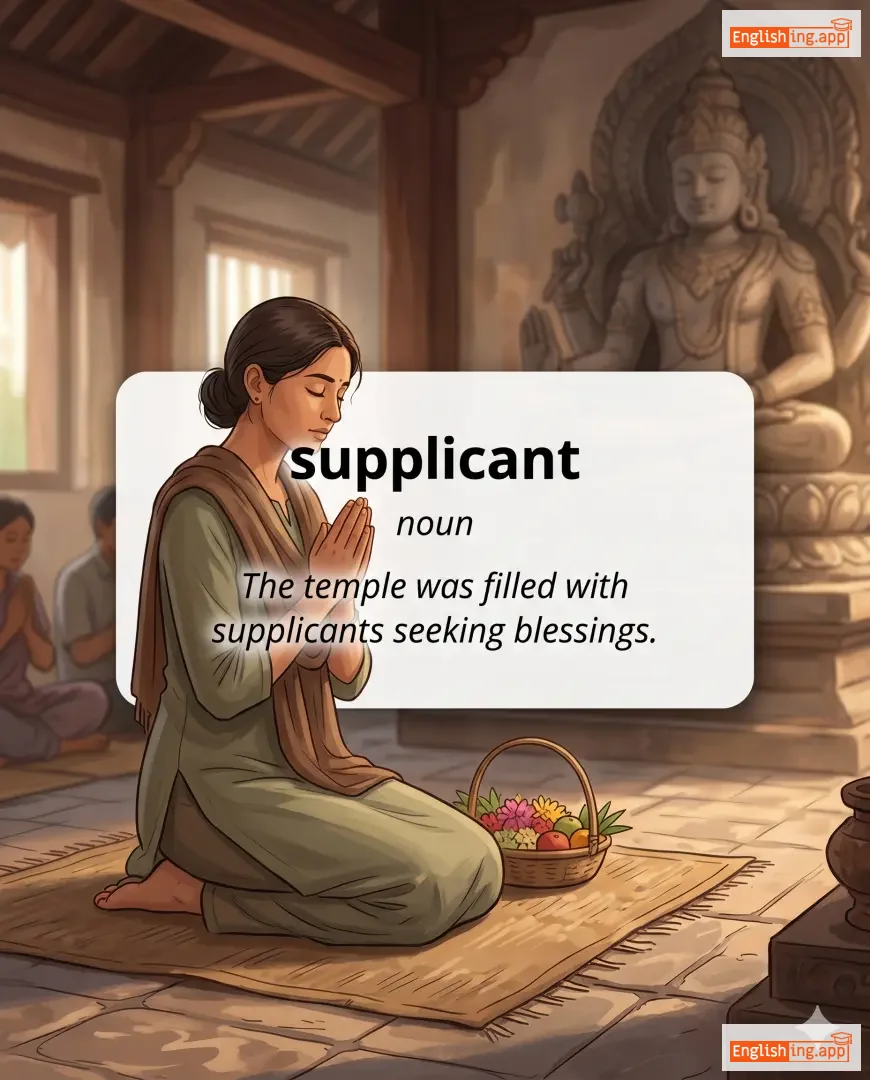
noun
/ˈsʌplɪkənt/
प्रार्थी (prarthi)

A person who humbly or earnestly asks for something, usually from a person of authority.

"The temple was filled with supplicants seeking blessings."

"मंदिर में आशीर्वाद मांगने वाले भक्त थे।" (Mandir mein ashirwad maangne wale bhakt the.)
suppliant definition card — visual illustration of the meaning
adjective
/ˈsʌpliənt/
विनम्र आवेदनकर्ता (vinamra aavedankarta)

Humbly or earnestly asking for something, especially from a person in authority.

"The suppliant man begged for mercy at the king's feet."

"विनम्र व्यक्ति ने राजा के पैरों में दया की भीख माँगी।" (vinamra vyakti ne raja ke pairon mein daya ki bhikh maangi.)
adjective
/ˌsʌplɪˈmɛntəri/
पूरक (poornak)

Additional, completing, or enhancing something else.

"The teacher gave supplementary materials to help the students prepare for exams."

"शिक्षक ने छात्रों को परीक्षा की तैयारी के लिए पूरक सामग्री दी।" (Shikshak ne chhatron ko pariksha ki taiyari ke liye poornak samagri di.)
noun/verb
/ˈsʌplɪmənt/
पूरक (pooraK)

Something added to complete or enhance; to add extra to make up for a deficiency.

"She takes vitamin supplements to improve her health."

"वह अपनी सेहत में सुधार के लिए विटामिन पूरक लेती है।" (Vah apni sehat mein sudhaar ke liye vitamin poorak leti hai.)
adjective
/ˈsʌpl/
लचीला (lachila)

Easily bending or moving without breaking; flexible and adaptable.

"The gymnast’s body was remarkably supple."

"जिम्नास्ट का शरीर असाधारण रूप से लचीला था।" (Gymnast ka sharir asadharan roop se lachila tha.)
supplant definition card — visual illustration of the meaning
verb
/səˈplænt/
स्थानापन्न करना (sthanapann karna)

To take the place of something or someone, often by force or strategy.

"Digital platforms have supplanted traditional newspapers."

"डिजिटल प्लेटफार्मों ने पारंपरिक समाचार पत्रों की जगह ले ली है।" (Digital platforms ne paramparik samachar patraon ki jagah le li hai.)
noun
/ˈsʌp.ər/
रात का खाना (raat ka khana)

an evening meal, typically a light or informal one

"We usually have supper around seven o'clock."

"हम सामान्यतः सात बजे रात का खाना खाते हैं।" (ham saamaanya roop se saat baje raat ka khana khaate hain.)
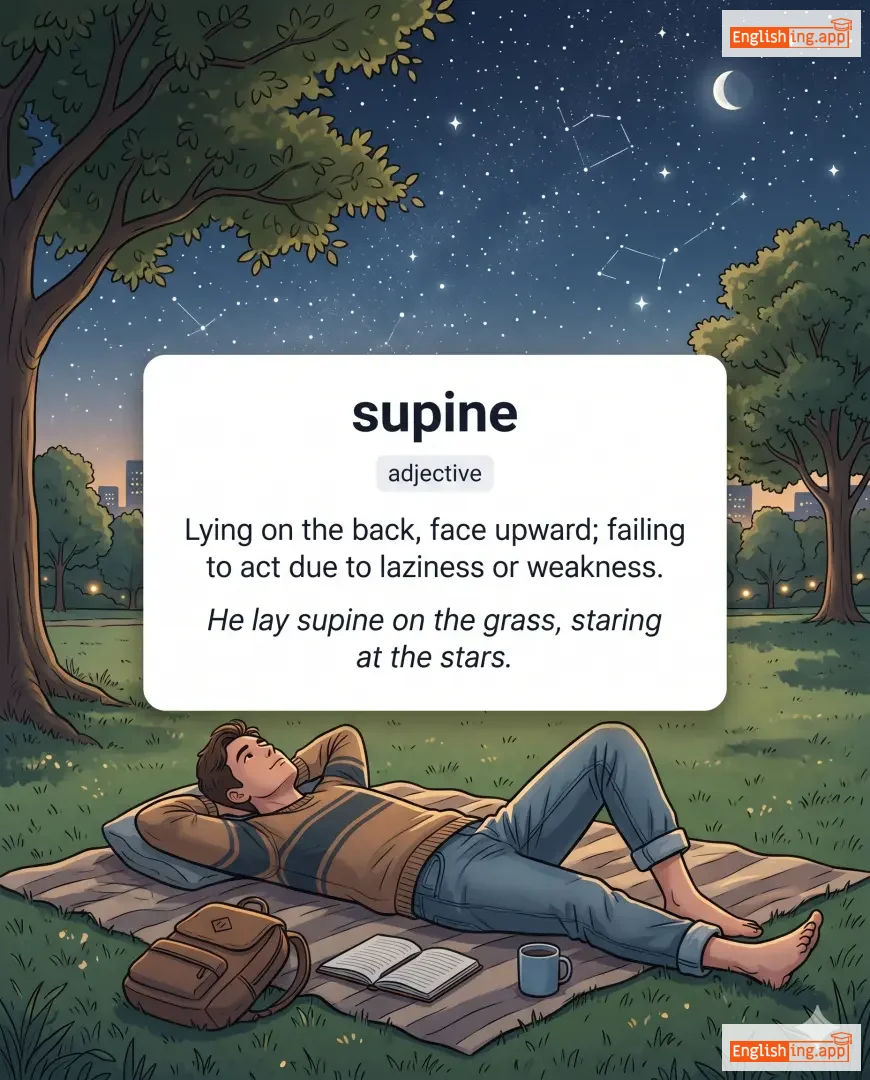
supine definition card — visual illustration of the meaning
adjective
/ˈsuːpaɪn/
पीठ के बल लेटना (peeth ke bal letna)

Lying on the back, face upward; failing to act due to laziness or weakness.

"He lay supine on the grass, staring at the stars."

"वह घास पर पीठ के बल लेटा हुआ था, तारों को देख रहा था।" (vah ghas par peeth ke bal leta hua tha, taaron ko dekh raha tha.)
noun
/swiːt/
सुइट (suit)

a set of rooms designated for one person's or family's use or for a particular purpose

"They stayed in the presidential suite at the hotel."

"वे होटल में प्रेसीडेंशियल सुइट में ठहरे थे।" (Ve hotel mein presidential suite mein thahre the.)
noun
/ˈsʌn.deɪ/
रविवार (ravivaar)

The day of the week between Saturday and Monday; often considered a day of rest or worship.

"We usually relax at home on Sunday."

"हम आमतौर पर रविवार को घर पर आराम करते हैं।" (ham aamtaur par ravivaar ko ghar par aaraam karte hain.)
noun
/ˈsʌn.flaʊər/
सूरजमुखी (surajmukhi)

a large yellow flower that turns to face the sun

"The sunflower field looked amazing in the bright sunlight."

"सूरजमुखी का खेत चमकदार धूप में अद्भुत लग रहा था।" (surajmukhi ka khet chamakdar dhoop me adbhut lag raha tha)
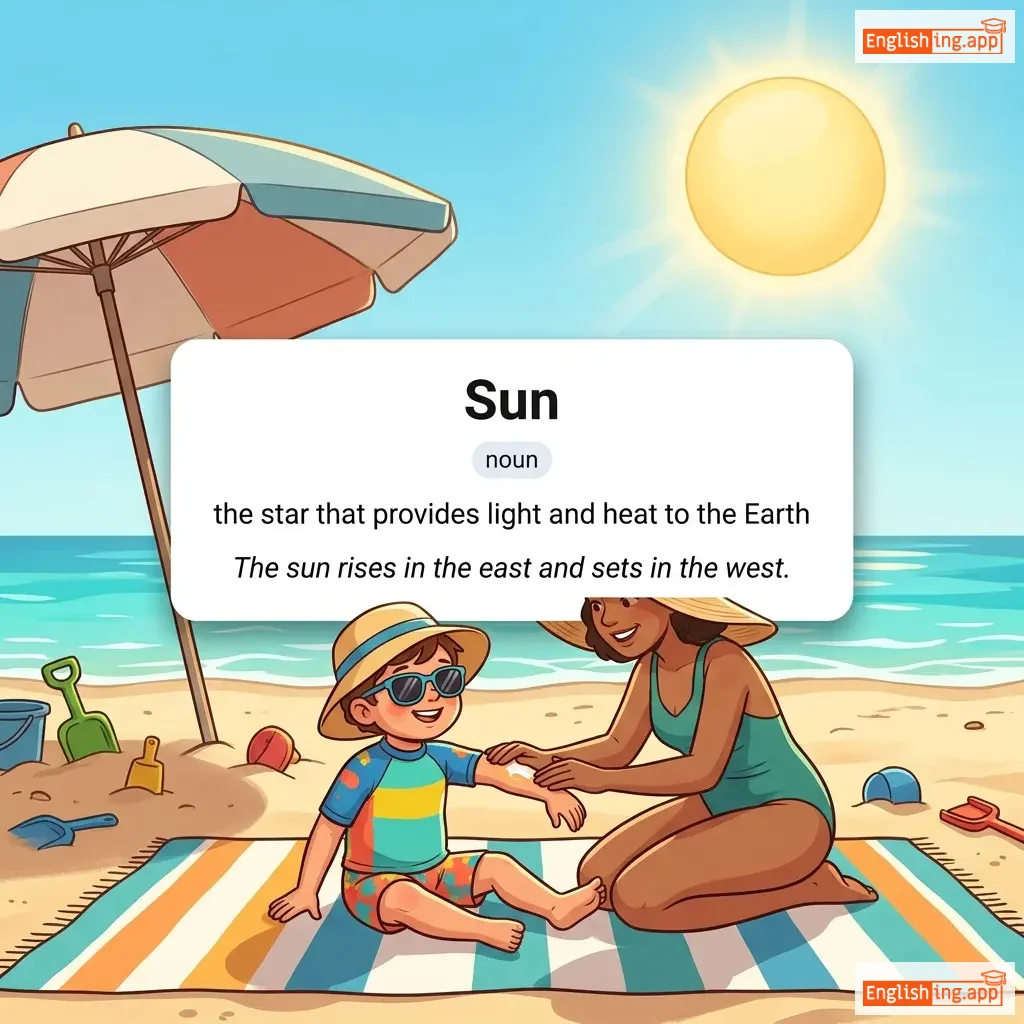
Sun definition card — visual illustration of the meaning
noun
/sʌn/
सूर्य (surya)

the star that provides light and heat to the Earth

"The sun rises in the east and sets in the west."

"सूर्य पूरब से उगता है और पश्चिम में डूबता है।" (Surya purab se ugta hai aur pashchim mein doobta hai.)
adjective
/ˈsʌmp.tʃu.əs/
विलासी (vilasi)

Splendid and expensive-looking; luxurious.

"The guests were treated to a sumptuous banquet."

"मेहमानों को एक शानदार भोज परोसा गया था।" (Mehmanon ko ek shandar bhoj parosa gaya tha.)
adjective
/ˈsʌmp.tʃuˌɛr.i/
वैशिष्ट्यपूर्ण खर्च से संबंधित (vaishishtyapurn kharch se sambandhit)

Relating to laws or regulations intended to limit personal spending on luxury goods.

"In medieval Europe, sumptuary laws restricted the wearing of expensive fabrics to the nobility."

"मध्यकालीन यूरोप में, संपूर्ण खर्च कानूनों ने महंगे कपड़ों के पहनने को केवल अभिजात वर्ग तक सीमित कर दिया था।" (Madhyakalīn Yūrop mein, sampūrn kharch kānūno ne mahenge kapdon ke pehennē ko keval abhjāt varg tak sīmit kar diyā thā.)
verb
/ˈsʌmən/
आह्वान करना, बुलाना (ahwan karna, bulana)

To order someone to come or to gather courage or strength.

"The king summoned his advisors to the court."

"राजा ने अपने सलाहकारों को दरबार में बुलाया।" (raja ne apne salahkaron ko darbar mein bulaya.)
Summit of the Future definition card — visual illustration of the meaning
noun
/ˈsʌm.ɪt əv ðə ˈfjuː.tʃər/
भविष्य सम्मेलन (bhavishya sammelan)

A high-level conference focused on addressing future challenges and opportunities.

"The Summit of the Future addressed global challenges."

"भविष्य सम्मेलन ने वैश्विक चुनौतियों पर चर्चा की।" (Bhavishya sammelan ne vaishvik chunautiyon par charcha ki.)
summit definition card — visual illustration of the meaning
noun
/ˈsʌmɪt/
चोटी, शिखर (choti, shikhar)

The highest point of a hill or mountain; a meeting between heads of state or leaders.

"The leaders met at the summit to discuss global issues."

"नेता वैश्विक मुद्दों पर चर्चा करने के लिए शिखर सम्मेलन में मिले।" (neta vaishvik muddon par charcha karne ke liye shikhar sammelan mein mile.)
summer definition card — visual illustration of the meaning
noun
/ˈsʌmər/
समर (samar)

the warmest season of the year, between spring and autumn

"We love going to the beach during summer."

"हमें समर में बीच पर जाना बहुत पसंद है।" (Humein summer mein beach par jana bahut pasand hai.)
noun
/sʌˈmeɪʃən/
योगफल, सारांश (yogfal, saransh)

The process of adding things together; a summary of points.

"The lawyer gave a powerful summation of the case."

"वकील ने मामले का एक शक्तिशाली समापन प्रस्तुत किया।" (vakil ne mamle ka ek shaktishaali samaapan prastut kiya.)
noun
/ˈsʌməri/
सारांश (saaransh)

A brief statement of the main points of something.

"She wrote a summary of the book for her class."

"उसने अपनी कक्षा के लिए पुस्तक का सारांश लिखा।" (Usne apni kaksha ke liye pustak ka saaransh likha.)
verb
/ˈsʌməraɪz/
सारांश प्रस्तुत करना (saransh prastut karna)

To give a brief statement of the main points of something

"She summarized the report in just a few minutes."

"उसने रिपोर्ट को केवल कुछ मिनटों में सारांश प्रस्तुत किया।" (Usne report ko keval kuch minuton me saransh prastut kiya)
noun
/sʌm/
योगफल (yogfal)

the total amount resulting from the addition of two or more numbers or items

"The sum of 8 and 12 is 20."

"8 और 12 का योगफल 20 है।" (8 aur 12 ka yogfal 20 hai.)
adjective
/ˈsʌltri/
गर्म और आर्द्र, आकर्षक (garm aur aardra, aakarshak)

Uncomfortably hot and humid; also describes someone attractive in a passionate or sensual way.

"The sultry weather made it hard to focus on work."

"गर्मी और आर्द्र मौसम ने काम पर ध्यान केंद्रित करना मुश्किल बना दिया।" (garmi aur ardhra mausam ne kaam par dhyaan kendrit karna mushkil bana diya.)
verb
/ˈsʌli/
कलंकित करना (kalankit karna)

to damage the purity, integrity, or reputation of something

"The scandal sullied the politician’s reputation."

"केलेंकार ने राजनेता की प्रतिष्ठा को कलंकित किया।" (Kelenkar ne rajneta ki pratishtha ko kalankit kiya.)
adjective
/ˈsʌlən/
चिड़चिड़ा (chidhchidhā)

bad-tempered and gloomy; silently resentful

"She gave him a sullen look and walked away."

"उसने उसे एक चिड़चिड़ी नजर से देखा और चली गई।" (Usne use ek chidhchidhī nazar se dekhā aur chalī ga'ī.)
adjective
/ˈsʌl.ki/
चिड़चिड़ा और चुपचाप; मूडी (chidchida aur chupchup; moody)

bad-tempered and sullen; moody

"The child became sulky when he couldn't get his favorite toy."

"बच्चा चिड़चिड़ा हो गया जब वह अपनी पसंदीदा खिलौना नहीं पा सका।" (bachcha chidchida ho gaya jab wah apni pasandida khilona nahi paa saka.)
sulk definition card — visual illustration of the meaning
verb
/sʌlk/
चुपचाप गुस्से में बैठना (chupchup gusse mein baithna)

to be silently resentful or moody

"He went to his room to sulk after the argument."

"वह बहस के बाद चुपचाप अपने कमरे में जाकर सल्क गया।" (Vah bahas ke baad chupchup apne kamre mein jaakar sulk gaya.)
noun
/ˈsuːtər/
प्रेमी (premi)

a man who pursues a relationship with a woman, often with the intent to marry

"She had many suitors vying for her attention."

"उसका ध्यान आकर्षित करने के लिए कई प्रेमी प्रयास कर रहे थे।" (uska dhyan akarshit karne ke liye kai premi prayas kar rahe the)
suffrage definition card — visual illustration of the meaning
noun
/ˈsʌfrɪdʒ/
मताधिकार (matadhikar)

the right to vote in political elections

"The movement fought for women’s suffrage in the early 20th century."

"आंदोलन ने बीसवीं सदी की शुरुआत में महिलाओं के मताधिकार के लिए संघर्ष किया।" (aandolan ne beesvin sadi ki shuruaat mein mahilaon ke matadhikar ke liye sangharsh kiya.)
noun
/ˈʃʊɡ.ər ˈkæn.di/
चीनी की मिठाई (cheeni ki mithai)

crystallized sugar formed into small pieces; rock candy made from sugar syrup

"The children enjoyed eating colorful sugar candy at the festival."

"बच्चों ने त्योहार पर रंगीन चीनी की मिठाई खाकर आनंद लिया।" (bachon ne tyohar par rangin cheeni ki mithai khakar anand liya)
noun
/ˈʃʊɡər/
चीनी (cheenee)

a sweet substance made from plants or produced synthetically

"She added two spoons of sugar to her tea."

"उसने अपनी चाय में दो चम्मच चीनी डाली।" (Usne apnee chaay mein do chammach cheenee daalee.)
verb
/səˈfjuːz/
व्याप्त होना (vyaapt hona)

to gradually spread through or over something

"A warm glow suffused her face as she smiled."

"जब वह मुस्काई, तो उसके चेहरे पर एक गर्म आभा फैल गई।" (Jab vah muskaai, to uske chehre par ek garm abha phail gayi.)
noun
/ˈsʌfrədʒɪst/
मताधिकार समर्थक (matadhikar samarthak)

a person advocating the extension of suffrage, especially to women

"The suffragists organized rallies to demand voting rights for women."

"सफ़्रेजिस्टों ने महिलाओं के लिए मतदान अधिकार की मांग करने के लिए रैलियाँ आयोजित कीं।" (Suffragiston ne mahilaon ke liye matdaan adhikar ki maang karne ke liye rallyen aayojit ki.)
adverb
/səˈfɪʃəntli/
पर्याप्त रूप से (paryapt roop se)

to an adequate degree or extent

"She studied sufficiently to pass the exam."

"उसने परीक्षा पास करने के लिए पर्याप्त रूप से अध्ययन किया।" (Usne pariksha paas karne ke liye paryapt roop se adhyayan kiya.)
adjective
/səˈpraɪzd/
हैरान (hairān)

feeling or showing astonishment or shock

"She was surprised by the news."

"वह खबर से हैरान हो गई थी।" (Vah khabar se hairān ho gayī thī.)
adjective
/səˈfɪʃənt/
पर्याप्त (paryapt)

enough; adequate for a purpose

"She had sufficient money to buy the dress."

"उसके पास ड्रेस खरीदने के लिए पर्याप्त पैसे थे।" (Uske paas dress kharidne ke liye paryapt paise the.)