वोकैबुलरीज

इंग्लिश वोकैबुलरी डिस्कवर, लर्न और मास्टर करें

verb
/lɜːrk/
छुपकर बैठना (chupkar baithna)

to remain hidden so as to wait for an opportunity to attack or observe

"A stranger lurked in the shadows."

"एक अजनबी साए में लर्कड था।" (Ek ajnabi saaye mein lurked tha.)
adjective
/ˈlʌʃəs/
स्वादिष्ट (swadisht)

deliciously sweet or rich; highly appealing to the senses

"She served a luscious chocolate cake."

"उसने एक स्वादिष्ट चॉकलेट केक परोसा।" (Usne ek swadisht chocolate cake parosa.)
adjective
/lʌʃ/
समृद्ध, प्रचुर और विलासपूर्ण, विशेष रूप से वनस्पति का संदर्भ देते हुए (samriddh, prachur aur vilaspurn, vishesh roop se vanspati ka sandarbh dete hue)

rich, abundant, and luxurious, especially referring to vegetation

"The valley was filled with lush green fields."

"घाटी हरे-भरे खेतों से भरी हुई थी।" (ghati hare-bhare kheton se bhari hui thi.)
noun
/lʌst/
वासना (vasana)

a very strong sexual desire or an intense craving for something

"His mind was clouded by lust for power."

"उसका मन शक्ति की वासना से ढका हुआ था।" (uska man shakti ki vasana se dhaka hua tha.)
noun
/ˈlʌstər/
चमक (chamak)

a gentle sheen or soft glow, especially from a polished surface

"The diamond had a brilliant luster."

"हीरे में शानदार चमक थी।" (hiere mein shandaar chamak thi.)
lustrous definition card — visual illustration of the meaning
adjective
/ˈlʌstrəs/
चमकदार (chamakdaar)

having a gentle sheen or soft glow

"Her hair looked smooth and lustrous."

"उसके बाल चिकने और चमकदार लग रहे थे।" (uske baal chikne aur chamakdaar lag rahe the.)
noun
/lʌɡˈʒʊəriəns/
समृद्धि (samriddhi)

abundant growth, richness, or elegance

"The garden was filled with the luxuriance of tropical plants."

"बग़ीचा उष्णकटिबंधीय पौधों की समृद्धि से भरा हुआ था।" (bagicha ushnakatibandhiya paudhon ki samriddhi se bhara hua tha.)
adjective
/lʌɡˈʒʊəriənt/
वृद्धिशील (vruddhishil)

abundant in growth or richly abundant

"The luxuriant forest was teeming with life."

"वृद्धिशील जंगल जीवन से भरपूर था।" (vruddhishil jangal jeevan se bharpoor tha.)
verb
/lʌɡˈʒʊrieɪt/
विलासिता का आनंद लेना (vilasita ka anand lena)

to enjoy something in a self-indulgent way; to take pleasure in great comfort

"She luxuriated in the warm bubble bath after a long day."

"वह एक लंबे दिन के बाद गर्म बबल स्नान में विलासिता का आनंद ले रही थी।" (Vah ek lambe din ke baad garm bubble snaan mein vilasita ka anand le rahi thi.)
adjective
/lʌɡˈʒʊəriəs/
विलासी (vilasi)

extremely comfortable, elegant, or enjoyable, often involving great expense

"They stayed in a luxurious hotel during their vacation."

"वे अपनी छुट्टियों के दौरान एक विलासी होटल में ठहरे थे।" (Ve apni chhutiyon ke dauran ek vilasi hotel mein thahare the.)
noun
/ˈlʌkʃəri/
विलासिता (vilasita)

a state of great comfort or elegance, often involving great expense

"Staying at a five-star hotel is a luxury for most people."

"पाँच सितारा होटल में रहना अधिकांश लोगों के लिए विलासिता है।" (paanch sitara hotel mein rehna adhikansh logon ke liye vilasita hai.)
verb
/ˈlaɪɪŋ/
झूठ बोलना (jhuth bolna)

the act of not telling the truth

"He was caught lying about his grades."

"वह अपने ग्रेड के बारे में झूठ बोलते हुए पकड़ा गया।" (Vah apne grade ke baare mein jhuth bolte huye pakda gaya.)
noun
/laɪər/
प्राचीन बांसुरी (prachin bamsuri)

a stringed musical instrument of ancient Greece

"The musician played a melody on the lyre."

"संगीतज्ञ ने लायर पर एक धुन बजाई।" (Sangeetgya ne lyre par ek dhun bajayi.)
noun
/ˈluː.məˌnɛr.i/
प्रकाशस्तंभ (prakashstambh)

A person who inspires or influences others, especially in a particular field.

"He is considered a luminary in the world of science."

"उसे विज्ञान की दुनिया में एक प्रकाशस्तंभ माना जाता है।" (use vigyan ki duniya mein ek prakashstambh maana jaata hai.)
noun
/ˈlɪrɪk/
गीत के बोल (geet ke bol)

the words of a song or a short poem that expresses personal feelings

"She memorized every lyric of her favorite song."

"उसने अपनी पसंदीदा गीत के हर बोल को याद किया।" (Usne apni pasandida geet ke har bol ko yaad kiya.)
adjective
/məˈkɑːbrə/
भयावह (bhayavah)

disturbing and horrifying because of involvement with or depiction of death and injury

"The horror movie had a macabre ending."

"हॉरर मूवी का एक भयावह अंत था।" (Horror movie ka ek bhayavah ant tha.)
verb
/məˈkadəˌmaɪz/
कच्ची सड़क को पत्थर से ढंकना (kachchi sadak ko pathar se dhanqna)

to construct or cover a road with broken stone

"The government decided to macadamize the old rural roads."

"सरकार ने पुराने ग्रामीण सड़कों को पत्थर से ढंकने का निर्णय लिया।" (Sarkar ne purane gramin sadkon ko pathar se dhanqne ka nirnay liya.)
noun
/meɪs/
गदा / राजदंड (gada / rajdand)

a ceremonial staff carried as a symbol of authority or a weapon similar to a club

"The guard carried a mace as a symbol of authority."

"गार्ड ने अधिकार के प्रतीक के रूप में एक गदा उठाई थी।" (Guard ne adhikar ke pratik ke roop mein ek gada uthayi thi.)
verb
/ˈmæsəˌreɪt/
नर्म करना (narm karna)

to soften or break up something, especially food, by soaking in liquid

"The chef macerated the fruit in wine before serving."

"शेफ ने फल को परोसने से पहले वाइन में मैसरट किया।" (Shef ne phal ko parosne se pehle wain mein macerate kiya.)
machiavellian definition card — visual illustration of the meaning
adjective
/ˌmækɪəˈvɛliən/
चतुर, षड्यंत्रकारी और नीतिहीन, खासकर राजनीति में या किसी के करियर को आगे बढ़ाने में (makiveliyan)

cunning, scheming, and unscrupulous, especially in politics or in advancing one's career

"The politician was known for his Machiavellian tactics."

"राजनेता अपने मैकीवेलियन चालों के लिए प्रसिद्ध थे।" (raajneta apne makiveliyan chalon ke liye prasiddh the.)
verb
/ˈmæk.ɪ.neɪt/
षड्यंत्र करना (shadyantr karna)

to engage in plots or schemes, usually for harmful or evil purposes

"The rebels tried to machinate against the king."

"विद्रोहियों ने राजा के खिलाफ षड्यंत्र करने की कोशिश की।" (Vidrohiyon ne raja ke khilaf shadyantr karne ki koshish ki.)
noun
/ˌmæk.ɪˈneɪ.ʃən/
षड्यंत्र (shadyantra)

a secret plan or scheme intended to accomplish something, especially something evil

"The detective uncovered the villain's machination."

"जांचकर्ता ने खलनायक के षड्यंत्र का खुलासा किया।" (Jaanch karta ne khalnayak ke shadyantra ka khulasa kiya.)
magical definition card — visual illustration of the meaning
adjective
/ˈmædʒɪkəl/
जादुई (maijikal)

having or producing the charm, beauty, or power of magic

"The sunset over the mountains was a magical sight."

"पर्वतों के ऊपर सूर्यास्त एक जादुई दृश्य था।" (Parvaton ke upar sooryaast ek jadui drishya tha)
Mail train definition card — visual illustration of the meaning
noun
/meɪl treɪn/
डाक गाड़ी (daak gaadi)

a train that carries mail and postal packages

"The mail train departs every evening to deliver letters across the country."

"मेल ट्रेन हर शाम पत्रों को देशभर में पहुँचाने के लिए प्रस्थान करती है।" (daak gaadi har shaam pattron ko deshbhar mein pahunchane ke liye prasthaan karti hai.)
noun/verb
/meɪl/
पत्र / डाक (patra / daak)

Letters, packages, or email messages sent or delivered to someone.

"I received an important letter in the mail."

"मैंने मेल में एक महत्वपूर्ण पत्र प्राप्त किया।" (Maine mail mein ek mahatvapurn patra prapt kiya.)
noun
/ˈmeɪdənˌhʊd/
कुमारीपन (kumaaripan)

The state of being a maiden; girlhood or virginity.

"The poem celebrated the innocence of maidenhood."

"ग़ज़ल ने कुमारीपन की मासूमियत का जश्न मनाया।" (Ghazal ne kumaaripan ki maasoomiyat ka jashn manaya.)
noun
/ˌmɑːhəˈrɑːdʒə/
महाराजा (maharaja)

A great king, especially a ruler of one of the principal states in India.

"The maharaja lived in a grand palace surrounded by gardens."

"महाराजा एक भव्य महल में रहते थे जो बागों से घिरा हुआ था।" (Maharaja ek bhavya mahal mein rehte the jo bagon se ghira hua tha.)
noun
/ˈmæɡnɪtuːd/
परिमाण (parimaan)

the great size, extent, or importance of something

"The magnitude of the earthquake shocked the nation."

"भूकंप का परिमाण ने राष्ट्र को चौंका दिया।" (Bhookamp ka parimaan ne rashtra ko chauka diya.)
adjective
/mæɡˈnɪləkwənt/
पाण्डित्यपूर्ण भाषा (pandityapurn bhasha)

using high-flown or pompous language

"The politician’s magniloquent speech impressed the crowd."

"राजनेता का पाण्डित्यपूर्ण भाषण भीड़ को प्रभावित कर गया।" (Rajneeta ka pandityapurn bhashan bheed ko prabhavit kar gaya.)
verb
/ˈmæɡnɪfaɪ/
बड़ा करना (bada karna)

to make something appear larger or more important than it really is

"The microscope can magnify tiny cells."

"सूक्ष्मदर्शी यंत्र छोटे कोशिकाओं को बड़ा कर सकता है।" (sookshmadarshi yantra chhote koshikaon ko bada kar sakta hai.)
adjective
/mæɡˈnɪfɪsənt/
शानदार (shandar)

extremely beautiful, impressive, or splendid

"The view from the mountain was truly magnificent."

"पर्वत से दृश्य सच में शानदार था।" (Parvat se drishya sach mein shandar tha.)
noun
/mæɡˈnɪfɪsəns/
शानदारता (shandarta)

splendor, grandeur, or impressive beauty

"The magnificence of the palace left everyone speechless."

"महल की शानदारता ने सभी को चुप करा दिया।" (Mahal ki shandarta ne sabhi ko chup kara diya.)
verb
/ˈmæɡnɪtaɪz/
चुम्बकीकरण करना (chumbkikaran karna)

to make something magnetic or to strongly attract

"The scientist managed to magnetize the iron rod."

"वैज्ञानिक ने लोहे की छड़ी को चुम्बकीय बनाने में सफलता पाई।" (Vaigyanik ne lohe ki chhadi ko chumbakiya banane mein safalta paayi.)
adjective
/mæɡˈnɛtɪk/
चुम्बकीय (chumbikīya)

having the power to attract metal objects or to attract people or things in a strong way

"The magnetic field of the Earth protects us from harmful solar radiation."

"पृथ्वी का चुम्बकीय क्षेत्र हमें हानिकारक सौर विकिरण से बचाता है।" (Prithvī kā chumbikīya kṣetra humein hānikārak saur vikiraṇ se bachātā hai.)
noun
/ˈmæɡnət/
चुंबक (chumbak)

An object that produces a magnetic field and attracts metals like iron.

"The magnet held the paper to the fridge door."

"चुंबक ने कागज को फ्रिज के दरवाजे से चिपका लिया।" (chumbak ne kagaz ko frij ke darwaze se chipka liya.)
noun
/ˈmæɡneɪt/
धनकुबेर (dhankuber)

A wealthy and influential person, especially in business or industry.

"The oil magnate donated millions to charity."

"तेल के धनकुबेर ने चैरिटी को लाखों डॉलर दान किए।" (Tel ke dhankuber ne charity ko lakhon dollar dan kiye.)
magnanimous definition card — visual illustration of the meaning
adjective
/mæɡˈnænɪməs/
उदार (udar)

Generous or forgiving, especially toward a rival or less powerful person.

"He was magnanimous in victory, praising his opponent."

"वह विजय में महान था, अपने प्रतिद्वंद्वी की सराहना करते हुए।" (Vah vijay mein mahaan tha, apne pratidvandvi ki sarahna karte hue.)
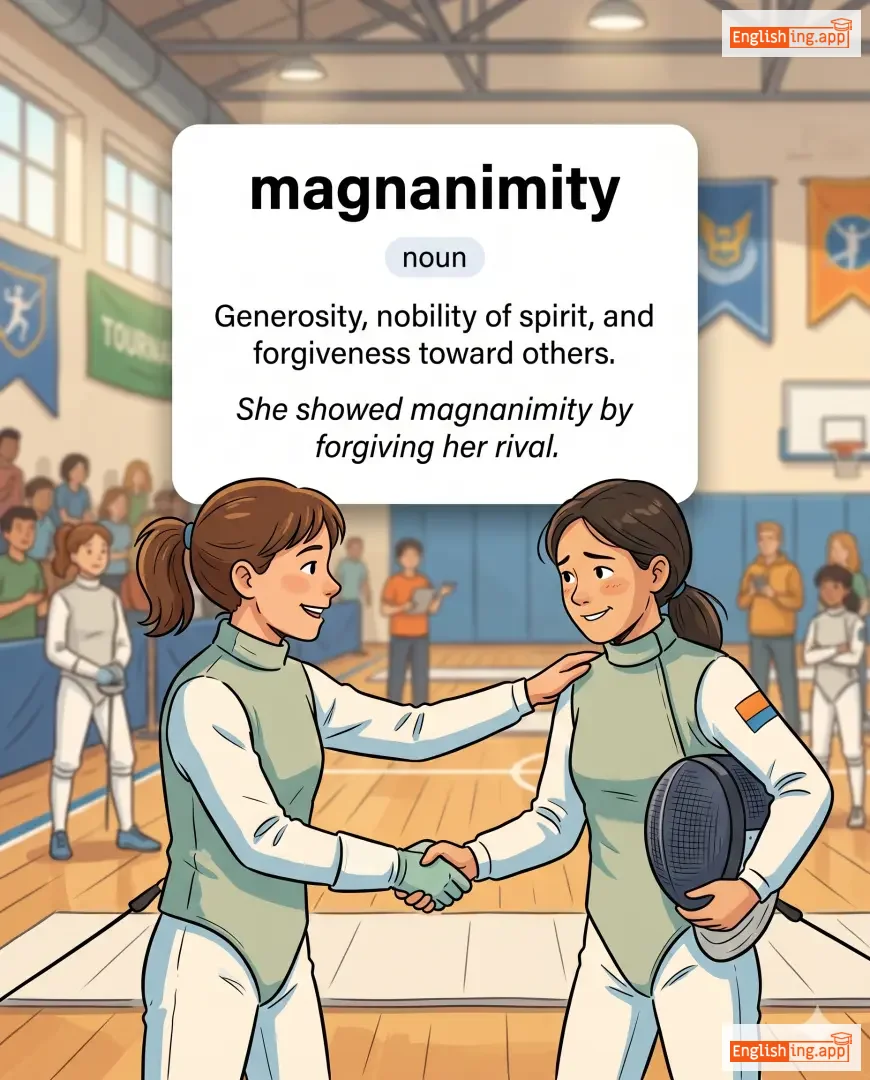
magnanimity definition card — visual illustration of the meaning
noun
/ˌmæɡnəˈnɪmɪti/
उदारता (udarata)

Generosity, nobility of spirit, and forgiveness toward others.

"She showed magnanimity by forgiving her rival."

"उसने अपने प्रतिद्वंद्वी को माफ करके उदारता दिखाई।" (Usne apne pratidvandi ko maaf karke udarata dikhayi.)
noun
/ˈmædʒɪstreɪt/
मैजिस्ट्रेट (maijisṭreṭ)

A civil officer who administers the law, often with limited judicial authority.

"The magistrate presided over the minor criminal case."

"मैजिस्ट्रेट ने छोटे आपराधिक मामले की अध्यक्षता की।" (Majistrate ne chhote aparaadh mamle ki adhyakshata ki.)
noun
/ˈmædʒɪstrəsi/
न्यायिक कार्यालय (nyayik karyalay)

The office, authority, or district of a magistrate.

"He was proud to serve in the local magistracy for over a decade."

"वह एक दशक से अधिक समय तक स्थानीय न्यायिक कार्यालय में सेवा देने पर गर्वित था।" (Vah ek dashak se adhik samay tak sthaniya nyayik karyalay mein seva dene par garvit tha.)
adjective
/ˌmædʒɪˈstɪəriəl/
प्रभुत्वशाली (prabhutvashali)

Having the characteristics of a master or authority; commanding and dignified.

"The professor spoke in a magisterial tone during the lecture."

"प्रोफेसर ने व्याख्यान के दौरान प्रभुत्वशाली स्वर में बात की।" (Professor ne vyakhyan ke dauran prabhutvashali swar mein baat ki.)
noun
/məˈdʒɪʃən/
जादूगर (jadugar)

A person who performs tricks and illusions for entertainment or one believed to have magical powers.

"The magician pulled a rabbit out of his hat."

"जादूगर ने अपनी टोपी से एक खरगोश निकाला।" (Jadugar ne apni topi se ek khargosh nikala.)
noun
/ˈmækɪntɒʃ/
बारिश कोट (baarish coat)

a waterproof raincoat, originally made from rubberized fabric

"He wore a mackintosh to stay dry in the rain."

"उसने बारिश से बचने के लिए एक मैकिन्टोश पहना।" (Usne barish se bachne ke liye ek mackintosh pehna.)
verb
/ˈmæk.jʊˌleɪt/
धब्बा लगाना (dhabba lagana)

To stain, spot, or pollute something.

"The white cloth was maculated by ink stains."

"सफेद कपड़ा स्याही के दागों से धब्बा लग गया था।" (safed kapda syahi ke dagon se dhabba lag gaya tha.)
macronutrients definition card — visual illustration of the meaning
noun
/ˈmæk.rəʊˌnjuː.tri.ənts/
मैक्रोन्यूट्रिएंट्स (makronyutrients)

Nutrients that are needed in large amounts to provide energy and building materials for the body, including carbohydrates, proteins, and fats.

"Proteins, fats, and carbohydrates are vital macronutrients."

"प्रोटीन, वसा और कार्बोहाइड्रेट्स महत्वपूर्ण मैक्रोन्यूट्रिएंट्स हैं।" (Protein, vasa aur carbohydrates mahatvapurn macronutrients hain.)
macroeconomic definition card — visual illustration of the meaning
adjective
/ˌmæk.rəʊ.iː.kəˈnɒm.ɪk/
मैक्रोइकोनॉमिक (macroeconomic)

Relating to macroeconomics or the large-scale or general economic factors, such as interest rates and national productivity.

"Macroeconomic policies influence inflation and employment rates."

"मैक्रोइकोनॉमिक नीतियाँ मुद्रास्फीति और रोजगार दरों को प्रभावित करती हैं।" (Macroekonomic neetiyan mudrasfiti aur rojgar daron ko prabhavit karti hain.)
noun
/ˈmæk.rəˌkɒz.əm/
ब्रह्मांड (brahmand)

The whole universe considered as a large, complex system; a large-scale representation of something.

"The macrocosm of the universe reflects the microcosm of human life."

"ब्रह्मांड का मैक्रोकॉज़म मानव जीवन के सूक्ष्म ब्रह्मांड को दर्शाता है।" (brahmand ka macrocosm manav jeevan ke sukhshm brahmand ko darshata hai.)
noun
/məˈʃiː.nɪst/
यांत्रिक तकनीशियन (yantrik takneeshiyan)

a person who operates machine tools or makes and repairs machines

"The machinist carefully adjusted the gears on the lathe."

"मैकिनिस्ट ने धीरज से लेथ पर गियर को एडजस्ट किया।" (Maikinist ne dheeraj se leth par gear ko adjust kiya.)
noun
/məˈʃiːn/
यंत्र (yantra)

A device with moving parts that uses energy to perform a particular task.

"This washing machine is very efficient."

"यह वाशिंग मशीन बहुत प्रभावी है।" (Yeh washing machine bahut prabhavi hai.)
noun
/məˈʃiː.nər.i/
मशीनीकरण (mashinīkaraṇ)

machines collectively, or the parts of a machine; also, the system or process by which something works

"The factory invested in new machinery to increase production."

"फैक्ट्री ने उत्पादन बढ़ाने के लिए नए मशीनीकरण में निवेश किया।" (fekṭrī ne utpādan baṛhāne ke liye naye mashīnīkaraṇ meṁ nivesh kiyā.)