Vocabulaires

Découvrez, apprenez et maîtrisez le vocabulaire anglais

noun
/stɑːˈveɪ.ʃən/
famine (famine)

suffering or death caused by lack of food; extreme hunger

"Many people died of starvation during the famine."

"Beaucoup de gens sont morts de famine pendant la famine." (beaucoup de gens sont morts de famine pendant la famine.)
verb
/stɑːv/
mourir de faim (mourir de faim)

to suffer or die from lack of food

"He was left to starve in the desert."

"Il a été laissé pour mourir de faim dans le désert." (Il a été laissé pour mourir de faim dans le désert.)
noun
/ˈsteɪsɪs/ or /ˈstæsɪs/
stase (stase)

A state of inactivity or equilibrium; a situation where nothing changes.

"The negotiations reached a state of stasis with no progress made."

"Les négociations ont atteint un état de stase sans progrès." (Les négociations ont atteint un état de stase sans progrès.)
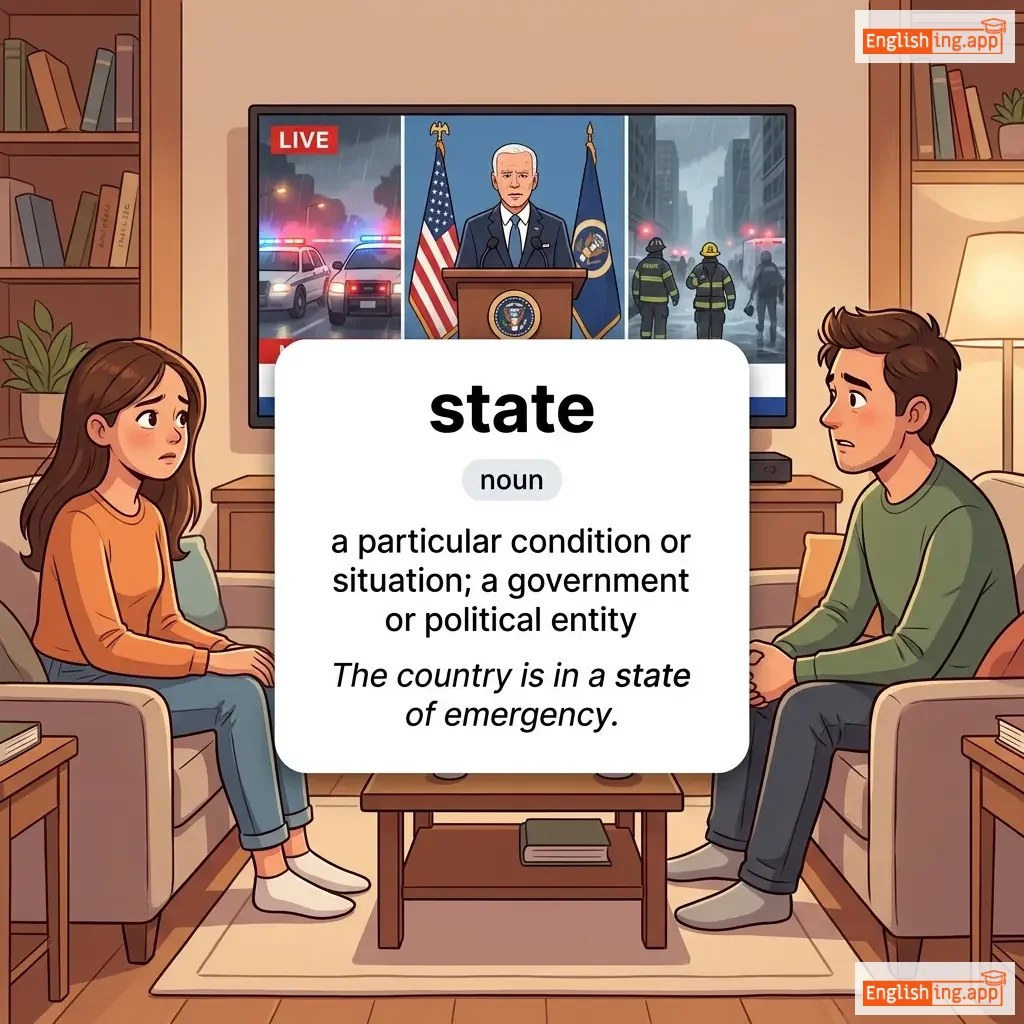
state definition card — visual illustration of the meaning
noun
/steɪt/
état (etat)

a particular condition or situation; a government or political entity

"The country is in a state of emergency."

"Le pays est en état d'urgence." (Le pays est en etat d'urgence.)
noun
/ˈsteɪtkraft/
art de gouverner (art de gouverner)

The art of governing and managing state affairs effectively.

"The leader was praised for his exceptional statecraft in handling international relations."

"Le leader a été félicité pour son art de gouverner exceptionnel dans la gestion des relations internationales." (Le leader a été félicité pour son art de gouverner exceptionnel dans la gestion des relations internationales.)
adjective
/ˈsteɪtli/
majestueux et digne (majestueux et digne)

Having a dignified, majestic, and impressive appearance or manner.

"The stately mansion stood at the end of the long driveway."

"Le manoir majestueux se tenait à l'extrémité de l'allée." (Le manoir majestueux se tenait à l'extrémité de l'allée.)
noun
/ˈsteɪtmənt/
déclaration (declaration)

a clear expression of something in speech or writing

"She made a statement about the company's new policies."

"Elle a fait une déclaration sur les nouvelles politiques de l'entreprise." (Elle a fait une declaration sur les nouvelles politiques de l'entreprise.)
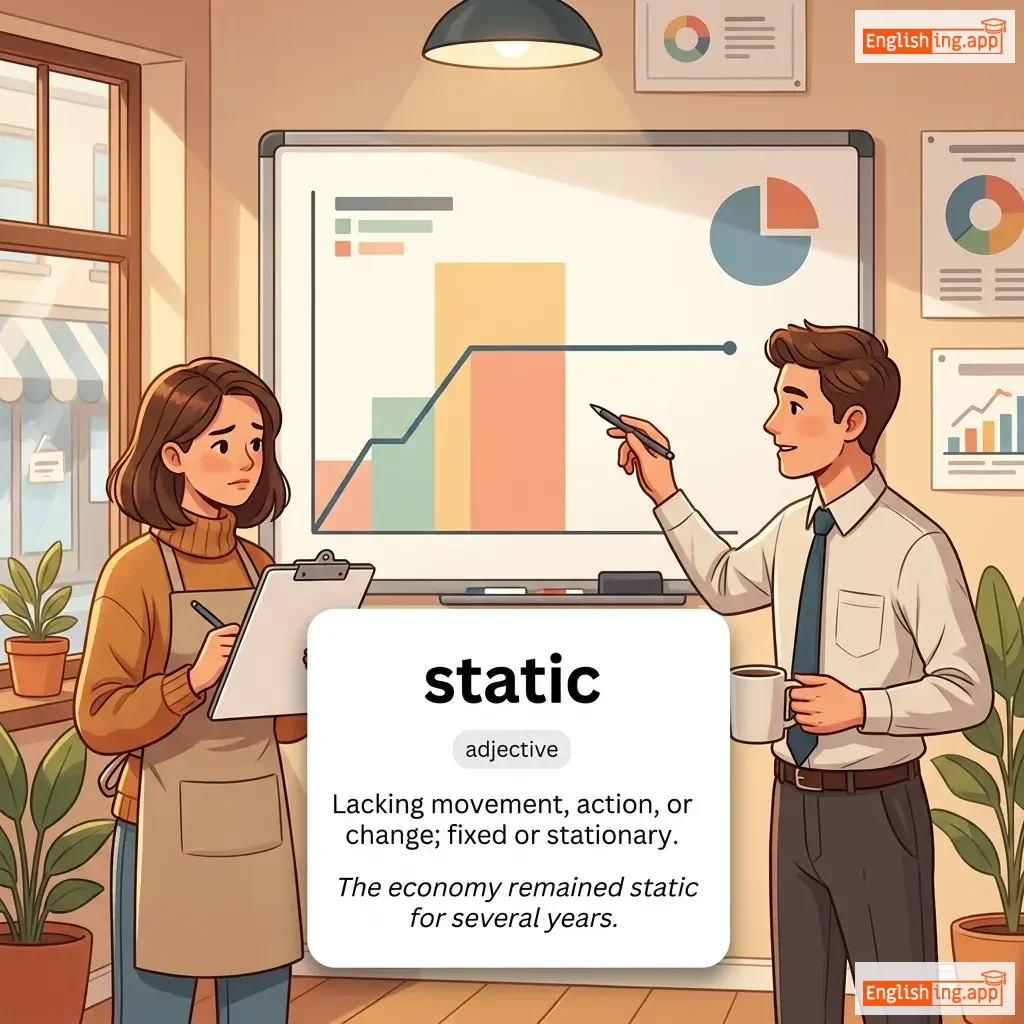
static definition card — visual illustration of the meaning
adjective
/ˈstætɪk/
statique (statik)

Lacking movement, action, or change; fixed or stationary.

"The economy remained static for several years."

"L'économie est restée statique pendant plusieurs années." (L'economie est restee statique pendant plusieurs annees.)
noun
/ˈstætɪks/
statique (statique)

The branch of mechanics dealing with bodies at rest and forces in equilibrium.

"She is studying statics as part of her engineering course."

"Elle étudie la statique dans le cadre de son cours d'ingénierie." (Elle étudie la statique dans le cadre de son cours d'ingénierie.)
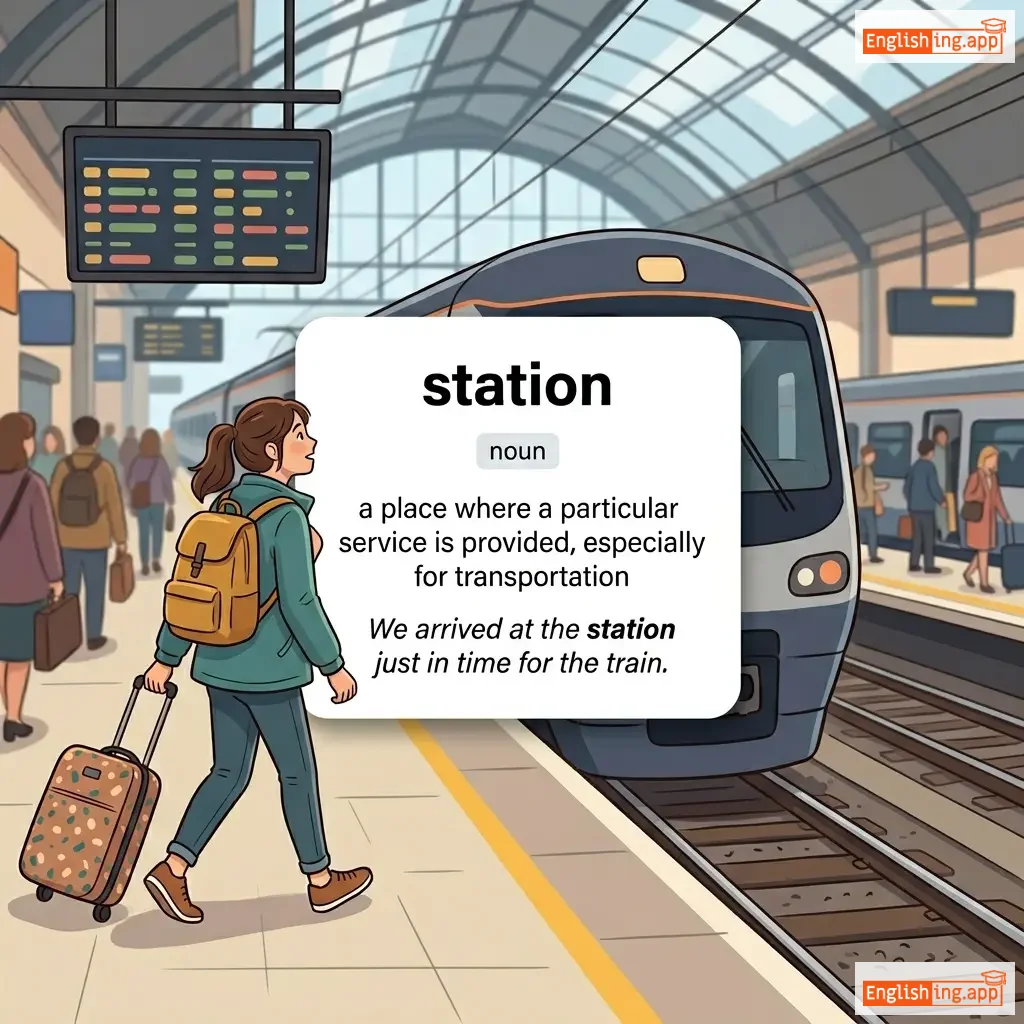
station definition card — visual illustration of the meaning
noun
/ˈsteɪʃən/
gare (gare)

a place where a particular service is provided, especially for transportation

"We arrived at the station just in time for the train."

"Nous sommes arrivés à la gare juste à temps pour le train." (Nous sommes arrives a la gare juste a temps pour le train.)
adjective
/ˈsteɪʃəˌneri/
immobile (immobile)

Not moving or not intended to be moved.

"The car remained stationary at the red light."

"La voiture est restée immobile au feu rouge." (La voiture est restée immobile au feu rouge.)
noun
/ˈsteɪ.ʃən.ər/
papetier (papetier)

a person who sells paper, pens, pencils, and other office supplies

"The stationer recommended the best pens for writing exams."

"Le stationnaire a recommandé les meilleurs stylos pour les examens." (Le stationnaire a recommandé les meilleurs stylos pour les examens.)
adjective
/stəˈtɪstɪkəl/
statistique (statistique)

relating to the use or analysis of numerical data

"The report provides statistical data about population growth."

"Le rapport fournit des données statistiques sur la croissance de la population." (Le rapport fournit des donnees statistiques sur la croissance de la population.)
noun
/ˌstætɪˈstɪʃən/
statisticien (statisticien)

A person who specializes in collecting, analyzing, and interpreting numerical data.

"The statistician presented the survey results with great clarity."

"Le statisticien a présenté les résultats du sondage avec grande clarté." (Le statisticien a presente les resultats du sondage avec grande clarte.)
noun
/stəˈtɪstɪks/
statistiques (statistiques)

the practice or science of collecting and analyzing numerical data

"The statistics showed an increase in the number of users last year."

"Les statistiques ont montré une augmentation du nombre d'utilisateurs l'année dernière." (Les statistiques ont montré une augmentation du nombre d'utilisateurs l'année dernière.)
noun
/ˈstætʃuː/
statue (statue)

a carved or cast figure of a person or animal, especially one that is life-size or larger

"They built a statue of the national hero in the city square."

"Ils ont construit une statue du héros national sur la place de la ville." (Ils ont construit une statue du heros national sur la place de la ville.)
adjective
/ˌstætʃuˈɛsk/
statuesque (statuesque)

Having the grace, beauty, or dignity of a statue; tall and attractively proportioned.

"She had a statuesque figure that turned heads wherever she went."

"Elle avait une silhouette statuaire qui attirait les regards partout où elle allait." (Elle avait une silhouette statuaire qui attirait les regards partout où elle allait.)
noun
/ˌstætʃuˈɛt/
statuette (statuette)

A small statue, usually decorative or artistic.

"The artist won a gold statuette for his work."

"L'artiste a gagné une petite statuette en or pour son travail." (L'artiste a gagne une petite statuette en or pour son travail.)
noun
/ˈstætʃər/
stature, prestige (stature, prestige)

A person's natural height or their reputation and importance.

"Her intellectual stature made her a respected figure in academia."

"Sa stature intellectuelle a fait d'elle une figure respectée dans le monde académique." (Sa stature intellectuelle a fait delle une figure respectee dans le monde academique.)
noun
/ˈsteɪtəs/
statut (statut)

the social or professional position or condition of someone or something

"His social status improved after the promotion."

"Son statut social s'est amélioré après la promotion." (Son statut social s'est amélioré après la promotion.)
noun
/ˈsteɪtəs kwoʊ/
statu quo (statu quo)

The existing state of affairs, especially regarding social or political issues.

"The government decided to maintain the status quo until further review."

"Le gouvernement a décidé de maintenir le statu quo jusqu'à un examen ultérieur." (Le gouvernement a décidé de maintenir le statu quo jusqu'à un examen ultérieur.)
noun
/stɛntʃ/
puanteur (puanteur)

A very strong and unpleasant smell.

"The stench of garbage filled the alley."

"La puanteur des ordures remplit la ruelle." (La puanteur des ordures remplit la ruelle.)
adjective
/ˈstɪki/
collant (collant)

having the quality of adhering or clinging; difficult to remove or deal with

"The candy is too sticky to eat with your hands."

"Le bonbon est trop collant pour être mangé à la main." (Le bonbon est trop collant pour etre mange a la main.)
noun
/ˈstɪklər/
personne exigeante sur les règles (personne exigeante sur les regles)

a person who insists on a certain quality or standard of behavior

"He is a stickler for punctuality and never tolerates delays."

"Il est très strict sur la ponctualité et ne tolère pas les retards." (Il est tres strict sur la ponctualite et ne tolera pas les retards.)
verb
/stɪk/
coller (coller)

to adhere or attach something to a surface

"The glue will stick to the paper."

"La colle collera au papier." (La colle collera au papier.)
abbreviation (noun/pronoun)
/ˈsʌmθɪŋ/
quelque chose (quelque chose)

abbreviation for 'something'

"Can you give me sth. to write with?"

"Peux-tu me donner quelque chose pour écrire ?" (Peux-tu me donner quelque chose pour écrire ?)
noun
/ˈstiː.vəˌdɔːr/
dockeur (dockeur)

A person employed to load and unload cargo from ships.

"The stevedores worked tirelessly to unload the cargo before dawn."

"Les dockeurs ont travaillé sans relâche pour décharger la cargaison avant l'aube." (Les dockeurs ont travaillé sans relâche pour décharger la cargaison avant l'aube.)
adjective
/ˈstɜːr.tər.əs/
ronflement bruyant (ronflement bruyant)

Characterized by heavy snoring or breathing.

"The patient’s stertorous breathing alarmed the nurses."

"La respiration stertoreuse du patient a alarmé les infirmières." (La respiration stertoreuse du patient a alarmé les infirmières.)
adjective/noun
/stɜːrn/
sévère / la partie arrière d'un navire (severe / la partie arriere d'un navire)

Serious and strict in manner or attitude; the back part of a ship.

"The teacher gave the students a stern warning before the exam."

"L'enseignant a donné aux élèves un avertissement sévère avant l'examen." (L'enseignant a donne aux eleves un avertissement severe avant l'examen.)
noun/adjective
/ˈstɜː.lɪŋ/
monnaie britannique / excellent (monnaie britannique / excellent)

British money, especially pounds; of excellent quality.

"She was praised for her sterling work on the project."

"Elle a été félicitée pour son excellent travail sur le projet." (Elle a été félicitée pour son excellent travail sur le projet.)
adjective
/ˈstɛr.aɪl/
stérile (steril)

Free from bacteria or other living microorganisms; incapable of producing offspring.

"The surgeon worked in a sterile environment to avoid infection."

"Le chirurgien a travaillé dans un environnement stérile pour éviter l'infection." (Le chirurgien a travaillé dans un environnement stérile pour éviter l'infection.)
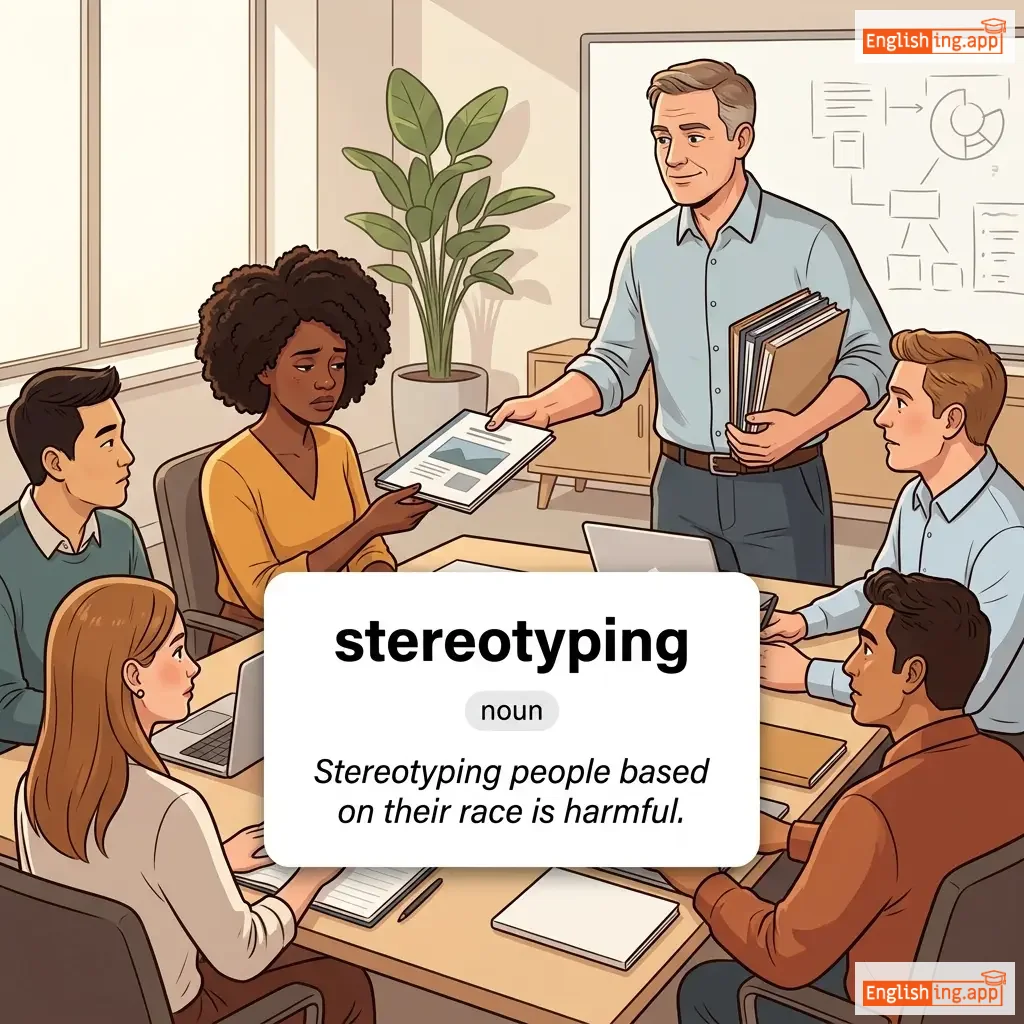
stereotyping definition card — visual illustration of the meaning
noun
/ˈstɛə.rɪ.əʊˌtaɪ.pɪŋ/
stéréotype (stereotype)

A widely held but fixed and oversimplified image or idea of a particular type of person or thing.

"Stereotyping people based on their race is harmful."

"Stéréotyper les gens en fonction de leur race est nuisible." (Stéréotyper les gens en fonction de leur race est nuisible.)
adjective
/ˈstɛriəˌtaɪpt/
stéréotypé (stereotype)

Conforming to a fixed or oversimplified idea of what someone or something is like.

"His stereotyped jokes failed to impress the audience."

"Ses blagues stéréotypées n'ont pas réussi à impressionner le public." (Ses blagues stereotypees n ont pas reussi a impressionner le public.)
noun
/ˈstɛriəˌtaɪp/
stéréotype (stereotype)

A widely held but oversimplified and fixed idea of a particular type of person or thing.

"It is a stereotype that all gamers are antisocial."

"C'est un stéréotype que tous les joueurs sont antisociaux." (C'est un stéréotype que tous les joueurs sont antisociaux.)
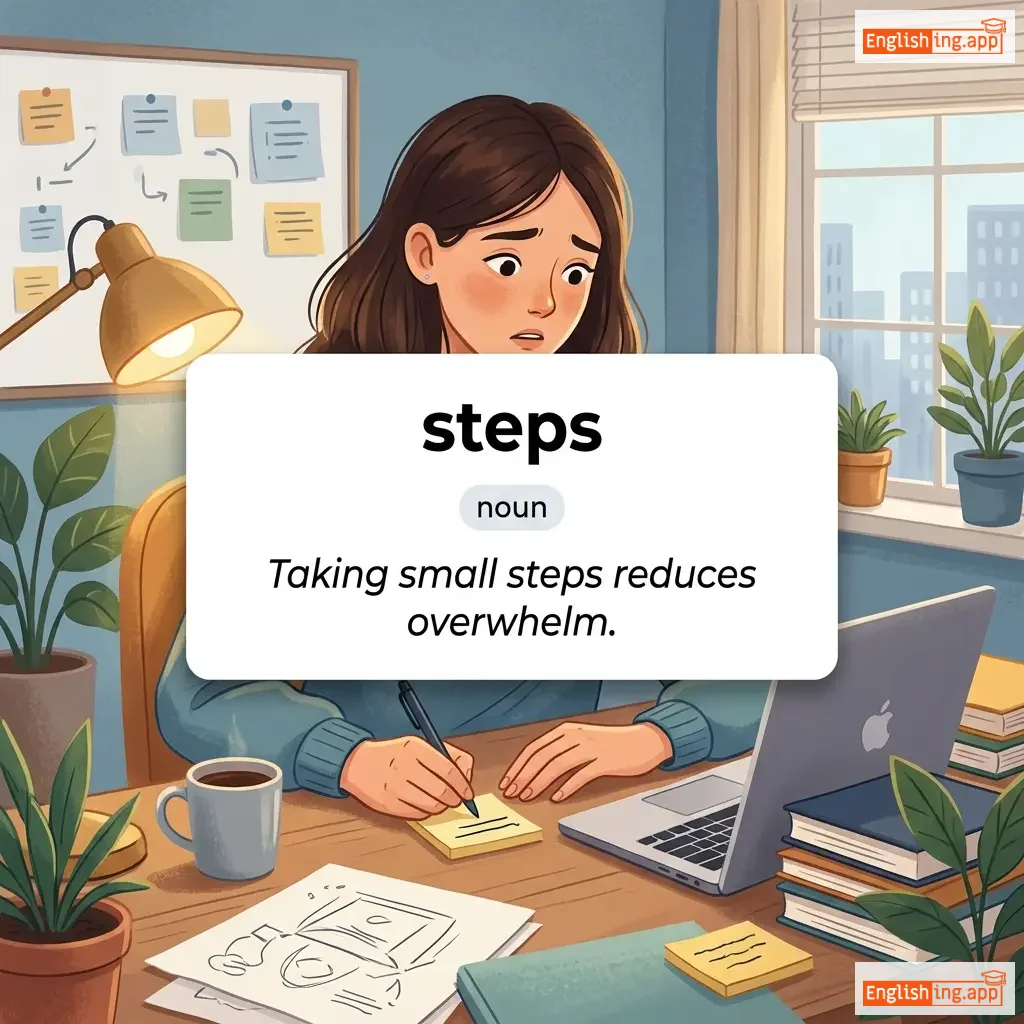
steps definition card — visual illustration of the meaning
noun
/stɛps/
étapes (etap)

A measure or action, especially one of a series taken in order to deal with or achieve a particular thing.

"Taking small steps reduces overwhelm."

"Faire de petits pas réduit la surcharge." (Faire de petits pas réduit la surcharge.)
noun
/stɛp/
steppe (steppe)

A large flat area of unforested grassland, especially in southeastern Europe or Siberia.

"The nomads traveled across the vast steppe with their herds."

"Les nomades ont voyagé à travers la vaste steppe avec leurs troupeaux." (Les nomades ont voyagé à travers la vaste steppe avec leurs troupeaux.)
noun
/stɛp/
pas (pa)

a movement made by lifting one foot and putting it down in a new position

"She took a step towards the door."

"She took a step towards the door." (Elle a fait un pas vers la porte.)
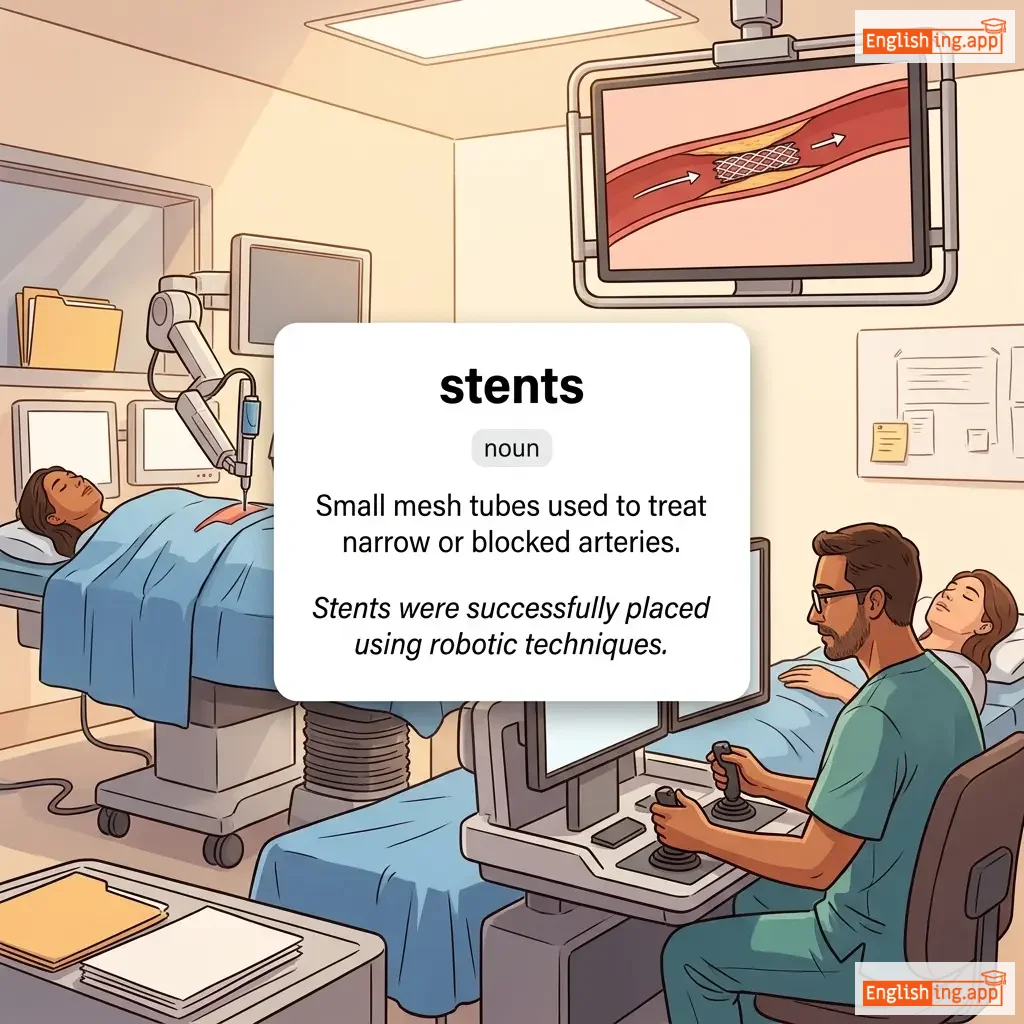
stents definition card — visual illustration of the meaning
noun
/stents/
stents (stents)

Small mesh tubes used to treat narrow or blocked arteries.

"Stents were successfully placed using robotic techniques."

"Les stents ont été placés avec succès en utilisant des techniques robotiques." (Les stents ont été placés avec succès en utilisant des techniques robotiques.)
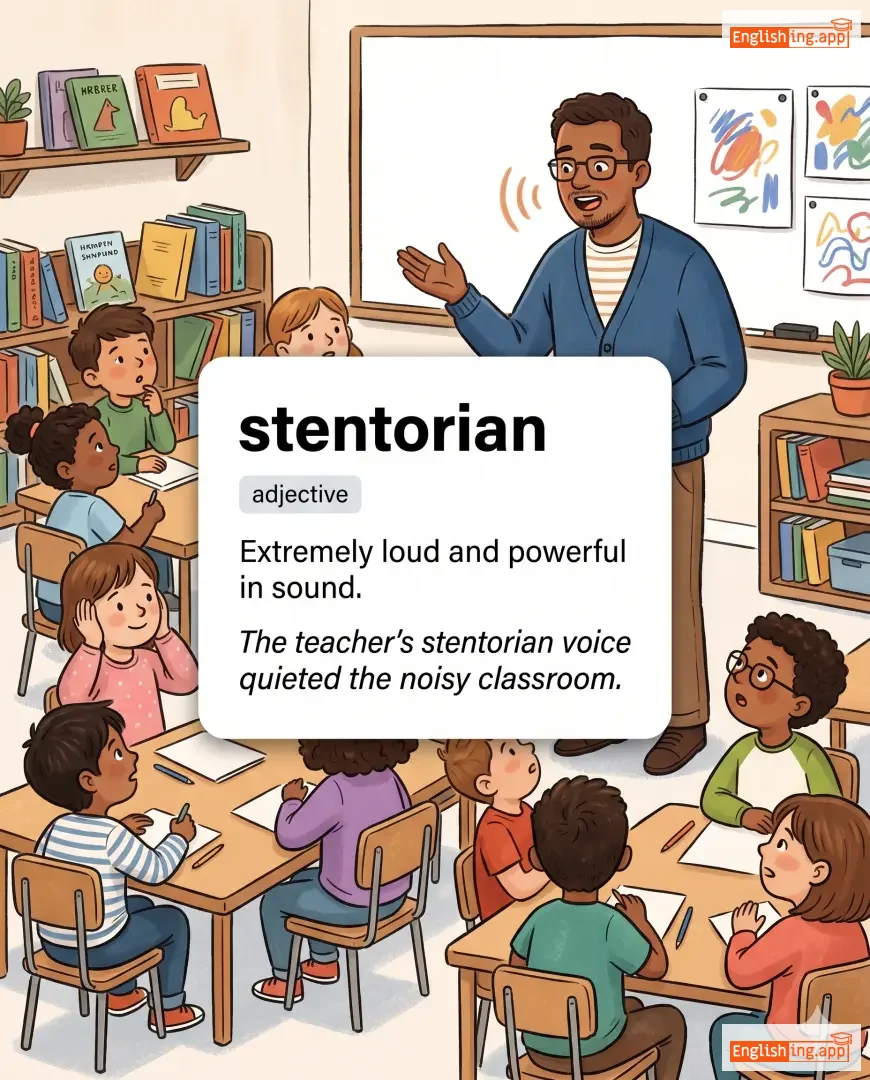
stentorian definition card — visual illustration of the meaning
adjective
/stɛnˈtɔːriən/
tonitruant (tonitruant)

Extremely loud and powerful in sound.

"The teacher’s stentorian voice quieted the noisy classroom."

"La voix tonitruante du professeur a calmé la classe bruyante." (La voix tonitruante du professeur a calmé la classe bruyante.)
noun
/ˈstɛnsəl/
pochoir (pochoir)

A thin sheet of material with a design cut out, used to produce the design on the surface below by applying paint or ink through the cut-out holes.

"The artist used a stencil to paint identical stars on the wall."

"L'artiste a utilisé un pochoir pour peindre des étoiles identiques sur le mur." (L'artiste a utilisé un pochoir pour peindre des étoiles identiques sur le mur.)
adverb
/ˈstɛdɪli/
de manière régulière (de maniere reguliere)

in a regular and continuous way; without stopping or changing

"The company's profits have been increasing steadily."

"Les bénéfices de l'entreprise augmentent régulièrement." (Les benefices de l'entreprise augmentent regulierement.)
noun
/stɛlθ/
discrétion, furtivité (discretion, furtivite)

The act of moving, doing, or achieving something quietly and secretly.

"The cat moved with stealth towards its prey."

"Le chat s'est déplacé furtivement vers sa proie." (Le chat s'est déplacé furtivement vers sa proie.)
steal definition card — visual illustration of the meaning
🕵️‍♂️

steal (stil)

verb
/stiːl/
voler (voler)

to take something without permission or right

"He tried to steal my wallet while I wasn't looking."

"Il a essayé de voler mon portefeuille pendant que je ne regardais pas." (Il a essayé de voler mon portefeuille pendant que je ne regardais pas.)
noun
/steɪk/
steak (steak)

a thick slice of meat, typically beef, cooked by grilling or frying

"He ordered a grilled steak with vegetables."

"Il a commandé un steak grillé avec des légumes." (Il a commande un steak grille avec des legumes.)
adjective
/ˈstɛdi/
stable (stable)

firm, stable, and not likely to change suddenly

"He kept his hand steady while painting the picture."

"Il a gardé sa main stable en peignant le tableau." (Il a gardé sa main stable en peignant le tableau.)
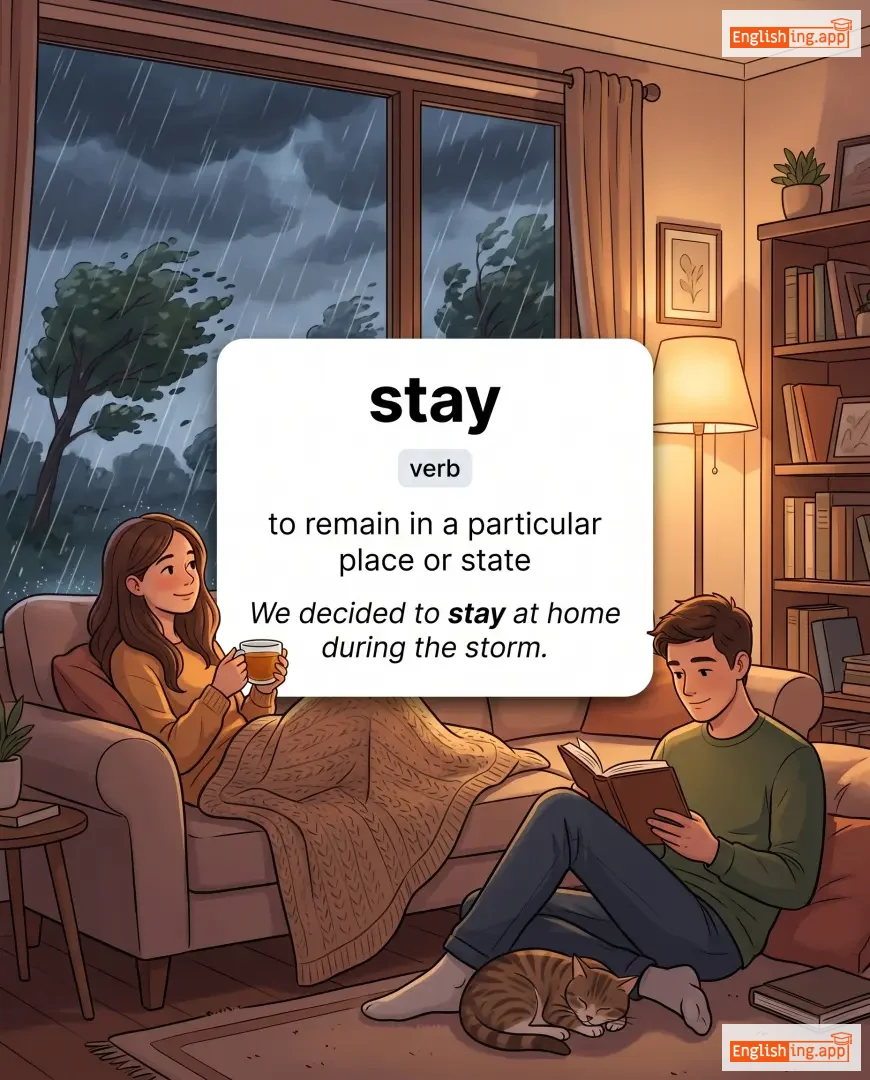
stay definition card — visual illustration of the meaning
verb
/steɪ/
rester (rester)

to remain in a particular place or state

"We decided to stay at home during the storm."

"Nous avons décidé de rester à la maison pendant la tempête." (Nous avons décidé de rester à la maison pendant la tempête.)
adjective
/ˈstætʃətɔːri/
législatif (legislatif)

Required, permitted, or enacted by law.

"The company must comply with all statutory regulations."

"L'entreprise doit se conformer à toutes les régulations législatives." (L'entreprise doit se conformer à toutes les régulations législatives.)
adjective
/stɔːntʃ/
ferme, fidèle (ferme, fidele)

Loyal, committed, and firm in support.

"She is a staunch supporter of environmental protection."

"Elle est une défenseure ferme de la protection de l'environnement." (Elle est une défenseure ferme de la protection de l'environnement.)
noun, verb
/stiːm/
vapeur (vapeur)

the vapor into which water is converted when heated; to emit or treat with steam

"The kettle was steaming on the stove."

"La bouilloire fumait sur la cuisinière." (La bouilloire fumait sur la cuisinière.)
adjective
/ˈstɛdfæst/
ferme, fidèle (ferme, fidele)

Firm, loyal, and unwavering in purpose or support.

"He remained steadfast in his determination to succeed."

"Il est resté ferme dans sa détermination à réussir." (Il est reste ferme dans sa determination a reussir.)