Vocabularios

Descubra, aprenda y domine el vocabulario en inglés

noun
/stɑːˈveɪ.ʃən/
inanición (inanicion)

suffering or death caused by lack of food; extreme hunger

"Many people died of starvation during the famine."

"Muchas personas murieron de inanición durante la hambruna." (muchas personas murieron de inanicion durante la hambruna.)
verb
/stɑːv/
morir de hambre (morir de hambre)

to suffer or die from lack of food

"He was left to starve in the desert."

"Él fue dejado para morir de hambre en el desierto." (Él fue dejado para morir de hambre en el desierto.)
noun
/ˈsteɪsɪs/ or /ˈstæsɪs/
estasis (estasis)

A state of inactivity or equilibrium; a situation where nothing changes.

"The negotiations reached a state of stasis with no progress made."

"Las negociaciones llegaron a un estado de estasis sin avances." (Las negociaciones llegaron a un estado de estasis sin avances.)
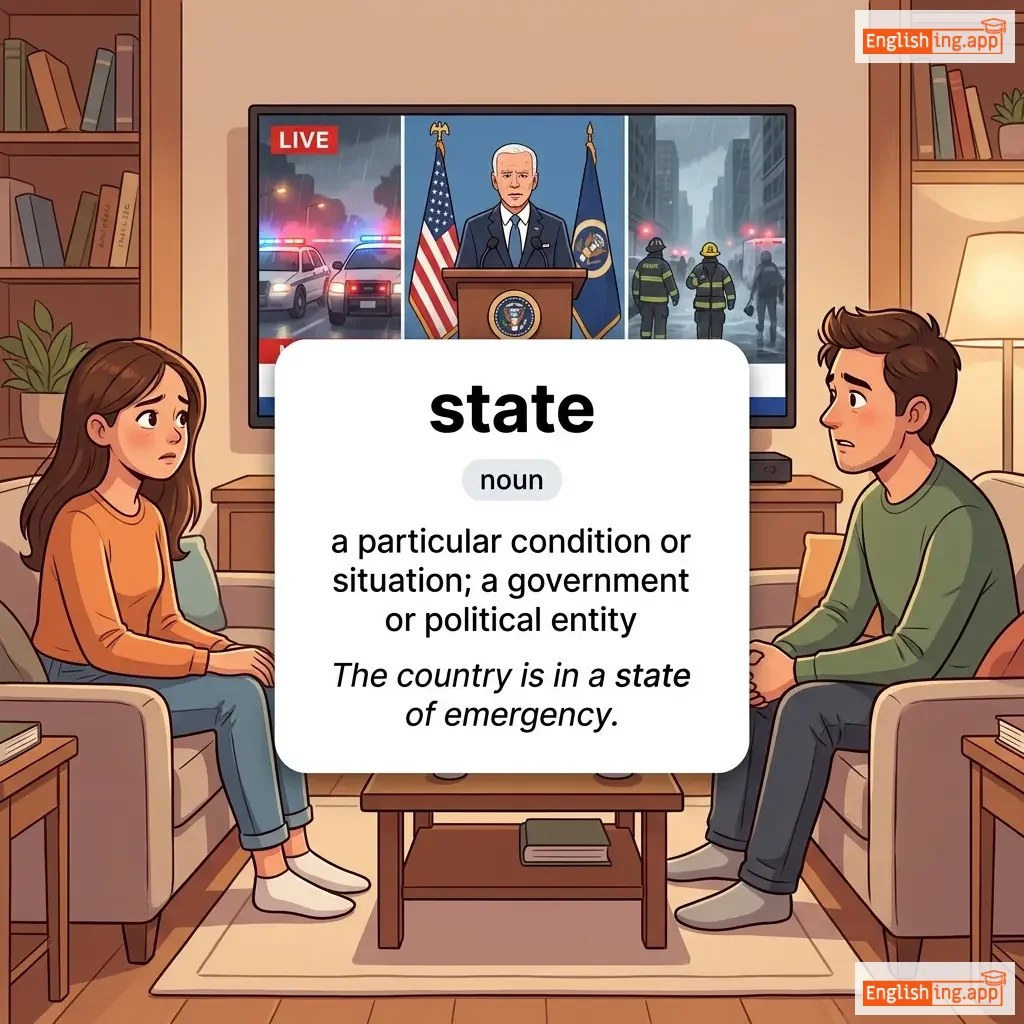
state definition card — visual illustration of the meaning
noun
/steɪt/
estado (estado)

a particular condition or situation; a government or political entity

"The country is in a state of emergency."

"El país está en estado de emergencia." (El pais esta en estado de emergencia.)
noun
/ˈsteɪtkraft/
arte del gobierno (arte del gobierno)

The art of governing and managing state affairs effectively.

"The leader was praised for his exceptional statecraft in handling international relations."

"El líder fue elogiado por su excepcional arte del gobierno en el manejo de relaciones internacionales." (El líder fue elogiado por su excepcional arte del gobierno en el manejo de relaciones internacionales.)
adjective
/ˈsteɪtli/
majestuoso y digno (majestuoso y digno)

Having a dignified, majestic, and impressive appearance or manner.

"The stately mansion stood at the end of the long driveway."

"La majestuosa mansión se encontraba al final del largo camino de entrada." (La majestuosa mansión se encontraba al final del largo camino de entrada.)
noun
/ˈsteɪtmənt/
declaración (declaracion)

a clear expression of something in speech or writing

"She made a statement about the company's new policies."

"Ella hizo una declaración sobre las nuevas políticas de la empresa." (Ella hizo una declaracion sobre las nuevas politicas de la empresa.)
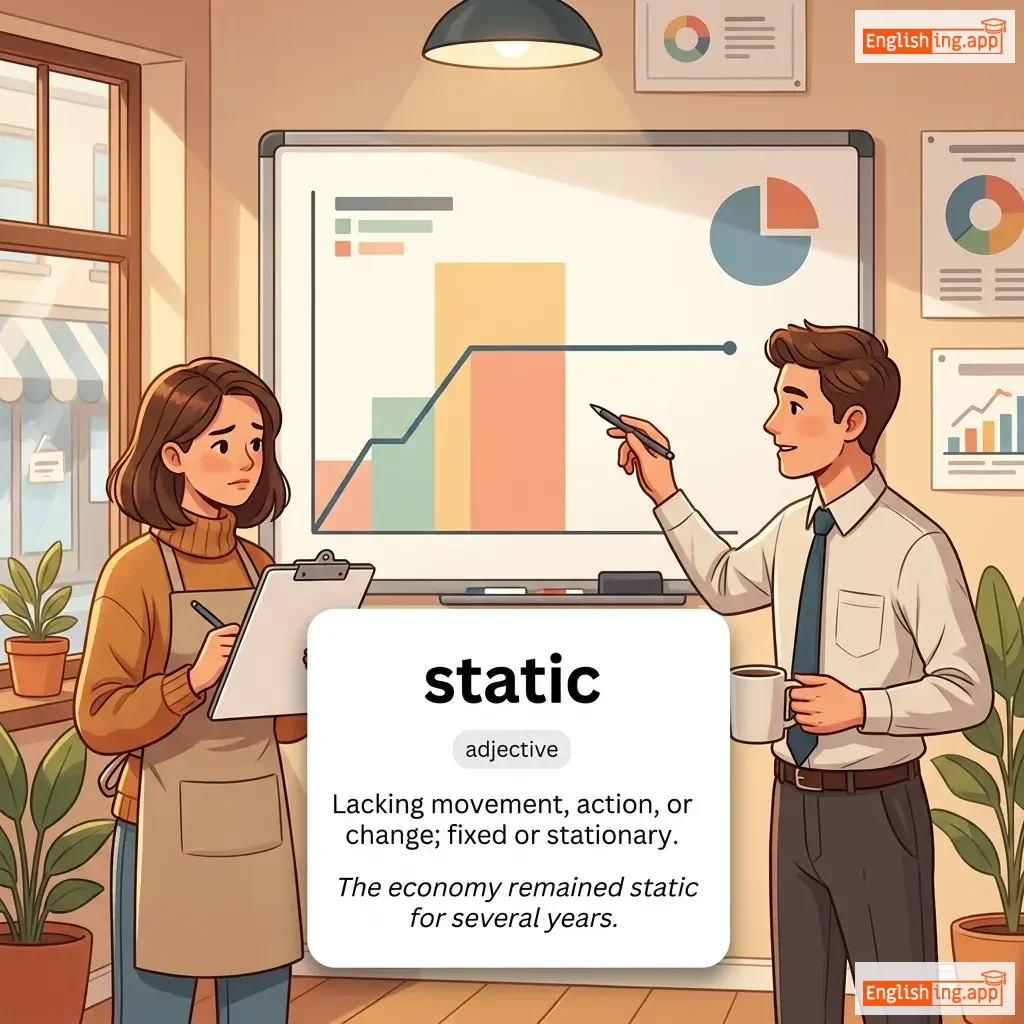
static definition card — visual illustration of the meaning
adjective
/ˈstætɪk/
estático (estatico)

Lacking movement, action, or change; fixed or stationary.

"The economy remained static for several years."

"La economía permaneció estática durante varios años." (La economia permanecio estatica durante varios anos.)
noun
/ˈstætɪks/
estática (estática)

The branch of mechanics dealing with bodies at rest and forces in equilibrium.

"She is studying statics as part of her engineering course."

"Ella está estudiando estática como parte de su curso de ingeniería." (Ella está estudiando estática como parte de su curso de ingeniería.)
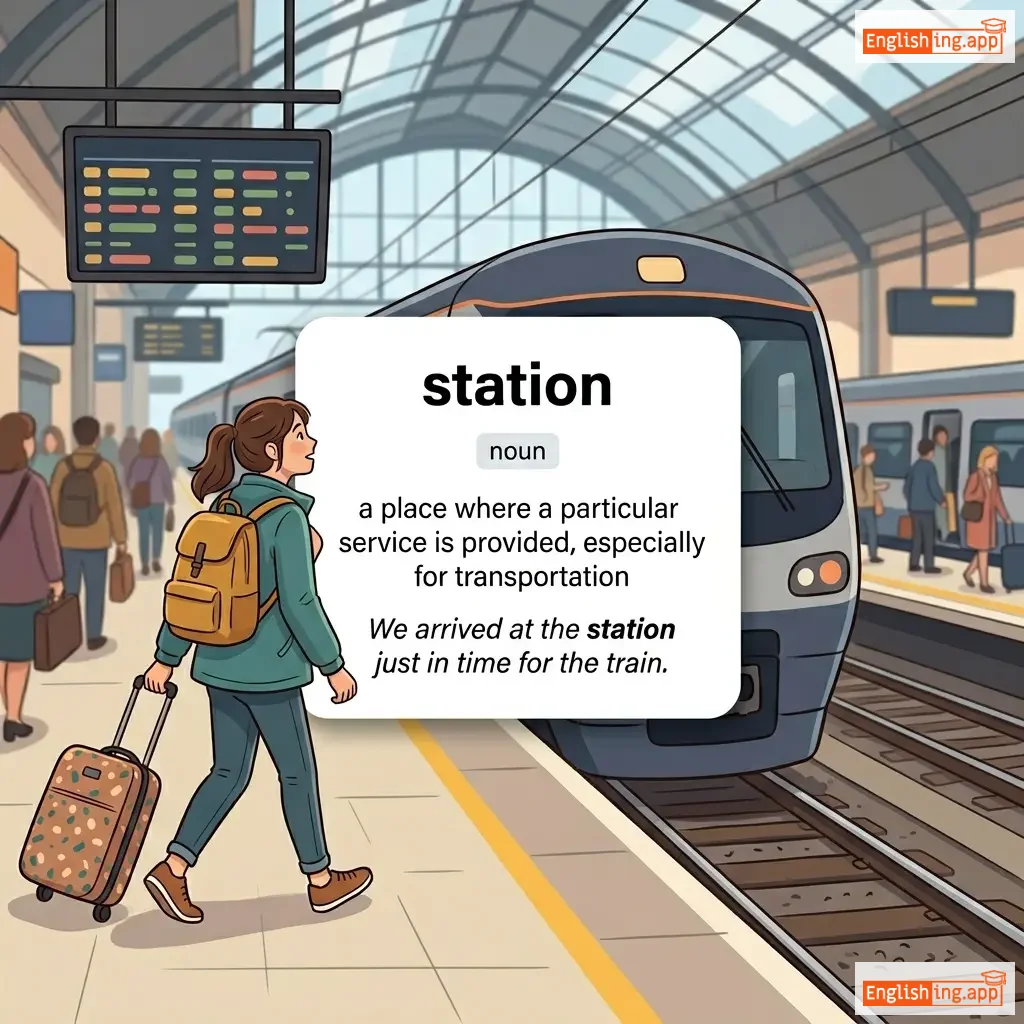
station definition card — visual illustration of the meaning
noun
/ˈsteɪʃən/
estación (estacion)

a place where a particular service is provided, especially for transportation

"We arrived at the station just in time for the train."

"Llegamos a la estación justo a tiempo para el tren." (Llegamos a la estacion justo a tiempo para el tren.)
adjective
/ˈsteɪʃəˌneri/
estático (estatico)

Not moving or not intended to be moved.

"The car remained stationary at the red light."

"El coche permaneció estacionario en el semáforo rojo." (El coche permaneció estacionario en el semáforo rojo.)
noun
/ˈsteɪ.ʃən.ər/
papelería (papeleria)

a person who sells paper, pens, pencils, and other office supplies

"The stationer recommended the best pens for writing exams."

"El estacionista recomendó los mejores bolígrafos para los exámenes." (El estacionista recomendó los mejores bolígrafos para los exámenes.)
adjective
/stəˈtɪstɪkəl/
estadístico (estadistico)

relating to the use or analysis of numerical data

"The report provides statistical data about population growth."

"El informe proporciona datos estadísticos sobre el crecimiento de la población." (El informe proporciona datos estadisticos sobre el crecimiento de la poblacion.)
noun
/ˌstætɪˈstɪʃən/
estadístico (estadistico)

A person who specializes in collecting, analyzing, and interpreting numerical data.

"The statistician presented the survey results with great clarity."

"El estadístico presentó los resultados de la encuesta con gran claridad." (El estadistico presento los resultados de la encuesta con gran claridad.)
noun
/stəˈtɪstɪks/
estadísticas (estadísticas)

the practice or science of collecting and analyzing numerical data

"The statistics showed an increase in the number of users last year."

"Las estadísticas mostraron un aumento en el número de usuarios el año pasado." (Las estadísticas mostraron un aumento en el número de usuarios el año pasado.)
noun
/ˈstætʃuː/
estatua (estatua)

a carved or cast figure of a person or animal, especially one that is life-size or larger

"They built a statue of the national hero in the city square."

"Construyeron una estatua del héroe nacional en la plaza de la ciudad." (Construyeron una estatua del heroe nacional en la plaza de la ciudad.)
adjective
/ˌstætʃuˈɛsk/
de estatua (de estatua)

Having the grace, beauty, or dignity of a statue; tall and attractively proportioned.

"She had a statuesque figure that turned heads wherever she went."

"Ella tenía una figura de estatua que hacía que todos se giraran donde quiera que fuera." (Ella tenía una figura de estatua que hacía que todos se giraran donde quiera que fuera.)
noun
/ˌstætʃuˈɛt/
estatuilla (estatuilla)

A small statue, usually decorative or artistic.

"The artist won a gold statuette for his work."

"El artista ganó una estatuilla de oro por su trabajo." (El artista gano una estatuilla de oro por su trabajo.)
noun
/ˈstætʃər/
estatura, prestigio (estatura, prestigio)

A person's natural height or their reputation and importance.

"Her intellectual stature made her a respected figure in academia."

"Su estatura intelectual la convirtió en una figura respetada en el mundo académico." (Su estatura intelectual la convirtio en una figura respetada en el mundo academico.)
noun
/ˈsteɪtəs/
estado (estado)

the social or professional position or condition of someone or something

"His social status improved after the promotion."

"Su estado social mejoró después de la promoción." (Su estado social mejoró después de la promoción.)
noun
/ˈsteɪtəs kwoʊ/
status quo (status quo)

The existing state of affairs, especially regarding social or political issues.

"The government decided to maintain the status quo until further review."

"El gobierno decidió mantener el status quo hasta una revisión posterior." (El gobierno decidió mantener el status quo hasta una revisión posterior.)
noun
/stɛntʃ/
hedor (hedor)

A very strong and unpleasant smell.

"The stench of garbage filled the alley."

"El hedor de la basura llenó el callejón." (El hedor de la basura llenó el callejón.)
adjective
/ˈstɪki/
pegajoso (pegajoso)

having the quality of adhering or clinging; difficult to remove or deal with

"The candy is too sticky to eat with your hands."

"El caramelo es demasiado pegajoso para comer con las manos." (El caramelo es demasiado pegajoso para comer con las manos.)
noun
/ˈstɪklər/
persona estricta con las normas (persona estricta con las normas)

a person who insists on a certain quality or standard of behavior

"He is a stickler for punctuality and never tolerates delays."

"Él es muy estricto con la puntualidad y no tolera retrasos." (El es muy estricto con la puntualidad y no tolera retrasos)
verb
/stɪk/
pegar (pegar)

to adhere or attach something to a surface

"The glue will stick to the paper."

"El pegamento se pegará al papel." (El pegamento se pegará al papel.)
abbreviation (noun/pronoun)
/ˈsʌmθɪŋ/
algo (algo)

abbreviation for 'something'

"Can you give me sth. to write with?"

"¿Puedes darme algo con qué escribir?" (¿Puedes darme algo con qué escribir?)
noun
/ˈstiː.vəˌdɔːr/
estibador (estibador)

A person employed to load and unload cargo from ships.

"The stevedores worked tirelessly to unload the cargo before dawn."

"Los estibadores trabajaron incansablemente para descargar la carga antes del amanecer." (Los estibadores trabajaron incansablemente para descargar la carga antes del amanecer.)
adjective
/ˈstɜːr.tər.əs/
ronquido fuerte (ronquido fuerte)

Characterized by heavy snoring or breathing.

"The patient’s stertorous breathing alarmed the nurses."

"La respiración estertorosa del paciente alarmó a las enfermeras." (La respiración estertorosa del paciente alarmó a las enfermeras.)
adjective/noun
/stɜːrn/
estricto / la parte trasera de un barco (estricto / la parte trasera de un barco)

Serious and strict in manner or attitude; the back part of a ship.

"The teacher gave the students a stern warning before the exam."

"El maestro dio a los estudiantes una advertencia severa antes del examen." (El maestro dio a los estudiantes una advertencia severa antes del examen.)
noun/adjective
/ˈstɜː.lɪŋ/
moneda británica / excelente (moneda británica / excelente)

British money, especially pounds; of excellent quality.

"She was praised for her sterling work on the project."

"Fue elogiada por su excelente trabajo en el proyecto." (Fue elogiada por su excelente trabajo en el proyecto.)
adjective
/ˈstɛr.aɪl/
estéril (esteril)

Free from bacteria or other living microorganisms; incapable of producing offspring.

"The surgeon worked in a sterile environment to avoid infection."

"El cirujano trabajó en un ambiente estéril para evitar infecciones." (El cirujano trabajó en un ambiente estéril para evitar infecciones.)
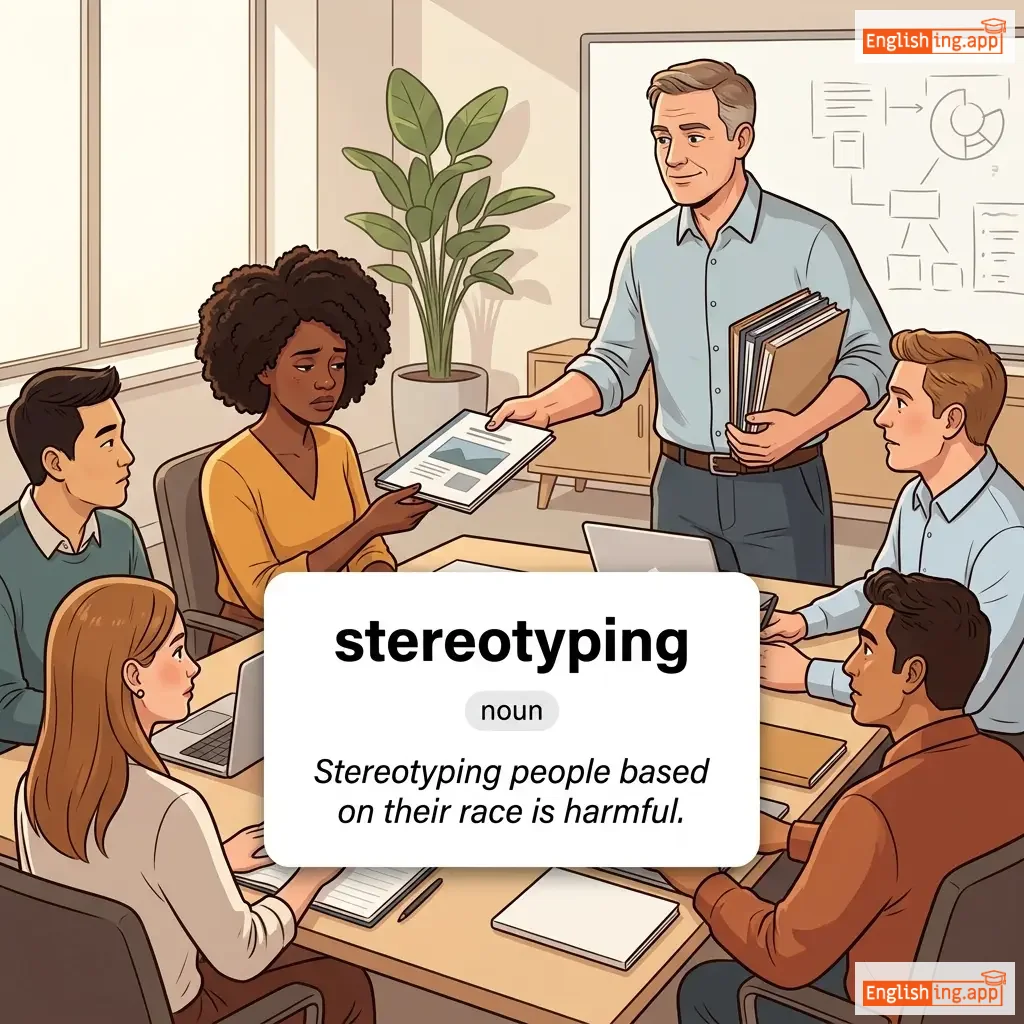
stereotyping definition card — visual illustration of the meaning
noun
/ˈstɛə.rɪ.əʊˌtaɪ.pɪŋ/
estereotipar (estereotipar)

A widely held but fixed and oversimplified image or idea of a particular type of person or thing.

"Stereotyping people based on their race is harmful."

"Estereotipar a las personas según su raza es perjudicial." (Estereotipar a las personas según su raza es perjudicial.)
adjective
/ˈstɛriəˌtaɪpt/
estereotipado (estereotipado)

Conforming to a fixed or oversimplified idea of what someone or something is like.

"His stereotyped jokes failed to impress the audience."

"Sus chistes estereotipados no lograron impresionar a la audiencia." (Sus chistes estereotipados no lograron impresionar a la audiencia.)
noun
/ˈstɛriəˌtaɪp/
estereotipo (estereotipo)

A widely held but oversimplified and fixed idea of a particular type of person or thing.

"It is a stereotype that all gamers are antisocial."

"Es un estereotipo que todos los jugadores son antisociales." (Es un estereotipo que todos los jugadores son antisociales.)
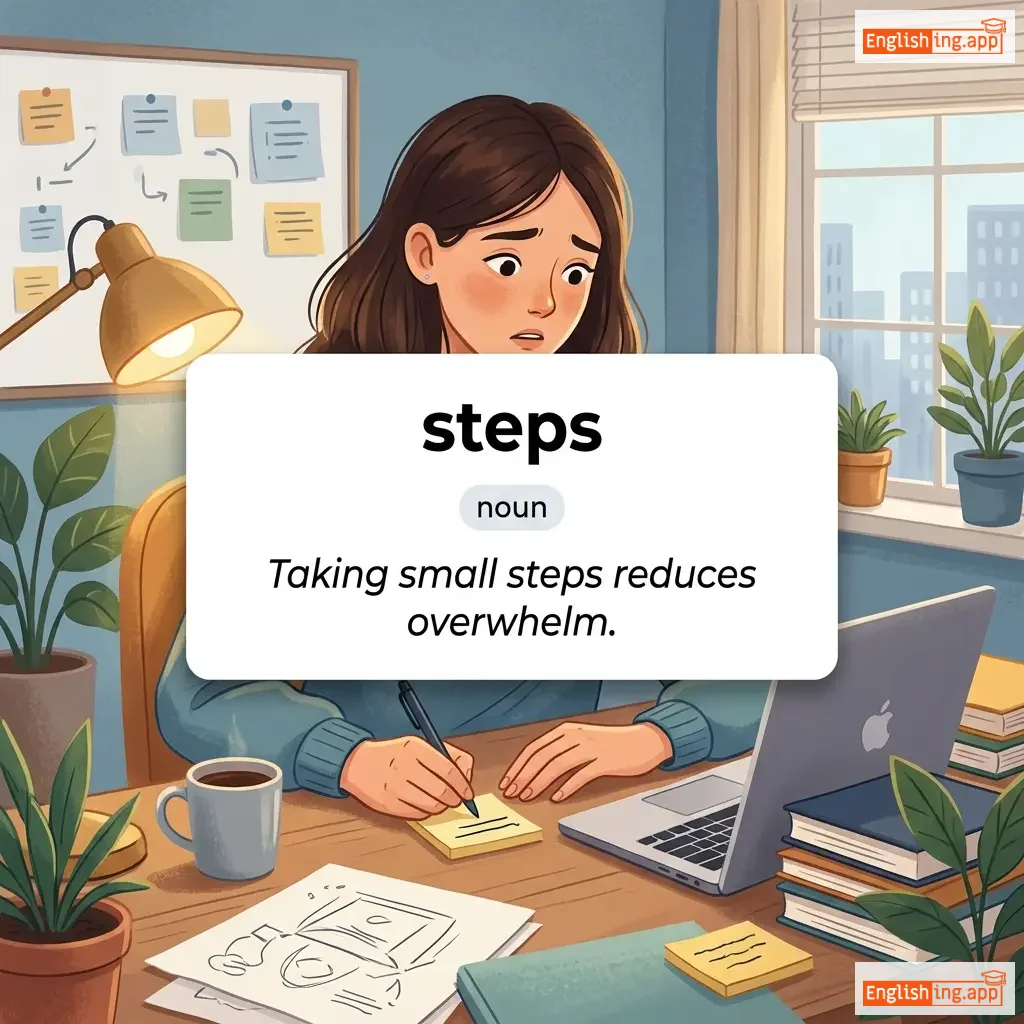
steps definition card — visual illustration of the meaning
noun
/stɛps/
pasos (pasos)

A measure or action, especially one of a series taken in order to deal with or achieve a particular thing.

"Taking small steps reduces overwhelm."

"Dar pequeños pasos reduce el agobio." (Dar pequeños pasos reduce el agobio.)
noun
/stɛp/
estepa (estepa)

A large flat area of unforested grassland, especially in southeastern Europe or Siberia.

"The nomads traveled across the vast steppe with their herds."

"Los nómadas viajaban por la vasta estepa con sus rebaños." (Los nómadas viajaban por la vasta estepa con sus rebaños.)
noun
/stɛp/
paso (paso)

a movement made by lifting one foot and putting it down in a new position

"She took a step towards the door."

"Ella dio un paso hacia la puerta." (Ella dio un paso hacia la puerta)
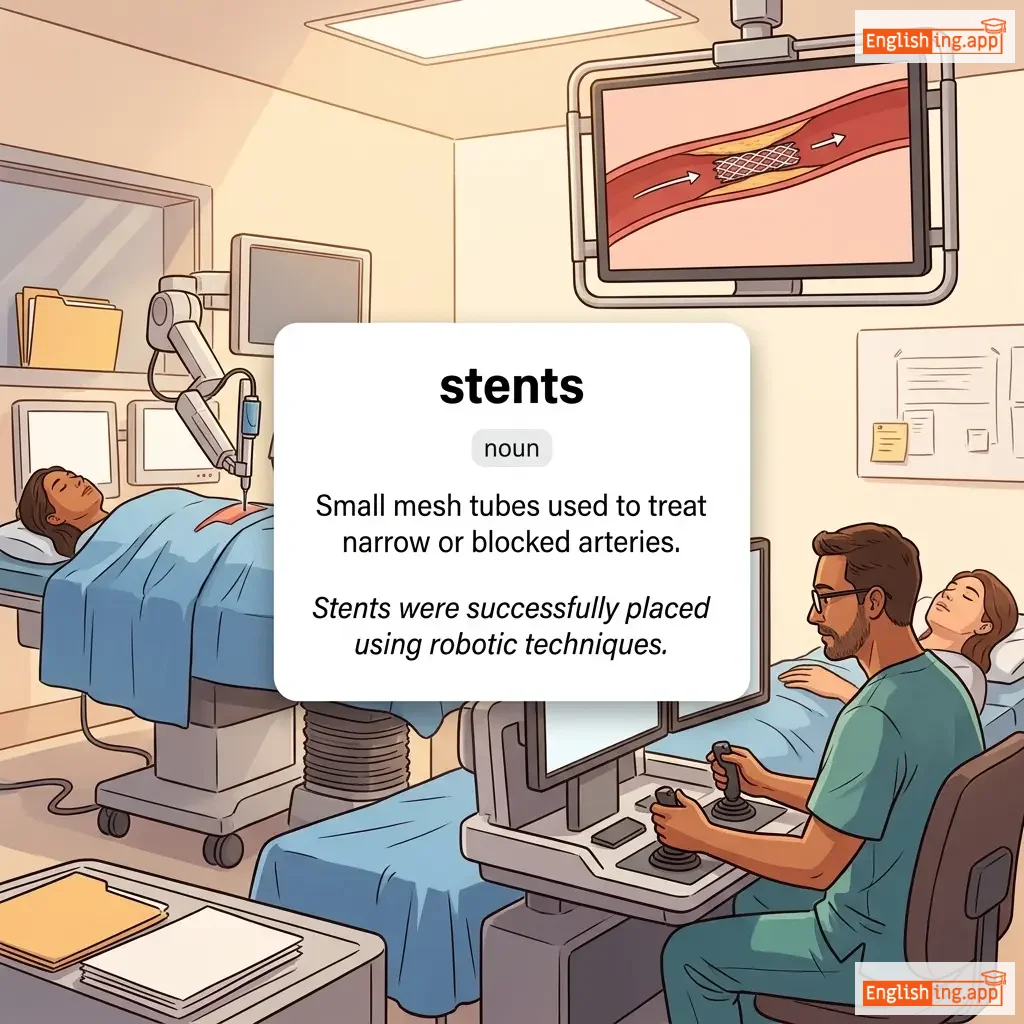
stents definition card — visual illustration of the meaning
noun
/stents/
stents (stents)

Small mesh tubes used to treat narrow or blocked arteries.

"Stents were successfully placed using robotic techniques."

"Los stents fueron colocados con éxito utilizando técnicas robóticas." (Los stents fueron colocados con éxito utilizando técnicas robóticas.)
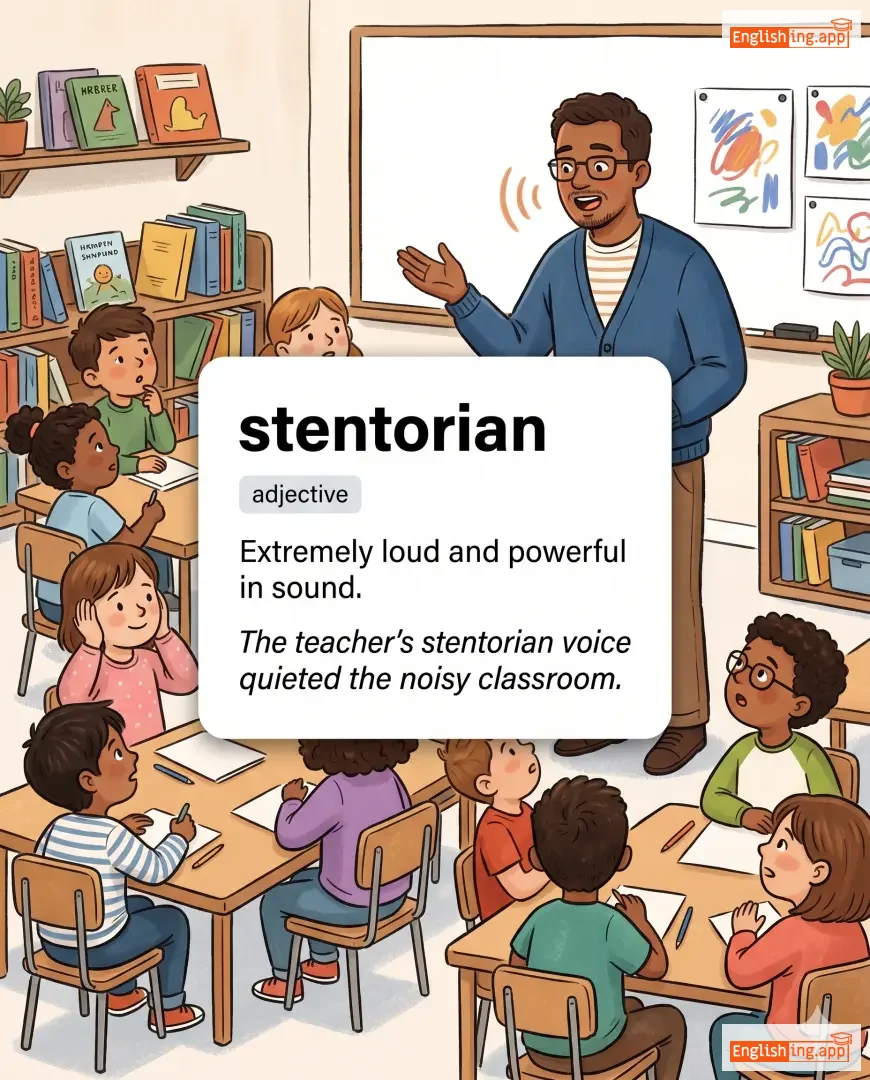
stentorian definition card — visual illustration of the meaning
adjective
/stɛnˈtɔːriən/
estruendoso (estruendoso)

Extremely loud and powerful in sound.

"The teacher’s stentorian voice quieted the noisy classroom."

"La voz estentórica del maestro calló el ruidoso salón de clases." (La voz estentórica del maestro calló el ruidoso salón de clases.)
noun
/ˈstɛnsəl/
plantilla (plantilla)

A thin sheet of material with a design cut out, used to produce the design on the surface below by applying paint or ink through the cut-out holes.

"The artist used a stencil to paint identical stars on the wall."

"El artista usó una plantilla para pintar estrellas idénticas en la pared." (El artista usó una plantilla para pintar estrellas idénticas en la pared.)
adverb
/ˈstɛdɪli/
de manera constante (de manera constante)

in a regular and continuous way; without stopping or changing

"The company's profits have been increasing steadily."

"Las ganancias de la empresa han aumentado de manera constante." (Las ganancias de la empresa han aumentado de manera constante.)
noun
/stɛlθ/
sigilo, moverse en secreto (sigilo, moverse en secreto)

The act of moving, doing, or achieving something quietly and secretly.

"The cat moved with stealth towards its prey."

"El gato se movió sigilosamente hacia su presa." (El gato se movió sigilosamente hacia su presa.)
steal definition card — visual illustration of the meaning
🕵️‍♂️

steal (estil)

verb
/stiːl/
robar (robar)

to take something without permission or right

"He tried to steal my wallet while I wasn't looking."

"Trató de robar mi billetera mientras no estaba mirando." (Trató de robar mi billetera mientras no estaba mirando.)
noun
/steɪk/
bistec (bistek)

a thick slice of meat, typically beef, cooked by grilling or frying

"He ordered a grilled steak with vegetables."

"Él pidió un bistec a la parrilla con verduras." (El pidio un bistek a la parrilla con verduras.)
adjective
/ˈstɛdi/
firme (firme)

firm, stable, and not likely to change suddenly

"He kept his hand steady while painting the picture."

"Mantuvo su mano firme mientras pintaba el cuadro." (Mantuvo su mano firme mientras pintaba el cuadro.)
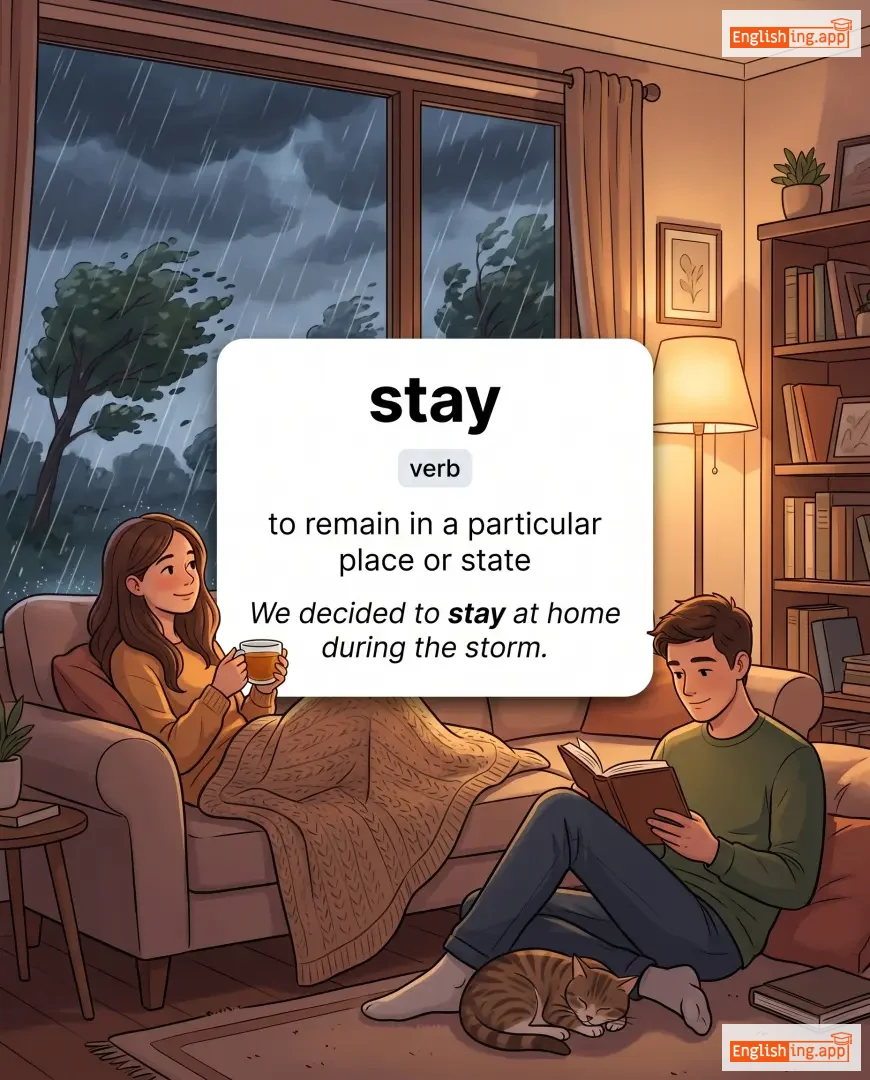
stay definition card — visual illustration of the meaning
verb
/steɪ/
quedarse (quedarse)

to remain in a particular place or state

"We decided to stay at home during the storm."

"Decidimos quedarnos en casa durante la tormenta." (Decidimos quedarnos en casa durante la tormenta.)
adjective
/ˈstætʃətɔːri/
estatutario (estatutario)

Required, permitted, or enacted by law.

"The company must comply with all statutory regulations."

"La empresa debe cumplir con todas las regulaciones estatutarias." (La empresa debe cumplir con todas las regulaciones estatutarias.)
adjective
/stɔːntʃ/
firme, leal (firme, leal)

Loyal, committed, and firm in support.

"She is a staunch supporter of environmental protection."

"Ella es una firme defensora de la protección del medio ambiente." (Ella es una firme defensora de la protección del medio ambiente.)
noun, verb
/stiːm/
vapor (vapor)

the vapor into which water is converted when heated; to emit or treat with steam

"The kettle was steaming on the stove."

"La tetera estaba vaporando en la estufa." (La tetera estaba vaporando en la estufa.)
adjective
/ˈstɛdfæst/
firme, leal (firme, leal)

Firm, loyal, and unwavering in purpose or support.

"He remained steadfast in his determination to succeed."

"Él se mantuvo firme en su determinación de tener éxito." (El se mantuvo firme en su determinacion de tener exito.)