Vocabulaires

Découvrez, apprenez et maîtrisez le vocabulaire anglais

noun
/ˌbæstərdaɪˈzeɪʃən/
dégénérescence / altération (degenerescence / alteracion)

the act of corrupting, degrading, or misrepresenting something

"Critics called the remake a bastardization of the original film."

"Les critiques ont qualifié le remake de bastardisation du film original." (Les critiques ont qualifie le remake de bastardisation du film original.)
verb
/ˈbæstərdaɪz/
dénaturer (denaturer)

to corrupt or debase something by altering it from its original form; to change in a way that reduces quality or purity

"Critics argue that the remake bastardized the original novel."

"Les critiques disent que le remake a dénaturé l’œuvre originale." (Les critiques disent que le remake a denature l oeuvre originale)
verb
/beɪst/
verser ou badigeonner de la graisse fondue, du jus ou du liquide sur la viande pendant la cuisson pour la garder humide (verser ou badigeonner de la graisse fondue, du jus ou du liquide sur la viande pendant la cuisson pour la garder humide)

to pour or brush melted fat, juices, or liquid over meat during cooking to keep it moist

"She basted the turkey every 30 minutes to keep it juicy."

"Elle a badigeonné la dinde toutes les 30 minutes pour la garder juteuse." (Elle a badigeonné la dinde toutes les 30 minutes pour la garder juteuse.)
noun
/ˈbæs.ti.ən/
bastion, forteresse (bastion, forteresse)

a stronghold or fortification; a place or institution strongly defending particular principles

"The castle stood as a bastion against enemy attacks."

"Le château se tenait comme un bastion contre les attaques ennemies." (Le chateau se tenait comme un bastion contre les attaques ennemies.)
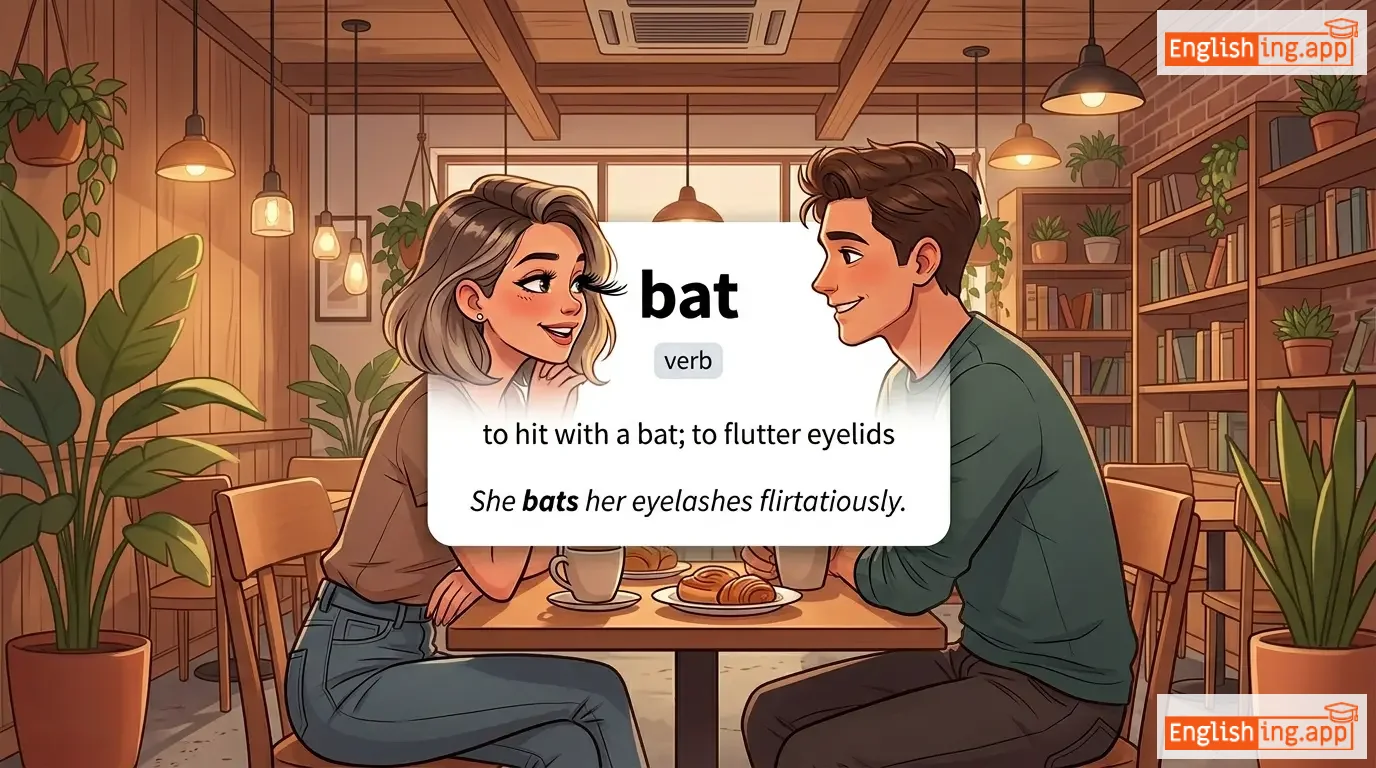
bat definition card — visual illustration of the meaning
noun
/bæt/
batte (batte)

a wooden or metal club used to hit a ball in sports like baseball or cricket

"He swung the bat and hit the ball hard."

"Il a tourné la batte et a frappé la balle fort." (Il a tourne la batte et a frappe la balle fort.)
noun
/bætʃ/
une quantité d'articles produits ou traités en même temps (une quantité d'articles produits ou traités en même temps)

a quantity of items produced or processed at one time

"She baked a fresh batch of cookies this morning."

"Elle a cuit un nouveau lot de biscuits ce matin." (Elle a cuit un nouveau lot de biscuits ce matin.)
😮‍💨

bate (bête)

verb
/beɪt/
réduire, atténuer (réduire, atténuer)

to lessen or restrain; to diminish the force or intensity of something

"He spoke with bated breath as he waited for the result."

"Il parla avec une respiration retenue en attendant le résultat." (Il parla avec une respiration retenue en attendant le résultat.)
noun
/bɑːθ/
bain (bain)

an act of washing the body in water; or the container used for this purpose

"She took a long bath after work."

"Elle a pris un long bain après le travail." (Elle a pris un long bain après le travail.)
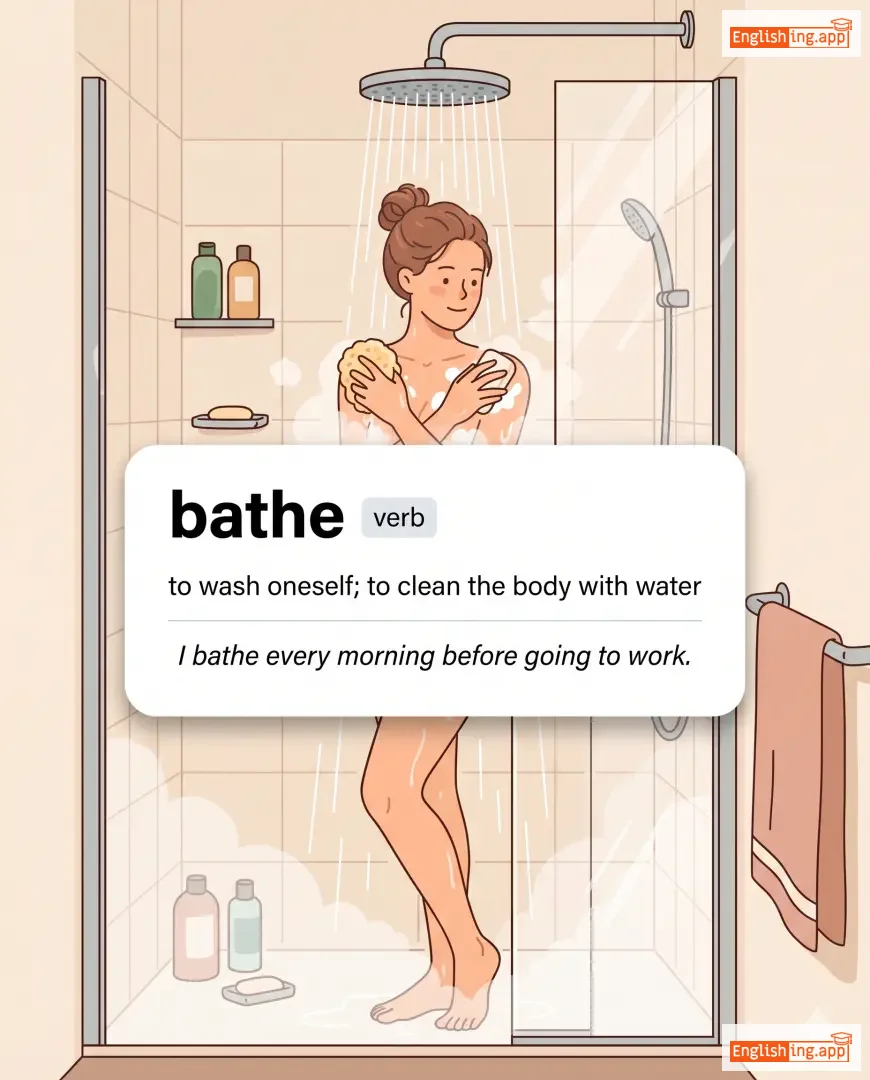
bathe definition card — visual illustration of the meaning
verb
/beɪð/
se baigner (se baigner)

to wash oneself; to clean the body with water

"I bathe every morning before going to work."

"Je me baigne chaque matin avant d'aller au travail." (Je me baigne chaque matin avant d'aller au travail)
adjective
/bəˈθɛt.ɪk/
sentiment insignifiant (sentiment insignifiant)

displaying insincere or trivial emotion; producing an unintended ridiculous effect through sudden change from serious to silly

"The movie's ending was unintentionally bathetic rather than tragic."

"La fin du film était bathétique au lieu d'être tragique." (La fin du film etait bathetique au lieu d'etre tragique.)
noun
/ˈbɑːθruːm/
salle de bains (salle de bains)

a room containing a toilet and usually a sink or shower

"The bathroom is on the second floor."

"La salle de bains est au deuxième étage." (La salle de bains est au deuxieme etage.)
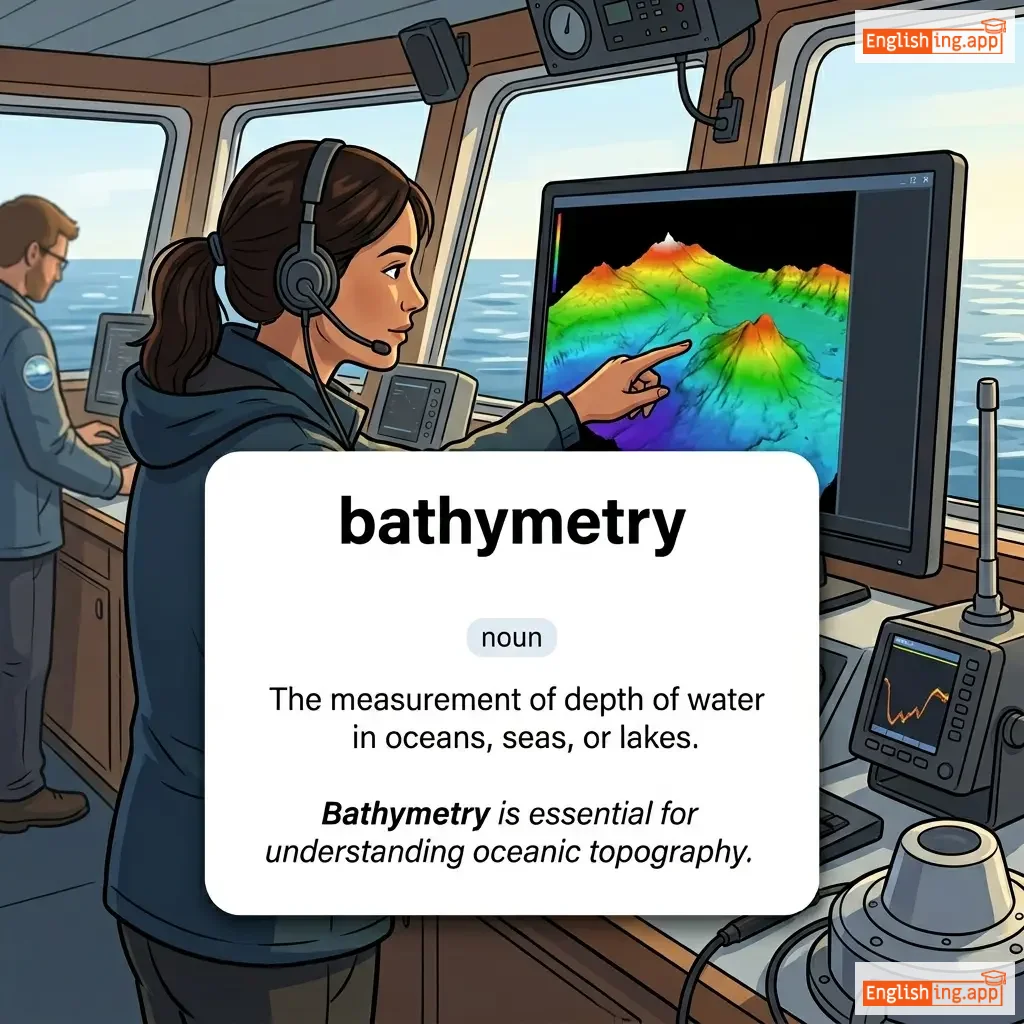
bathymetry definition card — visual illustration of the meaning
noun
/bəˈθɪm.ə.tri/
bathymétrie (bathymetrie)

The measurement of depth of water in oceans, seas, or lakes.

"Bathymetry is essential for understanding oceanic topography."

"La bathymétrie est essentielle pour comprendre la topographie océanique." (La bathymétrie est essentielle pour comprendre la topographie océanique.)
noun
/bəˈtɒn/
bâton / symbole d'autorité (baton / symbole d'autorite)

A thin stick carried by a conductor to direct an orchestra, or used as a symbol of authority.

"The conductor raised his baton to begin the symphony."

"Le chef d'orchestre leva son bâton pour commencer la symphonie." (Le chef d'orchestre leva son baton pour commencer la symphonie.)
noun
/bəˈtæljən/
bataillon (bataillon)

A large body of soldiers ready for battle, typically consisting of several companies.

"The battalion was deployed to the front line."

"Le bataillon a été déployé sur la ligne de front." (Le bataillon a ete deploie sur la ligne de front.)
verb
/ˈbætn/
fixer (fixer)

To fasten or secure something tightly.

"They battened down the hatches before the storm."

"Ils ont fixé les écoutilles avant la tempête." (Ils ont fixé les écoutilles avant la tempête.)
verb
/ˈbætər/
frapper violemment (frapper violemment)

To strike repeatedly with force.

"The waves battered the shoreline all night."

"Les vagues ont battu le rivage toute la nuit." (Les vagues ont battu le rivage toute la nuit.)
noun
/ˈbætəri/
batterie (batterie)

A device that stores and provides electrical energy; also refers to a group of similar things or repeated blows.

"The phone battery ran out after a long day."

"La batterie du téléphone s'est épuisée après une longue journée." (La batterie du telephone s'est epuisée apres une longue journee.)
noun/verb
/ˈbætəl/
bataille (bataille)

A fight between armed forces or a struggle to achieve or resist something.

"The soldiers prepared for the final battle."

"Les soldats se sont préparés pour la bataille finale." (Les soldats se sont préparés pour la bataille finale.)
noun
/ˈbætəlˌfiːld/
champ de bataille (champ de bataille)

a place where a battle is fought

"The battlefield was covered with the remnants of the fight."

"Le champ de bataille était couvert des restes du combat." (Le champ de bataille était couvert des restes du combat.)
adjective
/ˈbæti/
fou (fou)

crazy or eccentric in behavior

"The old man down the street is a bit batty but harmless."

"Le vieil homme dans la rue est un peu fou mais inoffensif." (Le vieil homme dans la rue est un peu fou mais inoffensif.)
noun
/ˈbɔːbəl/
bibelot (bibelot)

A small, decorative trinket or ornament, often of little value.

"She wore a shiny bauble around her neck."

"Elle portait un bibelot brillant autour de son cou." (Elle portait un bibelot brillant autour de son cou.)
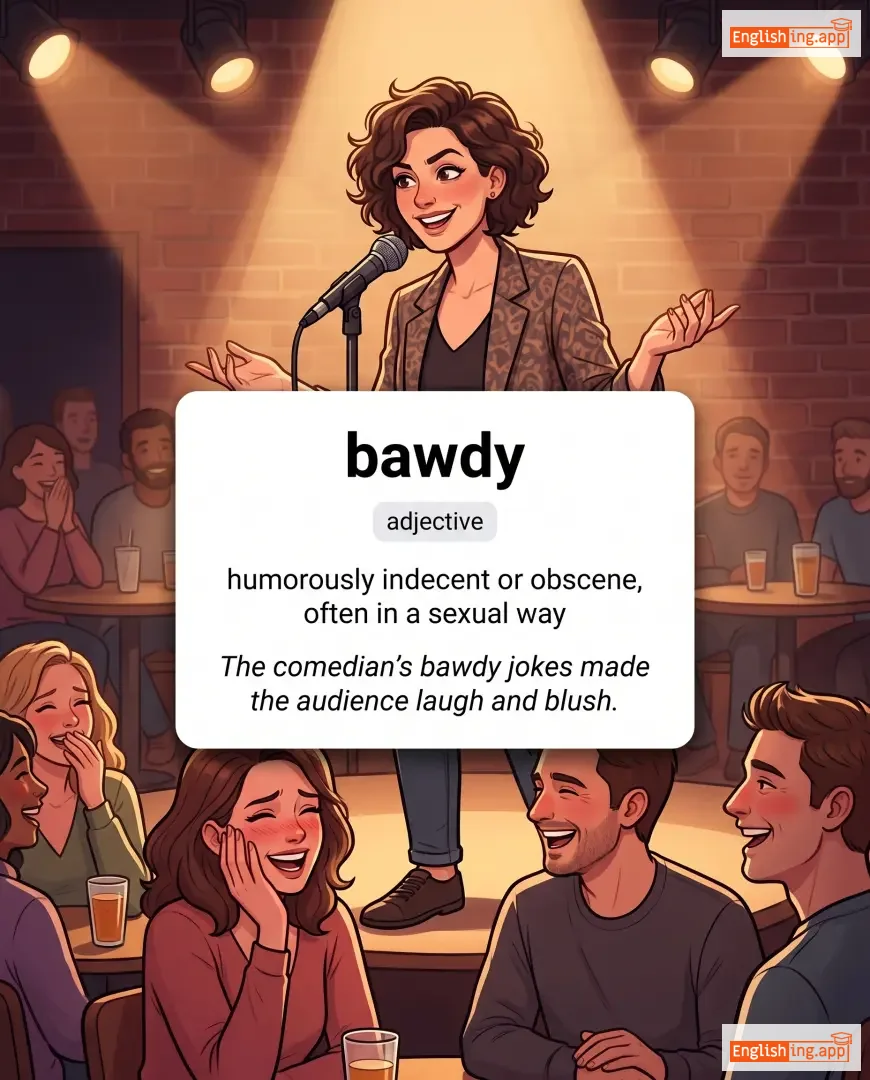
bawdy definition card — visual illustration of the meaning
adjective
/ˈbɔːdi/
obscène (obscene)

humorously indecent or obscene, often in a sexual way

"The comedian’s bawdy jokes made the audience laugh and blush."

"Les blagues obscènes du comédien ont fait rire le public et ont fait rougir certains." (Les blagues obscene du comedian ont fait rire le public et ont fait rougir certains.)
verb
/bɔːl/
crier fort (crier fort)

to shout or cry loudly

"The baby bawled all night, keeping everyone awake."

"Le bébé a pleuré toute la nuit, empêchant tout le monde de dormir." (Le bébé a pleuré toute la nuit, empêchant tout le monde de dormir.)
noun
/beɪ/
baie (baie)

a broad inlet of the sea where the land curves inward

"The ship anchored safely in the bay."

"Le navire a jeté l'ancre en toute sécurité dans la baie." (Le navire a jeté l'ancre en toute sécurité dans la baie.)
noun
/beɪ liːf/
feuille de laurier (feuille de laurier)

dried aromatic leaf of the bay laurel tree used as a culinary herb

"Add a bay leaf to the soup for extra flavor."

"Ajoutez une feuille de laurier à la soupe pour plus de saveur." (Ajoutez une feuille de laurier à la soupe pour plus de saveur.)
verb
/ˈbeɪɪŋ/
aboyer (aboyer)

making a loud, prolonged barking or howling sound, especially of dogs

"The baying of the hounds echoed through the forest."

"Les aboiements des chiens résonnaient à travers la forêt." (Les aboiements des chiens résonnaient à travers la forêt.)
verb
/biː/
être (etre)

To exist, to occur, or to have a particular quality.

"She wants to be a doctor."

"Elle veut être médecin." (Elle veut etre medecin.)
noun
/biːtʃ/
plage (plage)

An area of sand or small stones beside the sea or a lake.

"They spent the day relaxing on the beach."

"Ils ont passé la journée à se détendre sur la plage." (Ils ont passe la journee a se detendre sur la plage.)
noun
/biːd/
perle (perle)

a small round object with a hole through it for threading

"She made a necklace with colorful beads."

"Elle a fabriqué un collier avec des perles colorées." (Elle a fabrique un collier avec des perles colorees.)
noun
/biːk/
bec (bek)

the hard pointed part of a bird's mouth

"The eagle has a sharp beak for tearing meat."

"L'aigle a un bec pointu pour déchirer la viande." (L'aigle a un bec pointu pour dechirer la viande.)
noun
/biːm/
rayon / poutre (rayon / poutre)

a ray or shaft of light; a long piece of wood or metal used to support weight

"A beam of sunlight entered through the window."

"Un rayon de lumière est entré par la fenêtre." (Un rayon de lumière est entré par la fenêtre.)
noun
/biːn/
haricot (haricot)

A seed that is eaten as a vegetable or used to make food products.

"She cooked a pot of bean soup."

"Elle a cuisiné un pot de soupe aux haricots." (Elle a cuisiné un pot de soupe aux haricots.)
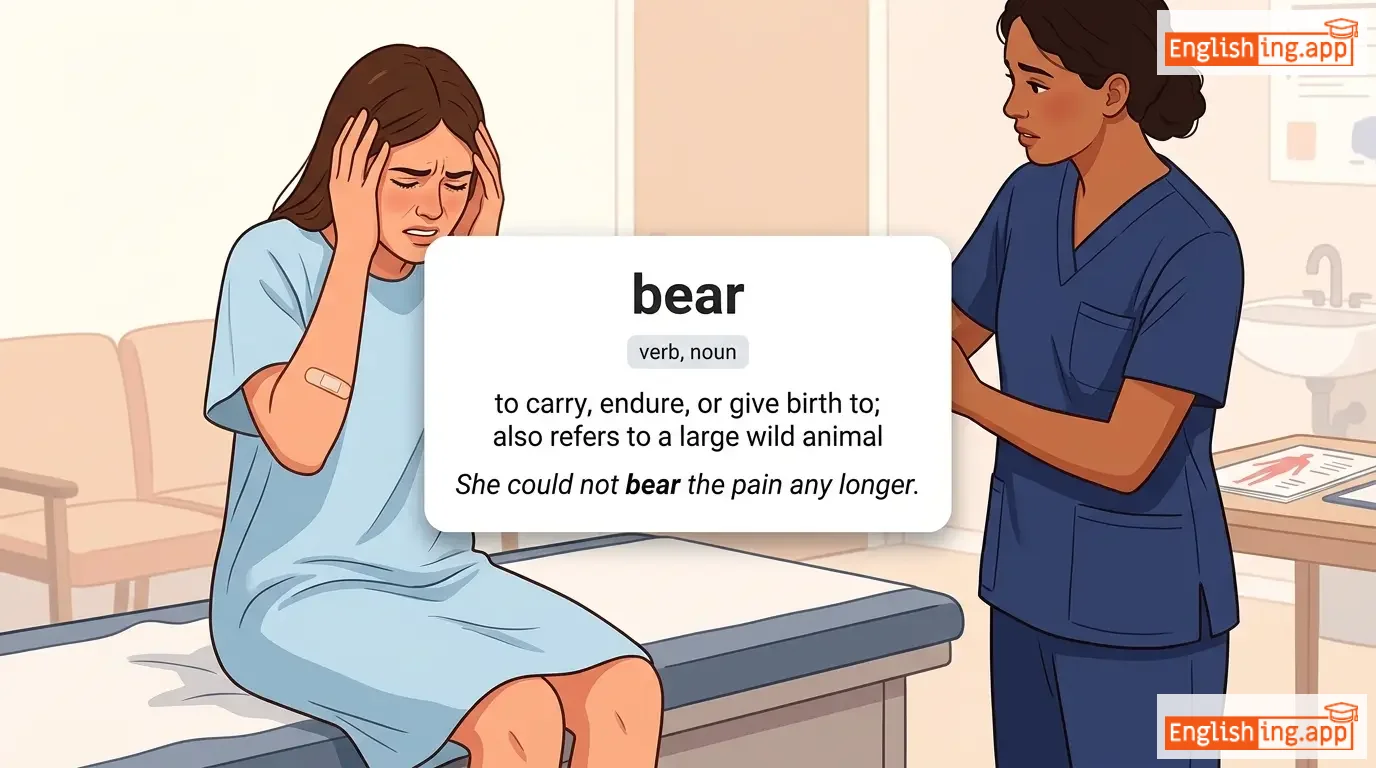
bear definition card — visual illustration of the meaning
verb, noun
/bɛər/
supporter / ours (supporter / ours)

to carry, endure, or give birth to; also refers to a large wild animal

"She could not bear the pain any longer."

"Elle ne pouvait plus supporter la douleur." (Elle ne pouvait plus supporter la douleur.)
adjective
/ˈbeə.rə.bəl/
supportable; tolérable; pas trop désagréable ou douloureux (bearable)

able to be endured; tolerable; not too unpleasant or painful

"The pain became bearable after taking the medicine."

"La douleur est devenue supportable après avoir pris le médicament." (La douleur est devenue supportable après avoir pris le médicament.)
noun
/bɪəd/
bonheur (bonheur)

the hair growing on the lower part of a man's face

"He decided to grow a beard during his vacation."

"Elle ne pouvait pas cacher sa joie quand elle a reçu le prix." (Elle ne pouvait pas cacher sa joie quand elle a reçu le prix.)
noun
/ˈbeə.rər/
porteur; détenteur de document (porteur; détenteur de document)

a person who carries or brings something; holder of a document

"The bearer of this message must deliver it quickly."

"Le porteur de ce message doit le livrer rapidement." (Le porteur de ce message doit le livrer rapidement.)
noun
/ˈbɛərɪŋ/
comportement / posture (comportement / posture)

a person's way of standing or moving; relevance or connection to something

"Her calm bearing impressed everyone in the room."

"Son comportement calme a impressionné tout le monde dans la pièce." (Son comportement calme a impressionné tout le monde dans la pièce.)
noun
/biːst/
bête / animal (bête / animal)

a large or dangerous animal; a cruel or brutal person

"The lion is known as the king of beasts."

"Le lion est connu comme le roi des bêtes." (Le lion est connu comme le roi des bêtes.)
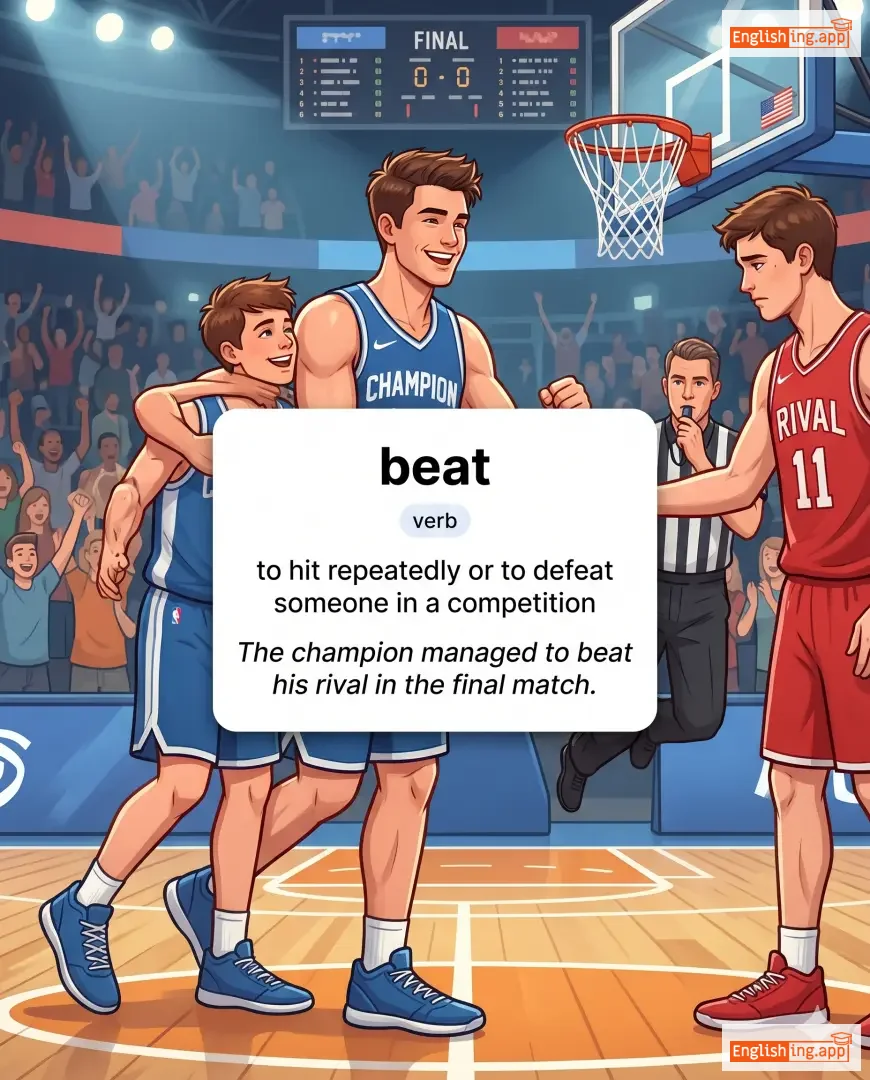
beat definition card — visual illustration of the meaning
verb
/biːt/
battre, vaincre (battre, vaincre)

to hit repeatedly or to defeat someone in a competition

"The champion managed to beat his rival in the final match."

"Le champion a réussi à battre son rival lors du match final." (Le champion a réussi à battre son rival lors du match final.)
noun
/ˈbiːtənd raɪs/
riz battu (riz battu)

flattened rice; rice that has been parboiled, dried, and beaten into flat flakes

"Beaten rice is commonly eaten with milk and sugar for breakfast."

"Le riz battu est généralement mangé avec du lait et du sucre au petit-déjeuner." (Le riz battu est généralement mangé avec du lait et du sucre au petit-déjeuner.)
adjective
/ˌbiːəˈtɪfɪk/
béatifique (beatifique)

blissfully happy or showing great joy

"She had a beatific smile after hearing the good news."

"Elle avait un sourire béatifique après avoir entendu les bonnes nouvelles." (Elle avait un sourire béatifique après avoir entendu les bonnes nouvelles.)
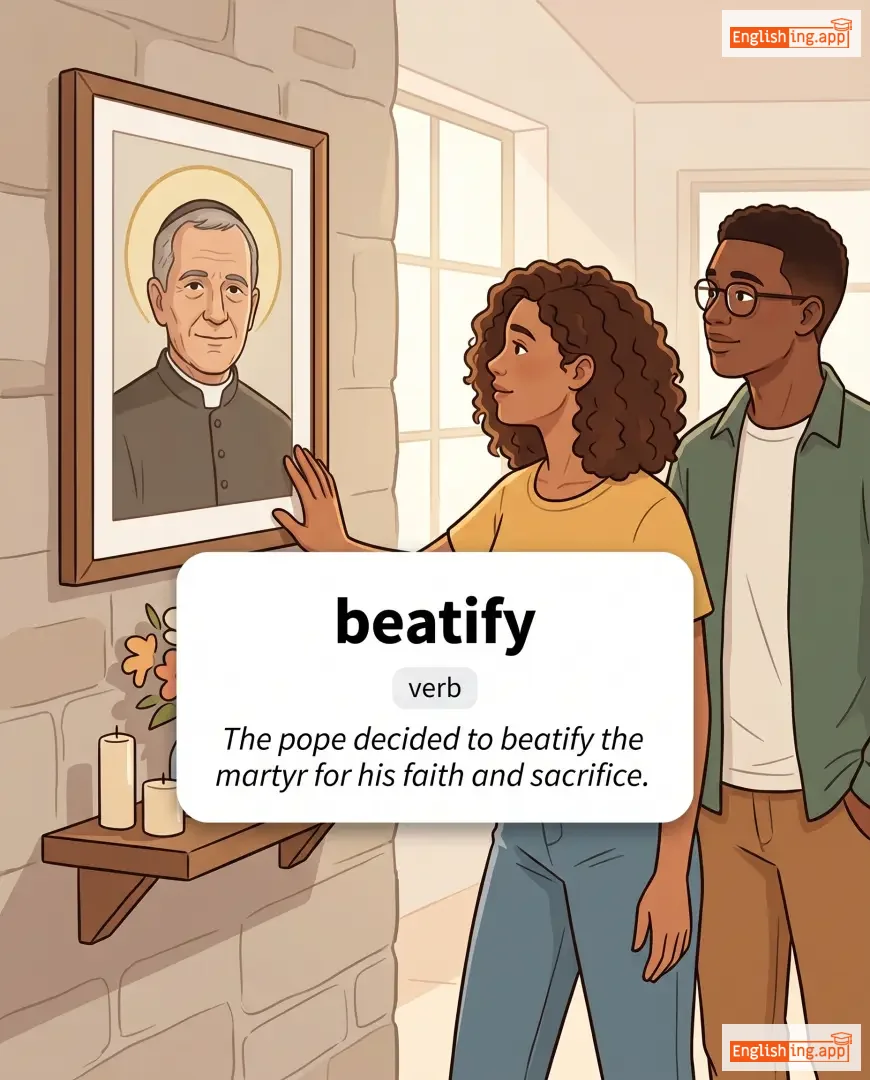
beatify definition card — visual illustration of the meaning
verb
/biˈætɪfaɪ/
béatifier (beatifier)

to make blessed or holy, especially in the Roman Catholic Church, to declare a deceased person to be among the blessed

"The pope decided to beatify the martyr for his faith and sacrifice."

"Le pape a décidé de béatifier le martyr pour sa foi et son sacrifice." (Le pape a decide de beatifier le martyr pour sa foi et son sacrifice.)
noun
/biˈætɪtjuːd/
béatitude, une grande bénédiction ou bonheur, souvent en référence aux paroles de Jésus dans le Sermon sur la Montagne (beatitude, une grande benediction ou bonheur, souvent en reference aux paroles de Jesus dans le Sermon sur la Montagne)

supreme blessedness or happiness, often used in reference to the sayings of Jesus in the Sermon on the Mount

"She felt a state of beatitude after receiving the good news."

"Elle se sentait dans un état de béatitude après avoir reçu la bonne nouvelle." (Elle se sentait dans un etat de beatitude apres avoir recu la bonne nouvelle.)
noun
/boʊ/
amant (amant)

a male admirer or boyfriend; a fashionable young man

"She arrived at the party with her beau."

"Elle est arrivée à la fête avec son amant." (Elle est arrivée à la fête avec son amant.)
adjective
/ˈbjuː.tɪ.fəl/
beau (bo)

pleasing to the senses or mind; very attractive

"The garden looked beautiful in the morning sunlight."

"Le jardin était magnifique sous la lumière du matin." (Le jardin était magnifique sous la lumière du matin.)
adverb
/ˈbjuːtɪfəli/
magnifiquement (magnifiquement)

in a beautiful or pleasing manner; excellently or skillfully

"She sang beautifully at the concert."

"Elle a chanté magnifiquement au concert." (elle a chante magnifiquement au concert)
verb
/ˈbjuːtɪfaɪ/
embellir (embellir)

to make something more beautiful or attractive

"The city plans to beautify the old park with trees and lights."

"La ville prévoit d’embellir l’ancien parc avec des arbres et des lumières." (La ville prevoit d embellir l ancien parc avec des arbres et des lumieres)
noun
/ˈbjuːti/
beauté (beauté)

a combination of qualities that please the senses or mind

"The beauty of the sunset took her breath away."

"La beauté du coucher du soleil lui a coupé le souffle." (La beaute du coucher du soleil lui a coupe le souffle.)
verb
/bɪˈkɑːm/
calmer (calmer)

to make calm or still; to deprive a sailing vessel of wind

"The captain tried to becalm the anxious crew."

"Le capitaine a essayé de calmer l'équipage anxieux." (Le capitaine a essaié de calmer l'équipage anxieux.)
conjunction
/bɪˈkɔːz/
parce que (parce que)

for the reason that; since

"He stayed home because it was raining."

"Il est resté à la maison parce qu'il pleuvait." (Il est reste a la maison parce qu'il pleuvait.)