Vocabulaires

Découvrez, apprenez et maîtrisez le vocabulaire anglais

noun
/ˈbeɪlɪf/
officier de justice (officier de justice)

An official who keeps order in a court, carries out court orders, or collects debts.

"The bailiff asked everyone to rise as the judge entered the courtroom."

"L'officier de justice a demandé à tout le monde de se lever lorsque le juge est entré dans la salle d'audience." (L'officier de justice a demandé à tout le monde de se lever lorsque le juge est entré dans la salle d'audience.)
noun
/ˈbeɪlɔːr/
bailleur (bailleur)

a person who temporarily transfers possession of goods or property to another under a bailment agreement

"The bailor entrusted the valuable artwork to the museum for safekeeping."

"Le bailleur a confié l’œuvre d’art au musée." (Le bailleur a confie l oeuvre d art au musee)
noun/verb
/beɪt/
nourriture ou appât utilisé pour attirer les poissons ou les animaux ; provoquer ou déranger délibérément. (nourriture ou appât utilisé pour attirer les poissons ou les animaux ; provoquer ou déranger délibérément.)

Food or lure used to attract fish or animals; to deliberately provoke or annoy.

"He used worms as bait to catch fish."

"Il a utilisé des vers de terre comme appât pour attraper du poisson." (Il a utilisé des vers de terre comme appât pour attraper du poisson.)
noun
/beɪz/
un type de tissu en laine épais (un type de tissu en laine épais)

A type of coarse woolen cloth, often green, used for covering tables such as billiard tables.

"The old card table was covered with worn baize."

"La vieille table de cartes était recouverte de baize usé." (La vieille table de cartes était recouverte de baize usé.)
verb
/beɪk/
cuire (cuire)

to cook food using dry heat, usually in an oven

"She baked a cake for her friend's birthday."

"Elle a cuit un gâteau pour l'anniversaire de son ami." (Elle a cuit un gâteau pour l'anniversaire de son ami.)
noun
/beɪkt miːt/
viande cuite (viande cuite)

meat that has been cooked in an oven using dry heat

"The baked meat was tender and flavorful."

"La viande cuite au four était tendre et savoureuse." (La viande cuite au four était tendre et savoureuse.)
noun
/ˈbeɪ.kɪŋ ˈpaʊ.dər/
levure chimique (levure chimique)

a dry chemical leavening agent used to increase volume and lighten texture in baked goods

"The recipe calls for two teaspoons of baking powder."

"La recette nécessite deux cuillères à café de levure chimique." (La recette nécessite deux cuillères à café de levure chimique.)
noun
/ˈbeɪ.kɪŋ ˈsoʊ.də/
bicarbonate de soude (bicarbonate de soude)

sodium bicarbonate used in cooking and baking as a leavening agent

"Add a teaspoon of baking soda to make the cake fluffy."

"Ajoutez une cuillère à café de bicarbonate de soude pour rendre le gâteau moelleux." (Ajoutez une cuillère à café de bicarbonate de soude pour rendre le gâteau moelleux.)
noun
/bəˈkuːl/
fleur bakul (fleur bakul)

a fragrant white flower native to South Asia, scientifically known as Mimusops elengi

"The sweet fragrance of bakul flowers filled the evening air in the village."

"La douce fragrance des fleurs bakul a rempli l'air du soir dans le village." (La douce fragrance des fleurs bakul a rempli l'air du soir dans le village.)
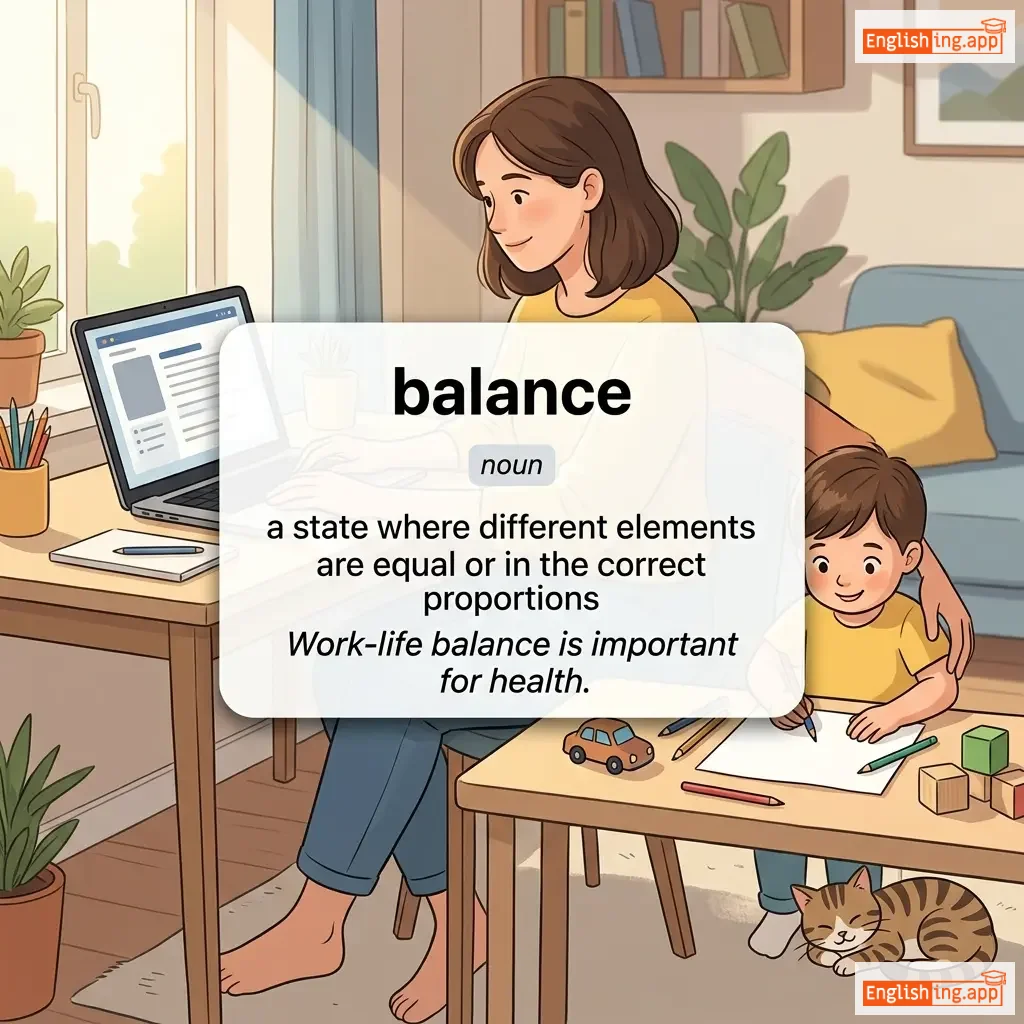
balance definition card — visual illustration of the meaning
noun
/ˈbæləns/
équilibre (equilibre)

a state where different elements are equal or in the correct proportions

"Work-life balance is important for health."

"L'équilibre travail-vie est important pour la santé." (L'equilibre travail-vie est important pour la sante.)
adjective
/ˈbælənst/
équilibré (equilibre)

keeping or showing a sensible and fair view or position; evenly arranged

"A balanced diet is essential for good health."

"Un régime alimentaire équilibré est essentiel pour une bonne santé." (Un regime alimentaire equilibre est essentiel pour une bonne sante.)
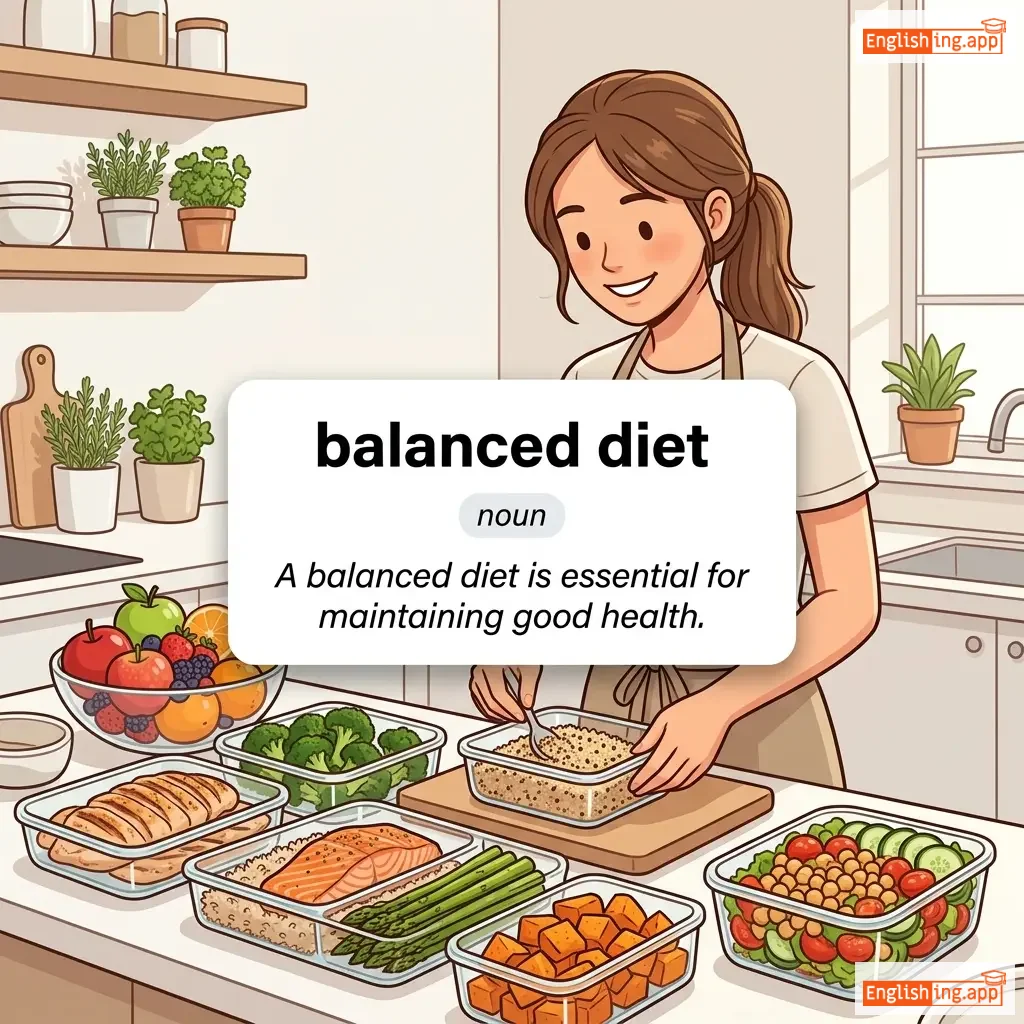
balanced diet definition card — visual illustration of the meaning
noun
ˈbæl.ənst daɪ.ət
régime équilibré (regime equilibre)

A diet consisting of the proper quantities and proportions of foods needed to maintain health or growth.

"A balanced diet is essential for maintaining good health."

"Un régime équilibré est essentiel pour maintenir une bonne santé." (Un régime équilibré est essentiel pour maintenir une bonne santé.)
noun
/beɪl/
ballot (ballot)

A large bundle of goods tightly wrapped and bound.

"The workers loaded the bale of cotton onto the truck."

"Les travailleurs ont chargé le ballot de coton sur le camion." (Les travailleurs ont chargé le ballot de coton sur le camion.)
adjective
/ˈbeɪlfəl/
menaçant (menasant)

Threatening harm; menacing or expressing hatred.

"She gave him a baleful look after the insult."

"Après l'insulte, elle lui lança un regard menaçant." (Après l'insulte, elle lui lança un regard menaçant.)
verb
/bɔːk/
refuser (refuser)

to hesitate or refuse to proceed or comply

"She balked at signing the contract without reading it fully."

"Elle a hésité à signer le contrat sans le lire complètement." (Elle a hésité à signer le contrat sans le lire complètement.)
adjective
/ˈbɔːlki/
têtu (tetu)

difficult, uncooperative, or stubborn

"The balky printer refused to work when needed most."

"L'imprimante têtue a refusé de fonctionner quand elle en avait le plus besoin." (L'imprimante tetue a refuse de fonctionner quand elle en avait le plus besoin.)
noun
/bɔːl/
balle (balle)

a round object used in games or sports

"The children played with a ball in the park."

"Les enfants ont joué avec une balle dans le parc." (Les enfants ont joué avec une balle dans le parc.)
noun
/ˈbæləd/
chanson narrative (chanson narrative)

a narrative song or poem, often sentimental or romantic

"The singer performed a moving ballad about lost love."

"Le chanteur a interprété une ballade émouvante sur l'amour perdu." (Le chanteur a interprete une ballade emouvante sur l'amour perdu.)
noun
/ˈbælæst/
ballast (ballast)

heavy material used to stabilize a ship or vehicle

"The ship was loaded with ballast to remain steady in the storm."

"Le navire a été chargé de ballast pour rester stable dans la tempête." (Le navire a été chargé de ballast pour rester stable dans la tempête.)
noun
/bæˈleɪ/
ballet (ballet)

a highly stylized and artistic form of dance

"She has trained for years in classical ballet."

"Elle a entraîné pendant des années dans le ballet classique." (Elle a entraine pendant des annees dans le ballet classique.)
noun/verb
/bəˈluːn/
ballon (ballon)

A small bag made of thin rubber or similar material that can be inflated with air or gas; as a verb, to expand rapidly.

"The children played with a red balloon at the party."

"Les enfants ont joué avec un ballon rouge à la fête." (Les enfants ont joué avec un ballon rouge à la fête.)
noun
/ˈbælət/
bulletin de vote (byooltan duh vot)

a process of voting, usually in secret; the paper used to record a vote

"Voters cast their ballot in the election."

"Les électeurs ont déposé leur bulletin de vote dans l’élection." (Lay electeur on depoze ler byooltan duh vot dan lelekssion.)
noun
/bɑːm/
baume (baume)

A soothing ointment or something that provides comfort or relief.

"The balm helped relieve the pain from her sunburn."

"Le baume a aidé à soulager la douleur de son coup de soleil." (Le baume a aidé à soulager la douleur de son coup de soleil.)
adjective
/ˈbɑːmi/
doux et agréablement chaud; apaisant. (doux et agreablement chaud; apaisant.)

Mild and pleasantly warm; soothing.

"We enjoyed a walk on a balmy summer evening."

"Nous avons apprécié une promenade lors d'une douce soirée d'été." (Nous avons apprécié une promenade lors d'une douce soirée d'été.)
noun
/ˈbɔːlsəm/
balsame parfumé (balsame parfume)

An aromatic resinous substance or plant used for healing or soothing.

"The tree produced a fragrant balsam used in medicine."

"L'arbre a produit un baume parfumé utilisé en médecine." (L'arbre a produit un baume parfumé utilisé en médecine.)
noun
/ˈbɔːl.səm ˈæp.əl/
melon amer (melon amer)

a bitter gourd vegetable with a bumpy green skin, also known as bitter melon

"Balsam apple is cooked with spices to reduce its bitter taste."

"Le melon amer est cuit avec des épices pour réduire son goût amer." (Le melon amer est cuit avec des epices pour réduire son goût amer.)
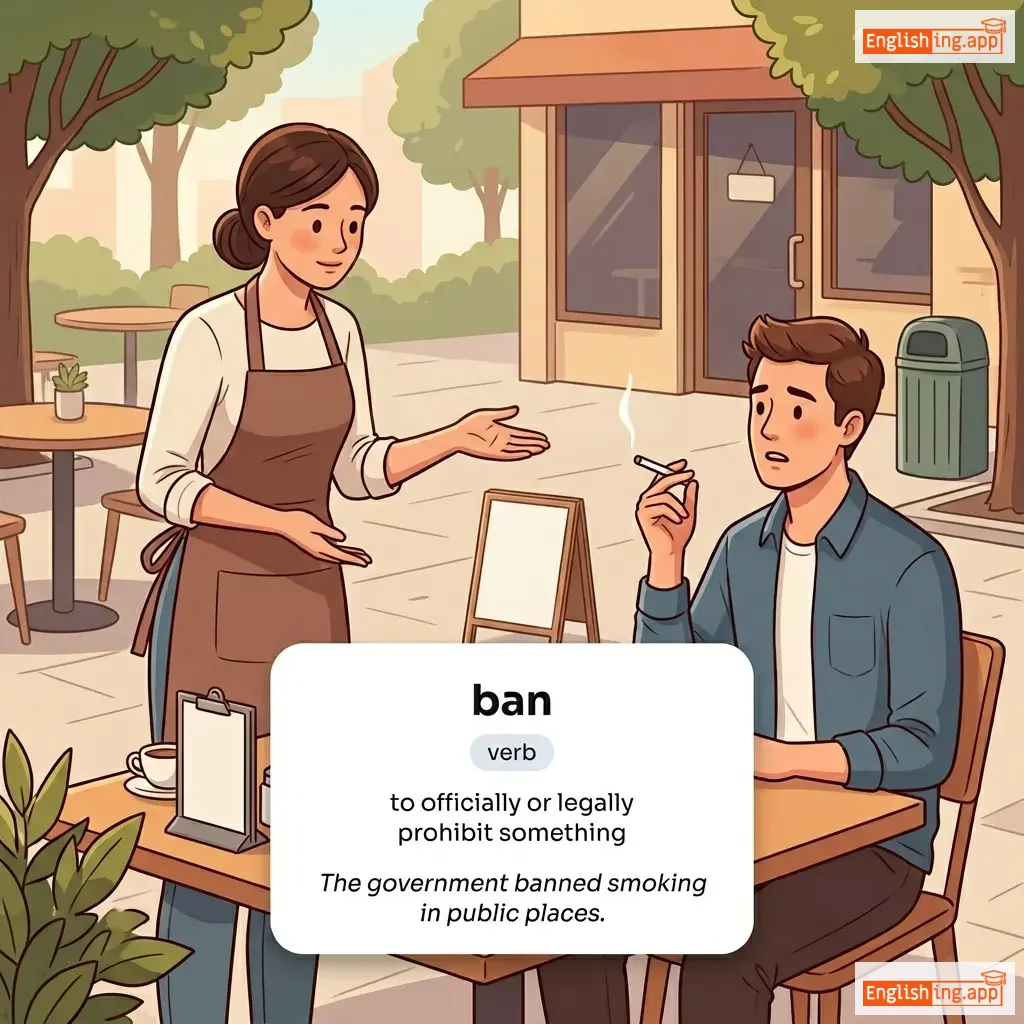
ban definition card — visual illustration of the meaning
verb
/bæn/
interdire (interdire)

to officially or legally prohibit something

"The government banned smoking in public places."

"Le gouvernement a interdit de fumer dans les lieux publics." (Le gouvernement a interdit de fumer dans les lieux publics.)
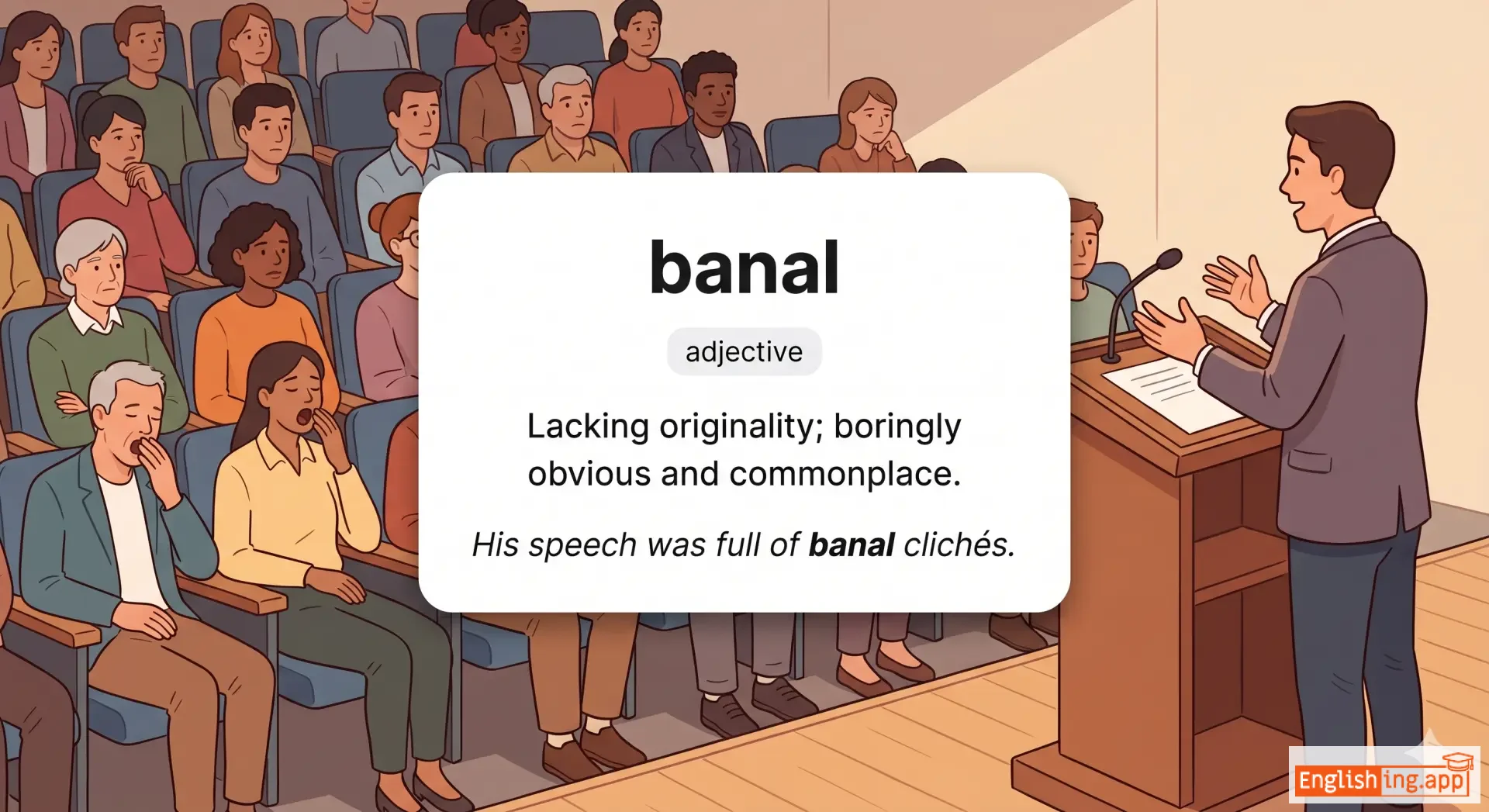
banal definition card — visual illustration of the meaning
adjective
/bəˈnɑːl/ or /ˈbeɪnəl/
banal (banal)

Lacking originality; boringly obvious and commonplace.

"His speech was full of banal clichés."

"Son discours était plein de clichés banals." (Son discours était plein de clichés banals.)
noun
/bəˈnæləti/
banalité (banalite)

The condition of being unoriginal, boring, or obvious; trite remark or quality.

"The speech was criticized for its banality and lack of originality."

"Le discours a été critiqué pour sa banalité et son manque d'originalité." (Le discours a ete critique pour sa banalite et son manque d'originalite.)
noun
/bəˈnænə/
bonheur (bonheur)

a long curved fruit with a yellow skin and soft sweet flesh inside

"She ate a ripe banana for breakfast."

"Elle ne pouvait pas cacher son bonheur lorsqu'elle a reçu le prix." (Elle ne pouvait pas cacher son bonheur lorsqu'elle a reçu le prix.)
noun
/bænd/
groupe de musique (groupe de musique)

a group of musicians who play music together

"The band performed live at the concert."

"Le groupe a joué en direct lors du concert." (Le groupe a joue en direct lors du concert.)
noun, verb
/ˈbændɪdʒ/
bandage (bandage)

a strip of material used to cover or protect a wound; to cover or wrap a wound with such material

"The nurse carefully bandaged his injured arm."

"L’infirmière a bandagé son bras blessé." (Linfirmiere a bandage son bras blesse)
noun
/bænˈdænə/
grand foulard coloré (grand foulard colore)

A large, often brightly colored handkerchief, typically worn on the head or around the neck.

"He tied a red bandanna around his neck."

"Il a attaché un foulard rouge autour de son cou." (Il a attaché un foulard rouge autour de son cou.)
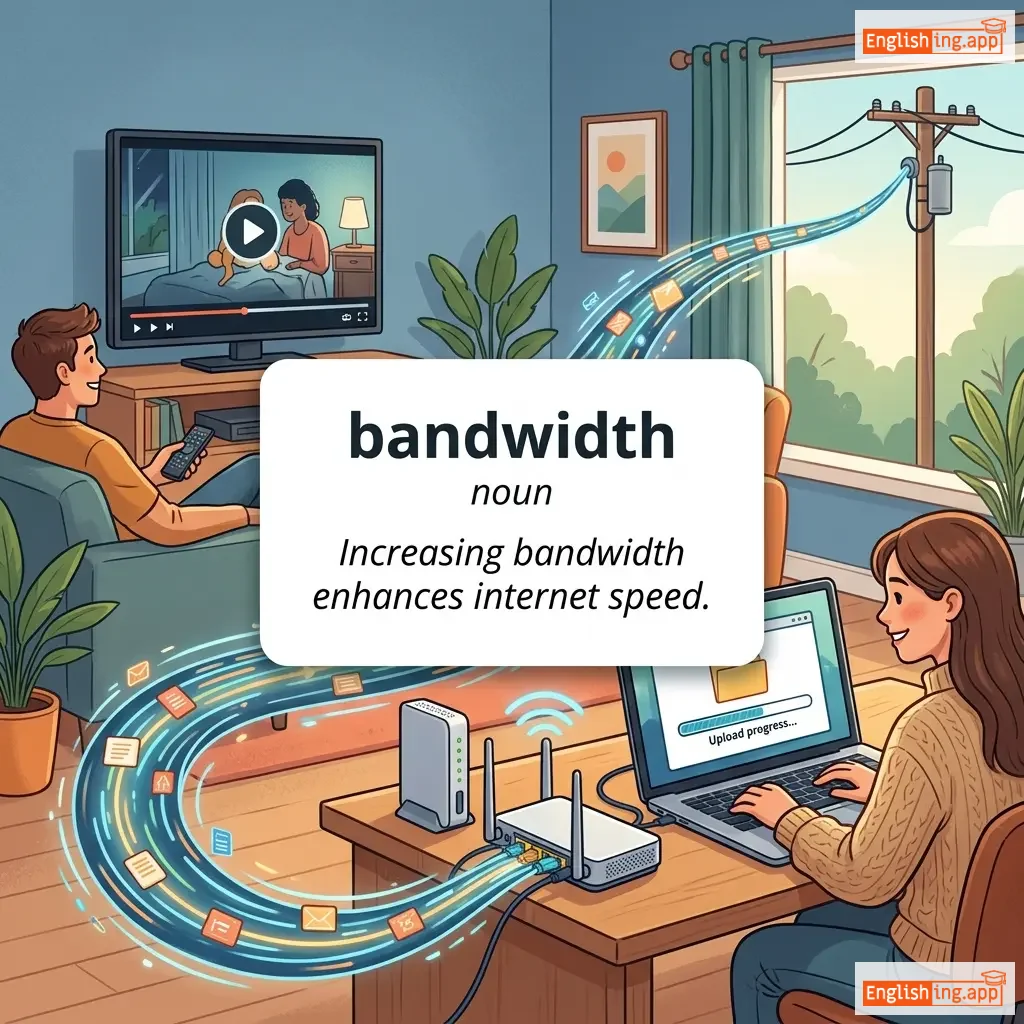
bandwidth definition card — visual illustration of the meaning
noun
ˈbænd.wɪdθ
bande passante (bande passante)

A range of frequencies within a given band, in particular that used for transmitting a signal; the maximum amount of data that can be transmitted in a fixed amount of time.

"Increasing bandwidth enhances internet speed."

"Augmenter la bande passante améliore la vitesse d'Internet." (augmenter la bande passante ameliore la vitesse d internet.)
verb
/ˈbændi/
échanger (echanger)

To pass (words, ideas, or gossip) back and forth in a casual or argumentative way.

"They bandied jokes across the table."

"Ils échangeaient des blagues à travers la table." (Ils échangeaient des blagues à travers la table.)
noun
/beɪn/
fléau (fleau)

A cause of great distress, harm, or annoyance.

"Traffic jams are the bane of city life."

"Les embouteillages sont le fléau de la vie urbaine." (Les embouteillages sont le fleau de la vie urbaine.)
adjective
/ˈbeɪnfəl/
nuisible (nuisible)

Causing harm, ruin, or destruction; deadly or poisonous.

"His baneful influence ruined the community."

"Son influence nuisible a ruiné la communauté." (Son influence nuisible a ruiné la communauté.)
noun
/bæŋ/
un bruit soudain fort; un coup ou une frappe violente (un bruit soudain fort; un coup ou une frappe violente)

a sudden loud noise; a hard blow or hit

"The door closed with a loud bang that woke everyone up."

"La porte s'est fermée avec un bruit fort qui a réveillé tout le monde." (La porte s'est fermée avec un bruit fort qui a réveillé tout le monde.)
noun
/ˈbæŋ.ɡəl/
bracelet (bracelet)

a rigid bracelet or anklet worn as jewelry

"She wore beautiful gold bangles on her wrists."

"Elle portait de magnifiques bracelets en or à ses poignets." (elle portait de magnifiques bracelets en or a ses poignets)
noun
/ˈbæn.jən/
sous-vêtement sans manches (sous-vetement sans manches)

a sleeveless undergarment worn next to the skin; vest

"He put on a cotton banian under his shirt."

"Il a mis un banian en coton sous sa chemise." (Il a mis un banian en coton sous sa chemise.)
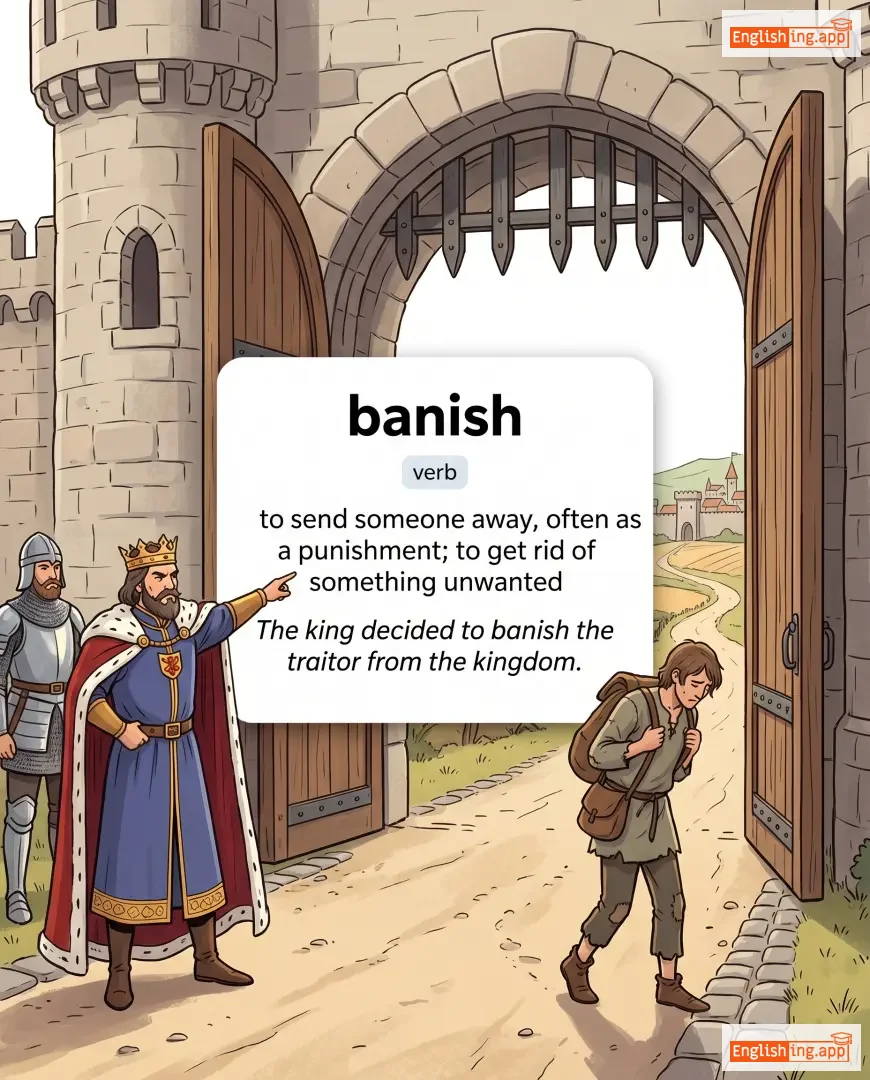
banish definition card — visual illustration of the meaning
verb
/ˈbænɪʃ/
exiler (exiler)

to send someone away, often as a punishment; to get rid of something unwanted

"The king decided to banish the traitor from the kingdom."

"Le roi a décidé d'exiler le traître du royaume." (Le roi a décidé d'exiler le traître du royaume.)
noun
/ˈbænɪstər/
rampe (rampe)

a railing supported by posts at the side of a staircase or balcony

"She held the banister tightly while going down the stairs."

"Elle tenait fermement la rampe en descendant les escaliers." (Elle tenait fermement la rampe en descendant les escaliers.)
noun/verb
/bæŋk/
banque (banque)

an institution where money is kept and managed; or to tilt in movement (like an airplane or riverbank)

"She deposited the money in the bank."

"Elle a déposé l'argent à la banque." (Elle a depose l'argent a la banque.)
noun
/ˈbæŋkər/
banquier (banquier)

a person who works in or manages a bank

"The banker approved the loan after reviewing the documents."

"Le banquier a approuvé le prêt après avoir examiné les documents." (Le banquier a approuvé le prêt après avoir examiné les documents.)
noun
/ˈbæŋkɪŋ/
bancarisation ou services bancaires (bancarisation ou services bancaires)

the business or services provided by a bank

"Online banking has made financial transactions easier."

"La banque en ligne a facilité les transactions financières." (La banque en ligne a facilité les transactions financières.)
noun
/ˈbæŋkrʌpt/
faillite (faillite)

a person unable to pay debts; having no money; completely lacking in something

"The company went bankrupt after years of poor financial management."

"L'entreprise a fait faillite après des années de mauvaise gestion financière." (L'entreprise a fait faillite après des années de mauvaise gestion financière.)
noun
/ˈbæŋkrʌptsi/
faillite (faillite)

the state of being unable to pay debts owed, declared by a legal process

"The company declared bankruptcy after months of financial struggles."

"L'entreprise a déclaré faillite après des mois de difficultés financières." (L'entreprise a déclaré faillite après des mois de difficultés financières.)
noun
/ˈbænər/
bannière (banniere)

a large printed sign used for advertisements or announcements

"The company displayed a banner to advertise their new product."

"L'entreprise a affiché une bannière pour faire la publicité de son nouveau produit." (Lentreprise a affichee une banniere pour faire la publicite de son nouveau produit)
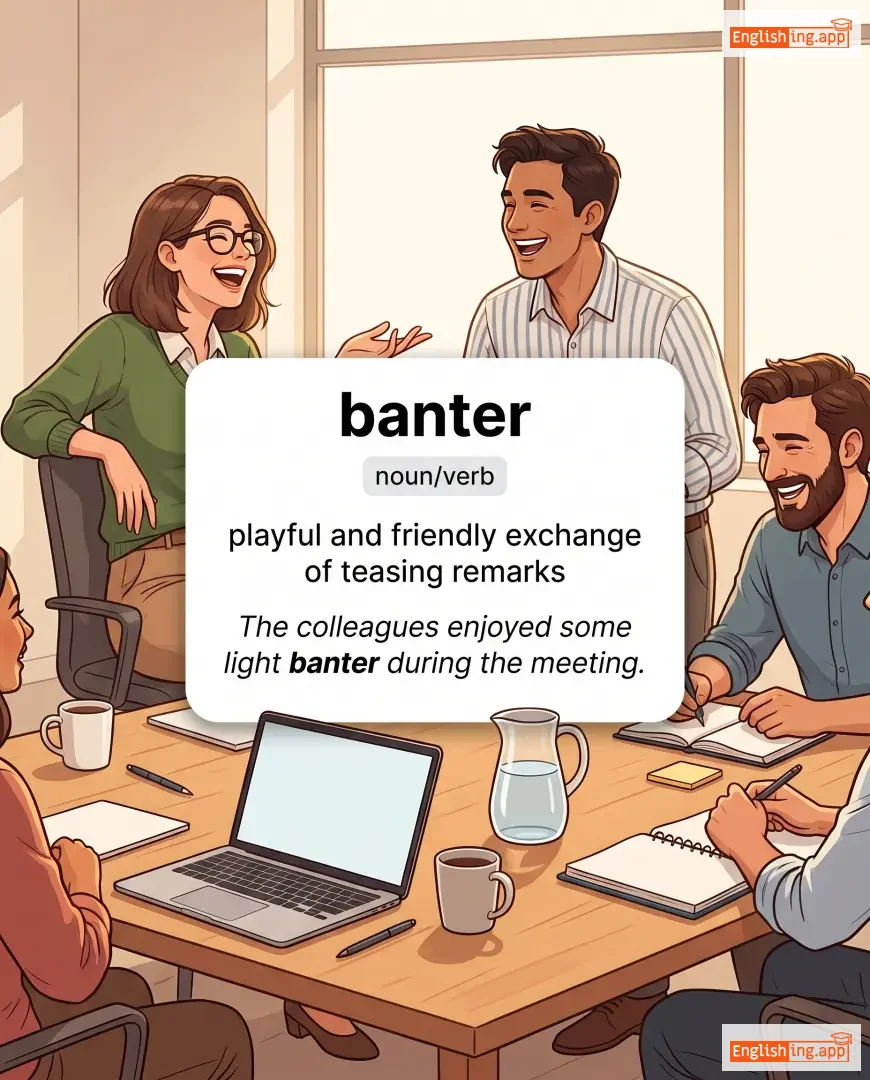
banter definition card — visual illustration of the meaning
noun/verb
/ˈbæntər/
plaisanterie (plaisanterie)

playful and friendly exchange of teasing remarks

"The colleagues enjoyed some light banter during the meeting."

"Les collègues ont apprécié un peu de banter léger pendant la réunion." (Les collègues ont apprécié un peu de banter léger pendant la réunion.)
adjective/verb
/ˈbæntərɪŋ/
plaisanter (plaisanter)

characterized by good-humored teasing or joking

"They had a bantering conversation at the café."

"Ils ont eu une conversation en plaisantant au café." (Ils ont eu une conversation en plaisantant au café.)