Vocabulaires

Découvrez, apprenez et maîtrisez le vocabulaire anglais

noun, verb
/bɑːr/
bar, barrer (bar, barrer)

a counter where drinks are served; to prevent or block

"They decided to meet at the bar after work."

"Ils ont décidé de se retrouver au bar après le travail." (Ils ont décidé de se retrouver au bar après le travail.)
noun
/bɑːrb/
dard, remarque acerbe (dard, remarque acerbe)

a sharp projection such as on a fishhook; a cutting remark

"The fishhook has a small barb to keep the fish from escaping."

"L'hameçon a une petite barb pour empêcher le poisson de s'échapper." (L'hamecon a une petite barb pour empecher le poisson de s'echapper.)
noun
/ˈbɑːr.bər/
coiffeur (coiffeur)

a person whose job is to cut men's hair and shave or trim beards

"The barber gave him a perfect haircut for his wedding."

"Le coiffeur lui a donné une coupe de cheveux parfaite pour son mariage." (Le coiffeur lui a donné une coupe de cheveux parfaite pour son mariage.)
noun
/bɑːrˈbeəriən/
barbare; sauvage; (barbare; sauvage)

a person from an uncivilized group; someone who is cruel or brutal

"The ancient Romans considered anyone outside their empire to be barbarians."

"Les anciens Romains considéraient comme des barbares tous ceux qui étaient hors de leur empire." (Les anciens Romains considéraient comme des barbares tous ceux qui étaient hors de leur empire.)
noun
/ˈbɑːrbərɪzəm/
barbarie (barbarie)

extreme cruelty or brutality; absence of culture and civilization

"The barbarism of the war crimes shocked the entire international community."

"Le barbarisme des crimes de guerre a choqué la communauté internationale." (Le barbarisme des crimes de guerre a choque la communaute internationale.)
adjective
/ˈbɑːr.bə.rəs/
barbare, cruel (barbare, cruel)

extremely cruel or uncivilized

"The prisoners were treated in a barbarous manner."

"Les prisonniers ont été traités de manière barbare." (Les prisonniers ont été traités de manière barbare.)
noun
/ˈbɑːr.kəˌroʊl/
barcarole (barcarole)

a traditional Venetian boat song, often in 6/8 time

"The orchestra played a beautiful barcarole that reminded me of Venice."

"L'orchestre a joué une belle barcarole qui m'a rappelé Venise." (L'orchestre a joue une belle barcarole qui m'a rappele Venise.)
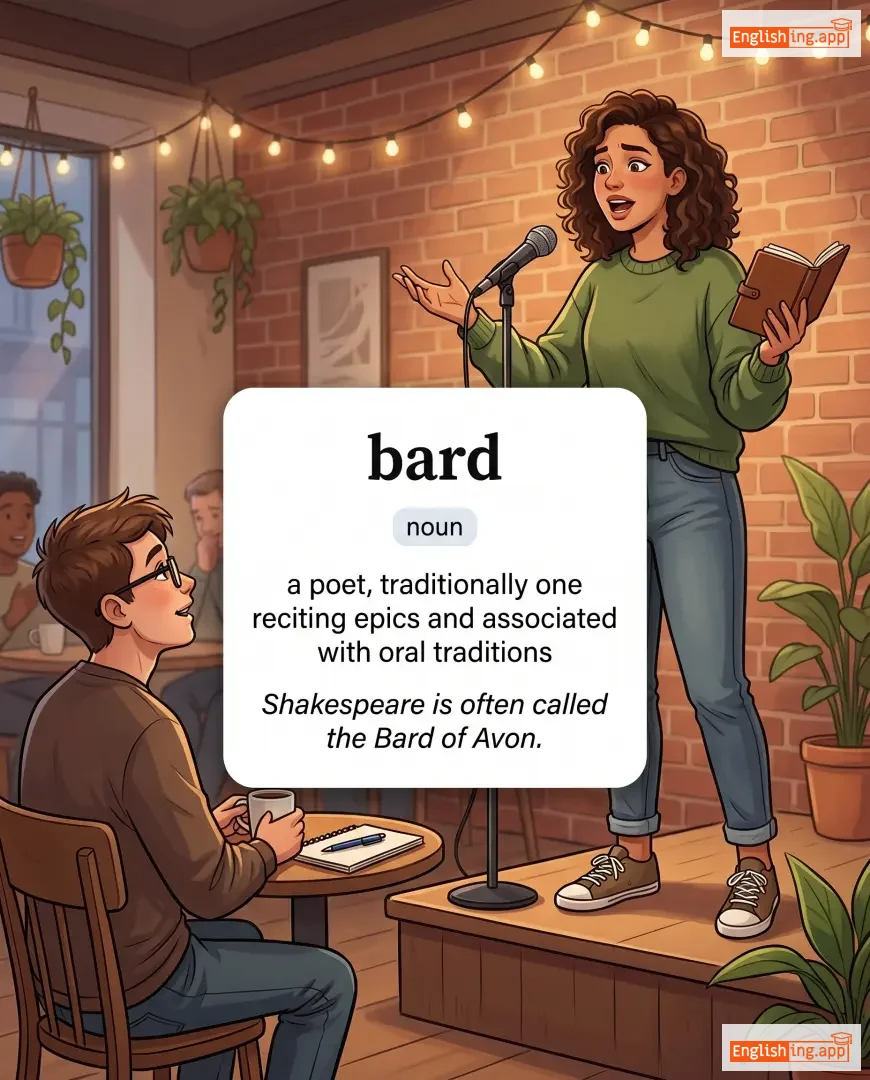
bard definition card — visual illustration of the meaning
noun
/bɑːrd/
poète (poete)

a poet, traditionally one reciting epics and associated with oral traditions

"Shakespeare is often called the Bard of Avon."

"Shakespeare est souvent appelé le poète de l'Avon." (Shakespeare est souvent appele le poete de l'Avon.)
adjective
/beər/
nu (nu)

not covered by any clothing or decoration; simple and without addition

"He walked on the beach with bare feet."

"Il a marché sur la plage pieds nus." (Il a marche sur la plage pieds nus.)
adjective
/ˈbɛərˌfeɪst/
effronté (effronte)

shameless and undisguised; openly bold or unashamed

"He told a barefaced lie in front of everyone."

"Il a raconté un mensonge effronté devant tout le monde." (Il a raconté un mensonge effronté devant tout le monde.)
adverb
/ˈbɛərli/
à peine (a peine)

only just; almost not

"She barely passed the exam."

"Elle a à peine réussi l'examen." (Elle a à peine réussi l'examen.)
noun
/ˈbɛərnəs/
nudité (nudite)

the state of being bare or uncovered; lack of decoration, warmth, or concealment

"The bareness of the room made it feel cold and unwelcoming."

"La nudité de la pièce la rendait froide et peu accueillante." (La nudite de la piece la rendait froide et peu accueillante)
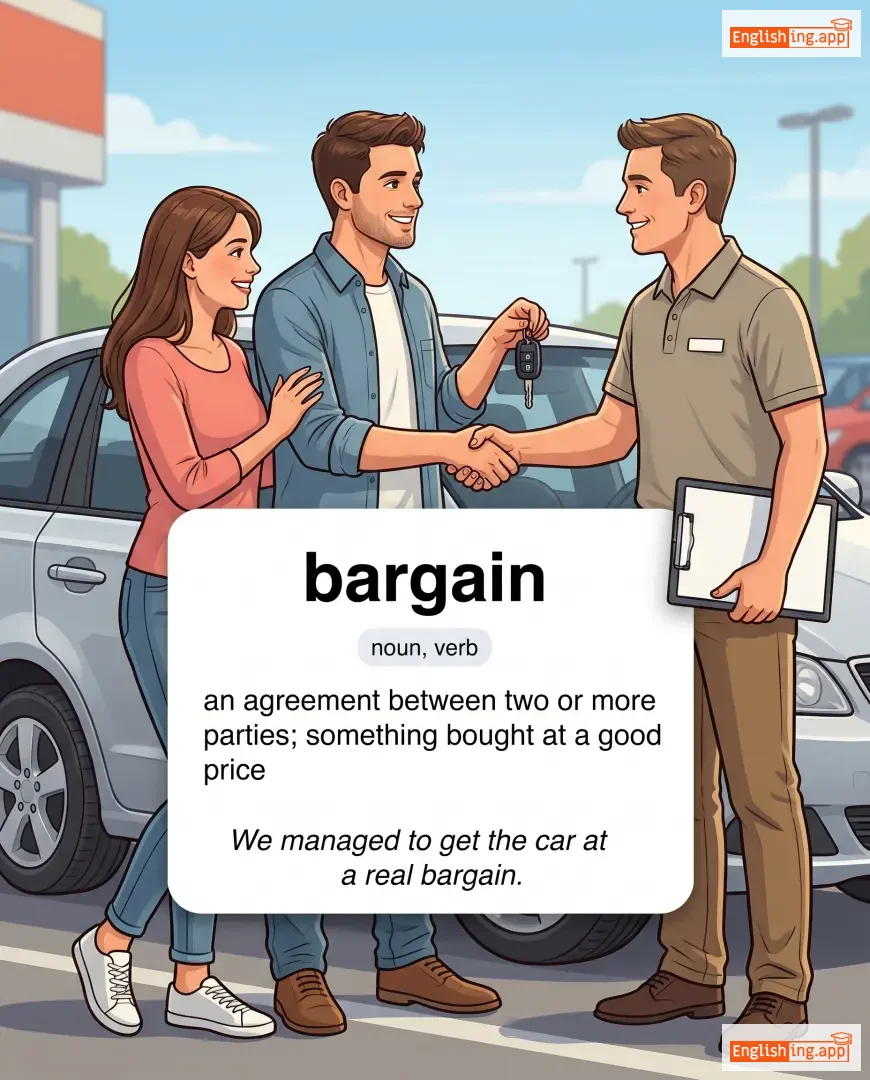
bargain definition card — visual illustration of the meaning
noun, verb
/ˈbɑːrɡən/
affaire / bonne affaire (affaire / bonne affaire)

an agreement between two or more parties; something bought at a good price

"We managed to get the car at a real bargain."

"Nous avons réussi à obtenir la voiture à une vraie bonne affaire." (Nous avons réussi à obtenir la voiture à une vraie bonne affaire.)
noun
/ˈbærɪˌtoʊn/
voix masculine grave (voix masculine grave)

a male singing voice between tenor and bass

"The singer’s baritone voice impressed the audience."

"La voix de baryton du chanteur a impressionné le public." (La voix de baryton du chanteur a impressionné le public.)
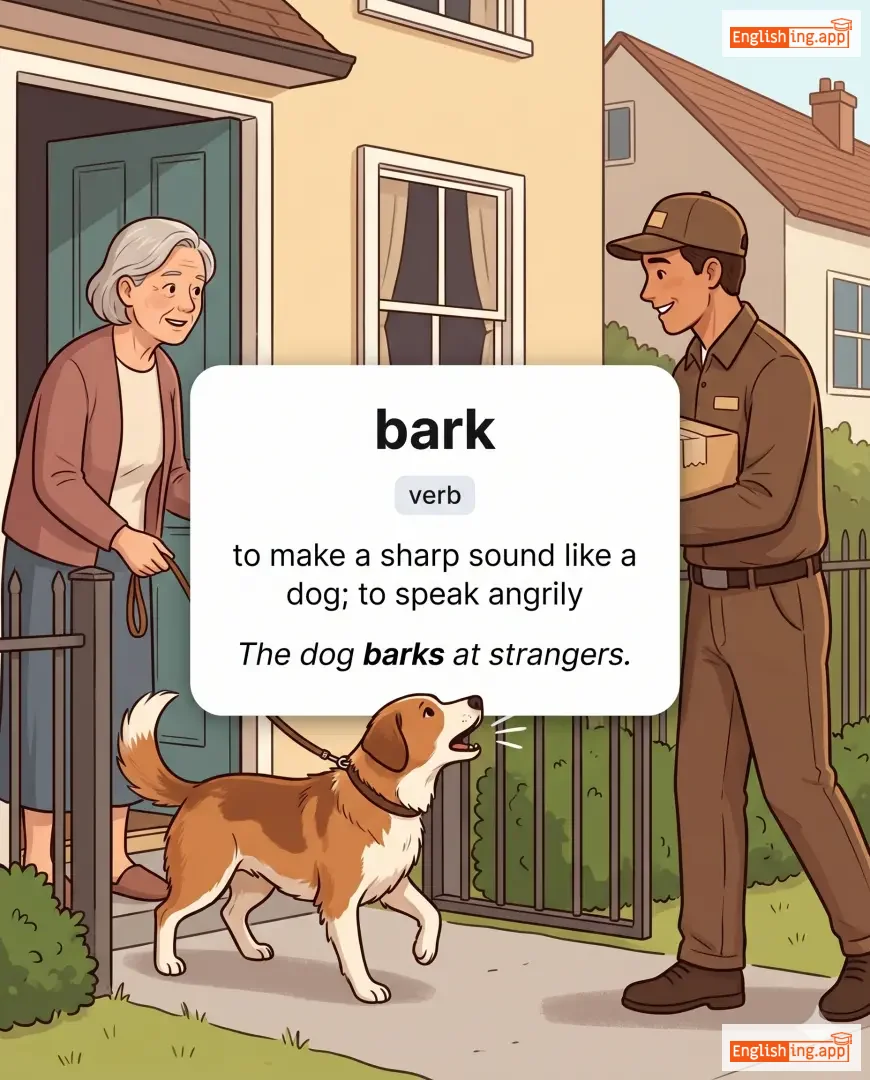
bark definition card — visual illustration of the meaning
verb
/bɑːrk/
aboyer (aboyer)

to make a sharp sound like a dog; to speak angrily

"The dog barks at strangers."

"Le chien aboie contre les étrangers." (Le chien aboie contre les étrangers.)
noun
/ˈbɑː.li/
orge (orge)

a cereal grain used for food, brewing beer, and animal feed

"The farmer harvested barley from his fields in autumn."

"Le fermier a récolté de l'orge de ses champs en automne." (Le fermier a recolte de l'orge de ses champs en automne.)
noun
/bɑːn/
grange (grange)

a large building used for storing grain or housing farm animals

"The farmer keeps his cows in the barn."

"Le fermier garde ses vaches dans la grange." (Le fermier garde ses vaches dans la grange.)
noun
/ˈbɑːr.nɪ.kəl/
balane (balane)

a marine crustacean that attaches itself permanently to underwater surfaces

"The old ship's hull was covered with barnacles."

"La coque du vieux navire était couverte de balanes." (La coque du vieux navire était couverte de balanes.)
noun
/ˈbærəˌɡræf/
instrument qui enregistre les variations de pression atmosphérique (instrument qui enregistre les variations de pression atmospherique)

an instrument that records changes in atmospheric pressure

"The scientist checked the barograph for pressure variations."

"Le scientifique a vérifié le barographe pour les variations de pression." (Le scientifique a verifie le barographe pour les variations de pression.)
noun
/bəˈrɒmɪtər/
baromètre de pression atmosphérique (barometre de pression atmospherique)

an instrument that measures atmospheric pressure

"The barometer indicated a storm was approaching."

"Le baromètre a indiqué qu'une tempête approchait." (Le barometre a indique qu'une tempete approchait.)
adjective
/bəˈroʊk/
style baroque (style baroque)

relating to a highly ornate and extravagant style of art, architecture, or music from the 17th and early 18th centuries; excessively elaborate or complex

"The church was decorated in a baroque style with intricate details."

"L'église était décorée dans un style baroque avec des détails complexes." (L'église était décorée dans un style baroque avec des détails complexes.)
noun
/bəˈrɑːʒ/
barrage ou attaque rapide (barrage)

a concentrated outpouring of questions, criticisms, or blows; a rapid, continuous attack

"The politician faced a barrage of tough questions from reporters."

"Le politicien a fait face à un barrage de questions difficiles de la part des journalistes." (Le politicien a fait face à un barrage de questions difficiles de la part des journalistes.)
noun
/ˈbærəl/
grand baril (grand baril)

a large cylindrical container used to hold liquids

"The wine was stored in a wooden barrel."

"Le vin a été stocké dans un grand baril en bois." (Le vin a ete stocke dans un grand baril en bois.)
adjective
/ˈbærən/
stérile (steril)

too poor to produce much or any vegetation; unproductive or empty

"The land was barren and could not support crops."

"La terre était stérile et ne pouvait pas supporter les cultures." (La terre était stérile et ne pouvait pas supporter les cultures.)
noun/verb
/ˌbærɪˈkeɪd/
barricade (barricade)

a barrier erected to block or defend against movement; to block a passage with obstacles

"Protesters built a barricade across the street."

"Les manifestants ont construit une barricade à travers la rue." (Les manifestants ont construit une barricade à travers la rue.)
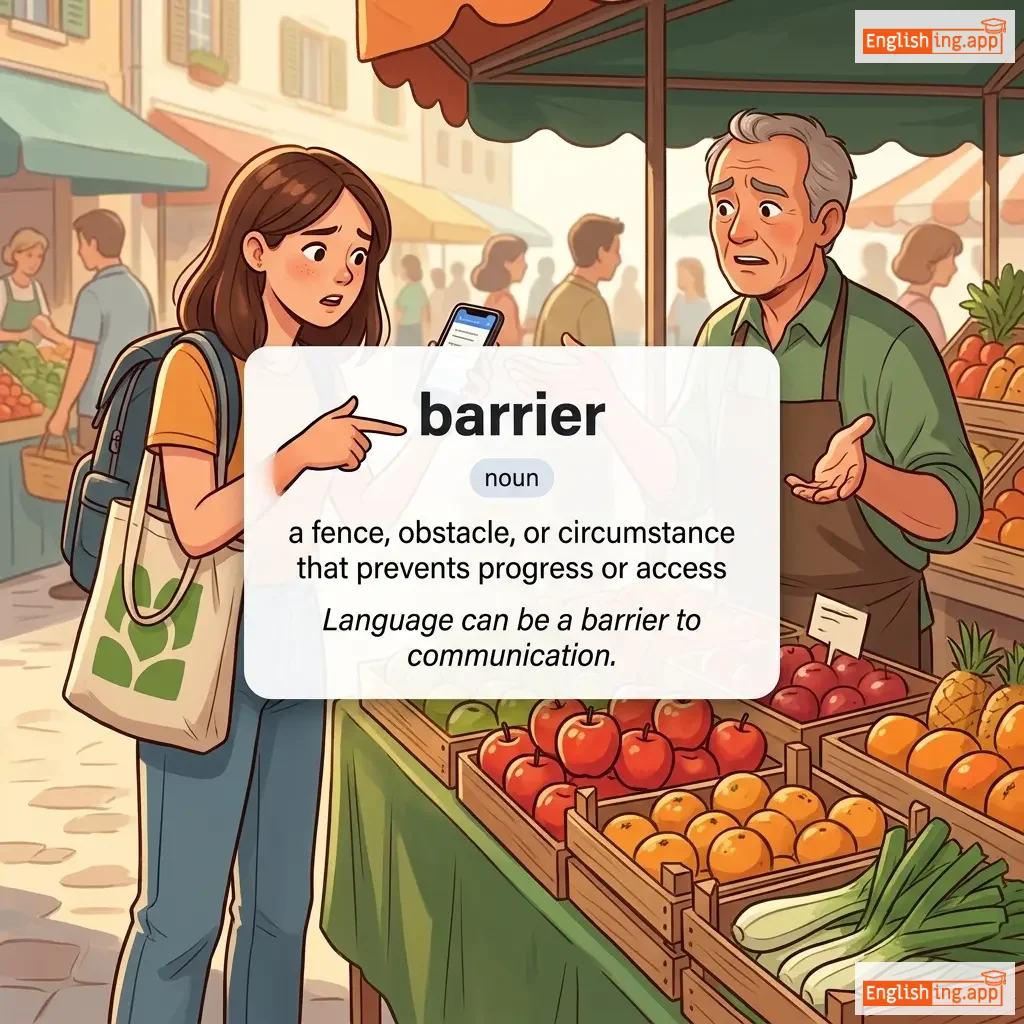
barrier definition card — visual illustration of the meaning
noun
/ˈbæriər/
barrière (barrière)

a fence, obstacle, or circumstance that prevents progress or access

"Language can be a barrier to communication."

"La langue peut être une barrière à la communication." (La langue peut être une barrière à la communication.)
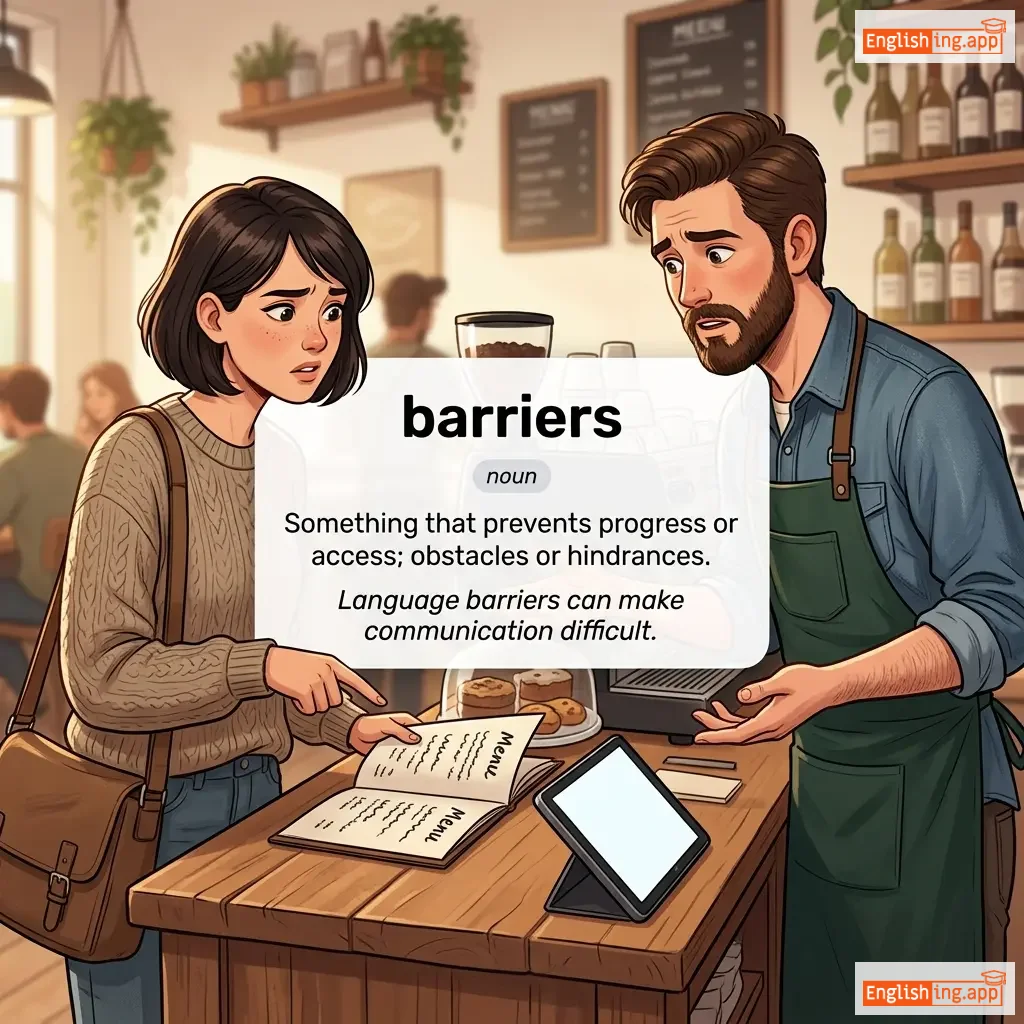
barriers definition card — visual illustration of the meaning
noun
/ˈbæɹɪəz/
barrières (barrieres)

Something that prevents progress or access; obstacles or hindrances.

"Language barriers can make communication difficult."

"Les barrières linguistiques peuvent rendre la communication difficile." (Les barrières linguistiques peuvent rendre la communication difficile.)
preposition
/ˈbɑːrɪŋ/
sauf, à l'exception de (sauf, a l'exception de)

except for; if not for

"Barring a miracle, the team will not win the championship."

"À l'exception d'un miracle, l'équipe ne gagnera pas le championnat." (A l'exception d'un miracle, l'équipe ne gagnera pas le championnat.)
noun
/ˈbærɪstər/
avocat (avocat)

A type of lawyer in certain legal systems who specializes in courtroom advocacy and litigation.

"The barrister argued the case passionately before the judge."

"L'avocat a plaidé l'affaire avec passion devant le juge." (L'avocat a plaidé l'affaire avec passion devant le juge.)
verb
/ˈbɑːrtər/
troc (trok)

To exchange goods or services without using money.

"They bartered their crops for handmade tools."

"Ils ont échangé leurs récoltes contre des outils faits à la main." (Ils ont échangé leurs récoltes contre des outils faits à la main.)
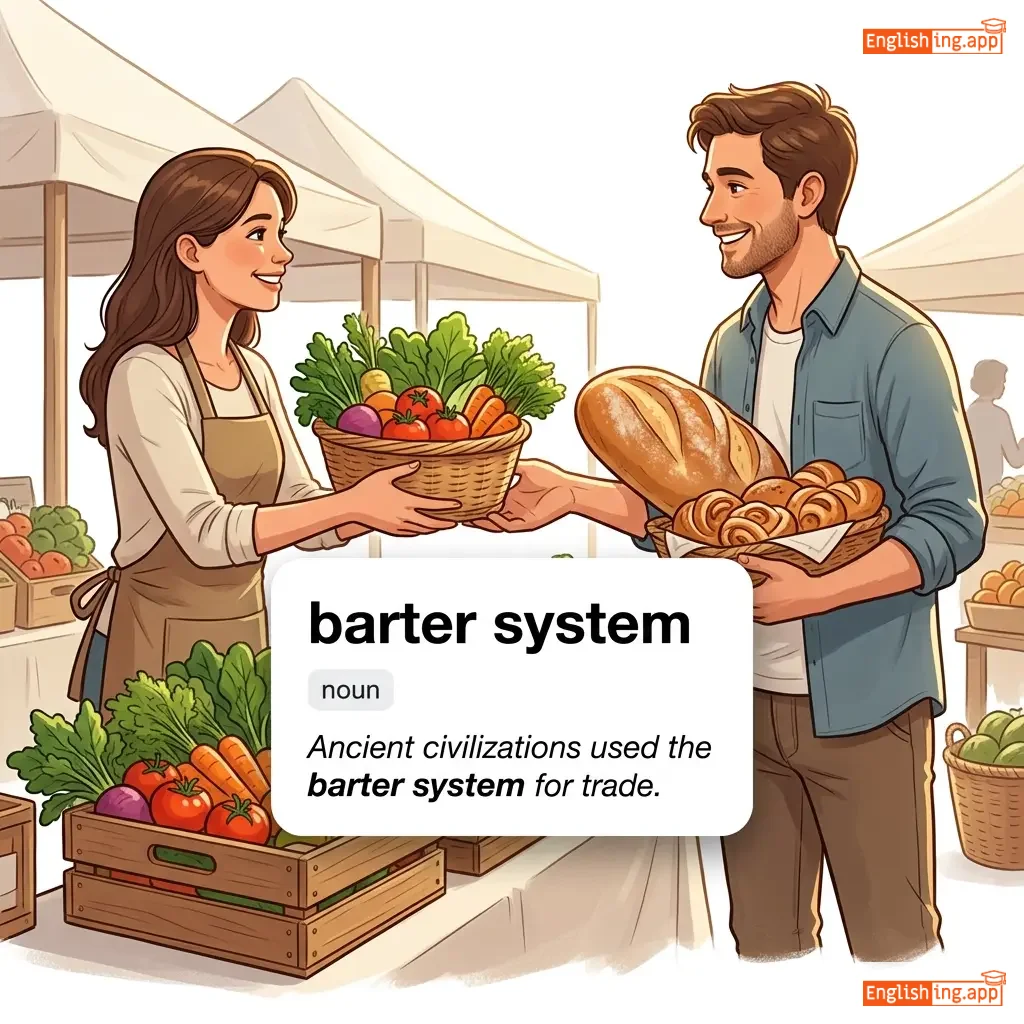
barter system definition card — visual illustration of the meaning
noun
/ˈbɑːr.tər ˌsɪs.təm/
système d'échange (systeme d'echange)

A system of exchange where goods and services are traded directly without using money.

"Ancient civilizations used the barter system for trade."

"Les civilisations anciennes utilisaient le système d'échange pour le commerce." (Les civilisations anciennes utilisaient le systeme d'echange pour le commerce.)
noun
/ˈbɑːrtərər/
barteur (barteur)

A person who trades goods or services without using money.

"The barterer exchanged fruits for some pottery."

"Le barteur a échangé des fruits contre des pots." (Le barteur a échangé des fruits contre des pots.)
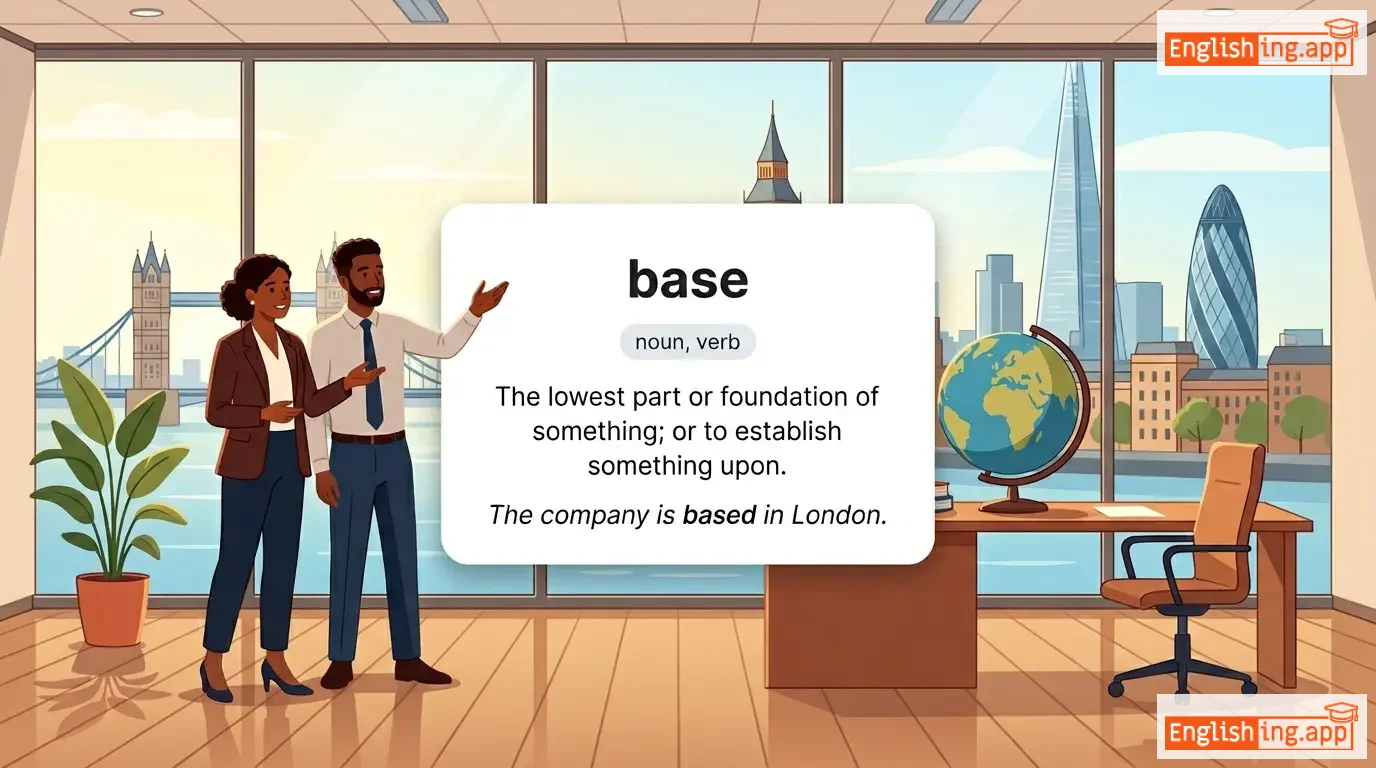
base definition card — visual illustration of the meaning
noun, verb
/beɪs/
base (base)

The lowest part or foundation of something; or to establish something upon.

"The company is based in London."

"L'entreprise est basée à Londres." (L'entreprise est basée à Londres.)
noun
/ˈbeɪsˌbɔːl/
béisbol (beisbol)

a sport in which two teams try to score runs by hitting a ball and running around bases

"He loves watching baseball games on TV."

"Il adore regarder des matchs de béisbol à la télévision." (Il adore regarder des matchs de béisbol à la télévision.)
noun
/ˈbeɪsbɔːrd/
plinthe (plinthe)

A narrow board running along the bottom of an interior wall, covering the joint between wall and floor.

"The carpenter painted the baseboard white."

"Le menuisier a peint la plinthe en blanc." (Le menuisier a peint la plinthe en blanc.)
adjective
/ˈbeɪs.ləs/
sans fondement; infondé; sans base (sans fondement; infondé; sans base)

without foundation; groundless; unfounded

"The accusations against him were completely baseless."

"Les accusations contre lui étaient complètement infondées." (Les accusations contre lui étaient complètement infondées.)
noun
/ˈbeɪsmənt/
cave (kav)

the lowest floor of a building, usually partly or completely below ground

"The laundry room is in the basement."

"La buanderie est dans la cave." (La buanderie est dans la cave.)
adjective
/ˈbæʃ.fəl/
timide (timid)

shy, easily embarrassed, or reluctant to draw attention

"She gave a bashful smile when he complimented her."

"Elle a donné un sourire timide lorsqu'il l'a complimentée." (Elle a donne un sourire timide lorsqu'il l'a complimentee.)
adjective
/ˈbeɪsɪk/
de base (de base)

forming the most important or simplest part of something

"She taught me the basic rules of chess."

"Elle m'a enseigné les règles de base des échecs." (Elle m'a enseigne les regles de base des echecs.)
adverb
/ˈbeɪsɪkli/
fondamentalement (fondamentalement)

in the most important or fundamental way; essentially

"Basically, the project was a success despite some small issues."

"Fondamentalement, le projet a été un succès malgré quelques petits problèmes." (Fondamentalement, le projet a ete un succes malgre quelques petits problemes.)
noun
/ˈbeɪ.zəl/
basilic (basilic)

an aromatic herb with green leaves used in cooking, especially Italian cuisine

"The pasta sauce was flavored with fresh basil."

"La sauce de pâtes était parfumée avec du basilic frais." (La sauce de pâtes était parfumée avec du basilic frais.)
noun
/ˈbeɪ.zəl siːdz/
graines de basilic (graines de basilic)

small black seeds from the basil plant, often used in drinks and desserts

"I added basil seeds to my lemonade for a refreshing drink."

"J'ai ajouté des graines de basilic à ma limonade pour une boisson rafraîchissante." (J'ai ajouté des graines de basilic à ma limonade pour une boisson rafraîchissante.)
noun
/ˈbeɪsɪs/
base (base)

the underlying support or foundation for an idea, argument, or process

"Trust is the basis of any strong relationship."

"La confiance est la base de toute relation forte." (La confiance est la base de toute relation forte.)
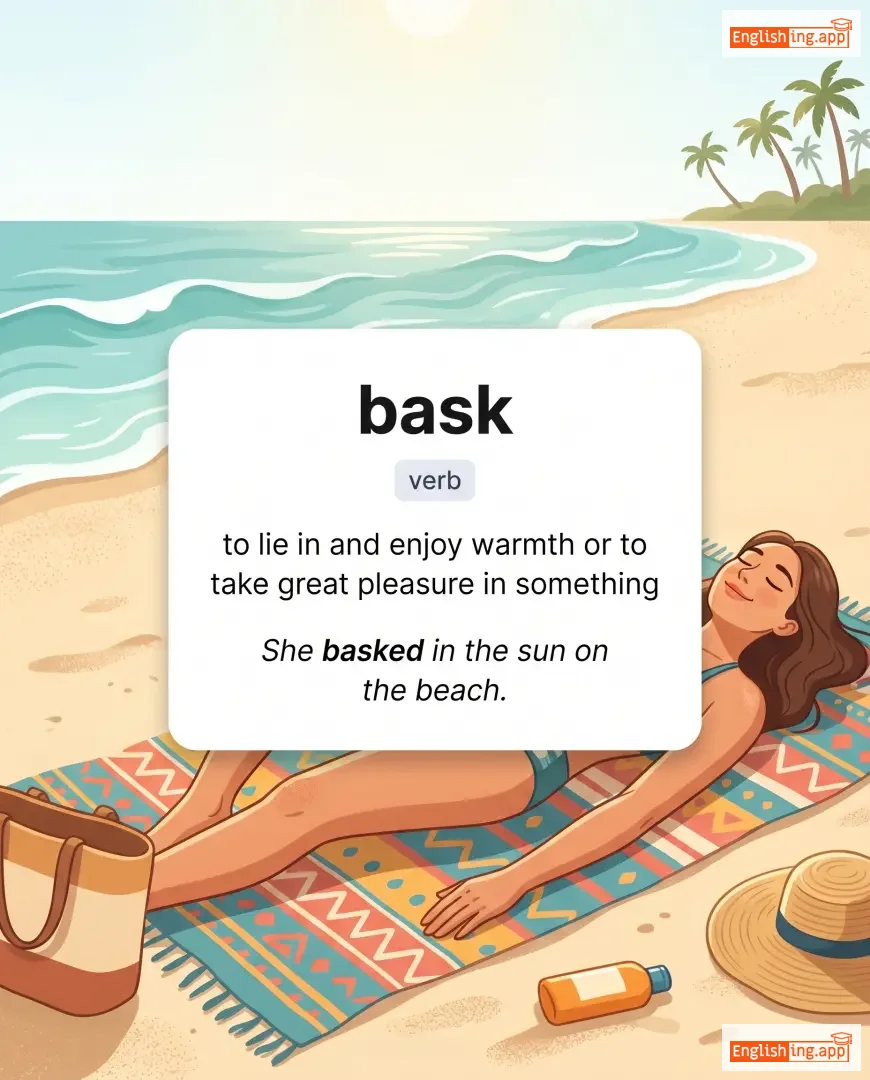
bask definition card — visual illustration of the meaning
verb
/bæsk/
prendre le soleil (prendre le soleil)

to lie in and enjoy warmth or to take great pleasure in something

"She basked in the sun on the beach."

"Elle a pris le soleil sur la plage." (Elle a pris le soleil sur la plage.)
noun
/ˈbæskɪt/
panier (panier)

a container made of woven materials used for carrying or storing things

"She carried the apples in a basket."

"Elle a porté les pommes dans un panier." (Elle a porté les pommes dans un panier.)
noun
/ˈbæskɪtbɔːl/
basket-ball (basketball)

a game played by two teams who try to score points by throwing a ball through a hoop

"He loves playing basketball with his friends."

"Il aime jouer au basket-ball avec ses amis." (Il aime jouer au basketball avec ses amis.)
noun
/beɪs/
voix masculine basse / guitare basse (voix masculine basse / guitare basse)

the lowest adult male singing voice; also, low-frequency sounds in music or a type of fish

"He played the bass guitar at the concert."

"Il a joué de la guitare basse au concert." (Il a joué de la guitare basse au concert.)
noun
/bəˈsuːn/
un type de hautbois (instrument à vent en bois de grande taille) (un type de hautbois (instrument à vent en bois de grande taille))

a large woodwind instrument with a deep sound

"The orchestra featured a beautiful bassoon solo."

"L'orchestre a présenté un magnifique solo de basson." (L'orchestre a présenté un magnifique solo de basson.)
noun/adjective
/ˈbæstərd/
bâtard (batard)

a child born to unmarried parents (offensive); also used informally as an insult or to describe something unpleasant

"He called him a bastard in anger."

"Il l'a traité de bâtard avec colère." (Il l'a traité de bâtard avec colère.)
noun
/ˈbæs.tərd tiːk/
teck bâtard (teck batard)

A flowering tree with bright orange-red flowers, also known as flame of the forest

"The bastard teak tree blooms with vibrant orange flowers in spring."

"L'arbre de teck bâtard fleurit avec des fleurs orange vibrantes au printemps." (L'arbre de teck batard fleurit avec des fleurs orange vibrantes au printemps.)