Vocabularios

Descubra, aprenda y domine el vocabulario en inglés

noun
/broʊˈʃʊr/
folleto (folleto)

a small booklet or pamphlet containing information or advertising

"The travel agent gave us a brochure about the holiday package."

"El agente de viajes nos dio un folleto sobre el paquete de vacaciones." (El agente de viajes nos dio un folleto sobre el paquete de vacaciones.)
noun
/ˈbroʊɡən/
zapato pesado (zapato pesado)

A heavy, sturdy shoe, often made of leather.

"The farmer wore old brogans while working in the field."

"El granjero llevaba viejos brogans mientras trabajaba en el campo." (El granjero llevaba viejos brogans mientras trabajaba en el campo.)
noun
/broʊɡ/
zapato resistente; acento (zapato resistente; acento)

A strong outdoor shoe; also a marked accent, especially Irish or Scottish.

"He bought a pair of stylish brogues for the wedding."

"Él compró un par de brogues elegantes para la boda." (El compro un par de brogues elegantes para la boda.)
verb
/brɔɪl/
asar a la parrilla (asar a la parrilla)

To cook food by direct heat, usually under a grill or over a fire.

"She broiled the chicken until it was golden brown."

"Ella asó el pollo hasta que estuvo dorado." (Ella asó el pollo hasta que estuvo dorado.)
verb; adjective
/broʊk/
rompió; sin dinero (rompio; sin dinero)

past tense of break; having no money or being financially poor

"I broke my phone last night and now I’m completely broke."

"Rompí mi teléfono anoche y ahora estoy sin dinero." (rompi mi telefono anoche y ahora estoy sin dinero)
adjective
/ˈbroʊkən/
roto (roto)

damaged or not working properly

"The chair is broken and needs repair."

"La silla está rota y necesita reparación." (La silla esta rota y necesita reparacion.)
noun
/ˈbroʊ.kər/
corredor (corredor)

a person who buys and sells things for others as a middleman, especially in financial or property deals

"He works as a real estate broker in the city."

"Él trabaja como corredor de bienes raíces en la ciudad." (Él trabaja como corredor de bienes raíces en la ciudad.)
noun
/ˈbroʊkərɪdʒ/
corretaje (corretaje)

A firm that acts as an intermediary between buyers and sellers, often charging a fee.

"The real estate brokerage helped them find a new home."

"La correduría inmobiliaria les ayudó a encontrar una nueva casa." (La correduría inmobiliaria les ayudó a encontrar una nueva casa.)
noun
/ˈbroʊmaɪd/
idea trillada (idea trillada)

A trite or unoriginal idea or remark; also a chemical compound of bromine.

"His speech was full of old bromides about hard work."

"Su discurso estaba lleno de viejas ideas trilladas sobre el trabajo duro." (Su discurso estaba lleno de viejas ideas trilladas sobre el trabajo duro.)
noun
/ˈbroʊmiːn/
bromo (bromo)

a dark red, dense, toxic liquid element used in making dyes, flame retardants, and medications

"Bromine is commonly used in water treatment chemicals."

"El bromo se utiliza comúnmente en productos químicos de tratamiento de agua." (El bromo se utiliza comunmente en productos quimicos de tratamiento de agua.)
noun
/brɒŋˈkaɪtɪs/
bronquitis (bronquitis)

inflammation of the lining of the bronchial tubes, which carry air to and from the lungs

"The doctor diagnosed him with acute bronchitis."

"El doctor lo diagnosticó con bronquitis aguda." (El doctor lo diagnostico con bronquitis aguda.)
noun
/ˈbrɒŋkəs/
bronquio (bronquio)

either of the two main branches of the trachea that lead directly into the lungs

"The left bronchus carries air into the left lung."

"El bronquio izquierdo lleva el aire al pulmón izquierdo." (El bronquio izquierdo lleva el aire al pulmón izquierdo.)
noun
/brɑːnz/
bronce (bronce)

a metal made by combining copper and tin, often used for statues and medals

"The statue was made of solid bronze."

"La estatua estaba hecha de bronce sólido." (La estatua estaba hecha de bronce sólido.)
noun
/broʊtʃ/
broche (brooch)

a decorative jewelry pin that is attached to clothing

"She wore a beautiful silver brooch on her jacket."

"Llevó un hermoso broche de plata en su chaqueta." (Llevo un hermoso broche de plata en su chaqueta.)
verb
/bruːd/
pensar profundamente, grupo de pajaritos recién nacidos (brud)

to think deeply about something that makes one unhappy; also, a group of young birds hatched at the same time

"He sat alone, brooding over his failures."

"Él se sentó solo, pensando profundamente sobre sus fracasos." (El se sentó solo, pensando profundamente sobre sus fracasos.)
noun/verb
/brʊk/
arroyo / tolerar (arroyo / tolerar)

As a noun: a small natural stream; As a verb: to tolerate or endure something

"The village was built near a clear brook."

"La aldea fue construida cerca de un arroyo claro." (La aldea fue construida cerca de un arroyo claro.)
noun
/brum/
escoba (escoba)

a long-handled brush of bristles or twigs, used for sweeping

"She used an old broom to sweep the fallen leaves from the porch."

"Ella usó una escoba vieja para barrer las hojas caídas del porche." (Ella usó una escoba vieja para barrer las hojas caídas del porche.)
noun
/ˈbrʌðər/
hermano (hermano)

a male sibling

"My brother is two years older than me."

"Mi hermano tiene dos años más que yo." (Mi hermano tiene dos años más que yo.)
noun
/ˈbrʌðərhʊd/
hermandad (hermandad)

The relationship between brothers; an association of people with common interests

"The soldiers shared a strong sense of brotherhood."

"Los soldados compartieron un fuerte sentido de hermandad." (Los soldados compartieron un fuerte sentido de hermandad.)
noun
/braʊ/
frente (frente)

the part of the face above the eyes; forehead

"She wiped the sweat from her brow."

"Ella se limpió el sudor de la frente." (Ella se limpió el sudor de la frente.)
verb
/ˈbraʊˌbiːt/
intimidar / coaccionar (intimidar / coaccionar)

To intimidate or bully someone into doing something

"The lawyer tried to browbeat the witness."

"El abogado intentó intimidar al testigo." (El abogado intentó intimidar al testigo.)
adjective
/braʊn/
marrón (marron)

of a color produced by mixing red, yellow, and black

"She wore a brown dress to the party."

"Ella llevaba un vestido marrón a la fiesta." (Ella llevaba un vestido marrón a la fiesta.)
adjective
/ˈbraʊn.ɪʃ/
marrón (marron)

having a color somewhat like brown; tending toward brown

"The old paper had a brownish tint from age."

"El papel viejo tenía un tinte marrón debido a la edad." (El papel viejo tenia un tinte marron debido a la edad)
verb
/braʊz/
navegar (navegar)

To look at or skim through casually, especially online or in a store

"She likes to browse books in the library."

"A ella le gusta navegar libros en la biblioteca." (A ella le gusta navegar libros en la biblioteca.)
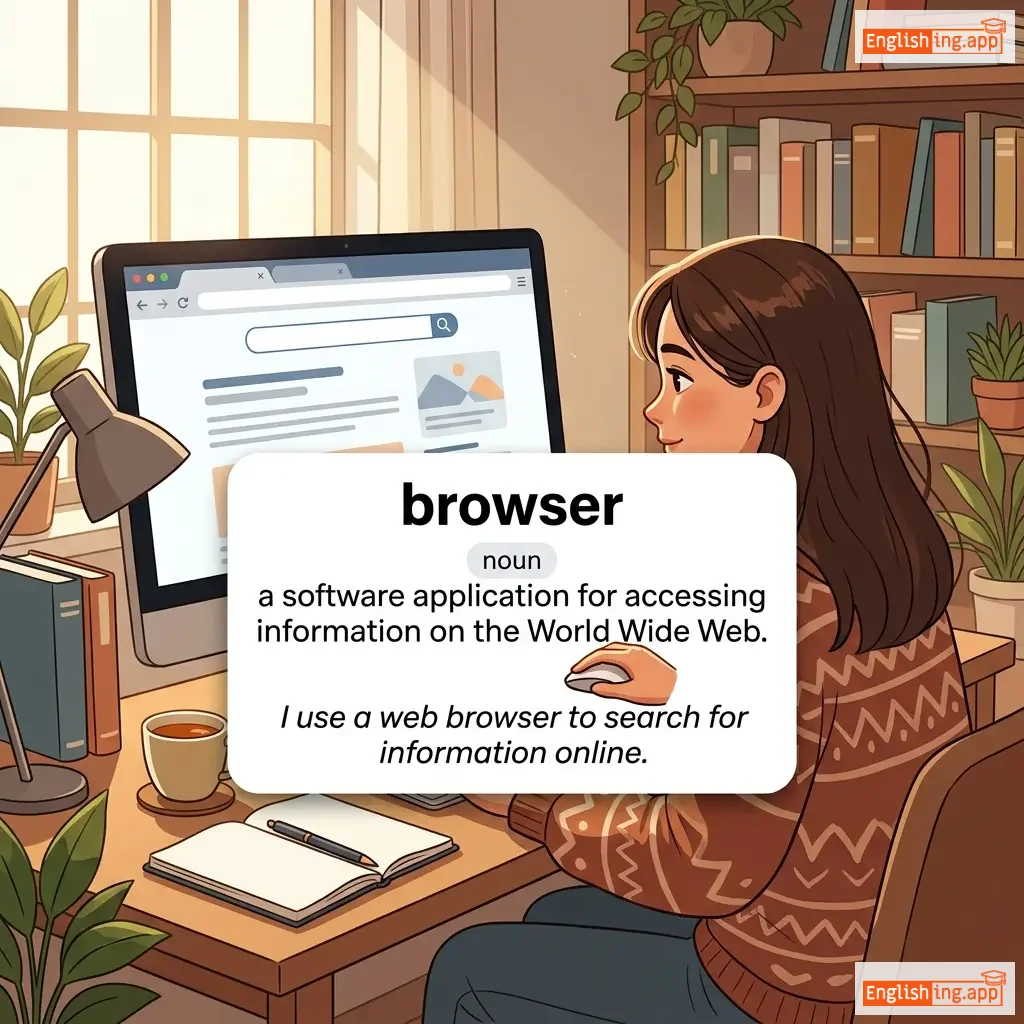
browser definition card — visual illustration of the meaning
noun
/ˈbraʊzər/
navegador (navegador)

a software application for accessing information on the World Wide Web.

"I use a web browser to search for information online."

"Uso un navegador web para buscar información en línea." (Uso un navegador web para buscar informacion en linea.)
noun/verb
/bruːz/
moretón / contusión (moreton / contusion)

As a noun: an injury appearing as a purple or blue mark on the skin; As a verb: to injure without breaking the skin

"He got a bruise on his arm after falling."

"Él consiguió un moretón en su brazo después de caerse." (El consiguio un moreton en su brazo despues de caerse.)
verb
/bruːt/
difundir un rumor (difundir un rumor)

to spread a rumor or report widely

"The scandal was quickly bruited about the town."

"El escándalo se difundió rápidamente por la ciudad." (El escándalo se difundió rápidamente por la ciudad.)
noun
/brʌnt/
golpe principal (golpe principal)

the worst part or main impact of something unpleasant

"The small town bore the brunt of the storm."

"La pequeña ciudad soportó el impacto principal de la tormenta." (La pequena ciudad soporto el impacto principal de la tormenta.)
noun/verb
/brʌʃ/
cepillo (cepillo)

A tool with bristles for cleaning, painting, or grooming; to clean, arrange, or apply with a brush.

"She used a brush to paint the fence."

"Ella usó un cepillo para pintar la cerca." (Ella uso un cepillo para pintar la cerca.)
adjective
/bruːsk/ or /brʌsk/
rudo (rudo)

abrupt or blunt in manner or speech, often seen as rude

"His brusque reply ended the conversation."

"Su respuesta brusca terminó la conversación." (Su respuesta brusca terminó la conversación.)
adverb
/ˈbruːskli/ or /ˈbrʌskli/
bruscamente (bruscamente)

in a blunt, abrupt, or rude manner

"She brusquely dismissed the suggestion."

"Ella desechó la sugerencia de manera brusca." (Ella desechó la sugerencia de manera brusca.)
adjective
/ˈbruː.təl/
brutal (brutal)

extremely cruel or harsh; violent and without feeling

"The dictator’s rule was marked by brutal violence."

"El gobierno del dictador estuvo marcado por una violencia brutal." (El gobierno del dictador estuvo marcado por una violencia brutal.)
noun
/bruːˈtæləti/
brutalidad (brutalidad)

extreme cruelty or violence; savage or inhumane treatment

"The brutality of the attack shocked the entire community."

"La brutalidad del ataque conmocionó a toda la comunidad." (La brutalidad del ataque conmociono a toda la comunidad)
verb
/ˈbruːtəlaɪz/
brutalizar (brutalizar)

to treat someone with extreme violence or cruelty; to make something harsh or cruel

"The regime was accused of brutalizing innocent civilians."

"El régimen fue acusado de brutalizar a civiles inocentes." (El regimen fue acusado de brutalizar a civiles inocentes)
adverb
/ˈbruːtəli/
brutalmente (brutalmente)

in a cruel, violent, or harsh manner; in a very direct and blunt way

"The prisoners were treated brutally by the guards."

"Los prisioneros fueron tratados brutalmente por los guardias." (los prisioneros fueron tratados brutalmente por los guardias)
noun
/ˈbʌb.əl/
burbuja (burbuja)

a thin sphere of liquid enclosing air or gas; a temporary state of inflated value or excitement

"The children chased the bubbles in the air."

"Los niños persiguieron las burbujas en el aire." (Los ninos persiguieron las burbujas en el aire.)
noun
/ˌbʌkəˈnɪər/
pirata (pirata)

a pirate, especially one active in the Caribbean during the 17th and 18th centuries

"The buccaneer sailed across the Caribbean in search of treasure."

"El bucanero navegó por el Caribe en busca de tesoros." (El bucanero navegó por el Caribe en busca de tesoros.)
noun/verb
/bʌk/
ciervo macho / resistir (ciervo macho / resistir)

A male deer; also to resist or oppose strongly.

"The horse began to buck wildly as the rider tried to hold on."

"El caballo comenzó a buckear salvajemente mientras el jinete intentaba mantenerse firme." (El caballo comenzo a buckear salvajemente mientras el jinete intentaba mantenerse firme.)
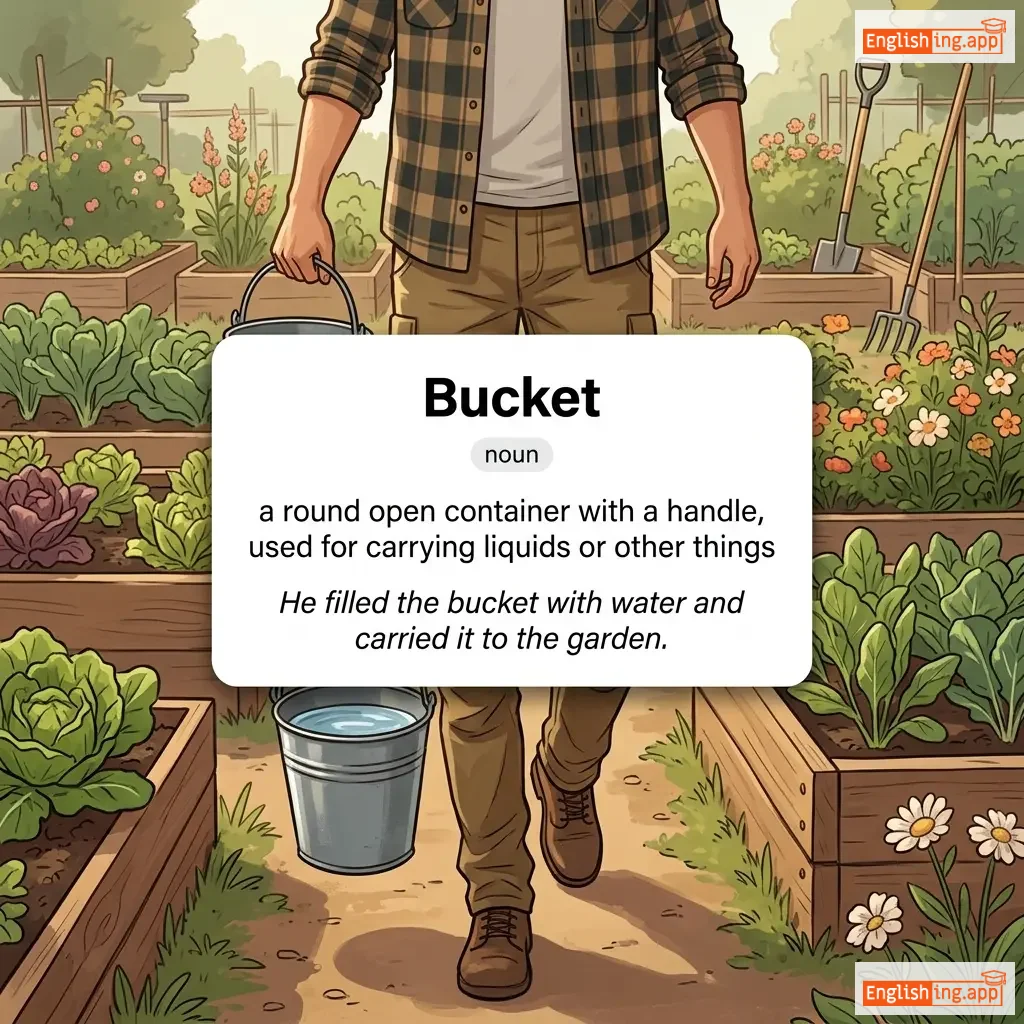
Bucket definition card — visual illustration of the meaning
noun
/ˈbʌkɪt/
balde (balde)

a round open container with a handle, used for carrying liquids or other things

"He filled the bucket with water and carried it to the garden."

"Él llenó el balde con agua y lo llevó al jardín." (Él llenó el balde con agua y lo llevó al jardín.)
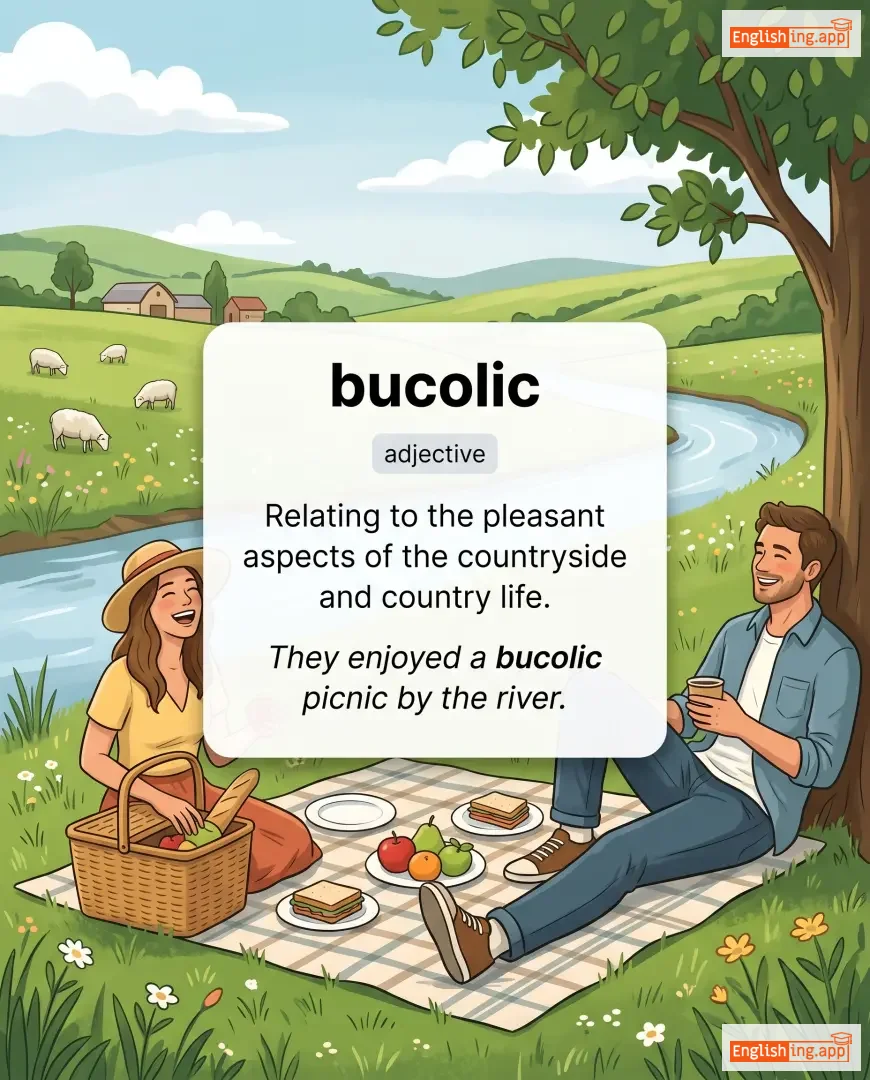
bucolic definition card — visual illustration of the meaning
adjective
/bjuːˈkɒlɪk/
bucólico (bucolico)

Relating to the pleasant aspects of the countryside and country life.

"They enjoyed a bucolic picnic by the river."

"Ellos disfrutaron de un picnic bucólico junto al río." (Ellos disfrutaron de un picnic bucólico junto al río.)
noun
/bʌd/
capullo (capullo)

An undeveloped or immature flower before it opens

"The rose bud will bloom into a beautiful flower in a few days."

"El capullo de rosa se convertirá en una hermosa flor en unos pocos días." (El capullo de rosa se convertirá en una hermosa flor en unos pocos días.)
noun
/ˈbʌdi/
amigo (amigo)

a close friend or companion, used informally

"He went to the movies with his best buddy."

"Él fue al cine con su mejor amigo." (El fue al cine con su mejor amigo.)
verb
/bʌdʒ/
mover ligeramente / cambiar de opinión o posición (mover ligeramente / cambiar de opinion o posicion)

To move slightly; to change one’s opinion or position.

"Despite the pressure, he refused to budge from his decision."

"A pesar de la presión, él se negó a moverse de su decisión." (A pesar de la presion, el se nego a moverse de su decision.)
noun/verb
/ˈbʌdʒɪt/
presupuesto (presupuesto)

An estimate of income and expenditure for a set period of time; to plan expenses and income.

"The family created a budget to manage their expenses."

"La familia creó un presupuesto para gestionar sus gastos." (La familia creo un presupuesto para gestionar sus gastos.)
noun/adjective/verb
/bʌf/
aficionado / pulir (aficionado / pulir)

A fan or enthusiast; also to polish or shine something.

"He is a movie buff who watches films every weekend."

"Él es un aficionado al cine que ve películas cada fin de semana." (El es un aficionado al cine que ve peliculas cada fin de semana.)
noun
/ˈbʌf.ə.loʊ/
búfalo (bufalo)

a large wild ox with heavy horns; American bison

"The buffalo grazed peacefully in the meadow."

"El búfalo pastaba tranquilamente en el prado." (El bufalo pastaba tranquilamente en el prado.)
noun/verb
/ˈbʌfər/
amortiguador / absorbente de impacto (amortiguador / absorbente de impacto)

Something that lessens or absorbs the impact of a shock; to act as a protective barrier.

"The organization acts as a buffer between workers and management."

"La organización actúa como un amortiguador entre los trabajadores y la gerencia." (La organización actúa como un amortiguador entre los trabajadores y la gerencia.)
noun, verb
/bəˈfeɪ/ (noun), /ˈbʌfɪt/ (verb)
buffet (buffet)

A meal where guests serve themselves from a variety of dishes arranged on a table; also means to strike repeatedly (as a verb).

"We enjoyed a large buffet at the wedding reception."

"Disfrutamos de un gran buffet en la recepción de la boda." (Disfrutamos de un gran buffet en la recepcion de la boda.)
noun
/bəˈfuːn/
bufón (bufon)

A ridiculous but amusing person; a clown or jester.

"He acted like a buffoon at the party, making everyone laugh."

"Actuó como un bufón en la fiesta, haciendo reír a todos." (Actuo como un bufon en la fiesta, haciendo reir a todos.)
noun
/bəˈfuːnəri/
payasada (payasada)

Foolish or ridiculous behavior intended to amuse.

"His constant buffoonery irritated the serious audience."

"Su constante payasada irritó al público serio." (Su constante payasada irritó al público serio.)