語彙集

英単語辞書 | 単語の意味、定義、例文

adverb
/ˈtrɛbli/

in a triple manner or to a threefold degree

"The sound was trebly distorted through the old speakers."

noun
/triː/
(ki)

a large plant with a trunk, branches, and leaves

"The tree in our backyard is over a hundred years old."

"私たちの裏庭にある木は百年以上の歴史があります。" (Watashitachi no uraniwa ni aru ki wa hyaku-nen ijō no rekishi ga arimasu.)
🥾

trek

verb
/trɛk/

to go on a long, difficult journey, especially on foot

"They trekked across the mountains for three days."

verb
/ˈtrɛmbəl/
震える (furueru)

To shake slightly, often because of fear, cold, or nervousness.

"She began to tremble with fear before speaking."

"彼女は話す前に恐怖で震え始めました。" (Kanojo wa hanasu mae ni kyoufu de furu e hajimemashita.)
adjective
/trəˈmɛndəs/
巨大な (kyodaina)

very great in amount, scale, or intensity

"She made a tremendous effort to finish the project on time."

"彼女はプロジェクトを時間通りに終わらせるために巨大な努力をしました。" (Kanojo wa purojekuto o jikan dōri ni owaraseru tame ni kyodaina doryoku o shimashita.)
noun
/ˈtrɛmər/
震え (furue)

a slight shaking movement in a person’s body or in the ground

"A small tremor was felt before the earthquake."

"地震の前に小さな震えが感じられました。" (Jishin no mae ni chiisana furue ga kanjiraremashita.)
tremulous definition card — visual illustration of the meaning
adjective
/ˈtrɛmjələs/
震える (furu eru)

shaking or quivering slightly, often from nervousness or weakness

"Her voice was tremulous as she gave her speech."

"彼女の声は震えていました、彼女がスピーチをした時。" (Kanojo no koe wa furueteimashita, kanojo ga supīchi o shita toki.)
noun
/trentʃ/
塹壕 (senkō)

a long narrow ditch dug in the ground for defense in warfare

"Soldiers hid in the trench during the enemy attack."

"兵士たちは敵の攻撃中に塹壕に隠れていた。" (Heishitachi wa teki no kōgeki-chū ni senkō ni kakurete ita.)
adjective
/ˈtrɛntʃənt/
鋭い (surudoi)

expressed strongly, effectively, and clearly; sharp or cutting in style or expression

"Her trenchant criticism of the policy left no room for misunderstanding."

"彼女の鋭い政策批判は誤解の余地を残しませんでした。" (Kanojo no surudoi seisaku hihan wa gokai no yochi o nokoshimasen deshita.)
noun
/ˈtrɛntʃərmən/
大食い (ōgui)

a person who eats in a hearty or robust manner; a big eater

"The trencherman devoured the feast with great enthusiasm."

"その大食いは大きな熱意でご馳走を食べました。" (Sono ōgui wa ōkina netsui de gochisō o tabemashita.)
trend definition card — visual illustration of the meaning
noun
/trɛnd/
傾向 (keikou)

a general direction in which something is developing or changing

"The trend of online shopping continues to rise every year."

"オンラインショッピングのトレンドは年々増加しています。" (Onrain shoppingu no torendo wa nen-nen zouka shiteimasu.)
trepidation definition card — visual illustration of the meaning
noun
/ˌtrɛpɪˈdeɪʃən/
恐れ (osore)

a feeling of fear or anxiety about something that may happen

"She opened the letter with some trepidation."

"彼女は少し恐れを抱えて手紙を開けた。" (Kanojo wa sukoshi osore o kakaete tegami o aketa.)
verb
/ˈtrɛspəs/

to enter someone's land or property without permission

"He was fined for trespassing on private land."

noun
/ˈtres.pæs.ər/
侵入者 (shinnyūsha)

a person who enters someone's property without permission

"The security guard caught the trespasser climbing over the fence."

"セキュリティガードはフェンスを越えて登る侵入者を捕まえました。" (Sekyuriti gādo wa fensu o koete noboru shinnyūsha o tsukamaemashita.)
noun
/ˈtrɛsəl/
足場 (ashiba)

a frame or support consisting of a horizontal beam held up by two pairs of sloping legs, used especially for supporting a bridge or table

"The workers built a wooden trestle to support the temporary bridge."

"作業員たちは仮設橋を支えるために木製の足場を作りました。" (Sagyouintachi wa kasetsu hashi o sasaeru tame ni mokusei no ashiba o tsukurimashita.)
noun
/ˈtraɪæd/
三位一体 (sanwi ittai)

a group of three closely related people or things

"The project was managed by a triad of experts."

"そのプロジェクトは三人の専門家によって管理されていました。" (Sono purojekuto wa sannin no senmonka ni yotte kanri sarete imashita.)
noun
/ˈtraɪəl/
裁判 (saiban)

a formal examination of evidence in a court of law

"The trial will start next week."

"裁判は来週開始されます。" (Saiban wa raishū kaishi saremasu.)
adjective
/ˈtraɪbəl/
部族の (buzoku no)

relating to a tribe or tribes, especially indigenous people

"The tribal community has preserved its culture for centuries."

"部族コミュニティは何世代にもわたりその文化を守り続けてきました。" (Buzoku komyuniti wa nan-sedai ni mo watari sono bunka o mamori tsudzukete kimashita.)
noun
/traɪb/
部族 (buzoku)

a social group consisting of people with common customs, language, and culture

"The tribe lived in harmony with nature."
"部族は自然と調和して生活していた。" (Buzoku wa shizen to chōwa shite seikatsu shite ita.)
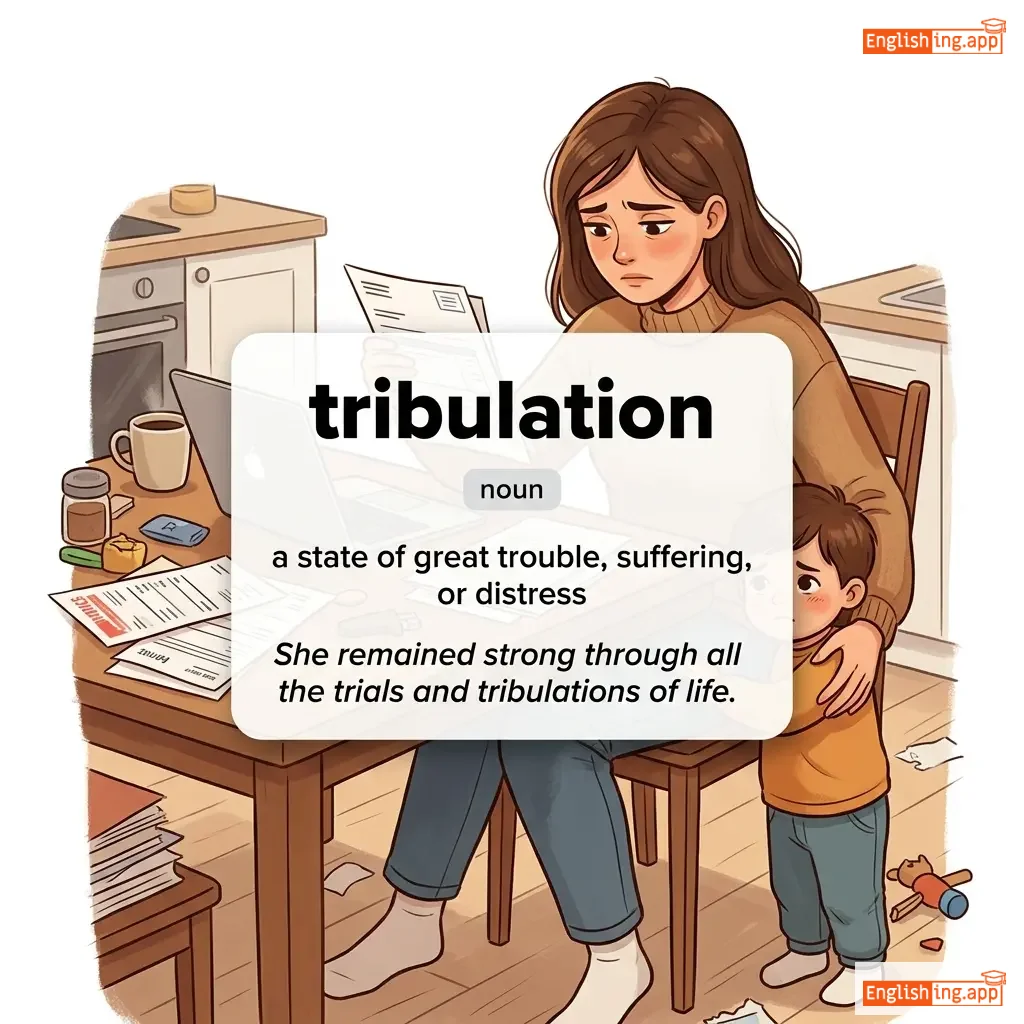
tribulation definition card — visual illustration of the meaning
noun
/ˌtrɪbjʊˈleɪʃən/

a state of great trouble, suffering, or distress

"She remained strong through all the trials and tribulations of life."

noun
/traɪˈbjuːnəl/
裁判所 (saibansho)

a court of justice or body established to settle disputes

"The case was heard in an international tribunal."
"その事件は国際裁判所で審理されました。" (Sono jiken wa kokusai saibansho de shinri saremashita.)
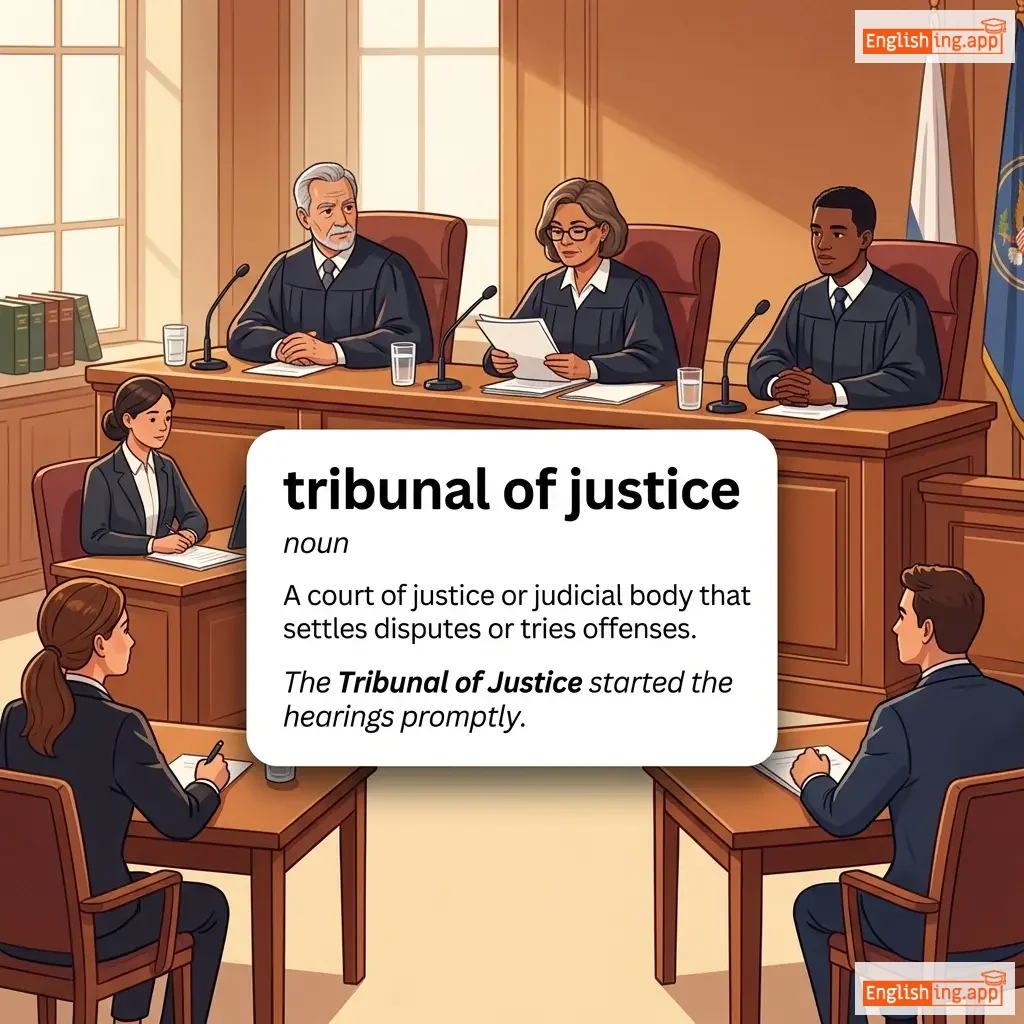
tribunal of justice definition card — visual illustration of the meaning
noun
ˌtraɪ.bjuˈnæl əv ˈdʒʌs.tɪs
裁判所 (saibansho)

A court of justice or judicial body that settles disputes or tries offenses.

"The Tribunal of Justice started the hearings promptly."

"裁判所は直ちに聴聞を開始しました。" (Saibansho wa tadachini choummon wo kaishi shimashita.)
🗣️

tribune

noun
/ˈtrɪbjuːn/

a person or platform representing the people; historically, a Roman official elected to protect citizens' rights

"He was seen as a tribune of the common people."

noun
/ˈtrɪb.jə.ter.i/
支流 (shiryu)

a river or stream flowing into a larger river or lake

"The tributary joins the main river near the city."
"支流は都市の近くで本流と合流します。" (shiryu wa toshi no chikaku de honryū to gōryū shimasu)
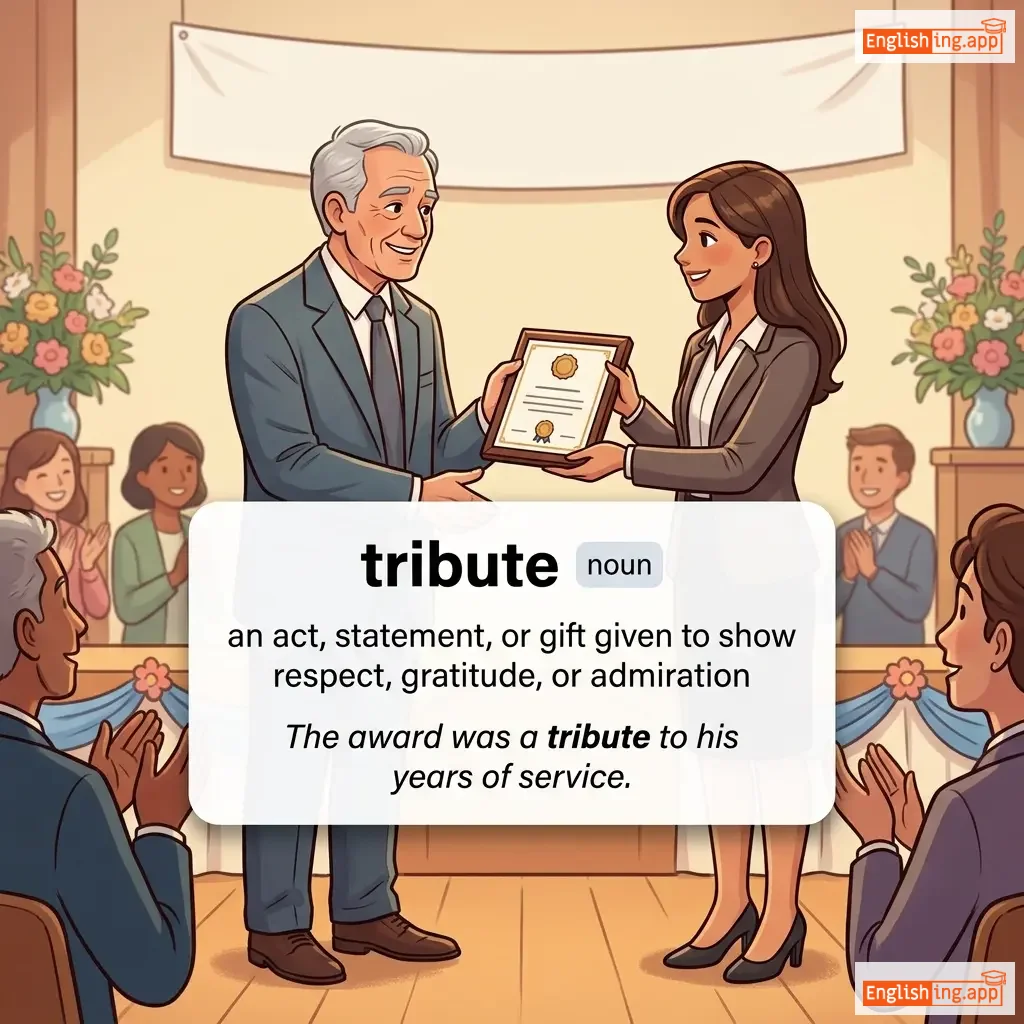
tribute definition card — visual illustration of the meaning
noun
/ˈtrɪbjuːt/
賛辞 (sanchi)

an act, statement, or gift given to show respect, gratitude, or admiration

"The award was a tribute to his years of service."

"その賞は彼の長年の奉仕への賛辞でした。" (Sono shō wa kare no naganen no hōshi e no sanchi deshita.)
noun
/trɪk/
トリック (torikku)

a cunning or deceitful action or plan intended to mislead or deceive someone

"She pulled a trick to win the game."

"彼女はゲームに勝つためにトリックを使った" (Kanojo wa gēmu ni katsu tame ni torikku o tsukatta)
noun
/ˈtrɪkəri/

The use of dishonest methods to deceive or cheat someone.

"The politician was accused of winning the election through trickery."

verb
/ˈtrɪkl̩/
滴る (shitataru)

To flow or fall in a small, slow stream or drops.

"Water began to trickle down the wall after the heavy rain."

"激しい雨の後、水は壁をゆっくりと流れ始めた。" (Hageshī ame no ato, mizu wa kabe o yukkuri to nagare hajimeta.)
noun
/ˈtrɪkstər/
詐欺師 (sagishi)

A person who cheats or deceives people.

"The old man turned out to be a clever trickster who fooled everyone."

"その老人はすべての人を騙した巧妙な詐欺師だった。" (Sono rōjin wa subete no hito o damashita kōmyō na sagishi datta.)
adjective
/ˈtrɪki/
難しい; 狡猾な; 騙すような (muzukashii; kōkatsu na; damasu yō na)

requiring skill or careful handling; difficult to deal with

"This math problem is quite tricky to solve."

"この数学の問題はかなり解くのが難しい。" (Kono suugaku no mondai wa kanari toku no ga muzukashii.)
noun/adjective
/ˈtraɪkʌlər/
三色旗 (sanshokuki)

A flag with three colors; consisting of three colors.

"The French tricolor is one of the most famous national flags in the world."

"フランスの三色旗は世界で最も有名な国旗の一つです。" (Furansu no sanshokuki wa sekai de mottomo yūmei na kokki no hitotsu desu.)
noun
/ˈtraɪsɪkl̩/
三輪車 (sanrinsha)

A small vehicle with three wheels, usually for children.

"The child rode happily on his red tricycle around the park."

"その子供は公園を赤い三輪車で楽しそうに乗っていました。" (Sono kodomo wa kōen o akai sanrinsha de tanoshisō ni notte imashita.)
noun
/ˈtraɪdənt/
トライデント (toraidento)

A three-pronged spear, often associated with Neptune or Poseidon.

"The statue of Poseidon holds a mighty trident."

"ポセイドンの像は力強いトライデントを持っています。" (Poseidon no zō wa chikara tsuyoi toraidento o motteimasu.)
adjective
/traɪˈɛniəl/
三年ごとの (sannen goto no)

Occurring once every three years.

"The art festival is a triennial event in the city."

"アートフェスティバルはこの都市の三年ごとのイベントです。" (Aato fesutibaru wa kono toshi no sannen goto no ibento desu.)
noun
/ˈtraɪfəl/
些細なこと (sasai na koto)

A thing of little value or importance; also a layered dessert.

"He dismissed the issue as a mere trifle."

"彼はその問題を些細なことだとして無視した。" (Kare wa sono mondai wo sasai na koto da to shite mushishita.)
adjective
/ˈtraɪflɪŋ/
些細な (sasaina)

Of little importance or value; trivial.

"The mistake was trifling and easily corrected."

"その間違いは些細なもので、簡単に訂正できました。" (Sono machigai wa sasaina mono de, kantan ni teisei dekimashita.)
verb
/ˈtrɪɡər/
引き金 (hikigane)

To cause something to happen or start, often suddenly.

"The loud noise triggered the alarm system."

"大きな音がアラームシステムをトリガーした。" (Ōkina oto ga arāmu shisutemu o torigā shita.)
triggers definition card — visual illustration of the meaning
verb
ˈtrɪɡərz
引き起こす (hikiokosu)

To cause or initiate something to happen

"Air pollution triggers chronic diseases."

"大気汚染は慢性疾患を引き起こします。" (Taiki osen wa mansei shikkan o hikiokoshimasu.)
noun
/ˈtrɪl.jən/
トリリオン (tririon)

a number equal to 1,000 billion, or 10^12

"The company's worth has risen to over a trillion dollars."

"その企業の価値は1兆ドル以上に上昇しました。" (Sono kigyō no kachi wa 1 chō doru ijō ni jōshō shimashita.)
noun
/ˈtrɪlədʒi/
三部作 (sanbusaku)

a set of three related works, usually books or films, that form a connected story

"The director finally released the third film to complete the sci-fi trilogy."

"監督はついに三部作を完成させるために、三番目の映画を公開しました。" (Kantoku wa tsuini sanbusaku wo kansei saseru tame ni, sanbanme no eiga wo koukai shimashita.)
✂️

Trim

verb
/trɪm/

to cut away small parts to make something neat, tidy, or the right size

"I need to trim the video to remove the awkward pause at the end."

noun
/ˈtrɪmnəs/
整頓 (seiton)

the quality of being neat, orderly, or slender and well-proportioned

"Her room’s trimness reflected a habit of putting everything back in its place."

"彼女の部屋の整頓は、すべてを元の場所に戻す習慣を反映していた。" (Kanojo no heya no seiton wa, subete o moto no basho ni modosu shūkan o han'ei shiteita.)
noun
/ˈtrɪnɪti/
三位一体 (san'iittai)

a group of three closely related things; in Christianity, the Father, the Son, and the Holy Spirit

"The museum’s exhibit focused on a trinity of themes: memory, identity, and power."

"博物館の展示は、三つのテーマの三位一体に焦点を当てていました:記憶、アイデンティティ、そして力。" (Hakubutsukan no tenji wa, mittsu no tēma no san'iittai ni shōten o atete imashita: kioku, aidentiti, soshite chikara.)
noun
/ˈtrɪŋkɪt/
小さな装飾品 (chiisana shoushokuhin)

a small ornament or piece of jewelry that is not expensive

"She bought a little trinket from the beach market as a souvenir."

"彼女はビーチマーケットで小さな装飾品をお土産として買った。" (Kanojo wa bīchi māketto de chiisana shoushokuhin o omiyage toshite katta.)
noun
/ˈtriː.oʊ/
三人組 (sanningumi)

A group of three people or things, especially in music or performance.

"The jazz trio played beautifully at the concert."

"ジャズトリオはコンサートで素晴らしい演奏をしました。" (Jazu torio wa konsāto de subarashī ensō o shimashita.)
noun
/trɪp/
旅行 (ryokou)

a journey or excursion, especially for pleasure

"They took a trip to the mountains last summer."

"彼らは昨年の夏に山へ旅行しました。" (Karera wa sakunen no natsu ni yama e ryokou shimashita.)
verb
/ˈtrɪp.əl/

To increase or become three times as much.

"The company tripled its profits in just one year."

noun
/ˈtrɪp.lət/
三つ子 (mittsu go)

One of three children or animals born at the same time to the same mother.

"The family was surprised to have triplets instead of twins."

"その家族は双子ではなく三つ子を持つことに驚いていました。" (Sono kazoku wa futago dewa naku mittsu go wo motsu koto ni odoroiteimashita.)
noun
/ˈtrɪp.lɪ.kət/
三部コピー (sanbu kopi)

A set of three identical copies of something.

"The documents were prepared in triplicate for official use."

"文書は公式用に三部コピーで準備されました。" (Bunsho wa koushiki you ni sanbu kopi de junbi saremashita.)
noun
/trɪˈplɪs.ə.ti/
三重性 (sanjusei)

The state of being triple or consisting of three parts.

"The design shows a triplicity of forms combined harmoniously."

"デザインは、調和の取れた形態の三重性を示しています。" (Dezain wa, chōwa no toreta keitai no sanjusei o shimeshiteimasu.)