語彙集

英単語辞書 | 単語の意味、定義、例文

noun
/sɪˈtɑːr/
シタール (shitāru)

a traditional Indian stringed musical instrument with a long neck and resonating body

"The sitar creates beautiful ragas in Indian classical music."

"シタールはインディアン・クラシック音楽の中で美しいラガを作り出します。" (Shitāru wa Indian kurashikku ongaku no naka de utsukushī ragā o tsukuridashimasu.)
noun
/saɪt/
場所 (basho)

a location or place, often used for a specific purpose, such as a construction site or a website

"The construction site is ready for the next phase of the project."

"建設現場は次のプロジェクトの段階に進む準備ができています。" (Kensetsu genba wa tsugi no purojekuto no dankai ni susumu junbi ga dekiteimasu.)
adjective
/ˈsɪtʃueɪtɪd/
位置する (ichi suru)

located in a particular place or position

"The hotel is situated near the beach."

"ホテルはビーチの近くにあります。" (Hoteru wa bīchi no chikaku ni arimasu.)
noun
/ˌsɪtʃʊˈeɪʃən/
状況 (joukyou)

a set of circumstances or state of affairs at a particular time

"The situation at work became difficult after the new policies were introduced."

"新しいポリシーが導入された後、職場の状況は難しくなりました。" (Atarashii porishī ga dōnyū sareta ato, shokuba no joukyou wa muzukashiku narimashita.)
noun
/sɪks/
(roku)

the number 6

"There are six apples on the table."

"テーブルにリンゴが六個あります。" (Tēburu ni ringo ga roku ko arimasu.)
adjective
/sɪksθ/
六番目 (rokubamme)

coming after the fifth in order, position, or rank

"He finished the race in sixth place."

"彼はレースで六番目に終わった。" (Kare wa reesu de rokkammme ni owatta.)
noun
/saɪz/
サイズ (saizu)

the physical dimensions, proportions, or magnitude of something

"This shirt is too small in size for me."

"このシャツは私にはサイズが小さすぎます。" (Kono shatsu wa watashi ni wa saizu ga chiisasugimasu.)
noun
/ˈskɛlɪtən/
骨格 (kekkaku)

The internal framework of bones that supports the body of a human or animal.

"The teacher showed the students a human skeleton in the biology class."

"先生は生物の授業で学生たちに人間の骨格を見せました。" (Sensei wa seibutsu no jugyō de gakusei-tachi ni ningen no kekkaku o misemashita.)
skeptic definition card — visual illustration of the meaning
noun
/ˈskɛptɪk/
懐疑論者 (kaigironsha)

A person who doubts or questions accepted beliefs or claims.

"The scientist was a skeptic of theories without solid evidence."

"その科学者は確固たる証拠のない理論に懐疑的でした。" (Sono kagakusha wa kakotaru shouko no nai riron ni kaigiteki deshita.)
adjective
/ˈskɛptɪkəl/
懐疑的な (kaigiteki na)

not easily convinced; having doubts or reservations

"She was skeptical about the new plan."
"彼女は新しい計画に懐疑的だった。" (Kanojo wa atarashī keikaku ni kaigiteki datta.)
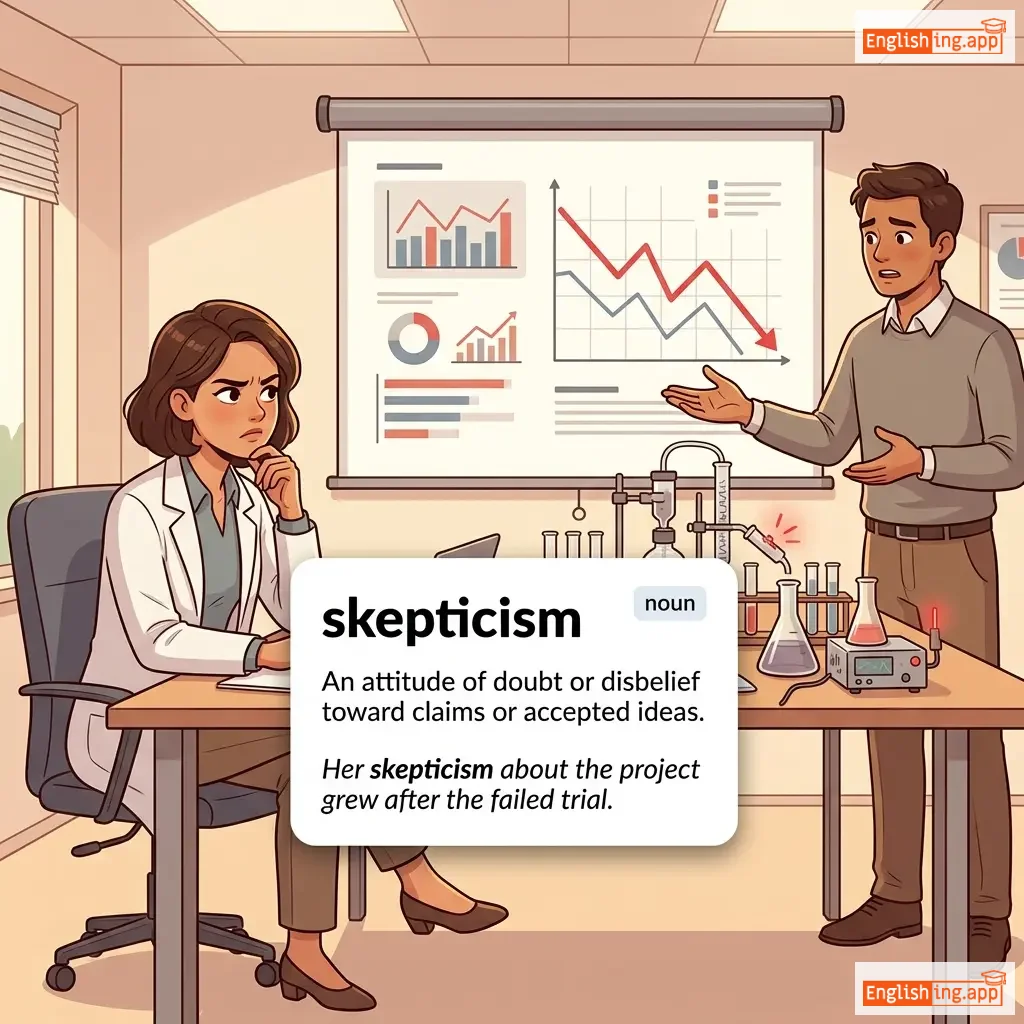
skepticism definition card — visual illustration of the meaning
noun
/ˈskɛptɪˌsɪzəm/
懐疑主義 (kaigi shugi)

An attitude of doubt or disbelief toward claims or accepted ideas.

"Her skepticism about the project grew after the failed trial."

"プロジェクトに対する彼女の懐疑主義は、失敗した実験の後に強まりました。" (Purojekuto ni taisuru kanojo no kaigi shugi wa, shippai shita jikken no ato ni tsuyomarimashita.)
noun
/skɛtʃ/
スケッチ (suketchi)

a simple, rough drawing or outline

"He made a quick sketch of the landscape."

"彼は風景の素早いスケッチを作成しました。" (Kare wa fūkei no subayai suketchi o sakusei shimashita.)
adjective
/ˈskɛtʃi/
不完全 (fukanzen)

not thorough or detailed; suspicious or unsafe

"The details of the project were still sketchy."

"プロジェクトの詳細はまだ不完全でした。" (Purojekuto no shousai wa mada fukanzen deshita.)
verb
/skiː/
スキーをする (sukī o suru)

to glide over snow on skis

"We went skiing in the Alps last winter."

"私たちは昨冬アルプスでスキーをしました。" (Watashitachi wa saku fuyu Arupusu de sukī o shimashita.)
noun
/skɪf/
小舟 (shoubune)

a small, light boat usually for one person

"The fisherman paddled his skiff across the lake."

"漁師は彼の小舟で湖を渡った。" (Gyoshi wa kare no shoubune de mizuumi o watatta.)
adjective
/ˈskɪlfʊl/
熟練した; 才能のある; 熟達した (jukurenshita; saino no aru; jukutatsu shita)

having or showing skill; expert and accomplished

"The skilful surgeon performed the operation with great precision."

"熟練した外科医は、非常に高い精度で手術を行いました。" (Jukuren shita gekai wa, hijou ni takai seido de shoushu wo okonaimashita.)
adverb
/ˈskɪl.fəl.i/
巧みに (takumi ni)

in a way that shows ability and training; expertly

"She skilfully painted the portrait in just two hours."

"彼女は二時間で巧みに肖像を描いた。" (Kanojo wa nijikan de takumi ni shouzou o kaita.)
noun
/skɪl/
スキル (sukiru)

the ability to do something well through training or experience

"Her skill in painting impressed everyone."

"彼女の絵画のスキルは皆を感動させました。" (Kanojo no kaiga no sukiru wa mina wo kandou sasemashita.)
adjective
/skɪld/
熟練 (jukuren)

having the ability, experience, or training to do something well

"She is a highly skilled surgeon with years of experience."
"彼女は長年の経験を持つ高い技術を持つ外科医です。" (Kanojo wa naganen no keiken o motsu takai gijutsu o motsu gekai desu.)
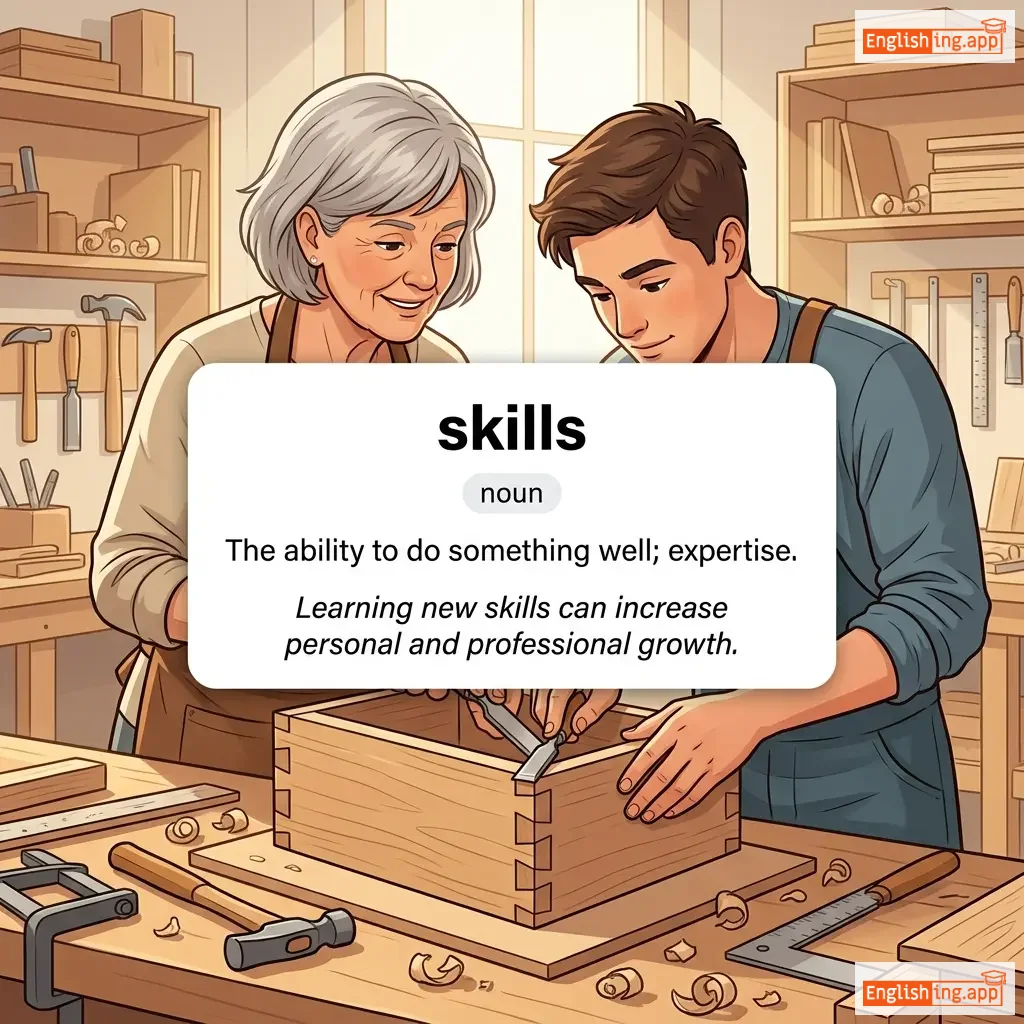
skills definition card — visual illustration of the meaning
noun
/skɪlz/
技術 (gijutsu)

The ability to do something well; expertise.

"Learning new skills can increase personal and professional growth."

"新しいスキルを学ぶことで、個人的および職業的成長が促進されることがあります。" (Atarashī sukiru o manabu koto de, kojinteki oyobi shokugyōteki seichō ga sokushin sareru koto ga arimasu.)
verb
/skɪm/
素早く読む (subayaku yomu)

to move quickly over a surface or to read something quickly

"She skimmed through the report before the meeting."

"彼女は会議の前にレポートをサッと読みました。" (Kanojo wa kaigi no mae ni repoto o satto yomimashita.)
verb
/skɪmp/
ケチる (kechiru)

to use less of something than is necessary in order to save money or effort

"Don’t skimp on quality when buying a new laptop."

"新しいノートパソコンを買うときは、品質をケチらないでください。" (Atarashī nōtopasokon o kau toki wa, hinshitsu o kechiranaide kudasai.)
noun
/skɪn/
(hada)

the outer layer of the body

"She has fair skin and bright blue eyes."

"彼女は白い肌と明るい青い目をしています。" (Kanojo wa shiroi hada to akarui aoi me o shiteimasu.)
noun
/ˈskɪnˌflɪnt/
けちん坊 (kechinbō)

a person who spends as little money as possible; a miser

"The landlord was such a skinflint that he never repaired anything."

"家主はそんなけちん坊で、何も修理しなかった。" (Yamushi wa sonna kechinbō de, nanimo shūri shinakatta.)
adjective
/ˈskɪni/
痩せた; 細い; 骨ばかりの (yaseta; hosoi; hone bakari no)

very thin; having little flesh or fat on the body

"The skinny cat looked like it hadn't eaten for days."

"その痩せた猫は、数日間食べていないように見えました。" (Sono yaseta neko wa, suujitsukan tabete inai you ni miemashita.)
verb
/skɪp/
スキップする (sukippu suru)

to omit or pass over something; to move lightly or quickly

"He decided to skip breakfast and go straight to work."

"彼は朝食をスキップして、仕事に直接行くことに決めました。" (Kare wa choushoku wo sukippu shite, shigoto ni chokusetsu iku koto ni kimemashita.)
⚔️

skirmish

noun/verb
/ˈskɜːrmɪʃ/

a small or brief fight between groups of soldiers; to engage in such a fight

"The soldiers got into a skirmish near the border."

👗

Skirt

noun/verb
/skɜːrt/

a piece of clothing that hangs from the waist; to go around the edge of something

"She wore a red skirt to the party."

noun
/skɪt/
寸劇 (sungeki)

a short, humorous performance or piece of writing

"The students performed a funny skit at the event."

"学生たちはイベントで面白い寸劇を演じました。" (Gakusei tachi wa ibento de omoshiroi sungeki o enjimashita.)
adjective
/ˈskɪtɪʃ/
神経質な (shinkeishitsu na)

easily frightened or nervous; unpredictable

"The horse was too skittish to ride."

"その馬は乗るには神経質すぎた。" (Sono uma wa noru ni wa shinkeishitsu sugita.)
noun
/skʌlˈdʌɡəri/
不正行為 (fusei kōi)

underhanded or dishonest behavior

"The politician was accused of financial skulduggery."

"その政治家は金融詐欺で告発された。" (Sono seiji-ka wa kin'yū sagi de kokuhatsu sareta.)
🕵️

skulk

verb
/skʌlk/

to move or hide secretly, often because you are planning something bad or are feeling guilty

"He tried to skulk in the shadows to avoid being seen."

noun
/skʌl/
頭蓋骨 (zugaikotsu)

the bony structure that forms the head and protects the brain

"The archaeologists found an ancient human skull."

"考古学者たちは古代の人間の頭蓋骨を発見しました。" (Kougakusha-tachi wa kodai no ningen no zugaikotsu wo hakken shimashita.)
noun
/ˌskʌlˈdʌɡəri/
不正行為 (Fusei Kōi)

dishonest behavior or activities, often done secretly

"The election was full of political skullduggery."

"選挙は政治的不正行為に満ちていた。" (Senkyō wa seijiteki na fusei kōi ni michite ita.)
🌌

Sky

noun
/skaɪ/

the expanse of air over the Earth, often appearing blue

"The sky was clear and the sun was shining brightly."

adjective
/skaɪ bluː/
空色 (sora iro)

a bright blue color like that of a clear sky

"Her sky-blue eyes sparkled in the sunlight."

"彼女の空色の目が太陽の光で輝いていた。" (Kanojo no sora iro no me ga taiyo no hikari de kagayaite ita.)
noun
/ˈskaɪ.lɑːrk/
ヒバリ (hibari)

a small brown bird known for singing while flying high in the sky

"The skylark sang beautifully as it soared above the meadow."

"ヒバリは草地の上を飛びながら美しく歌った。" (Hibari wa kusachi no ue wo tobinagara utsukushiku utatta)
noun
/ˈskaɪˌskreɪpər/
超高層ビル (chou kousou biru)

a very tall building of many stories

"The new skyscraper dominates the city's skyline."

"新しい超高層ビルが街のスカイラインを支配しています。" (Atarashī chou kousou biru ga machi no sukairain o shihaishiteimasu.)
noun
/slæb/
スラブ (surabu)

a large, thick, flat piece of stone, concrete, or other hard material

"The workers laid a concrete slab for the foundation."

"作業員たちは基礎のためにコンクリートのスラブを敷きました。" (Sagyouintachi wa kiso no tame ni konkurīto no surabu o shikimashita.)
adjective
/slæk/
緩い (yurui)

not tight, firm, or busy; lacking tension or activity

"Business is slack during the rainy season."

"雨季の間、ビジネスは鈍くなる。" (Uki no aida, bijinesu wa donkunaru.)
verb
/ˈslækən/
緩める (yurumeru)

to make or become less tight, less active, or slower

"The driver slackened his speed as he approached the village."

"運転手は村に近づくにつれて速度を緩めた。" (Unten-shu wa mura ni chikaduku ni tsurete sokudo o yurumeta.)
noun
/slæɡ/
鉱滓 (kōsai)

Stony waste matter separated from metals during the smelting process.

"The factory dumped the slag near the river."

"工場は川の近くに鉱滓を捨てました。" (Kōjō wa kawa no chikaku ni kōsai o sutemashita.)
verb
/sleɪk/
渇きを癒す (kawaki wo iyasu)

To satisfy thirst or desire.

"She drank cold water to slake her thirst."

"彼女は渇きを癒すために冷たい水を飲んだ。" (Kanojo wa kawaki wo iyasu tame ni tsumetai mizu wo nonda.)
verb
/slæm/
強く閉める (tsuyoku shimeru)

to close or hit something with great force

"He slammed the door angrily after the argument."

"彼は議論の後に怒ってドアを叩きつけた。" (Kare wa giron no ato ni okotte doa o tatakitsuketa.)
noun
/ˈslændər/
中傷 (chuushou)

The action of making false spoken statements damaging to a person's reputation.

"He sued the newspaper for slander."

"彼は中傷で新聞を訴えた。" (Kare wa chuushou de shinbun wo sasaeta.)
noun
/slæŋ/
スラング; 不正な言葉 (surangu; fusei na kotoba)

very informal language that is usually spoken rather than written

"The teenagers used slang that their parents couldn't understand."

"ティーンエイジャーは親が理解できないスラングを使いました。" (Tīn'eijā wa oya ga rikai dekinai surangu o tsukaimashita.)
noun, verb
/slænt/
偏った見解 (katayotta kenkai)

A particular point of view; to slope or lean in a particular direction.

"The article had a political slant."
"その記事には政治的な傾向がありました。" (sono kiji ni wa seijiteki na keikō ga arimashita.)
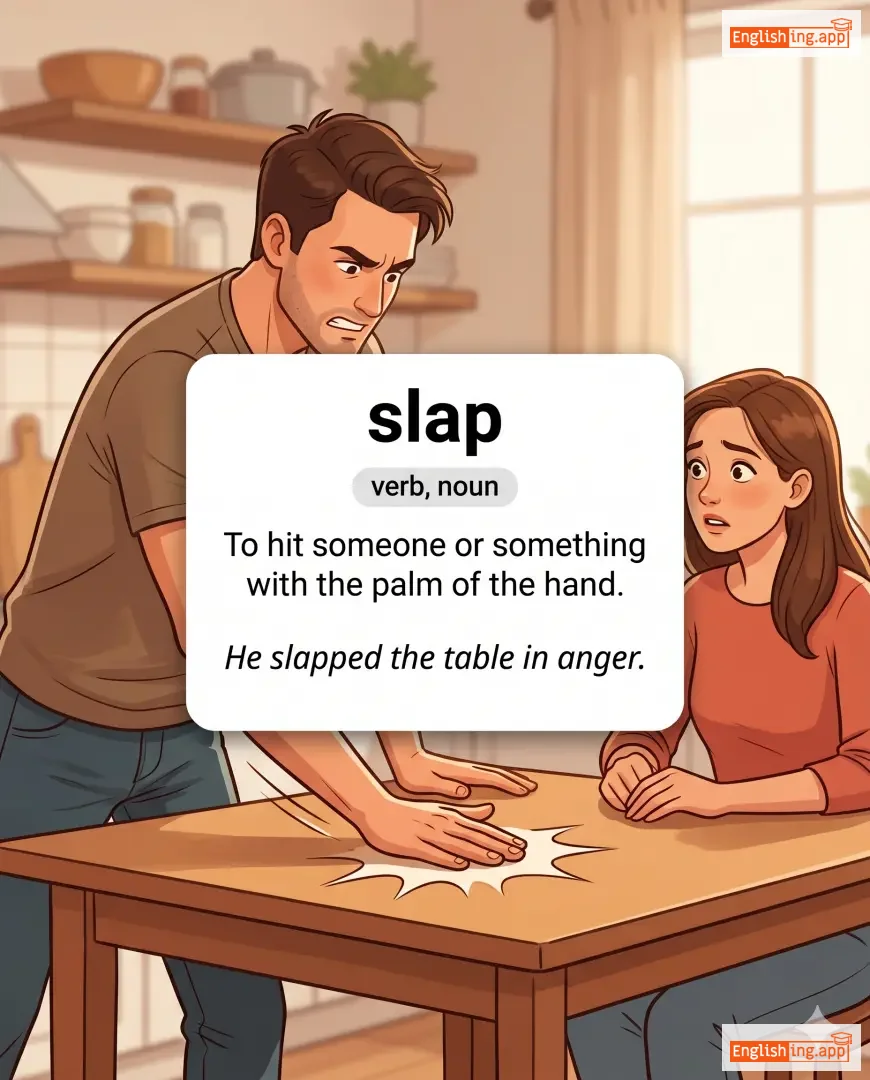
slap definition card — visual illustration of the meaning
verb, noun
/slæp/
平手打ち (hirate uchi)

To hit someone or something with the palm of the hand.

"He slapped the table in anger."

"彼は怒ってテーブルを叩いた。" (Kare wa okotte tēburu o tataita.)
adjective
/ˈslæp.dæʃ/
ぞんざい (zonzai)

done too quickly and carelessly; hasty and careless

"The report was written in a slapdash manner, full of errors."
"レポートはぞんざいに書かれており、間違いだらけだった。" (Repoto wa zonzai ni kakarete ori, machigai darake datta.)
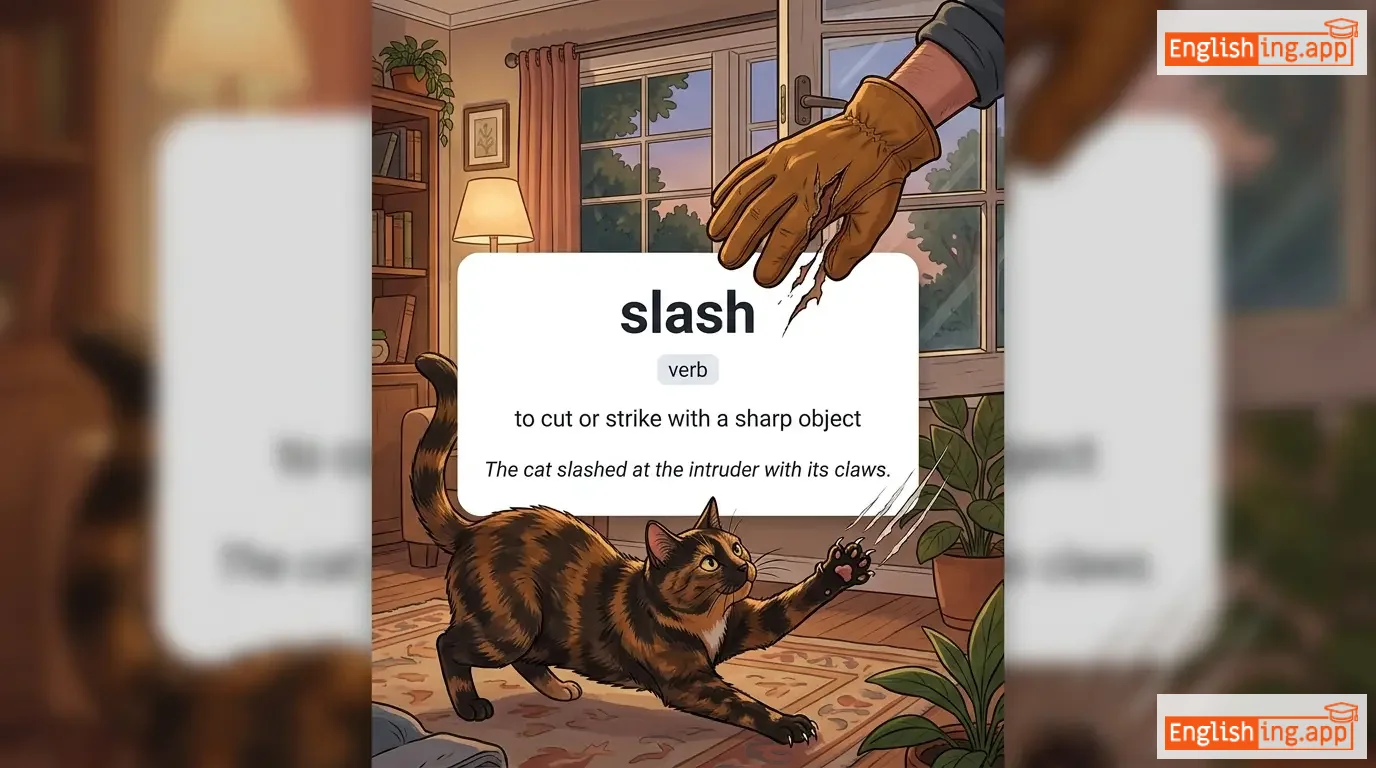
slash definition card — visual illustration of the meaning
verb
/slæʃ/
切る (kiru)

to cut or strike with a sharp object

"The cat slashed at the intruder with its claws."

"猫は爪で侵入者を切りました。" (Neko wa tsume de shinnyū-sha o kirimashita.)